
Preview: Naghash Ensemble of Armenia on Friday, Nov. 5 at Universal Preservation Hall
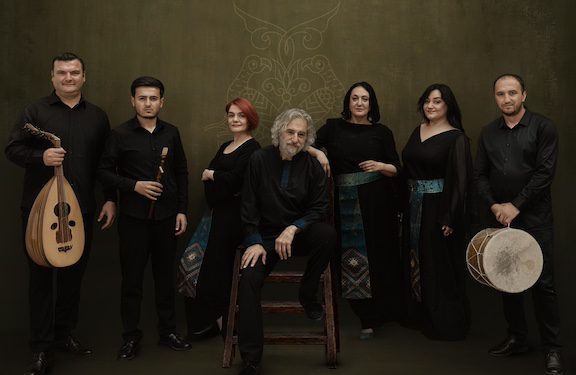
The Naghash Ensemble makes music from the crossroads of Europe and Asia; land of both hazards and beauty. Performing Friday at Universal Preservation Hall – one of only 11 US shows on a world tour – its three women singers and four men players honor Armenia’s tortured history in poetry powering serene sounds from a land in almost constant conflict.
Naghash Ensemble, formed in 2014 by John Hodian, at center. Photo provided
History: A Lament
“Between the 4th and the 19th centuries Armenia was conquered and ruled by, among others, Persians, Arabs, Byzantines, Mongols and Turks,” reads our State Department Historian’s summary. Armenia once stretched from the Mediterranean to the Caspian Sea, before the Ottoman and Persian Empires divided it in the 16th Century. Russia took it over in the 19th, while the Ottoman Empire murdered 1.5 million Armenians in the first tragedy called a genocide.
Armenia only became independent again after the USSR collapsed in 1990.
Armenian music mixes pride and pain, like songs of many oppressed peoples: Here we call it the blues.
Words Becomes Songs
Armenian-American John Hodian founded the Nagash Ensemble to make music from poems of Mkrtich Naghash. His work, Wkipedia says, “describes the perils of living a life in exile and man’s relationship with God.” Poet, priest, painter, Naghash lived for decades in exile.
When Hodian began setting Naghash’s to poems to music in 2006 to make what became “Songs of Exile,” he joined a centuries-deep tradition of tunesmiths fitting sounds to words – from the ancients to Shakespeare, Blake, Tennyson and Yeats to recent times.
Proto-punk band the Fuggs set Matthew Arnold’s “Dover Beach” to a rock beat in 1968, for example; and composer Peter Lieberson set five Pablo Neruda love poems to music his wife Lorraine Hunt Lieberson sang on their touching 2005 album “Neruda Songs.”
When Woody Guthrie’s daughter Nora discovered hundreds of poems her late father had never set to music, she enlisted British troubadour Billy Bragg to complete them as songs. Bragg and Chicago rockers Wilco recorded 15 as “Mermaid Avenue” (1998) – a Grammy nominee as Best Contemporary Folk Album and no. 4 in the Village Voice’s Jazz and Jop Poll that same year. This summer, Wilco, Bragg and Natalie Merchant performed those songs live for the first time at Wilco’s Solid Sound Festival at nearby MASSMoCA. But I digress.
“We didn’t set out to be cultural ambassadors of Armenia,” Hodian told the Asbaraz newsletter. “When I wrote this music, I just followed my intuition. It’s natural outcome of someone who grew up in a tight-knit Armenian family, but studied Western classical music and was surrounded by contemporary music in all its forms.”
Sound and Feel
“I fell head over heels in love with their music when I saw them perform at globalFEST at Lincoln Center back in January 2026,” Music Haven Passport Series Producing Artistic Director Mona Golub told me.
The Naghash Ensemble’s music expresses both an anguished heritage and cultural resilience, while its poetry-to-music evolution shows ambitious compositional intent. Sonically, it feels like the vocal splendor of the Bulgarian Women’s Choir stirred into the complex Euro-Asian instrumental sound of Jordi Savall’s “Istanbul” to express a DNA-deep sense of identity, like DakhaBrakha, who thrilled Music Haven with its defiant assertion of Ukrainian resilient courage several summers ago.
Although it arrives from a complex place, Nagash music reaches the heart with straightforward impact, a sort of transcontinental blues.
Breaking it down, the voices combine in a powerful mass until solo singers wander and different personalities, ranges and emotions emerge before they re-blend.
Then the instruments. Hodian’s piano leads from center stage. The other players weave woodwind, stringed and percussion sounds whose tones and phrasing evoke Middle Eastern styles.
The wood-carved duduk has two reeds, like an oboe; and is played like an Irish pipe or classical recorder; a woody, sweet sound. Pear-shaped, also made of wood, the oud casts a wide shadow across Middle Eastern, North African and Central Asian music. Its 11 strings stretch along a fretless neck so players can glide their fingers to bend notes, like a slide guitar. A two-headed drum played with the hands or wooden beaters, the dhol is as essential to Armenian music as the duduk.
The Naghash Ensemble of Armenia is Hasmik Baghdasaryan and Tatevik Movsesyan, sopranos; Shahane Zalyan, alto; Andranik Gasparyan, duduk; Aram Nikoghosyan, oud; Tigran Hovhannisyan, dhol; and John Hodian, piano and compositions.
Proctors Passport Series
The Naghash Ensemble is the second of six Proctors Passport Series concerts that alternate between Proctors GE Theatre and Universal Preservation Hall (UPH), between-the-summers presentation of Music Haven whose “traveling the world, one concert at a time” programming shapes the series:
Feb. 4: Gili Yalo at Proctors GE Theatre
March 6: La Banda Morsica at UPH
Apr. 16: Yacouba Sissoka and Siya at Proctors GE Theatre
May 14: Kiran Ahluwalia at UPH
7:30 p.m. $34.50. 518-346-6204 www.proctorscollaborative.org/passportseries

