Cool Universe, on a “Lovely Day” to Play Indoors

Review: Cool Universe at Jazz on (or Near…) Jay

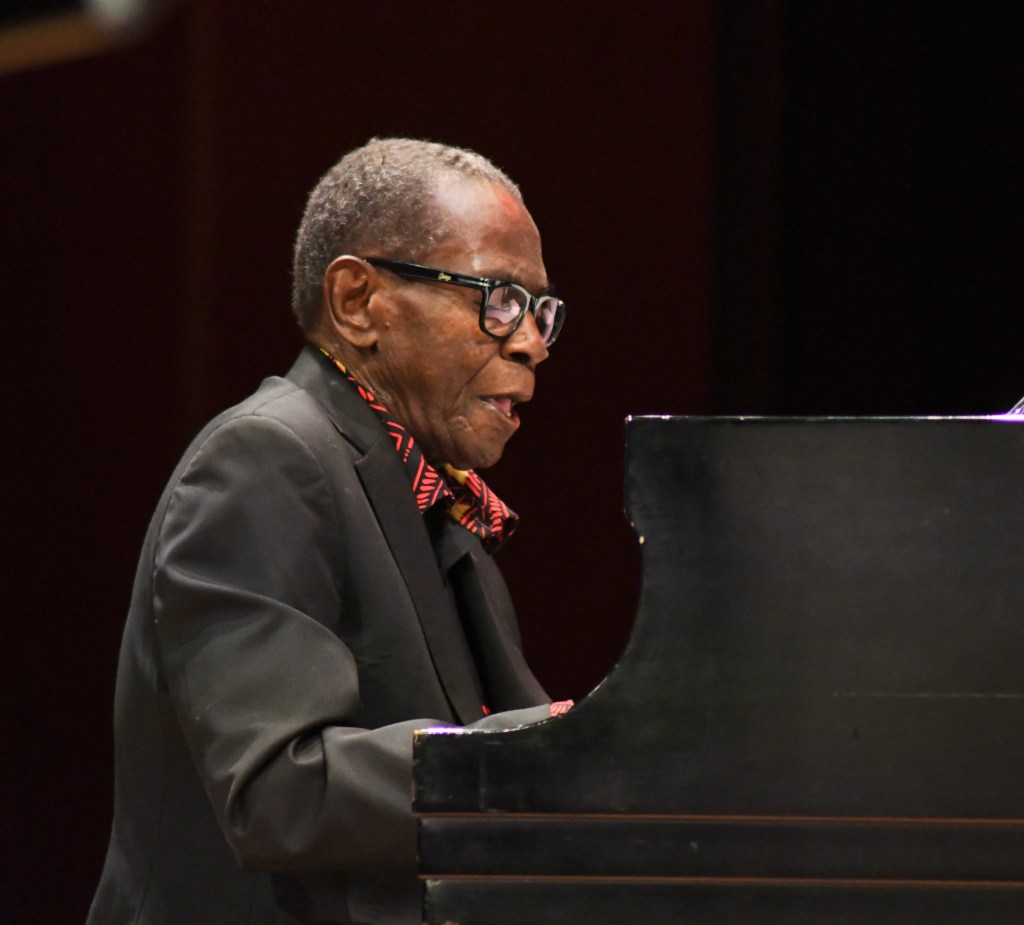
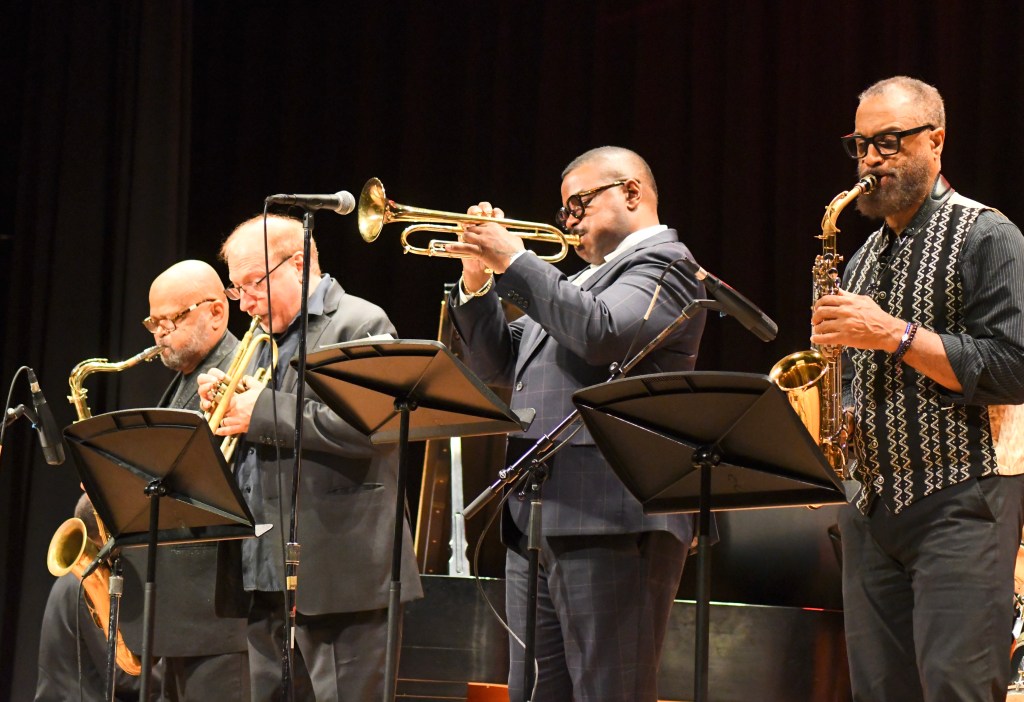
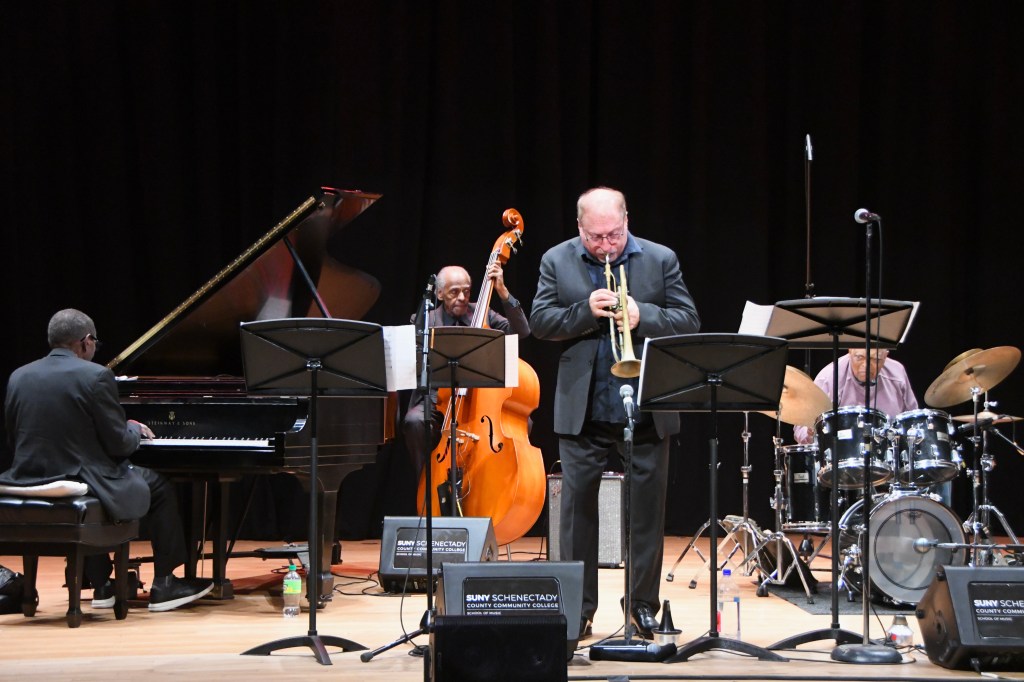
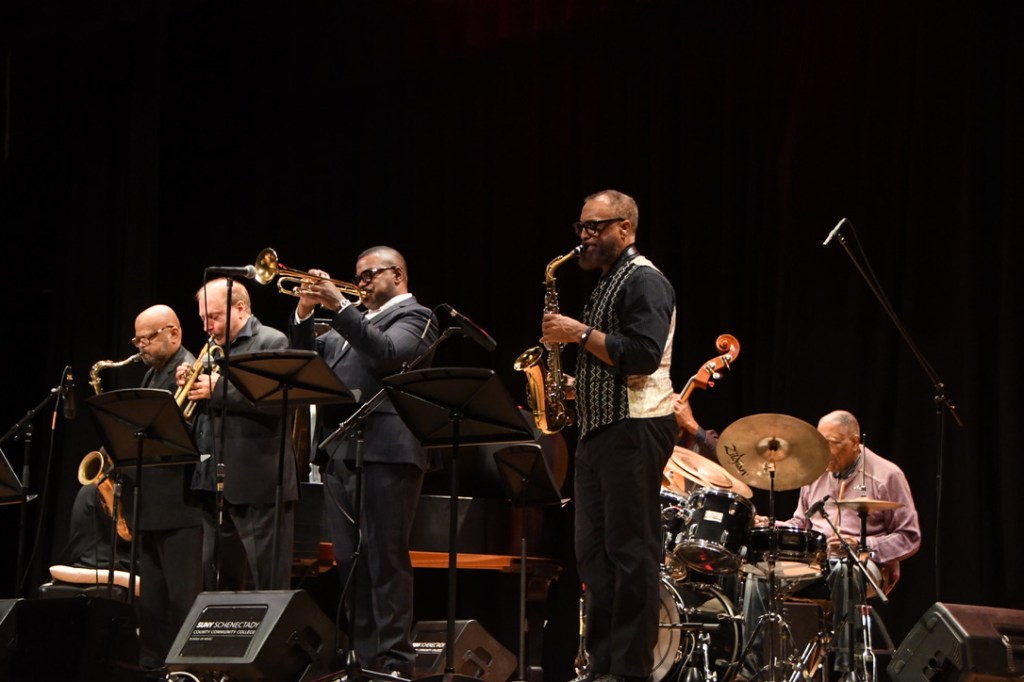
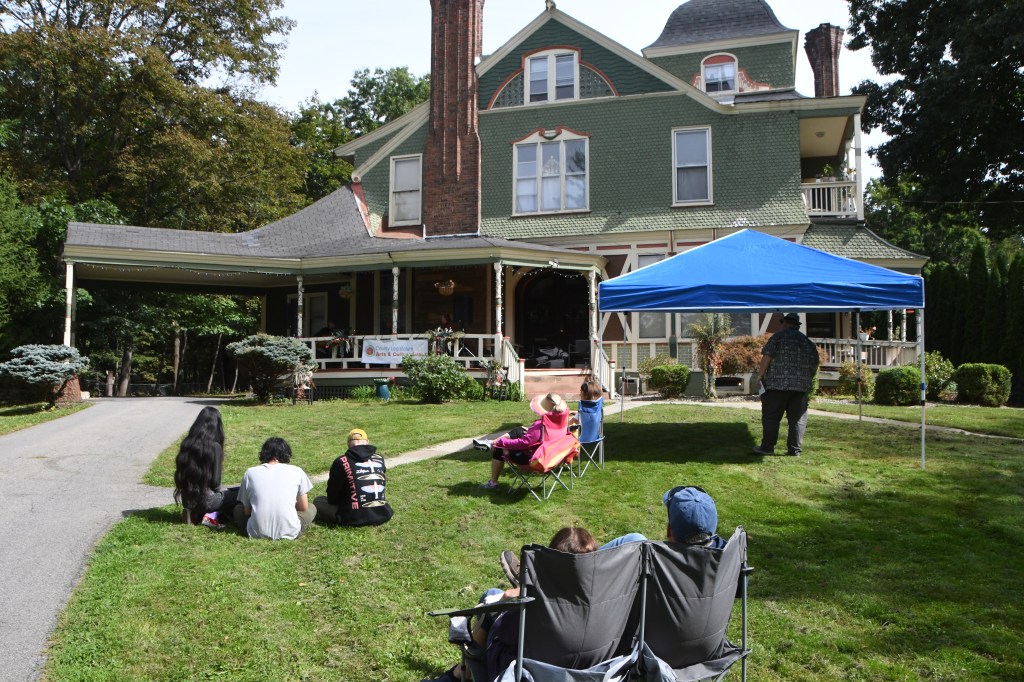
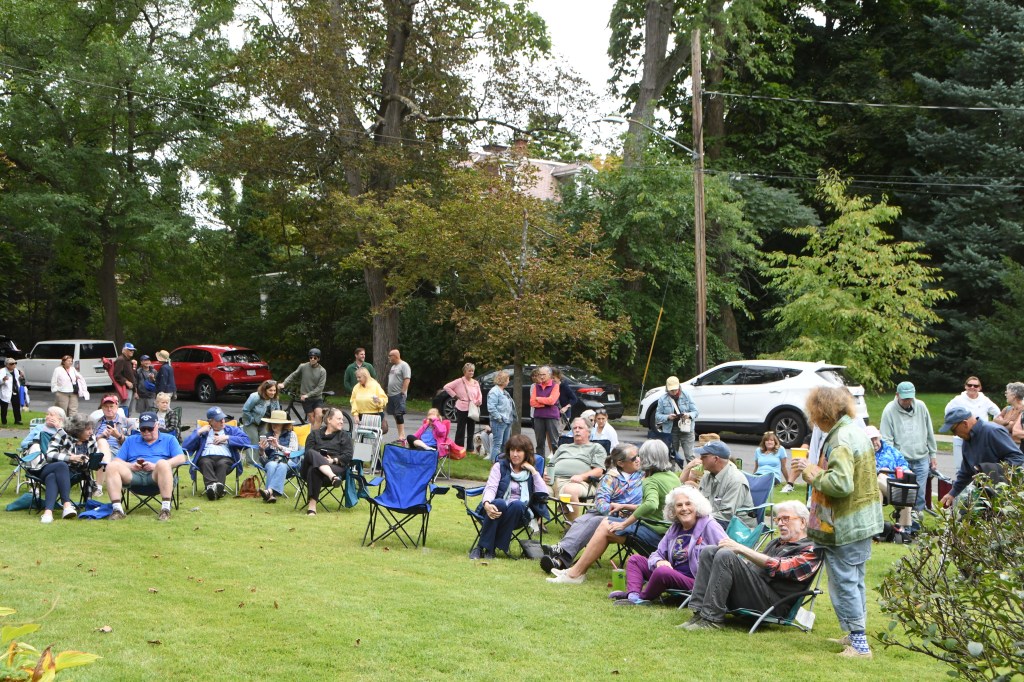
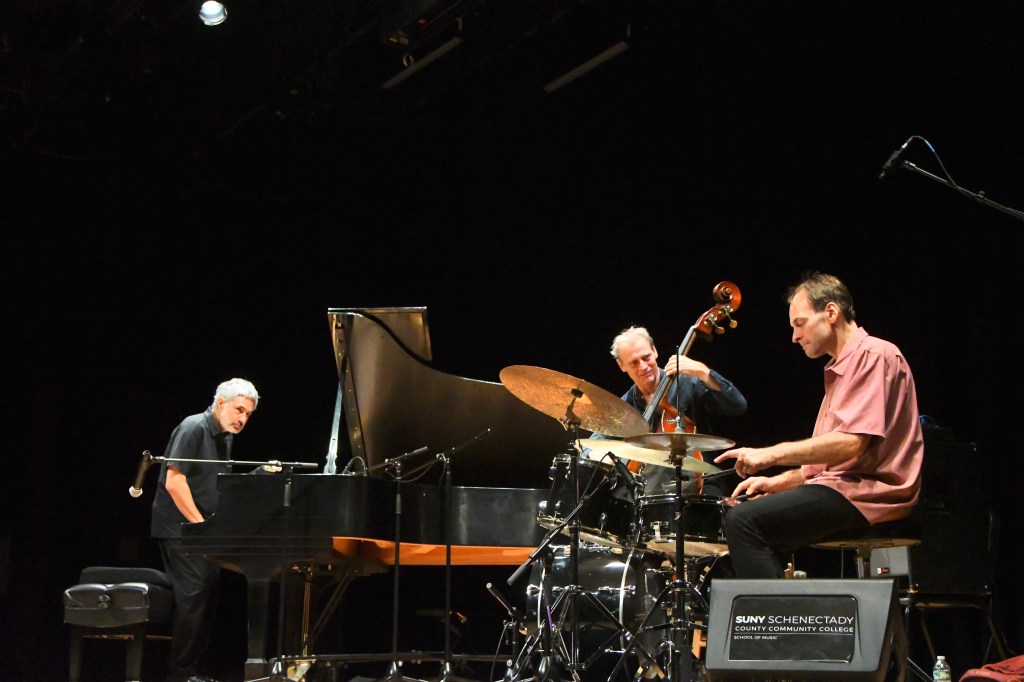
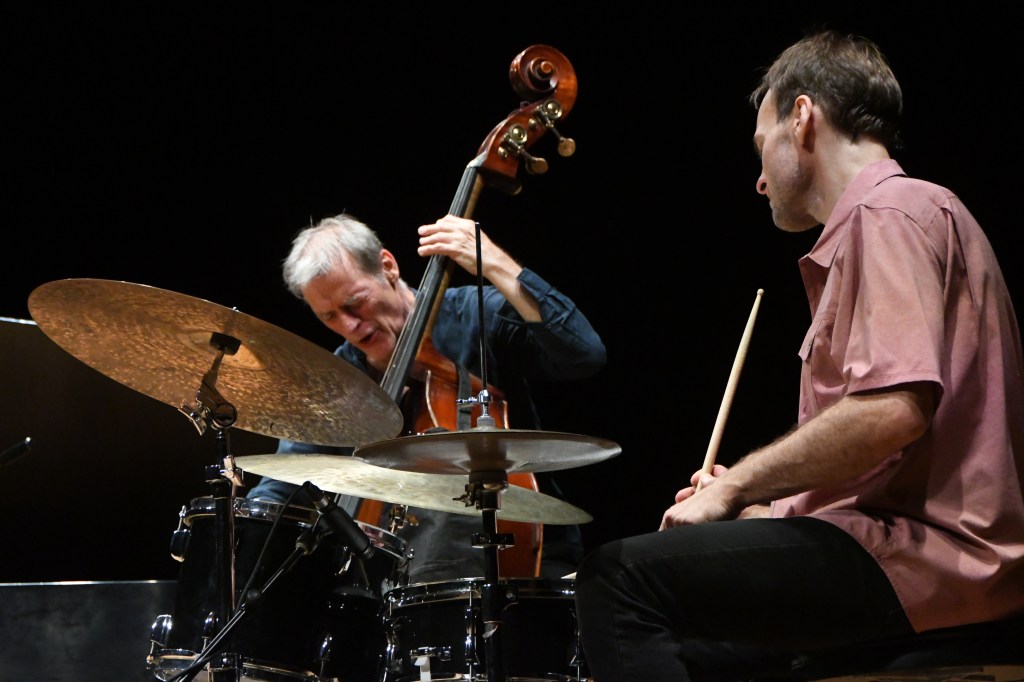
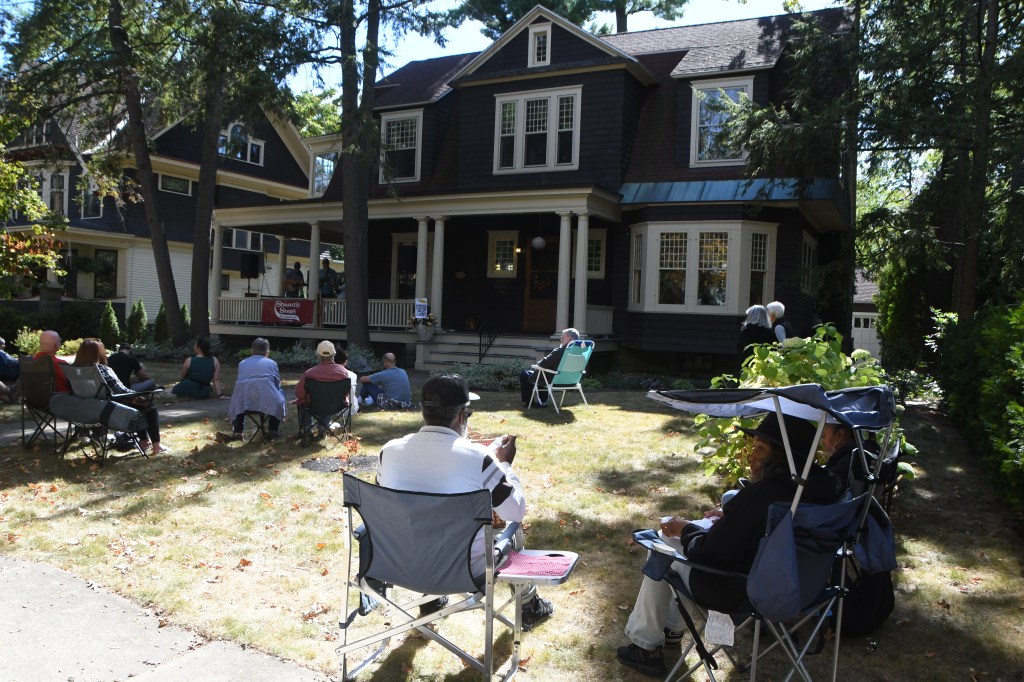
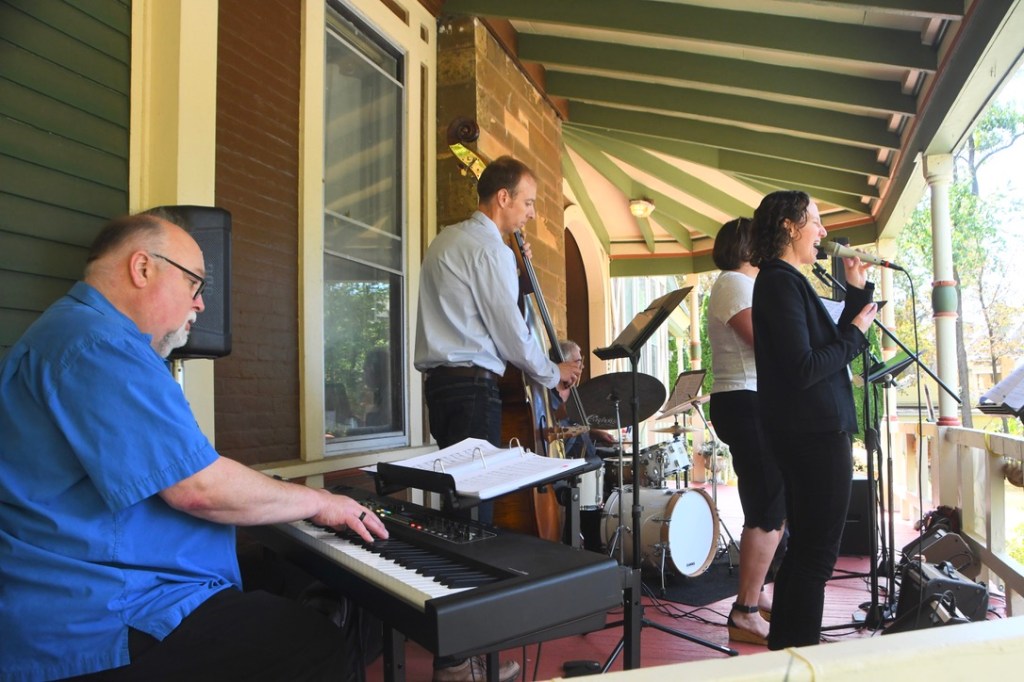
Like a smooth-jazz radio station in the room, Cool Universe charmed a good deal and awed some on Thursday at Jazz on Jay. An audience that has learned to be mobile followed them from the usual outdoor stage at Jay Square into the dry air-conditioned Proctors GE Theatre.

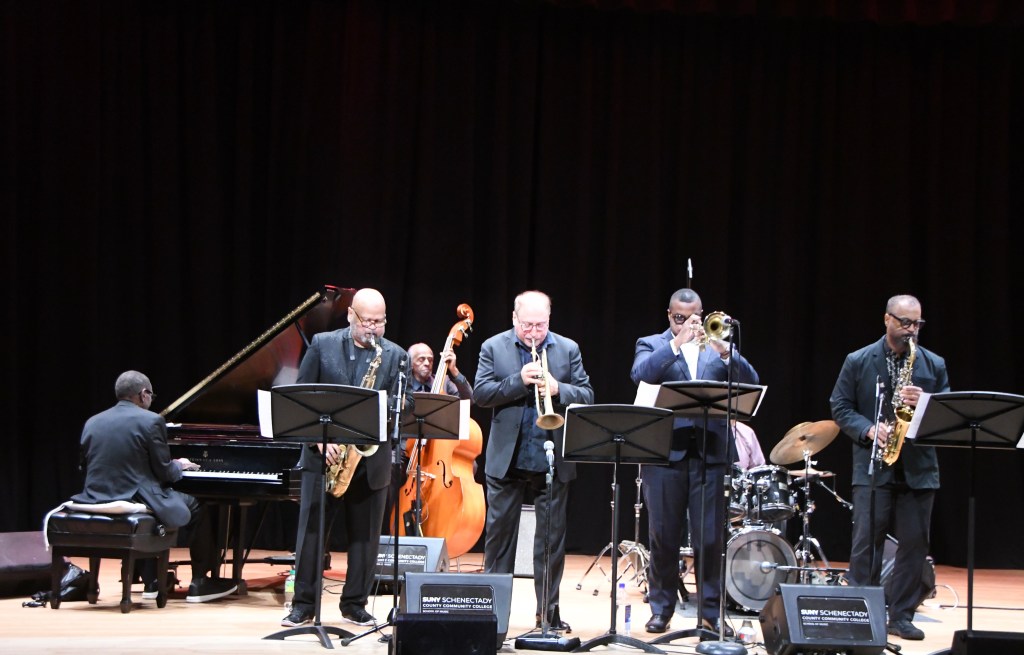
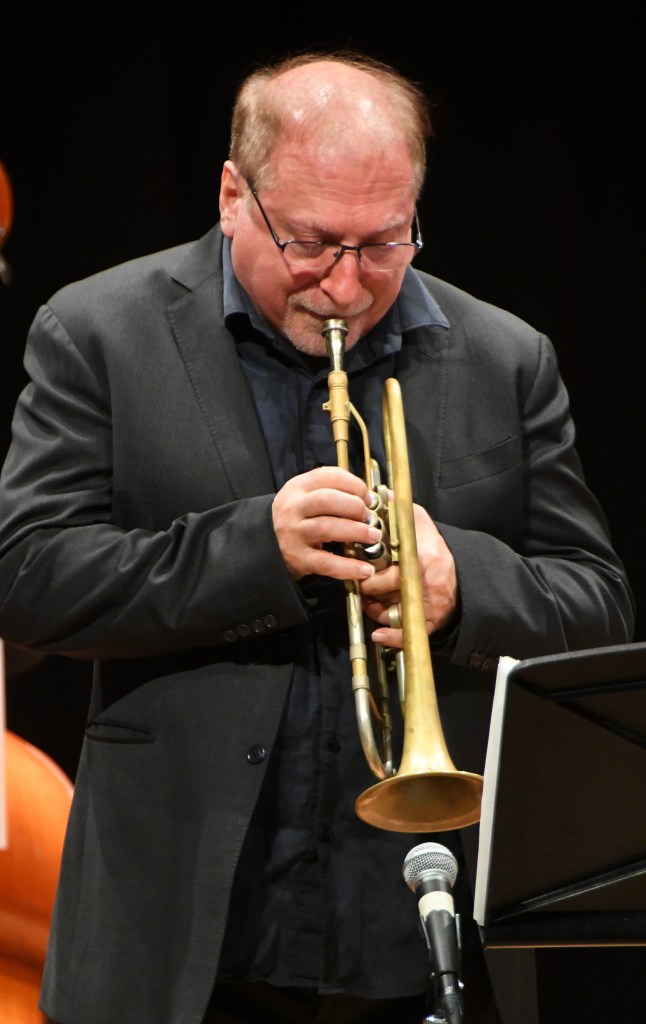
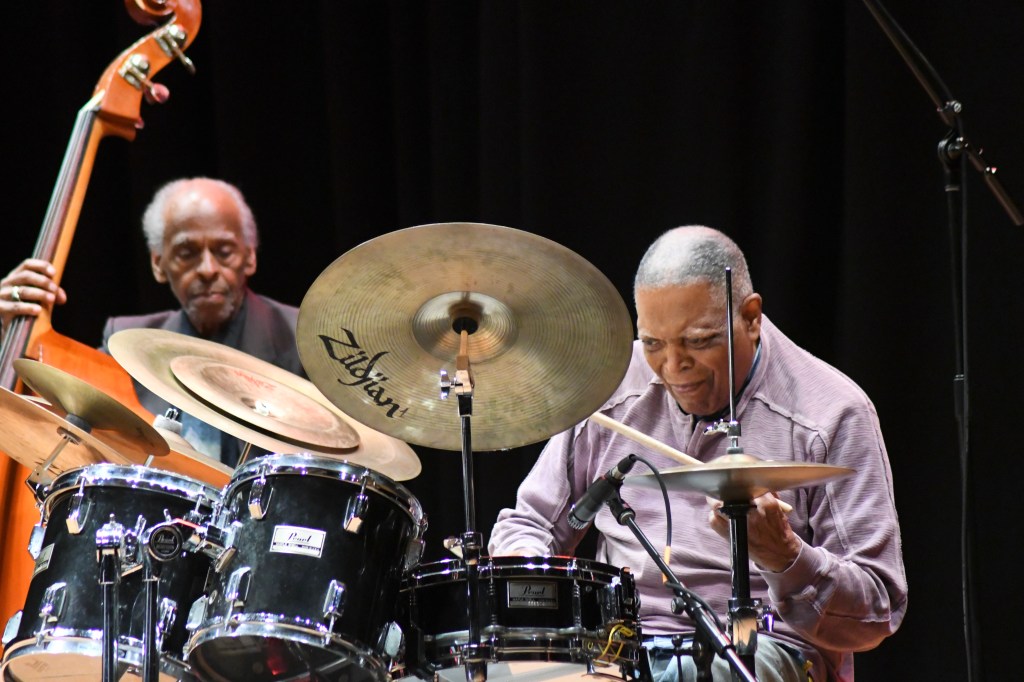
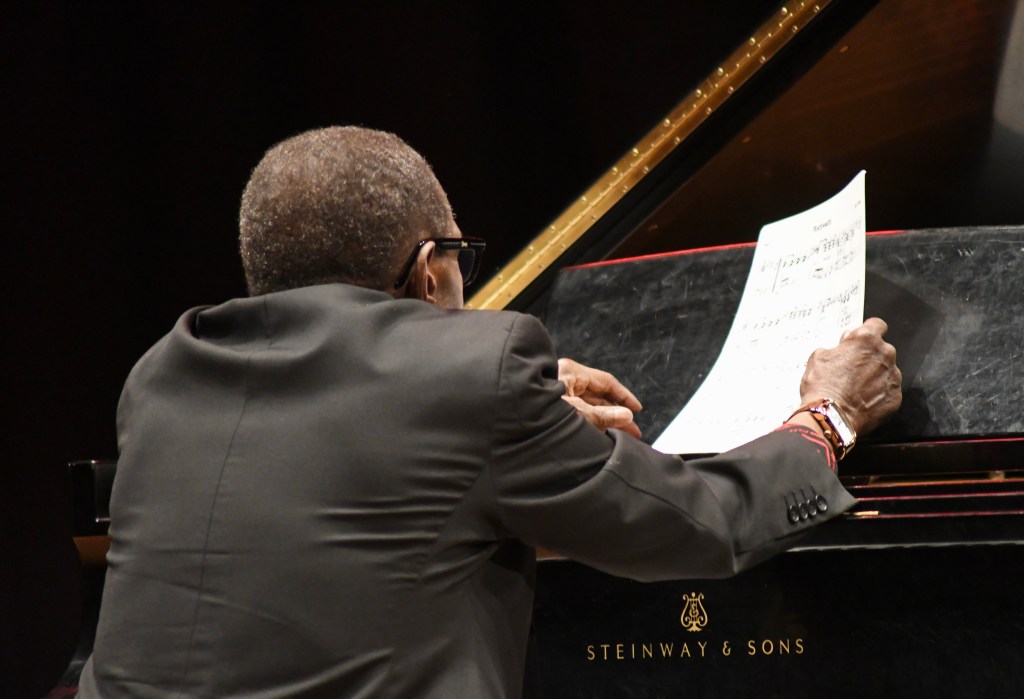
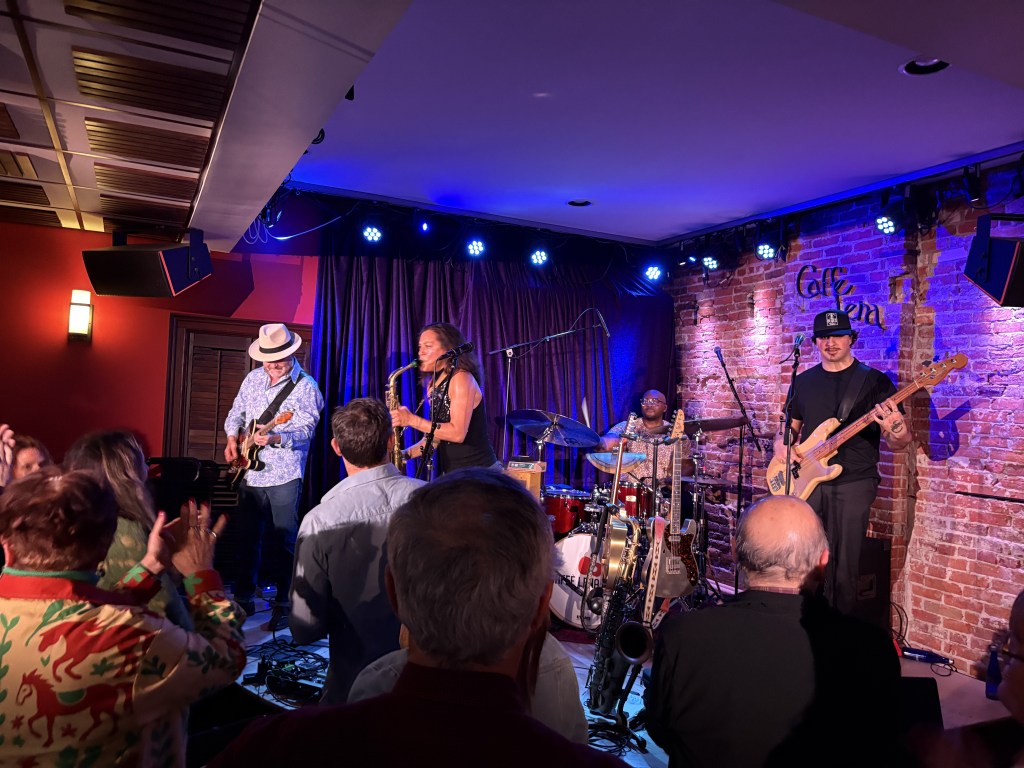
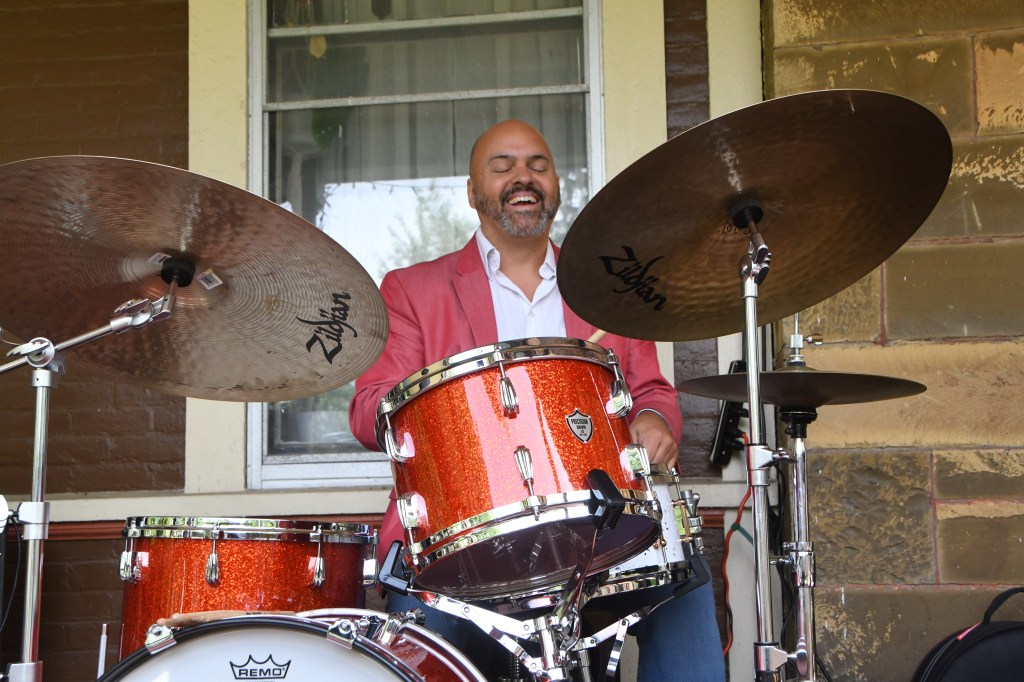
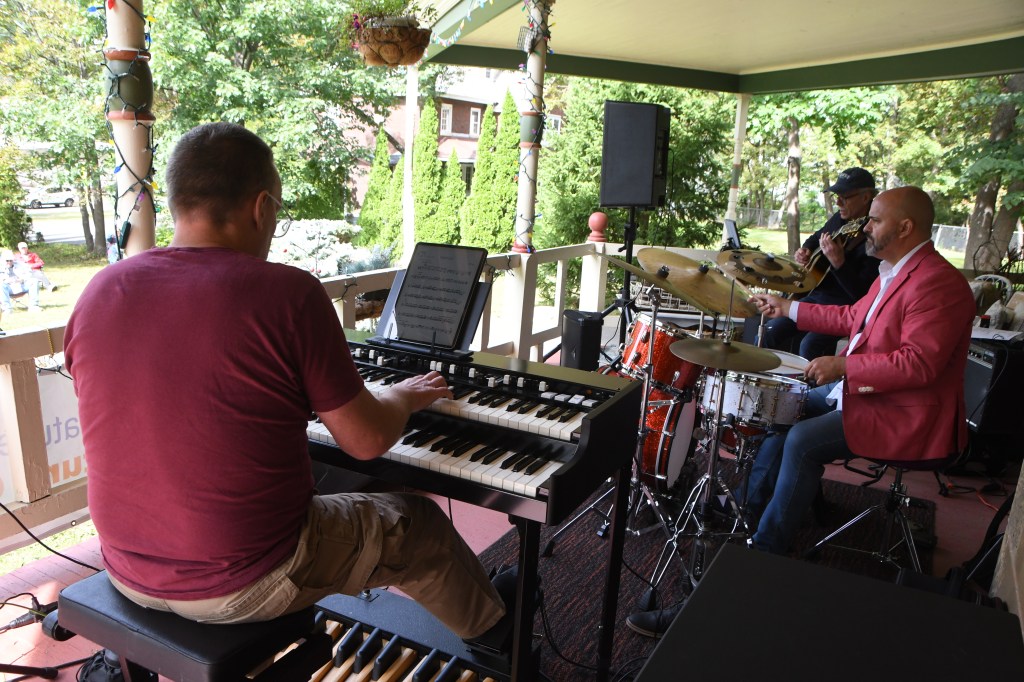
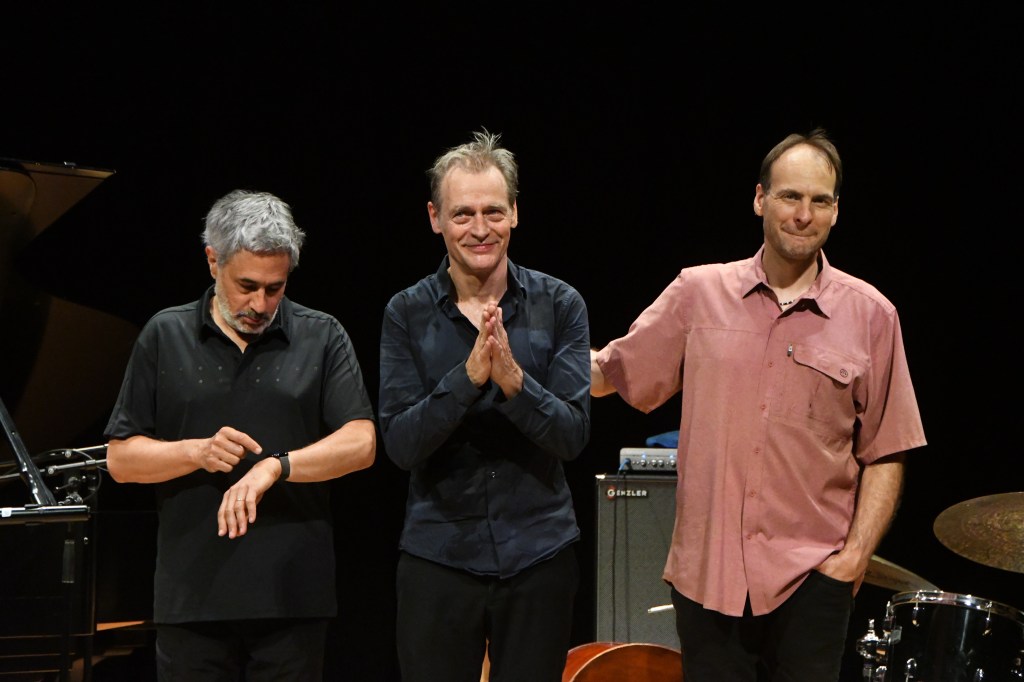
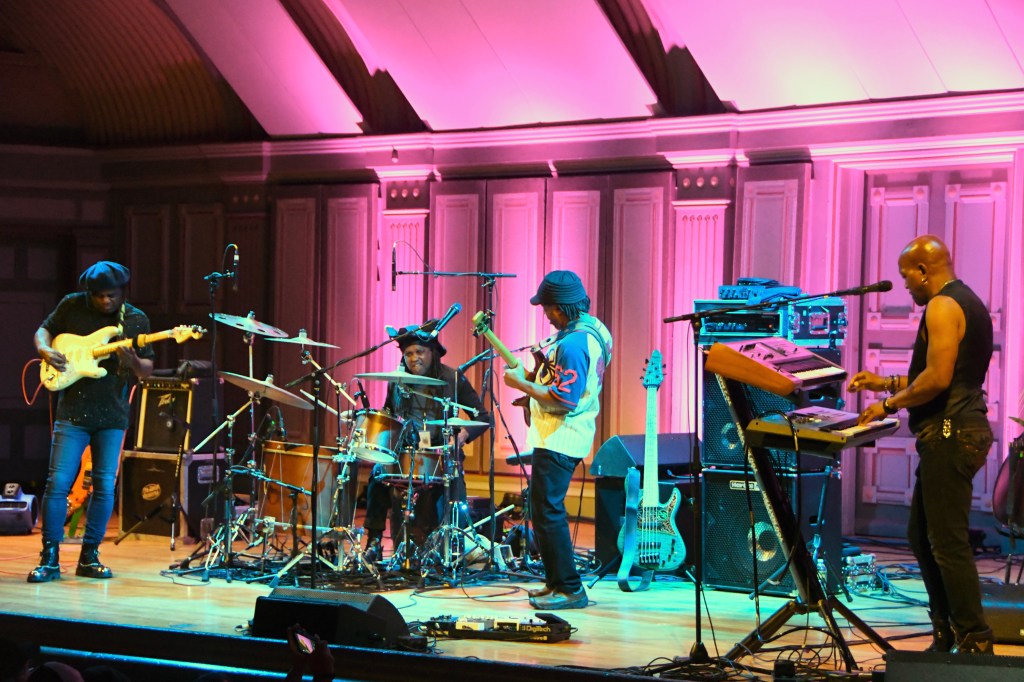
All four had previously played the free downtown Schenectady concert series, but not together as Cool Universe: bassist-singer-leader Ben Odom, keyboardist-singer Azzaam Hameed, saxophonist-flute player Eric Walentowicz and drummer-singer Jack Kelle. All experienced pros, they rolled easy, handing off solos and taking tunes home whenever Odom tapped his head to cue their endings.

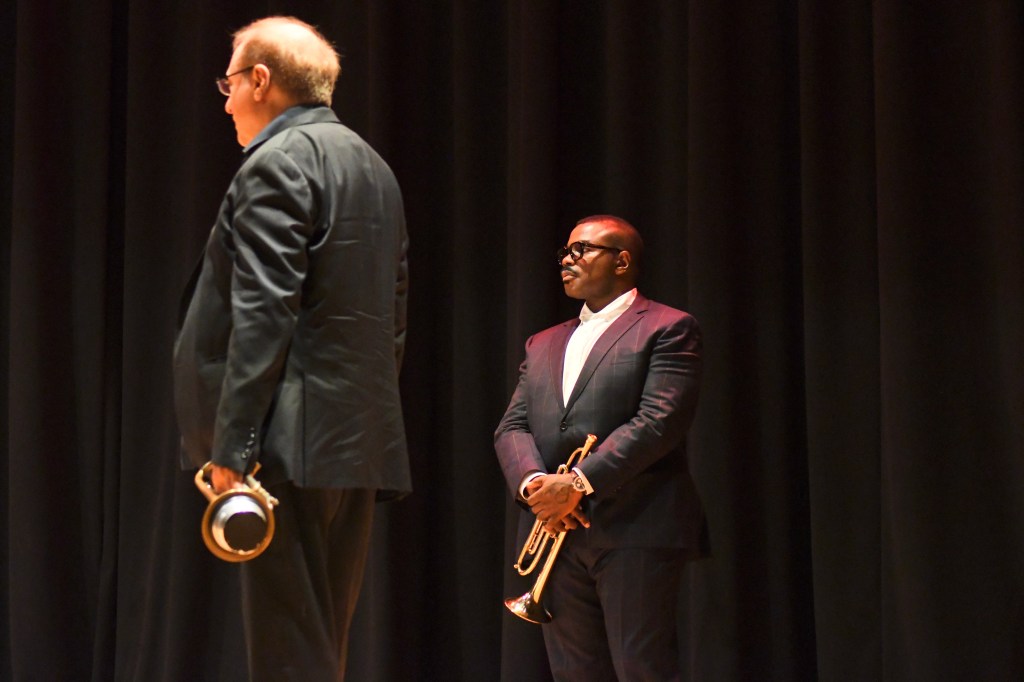
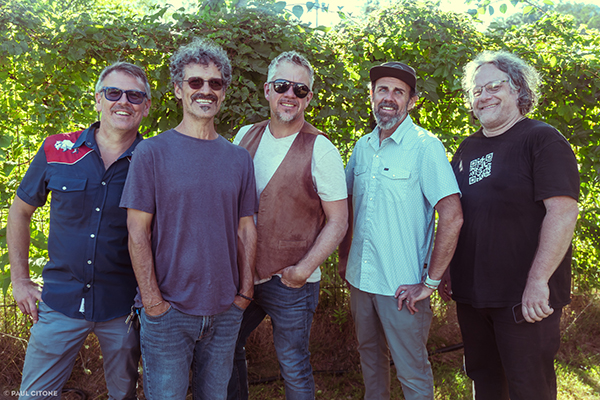
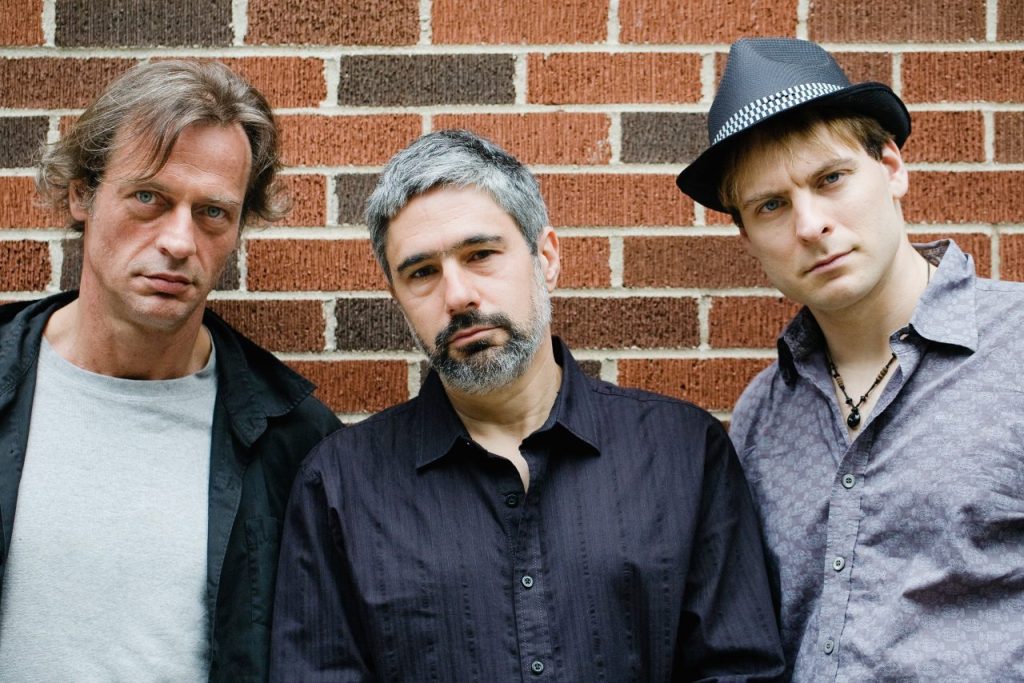
Cool Universe, from left: Azzaam Hameed, Eric Walentowicz, Jack Kelle, Ben Odom

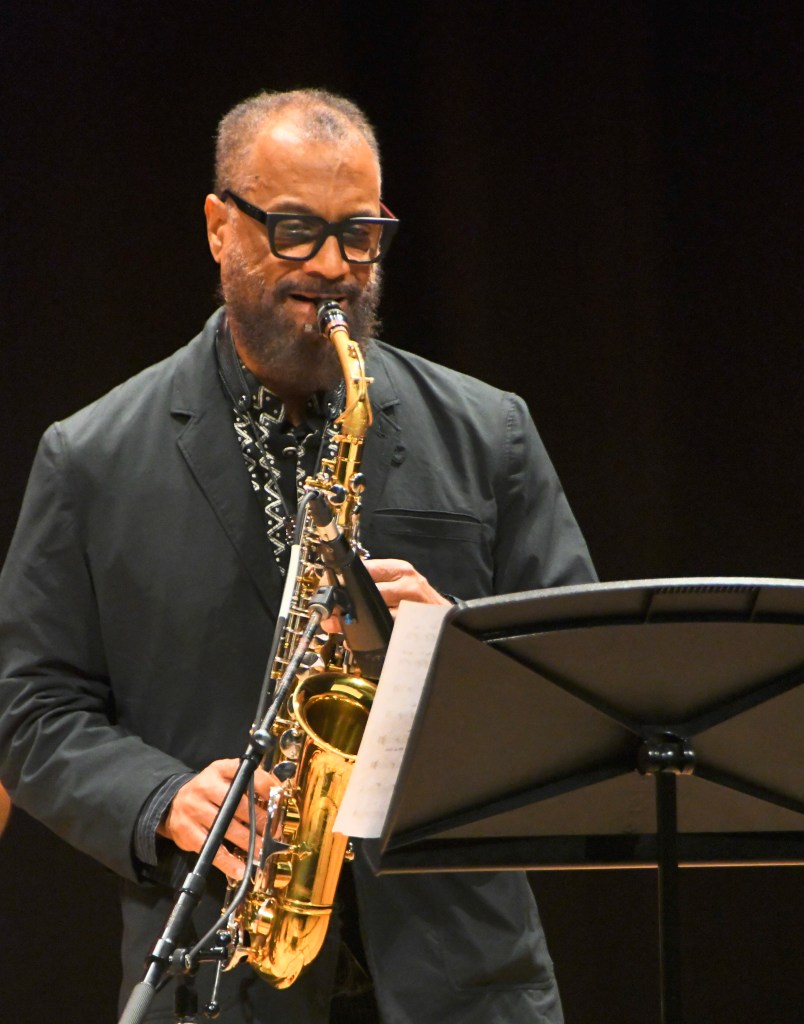
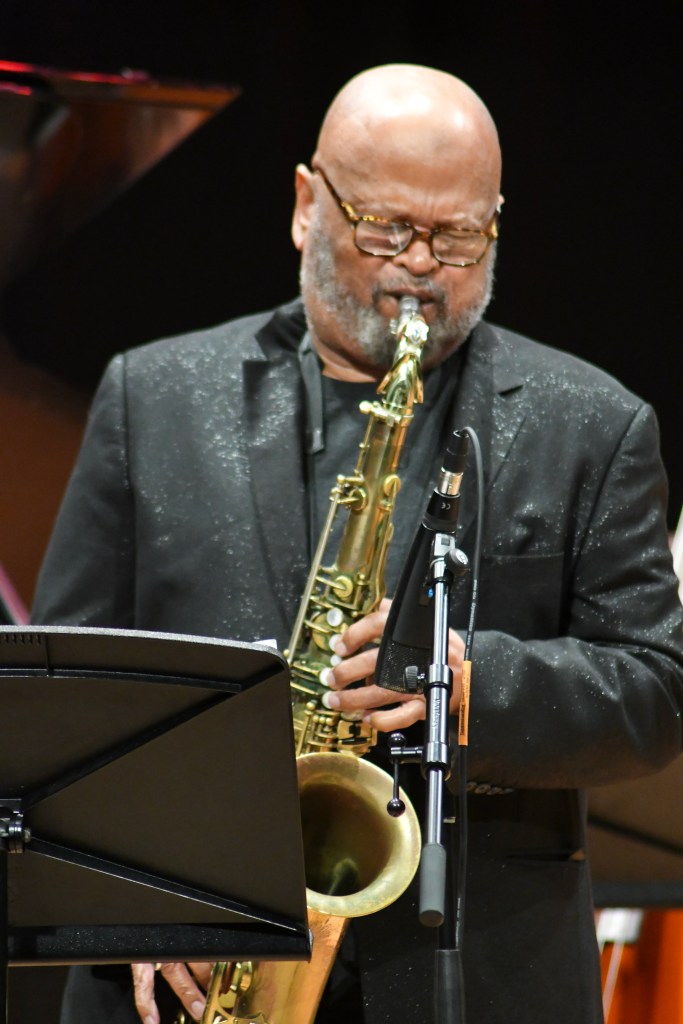
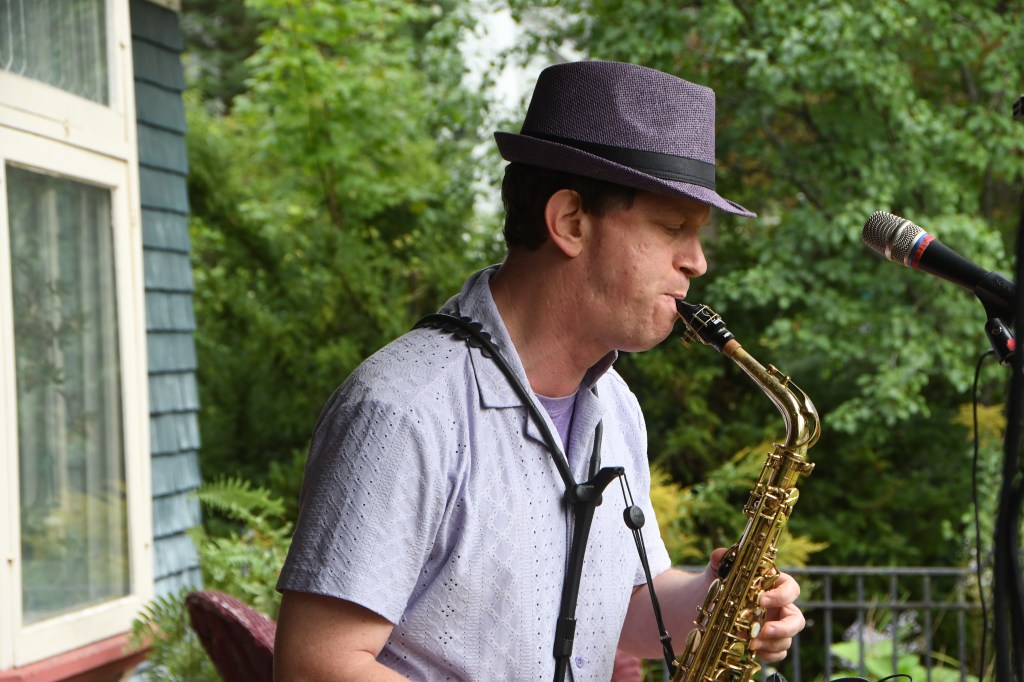
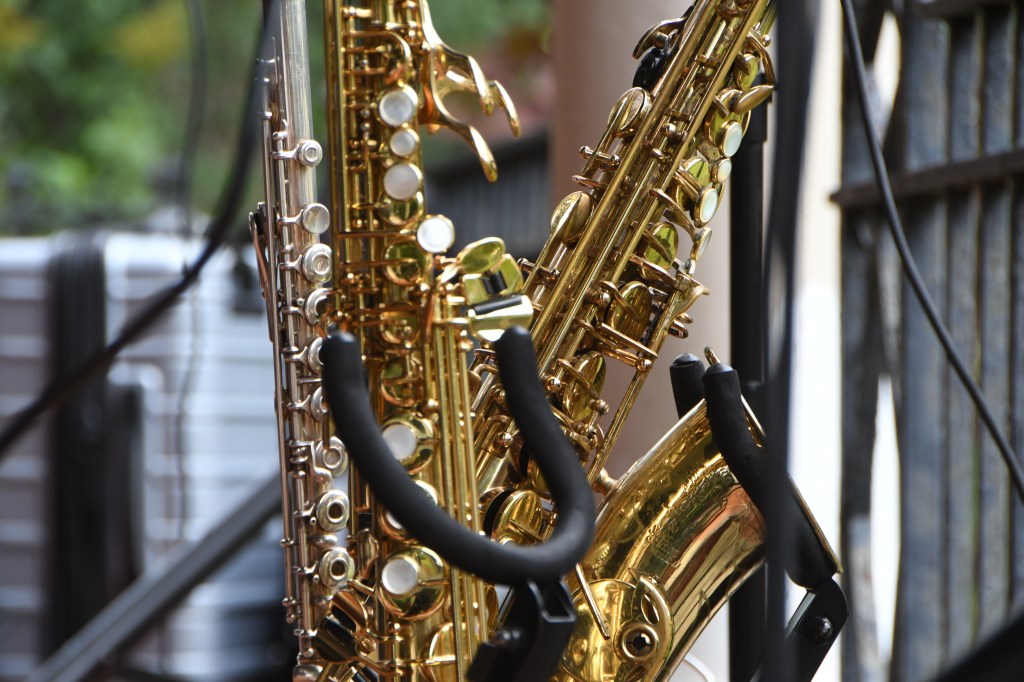
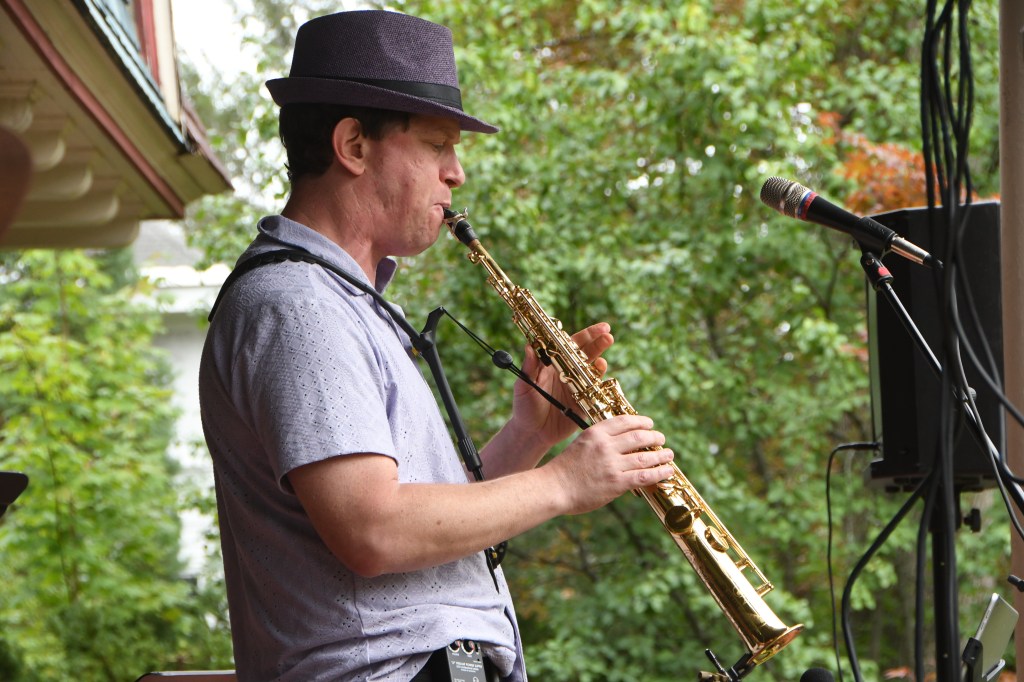
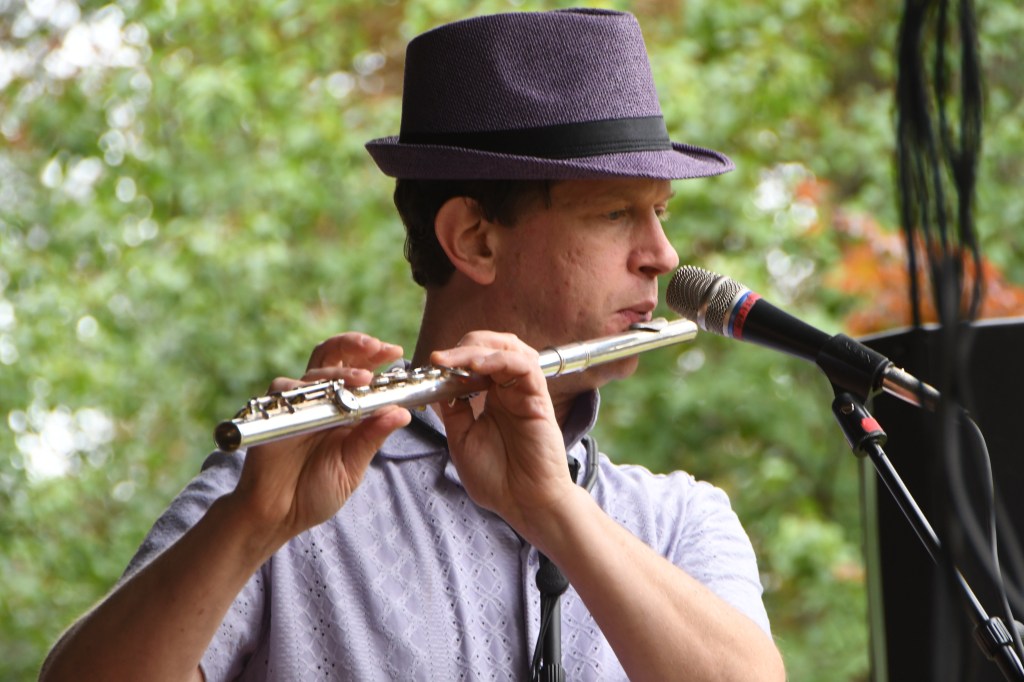
Saxophonist Eric Walentowicz earned most of the awe with strongly rhythmic tenor sax solos, plus one flute feature. 

The hearty funk shuffle “Killer Joe” spotlighted everybody in solos that circled around before homecoming to the main melody. Here, and often in songs to come, Walentowicz took two breaks, others just one. Most often, he went furthest outside, running rapid scales, while Hameed understated. They turned this effective contrast inside out beautifully in an extra-funky “Mr. Magic” late – Walentowicz tasty and quiet in his first solo, Hameed romping up and down the keyboard, all happy energy, before Walentowicz followed and hit the melody hard.

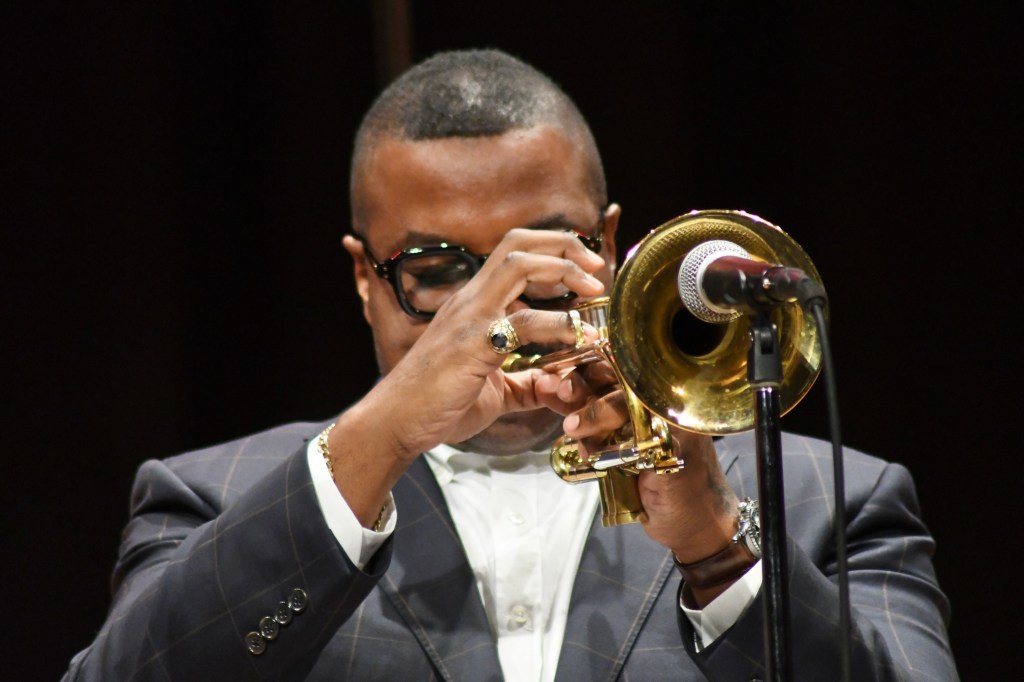
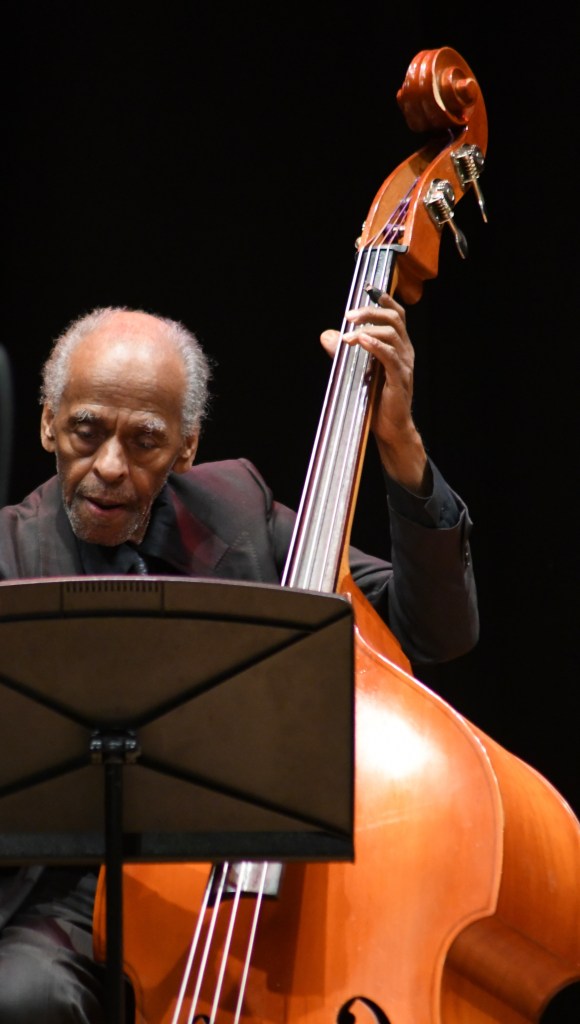
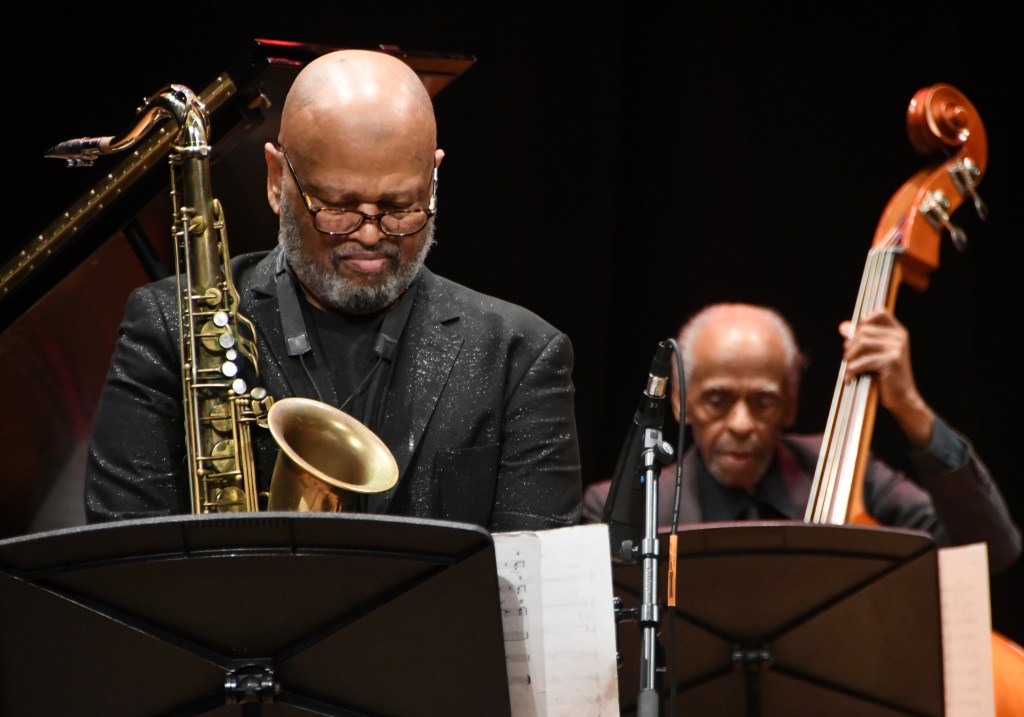
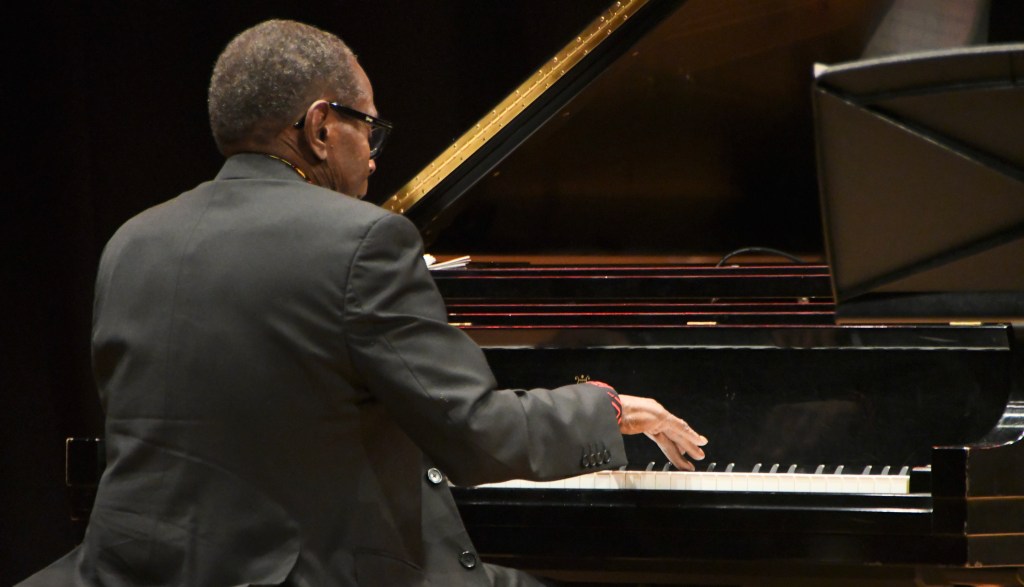
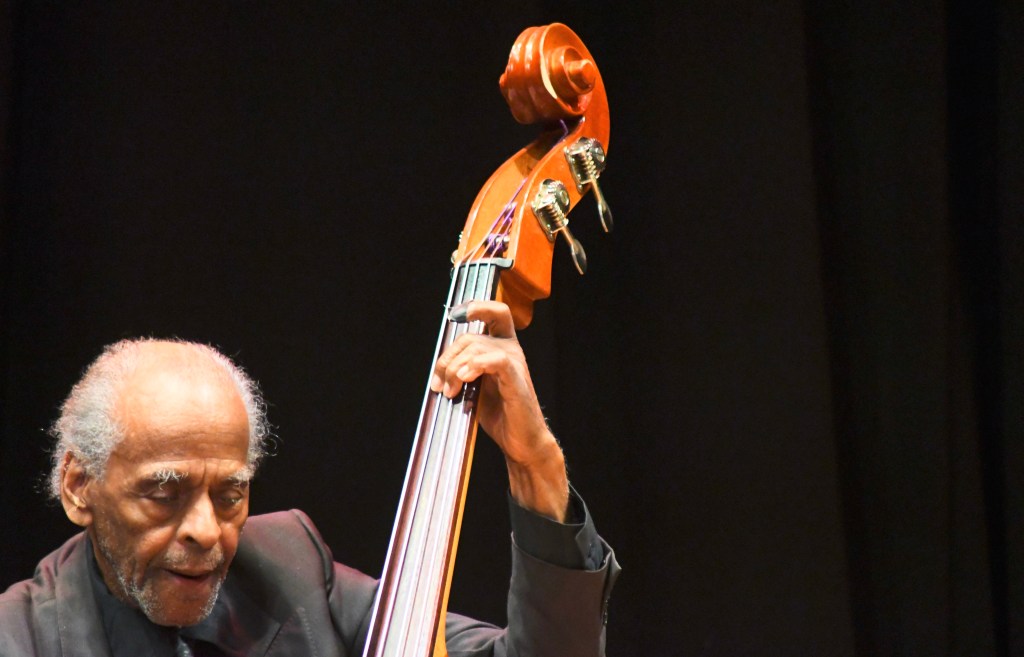
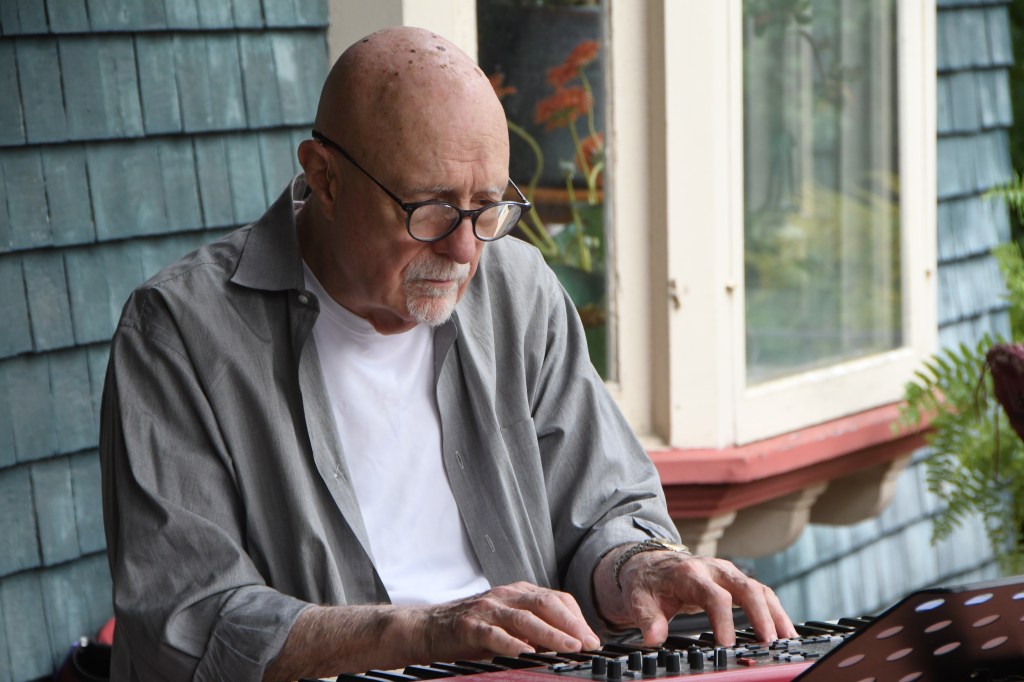
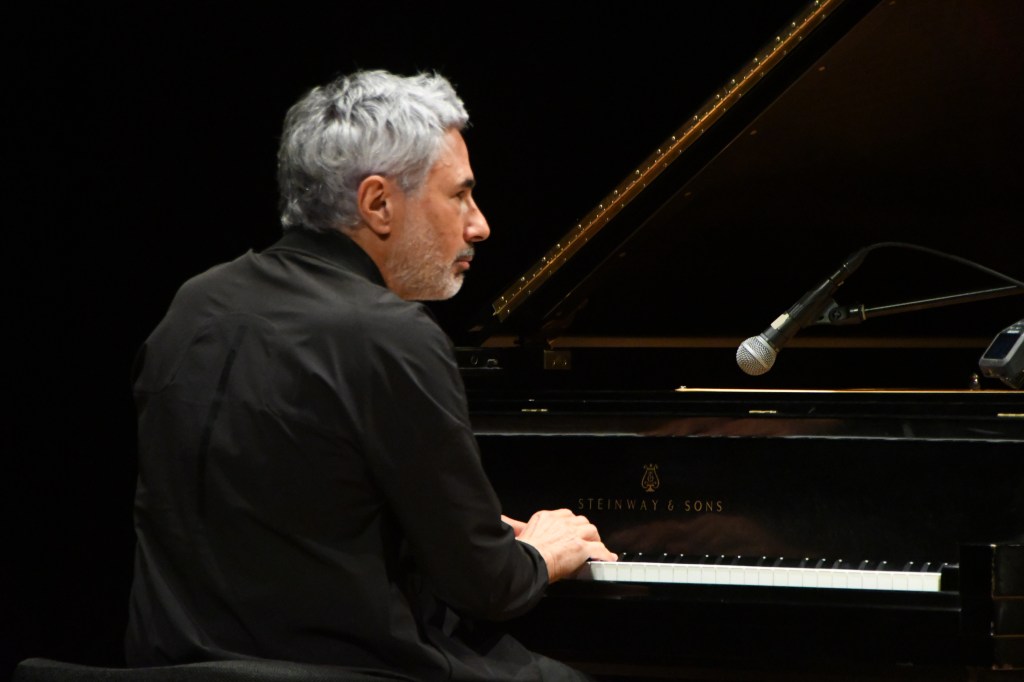
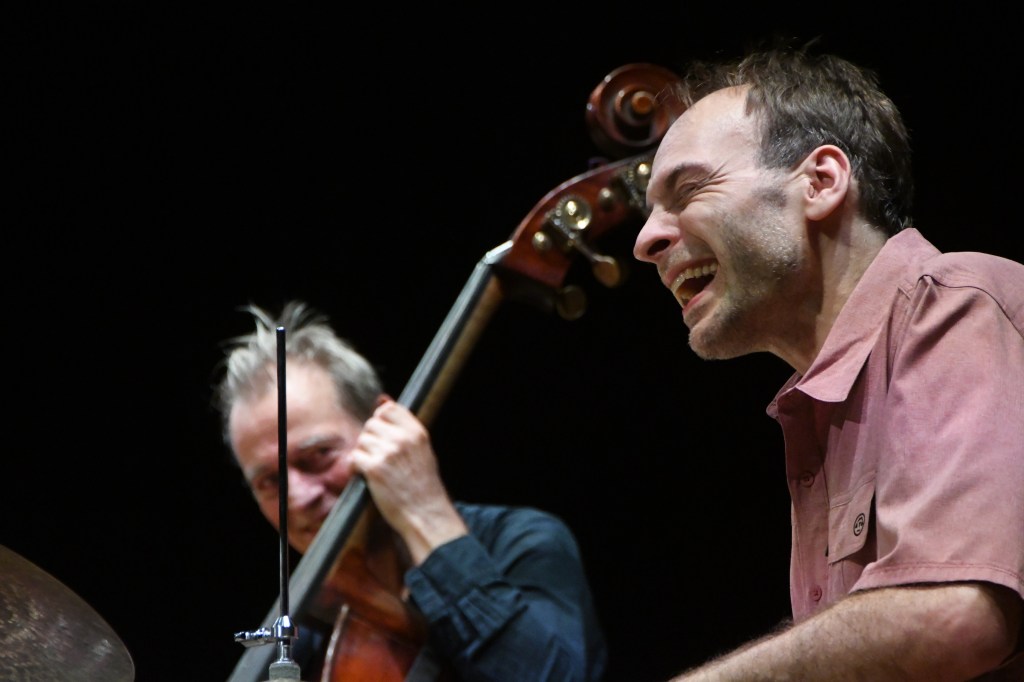
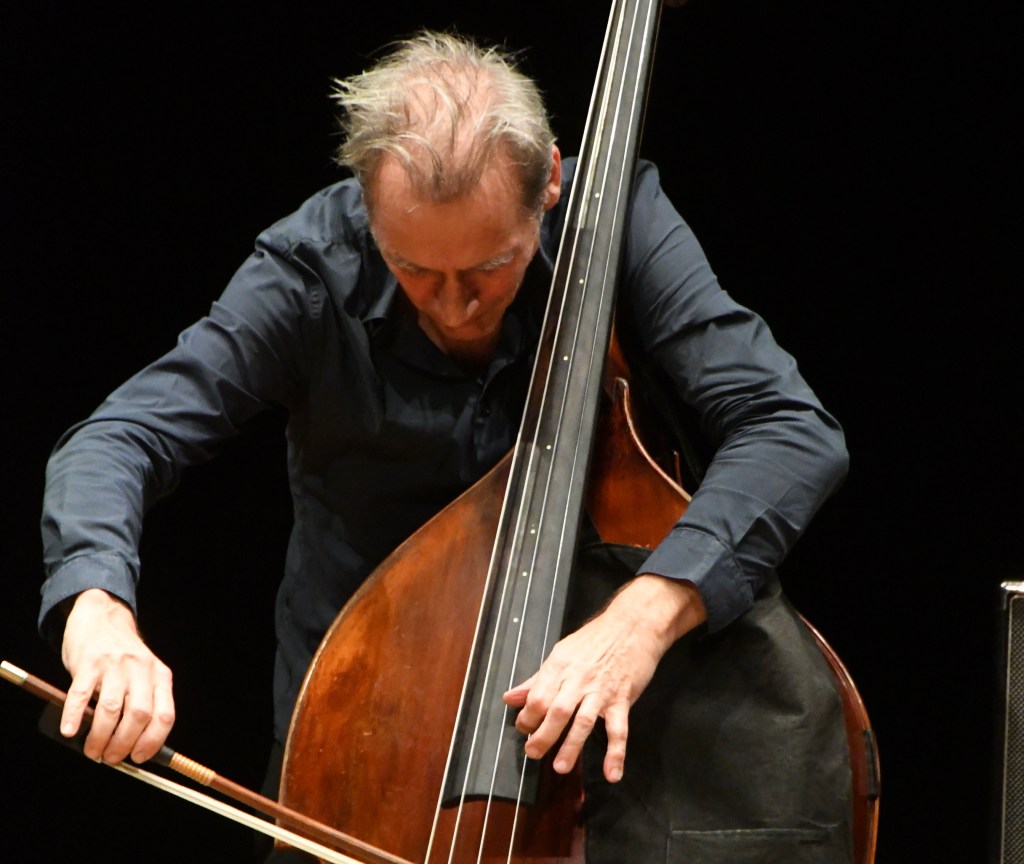
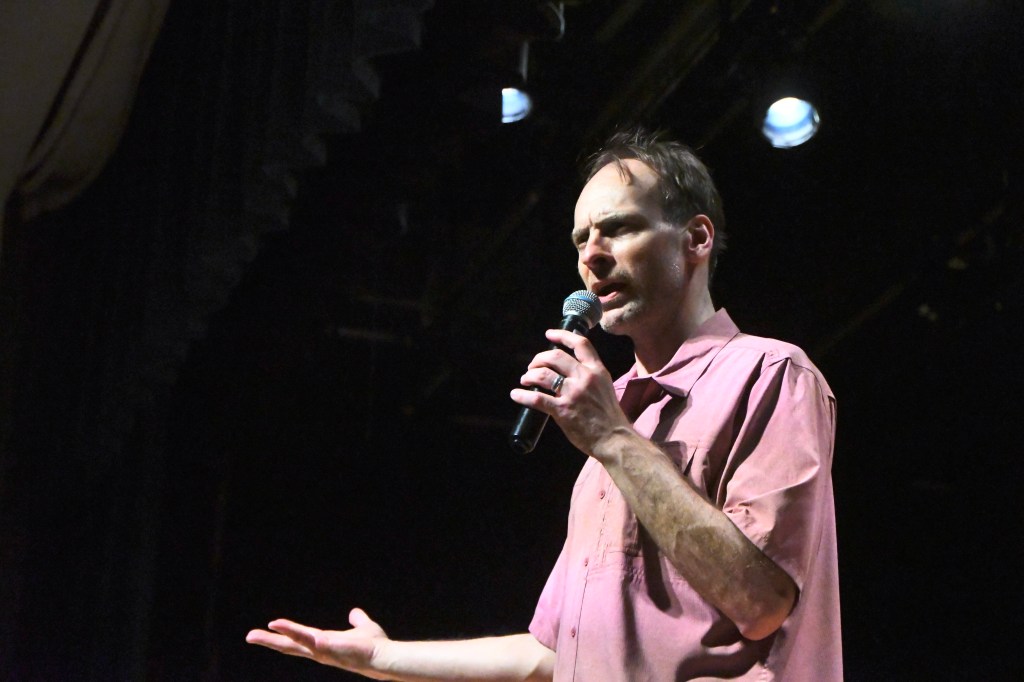
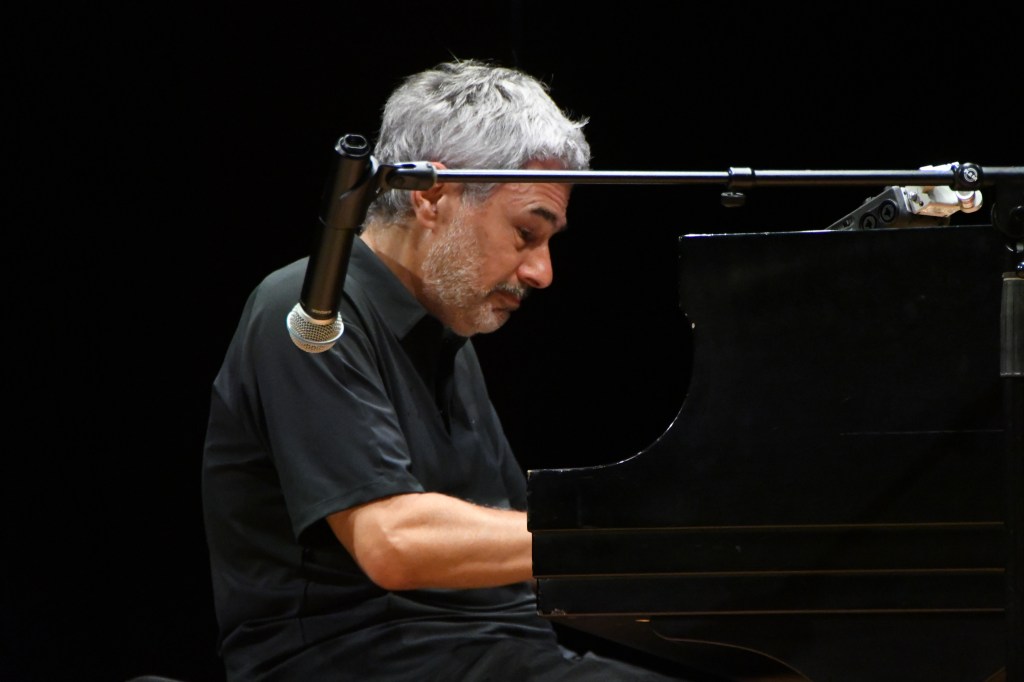
Azzaam Hameed and Eric Walentowicz, above; Ben Odom below

Whenever Hameed soloed, Walentowicz played supportively in the seams between his riffs; a cooperative natural rhythm. Hameed’s keyboard work reflects how he breathes as a singer while Walentowicz plays often with singers including the charismatic Bronte Roman. In the lusciously slow “Sweet Love,” the eloquent Walentowicz-Hameed solo tag team blended at their most expressive. 

In songs usually done as vocal numbers, Walentowicz riffed and breathed like a singer in natural cadences. In “Georgia on My Mind,” he roughed up his usually elegant tone and tilted his phrasing, both departures recalling alto giant David Sunburn.
Always confident in their playing, they sang a bit tentatively at first but settled in; Odom more confident in “Fly Me to the Moon” later after the early “Lovely Day.” Hameed crooned elegant in “Summertime” after cruising in the inviting soft groove of “Morning.” They gave the drummer some, too; Kelle sang lead in “Night and Day.”

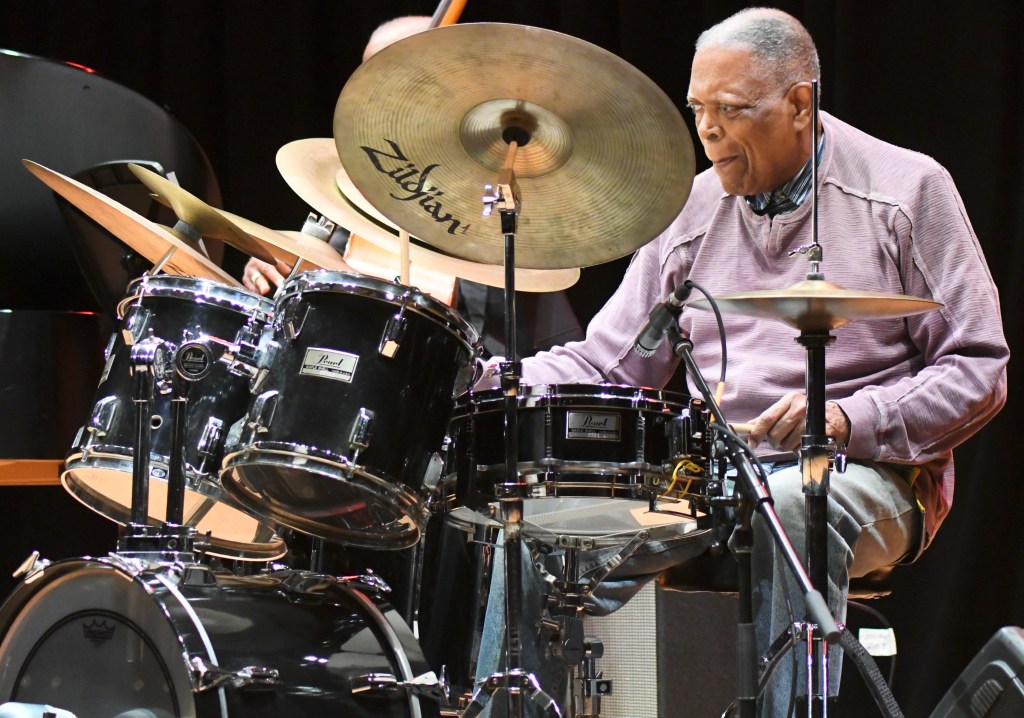
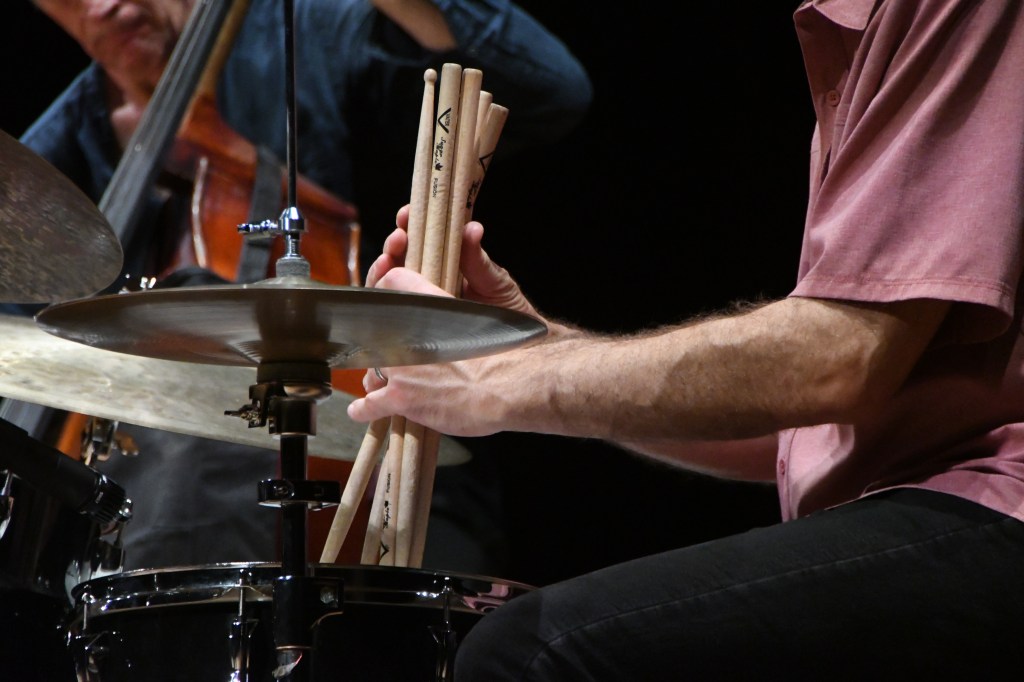
Jack Kelle

Their most fun material featured funk or soul grooves, Odom weaving impeccable undertow with Kelle’s drums, the fat end of his left stick clattering strong on his snare. Odom played without a pick, fast fingertips plucking upward in unfancy polyrhythms of equal glide and punch. While “Blue Bossa” sounded more straight-ahead than Brazilian, “Girl From Ipanema” had the right groove.

Guest singer-keyboardist Amna Khan with Cool Universe, below

Realizing late they had to cut down their overambitious setlist, they bypassed “Take 5” mid-set and several songs later. Some songs simply stretched more than expected, a good thing. A young music student singer-keyboardist guested briefly. Stronger at the mic than the keyboard (the opposite of Hameed), she earned a nice reception in a classy, generous opportunity.

Gallery

Cool Universe; Where Jazz, Classic Jazz and Modern Song Meet

Preview: Cool Universe Plays Thursday, July 30 at Jazz on Jay

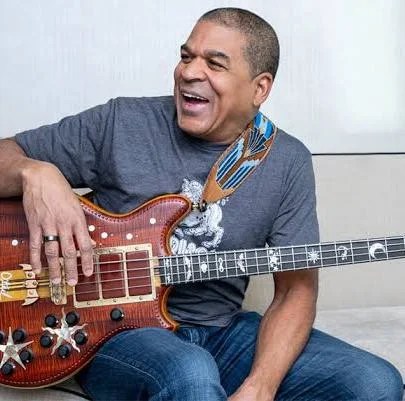
Bassist-singer Ben Odom leads Cool Universe, with keyboardist-singer Azzaam Hameed, drummer Jack Kelle and saxophonist Eric Walentowicz.

“Our music is a mix of jazz and classic jazz and modern inflections of jazz on modern song,” says Odom.

Ben Odom, bassist-singer with Cool Universe. Robyn Gould photo, provided

Odom includes Donny Hathaway; Earth Wind & Fire; Stevie Wonder; Lambert, Hendricks & Ross; the Hebrew Boys; Take 6 and Professor Rudolph Stinney among his inspirations and influences – plus his parents who insisted he take piano lessons. These influences shape his work with the Soul Stirrers and with Cool Universe, performing Thursday at Jazz on Jay.

Azzaam Hameed studied music at Union College, plays organ and piano at Friendship Baptist Church and with jazz, soul and R&B artists including Garland Nelson, Felicia Collins and Tarik Shah.

Drummer Jack Kelle also plays guitar, piano and saxophone, enhancing his skills as a versatile accompanist. He also leads his own jazz groups.

Eric Walentowicz guested with the Union College Jazz Ensemble at Jazz on Jay on opening day, June 4, playing most of the saxophone solos. He studied at several Interlochen Arts summer programs, the University of Miami and the University of North Texas. With his own group, co-starring charismatic singer Bronte Roman, he’s released several recordings.

“Our hope is to spread love through music and joy through our love of music,” says Odom. “We always strive to make someone’s heart smile.”

Cool Universe played at the Empire State Plaza Summer Series on June 3.

Odom also has another band, a much-honored Gospel group that boasts a century-deep historic reputation, international renown, top awards and ongoing durability.

Odom sings with the Gospel group the Soul Stirrers and also serves as manager.

The Soul Stirrers were inducted into the Rock and Roll Hall of Fame in 1989 as one of rock’s early influences, then into the Grammy Hall of Fame earlier this year. 

Inspired by jubilee Gospel quartets, as well as superstar solo singers Mahalia Jackson and Sister Rosetta Tharpe, the Soul Stirrers have featured Sam Cooke, Johnny Taylor and Lou Rawls among a long roster of former members. They’ve sung with Stevie Wonder, Aaron Neville, Dr. John, Sinead O’Connor, Billy Preston, The Band, Tom Petty, Bobby McFerrin, Taj Mahal, the Preservation Hall Jazz Band and many others. Odom has also performed with The Blind Boys of Alabama, in “Gospel At Colonus” on Broadway with Morgan Freeman and in “La Davina” off Broadway.

Jazz on Jay continues Aug. 6 with the Cribtet.

Jazz on Jay is presented by the ElectriCity Arts and Entertainment District. 

Sponsors are the New York State Council on the Arts, a Schenectady County Legislature Arts & Culture Grant, Downtown Schenectady Improvement Corporation and The Schenectady Foundation. We also receive support from Schenectady City Hall and this site, Hoke’s Juke Box. 
Show time is 12 noon at Jay Square opposite City Hall. Rain site: Robb Alley at Proctors; seating is provided indoors.

Cape Verdean Creole, Afro-Dominican Guitar Fireworks: Elida Almeida; Yasser Tejeda Spin the Globe

Review: Elida Almeida, and Yasser Tejeda at Music Haven on Sunday, July 26, 2026

“This is…how people dance, in the U.S.?” asked Elida Almeida, mock-skeptical, glancing in feigned confusion at too many fans seated at Music Haven Sunday night behind too few dancers up front.

Elida Almeida, above; with band, below

She soon changed things, energizing the audience by first revving herself. Elegance gave way to kinetic excitement that lifted everything through call-and-response vocals and her own increasingly abandoned dancing in mostly upbeat songs. The turning point came, however, in her quietest moments.

Almeida topped a twin-bill of hybrid cross-ocean singers; she combined Cape Verde’s blend of Africa and European cultures in music that leaned toward Africa while opener Yasser Tejeda’s celebration of Afro-Dominican traditions felt Caribbean.
Almeida started singing offstage as her four-piece band grooved strong. She came on mid-song in glowing silver that changed colors with the stage lights. She said Sunday’s show was only the second on this tour, hailed her tiny island nation’s surprising World Cup success and at first sang in the understated style of world’s best-known Cape Verdean export, “barefoot diva” Cesaria Evora (RIP).
Seldom introducing her tunes, Almeida let them speak for themselves; bold, beat-powered surges of song whose meanings spoke through inflection and gesture – until she said her next, “Txika,” was a weapon aimed at an ex-boyfriend.

After another bold-fun dance-y tune, things got personal again. She told how she wrote her first-ever song at 17 to express and resolve troubles. In fervent quiet the aching, healing, uplifting “Nta Konsiqui” had just simple guitar riffs behind her – a major change from his aggressive riffing in upbeat tunes. Opening herself, she brought the audience into where the music led.

After that, she steered everybody around with a compelling, confident swagger, using singalongs to engage everyone from singing faces to fast feet. She kept things simple, no more than a syllable or two, mostly; and she shrewdly reprised some songs. Just when it seemed they’d stopped while the beat was still fun, she’d turn a hard stop into a pause, spurring things on again with renewed musical force.

She ended as she’d begun; leaving the stage while her band still grooved on in farewell. They’d earned their solo spotlight swan-song: keyboardist Kalu Ferreira, drummer Cau Paris, guitarist Jery Bidan and bassist Mayo Bass. Nobody soloed much, and didn’t have to; Almeida shone the star power, but Bidan’s guitar underlined her music’s African origins with treble high-life style runs.

Kinetic west African zip was one of many guitar colors opener Yasser Tejeda used to grab everybody in the confident grip of a trio riff explosion. 

Yasser Tejeda, above; with band, below

Like Almeida, Tejeda drew fans in with singalongs, starting right away with “Nuestra Raices” hailing all in the Dominical Republic’s complex population. The branches of the orange tree cited in “En Al Naranjo,” the linking of disparate peoples in “Universo Ancestral” and the bluesy tribute to ancestors in “La Vereda” all carried similar sentiments of unity. The tunes’ variety exploded from Tejeda’s guitar as much as from the words he sang, in Spanish. Bassist Pedro Fortunato and drummer Jonathan Troncoso in strong support, Tejeda’s guitar sailed all over. Blinding-fast jazz-rock runs, heavy-metal chord clangs, folkloric fundamentals, reverb eruptions – he reached deep into the six-string tool-box.

Tejeda said his musical mission was to fly past the stereotypical expectations of merengue and bachata, as confining Dominican styles, to a wider world of Afro-Dominican expression. While he introduced his praise of women in “Tu Ere Bonita” as a merengue and “Cascada” as a bachata, neither felt cliched. “Amor arrayáno” mourned a love doomed by the border between the (Spanish-speaking) Dominican Republic and the (French-speaking) Haiti. But then he closed with the tolerant, universal “Todo Va a Marchar” asserting – like John Lennon’s “Imagine” – the love in his chest has no borders or religion.

Neither does his music, or Almeida’s.

The Music Haven season continues Thursday with the comedy of Second City Touring Co., with Irish guitarist John Doyle and his Quartet on Sunday with the Murphy Beds opening.

Gallery

Yasser Tejeda trio, above; Elida Almeida and band, below

Yasser Tejeda set list, above; Elida Almeida set list, below

First the Words; then the Melody

Preview: Nancy Donnelly Thursday at Jazz on Jay

The words take singer Nancy Donnelly into a song, then she explores its melody, with imagination.

“I take a look at the lyrics – the song has to speak to me,” she says. Then she studies the melody and the harmonic structure. “I learn the song exactly as written and then try to make the song my own by embellishing the melody.”

Donnelly sings Thurday with Dan Sales, guitar; Otto Gardner, bass; and Bob Halek, drums – “all freelance jazz musicians,” says Donnelly.

Nancy Donnelly. Photo provided

She came to jazz via folk and rock. “I grew up listening to Carole King, Joni Mitchell, the Beatles; later on Pat Benatar,” she explains, adding her love of jazz came from hearing the greats: Ella Fitzgerald, Sarah Vaughan, Anita O’Day, Carmen McRae and Billie Holiday.

She studied classical vocal technique at the Crane School of Music with Patricia Misslin; then with Dominique Eade and Jerry Bergonzi in Boston; and now with Kim Nazarian of the New York Voices.

“We will be playing jazz standards as well as two originals,” she says of Thursday’s show. “Some bossa, blues and some Motown to mix up the set.” She lists her own “The Ballroom In our Backyard” and “Modern Day Troubadour” plus standards including “Louisiana Sunday Afternoon,” recorded by Diane Shuur, some Nancy Wilson and Antonio Carlos Jobim and Al Green’s “Lets Stay Together.”

She says she seldom scat-sings – but, “I do like to improvise on the melody.” She adds that guitarist Dan Sales and bassist Otto Gardner “will take solos and improvise on the song.”

Available online, her digital album “A Greater Love” presents both originals and standards. A second album is in the works.

Donnelly performs through the summer at Pamela’s on the Hudson (Newburgh, on July 31st), Sofia’s (Clifton Park, on Aug. 1), the Rotterdam Summer Concert Series (Rotterdam Senior Center, on Aug. 17) and Harmonies on the Hudson (Clermont State Historic Site, Germantown, on Aug. 27).

Jazz on Jay continues next Thursday, July 30, with Cool Universe.

Jazz on Jay is presented by the ElectriCity Arts and Entertainment District. 

Sponsors are the New York State Council on the Arts, a Schenectady County Legislature Arts & Culture Grant, Downtown Schenectady Improvement Corporation and The Schenectady Foundation. We also receive support from Schenectady City Hall and this site, Hoke’s Juke Box. 

Show time is 12 noon at Jay Square opposite City Hall. Rain site: Robb Alley at Proctors; seating is provided indoors.

North Country to the Whole Country

Review: The Gibson Brothers, and Sara Milonovich and Daisycutter at Music Haven on Sunday, July 19, 2026 

“Creativity has no address,” said former ad man and current North Country TV chief Jesse Jackson on winning a national TV commercial award.

Neither has bluegrass, as North Country creatives the Gibson Brothers and Sara Milonovich proved at Music Haven Sunday. Both built from the particular to the universal with music that often described a snowy homeland but whose emotional truth and sonic power reached out to everywhere.

The Gibson Brothers above; Eric at left, Leigh to the right. Below: Sara Milonovich

Milonovich opened; 45 minutes of well-received originals old and new and some covers. Her Daisycutter crew played and sang like the seasoned pros they are: Boo Reiners, banjo and electric guitar; Greg Anderson, guitar; and Bob Buckley, bass. Milonovich grabbed and held the spotlight, a star with voice and fiddle. 

Some originals told local tales. “87 North,” for example, is their “Route 66” or “Highway 61,” minus the romance but with icy spots and hot fiddle and banjo. “Hope You Like What We Did with the Place” decries Adirondacks gentrification by come-here folks, like Michael Jerling’s “How Can People Live Like That.” Others spun out wider; any touring musician could relate to “Last Resort Motor Inn,” Sara M’s high strong voice recounting the sleaze of the place, washed away in a serene fiddle break. Maybe the only bluegrass crew on the road that covers Led Zeppelin, their late-set highlight of Zep’s “Friends” hit hard, but lyrical. (They’d opened with Josh Ritter’s [geo-specific/universal] folkie “Lawrence, KS.”) An album in the making sourced the devotional “Planting and Harvest,” a strong live number that helped earn a standing ovation for a compressed but strong showcase.

Sara Milonovich and Daisycutter. from left: Boo Reiners, Milonovich Buckley and Greg Anderson

The Gibson Brothers came on with a quiet confidence so laid back they could have come from Tulsa rather than a farm near Ellenburg Depot. Afterwards, as Eric Gibson greeted fans at the lip of the stage, avid setlist collector JD requested theirs. “We don’t have any,” Gibson laughed. The whole 75-minute set seemed spontaneous; song choices, warm and loose, like NRBQ.

The Gibson Brothers and band, from left: Jason Carter, Eric Gibson, Leigh Gibson, Michael Barber, Cody Kilby

Playing and singing, though: world-class tight. After a blinding Jason Carter fiddle rip rapid as a horse race, Leigh told his bandmates he wanted to play “something slower.” They chose “They Called it Music” whose description of it – “it was honest, it was simple, and it helped in hard times” – rang like a mission statement. 

Some spoke serious sentiments: Barry and Holly Tashian’s “Home” and the loyal “Friend of Mine” – their famed musical DNA brother harmonies warming the words with honest, simple sentiment. Others ripped and romped, including travel tunes – the honky-tonk swagger “Walking West to Memphis” and Bill Monroe’s high-momentum “Roll On Buddy, Roll On” – also the party imperative “Shut Up and Dance.”

Eric Gibson, above; Leigh Gibson, below

A tremendous vocal duo, each brother also sang strongly alone, Eric in a higher tenor than 11-months younger Leigh. Consolingly slow or caffeinated-quick, the playing dazzled. While Eric took a few fine guitar or banjo breaks and Leigh soloed a verse or two in multi-guitar pile-ons, Carson’s fiddle and Cody Kilby’s mandolin and guitar solo work lit things up. Bassist Michael Barber, aboard the Gibson’s bus for 33 years played in brilliant unobtrusive perfection.

National stars, they localized some; Leigh – the brother in the cowboy hat – noted he’d lived on Schenectady’s Gillespie Street and Carter recalled a first date at Music Haven with the woman he’d marry. 

Jason Carter, above; Cody Kilbey, below

Michael Barber, left, and Cody Kilbey

They celebrated family, bringing out Eric’s son Kelley John Gibson to sing the songwriter’s classic announcement “I Got a New One.” (The earlier “Almost Proud” offered wry contrast.) Leigh thanked their mother for saying “You’ve lost weight” even when he hadn’t.

They simmered things down with the gentle “My Quiet Mind,” then the happy domestic “Homemade Wine” closed the set before an eager departure-less rocking encore “Highway.”

Few fans danced; at times the Gibsons played so fast dancers risked whiplash. But whoops and hollers rose from the crowd in upbeat numbers. Then, at the end, everybody rose.

Sara Milonovich, and the Gibson Brothers, will play Caffe Lena this fall; Josh Ritter, too.

Music Haven’s free presentations continue Saturday at 2 p.m. with the seven-band WEXT Local 518 Fest of local rock, pop and hip-hop acts. Sunday Music Haven presents singer Elida Almeida from the Cape Verde Islands whose team surprised big time at the World Cup.

Gallery

Boo Reiners, above and below

Bob Buckley, above; Greg Anderson, below

Kelley John Gibson, center, between Jason Carter and Eric Gibson, Kelley’s father

Hometown ‘Bone

Review: The Alex Slomka Trio at the Van Dyck; Saturday, July 18, 2026

“The trouble with a hometown show is that you all know I don’t really sound like that,” said Alex Slomka in his regular voice, after first rasping in “jazz voice” imitating Miles Davis’s fierce whisper.

That seemed the only trouble in sight at the packed Van Dyck Saturday. The Schenectady-born trombonist, now a downstate resident who plays often in New York, Slomka led his trio – guitarist Wyatt Ambrose and bassist Lou Smaldone – in a two-set homecoming showcase of mostly standards, spiced with a few originals.

Full Disclosure: I met Alex the day he was born; his parents Joe and Claudia are old friends. Both were in the house Saturday among many longtime jazz-fan pals. I’ve watched Alex grow up in music, from Late Night Show that he cited in introducing a ska song, to Keith Pray’s Big Soul Ensemble. He had played the Van Dyck with both. Saturday, he checked that nobody was still eating before confessing he’d taken off his shirt and pants to run around the room when Late Night Show opened for Monkey Gone Mad. He credited Pray with helping him learn big-band sight-reading and dynamics. Saturday, he showed off skills much advanced from those earlier gigs. 

The Alex Slomka Trio, above, from left Wyatt Ambrose, guitar; Alex Slomka, trombone; Lou Smaldone, bass. Below, Alex Slomka

As a fellow trombonist at our table noted, there’s nowhere to hide when playing trombone. Sound, intonation and phrasing must all be precise; and Slomka’s were. He also hosted in confident, amusing fashion, with plenty of the schtick dad Joe had suggested he bring to the stage. He encouraged generosity at the tip jar by lamenting heavy (losing) World Cup bets on Ireland, but he was all simple sincerity paying tribute to the late, great Tim Coakley – a Gazette work colleague of his dad – with the deeply felt ballad “Li’l Darlin’” late in the first set.

Unconventional with no drums, piano or second horn, Slomka’s trio applied a theme and variations approach to a mid-tempo romp through “September In The Rain” to open, varying the order and length of solos some from tune to tune. They usually launched from a unified melody statement, Slomka taking the lead; then, usually, Ambrose took the second solo, alternating chords and single-note runs with the always smooth Smaldone accompanying, steady and unobtrusive. They’d swap roles then, Smaldone leading, Ambrose comping. Then Slomka would bop to the top, sum up or simmer down.

Wyatt Ambrose, above; Lou Smaldone, below

In “If I Had You,” he started stretching out more, tone spanning from raspy to sweet, changing up his phrasing from long, smooth statements to more staccato runs. In “Yellow Moon” (from “Box of Socks,” his digital album on streaming services), a repeating bass figure blended with fluttering guitar before Slomka brought a droll, fun feel.

After Al Green’s soul classic “Let’s Stay Together” in straight-ahead smoothness and the spry, breezy “Out of Nowhere,” Slomka’s own “Bachwana” cruised easy, a cozy waltz carried on long trombone notes.

Dedicated to Tim Coakley, “Li’l Darlin’” built from delicate guitar shimmer via hesitation beat through raspy-to-sweet variations to a sincere, sparse unaccompanied trombone statement. Really nice; how “I’ve Never Been in Love Before” swelled from a slow unified opening, like the stately mood of “Li’l Darlin’,” into a swinging upshift.

Slomka used a plunger mute for wah-wah quaver to launch the Basie ballad “After Supper” after a break. Then they revved the energy in the fleet, fine swing of “Shiny Stockings” (a Frank Foster/Count Basie/Ella classic). Slomka’s own “Mammatus,” named for a cloud formation, felt tangible and ethereal by turns; impressionistic, then a happy bustle.

After a song-choice discussion, they landed on “Without a Song” in Sonny Rollins’s bop style, an elegant, agile Ambrose single-note guitar solo resolving into chord strums.

Reaching back to Slomka’s Late Night Show ska days, they put a Caribbean bounce on the Specials’ “A Message to You, Rudy.” “Day In, Day Out” followed well with cool melodic cheerfulness. “Polka Dots and Moonbeams” eased the pace into stately lyricism, bop at its most soft-spoken.

Then, more adrenalin in the upbeat “After You’ve Gone.” Slomka joke-warned, “If you know the words, don’t sing it; I hate that!” This felt like a fond, flying good-bye, Slomka using his horn’s full range, Ambrose building energy in a fleet solo and Smaldone uncorking his best bass break all night.

Hearing young players mature, adding skills and confidence while developing a distinctive style, stands among the most satisfying possible fan experiences. Now in his mid-30s, Slomka gave that Saturday, to fine, fun effect.

Stay tuned: Slomka returns to his hometown Thursday, Aug. 20, playing Jazz on Jay.

The Songs

September In the Rain

If I Had You

Yellow Moon

Let’s Stay Together

From out of Nowhere

Bachnawa

Lil’ Darlin’

Never Been in Love

After Supper

Mammatus

Without a Song

A Message to You Rudy

Day In, Day Out

Polka Dots and Moonbeams

After You’ve Gone

Blue Skies Indoors at Jazz Near Jay

Review: The Ragtime Windjammers at Jazz On Jay on Thursday, July 16, 2026

Heavy with irony, the opening number – “Blue Skies” – soared anyway.

Skies gray with Wednesday’s wildfire smoke drove Jazz on Jay into Proctors GE Theatre Thursday, the Ragtime Windjammers used two subs on the gig, and longtime drummer Tim Coakley died earlier in the week.

The noon-time free show fortunately featured the most cheerful possible jazz style; “traditional jazz” from New Orleans whose pioneers invented it a century ago, but dubbed Dixieland everywhere else. 

Pianist Tim Olsen (also a capable trumpeter and trombonist and Union College jazz chief) subbed for banjoist/guitarist Ron Bill while Mark Lambert (one of three Lamberts on the bandstand with clarinetist-singer Dave and cornetist Steve) took Mike Lawrence’s spot at the upright bass behind the other Lamberts and trombonist Woody Strobeck. Anything but tentative nonetheless, the five veteran players coalesced in the hip, happy buoyancy of the first musical style I ever loved.

The Ragtime Windjammers, from left: pianist Tim Olsen, clarinetist-singer-host Dave Lambert, cornetist Steve Lambert, bassist Mark Lambert behind Steve, and trombonist Woody Strobeck.

Dave Lambert, above and below

Dave Lambert sang, played clarinet and hosted, explaining the dual origin of traditional jazz in African and European styles; also the individual tunes and those who wrote and made them famous. He cited slave ships, plantations and church hymns but lightened up by quizzing the audience and joking around. 

When he led singalongs, some worked and some didn’t. But the venerable, well-known tunes did. 

Steve Lambert, above; Woody Strobeck, below

The solos showed skill and personality. Steve Lambert’s cornet breaks were the most fluent and enterprising, while Dave Lambert’s clarinet hit the most poignant depths; a more effective player than singer. Strobeck leaned into the cartoon-y abuse of the trombone for comic purposes with cheerful, humorous playing. Olsen’s two-handed attack packed the most rhythmic fire. Bassist Mark Lambert, the other sub, was hard to hear; I was tempted to sneak up and crank his amp.

The subs: Tim Olsen, above; Mark Lambert, below

Spirited ensemble parts that introduced the tunes and comprised all-in codas worked best. When everybody ganged up on the tunes, taking them apart and putting them back together in happy jumbles, instruments darting in and out of the flow, the cats had fun and this communicated really well.

The tunes were all highlights from early pages of the Great American Songbook. Yet some performances stood out: Steve Lambert’s bouncy cornet in “When You’re Smiling,” Dave’s clarinet sweetly eloquent in “Just a Closer Walk With Thee,” Strobeck’s spunky runs in “At the Jazz Band Ball,” Steve Lambert going all Louis Armstrong in the great Satchmo’s theme song “When It’s Sleepy Time Down South” – both flashy and profound – the tasty piano and bass duet in “Ain’t Misbehavin’” and the happy eruption of “Down By the River Side” in the middle of “When the Saints Go Marchin’ In.” (New Orleans buskers charge double to fulfill requests for the over-played “Saints”…)

In a classy move at the end, Proctors employee and Jazz on Jay impresario Lanaea Bailey stopped headed-for-the-exits fans in our tracks to pay poignant moment-of-silence tribute to the late, great Tim Coakley. After playing with the Ragtime Windjammers for years, Tim had retired from the bandstand some time ago on entering a nursing home. He’d led A Place for Jazz for years, broadcast a popular Saturday night jazz show on WAMC and remained a revered figure on the music scene. Even without an introduction linking “Just a Closer Walk With Thee” to Tim, this hymn felt like the band mourning him.

The Songs:

Blue Skies

When You’re Smiling

Dr. Jazz

Just a Closer Walk with Thee

Up a Lazy River

I Found a New Baby

Jada (Jada, Jing, Jing Jing)

At the Jazz Band Ball

I Can’t Give You Anything But Love, Baby

Way Down Yonder in New Orleans

When It’s Sleepy Time Down South

Tiger Rag

Ain’t Misbehavin’

When the Saints Go Marchin’ In

Down By the River Side

Saints Reprise

Ragtime Windjammers to Bring Traditional Jazz to Jazz on Jay Thursday

Traditional jazz charms easily with its happy upbeat energy. But playing this antique style takes dedication and skill. 

The Ragtime Windjammers bring plenty of both: Dave Lambert, clarinet; Woody Strobeck, trombone; Steve Lambert, trumpet; Mike Lawrence, bass; and Ron Bill, banjo and guitar. 

Dave Lambert started playing clarinet in fifth grade, learning from Mel Schiff, who also taught him saxophone in high school. Lambert returned to the clarinet when he fell in love with New Orleans traditional jazz. 

Woody Strobeck studied music at Syracuse University and SUNY Fredonia, then taught music in Cambridge schools. Strobeck played with Skip Parsons’ Riverboat Jazz Band, also the Storyville Stompers, the Steel Pier Jazz Band and others.

Before moving to New York City in 1999, Steve Lambert played with and learned from top area players including Nick Brignola, Mike Canonico and Brian Patneaude. In New York, he earned a BA in mechanical engineering at Columbia University, then worked at Second Floor Music, publisher of books on music including Charli Persip’s “How Not to Play Drums.” Since returning to Schenectady, he plays in Keith Pray’s Big Soul Ensemble, the Silver Arrow Band, the George Muscatello Quartet and the Dave Fisk/Jon Leroy Quartet; and supports such touring stars as Aretha Franklin, the Temptations and the Four Tops. 

Mike Lawrence started playing upright bass at 10 and electric bass somewhat later. After summer workshops at the Berklee College of Music, he earned a bachelor’s in music education from the College of St. Rose and a master’s in music education from Boston University. He has taught music in area schools while also playing with Sensemaya, the Yuko Kishimoto Trio, Mike Benedict’s Jazz Vibes, bluesmen Charlie Smith and Tas Cru, and others.

Ron Bill has also played for years with area stalwarts, mostly in the traditional jazz style, including Skip Parsons’ Riverboat Jazz Band and Reggie’s Red Hot Feetwarmers. He has also played with national stars including Vince Giordano’s Nighthawks, Pee Wee Irwin, Dave McKenna, Bobby Hackett and Vic Dickinson.

Thursday’s concert marks a return to Jazz on Jay by the Ragtime Windjammers who played the series in 2021. Fans wore masks against COVID and had a fine time.

Jazz on Jay is presented by the ElectriCity Arts and Entertainment District. 

Sponsors are the New York State Council on the Arts, a Schenectady County Legislature Arts & Culture Grant, Downtown Schenectady Improvement Corporation and The Schenectady Foundation. We also receive support from Schenectady City Hall and Hoke’s Juke Box. 

Jazz on Jay continues next Thursday, July 23, with singer Nancy Donnelly and her trio.

FYI, Traditional jazz is often called Dixieland; just not in New Orleans whose early 20th Century musicians invented it.

Music Haven Opens with Transatlantic Sounds

Review: Ricardo Lemvo and Makina Loka, and Taina Asili on Sunday, July 12, 2026 at Music Haven in Schenectady’s Central Park

Musical notes know no nationalities, beats have no boundaries – so nothing in human culture feels as international or inclusive as music. 

Music Haven launched its 36th season Sunday – 10 concerts, three musical movies and a comedy revue – with songs from Africa, the Caribbean, or both.

Ricardo Lemvo, second from right, and Makina Loca Sunday at Music Haven

Trans-continental in heritage and soul, headliner Ricardo Lemvo – a Congolese singer of Angolan descent who lives in Los Angeles – showed both the origins and development of Afro-Cuban music. His stirring stylistic mix revved the happy, large crowd from feet to smiling faces. Puerto Rican-born, Troy-based opener Taina Asili proved diversity can flourish anywhere and liberation can strengthen anyone.

Taina Asili, second from right, opened Music Haven’s 36th season Sunday with her band

Her message music balanced social activism and engaging, ecstatic force. Tender in underdog compassion, fierce in passion, Asili and band played a Latina expression of the call for equality in the Abbey Lincoln/Max Roach civil/human-rights oratorio “We Insist!”

Asili persuaded more than she pushed and charmed more than she accused. We all know the culprits; she focused formidable charisma on comforting victims and engaging us in helping them.

Taina Asili, above; guitarist Gaetano Vaccaro, below

“Sofrito” (“sauce”) stirred diversity as a musical flavor, Caribbean beats spiced with guitar – very Santana in tone and phrasing. After the defiant “Decir Que No” (“to say no”) affirmed personal autonomy, she increasingly sang of resiliency, truth and strength through community.

In constant, skirt-flying motion and strong voice, she owned the stage; the crowd, too. Stirring and strong, kinetic and kind, she urged us, in farewell, toward “Peace, love and liberation.” Yes, please.

Like Asili’s reach across the Caribbean from Puerto Rico to borrow fromJamaican reggae Sunday, Lemvo operated like a sonic welding rig uniting elements often far from home.

He took Cuban rhythms that came from Africa and bounced back across the Atlantic as rumbas, salsa, samba and merengue. Then he populated this mansion of many rooms with a tremendous band whose clarity and sonic force might remain unmatched all season.

Just as Lemvo couldn’t understand the Spanish lyrics of Cuban songs he loved anyway, most songs were linguistically opaque but rhythmically transparent, engaging.

Solos were few but fine, from guitar, keyboard or trombone, and almost as unnecessary as translated lyrics. The strength of Lemvo’s Makina Loca band pumped from its engine room of drums, congas and – especially! – bass. 

Lemvo identified the early “Yiri Yiri Bon” as Cuban, sang a lament of romantic betrayal in Portuguese (with a chorus in English), and “Mambo Yo Yo” hypnotized with repeating phrases in irresistible high-life dancehall style. A later chant of “Africa” drew in many crowd voices. 

Some crowd schtick, including a call for conga line that didn’t work until the end, let down the energy half-way through Lemvo’s 90-minute set, unlike Asili’s shorter, more firmly-focused opener. But he re-built the momentum, mainly through gloriously muscular grooves under high-range restless guitar, jazz-spicy trombone and his hefty, hot vocals. Devastating in gruff roars, his voice had a subtle, sinuous grace in quieter moments. Late in the show, he lay down at the front of stage, resting on an elbow and holding hands with fans while singing in a romantic croon.

Then he rose to his feet and got the conga line he’d urged earlier, but closed with the bizarre curveball of trombonist John Roberts singing “Plastic Jesus.” Against tall odds, the band grooved on that, too.

Lemvo got his conga line going, near the end of his show, above; and he brought out Music Haven Producing Artistic Director Mona Golub, below

Music Haven continues next Sunday, July 19 with the Adirondack-born Gibson Brothers, masters of bluegrass instrumental zip and sibling vocals sharing DNA.

Gallery

“…especially bass…”

2nd Galway Jazz Festival Presents 8 Bands Sunday at the Cock ’N’ Bull

Preview: Free Festival Samples Area Jazz Artists

Eight area jazz crews perform Sunday in the 2nd Galway Jazz Festival, presented free by Capital District Jazz Ltd.

The Cock ‘N’ Bull outdoor performance area; roofed artists’ shed in the background. Photo provided

From 11:30 a.m. to likely past 9 p.m., the festival presents these local and regional jazz artists:

11:30 a.m.: The Vinnie Marotta Trio

12:15 p.m.: Michael Benedict and Bopitude

1:30 p.m.: Tarik Shah Quartet

2:45 p.m.: Out of the Box

4 p.m.: The Jeannine Ouderkirk Quartet

5:15 p.m.: Keith Pray’s Listen!

6:30 p.m.: Hot Club of Saratoga

8 p.m.: Brass Machine

The Cock ’N’ Bull Facebook page explains the event this way.

Rain or shine (indoors if inclement weather). A very family friendly venue and event so come one, come all! This event is made possible through donations, if you’d like to make a tax deductible donation visit www.cdjazz.org

PLEASE CALL AHEAD TO HELP THE VENUE PREPARE 518-882-6962

Feel free to bring lawn chairs and make a day of it, but no outside food or drinks are allowed. They will however be available for purchase throughout the day.

Partial view of Keith Pray’s Big Soul Ensemble, shown here playing indoors. Photo provided

The Cock ’N’ Bull (5342 Parkis Mills Rd., Galway) has long presented music in its converted barn dining and music room. It continued presenting music during COVID by adding an outdoor performance space whose roofed area accommodates even Keith Pray’s (17-piece) Big Soul Ensemble in its last-Tuesday-of-the-month residency.

A highly efficient sampler presenting selected artists from the area jazz scene, this festival – like most multi-act productions – offers the opportunity for tasty surprises. Find an act you hadn’t previously heard, fall in love, and go catch them elsewhere, down the road.

Photo provided