
Fair Warning: I digress
First came the name, then the presence, then the sound, and the soul.
Generally, I research some before I go hear a new-to-me artist; but I skipped that step before Cassandra Wilson played The Egg, back when I knew her name and nothing more.
She came onstage before a small band with a skinny Juilliard kid at the piano. Cassandra introduced him; John Batiste, from New Orleans. Her presence onstage changed the air in the place, her confidence opening us for discovery, a sense of occasion and suspense focusing our attention before something, as yet undefined but likely special, began happening.
When she started singing, her sound completely filled the space where the air had been; low, lower than Nina Simone who created drama like Wilson now wielded; but also easy flowing. As the cliche goes, we’d have been rapt if she’d just sung the phone book; but this felt more like singing the compressed emotional power of great novels. Even when the words were familiar, in songs we’d heard, they felt new in her voice.
I don’t recall a single song title she sang that night, but I remember how it felt to hear her.
After that first night, I went to see Cassandra Wilson whenever I could. We shared a candid, fun phone interview and a merch-table meet-up where she signed “New Moon Daughter” (Blue Note Records 1995), my favorite of her albums. She sang those songs in her swan song here, the last time I saw her, at the Saratoga Jazz Festival in June 2025.
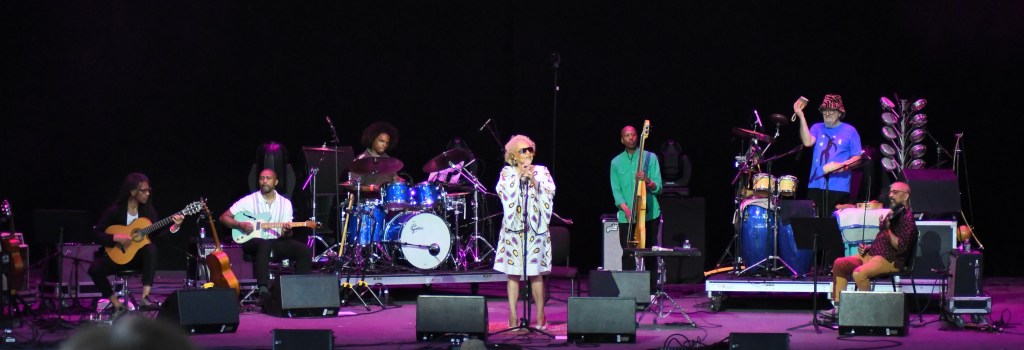
Cassandra Wilson, center, in white, at Saratoga Jazz Festival in June 2025
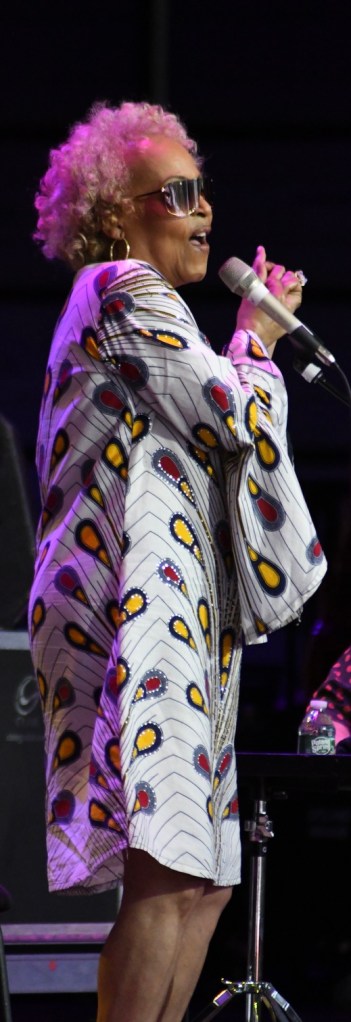
But now that Cassandra is gone too soon at 70, I feel her absence.
A pile of her CDs stands by this keyboard, but I’m not feeling any of that cheerful cant about “we can still hear them” – the artists we’ve lost but left us recordings.
Mostly, now, we miss, we mourn and their absence rings louder than any residual evidence why we loved them, how they awed us.
So it was, too, with Dolly Parton: a prototype of the larger-than-life, talent-and-ego-triumphant, self-invented American hero. That image was so noisy it drowned out her achievements in a pink cotton-candy fame-haze.
My own appreciation for Dolly, past the glitz that sort of blinded me, grew through the proxy of Diane Aliferis, a brilliantly creative woman who extolled Dolly’s talent as a song-crafter. Diane knew about this. She made songs of Robert Service poems and introduced me to a songwriter friend who penned the indelible tale of a Freihofer’s bread-van horse who died in its traces on a hot summer day, exuding a vast, city-wide stank. He called it “Follow Your Nose to Cohoes.”
Bottom line: any songwriter Diane recommends deserves my attention.
Before I ever saw Cassandra Wilson, I had met Dolly Parton – on the top evening for name-dropping of my entire musician-adjacent “career.”
It began in a Beverly Hills restaurant with my Rotterdam-born friend Nancy Lyons and her then-husband Albhy Galuten, the Grammy-winning record producer of the Bee Gees disco-era hits and much more.
We sat with musician friends; Chicago trombonist Jimmy Pankow and Eagles guitarist Don Felder and their wives; Karen and Susan respectively. There was wine, and Ted Knight came in, to happy hubbub of star-time uproar.
Afterwards, Albhy and I went to the Country Club music bar in Reseda to see Lone Justice, a country rock band Arista Records chief Clive Davis wanted Albhy to produce. Felder joined us later.
At the Country Club, the Eric Martin Band played first: OK LA pop rock. Then Los Lobos rocked the middle slot, mostly in Spanish. Years later, when Mona Golub brought them to Albany’s Washington Park, she took me backstage as they ate dinner on the deck behind the Park Playhouse. They remembered that gig and corrected my recollection of the location. Felder and Galuten were less impressed with Los Lobos than I was that night, but Lone Justice singer Maria McKee knocked Galuten out; everybody else, too.
Watching her that night, he whispered, “That’s a hell of a fucking singer!” Then 19, black boots up to there, McKee was half-sister of guitarist-singer Bryan MacLean of Arthur Lee’s under-rated LA band Love (“Forever Changes” – a classic!). Maria had the whole package: vocal sound, soulful delivery, projection and looks.
When Dolly Parton came into the dressing room, Maria burst into tears in sheer starstruck awe, mascara running down her cheeks. Dolly was wonderfully gracious to her, praising her talent and calming her gently.
I’d spotted Dolly at a front table with bassist Lee Sklar whom I’d met at Proctors playing with James Taylor in a Union College show. Taylor used to introduce the spectacularly-bearded long-haired Sklar as “Coming to us from deep in the forest: Leland Sklar!” Sklar remembered me and introduced me to Dolly by name. She was sweet as could be to me, smiling close and taking my hand.
Dolly was dressed down, relatively speaking, all in denim and a small wig, but her presence – like Cassandra Wilson’s – felt electric.
BUT I DIGRESS, a few times here
OK, so I also did that same Go See Her Without Research thing with singer Lizz Wright, also at The Egg.
And it worked again; Wright also proved wonderful on first hearing and many times since.
Wright is among many musicians who posted tributes to Cassandra Wilson. Her Facebook contribution simply showed a video of her own sad face, mourning in the most poignant, silent way. Other posts I admired include Elvis Costello with Diana Krall, Jason Moran and Jon Batiste; he said she sounds like the South.
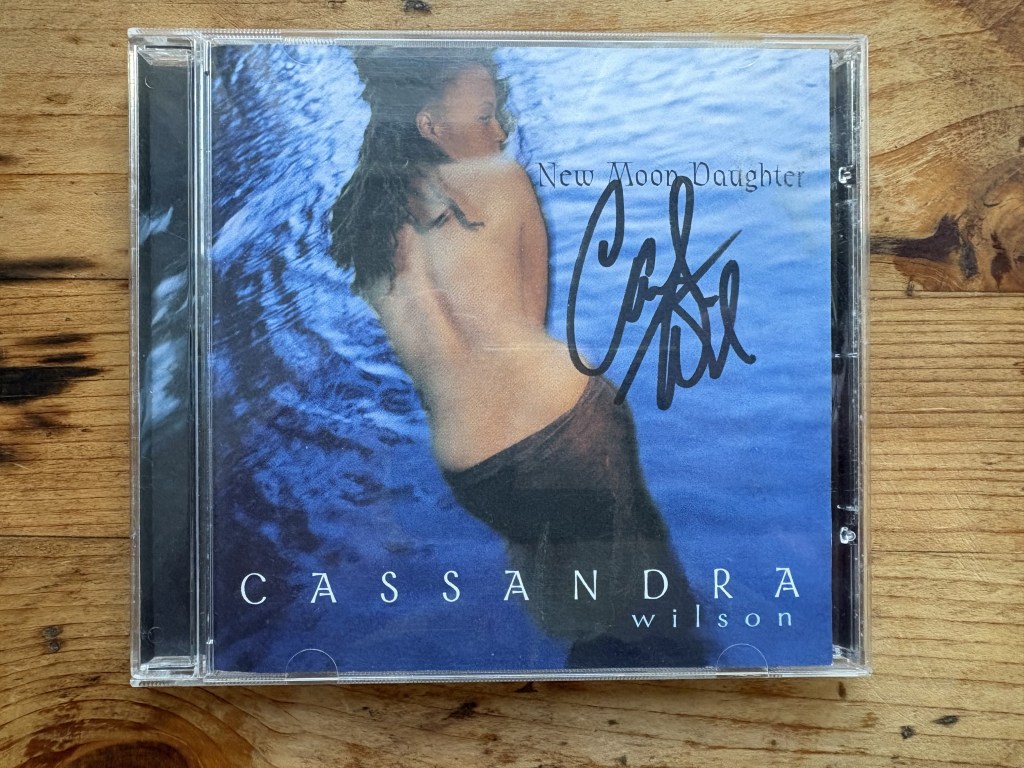
About “New Moon Daughter,” my favorite Cassandra Wilson album. The marvelous, magical thing starts with Lewis Allan’s lynching lament “Strange Fruit.” Billie Holiday sang it decades ago to tearful emotionally devastating effect; Cassandra Wilson owns it in the here and now. And what a nervy move to start from that hymn of heartbreak.
Who else could give the same artistic weight to both the doomed-love blues “Death Letter” of Son House and the Monkees’ pop-corn “Last Train to Clarksville”? Right after “Letter” comes Hoagy Carmichael’s serene “Skylark” that has never taken wing so gracefully as here. At a similar slow tempo, calm as breathing by a mirror-smooth lake, she sings Neil Young’s “Harvest Moon” as a lullaby. Among all these classics, Wilson’s own “Solomon Sang” more than holds its own. Here, Craig Street’s production and her band co-star to compelling effect, the guitars of Kevin Breit and Brandon Ross linking like hearts in tune.
If you don’t have this thing, you should.
It was Nancy who hatched the idea with me to wear gorilla suits to a spring 1975 Frank Zappa show at the Palace, co-starring Captain Beefheart! – playing mostly soprano sax – and the Fowler brothers.
When Nancy first donned the molded rubber gorilla head, it felt too claustrophobic. Nonetheless she paid the rental for our friend Ray Marshall, busted flat at that time, to wear one. So Ray and I rode to the Palace in Nancy’s vast red Ford station wagon. We went buck wild: You’d be surprised as I was that I burst out of the Nancy-mobile to run right over the hoods of cars stopped in traffic, and one entirely from front bumper to back over the roof.
Palace security (the cowboy-hatted gnome known as Grumpy) laughed and didn’t bother to frisk me: I held my ticket in one hairy paw. I never broke character as I sat down next to Don Wilcock, then my editor at Kite and still a friend, and deeply clueless that night that it was me in long brown fur.
At the end of the show, Ray emulated King Kong (Nancy and I had been inspired into this caper by Zappa’s song of that name) and picked up a woman in the aisle and carried her out of the Palace: It was my future wife, Ellie.
Years later, Don and I were kibitzing/reminiscing/bitching about unfortunate concert episodes. He recalled that as soon as he saw the guy in the gorilla suit at the Zappa Palace show, “sure as shit, I knew that asshole would sit right next to me, and – you know – he did!”
Thereupon I told him how offended I was that he hadn’t greeted me. Don sprang up and exclaimed, “That was YOU?”
Fast forward to a SPAC show where solo artist Maria McKee (living in Ireland, like Rhiannon Giddens) was opening for Neil Young, He was playing solo on that tour after leading his big band – the Blue Notes, 14 pieces – there the summer before.
Maria was singing great with just a second guitarist when Vinnie Birbiglia, voluble longtime chief of J.B.Scott’s music club in downtown Albany, dashed breathless up to my seat (section 2, row W, seat 138 – SPAC publicist Peter Hopper always put me there). Vinnie barked “C’mon!” in his outer-borough bray, urging “Neil wants to talk with somebody from the press!” I looked around, but didn’t see David Bauder, Seth Rogovoy or Steve Morse – more notable music scribes than I and guys I’d sometimes see at SPAC shows.
When I realized Vinnie actually meant me, I went to meet Neil Young.
Unprepared, trying to hide how flustered I felt, I first asked about his tour buses, maybe the coolest on the road. He was then using the old-school chariot with “Buffalo Springfield” on the front-window destination sign over its windshield, and the top half of a ’56 Plymouth welded into the roof with a sofa where you could watch the world from on high, as if from a railroad dome car. (He later updated, grafting the top of a Buick onto an Eagle bus he’d also retrofitted with a lift to swing his handicapped son in and out.)
I asked him about Maria and he said predictably nice, noncommittal things about her but said they had no plans to perform or record together.
Then I noted the profound change in his performing formats, from the previous summer’s giant, roaring Blue Notes big band, complete with horn section; to play alone onstage with guitars, piano and pipe organ.
He talked about the need to mix things up, change things up – “for me, you understand, for me,” he stressed.
Maybe they all make music for themselves; and maybe only the great ones fully invite us inside, to feel it with them.

