


Eighth Step Folk Community Tribute Repeats November Premiere
In a poignant reprise Sunday afternoon in Proctor’s cozy The Addy upstairs, Margie Rosenkranz’s Eighth Step crew reunited the nine folksingers and players of last November’s premiere tribute to the late, great folk scene hero Jackie Alper. Among the capacity crowd sat Alper family members, heightening the event’s strong emotion.
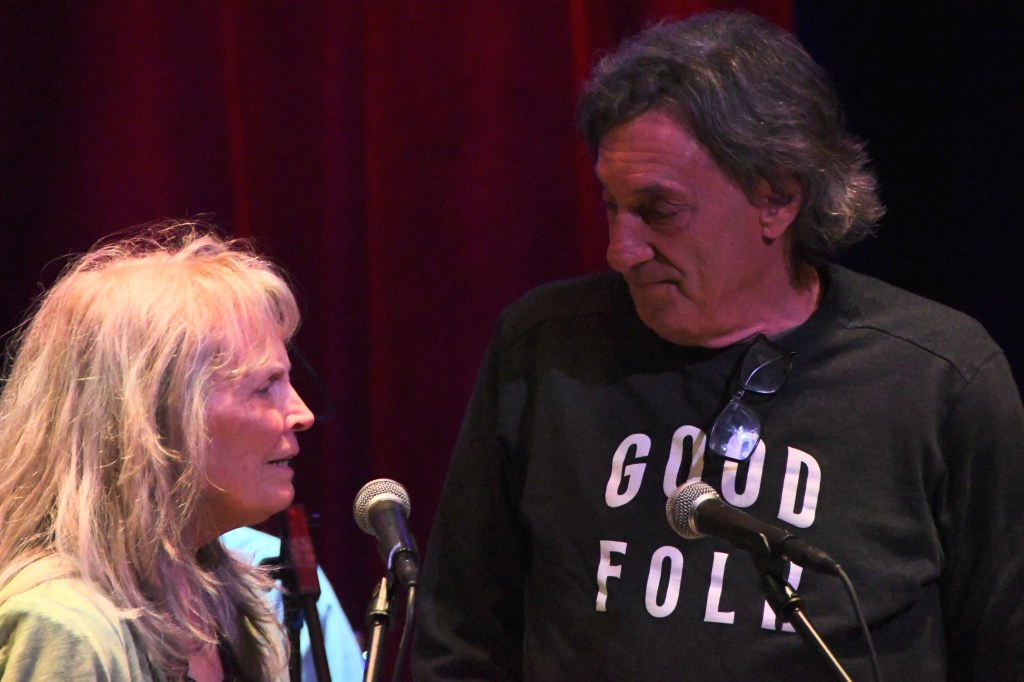
Eighth Step Director Margie Rosenkranz introduces Jackie Alper’s son George in Proctors The Addy
“Ms. Music: Jackie Alper – Her Story” alternated narration, often in her own words, with folk and blues songs; 12 in the first set, 16 in the second. Narration sketched an extraordinarily full life combining music with activism. Songs operated in parallel, lamenting societal ills, urging solidarity in protest and balancing outraged principle with optimism in action.
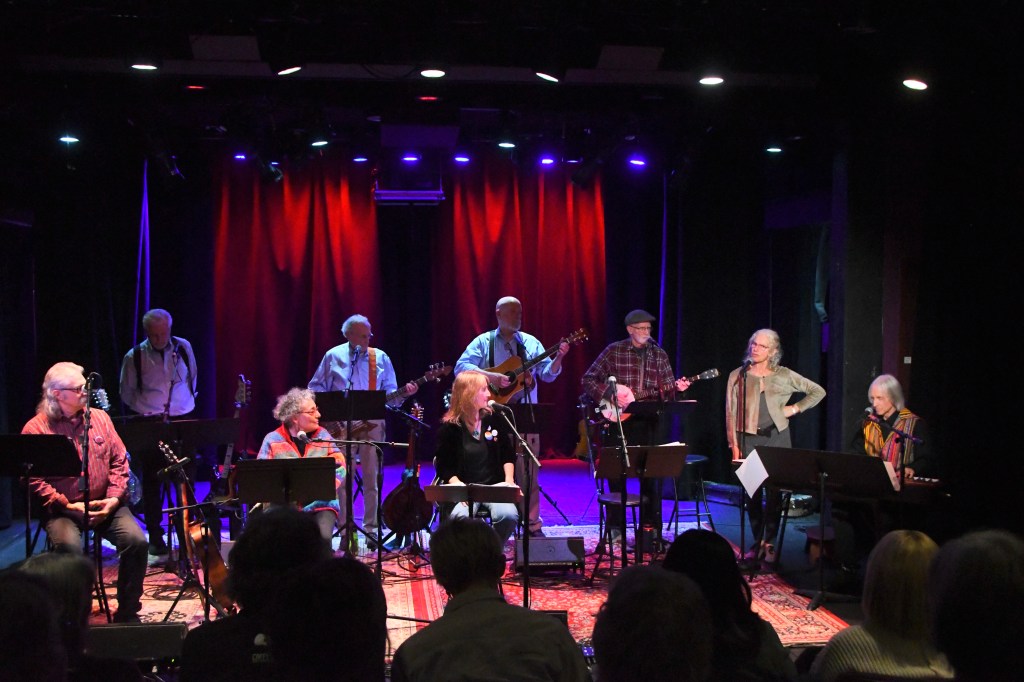
Singer Toby Stover, hand on hip, sings with pianist Alan Thomson Sunday in “Ms. Music Jackie Alper – Her Story”
Some spoken segments felt somber; others, seriously funny. When Alper was arrested at a protest as a teen, her mother took comfort that at least she’d know where young Jackie would be that night. Alper herself lamented the experience only because she learned to smoke in jail. A sort of musical and movement Zelig, Alper was seemingly everywhere: in labor union protest marches; at the Rosenbergs’ trial; the origin jams of the Almanac Singers, the Weavers and others; the Peekskill riots; hundreds of hootenannies, spinning records on WRPI.
If the same social inequity and aggressive militarism that galvanized Alper and her friends including Woody Guthrie and Pete Seeger still torment Americans decades after Alper’s time, the hope these heroes shared through lives in music still lives, too. It united performers and audience in agreement Sunday.
Union organizing songs hit first, hearty anthems that raised voices and fists onstage and off. This was both movement music and quite personal. A song Alper’s father Jacob Leiserowitz wrote in Yiddish highlighted immigrants’ hopes and challenges in the first set; an anti-racism blues Alper herself wrote with Nina Simone and a friend fit nicely among both protest songs and blues in the second.
Songs from Alper’s times took listeners far down memory lanes including both early radio classics “Frankie and Johnny” and “Brother, Can You Spare a Dime” and feisty flag-wavers “There Is Power in a Union,” “Which Side Are You On?” And “Waist Deep in the Big Muddy.”
Singalongs and shout-outs showed where Alper and both artists onstage and audience members stand. When narration noted Alper joined the Communist Party, a fan shouted in mock outrage, “Say it isn’t SO!”
Production co-writer Andy Spence had conducted the November premiere from a chair facing the performers, her back to the audience. But Sunday’s reprise proceeded without her as she recovers from recent surgery. Her absence may have contributed to some looseness in the performance as singers lost their places in the lyrics and spoken segments shrank some in omissions from the text. Overall, the women sang better than the men, including one gent whose blithe humorous covering for some scrambled words amused those onstage and off.
Guitars, banjo, bass, dobro, harmonica and piano blended in sparse Americana flavors while singers told tales either solo or in full choruses. Greg Giorgio and Ruth Pelham handled the narration, for which Pelham’s interviews with Jackie Alper in 2000 supplied many of the memories. Pelham milked boos from the audience at mentions of scummy Trump mentor Roy Cohn.
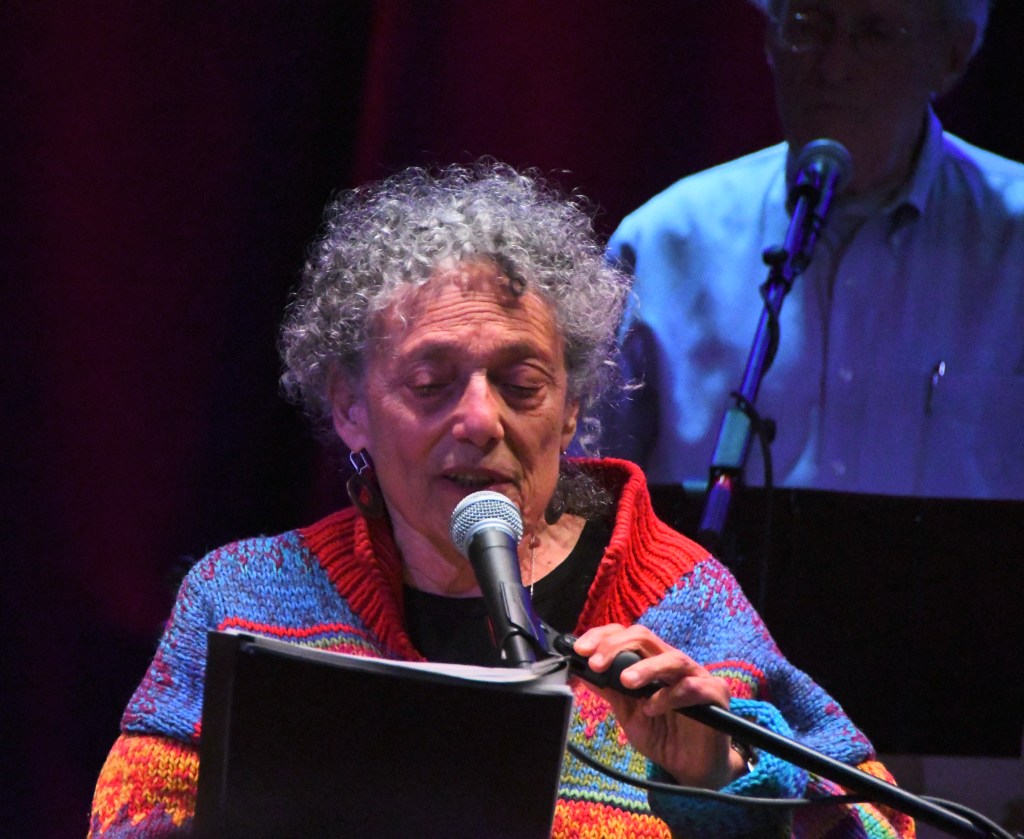
Ruth Pelham sang and spoke, and had compiled stories from Jackie Alper for the production
Before it began, the stage, far smaller than in the GE Theatre of the November premiere, seemed a too-dense forest of music- and mic-stands. But when populated by performers engaged with the words, the music, the audience and each other, it felt full but fine. In the front row, Alper’s son George, his wife Mary Ellen and their grown children Rowan, Charlie and Joe (named for Jackie’s husband and George’s father) quietly wept at times, laughed out loud in others – like all the rest of the crowd. George and family flew in from Arizona for Sunday’s performance; for local fans it felt like a pilgrimage.
Both November’s polished premiere and Sunday’s at times ragged repeat showed the strength of the production, a wondrous weave of words as both spoken and sung. While the premiere’s novelty and honed cohesion gave the one-shot feel of a unique performance, Sunday’s repeat reinforced how this entire heartfelt production belongs in the folk repertoire.
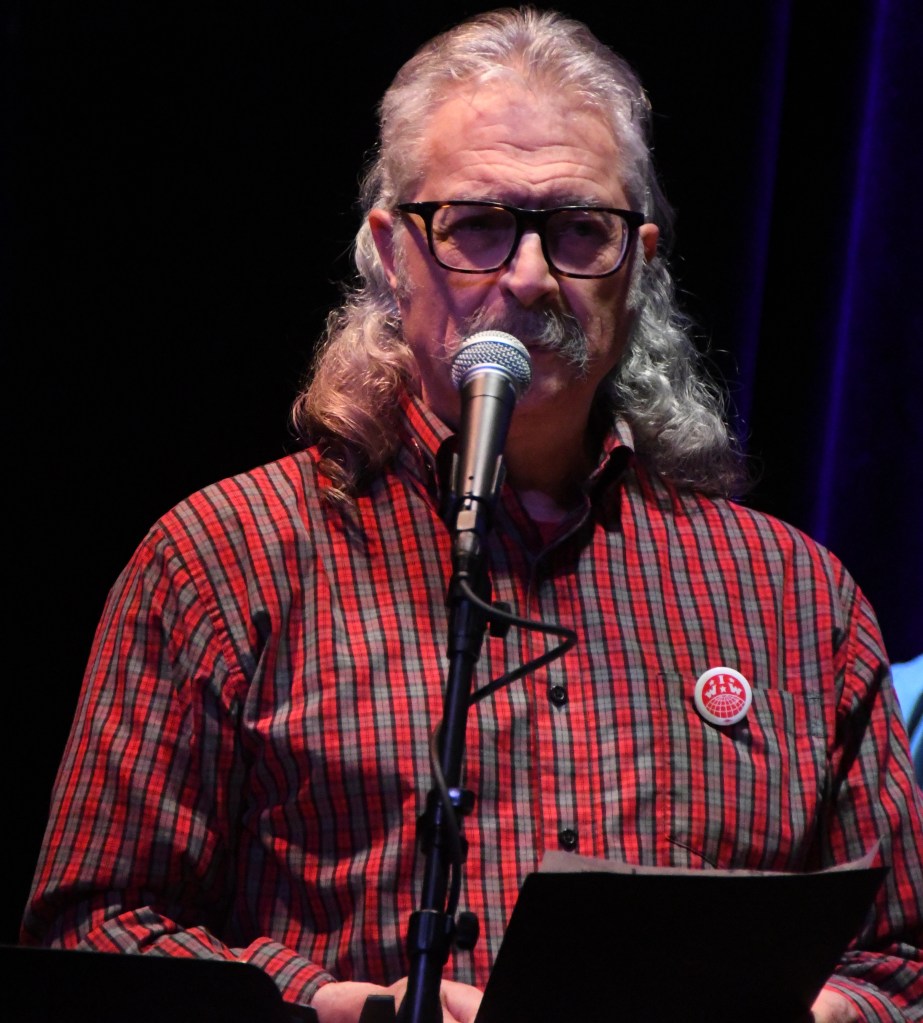
Narrator/singer Greg Giorgio, above; singer Kate Blain, below – both wearing buttons, a Jackie Alper trademark


Howard Jack sings, above; Charlie Rhynhart plays dobro and sings, below

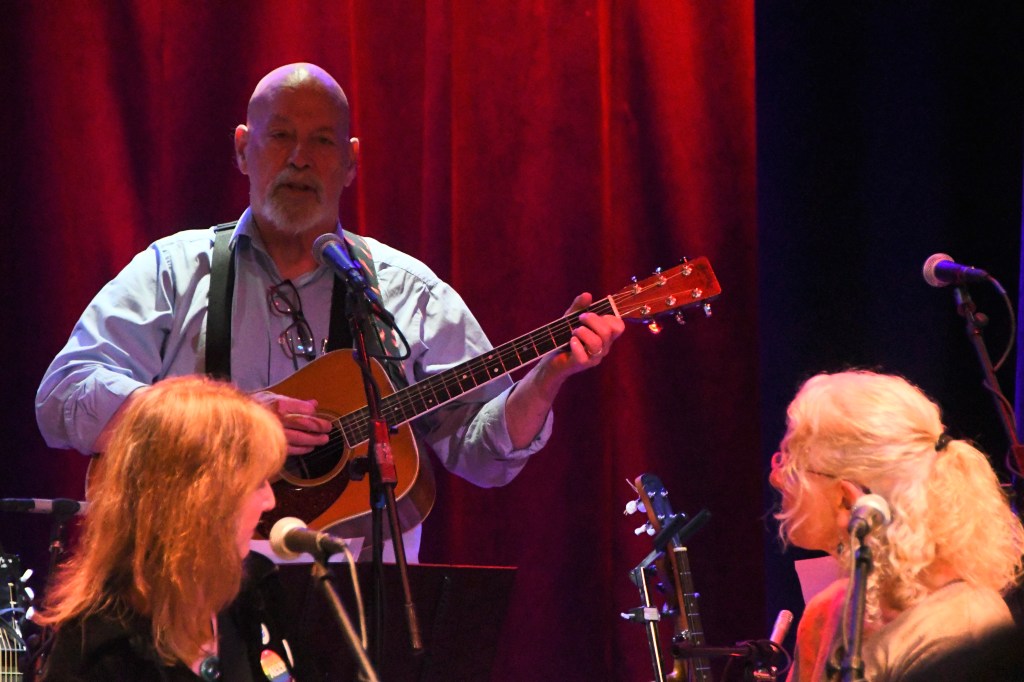
Michael Slik sings; with Kate Blain, left, and Toby Stover; above; George Wilson sings and plays 12-string, below, as Toby Stover harmonizes

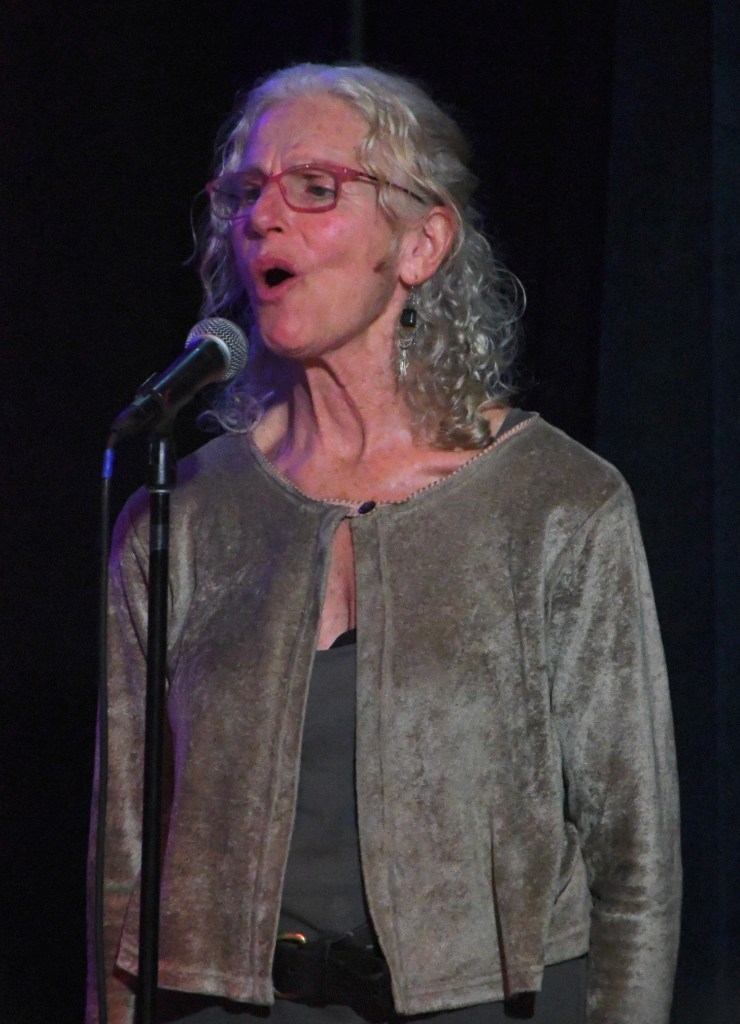
Toby Stover

