Review: Solo Guitarist Yasmin Williams at Caffe Lena, Wednesday, Feb. 12, 2025
Guitarist Yasmin Williams tossed off that humble, inclusive invitation casually at Caffe Lena Wednesday; then the innovative virtuoso played rare, wondrous sounds.
She traced her novel development from virtual to real guitarist in two sets of pristine playing; at once introspective and expansive, feelings expressed in beautiful sounds.
When she beat the online virtual Guitar Player 2 game at 12, her parents got her a real guitar. She found her victorious technique of tapping downward on the game controller across her knees also worked on a real instrument.
Dobro players hold their resonator guitars across their laps, as Williams does, but typically play with a slide; Williams used only her fingers Wednesday, but slid them at times to slur and glide notes.
She may have known how to play before deciding what to express. Then theory and composition training at NYU shaped technique into a questing, innovative vision: more Stanley Jordan (who played the Caffe recently), Michael Hedges and Adrian Legg, say, than John Fahey or Leo Kottke.
A screen above and behind Williams showed a narrow green river valley; later it held moving waters; and the natural world shaped the pastoral grace of her opener “Cliffwalk” from her new (third) album “Acadia.” At first, she held her Skytop acoustic in a conventional posture and picked cleanly, thumb pick hitting downward and fingers plucking upward. Lowering the guitar across her knees, she tapped the strings with both hands, right hand below the left that ranged over the neck, a kapo at the fourth or second frets. Meanwhile, she tapped the beat with metal tap shoes on a wide wooden board across her guitar case.
Those techniques served her well in “Juvenescence” with its jewel-like melody; in fact, at times, she had to explain emotional content counter to the sheer prettiness of steel-on-wood tones and graceful melodies.
“On A Friday Night” sounded stately and graceful, for example, as Williams lay the guitar flat across her lap – “lap-tapping,” she called this – and tapped the strings with a dulcimer hammer or smacked the body in a two-beat with her right hand as her left tapped the strings higher on the neck.
Afterward, she recalled how loneliness on arriving in the big city made her miserable. Later, she noted how becoming the first NYU freshman to win a campus talent contest brought friends and visibility, She followed “Friday” with “High Five” that celebrated those friends with spry, happy melodies.
“Through the Woods” again referenced the natural world, and introduced the kalimba, which she took up after watching an Earth Wind and Fire video. This busy, percussion-powered number featured hammer taps, left foot tapping the off-beat.
Playing kalimba – “You could call this a thumb piano…but you shouldn’t.”
Her first-set-closing mini-suite “Hummingbird” packed ironic content like “Friday.” She explained it portrayed time spent unhappily in Pittsburgh but started with a pretty finger-picked melody before hard-strummed explosions. Lowering the guitar from standard hold to across her knees, she launched an episodic deconstruction of the melody, a reprise charting the way back to it, then a speedy coda.
More irony in “Sisters,” a celebration of a mountainous Oregon stretch whose lack of turn-outs annoyed her while the view inspired the tune. Here she finger-picked circular riffs, then activated a recorded backing track, adding instruments like a sleek vehicle picking up hitchhiking harmonica, bass and strings. The melody mutated through insistent, minor key grumbles into a glorious chord-strum crescendo whose beautiful repeats formed the coda and brought a smile to Williams, awe in the near-capacity crowd.
“Virga” also relied on recorded backing tracks, the linked voices of Darlingside framing pretty guitar lines. The title refers to an ambiguous meteorological anomaly: rain falling through air so dry the drops evaporate before hitting the ground. The music felt mysterious, too; voices fading after her guitar went quiet.
For “Nectar,” she switched to a gleaming electric twin-neck she said she’d simply requested from Gibson and the company obliged. Masters Jimmy Page (Led Zeppelin) and John McLaughlin (Mahavishnu Orchestra, Shakti) play this combined six- and 12-string instrument one neck at a time; Williams played both at once, leads on the 12-string neck with her left hand, right hand tapping bass lines on the six-string neck.
“Song for Alex” featured her familiar single-neck six-string acoustic, finger-picking a tender melody that grew wings as she turned to spry lap-tapping and ringing harmonics to close.
She added kalimba again for “Skippin’ (Song for Bri)” – tapping with fingers and feet – then closed with “Restless Heart,” right hand tapping the body of the guitar, left hand tapping the strings.
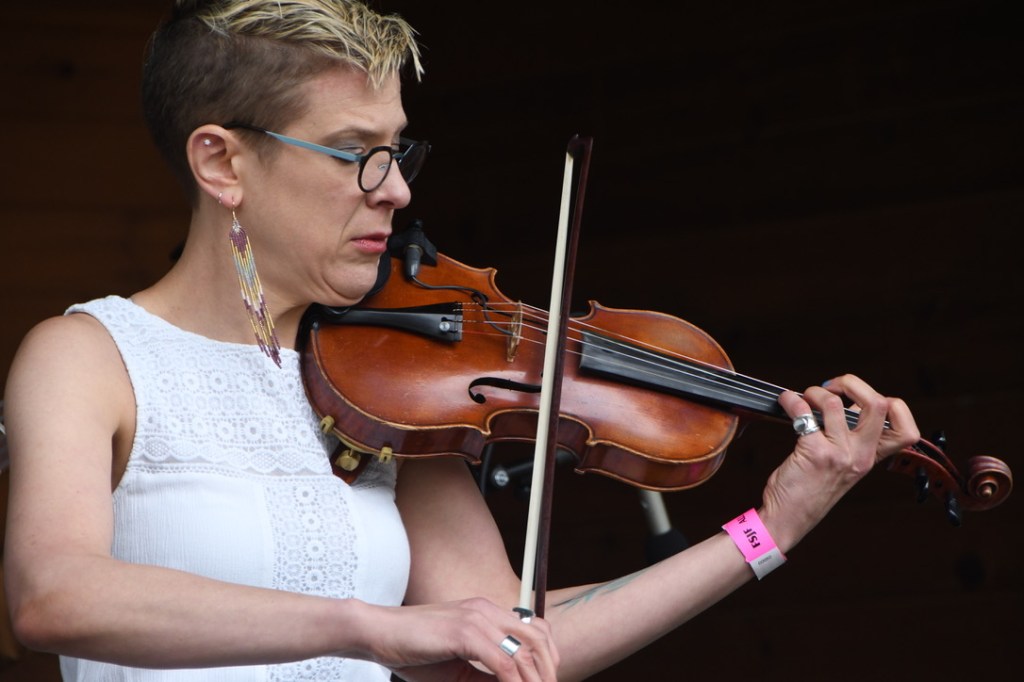
Although all instrumental, without vocals, the show wasn’t just for guitar nerds since Williams entertained with a humble affect and a wide warm smile like the great violinist Regina Carter, a virtuoso stylist half a generation older.
Showing Her Skytop Guitar – Twin sound-holes on the side
SET LIST
1 – 7:38-8:15 p.m.
Cliffwalk
Juvenescence
On a Friday Night
High Five
Through the Woods
Hummingbird
2 – 8:30–9:30 p.m.
Sisters
Virga
Nectar
Song for Alex
Skippin’ (Song for Bri)
Restless Heart
Playing kalimba right-handed, tapping on guitar strings with her left
Review – The Soggy Po’ Boys at Caffe Lena; Saturday, Feb. 8
Elbow to elbow on the cozy Caffe Lena stage, the Soggy Po’ Boys played just that tight Saturday in a wide-ranging soulful survey of New Orleans music.
The stage-full of young New Englanders, all bearded but trombonist Josh Gagnon, played more than the traditional sounds. They also got the soul, the spirit and the swing of street-parade chants, classic blues, rocking rumbas, even calypso, noting New Orleans is the northernmost Caribbean city.
The Soggy Po’ Boys, from left: Brian Waterhouse, drums; Mike Effenberger, piano (both with back to the camera); Scott Kiefner, bass; Nick Mainella, tenor saxophone; Eric Klaxon, clarinet, alto and soprano saxophones; Josh Gagnon, trombone; Stu Dias, vocals and guitar
They also scored extra points by playing the Earl King/Professor Longhair funk romp “Big Chief”* – but NOT the too-obvious/almost obligatory “When the Saints Go Marching In.”
As it happened, WAMC played an “American Roots” episode on my drive up, spotlighting New Orleans clarinetists including Evan Christopher (he’s also played Caffe Lena, plus SPAC’s Jazz Festival and the Cock ’N’ Bull), Sidney Bechet, Michael White, Doreen Ketchens and others. This tuned up my ears for fine work Saturday by Eric Klaxon, who also played alto and soprano saxophones, jammed between Gagnon and tenor saxophonist Nick Mainella.
In a return visit after their well-received 2023 Caffe Lena at SPAC set, they boldly opened with an original, the ominous “Waiting On the Bomb to Drop.” Like most tunes Saturday, they riffed a massed-horns intro to set up a dynamic Stu Dias vocal; then horn solos, a wrap-up vocal and killer all-aboard coda.
When I visited a close-up seat briefly, I needed two shots to include everybody. Top, from left: Brian Waterhouse, Nick Mainella, Eric Klaxon and Scott Kiefner. Bottom, from left: Eric Klaxon, Scott Kiefner, Josh Gagnon and Stu Dias. (Mike Effenberger is behind Kiefner.)
“By and By,” a standard New Orleans shuffle, followed “Bomb,” then they went tropical with “Gin and Coconut Water,” all the horns getting a piece of this happy calypso. Next, Klaxon owned “Joshua Fought the Battle of Jericho,” earning claps and whoops for his agile alto solo.
Jumping from gospel antique to the vintage-sounding “Weary Blues” felt natural; in fact, song sequences worked well all the way through. For something spunky to set up “Big Chief,” the upbeat “Weary Blues” was just right. The coda on “Chief” had loose, unanimous horn anarchy. Then Professor Longhair’s playful “Tootie Ma Is a Big Fine Thing”** mixed sentiment and sensuality perfectly.
While pianist Mike Effenberger and bassist Scott Kiefner were hard to see behind the horns, they floated to the top sonically in the bluesy groove “A Dirty Job,” Effenberger playing a muscular intro and Kiefner making the most of his first solo all night.
After “Serpent Miagre,” a Caribbean polka with a strong Gagnon trombone break, Dias sang at his mournful best in “It’s Raining,” an Allen Toussaint tune Irma Thomas still sings to stunning effect. Effenberger’s piano shone here, too, in a trio interlude with Kiefner and ever-steady drummer Brian Waterhouse.
The Mighty Sparrow’s calypso classic “Dorothy” launched the second set; wry, twisted-love tunes dominating the late run. In the kiss-off “Baby Would I Lie to You?” Mainella’s tenor set up Dias’s vocal beautifully.
Below: Nick Mainella
Josh Gagnon
Eric Klaxon
They played the calypso “Miss Tourist” as a fan’s request, then it was back to the blues with Bessie Smith’s cautionary “Moan, You Moaners,” Gagnon’s trombone bringing gospel fervor.
Two all-in rumbas – “Touloulou” and “Carmona AD” – bookended “Battle Hymn of the Republic,” a surprising choice in a straight, non-ironic read. Sidney Bechet’s “Shag” showcased Klaxon’s persuasive soprano sax, then a stop-and-go coda brought all the horns into dramatic dialog.
Stu Dias
They shrewdly chose the defiant shouter “It Ain’t My Fault” as sole singalong all night, then cruised “down In New Orleans” – key lyric of “Bourbon Street Parade” – as quick-hit encore.
Unique among concert merch tables, they offered chocolate made by friends back in New Hampshire; each bar earned the buyer an album download.
My preview noted 37 minutes drive time from home to Caffe Lena; snow slowed things, homeward bound, to more than twice that. And worth it.
* Dr. John played guitar on the original 7” single (Watch Records 1965) along with 15 other New Orleans studio stars. Covers include Dr. John’s 1972 version and others by the Neville Brothers, Jon Cleary, the subdudes, the Wild Magnolias, the Meters and the Dirty Dozen Brass Band.
** The Preservation Hall Jazz Band (at The Egg March 8) plays a terrific version on “This Is It,” produced by My Morning Jacket’s Jim James, a big fan.
This came by email from the Soggy Po’ Boys’ office
Set 1 Waitin on the Bomb to Drop By and By Gin and Coconut Water Joshua Fit the Battle of Jericho Weary Blues Big Chief Tootie Ma A Dirty Job Serpent Miagre It’s Raining
Set 2
Dorothy Rascal The chief Would I Lie to You? Miss tourist Moan You Moaners Touloulou Battle Hymn of the Republic (I believe we added a tune here.. Carmona AD, I think) Shag It Ain’t My Fault
Review: Nathan and the Zydeco Cha-Chas at Universal Preservation Hall; Friday, Feb. 7, 2025
Three conga lines blurred into one as fans formed an unbroken loop through Universal Preservation Hall Friday night in the joyful geometry of zydeco on the loose.
In the kinetic near-capacity tweens to boomers crowd: unanimous smiles, waving arms, clapping hands and shuffling feet. Onstage: the five virtuosos of Nathan and the Zydeco Cha-Chas, throwing it down.
Obstacles stacked up against such unanimous fun.
Bandleader Nathan Williams’s brother Sid (El Sid-O, in song titles and the sign on his Lafayette club) passed last week; and of course there was the forbidding chilly weather. So accordion ace, gruff-voiced singer and spark plug bandleader Nathan needed a party as much as anybody. The weather never had a chance as big warm filled the place, though some dancers never took off their coats.
The band set fire to zippy two-steps, waltzes fast or slow, and a chill-out cha-cha or two – one called “Zydeco Cha Cha,” of course. Nathan sang in English or French and traced his musical roots back to where “crawfish got soul and alligators get the blues.” After most tunes, he playfully asked, “Was that all right to you?” – and reaped the affirmation it deserved.
“Zydeco Boogaloo” hit early (and repeated later), but a tune based closely on “Bring It On Home to Me” showed the band’s flexible strength. When Nathan’s brother Dennis Paul Williams broke a guitar string, Nathan revved his accordion riffs to fill in the blanks while (Nathan’s nephew) Jason George welded his rub-board scratches even closer to Keith Sonnier’s snare-drum hits and Nathan’s cousin Alan Williams’s bass lines hit harder, too.
Dennis Paul Williams, and fat Gibson
Gaston George, left; and Nathan Williams
They mostly played at full strength, but some sparser, more subdued interludes showed they could have played the whole show as duets, especially Dennis Paul Williams’s relentless Snooks Eaglin-style rhythm-guitar chords. He didn’t have to solo much to deliver soulful strength. George scratched the steel furrows of his shoulder-mounted rub-board with spoon handles bent away from the bowls. Sonnier’s snare-and-kickdrum beats stayed simple since so much was happening above, notably Alan Williams’s hyperactive repeating bass runs that pumped and pushed with centrifugal force.
Keith Sonnier
Alan Williams, and seven-string bass
The songs didn’t have to say much, so Nathan’s vocals felt like another instrument; they changed up the tempos and beats more than the formidably dense arrangements. The shuffle “Follow Me Chicken” jumped into a subterranean groove whose title I didn’t catch, then the two-step “Your Mama Don’t Know” eased into the waltz “Too Much Wine.”
Nathan paid tribute to his mentor Buckwheat Zydeco in another waltz, Buckwheat’s “Take Me To the Mountaintop,” a soulful, seductive bluesy guitar solo stirring things up and going call and response with Nathan’s voice.
The energy of “I’m Looking Forward to It” organized the dancers into conga lines; then, impressively, they built the energy back up that had been dissipated some by a problematic shift from piano accordion to diatonic “button” accordion.
No problem: “Sid-O’s Zydeco Boogaloo” – or was it the other “Zydeco Boogaloo”? – re-energized band and fans as Nathan went wireless and wandered the house, playing, grinning, sitting down among his fans, dropping to one knee to acknowledge dancers by the stage.
Everybody, everybody, was in the show.
Set List – fuhgeddaboudit!
Nathan made up the show song by song, sometimes announcing tunes to band and fans, sometimes not. It was 92 minutes of fine, fierce, focused force.
New Orleans is 21 hours drive time from my house, five hours by air via Albany Airport.
Music erases travel: Nathan and the Zydeco Cha Chas play Friday at Universal Preservation Hall 39 minutes from my house, and the Soggy Po’ Boys play Saturday at Caffe Lena, 37 minutes away.
The Zydeco Cha Chas are mostly family; and Williams named the band after a tune by 1960s zydeco pioneer Clifton Chenier, an early inspiration. Williams first recorded for his brother Sid’s label at 21 and played weekly at El Sido’s Zydeco & Blues Club in their hometown of Lafayette, ground zero of zydeco and Cajun music. Williams bought his first accordion from mentor Buckwheat Zydeco, who also recommended his young protege to Rounder Records.
Nathan Williams Squeezes Big Fun from his Accordion, with the Zydeco Cha Chas. Photo Provided.
Since Williams and his Zydeco Cha Chas first played the New Orleans Jazz and Heritage Festival in 1988, they became regulars at New Orleans’ Rock ’N’ Bowl in 1988, recorded their live album “I’m A Zydeco Hog” there in 1997 and helped celebrate the venue’s 30th anniversary in 2018. They’ve also played Lincoln Center, the Kennedy Center, the Grand Ole Opry, top European venues and Jazz Fest after Jazz Fest.
On record, they earned a 2023 Grammy nomination for “Lucky Man” after collaborating with Cajun superstar Michael Doucet on “Creole Crossroads” (1995).
Zydeco – zippy, blues-deep but happy dance music – works best onstage. Its two-steps and waltzes aim beats at the feet, vocals and solos for the roof. The Zydeco Cha Chas feature accordionist-singer Nathan’s guitarist-brother Dennis Paul and bassist-cousin Alan Williams, plus rub-board player Jaston George and drummer Keith Sonnier. Pedigree is no guarantee of quality; but this band’s proof is in their swing.
Show time for Nathan and the Zydeco Cha Chas Friday, Feb. 7 at Universal Preservation Hall (25 Washington St., Saratoga Springs – 39 minutes from my place) is 7:30 p.m. 518-346-6204 www.proctors.org. Like Michael Doucet back in the fall, this is a Proctors Passport Series presentation
Geography is no barrier to love and mastery of music from elsewhere.
The Soggy Po’ Boys formed in Dover, New Hampshire for a Mardi Gras party in 2012. You can get a po’ boy* at NaNola and other places, and a muffuletta at Perreca’s – and good music travels just as well.
The Soggy Po’ Boys. Photo Provided.
Zydeco pumps down-home flavors, Creole country music; the Soggy Po’ Boys play more urban traditional jazz and street parade chants.
A brass-band, Soggy Po’ Boys echo Second Line struts, vintage jazz and late-night funk ala the Meters. New Orleans is the northernmost Caribbean city, and these guys play a distinctive island bounce.
The Soggy Po’ Boys pack more brass-band boogie than Nathan and the smaller Zydeco Cha Chas, with reeds (Eric Klaxon), trombone (Josh Gagnon) and tenor sax (Nick Mainella) plus Stu Dias, vocals and guitar; Mike Effenberger; piano; Brian Waterhouse, drums; and Scott Kiefner, bass. Their seventh album “Leave the Light On” hit in October.
Show time for Soggy Po’ Boys Saturday, Feb. 8 at Caffe Lena (47 Phila St., Saratoga Springs – 37 minutes from my place) is 8 p.m., doors at 7:30. Tickets $27.12, members $23.86, students and children $13.56. 518-583-0022. http://www.caffelena.org. It’s part of the Peak Jazz Series, supported by Joseph & Luann Conlon in memory of Corrine Simonds.
They return hereabouts on March 2, playing the cozy Parlor Room in Northampton.
CUISINE AND HAPPINESS NOTES
* A po’ boy is an iconic New Orleans sandwich on crusty French bread with shrimp or meat and cheese; topped with mayo, lettuce, pickles and tomato, it’s “full dressed.”
Sympathetic food purveyors reputedly developed it to support an early 20th century labor action, to feed “those po’ boys out on strike.”
Once at Jazz Fest in New Orleans, I ordered a sausage and shrimp po’ boy at a food stand I hit at every Jazz Fest I can get to. “I see the sausage, but where’s the shrimp?” I asked, confused. “Yeah, that’s IN the sausage.” And OMG.
Another warm spring Jazz Fest day, I was walking from one stage to another. There are 12, but I don’t remember now and didn’t care then who I was going to see next; it was enough that I was among unanimously happy multitudes. A cold Pilsener Urquell in one hand and a Cajun duck po’boy in the other, I realized this is one of the happiest moments of my life.
That’s why I’m going back this spring, my first return since Covid, and to Louisiana in Saratoga Springs Friday and Saturday, Feb. 7 and 8.
Dancing at the Fais-do-do Stage. Michael Hochanadel Photo
REVIEW: David Greenberger and the Huckleberries Perform “Universal Preservation” Sunday, Jan. 19, 2025 at Universal Preservation Hall
Spoken word artist and archivist of the old (among many creative activities) David Greenberger and his Huckleberries preserved and celebrated universal human truths Sunday at Universal Preservation Hall in a compelling talk-with-music presentation of the same name.
David Greenberger, center, and the Huckleberries, from left: Chris Carey, Sam Zucchini, Greenberger, James Gascoyne, and Peter Davis. Photos mine
Proctors impresario Philip Morris commissioned the project, recorded in 2019 before Covid stopped everything, including a planned performance celebrating the reopening of the Universal Preservation Hall, a Saratoga church repurposed as venue. Revived half a decade later and re-sharpened in recent rehearsals for the stage, “Universal Preservation” combined elements that each could have stood alone. The words Greenberger collected in conversations with area oldsters – a work of preservation and appreciation he began in 1979 as “The Duplex Planet” – fit well with new music by a capable quartet.
Combined on Sunday, it felt unified and organic. Sometimes Greenberger words fell right on the beat from the quartet behind him, and short solos fit his pauses at the mic. But it all mainly worked as a matching of moods, and those evolved in the 75-minute performance.
First came pure fun; a mellow soft-jazz groove as Greenberger recited words of Frank Nelson recalling his father’s alacrity at handicapping horses. “Dad and the Horses” opened both the two-CD recording and Sunday’s show; the light-hearted piece took on a poignant weight as Greenberger noted afterwards that Nelson had died since their conversation in a Saratoga care home. So had several others since Greenberger collected their words and he recorded them with the Huckleberries before Covid.
Many of the mostly short words-and-music constructions carried this message, that we all age, if we’re lucky, that good times are to be cherished and that fate serves them up to us unpredictably.
An immigrant story followed “Dad and the Horses,” at a slower tempo for a more serious feel. Then a gentle bossa beat underlined a recitation of a long career in caring from a retired nurse who lamented how workaholism limited his cultural opportunities. Then, back to fun in “A Great Story About a Bike,” an ironic tale Greenberber warned would be louder and was, a lively sax-flavored rocker with a stop-and-go cadence and a cozy coda that stopped in mid air.
Here we have to give the whole band some.
As noted, they could have played the whole show without words and still richly entertained the rapt audience. Drummer Sam Zucchini played the pulse, closely grafting his beats to bass (electric) from musical director Chris Carey, who also played keyboard and mandolin, or James Gascoyne (acoustic), who also played guitar and gourd banjo. Stage left stood Peter Davis who played keyboard, banjo, alto sax, low-whistle and alto dobro.
Sam Zucchini
As versatile as they were skilled, they echoed Frank Zappa’s jagged bass-heavy rock-jazz in “A Great Story About a Bike,” Paul McCartney-like piano punch in “The Future Is Great,” a blues stroll in “Lobster Bagpipes,” reflectively quiet banjo under “Fishing Poles,” while “Albany Girl” cruised on a bluegrass acoustic feel. Two rollicking keyboards ganged up on “Zucchini, Heat, Pipes and Bass” and maybe most direct influence by a single example, “Outdoor Person” packed the dignified simplicity of The Band.
Chris Carey, playing a Fender bass as well-loved and -used as Pete Donnelly’s (The Figgs)
If jazz was the dominant flavor, with rock and folk as spices, it also felt sophisticated as an episodic concerto or oratorio; Deep Truths over Discreet Charm, maybe.
David Greenberger, left, and James Gascoyne
Peter Davis
Between songs, Greenberger shared information, straight and off-kilter. Naming the sources of his monologs in conversations with Saratoga oldsters, some now deceased, he also lightened up with fanciful facets of a restless creative mind. He said he’d named the band behind him partly after a line in “Moon River” but mostly after Huckleberry Hound, noting he’d joined the cartoon character’s fan club as a kid. He rummaged among band names he’s obsessively devised for decades, collecting in notebooks such gems as “Being Yelled At” and “Little Pieces of Paper.” And he applied alphabetical numerology to band members names in intros as clever as those of Darlingside, another conspicuously clever crew that’s played Universal Preservation Hall.
The show had arc, development; mixing the humorous with the profound early on, though the line between them blurred often. Aging itself increasingly became the theme, mostly in satisfied musings over well-lived lives but also mourning loss at times: the lamented ends of long marriages, cherished homes or fulfilling work.
Ultimately, though, Greenberger managed to sequence and build his monologs to serene and sweet effect, with well-matched music framing, underlining and spicing his words.
David Greenberger’s blue suede shoes – an affectionate echo of Nippertown founder Greg Haymes’ love for publishing performers’ footwear
Earlier comments here on Saratoga Jazz Festival artists announcement felt incomplete without giving the full schedule. So here’s the full line-up for the 22 acts on two stages over two late June days/evenings.
First let’s parse how the list below – copied and pasted from the news release – translates into a schedule and, later, becomes a plan.
In short, the listings for the two stages are in reverse chronological order.
Saturday, saxophonist Kenny Garrett plays first on the Amphitheater (Main) stage where pianist Michel Camilo and his Trio follow; then blues guitar flamethrower Gary Clark Jr. closes Saturday’s music.
Meanwhile, the String Queens open on the Charles R. Wood “Discovery” Stage (formerly the Gazebo, and which I call the Wood, for brevity), followed by C.J. Chenier & The Red Hot Louisiana Band. All woman modern jazz crew Artemis closes there.
In one of the improvements that have made the festival increasingly fan-friendly over its nearly 50 years, the sets on the two stages are now staggered some. So fleet-of-foot fans can catch more music on the two stages and have less difficulty choosing which stage to hit when.
Moreover, only in the past few years have start times been announced beforehand; that will happen in the coming weeks. For years, those crucial planning essentials were closely held until just before show time.
Music wraps up on the Wood while the sun is still up, a convenient dinner break, while it continues on the Main.
Facility improvements also make the festival more welcoming including a tent over (much of) the audience area at the Wood; refurbished, relocated and expanded restrooms and food service areas – the latter a great place to meet strangers, always worthwhile.
Fans who prefer the lawn can still bring in their own seats, blankets and tents, unlike the shows Live Nation Entertainment presents, but must remove them after Saturday’s music. This facilitates cleaning of the grounds and ensures everyone gets a fair shot at prime or favorite positions on Sunday.
And, since I noted Laufey in my previous comments and included a photo of her rapt fans, here’s an onstage photo of the young Icelandic pop singer who swelled the crowds last year by expanding the festival’s young audience.
Laufey sings at the 2014 Saratoga Jazz Festival, the last sponsored by Freihofer’s. Water glass and teddy bear are at her feet.
SATURDAY, JUNE 28
Amphitheater:
Gary Clark Jr.
Gregory Porter
Lettuce
Veronica Swift
Michel Camilo Trio
Kenny Garrett
Charles R. Wood “Discovery” Stage:
Artemis
Nicole Zuraitis
Keyon Harrold
Julius Rodriguez
C.J. Chenier & The Red Hot Louisiana Band
The String Queens
SUNDAY, JUNE 29
Amphitheater:
Trombone Shorty & Orleans Avenue
Cory Wong
Cassandra Wilson
Al Di Meola Acoustic Band
DJ Logic & Friends featuring Vernon Reid, Cyro Baptista, Emilio Modeste, James Hurt, Felix Pastorius & Terreon Gully
Charles R. Wood “Discovery” Stage:
Gary Bartz
Bria Skonberg Quintet
Brandee Younger Trio
La Excelencia
Skidmore Jazz Institute Faculty All-Stars Celebrate their Heroes
featuring Clay Jenkins, Jimmy Greene, Steve Davis, Dave Stryker, Bill Cunliffe, Todd Coolman & Dennis Mackrel
A word about these guys and the special flavor of their shows.
In recent years, local acts have joined the national and international attractions playing the Festival, notably the late, great pianist Lee Shaw, the Hot Club of Saratoga, and Garland Nelson’s gospel-soul ensemble. This year, the Skidmore Jazz Institute Faculty All-Stars represent as the only home-grown artists on the schedule. All are skilled individual players, and their ensemble plays wonderfully well together.
Each summer, they select a jazz giant or two as the focus of virtuoso tributes, including both original arrangements and fresh reworking of vintage classics by these players themselves. Bassist leader Todd Coolman delivers the wittiest, most entertaining introductions we’re likely to hear, all festival. When the uniformly T-shirted Institute students take their customary places at the front of the Wood audience. You can feel their excitement, their happy energy, as their teachers offer glittering examples, inspirations, onstage.
As noted previously, tickets go on sale to SPAC members Feb. 21 and to everyone Feb. 24 at space.org.
Saratoga Jazz Festival Brings Strong Mix of Familiar and New Faces
Thursday’s announcement of 22 artists performing at the Saratoga Jazz Festival lists well-known stars on both Amphitheater (Main) and Discovery stages and introduces new artists; 10 in festival debuts. None will likely wield the young-audience box office clout of Laufey, who drew hordes who seemed new to the festival last year, but fresh faces and sounds abound.
Laufey fans at Saratoga Jazz Festival 2024
Sponsorship has shifted from Freihofer’s to GE Vernova, yet the formidable strengths of this festival, nearing half a century on the same stage(s), remain undiminished.
Welcoming GE Vernova, Saratoga Performing Arts Center President and CEO Elizabeth Sobol said, “we continue to find new ways to evolve and expand our vibrant weekend event” in the festival announcement news release. In the same announcement, longtime festival producer and President of Absolutely Live Entertainment Danny Melnick echoed this sentiment, hailing the “magical kaleidoscope of artists who are going to elevate this festival to new heights.”
Let’s start at the top: the closing sets each night that have traditionally honored the biggest names on the marquee. Both blues-rock guitarist Gary Clark Jr. (Saturday) and Trombone Shorty and Orleans Avenue (Sunday) have earned these top spots, though purists may argue that neither is jazz.
Texan fret-board force of nature Clark is among festival newcomers, a powerful guitarist anointed by Grammys, prime spots in reigning guitar god Eric Clapton’s Crossroads Festival and a melt-the-screen-intense Austin City Limits appearance.
Guitarists also star on Sunday, all on the main stage and all boasting sparkly track records. Cory Wong was a smash in 2023 with thrilling electric funk while Al DiMeola (Return to Forever, all-star guitar ensembles and his own bands) delivered a dynamic acoustic solo set last time around and returns with a full acoustic band; and Vernon Reid (Living Color) plays in DJ Logic’s all-star crew to open the main-stage action. But we digress.
Trombone Shorty closes the festival Sunday on the main stage with his explosive Orleans Avenue ensemble that lit up The Egg in Albany, a 2023 highlight. He now also owns the festival-closing spot in the eight-day 12-stage Jazz and Heritage Festival in his hometown.
Louisiana is also in the house Saturday when accordionist C.J. Chenier (heir to zydeco eminence dad Clifton Chenier) leads his aptly named Red Hot Louisiana Band.
Singers grab the Main stage mic both days: Gregory Porter of burly baritone and trademark hat and newcomer Veronica Swift on Saturday, longtime star Cassandra Wilson on Sunday with her deliciously deep voice, fearless song choices and magnetic presence.
Bria Skonberg at A Place for Jazz this fall
Let’s also note Bria Skonberg (Sunday on the Discovery Stage) among the singers, though she also plays versatile trumpet. And, hats off to area venues and programs who present these arena-level stars on our area stages: both Skonberg and the all-woman Artemis (Discovery Stage on Saturday) at A Place for Jazz this fall, C.J. Chenier coming up at Feb. 7 at Universal Preservation Hall in Proctors Passport series booked by Music Haven, and Veronica Swift at SPAC’s nearby Spa Little Theater May 1.
Artemis at A Place for Jazz; leader Renee Rosnes at the piano
Like country audiences, jazz fans hold dear for decades the venerable stars who first brought them into the fold. Saxophonists hold the longest tenure among 2025’s artists. Gary Bartz, 84, began recording in 1967 and plays Sunday on the Discovery Stage. His resume includes stints with Miles Davis, McCoy Tyner and dozens of others, as leader and sideman. Kenny Garrett, 64, plays Saturday on the Main Stage. Like Bartz, Garrett, 64, played with both Art Blakey’s Jazz Messengers and Miles Davis and made dozens of albums as a leader and sideman including the Grammy-winning “Five Peace Band” with Chick Corea, John McLaughlin, Christian McBride and Brian Blade or Vinnie Colauta.
While longtime fans might gravitate to familiar names, lesser-known artists will likely surprise and delight, as usual. In that sense, both stages are venues for discoveries, the large, indoor Amphitheater or Main Stage and the Charles R. Wood “Discovery” Stage. Formerly the open-air Gazebo stage, it’s now comfortably roofed from sun and rain.
Favorites, Revisited
Like most fans, I expect to join fans flocking to artists I’ve enjoyed here and elsewhere including Cassandra Wilson’s deep and magical way with a song, the fiery funk fun of Cory Wong, C.J. Chenier’s zydeco zip, the versatile Artemis, Gregory Porter’s warm-as-sunshine baritone, Trombone Shorty’s joyous New Orleans gumbo, the elegance of Bria Skonberg as both singer and player, the wit and respect for jazz pioneers of the Skidmore Jazz Institute Faculty All-Stars.
New Faves?
But I’m looking forward maybe even more to being surprised by artists I’ve never seen live including the venerable saxophonists Gary Bartz and (half a generation younger) Kenny Garrett, the intriguing hip-hop hybrid of DJ Logic and Friends, the group improv fireworks of Lettuce, and completely new-to-me Gary Clark Jr., Keyon Harrold, Nicole Zuraitis, the Brandee Younger Trio, La Excelencia, the String Queens, Julius Rodriguez and others. I’ll go there with sunblock AND rain gear, and happily open ears.
The festival offers food, drinks and crafts and allows tents in rear areas and blankets and chairs elsewhere – unlike at shows that promoter LiveNation presents at SPAC. Tickets go on sale Jan. 21 to members and Jan. 24 to everyone.
REVIEW: Old Friends Beckoned New Sounds Reckoned at Caffe Lena; Saturday, Jan. 11, 2025
With their new album as song-by-song roadmap, saxophonist and flute player Matt Steckler’s new quartet took the jazz fans who jam-filled Caffe Lena Saturday on a dynamic and dazzling ride from volcanic to wistful and back again.
From left: Tony Lewis, drums; Matt Steckler, saxophones and flute; Yayoi Ikawa, piano; Tarik Shah, bass
The title the album and band share – Old Friends Beckoned New Sounds Reckoned – explains both the old-friends connections among the players and the vitality of the new music they make, mostly Steckler compositions. But apart from exploring the music’s moods, melodies and meaning, they mainly seemed intent on making one another smile; audience, too.
Steckler played flute only in the opening “Forgive,” a happy, expansive number his staccato phrasing carried initially; then pianist Yayoi Ikawa took over to thrilling effect, kicking off her shoes and digging deep amid drum thunder from Tony Lewis and agile throb from bassist Tarik Shah, subbing for regular Lonnie Plaxico.
After the welcoming “Forgive,” Steckler shifted to tenor in “Labor Day,” running fast Coltrane-y scales and Ikawa and Shah echoing his busy bustle. In the waltz “Prince Eleventy” that followed, his alto gave only a short intro before handing off to Ikawa, but his second bite of the apple went further outside as Lewis swung hard in waltzy grace and march-time force before settling into a slow funk groove. Maybe from his R&B days, this fit nicely; then Ikawa and Shah locked a propulsive repeating riff into the coda.
Yayoi Ikawa, left; and Tarik Shah
Tarik Shah
Lewis’s old-school hard-bop beats might have overwhelmed lesser players, but the quartet balanced well apart from hard cymbal bell* hits that rang extra loud at times.
In Joe Deuel’s recent photos-and-stories presentation, the longtime sound engineer/photographer noted how Caffe founder Lena Spencer barred drums from her stage. Lewis’s mighty beats would either have won her over or sent her spirit flying far and fast.
Tony Lewis
When Steckler jokingly praised Lewis’s explosion in “Prince Eleventy,” reminding him they were playing a mostly folk venue, the cracked-up drummer nearly lost his just-quaffed mouthful of water, laughing. Then Steckler handed the mic to Ikawa to introduce her gorgeous “Butterfly.” She said the song linked a butterfly’s development, from caterpillar to winged wonder, to human self-definition and diversity. Its lyrical delicacy contrasted nicely with the uproar it followed, subdued at first, then more dramatic. Her solo told that tale to compelling effect that Steckler’s tenor echoed well.
Yayoi Ikawa introduces “Butterfly.”
His soprano sax fluttered through rapid sales in the playful upbeat waltz “I’d Know It If I Heard It,” Ikawa co-starring brilliantly with Lewis and Shah in close support before Shah downshifted into a funk walking pattern. They closed the first set with Sam Rivers’s “Beatrice,” their only cover all night and a liberating tenor workout. In the introduction, Ikawa studied her chart and bobbed her body to the beat before everybody dove into thrill-ride joy, with a sly quote of “Without A Song.”
“Show Some Class” punched in the second set with bluesy swagger, Steckler’s alto riding a jagged cadence and Ikawa exploding in all directions over bustling snare rolls. As in the “Prince Eleventy” to “Butterly” first set shift from fire to simmering coals, “Here and Now” downshifted; Ikawa powerful even in its expressive ballad mood. Things revved back up in “Mission Creep” with its jittery cadence and equally slippery melody. Here Steckler almost missed his cue to jump his soprano sax back in for the recap, hypnotized like everyone else by Ikawa’s McCoy Tyner-like zip.
They lounged into the cheesy schmaltz of “Vegas Mode” before rollicking round-robin short riffs punched the energy. Ikawa glanced over her shoulder at Steckler in full alto bop flight before taking her own dazzling turn. Shah revved the momentum double-time in the climactic “Nunavut,” Ikawa rising off her bench to chase its complex beats and suave melody around the place.
A happy virtuoso band of friends, they celebrated the album’s tunes in smiling mutual support, boldly soloing in shared, independent but linked imagination and, more than anything else, sharing the feel.
The full-to-bursting crowd welcomed this first show of the Caffe’s Peak Jazz Series, presented though support of Joseph and Luann Conlon to encourage jazz at the Caffe. Also a homecoming of sorts for Steckler, a Schenectady native now living and teaching in Manchester, Vt., it welcomed family, former teachers and, of course, old friends.
* When I asked musician brother Jim Hoke to identify that central zone of a cymbal, he told me it’s the “bell” and explained, “Drummers go to that part of the cymbal for an insistent, steady clang clang clang when they need that kind of energy and clarity. Jo El Sonnier, famous for his unique vocabulary replete with malapropisms galore, when he wanted to hear that would tell his drummer to ‘tang the hump.’ So in his honor, you may want to say the drummer tanged the hump.”
Pianist Chuck Lamb Duo welcomes guest vibraphonist Joe Locke Tuesday in the monthly JAZZ at Caffe series. Show time: 8;30 p.m., doors 6:30. $45.55, members $41.21, students and children $22.78. 518-583-0022. http://www.caffelena.org.
PREVIEW: David Greenberger and the Huckleberries perform (at last) “Universal Preservation” in (where else?) Universal Preservation Hall, Sunday, Jan. 19
“I want you to make something for us,” Phillip Morris invited David Greenberger in 2018.
“Something” is “Universal Preservation,” a two-CD album of words with music, and a one-time-only performance by Greenberger and the Huckleberries on Sunday, Jan. 19 at Universal Preservation Hall (UPH).
David Greenberger, left, and the Huckleberries: Sam Zucchini, Chris Carey, James Gascoyne and Peter Davis – shown in the balcony of Universal Preservation Hall. Richard Lovrich photo
CEO of the Proctors Collaborative that operates UPH (also Proctors in Schenectady, Albany’s The Rep and Troy’s soon to reopen American Theater), Morris commissioned the project to honor the rejuvenated UPH, a former church.
In David Greenberger, Morris found a kindred spirit. Drolly accepting, resourceful, clever, relentlessly hard-working, a comprehensive and detailed archivist to whom nothing is too mundane to record, Greenberger has for decades preserved universal human truths gleaned from conversations with oldsters. In print initially, then performances, they mix poignancy, offhand poetic beauty and deadpan wit – hilarious and touching by turns.
He first found those aging friends, and his life’s work, in a nursing home.
Old Material, New Vision
In Boston to study painting and play bass in the rock band Men & Volts, Greenberger became activities director at the Duplex in 1979. When he found the newsletter he published there of interviews with the residents was of less interest to the residents than to his artist and musician friends, he began collecting interview gems in “The Duplex Planet.” A vividly eccentric magazine, it continues to this day and has spawned print media including books, comics and trading cards.
After Faber & Faber published his illustrated book “Duplex Planet: Everybody’s Asking Who I Was” (1993), Greenberger hypnotized Conan O’Brien and Chuck Woolery on national TV with the droll, deadpan tale of an elderly gent describing favorite foods while graveside at a friend’s burial.
Shops stock his books in both humor and social science shelves, earning critical plaudits beyond categories. Blurbs on “No More Shaves” (2003) quote Richard Gehr who dubbed Greenberger a “stand-up sociologist” in Rolling Stone while Ann Powers noted in the New York Times that Greenberger’s pieces “possess this unsettling combination of wisdom and disconnectedness, representing the mix of vitality and decline that is the daily experience of their tellers.”
Greenberger creates The Duplex Planet and its offshoots, and makes art and graphic design works, at the Greenwich home he shares with the similarly versatile and creative Barbara Price. An end-of-life doula (counselor) and advocate for elder care, visual artist and blogger, she is also a community catalyst and valued editor, including former managing editor of “The Duplex Planet.”
Old People, Now
Greenberger’s multi-media enterprise stems from his interest in old people, here and now. Rather than paging through scrapbooks of memory, their confining common role, he engages them in the present. For example, he played spiky modern jazz and roaring rock for an elder fan of big-band swing, then published his reactions as a record-review column. Greenberger doesn’t deny the passage of time; he turns it inside out.
As he wrote on his site, “From the start, my mission has been to offer a range of characters who are already old, so that we can get to know them as they are in the present, without celebrating or mourning who they were before…I try to recast them as individuals…typical in their unique humanness.” Greenberger shares their “rich language of personal poetics, accidental utterances, and exuberant expressions that are the result of the brain working faster than the mouth.”
Greenberger became a proxy-mouth, performing monologs of his conversations, adding music for flavor and framing. He honed what became the blueprint for “Universal Preservation” in performances across America including in 2001 at Albany’s Larkin and many Caffe Lena shows with Jupiter Circle, Chandler Travis, and A Strong Dog, also title of a CD.
Words, Plus Music
Musician collaborators include Birdsongs of the Mezozoic, the Shaking Ray Levis, Paul Cebar, members of Los Lobos (“Growing Old in East L.A.,” a PBS co-production with Price and Jay Allison of Atlantic Public Media), and Keith Spring on “Take Me Where I Don’t Know Where I Am.” He made two albums with NRBQ’s Terry Adams – their “Duplex Planet Radio Hour” was a live performance at NYC’s prestigious avant-arts St. Anne’s Center. Greenberger cast many musicians behind words of late-in-life poet Ernst Noyes Brookings, notably Dave Alvin, the Incredible Casuals, the Figgs and Michael Eck.
The Duplex Planet, Live at The Larkin, Fall 2001. From left: Pete Toigo, bass; David Greenberger, spoken word; Terry Adams, piano. Michael Hochanadel photo.
However, on his new “My Autobiography Vol. 1,” Greenberger parcels out his own story, gleaned from decades of daily diaries, for others to speak: more than a dozen relatives (mother, daughter and granddaughter) and friends including Marshall Crenshaw, Penn Gillette, Geoff Muldaur, Louie Perez (Los Lobos), Mike Watt (Minutemen), Georgia Hubley (Yo La Tengo) and Chandler Travis. Tyson Rogers assembled the music, some from decades-old Greenberger recordings.
A musician himself, Greenberger chooses his players well, at the mic or on instruments, including the versatile, skilled crew he built for “Universal Preservation.”
First, he collected conversations at Saratoga Springs Senior Center and Home of the Good Shepherd.
Next, he built a band he calls the Huckleberries. “All of them are full time musicians in the area,” Greenberger noted. Multi-instrumentalist Peter Davis, formerly on “Prairie Home Companion” has played hereabouts for 50 years; he plays reeds, piano, mandolin and guitar in “Universal Preservation.” Chris Carey plays guitar, keyboard and bass guitar. James Gascoyne plays guitar, banjo and string bass. Sam Zucchini plays drums live on Jan. 19 but didn’t play on the recording, where Greenberger played some bass.
“I directed the music into as wide a variety of moods and modes as we could so I could respond to those with the texts I developed,” said Greenberger. “I worked on the text concurrent with directing the music into shape over the course of four or five studio sessions with the musicians” – at Millstone Studio in Ballston Spa. Grafting monologs to music, he adjusted timing and instrumentation a bit in “reverse engineering.” In Men & Volts, music followed lyrics. Now, “What I do with the monologs and music is the reverse of that for the most part.”
Create, Then Create Again
Completing recording and mastering in late 2019, they planned a live show. “We were going to perform at the reopened UPH, for which this was commissioned,” said Greenberger. Then Covid brought empty marquees everywhere. Released in 2022, the pandemic orphaned the album, without the live event that would have celebrated it as the occasion it now becomes.
On record, music and words fit well. In the reflective “Outdoor Person,” the music sounds like The Band, for example. “Soarin’ Dreams” sails on chiming Afro-pop guitar while “Piano Lessons” avoids the obvious, surfing on guitar riffs before the namesake instrument kicks in. “Lobster Bagpipes,” melodic cousin to the jazz standard “Killer Joe,” relies on organ and drums to funky effect.
They echo traditional and modern jazz, rocking romps, folkie antiques and classical reveries, mostly at thoughtful tempos but occasionally busting out in exuberance. Words and music fit and flow, paired either directly or ironically.
Of 44 pieces on the “Universal Preservation” two-CD album, they’ll play 24 live on Jan. 19. Reviving the live project after the Covid hiatus, “Everyone needs to learn what they had only done once,” said Greenberger of ongoing rehearsals. “The pieces will be bit longer live. Ninety seconds (duration of some pieces)…is too short in a live setting.”
Greenberger credited Philip Morris for inspiring and supporting the “Universal Preservation” project. “He’s the visionary, the one who said ‘Let’s have lunch, I want you to make something for us.’”
“David’s work is spectacular” said Morris, “(as is) his notion of capturing the historic essence of the church – built Episcopal, converted to Baptist then reimagined as a performance site.” Now, “A few years later, we look forward to finally sharing this story.”
David Greenberger and the Huckeberries perform “Universal Preservation” on Sunday, Jan. 19 at 3 p.m. Tickets: $25.50 518-3346-6204 www.proctors.org
Terry Adams, left; and David Greenberger, goofing on David’s glasses on an Albany backstreet. I made them do that.
Fired-up words and music at the Larkin. From left, Pete Toigo, David Greenberger, Terry Adams.