Rocking Around the Christmas Tree

Christmas eve/day, 1977

The ground was bare as my brother Jim and I walked into the now vanished Towne Tavern in Rotterdam, all those Christmas Eves ago – but it was cold.

Inside, everything was warm and ready for this rock ‘n’ roll bash. The stage was full of instruments, amps, lights and PA, a long buffet table offered mostly Italian foods, and the bar was busy, open and free.

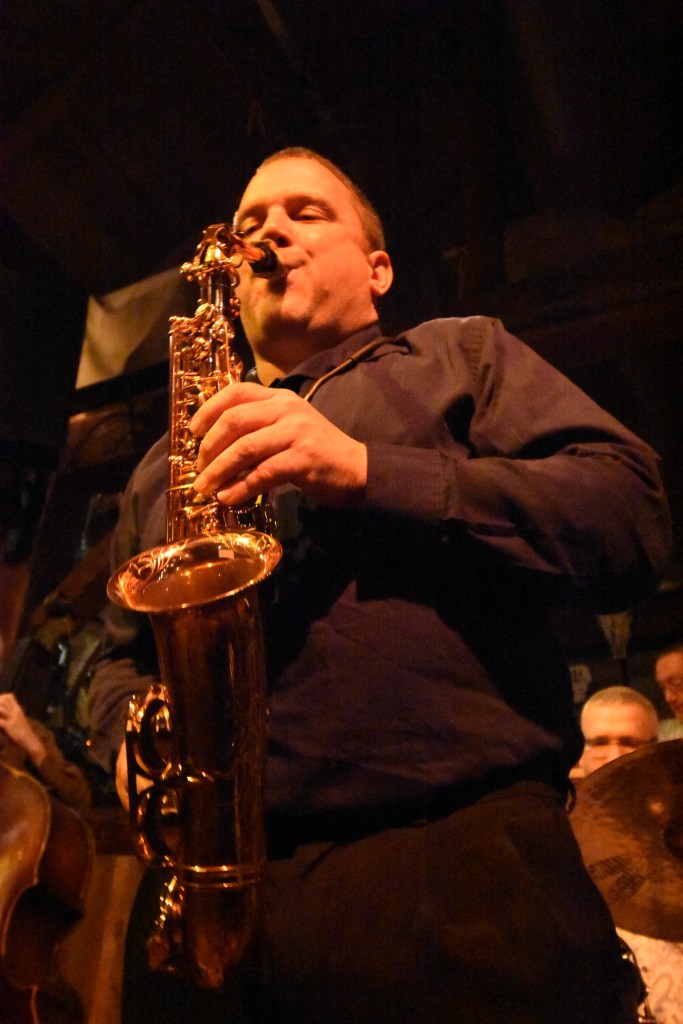
I’d heard about this Christmas Eve musicians’ party for years but I guess I needed Jim’s presence to authenticate my invitation. He’d played with hosts Louie and Ralph Mauriello since they were all in fourth grade, rocking hundreds of high school dances and bar gigs and recording a few songs, before they graduated.  Then the rest of the band had moved out to Oklahoma, where Jim studied music theory and composition, to resume playing together. That hadn’t worked out, but they were still friends. One night on a previous visit, we went to Allen’s on Rt. 50 where they were playing. Jim brought a sax, and in the middle of a song, he stood on his chair and started playing along. 

On this particular Christmas Eve, he’d come east from Santa Barbara to visit family for the holidays; or maybe he came mostly for Louie and Ralph’s bash. The stage was as open as the bar: If you had the nerve and the chops, you’d just get up and jump into the song. Jim played some, mostly harmonica, I think. These old musical friends played with more cooperation than competition. The solos got pretty assertive at times, but people played mostly within the songs; old rock ‘n’ roll and blues songs for the most part. However,  all kinds of people played various kinds of music, including a novice classical pianist who wobbled uncertainly through some Debussy. Everybody applauded everybody.

When the wingding wound down around 4 a.m., a new world waited outside: Two feet of snow had fallen. Even if it had fallen all at once, with a thud, the music inside was so loud we wouldn’t have heard a thing.

Jim and I dug out my old VW squareback station wagon – good in the snow, but with little or no heat in the cabin – and took nearly an hour to drive from Rotterdam to my home in Alplaus. My wife Ellie had left before the storm, heading west to join her big family (she’s one of 10) in the old farmhouse in the hamlet where she grew up. Called Newville, it’s closer to Little Falls than anywhere else familiar, but it really isn’t very close to much else at all. Newville is 12 or so houses and no businesses, just a church and a Grange. After two feet of snow, it’s a Christmas card,

Jim and I slept a few hours, bundled up again and hit the road on Christmas morning. Driving the 60 or so miles to Newville took two hours, over snow-drifted roads through beautiful white countryside that was equal parts Norman Rockwell and Stephen King. I don’t think we passed another car, in either direction, and if we had slid off the road, we’d have been stuck until spring.

The big white farmhouse stood quiet among the drifts as we skated up the long driveway. We clumped into the back shed on the back of the house and into the kitchen. There, the whole family stood waiting for us in a long line, with gaps for us. The family custom was to line up in age order and to march in procession into the living room with the Christmas tree and gifts; they had left spots in the line for Jim and me. While they waited, they had fired up the snowblower, grabbed shovels and cleared every driveway in Newville. They had also done some caroling: Sorry, but nobody in the family has much of a voice and they wouldn’t have lasted long onstage at Louie and Ralph’s party. It was a moderately big crew that year; maybe not as big as the 30-plus who celebrated Christmas there one year, when opening gifts (one at a time) took more than two hours. But it was big enough that Jim and I were both nodding off as gift after gift emerged to happy ooh’s and aaah’s. 

Then it was time for dinner, then to watch “Amahl and the Night Visitors” – the whole family knew every word – and to play board games and do jig-saw puzzles.

It was as perfect a Christmas as anyone ever enjoyed, starting with the warm, loud welcome of a rock ‘n’ roll/open-bar/old friends’ get-together; the drama of a shock snowstorm and two harrowing drives; and the second warm welcome of finding our places in a big-family fandango scrupulously honored/awaited – and all those people were happy to see us.

Wise-ass Wednesday

Well, sort of… Even a wise-ass feels grateful, like now.

When…

When I lean over my plate to savor the aroma of handmade pasta with vodka sauce and discover, when the condensation fog on my glasses clears, that some kind soul at the table has filled my wineglass.

When I walk through an alley in my neighborhood with Zak – searching for features my hero-wife Ellie has photographed on her early morning walks in our daily “Find this!” challenge; and we find a discarded, obsolete but immaculate PC; Zak lugs it home, we connect it up and it boots eagerly to read old 3.5 inch floppies I’d found but despaired of ever reading again.

When a friend in Maine phones and reports his broken leg is healing better/faster than he and his doctor expected.

When another friend, incommunicado for months, breaks radio silence (and my anxiety) by reporting his creative impulse has dragged him into the studio for hyper-creative activity and/or hyperactive creativity.

When my brother in Nashville sends eight CDs of his ironically titled CD “Home for the Holidays” (aren’t we all?) album and I delight in his sweet or sassy virtuoso re-imaginings of holiday songs – then send seven to friends – and am reminded why Jim Hoke is my favorite musician.

When a snowstorm threatens but I remember – unlike other such early-winter episodes – to park near the street end of the driveway to reduce shoveling and to bring snow-brushes inside so I don’t have to sweep snow from the door-handles and get my gloves all wet-useless.

When gift packages arrive from friends and family near and far – and I realize we’ve sent gift packages to ALL of them.

When such stuff happens, the gratitude that arrives with Thanksgiving and stays until spring feels especially sweet.

When I was working, I’d look forward to that first winter afternoon when I’d leave my office to find the sun was still up. That was Sun-Up Day, to celebrate. 

RIP Hal and Marianne

I don’t know if it’s worse or better that neither Greenwich-born country-folk singer-songwriter Hal Ketchum nor music super-fan Marianne Higgins Peruzzi Barone died from the damn plague.

Whatever; we just sadly lost both.

Marianne and I had been Facebook friends for years when we met just once, at an after-party for her high school reunion that our mutual friend Ray hosted. We discovered then that I’d likely bought tunes from her at Just A Song, a great vanished music Mecca on Albany’s Central Avenue, not far from the Blue Note and J.B. Scott’s. She kindly mentioned enjoying my Gazette reviews and columns. We also discovered we’d been at hundreds of the same shows. That’s no small thing among us boomers; a bond like Bruce Springsteen sang about in “Bobby Jean.” Imagine the Boss here, crooning in his most melancholy voice. “We liked the same music. We liked the same bands.”

Everybody liked Hal Ketchum songs and singing, as fans showed with a tribute-fundraising event nearly two years ago in one of his many adopted hometowns. He’d been diagnosed with Alzheimer’s and was no longer singing when I heard about the event, checked in with his former bandmate Bob Warren and the folks at Greune Hall down in Texas. Then I wrote this:

We don’t have to be Greenwich Central School grads or remember Hal Ketchum from teenaged gigs at St. Paul’s Parish Hall, the Oasis, the Curious Cat or Kayo’s to hail him as our voice of small town Saturday nights here.

And while we can’t get to the sold-out tribute-benefit show Sunday near Austin, we can contribute to his medical needs via GoFundMe and stream the show live as his musician friends pitch in to help him fight Alzheimer’s. At Gruene Hall in New Braunfels, “Raised by Wolves: Bound for Glory – A Texas Tribute to Hal Ketchum” sold out quickly.

After playing in the Greenwich area in the Norman Pumpernickel Choir, Ketchum moved to Texas in the mid-80s (when high school band-mate Bob Warren moved to Saratoga Springs) and began playing a weekly gig Sundays 4 to 8 p.m. at Gruene Hall. The Feb. 23 tribute fundraiser there will feature Bruce Robison and Kelly Willis, Lee Roy Parnell & Rob Roy, Walt Wilkins, Jesse Dayton, Slaid Cleaves, Waylon Payne, Kenny Grimes, Nico Leophonte, Los Mistiqueros and others.

Warren recalls meeting Ketchum in high school where he, Ketchum and Paul Foster harmonized in the band room on “Suite Judy Blue Eyes” and other soft-rock radio hits. As the Norman Pumpernickel Choir, they played songs by Cream, the Rolling Stones, Creedence Clearwater Revival and, of course, the Beatles. Ketchum drummed and sang, Foster played bass and Warren, guitar. They closed many shows goofing on “Hey Jude.” Warren said, “We stayed on a C-chord for the entire song including the long fade out.”

“Hal always had a little something extra in his voice,” said Warren, “a sweetness akin to that of the Everly Brothers….the stridency of Paul McCartney when he unleashed. You were thrilled to hear him sing!” Warren said, “His voice can sell a song whether it is mediocre or great. When he writes a great one it is something special!”

While Warren formed the Bob Warren Band as one of the North Country’s most versatile and powerful ensembles, Ketchum moved from Austin to Nashville and built mainstream stardom as the 72nd member of the Grand Ole Opry and a hit-making recording and touring artist. Soon, as Warren recalled, Ketchum’s hit “Small Town Saturday Night” was everywhere. Ketchum’s 1986 debut appeared on Austin-based Watermelon Records; later albums followed on Curb Records. His most recent (11th) release is on Music Road Records, “I’m The Troubadour” (2014). Curb also released compilations in 1996 and 2008. Ketchum’s Greenwich tribute “Small Town Saturday Night” was among 17 singles that charted on Billboard’s Hot Country songs; three reached number two.

Ketchum resumed making music, painting and carpentry work after recovering from acute transverse myelitis in 1998. He played The Egg in 2005, 2006, 2007 and 2010, often with former band-mates. “Inviting me to join him onstage at The Egg and lending his voice to a song from my ‘Clear Connection’ album at that time was very sweet and gracious of Hal,” Warren recalled.

Sunday, Ketchum’s (mostly Texan) musical friends return that sweet graciousness.

“We are very honored and grateful to all of the musicians who have stepped up to honor Hal with their presence and music,” read a statement from Gruene Hall, which also noted Sunday’s event will feature video of Hal performing with Kenny Grimes. The progression of Alzheimer’s prevents Hal from attending in person. “Thanks to all of the good folks who are donating their time to make this happen,” said Tracie Ferguson from the venue.

Fans can live stream “A Texas Tribute to Hal Ketchum” at Gruene Hall Sunday via The Dancehall Tapes: A Texas Music Preservation Project,” starting at 3 p.m. at http://www.thedancehalltapes.com/ or via Facebook – https://www.facebook.com/thedancehalltapes/ To help Ketchum’s family meet his medical needs, visit http://www.gofundme.com/f/halketchummedicalfund or buy a virtual ticket to the show at http://www.gruenehall.com

Let me play this song in your eye

On Monday, my friend Tom Ciancetta Facebooked about paddling around Collins Lake in what felt like a suggestion and photography lesson. Tom is now retired into kayaking, grandfathering, fine Italian cooking and old scotch. 

He posted such cool photos that I retrieved my beloved Hornbeck canoe from the basement, where I’d stored it for the cold months and headed to the same tame, teeming reverse island (wet, within dry) on Tuesday.

Apart from solid black devices with NIKON or CANON on the front, this 10-foot, 16-pound canoe may be the favorite thing I own, since it takes my eyes and cameras into places I otherwise couldn’t see.

I stuffed a mask into a pocket of the swimming suit I’d also stored away and had to dig out, then motored down Union Street, past cyclists on the Western Gateway bridge. I looped to the right, into the park past Jumpin’ Jacks; Our fun-food mecca in warm times, it’s now closed. They could have sold MOUNTAINS of grilled treats in Tuesday’s salubrious second-summer glow.

When I unstrapped the boat from the car top, I carried it in one hand, paddle in the other, past guys laboriously rigging a complicated pontoon boat and tugging a cumbersome kayak out and dragging it along the narrow beach.

The water was colder than I expected as I walked the boat in. But the sun warmed wet feet and legs as I set off onto mirror-y waters transformed by the season-change since my last paddle there, more than a month of cold wind and wild rainstorms ago. All the green, grasping vegetation that made the south bay a real challenges to paddle through earlier had died back away. Sadly, so had the water lilies that once decorated the lake. This left the water clear and sweet, the paddling easy. I slipped past reed and cat-tail forests in the south shallows, past a woman who sang out, “Is that a Hornbeck?” and said her beautiful canoe is a Slipstream, an emerald-green blade in the water. 

I investigated two muskrat lodges and two beaver mansions – muskrats build domed islands out away from the shore in open water, beavers build right at the edge, like millionaires. Wild-life seemed surprisingly scanty with only one painted turtle visible swimming underwater, another sunning on a log. The air was cool enough that the latter sun-worshipper held its position rather than fleeing in those ploppy dives turtles usually make off their perches when I get within about ten feet. On a September paddle in the same waters, I counted nearly 50 turtles, including half a dozen dinosaurian, slow-swimming snappers. Some of the flight-splashes I saw might have been snapping turtles, or maybe carp, I couldn’t tell. 

The great blue herons pair I usually spot there was gone, gambling in Atlantic City or snow-birding to Florida, winging past the hurricanes. I missed them, though the Canada geese in the east bay filled in for them, squawk-wise. One of those herons is laid-back, winging serenely, silently away as I approach. It  somehow seems languid, even in flight. The other is noisy, yelling at me as it flees; sassy-ass kingfishers give me the same snark.

Relishing the ease of paddling anywhere, without water chestnuts to grip the paddle, slow the hull, I stayed in-shore a lot, spooking slate-gray carp that cruise the shallows feeding. When the water moved in a shady spot overhung with trees, I  thought I was seeing the mellow, ancient snapping turtle I’d often spotted there, moss thick on its shell. As I got closer, I saw it was a carp, foraging in water so shallow its spine broke the surface, triangle head swinging restlessly right and left. Logs along the shore bore “W’ webworks of turtle-claw scratches.  

Fallen leaves carpeted the water under still-shedding shoreline trees, or sailed singly, like corsairs before the light wind, as if the feathery alto-cirrus clouds overhead were beckoning. As if proud to be strong still, despite the calendar, the sun spread wide within those clouds. Or maybe that glow signified this might be our last such day for months. Being there, loving the place, warmed me as much as the sun.

Empty Seats, Full Hearts

The Facebook photo caught my eye: I know that place.

In stark black and white, it showed the empty Starlite Music Theater, posted with the ask/challenge to recall shows in the place. The Colonie Tent Theater, Coliseum Theater and Starlite looked forlorn. The chairs were gone, exposing dusty rings of terraced floor rising from the empty stage; so desolate that somebody asked, “Did it have seats?”

When I scanned the posts for others’ memories of shows I saw there, I found one citing “David Brubeck. The best!!!”

So I checked the name and found it was by Anne (M.) S., the woman – a high school girl, then – I’d taken to that show. 

View Post

I posted back: “Right – I took you to see the original Dave Brubeck Quartet, went backstage and got the program autographed and gave it to you. Later saw and reviewed maybe 120 shows there for the Gazette; met many of those performers – discussed Kubrick films with Johnny Cash, had beers with the Everly Brothers and their great band, gave James Brown a photo of my son Zak in his walker, with a James Brown bumper sticker across the front. Brown pocketed it, said, “As long as I have this, I have you.”

Like the “ghost signs” of extinct businesses promoted in fading paint on neighboring survivor buildings, vanished venues echo to us over time. Sounds we heard there hum in memory.

These days, all venues sit silent; waiting, like we do.

But we have hope for them, unlike those that have become dust, or parking lots, office buildings or ashes: the Starlite, Proctors in Troy, Saratoga Winners, the Metro, Allen’s, the Skyway, the Chateau, the Hullaballoo, the Half Moon, the Embers, the University Twist Palace, Roth’s…

Here’s to those vanished, venerable palaces of sound, and the memories of songs we heard there, with our first loves.

Stop, hey – what’s that sound?

I couldn’t tell in what nearby backyard my neighbors were singing: “Na na na na, na na na na, hey hey, goodbye.” 

But I could hear the song clearly and their jubilation, singing to the end of America’s dank nightmare of incompetence, cruelty, and cluelessness. I could hear the smiles through the voices.

Was the song coming from the Guyanese family diagonally behind us, or the Black family two doors away, or the Dominican family right next door?

I didn’t care.

It was coming from America, and it was beautiful.

On the night Barack Obama was elected, our son Zak joined a spontaneous parade across his then-home city of Washington, DC. In their thousands, strangers stood together outside the White House and sang to George Bush: “Na na na na, na na na na, hey hey, goodbye.” 

I asked Zak today, “Is that New Orleans?” when he got back from buying champagne and showed me joyous video of a street parade on his phone: drums and brass instruments in Second Line glee from the back of a pickup truck. 

He said, “No, it’s in DC” – another song of joy at the eviction of evil.

And it was beautiful.

An American Tune

Casey Seiler’s column this morning (Sunday, Nov. 1) knocked it out of the park. Now editor of the Albany Times-Union, he’s written about nearly everything a reporter can, including concert reviews, where we’d occasionally meet up.

For more than 20 years, I’ve joined the same crew of music-crazed friends to meet in the dead of winter, usually in the far Adirondacks, to listen to, discuss and geek out on music. By tradition, we now end each meet-up with the late, great Allen Toussaint’s immortal cover of Paul Simon’s “American Tune” – which Seiler hails here.

It’s the perfect hymn for our times.

Hearing Simon sing “American Tune” feels incomplete compared to Toussaint’s. In his voice, we can hear everything human and essential about him: His age, his race, his hometown, his weariness and resilience.

Before sharing Seiler’s words, let me recall seeing him at some Jazz Fests in his native New Orleans. At the start of a pulsating, powerful showcase of his music, his 14-piece band was cooking a hot groove just fine when Toussaint came out to join them. They immediately all played better: The Boss is here, let’s go!

Then, at a later Jazz Fest, I was leaving the photo pit after Cecile McLorin Salvant had sung her heart out, and I met Mr. Toussaint, coming in to speak with her. Everybody in the stage and security crews knew him; everybody said, “Hello, Mr. Toussaint.” He answered every person. His dark green Rolls-Royce convertible parked outside the Jazz Tent bore the Louisiana license plate “PIANO.” Nobody else got to park that close. As I bagged my camera in the barricade gap, we both stopped; I was in his way and I had recognized him. And I’ve been grateful ever since for the chance to tell him how very much all his music means to me.

A song for the weary

  CASEY SEILER

Next week marks five years since the death of Allen Toussaint, a true renaissance figure in American popular music. With just a few days left before what’s likely to be a fractious Election Day and the nation facing yet another surge in coronavirus infections, that’s enough of a hook for me to exploit to write about something, anything other than politics or the pandemic.

Or sort of — you can decide by the time we’re done.

A masterful piano player and vocalist, Toussaint wrote classic songs — funk, soul, R&B and more —ranging from “Working in a Coal Mine” and “Fortune Teller” to “Mother in Law” and “Southern Nights”; those songs that have been covered, respectively, by artists as wildly diverse as Devo, the Rolling Stones, Ernie K-Doe and Glen Campbell. He was a masterful producer of singles and albums by the Meters and Labelle, and wrote the horn charts for productions such as The Band’s “Last Waltz” farewell concert.

I volunteered to interview Toussaint over the phone for the Times Union in 2014, as a preview of his appearance at Mass MoCA. He was every bit the courtly gentleman I had anticipated, answering my questions in a quiet, thoughtful voice that at times seemed to hover just a few clicks of the dial above a whisper.

He talked about losing his home in Hurricane Katrina nine years earlier, a catastrophe that forced him to leave New Orleans and resettle for an extended period in New York City. He spoke of the collaborations and friendships he had made during his exile as “a blessing.”

Near the end of our interview, I asked the 75-year-old Toussaint if new songs and compositions were still occurring to him as readily as when he was younger.

“Now more than ever before! I wake up in a hurry to get to the pen and page,” he said. “Yes — I’m inspired because I move around more than I used to, and inspiration is every door I open, every corner I turn, every other way I turn my head to look. And I enjoy inspiration all the time; it makes life so wonderful. Just on my own, I’m simply the me that I know, and after a while the me that I know is not very exciting. But all the new things that happen around me — everything is a surprise.”

I’ve interviewed a lot of people, including artists whose work has inspired me immeasurably. But I don’t think I’ve ever gotten an answer to a question that has stayed with me like Toussaint’s. I’d put it up there with my favorite passages from Walt Whitman, who once wrote in a slightly more fist-shaking mode: “I do not snivel that snivel the world over,/That months are vacuums and the ground but wallow and filth,/That life is a suck and a sell, and nothing remains at the end but threadbare crape and tears.”

If you want to see and hear Toussaint’s knack for creation in action, go listen to his version of “American Tune,” a song that Paul Simon released on the 1973 album “There Goes Rhymin’ Simon,” which included production contributions from Toussaint.

You’ve almost certainly heard the song, which over the course of five decades has been covered as often as Toussaint’s most popular compositions. It’s about being wrung-out, dog-weary, as beaten down as a man or woman might feel after watching their home and possessions washed away by a hurricane or seeing a loved one ferried to the hospital: “I don’t know a soul who’s not been battered/I don’t have a friend who feels at ease,” the singer tells us. “I don’t know a dream that’s not been shattered, or driven to its knees.”

In the last verse, he dreams of his own death, and his soul rising over the scene of the Statue of Liberty departing New York Harbor, destination unknown. “I don’t write overtly political songs,” Simon once told an interviewer, “although ‘American Tune’ comes pretty close, as it was written just after Nixon was elected.”

Toussaint had been performing the song live as part of his touring act, and recorded it back home in New Orleans a month before suffering a fatal heart attack after a concert in Madrid.

In recent months, I’ve gone back to Toussaint’s version every few weeks — it’s a salve, even as the singer concludes by wishing for nothing more than rest in the face of “the age’s most uncertain hour,” and all that’s gone wrong.

There’s comfort in knowing that this expression of resilience at the edge of despair is five decades old, and immense strength to be drawn from the way that Toussaint’s velvet tenor wraps around his piano.

He sounds beaten down but not yet defeated — American to the bone.

Wise-Ass Wednesday

A feature in this dive-bar; Observations, would-be aphorisms, remarks and what-not.

The hardest knot you’ll ever tie – tight enough to stymie a shipful of sailors, a campful of Boy Scouts – will happen by accident in the laces of the second shoe you’re tearing off to jump into bed with your best-beloved.

Just so, every tool, device or system will fail five feet, five microns, five turns of the wrench from finishing the job – prompting the vilest curse you know.

Except for ViceGrips and duct tape – no fails or curses for them.

The Boss – 46 Years Ago

Check out http://www.nippertown.com – it’s ALWAYS a good idea.

And see my post on Bruce Springsteen’s area debut at the Union College Memorial Chapel.

LIVE (Retro): Bruce Springsteen @ Union College Memorial Chapel, 10/19/1974

Jon Landau’s famous quote – “I’ve seen the future of rock and roll and its name is Bruce Springsteen” – mostly gets it right. But that Schenectady show was as much about where Springsteen was coming from as where he was going.