Young Players in Old and New Jazz

Review: Bohdan Kinal Quartet at Jazz on Jay, Thursday, June 11, 2026

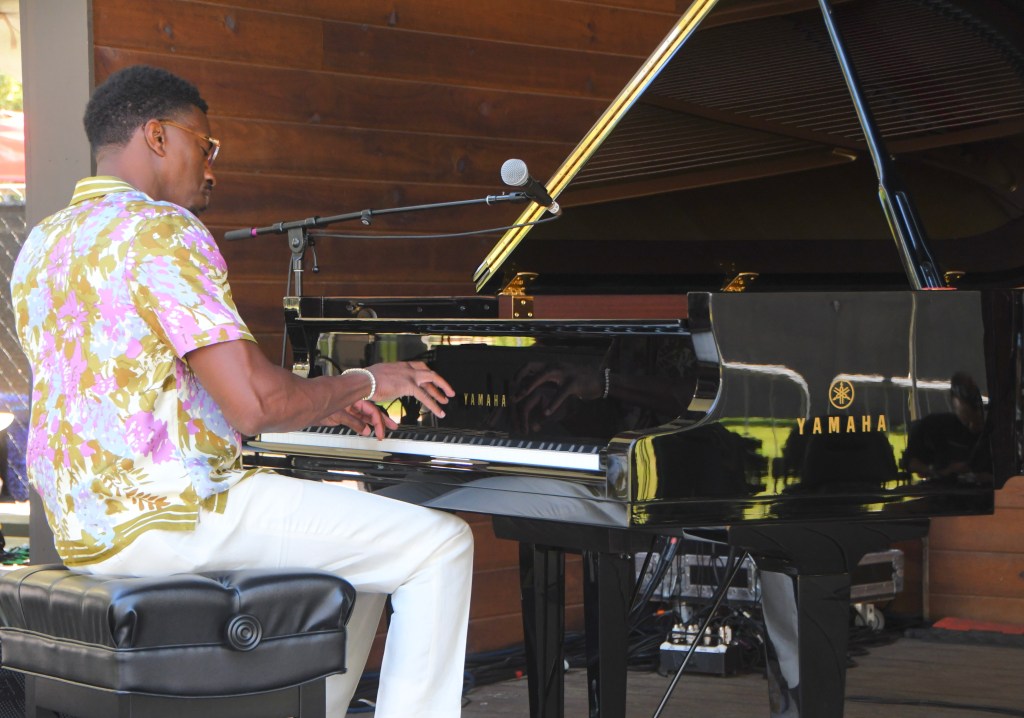
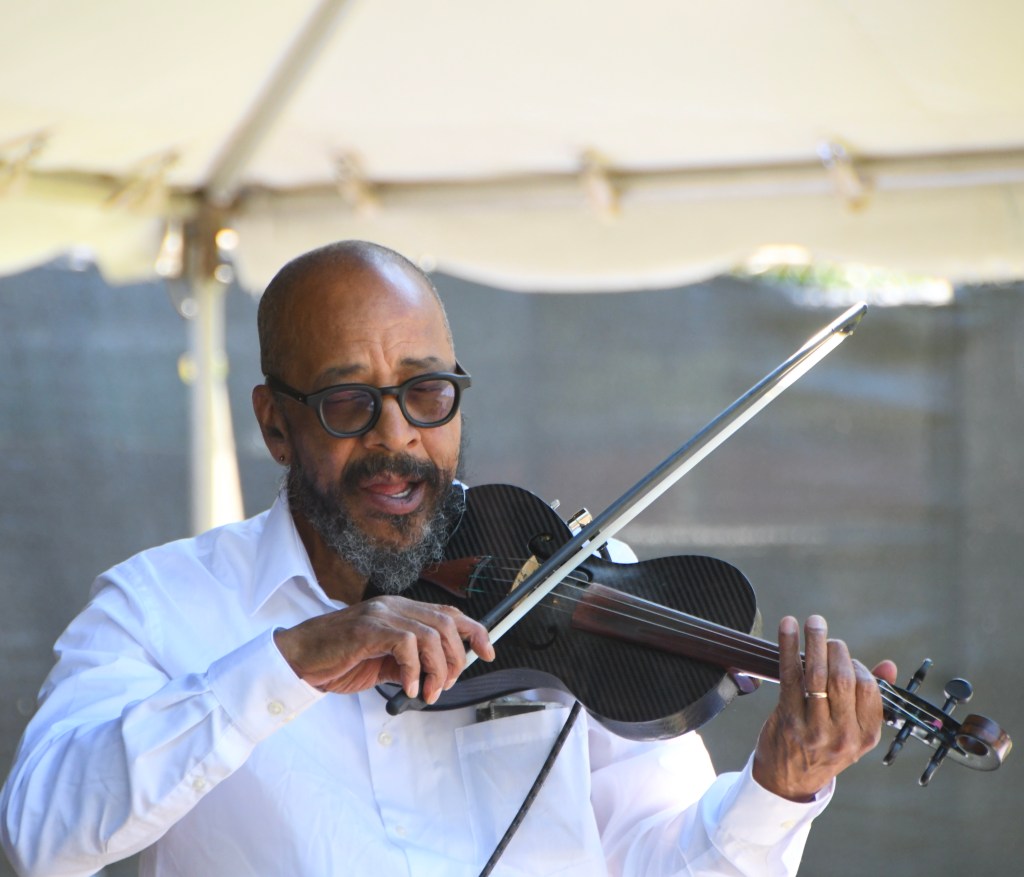
College students all, the skilled young players of the Bohdan Kinal Quartet coupled respect for the styles and songs of jazz giants with fresh invention Thursday in a sweltering Jazz on Jay show.

Starting with standards “Star Eyes” and “Let’s Cool One,” they settled into the episodic, theme-and-variations approach they then applied to the eight other tunes in their 90-minute set. They also changed up this conventional dynamic by altering players’ places in the arrangements. 

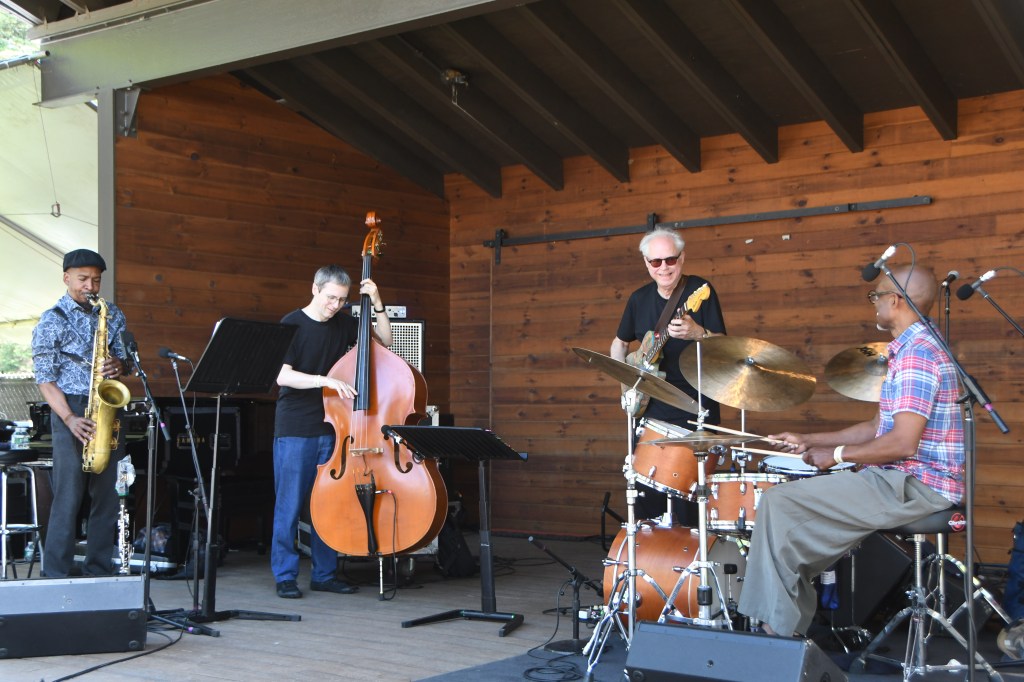
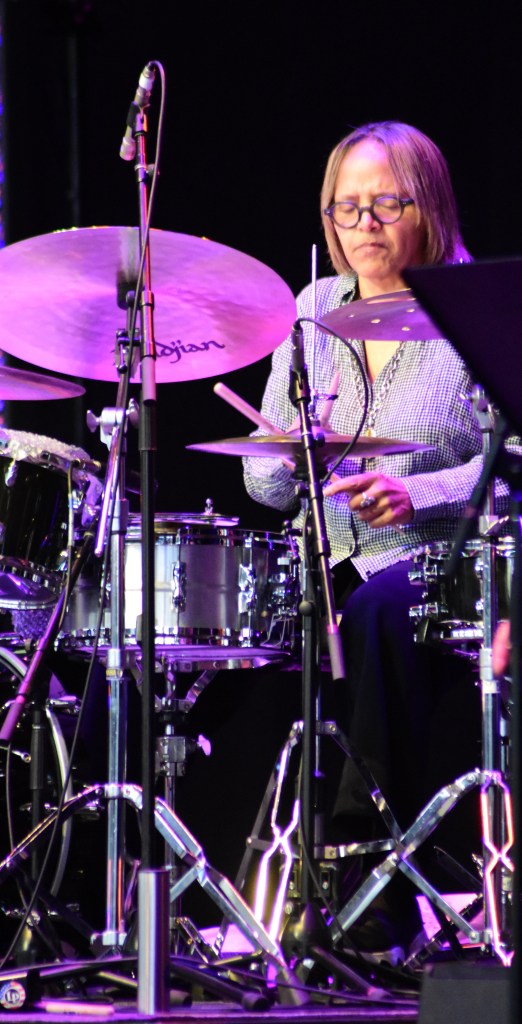
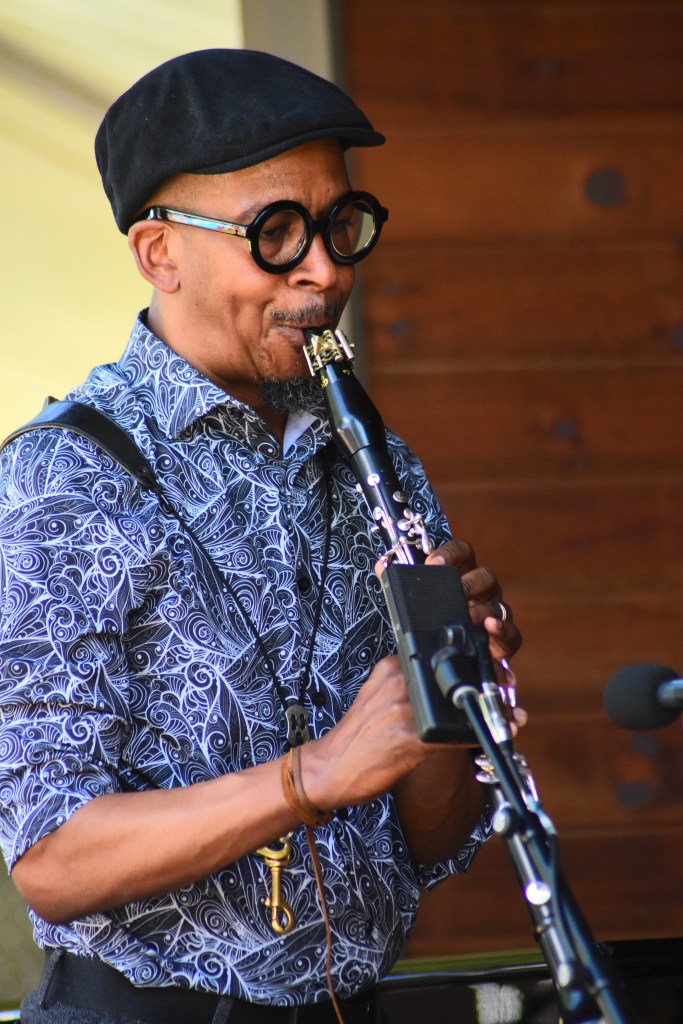
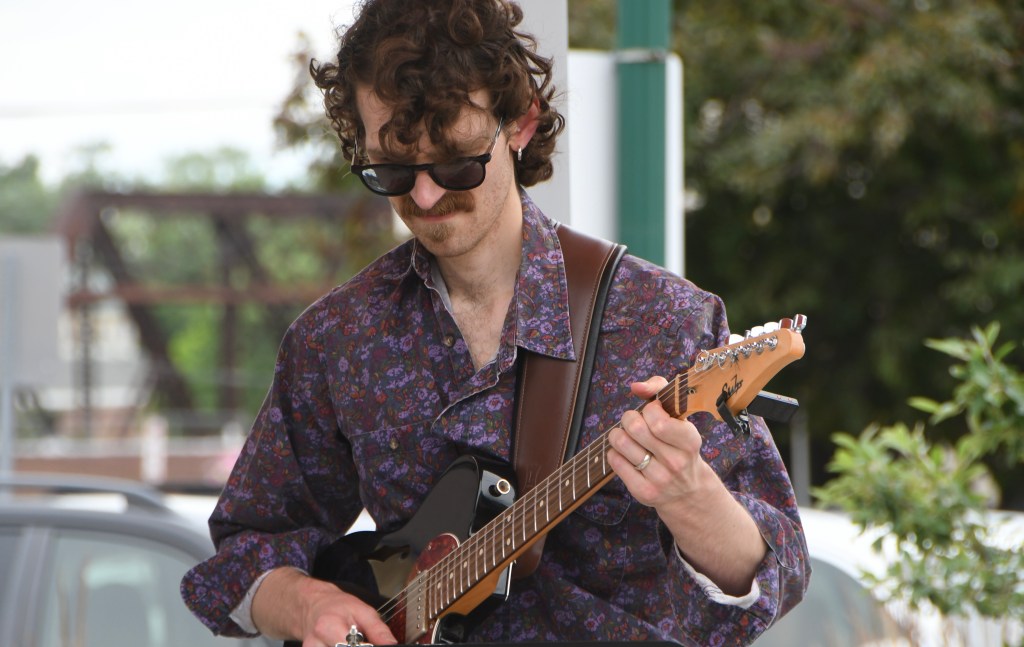
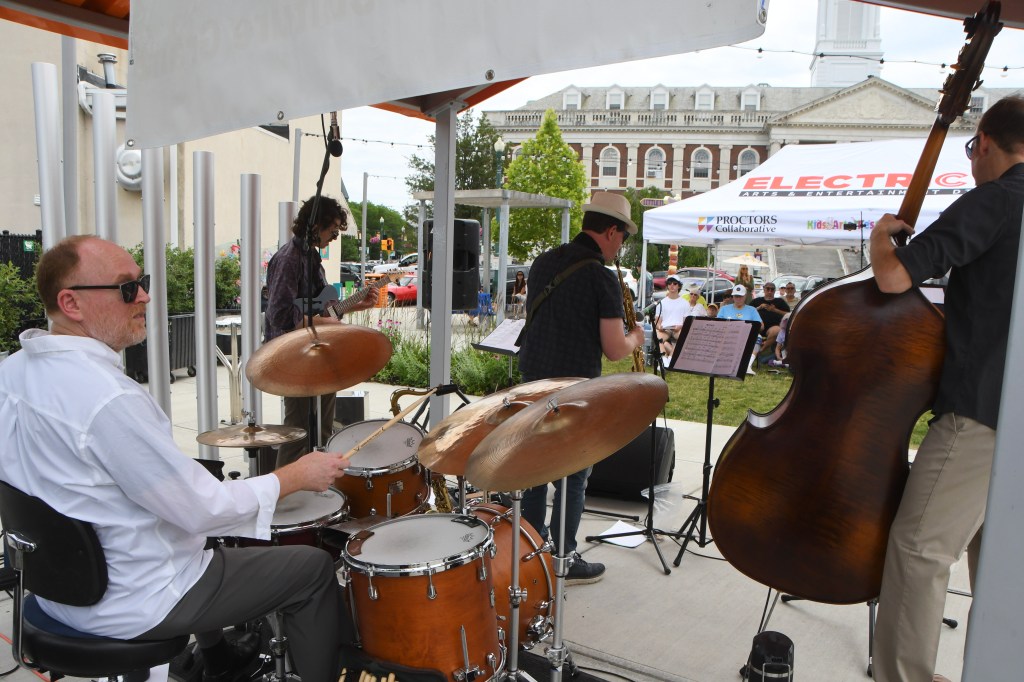
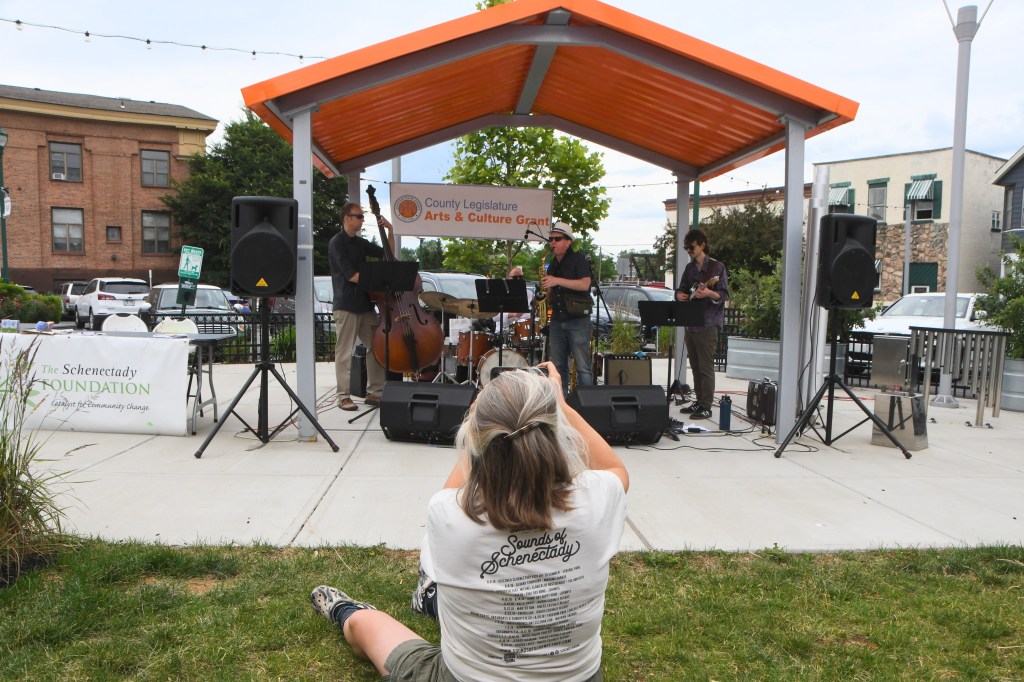
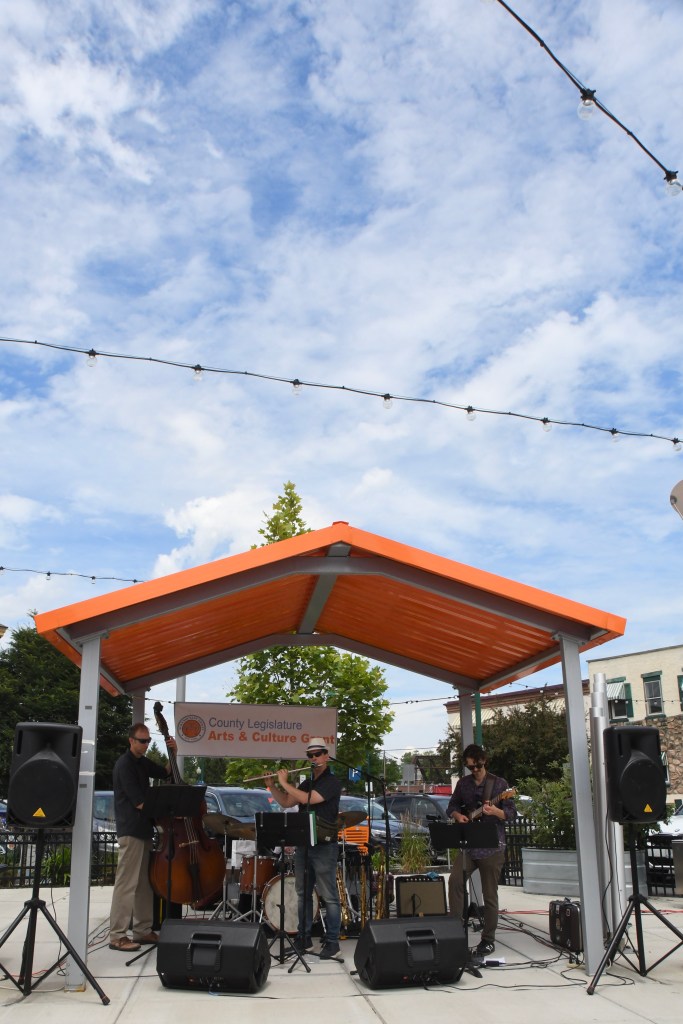
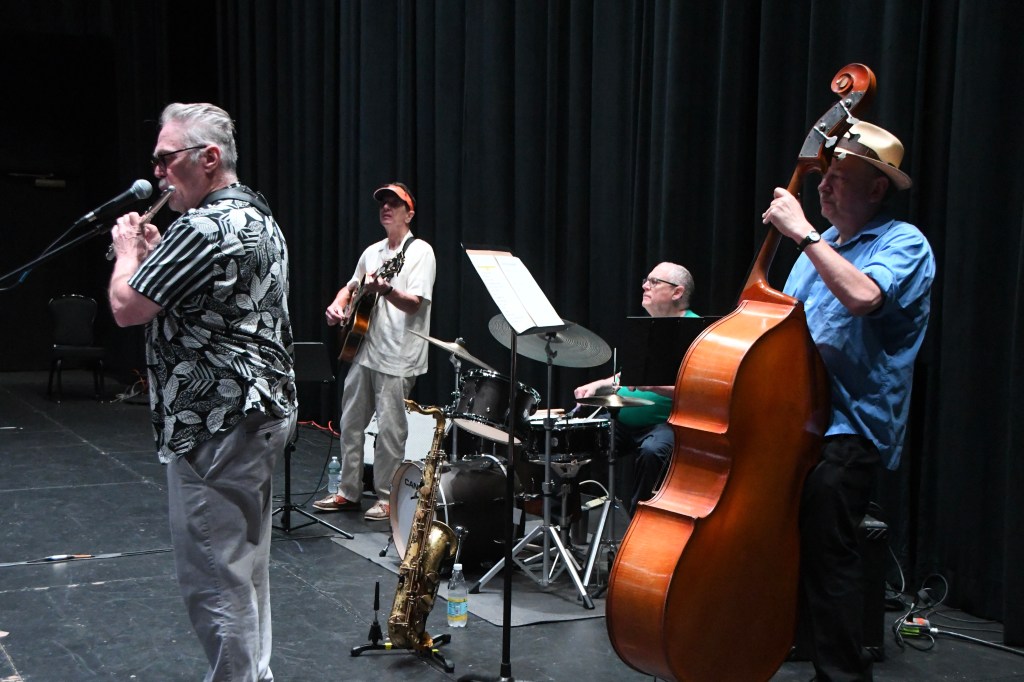
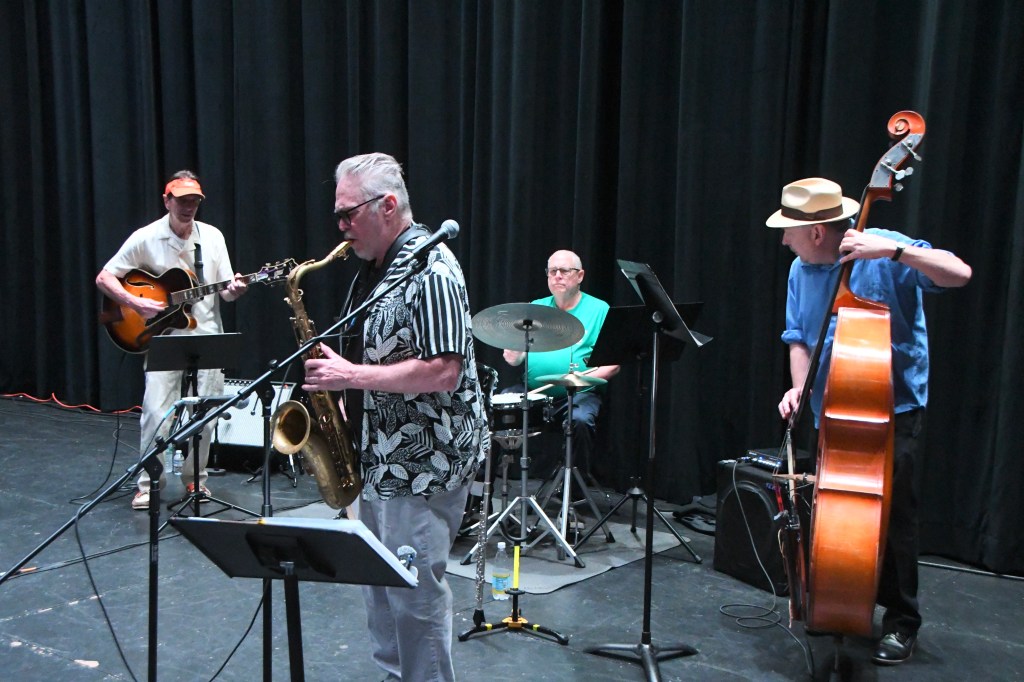
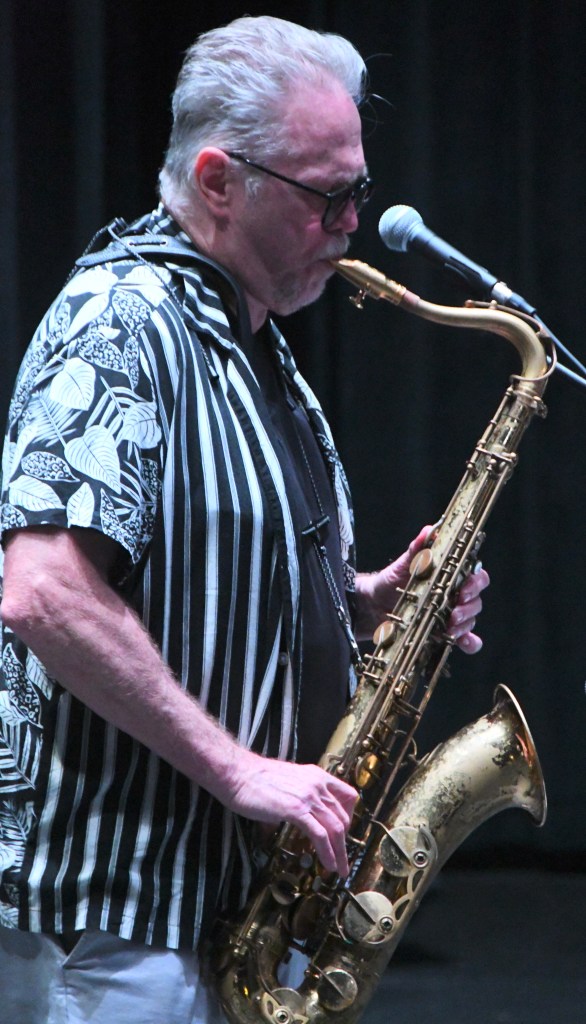
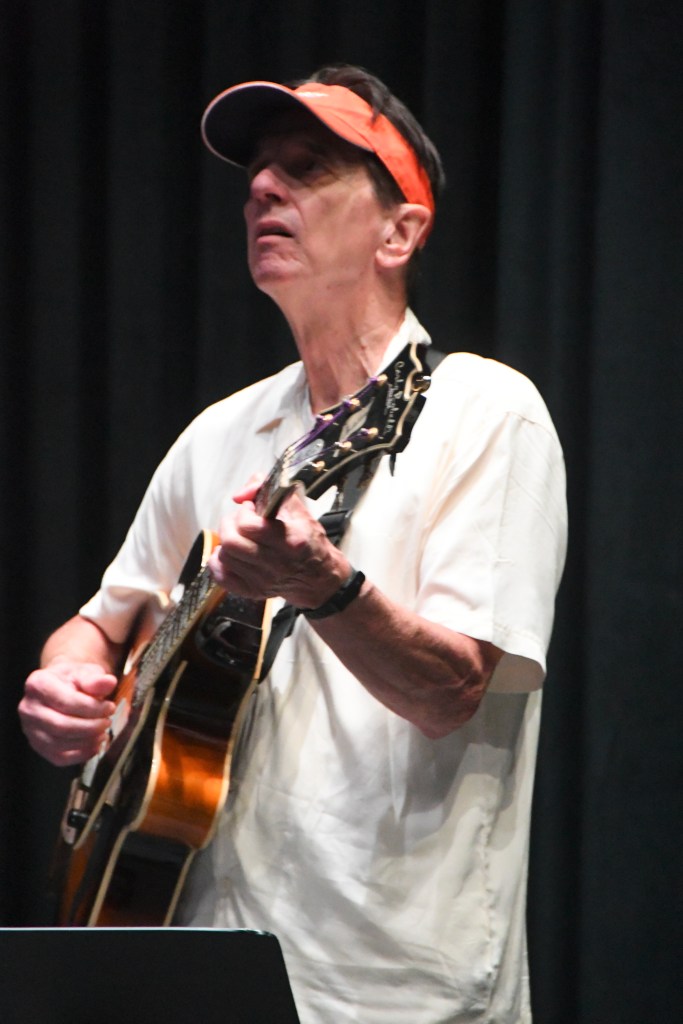
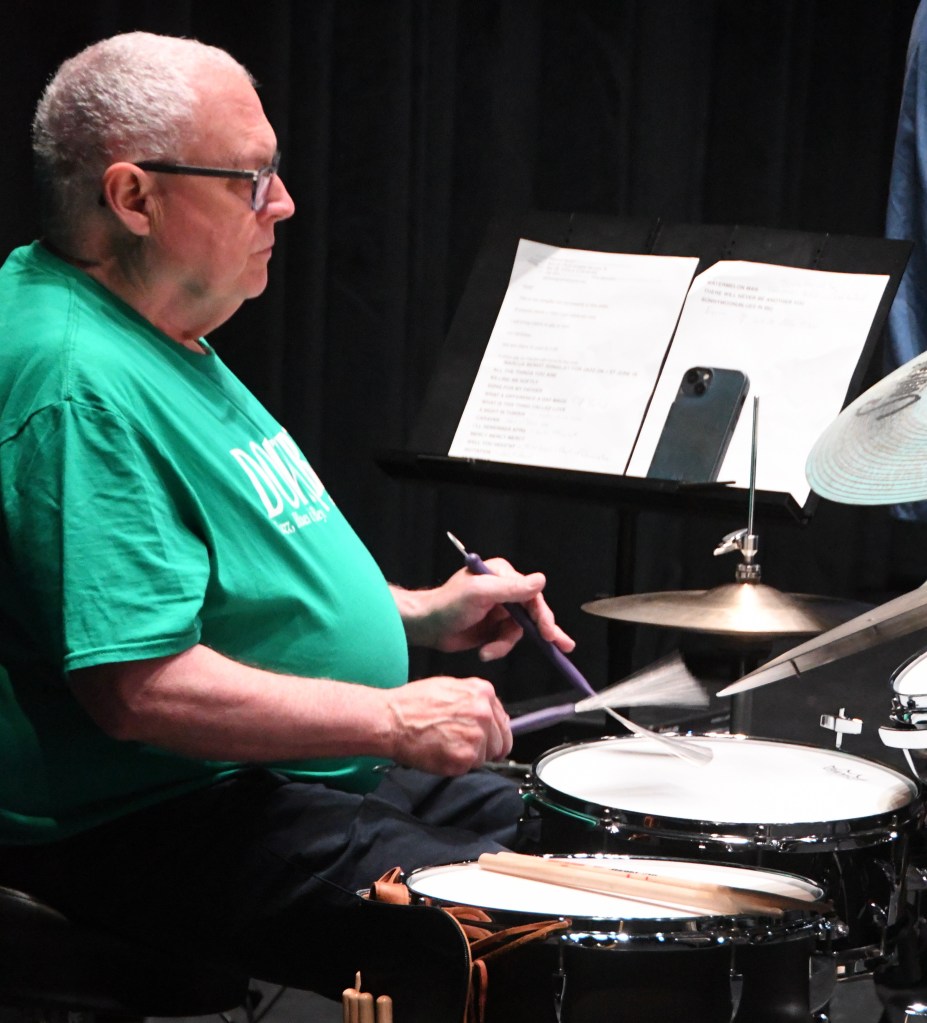
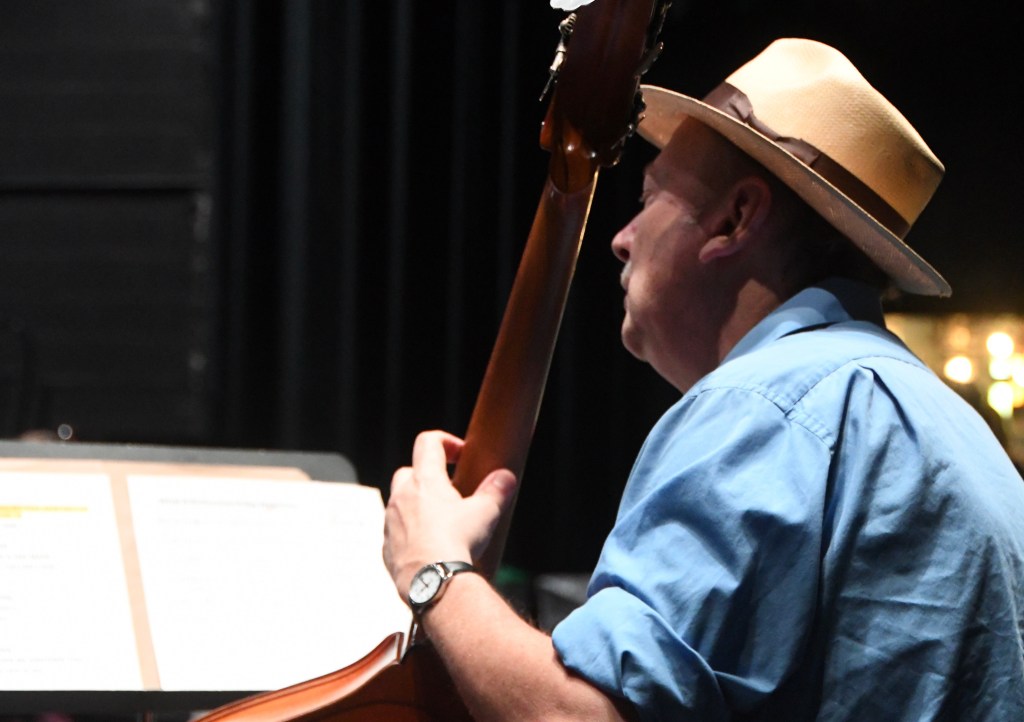
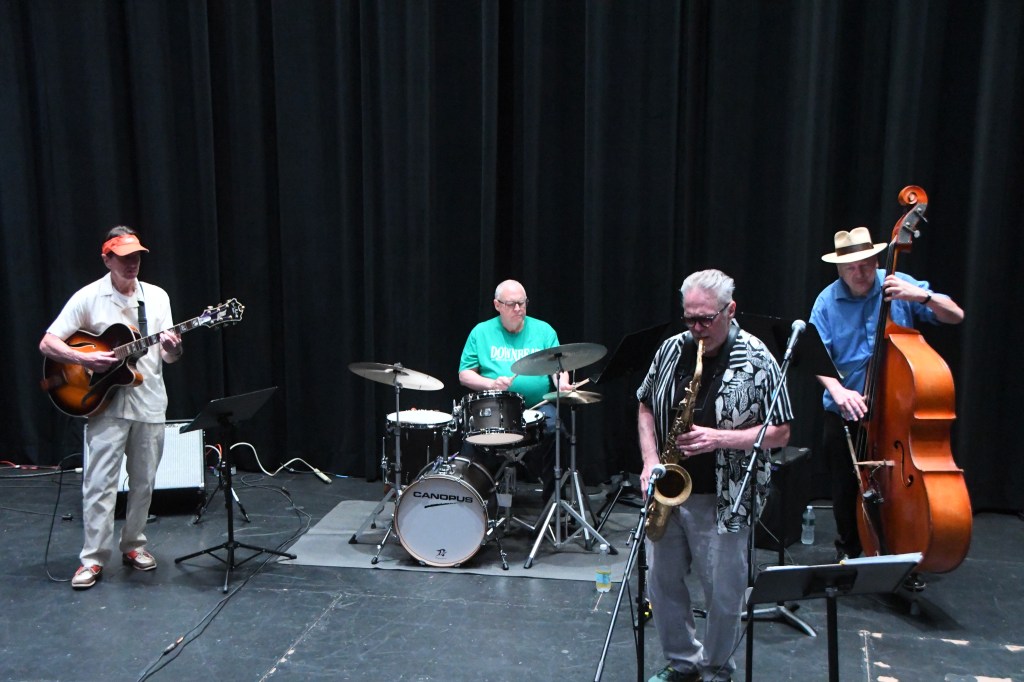
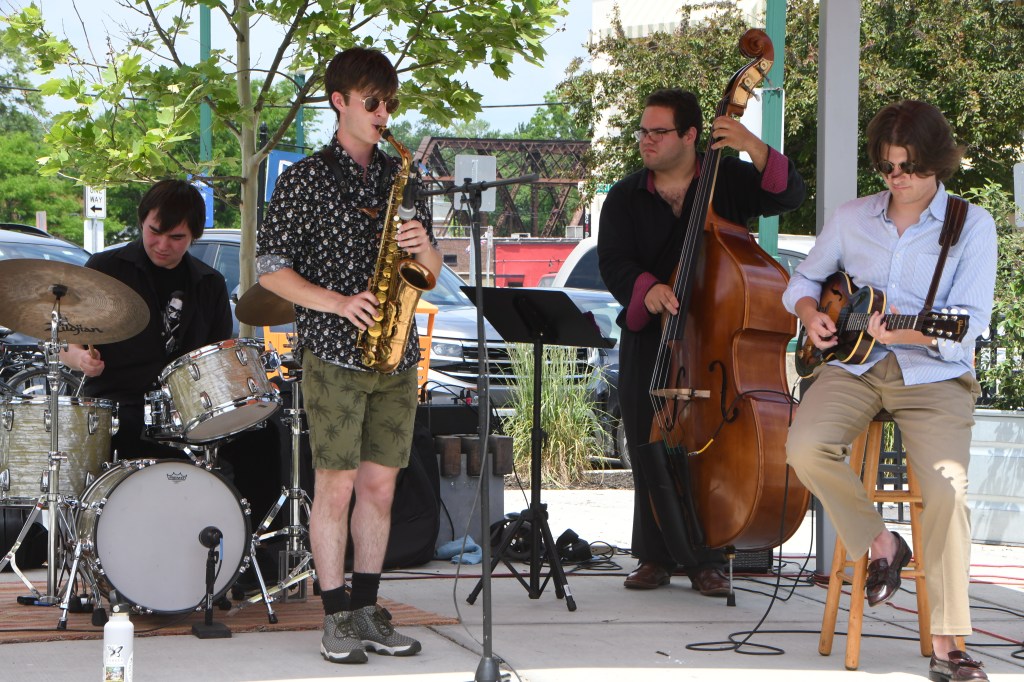
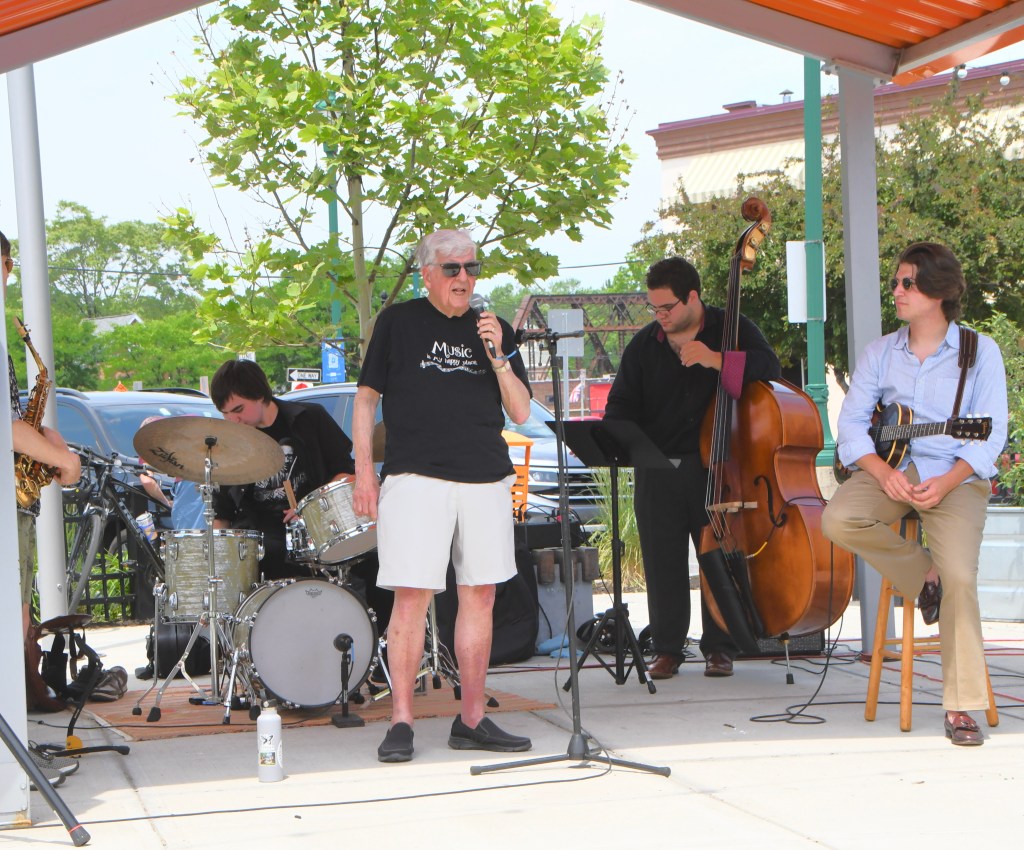
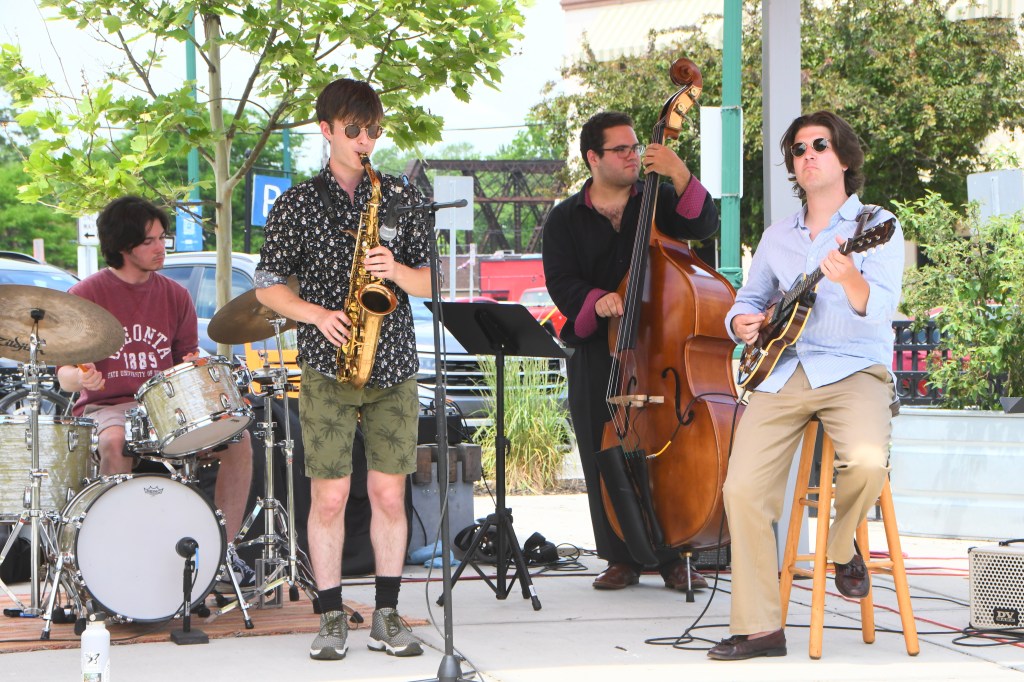
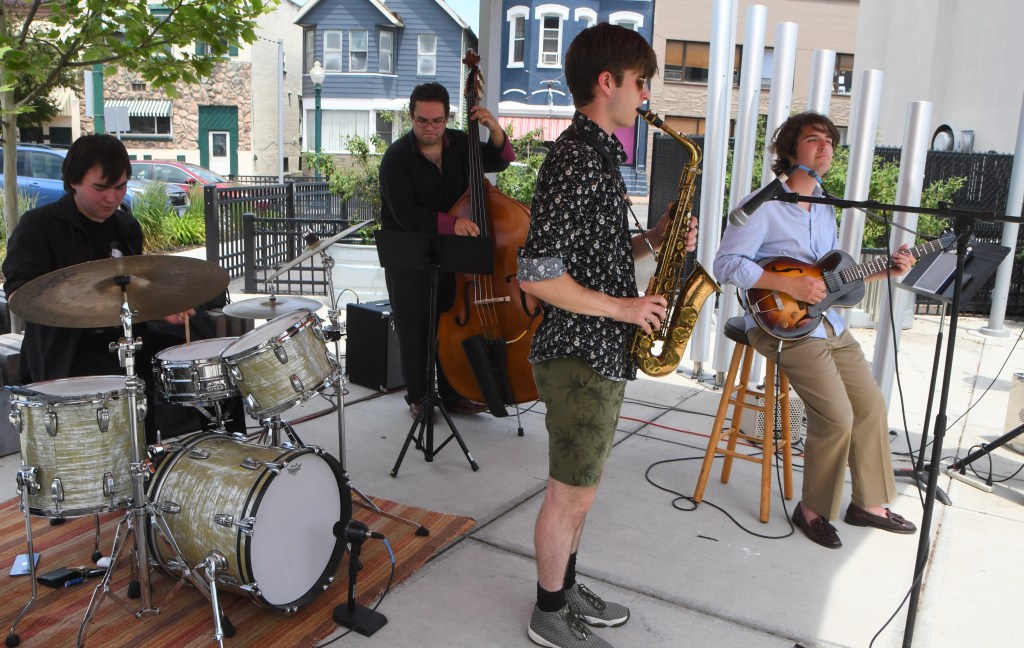
The Bohdan Kinal Quartet, from left: drummer Kiemon Noel, alto saxophonist Bohdan Kinal, bassist Vinny Marotta, and guitarist Sam Wagner

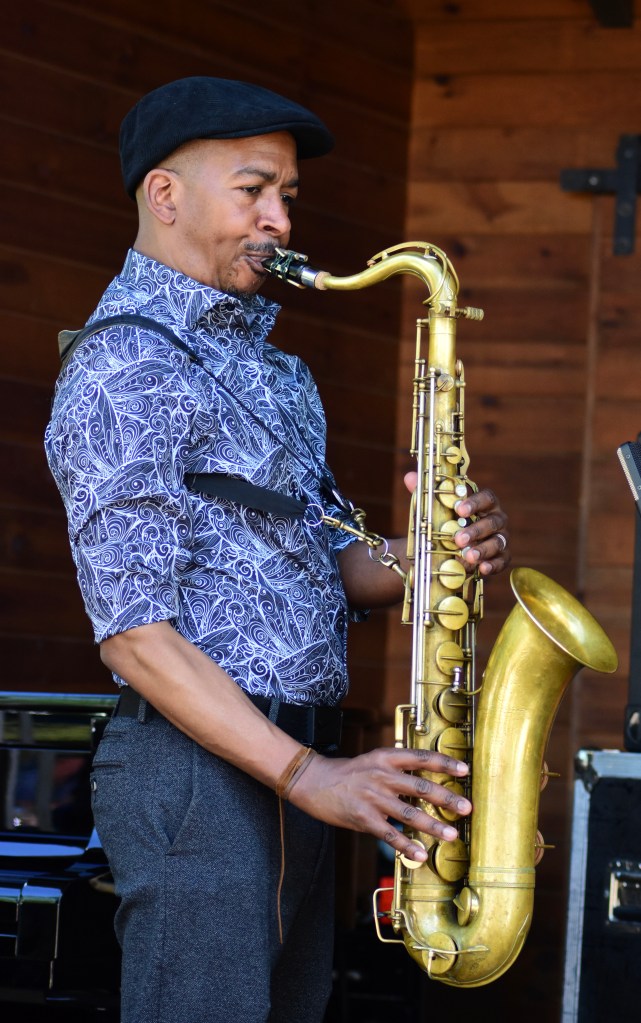
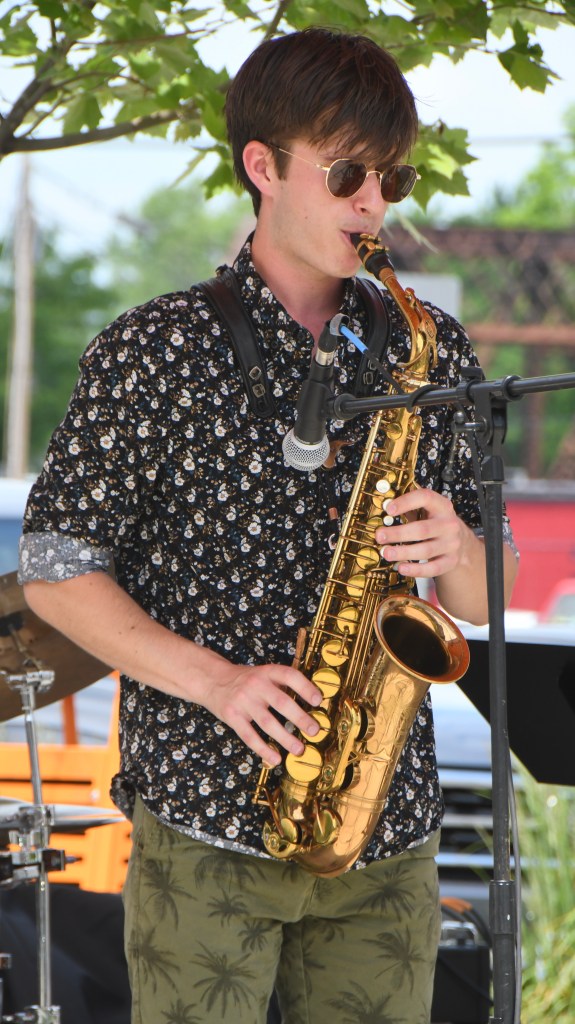
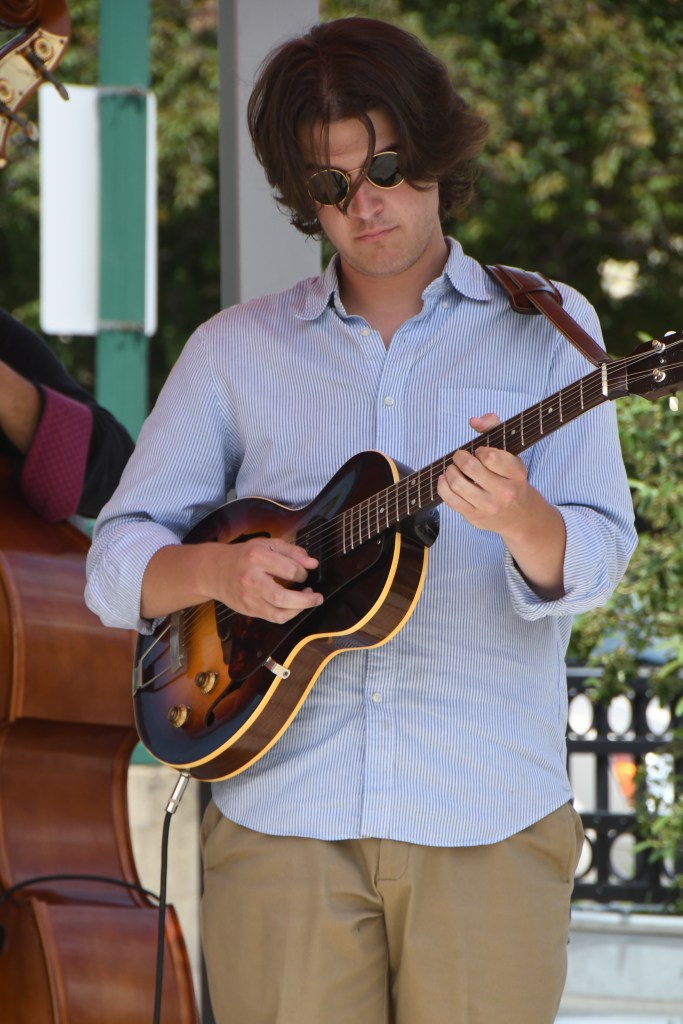
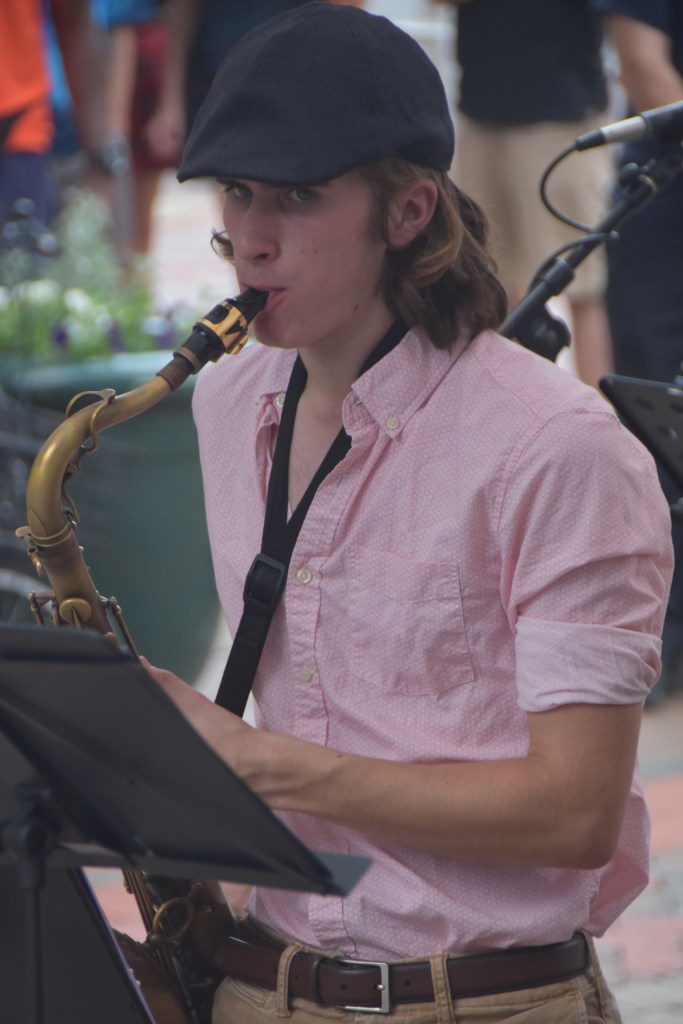
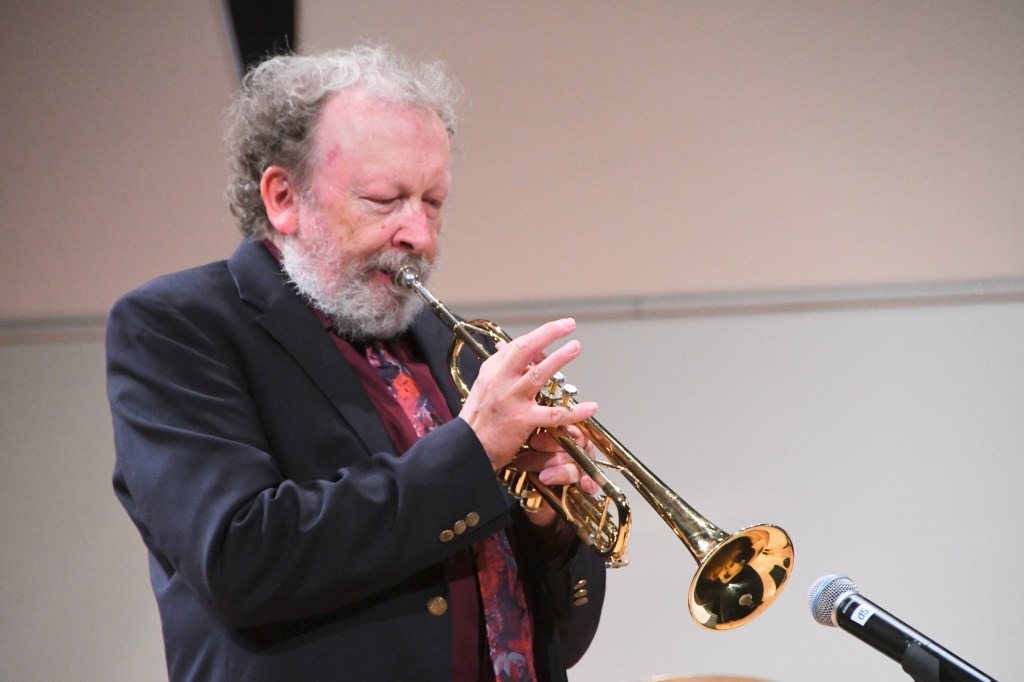
While leader-alto saxophonist Bohdan Kinal’s song choices, original compositions arrangements and vivid playing shaped the show, hyperactive guitarist Sam Wagner likely played the most notes. His fluency and freedom, the graceful way he phrased and always knew where things were going, all supported others’ solos. Actually, they all did that, and it worked well with standards and originals.

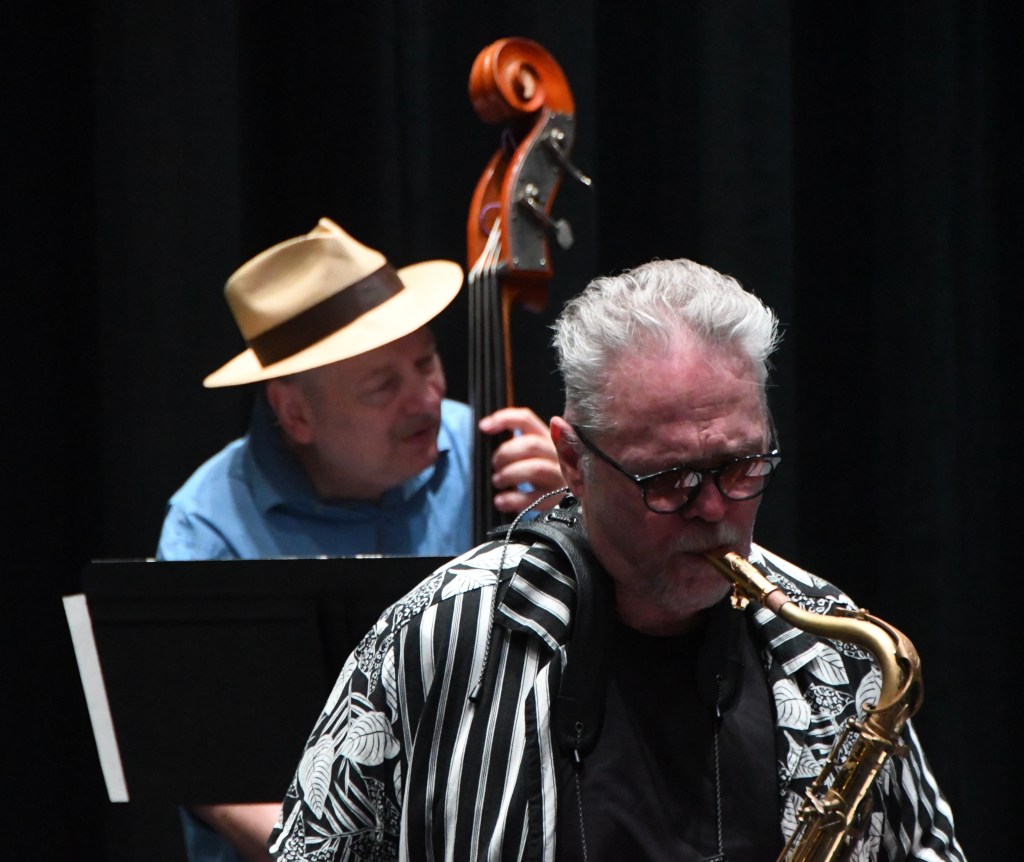
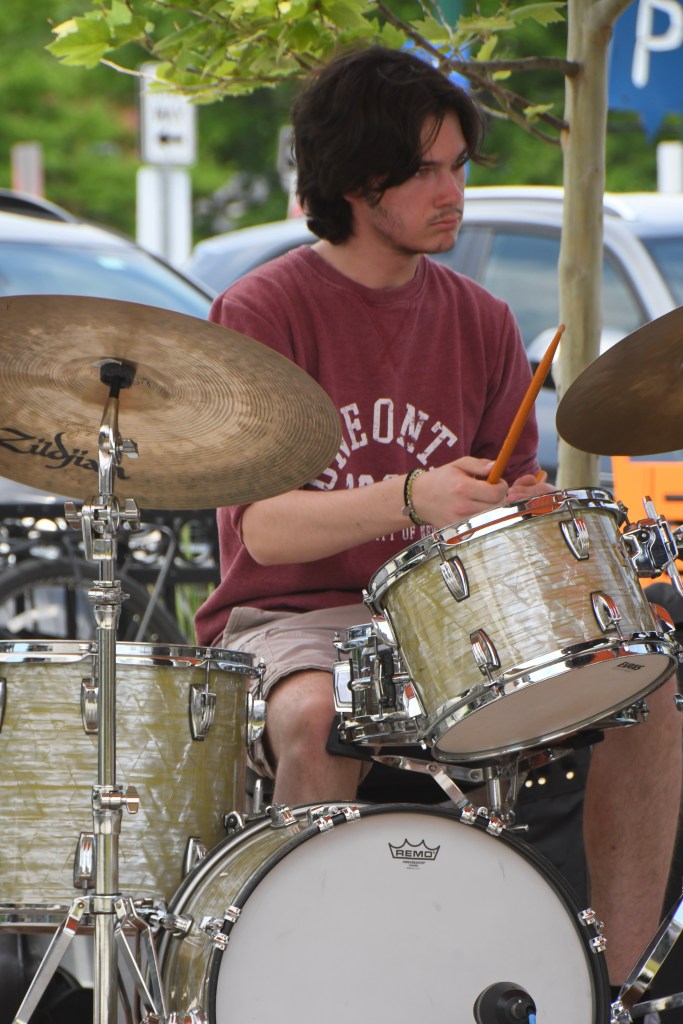
Bohdan Kinal, above; Sam Wagner, below

The classic melody of “Star Eyes” charmed right out of the box, giving everybody a chance to shine in solo passages then come together at the recap. The easy swagger of Monk’s “Let’s Cool One” featured Kinal’s fast Charlie Parker-like runs, just as Wagner’s guitar went all Wes Montgomery in “Star Eyes.” Kinal played his first break in “Let’s Cool One” for sheer melodic grace, the second for fun.

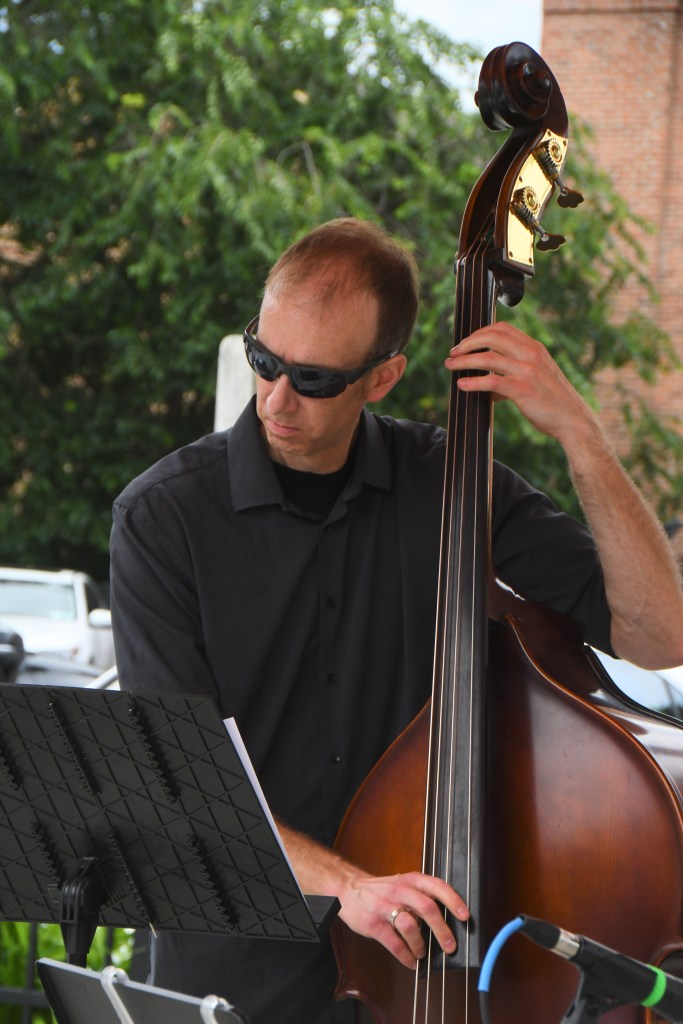
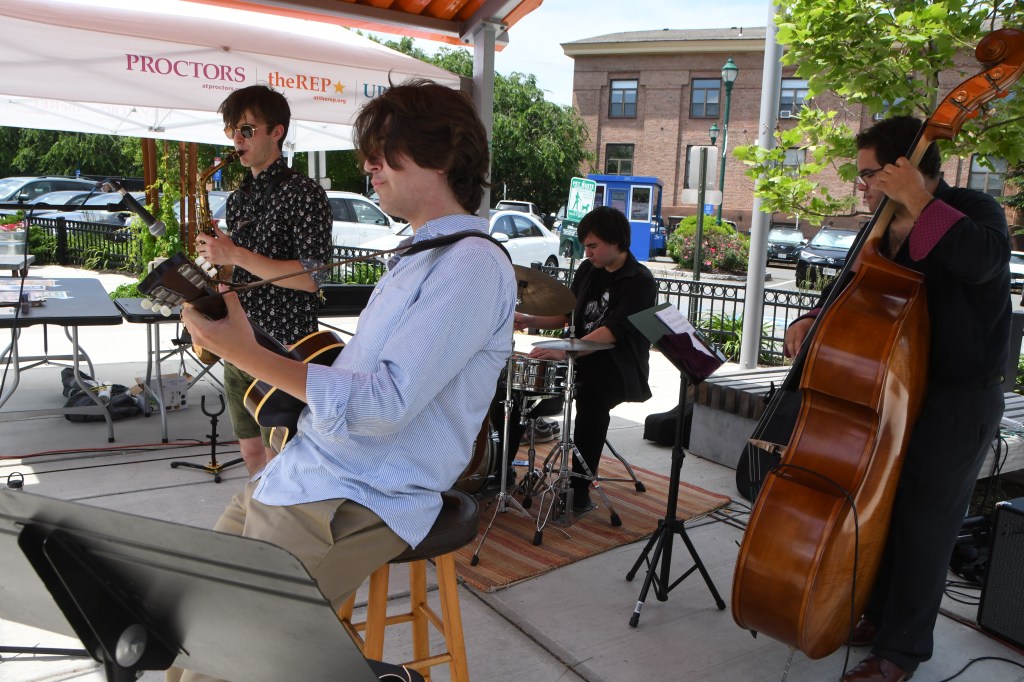
At times, the quartet played a bit like a pair of duos; the often syncopated beats team of drummer Kiemon Noel and bassist Vinny Marotta; and the melody guys up front: Kinal and Wagner. But things never separated for long as listening and commenting pulled things together.

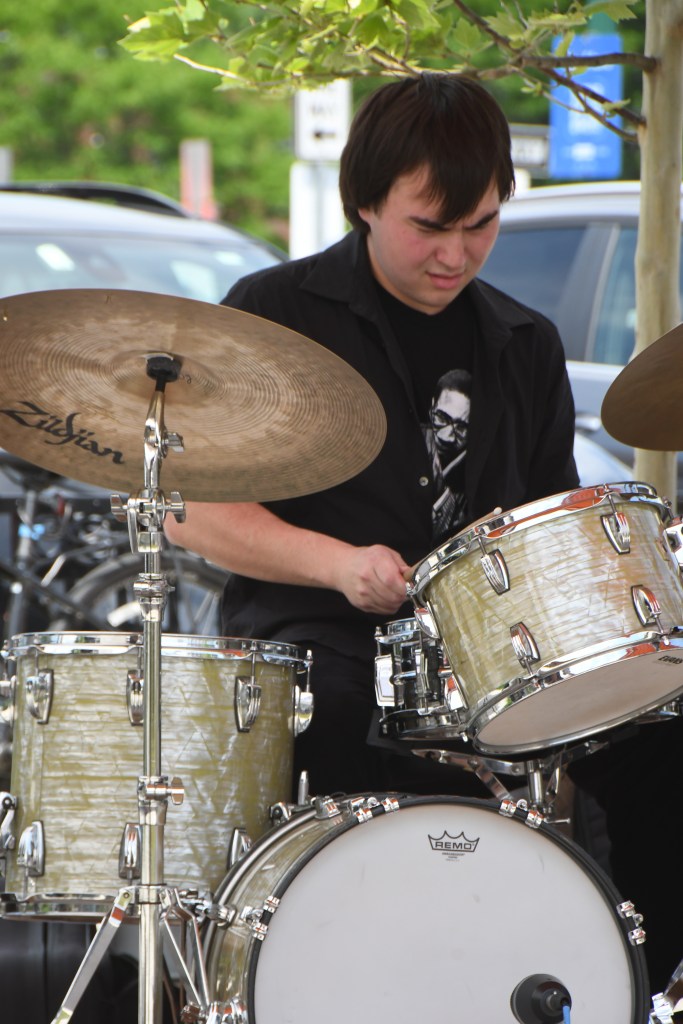
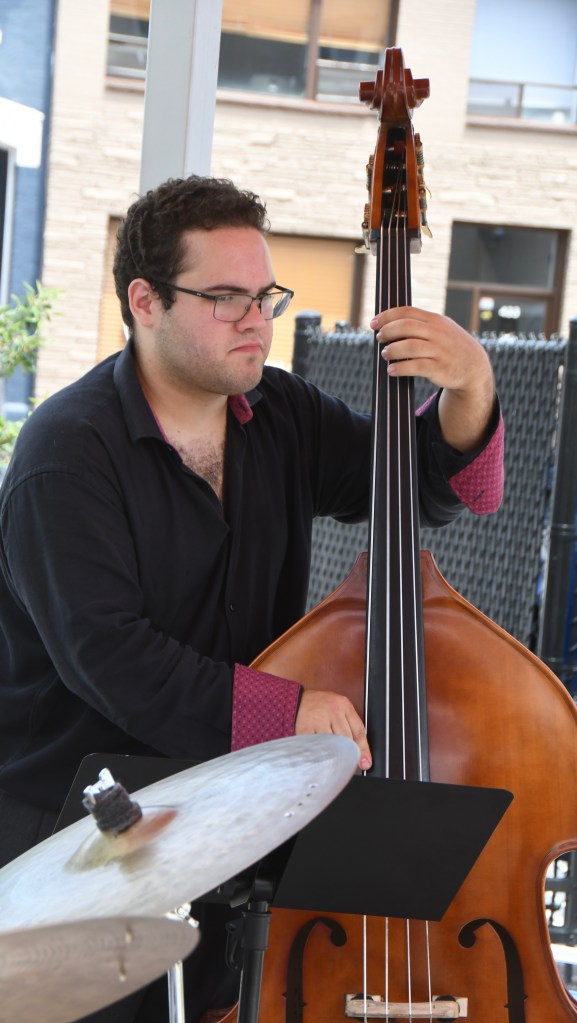
Kiemon Noel, above; Vinny Marotta, below

Bud Powell’s “Strictly Confidential” stood out, mid-set, with Kinal and Wagner playing in harmony – different notes, in the same places. In Kinal’s original “St.,” he introduced the main melody with everybody rolling strong on it, then launched his solo with a repeat, then a leap. 

They put a peppy hard-bop spin on “In the Still of the Night,” perfect for drummer Kiemon’s at first unaccompanied solo, teasing with a phrase on the toms that mutated into hot stuff on snare and cymbals and a quote of “Salt Peanuts.” Kinal and Wagner shared the spirit as Marotta set a repeating figure into the song’s seams. 

Another standard followed, “My Heart Belongs to Daddy” in an easy-swinging groove, Marotta’s bass again hitting just right, between riffs, then setting up Noel’s solo with long snare rolls before snare-and-cymbals bursts and unified alto and guitar coda.

Wagner introduced “I Should Care” – another antique, awakened and energized – jumping off from Wagner’s fast guitar bursts and Kinal edging his phrases with vibrato, then playing them straight, unadorned; then Wagner pulsating just as fast. Kinal’s original “Passerby” rode a mellow Latin feel, Marotta’s bass strong in the intro, Kinal’s alto on top through a happy melodic ride and Wagner’s guitar, which flowed fairly sparse early on, going strong at the end.

Like Kinal’s blues “Pensativa” and the cozy “St.,” this original closing number felt melodic, inventive and with a pleasing distinctive energy.

Steve Nover was nowhere in sight; maybe Thursday was just too hot to dance.

As a feel-good bonus, Jerry Gordon of the Swingtime Jazz Society hailed drummer Evan Frenyea, who sat in with the quartet for a song, as winner of the 27th Lee Shaw Memorial Scholarship. Both saxophonist Kinal and guitarist Sam Wagner are recent past winners.
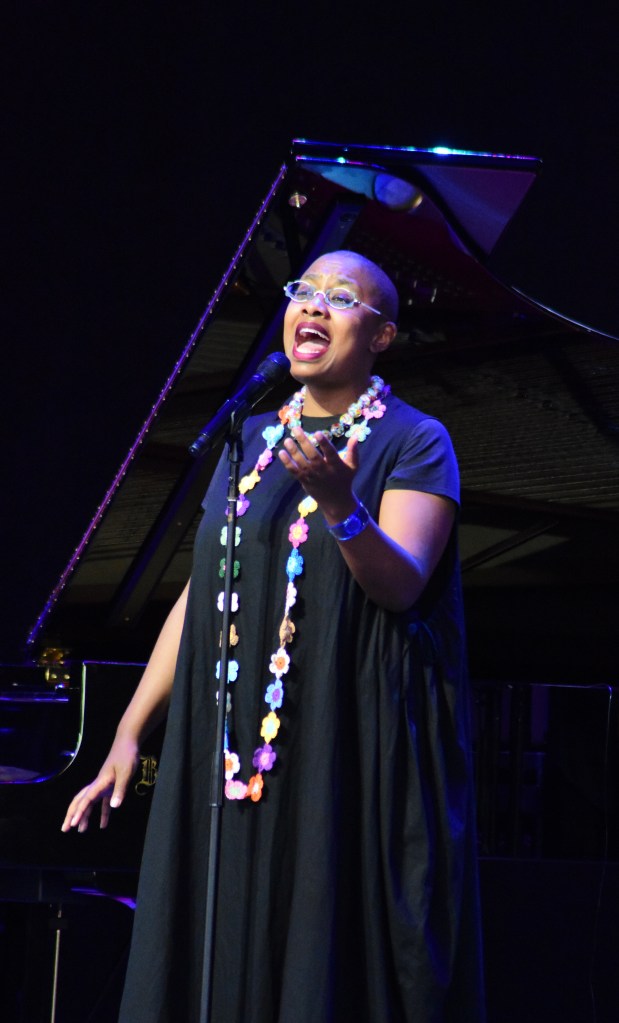
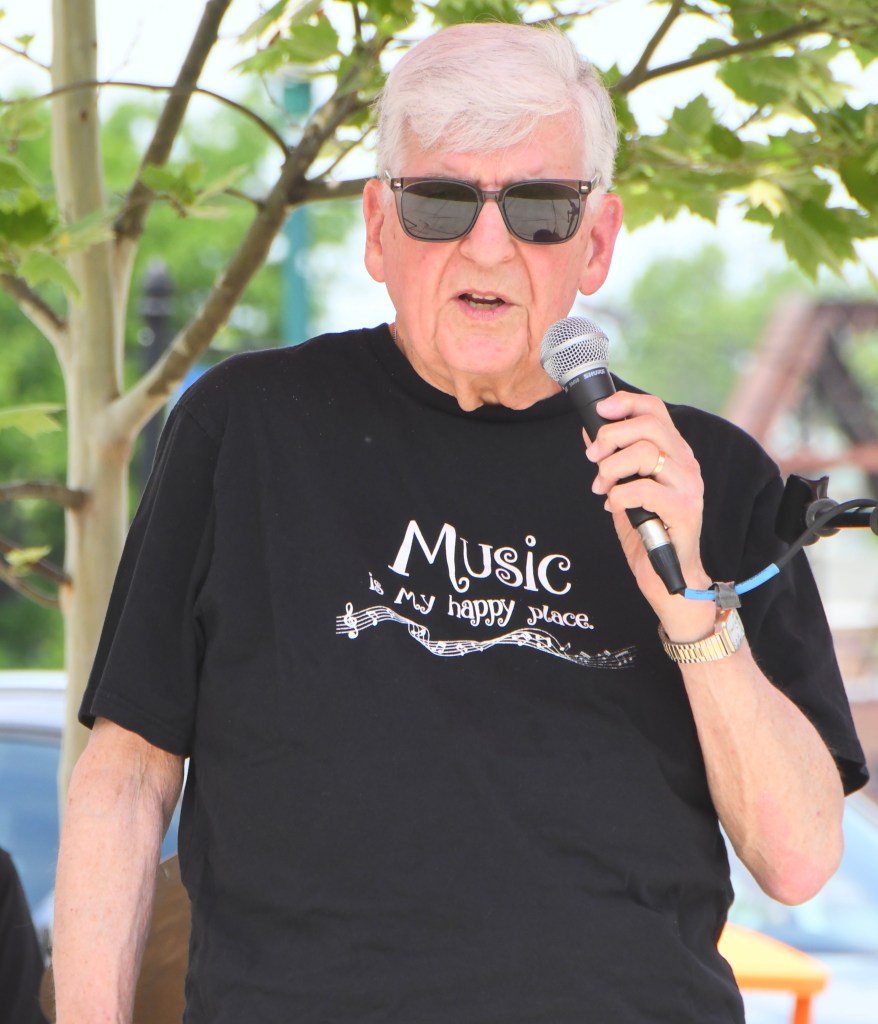
Evan Frenyea sits in with the Bohdan Kinal Quartet, above; Evan Frenyea, below

Kinal will soon be scarce hereabouts, spending the summer studying and performing in Michigan and Colorado.

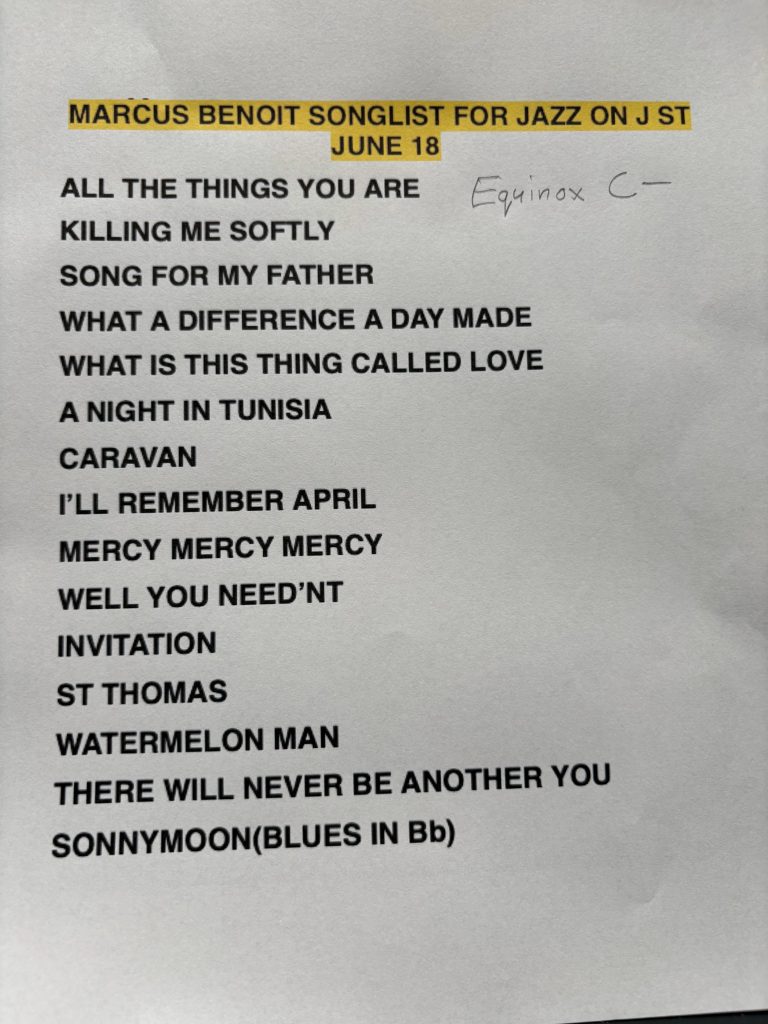
Jazz on Jay continues Thursday, June 18 with Marcus Benoit. Jay Square opposite Schenectady City Hall hosts Jazz on Jay shows; rain site for the free concert series is Robb Alley at Proctors.

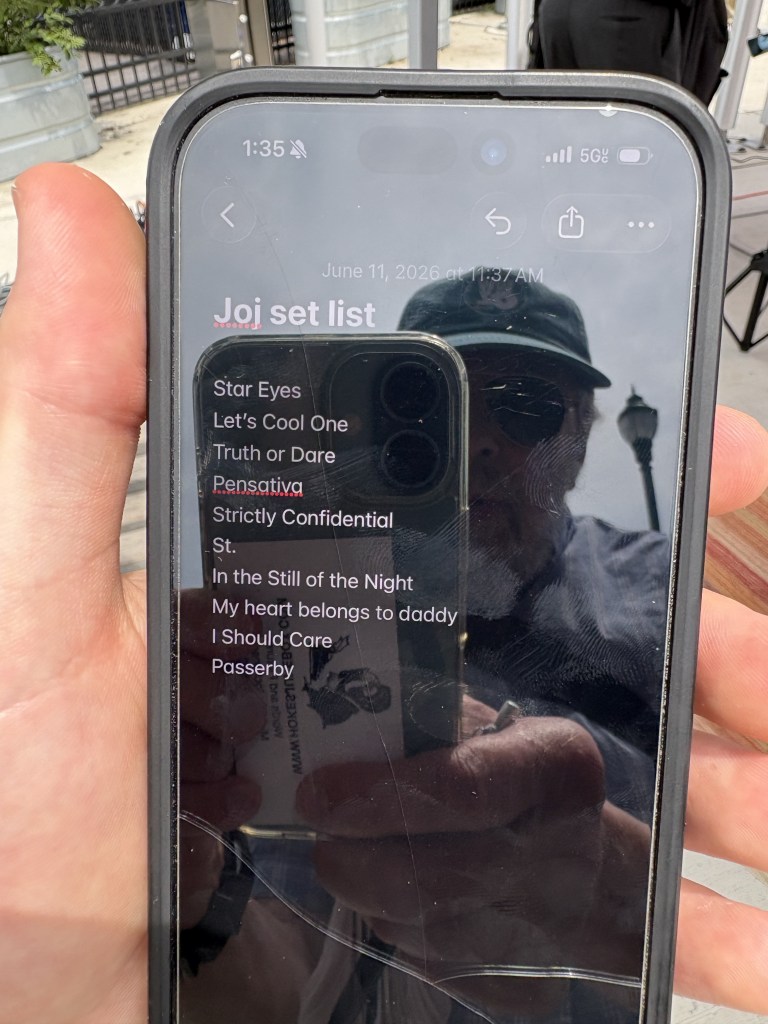
Set List? Right here, on Kinal’s phone:

Saxophonist Bohdan Kinal Leads Quartet at Jazz on Jay – Thurday, June 11

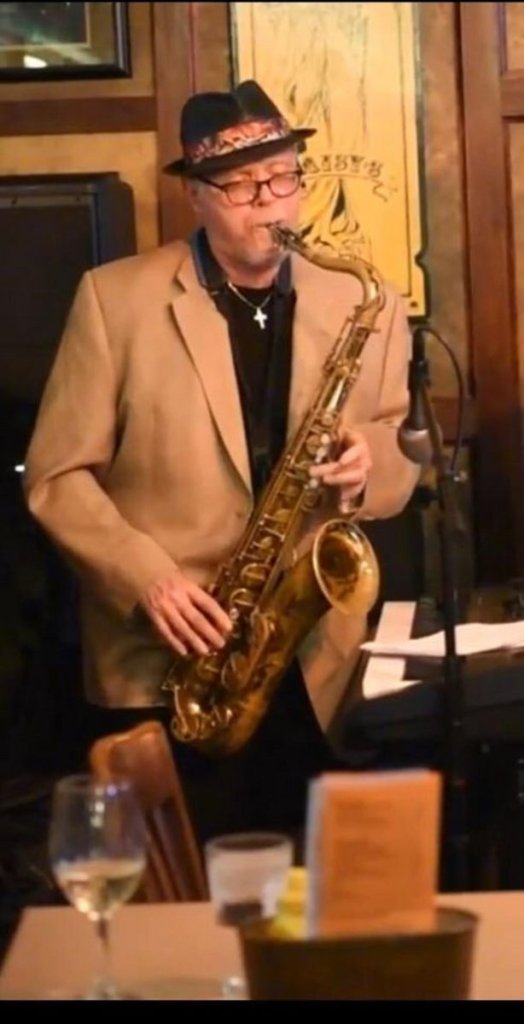
Bohdan Kinal gets around.

The saxophonist first played Jazz on Jay in 2021 when he and most of his bandmates in the Center Square Jazz Collective were still in high school; and he returned last year in bassist Nicholas Dwarwika’s Quartet.

Thursday he leads his own quartet with Sam Wagner, guitar; Vinny Marotta, bass; and Kiemon Noel, drums.

Bohdan Kinal plays tenor sax with Center Square Jazz Collective at Jazz on Jay on July 15, 2021

“Sam, Kiemon, and I have played together since high school,” said Kinal. “We’re all going into our senior year of college now; Vinny is new to our lineup.” (Marotta’s quartet opened for the Van Dyck’s recent all-star centennial tribute to Miles Davis and John Coltrane.) Past jazz giants have long inspired Kinal, plus family, friends and teachers.

His father played sax in middle school and his mother played trumpet and piano and sang through high school, then took up the banjo in college. His grandmother played stride piano for area silent films. “I aspire to have ears like her,” said Kinal.

When Eric Walentowicz brought his sax into Kinal’s third grade classroom, “I remember… being immediately drawn to the sound,” said Kinal. “I think that was the moment I was inspired to pick it up.” (Walentowicz played Jazz on Jay last Thursday with the Union College Jazz Ensemble.)

Kinal said Sonny Rollins’s “Sunny Side Up” album, plus Joe Henderson on both Lee Morgan’s “The Sidewinder” and Horace Silver’s “Song for my Father,” gave him “a concept for the sound of the music early on.” He learned with peers Josh Klamka and Aidan Doyle and from teachers including Walentowicz, Brian Patneaude, Jim Corigliano and Gary Bartz. At the highly selective Oberlin College and Conservatory, Bartz told him, “If I listen to the notes closely enough, they will tell me where they want to go and want to be.”

Doyle played with Klamka and Doyle in their first band after high school. On their first gig, they played the Guilderland Farmer’s Market for tips and a $30 fee.

Kinal played lead alto sax in the 2023 NAfME All-Eastern Jazz Orchestra, with the 2022 and 2023 New York All-State Jazz Orchestras and the Manhattan School of Music Pre-College Big Band. He won the Lee Shaw Memorial Scholarship, an award for best student jazz composition from the University of Denver and a Flint Initiative Grant.
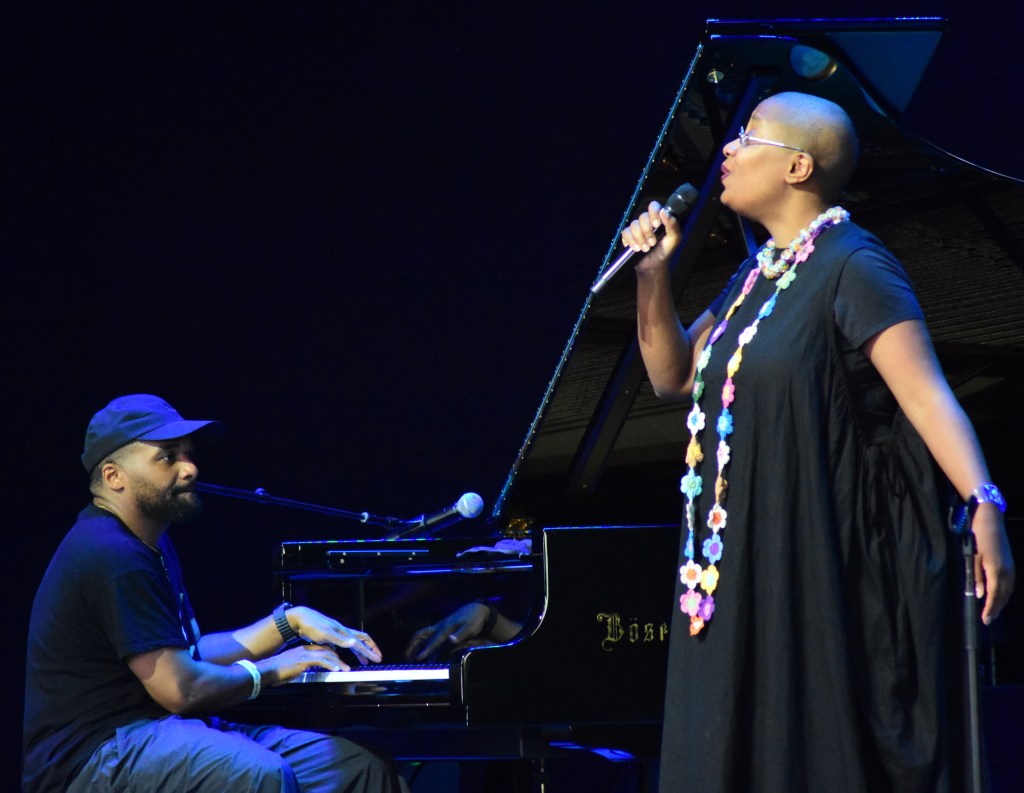
“We’ll be doing mostly standards…but are playing a few originals as well,” he said, listing “Star Eyes,” “My Heart Belongs to Daddy” and “In the Still of the Night.”

“I like to approach standards by honoring the melody, and making it the foundation for soloing,” Kinal said. “Jazz, to me, is just spontaneous themes and variations, and these melodies are the keystone to the themes that are developed during solos.

“There is a lot of room for improvisation and interaction between us. Our music is a space to share and collectively develop ideas.”

Jazz on Jay continues next Thursday, June 18, with Marcus Benoit.

Jazz on Jay is presented by the ElectriCity Arts and Entertainment District. 

Sponsors are the New York State Council on the Arts, a Schenectady County Legislature Arts & Culture Grant, Downtown Schenectady Improvement Corporation and The Schenectady Foundation. We also receive support from Schenectady City Hall and Hoke’s Jukebox. 

Show time is 12 noon at Jay Square opposite City Hall. Rain site: Robb Alley at Proctors.

Review: Union College Jazz Ensemble Opens Jazz on Jay Season; Thursday, June 4

Review: Union College Jazz Ensemble at Jazz on Jay, Thursday June 4, 2026

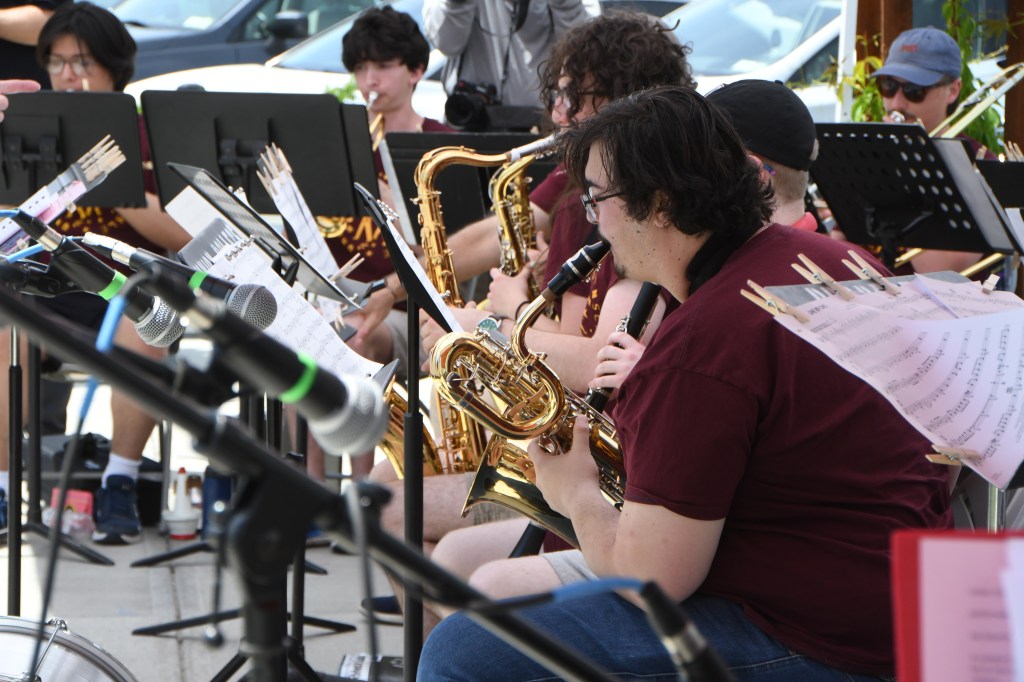
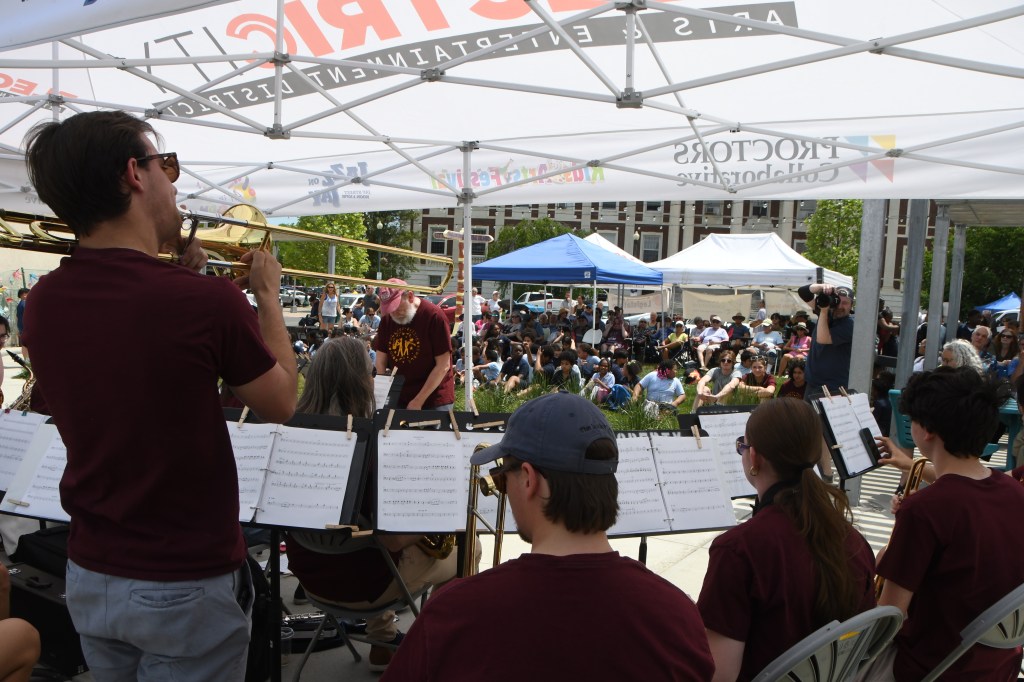
Setting an attendance record – audience AND artists – and adding a bonus performance by the Ellen Sinopoli Dance Company, Jazz on Jay began its new season with the extra-large Union College Jazz Ensemble Thursday in Schenectady’s downtown Jay Square.

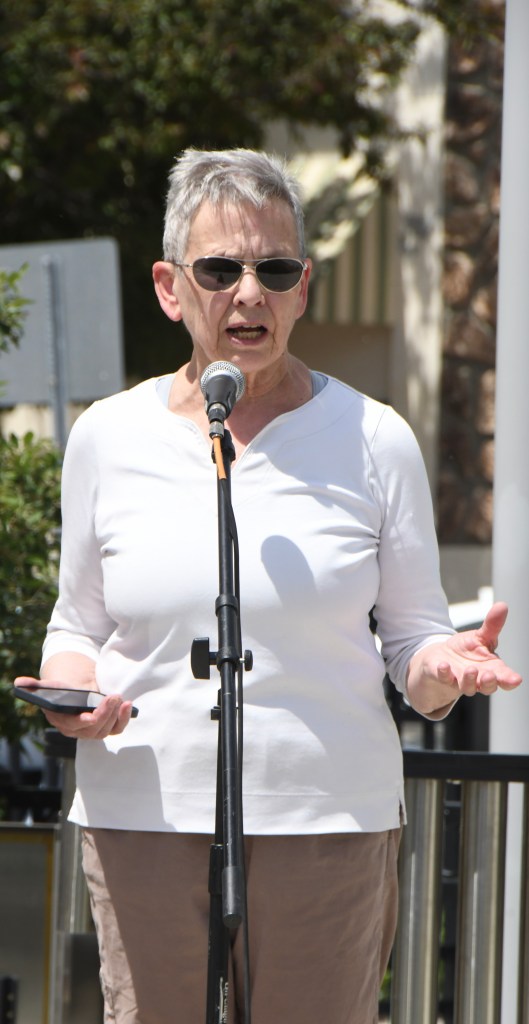
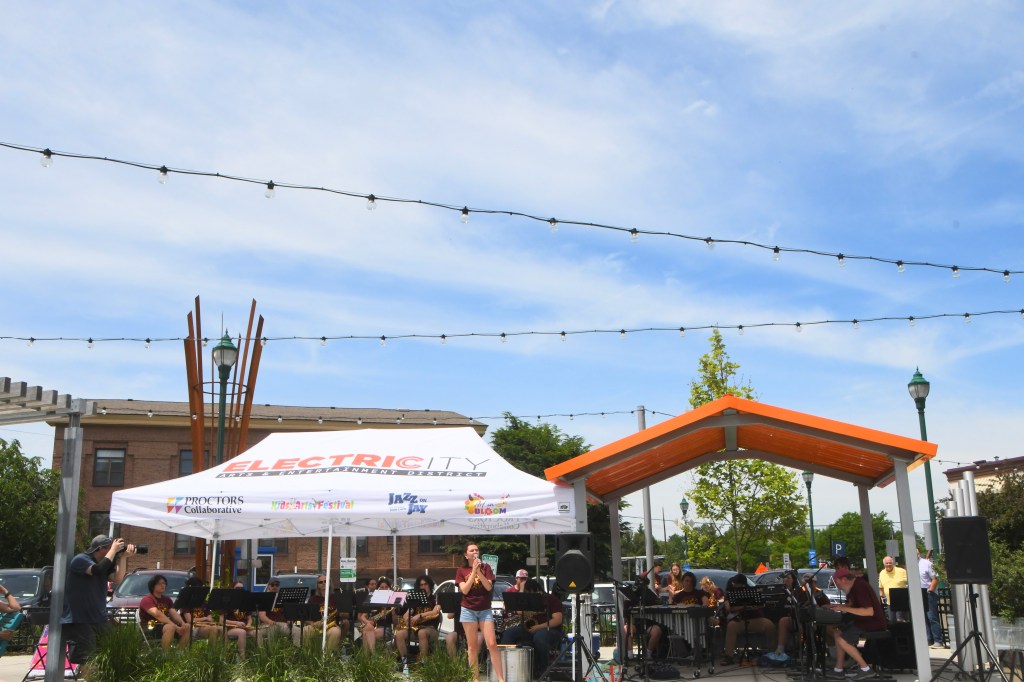
Above: Lanaea Bailey of Proctors Collaborative introduces the Union College Jazz Ensemble at Jazz on Jay; below, Tim Olsen; still lower, students file in.

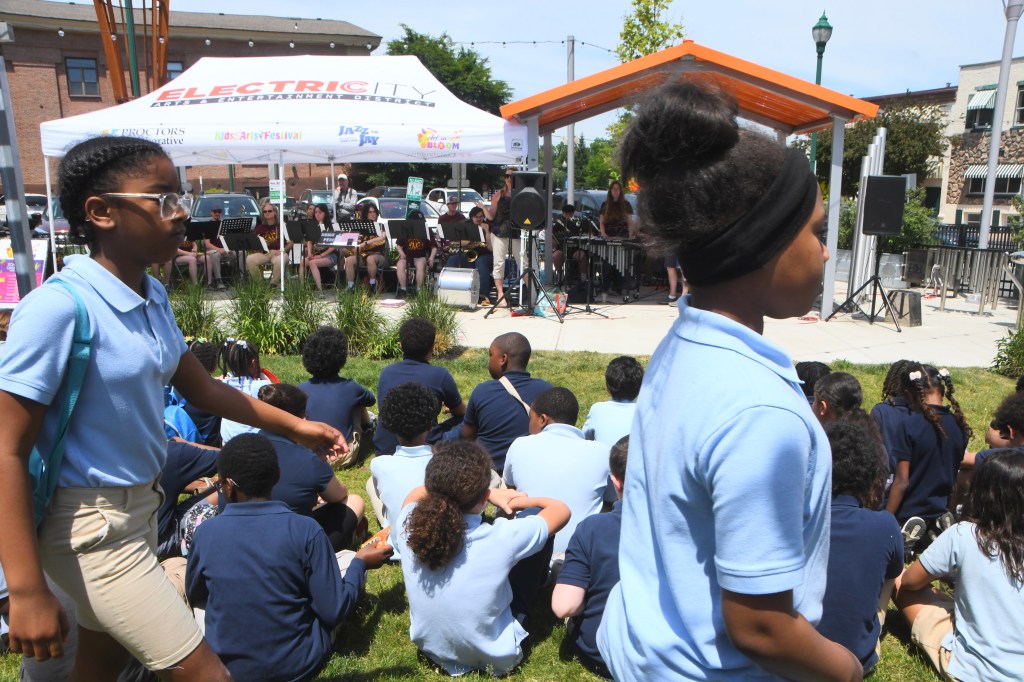
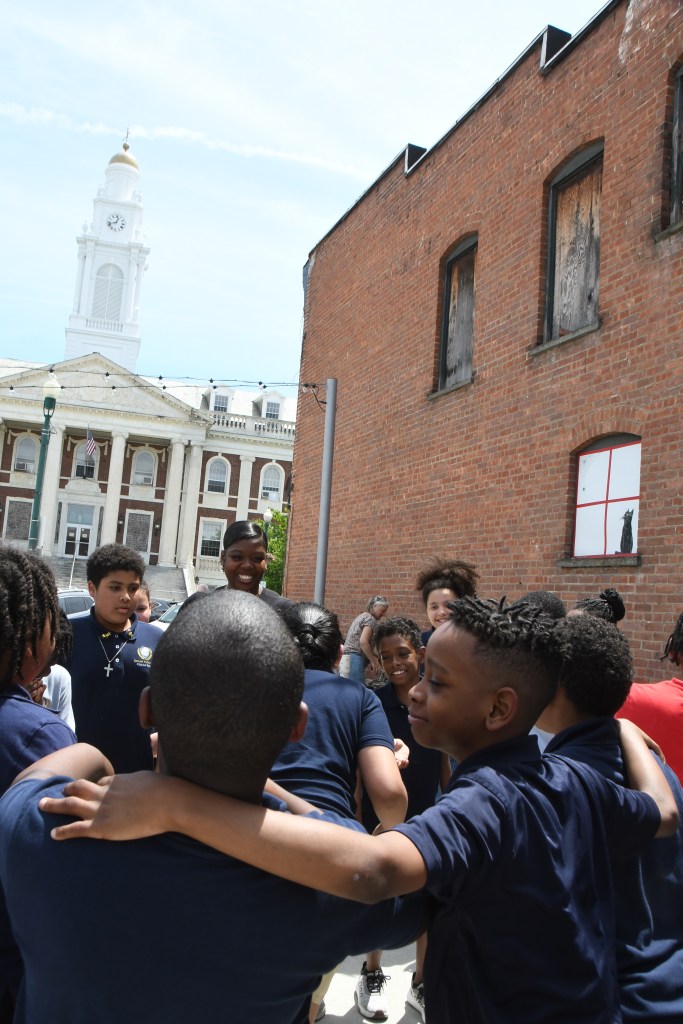
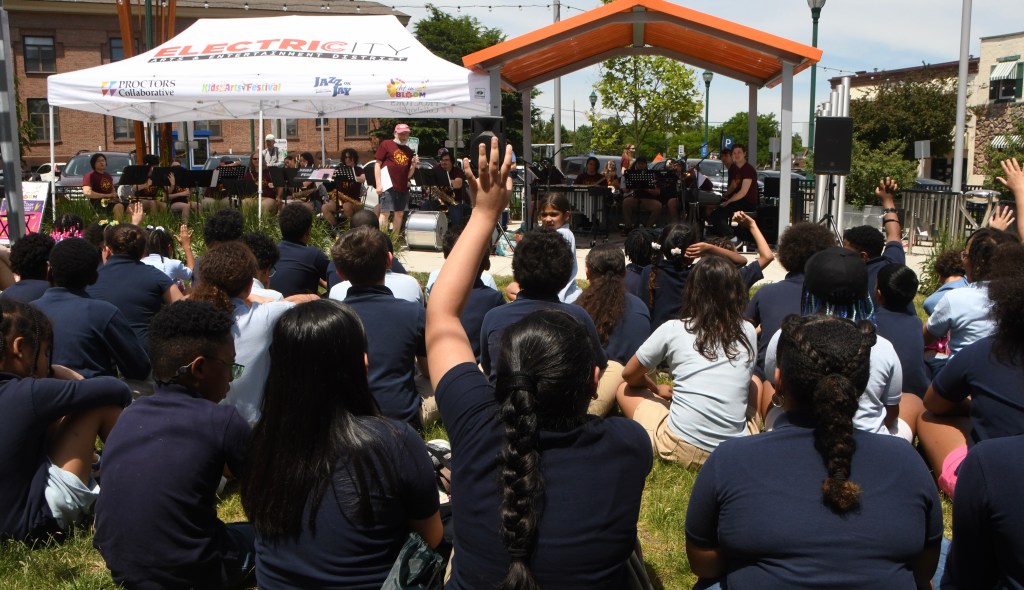
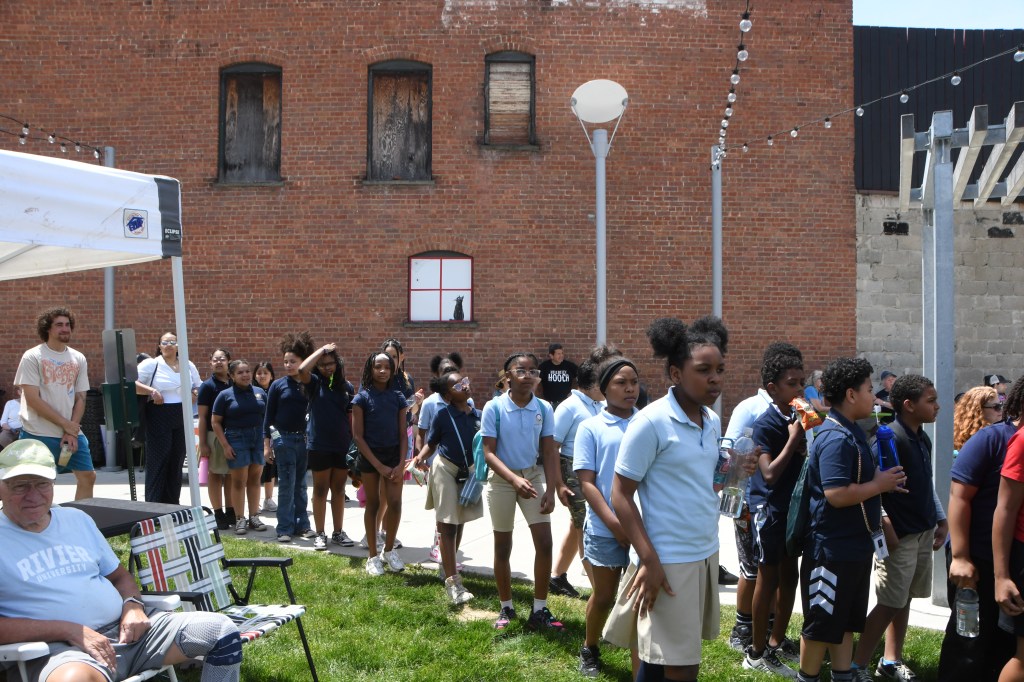
Maroon T-shirted Union student players and singers sheltered from the sun under a tent and the adjacent  permanent orange-roofed gazebo while blue-T-shirted young charter school students swelled the crowd out front. The Ensemble numbered 31, with more singers than any instrument section. Vocal numbers mixed with instrumentals early, then vocals dominated late, singing chorus style. 

Music Professor and Ensemble Director Tim Olsen seldom sounded academic in intros of songs and performers, starting with Wayne Shorter’s “One By One.” Alto sax “ringer” Eric Walentowicz, a respected saxophone pro Olsen later predicted would return to Jazz on Jay with other crews, energized this hard-bop classic, cranking up a busy, fluid alto break. Then “Boplicity” by the Miles Davis Nonet set a cool-jazz vibe featuring trumpets and baritone sax.

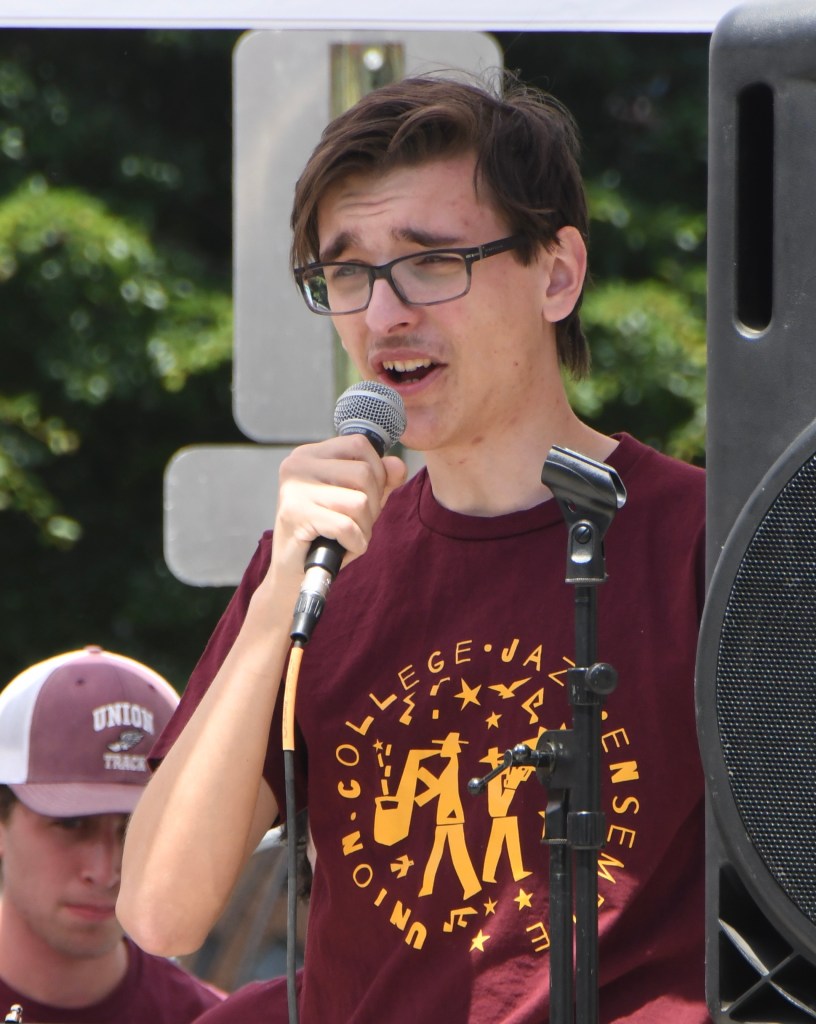
Evan Schieren, above, set aside his trombone to step front and sing “Mack the Knife,” Thursday’s first vocal, and a strong one. Adrianna Miles also sang well, in “Hey Big Spender” – another show-tune favorite. Generally, section playing impressed more often than instrumental solos, showing the ensemble is both well-rehearsed and inclusive, staffed with players of varying skills and experience. The same with vocals; soloists were uneven, but the seven vocalists massed at the end sang cohesive and crisp.

Like a jukebox with deep inventory, well-known numbers dominated. Early vocal tunes “Danke Schoen,” with wobbly vocal, and “I Will Survive” by the all-women trio Debi and the Tri-Tones, spanned Vegas pop and NYC disco, respectively. Olsen gleefully grabbed up a bass drum for the New Orleans parade instrumental “Second Line,” Walentowicz’s alto again soaring over sharp section play. 

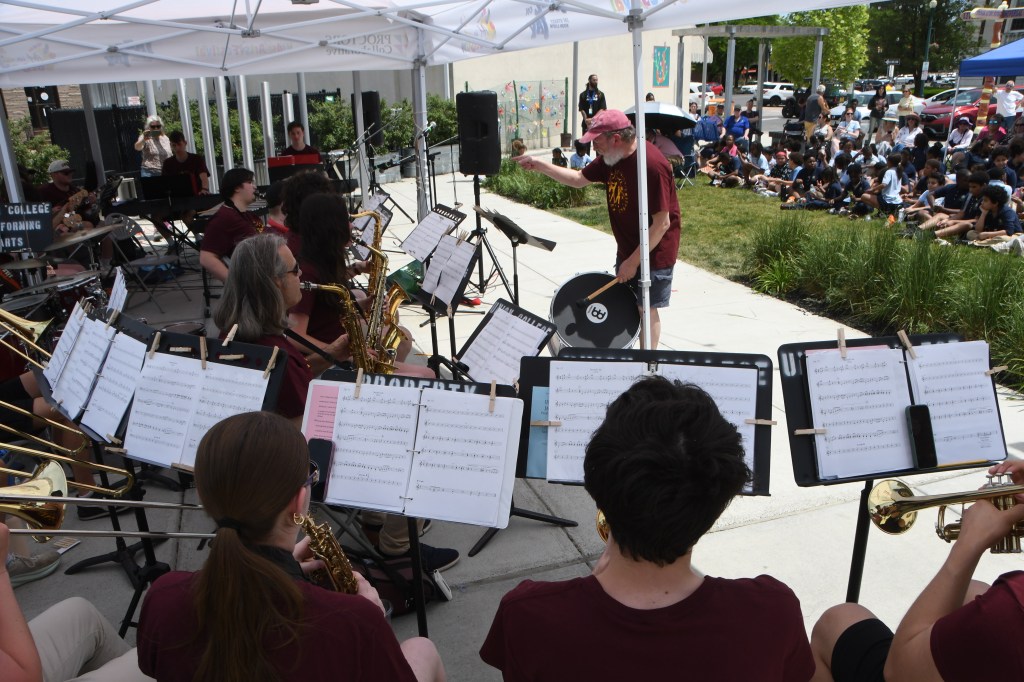
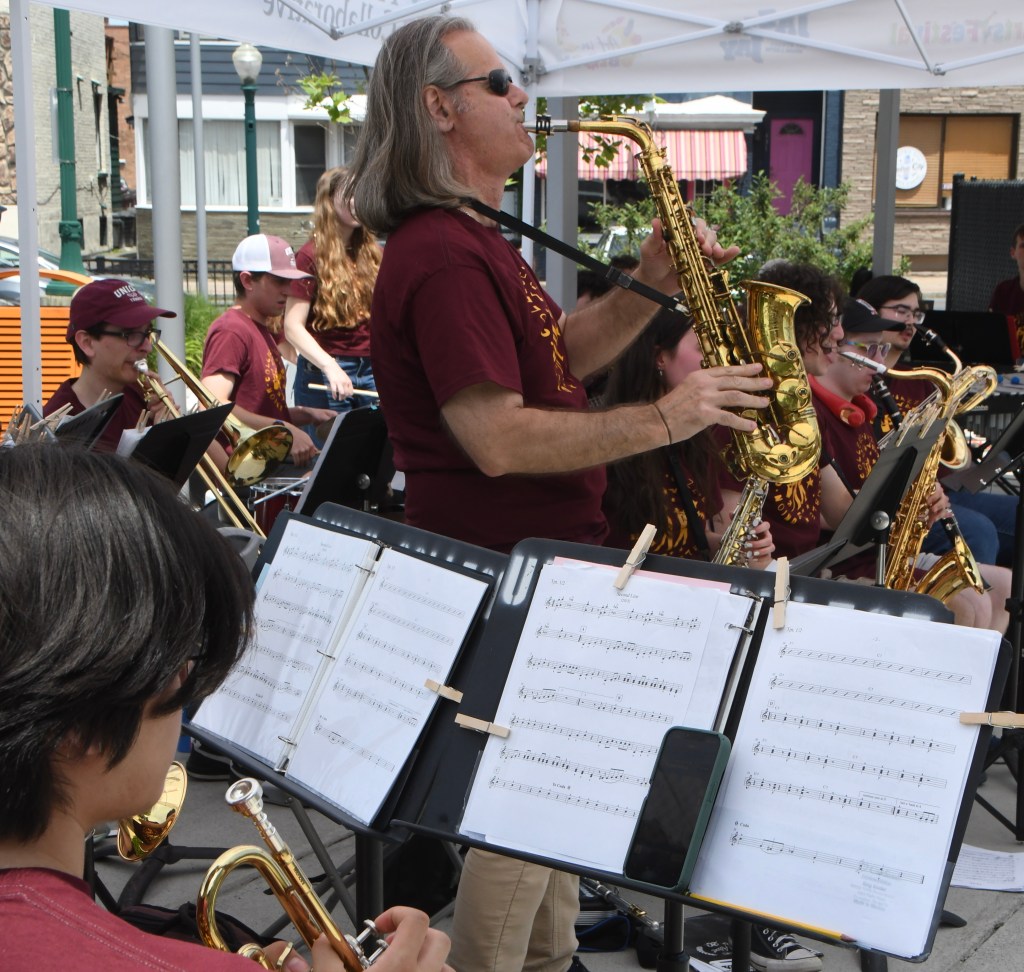
Above, Director Tim Olsen, center, in red cap with bass drum, leads the Union College Jazz Ensemble; below, Eric Walentowicz solos

Olsen’s solo piano framed the vocal in Abba’s punchy-pop “Winner Takes It All” before a cozy trio formed to add heft. Chris Tompkins left the brass section to take over the mic up front in the Sinatra signature croon “The World We Knew.” Walentowicz’s alto co-starred with Rosi Lampert’s voice in Dylan’s “Make You Feel My Love,” soloing sweet and punching short phrases in the song’s seams.

Neal Hefti’s “Cute” faltered a bit from relaxed into languid in its middle section, but things sharpened up at the end. The PMW Trio’s original “Block A” had an easy bossa charm and conventional development. But then they rode a smooth segue into Dave Brubeck’s familiar “Take Five” in a muscular glide without the trademark saxophone; Walentowicz could certainly have handled that.

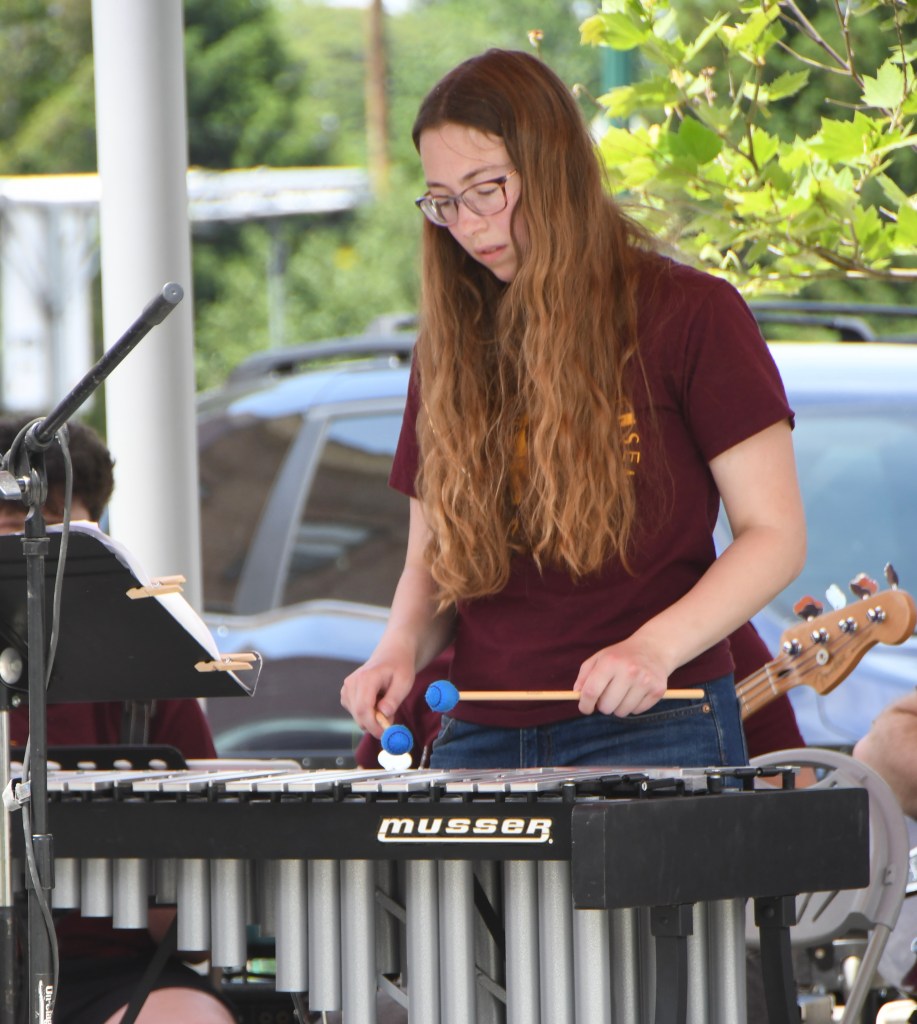
Grace Schultz

Grace Schultz left the drums and percussion section at the rear for the vibraphone up front in the Lionel Hampton/Benny Goodman upbeat classic “Flying Home;” this faltered some on tentative sax playing but recovered its energy and cohesion.

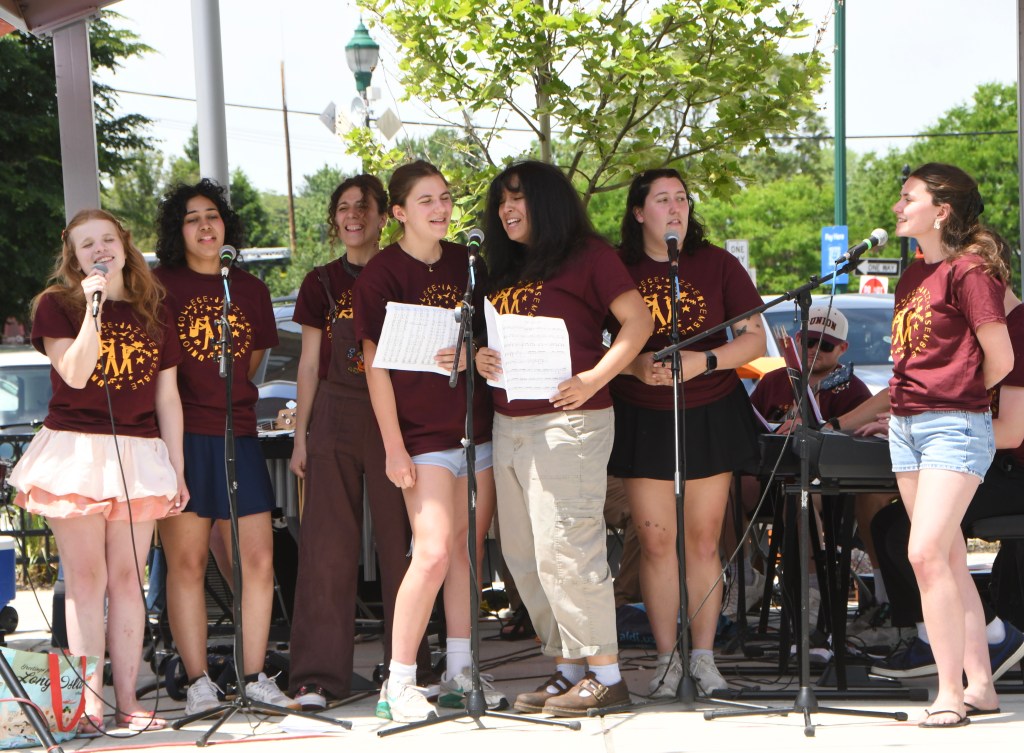
Then Olsen summoned seven singers up front, all women, for the Andrews Sisters’ swing time staple “Don’t Sit Under the Apple Tree With Anyone Else But Me,” sung both straight and with counterpoint. This voice-dominant version of the Ensemble stayed put for Raye’s peppy “Where’s My Husband?” – alternating sung and rapped verses. Behind them, the instruments shone strong, too, a fine, big finish.

Let’s give the stage crew some: Balancing inputs from dozens of microphones, and likely direct inputs for electric instruments, didn’t faze the sound engineer, who delivered clarity and kick. The crew helped the Ensemble strip down the stage for the Ellen Sinopoli Dance Company to take over. 

Jazz on Jay continues through Aug. 27. Next up: the Bohdan Kinal Quartet on Thursday, June 11. The Jazz on Jay weather haven is Robb Alley at Proctors.

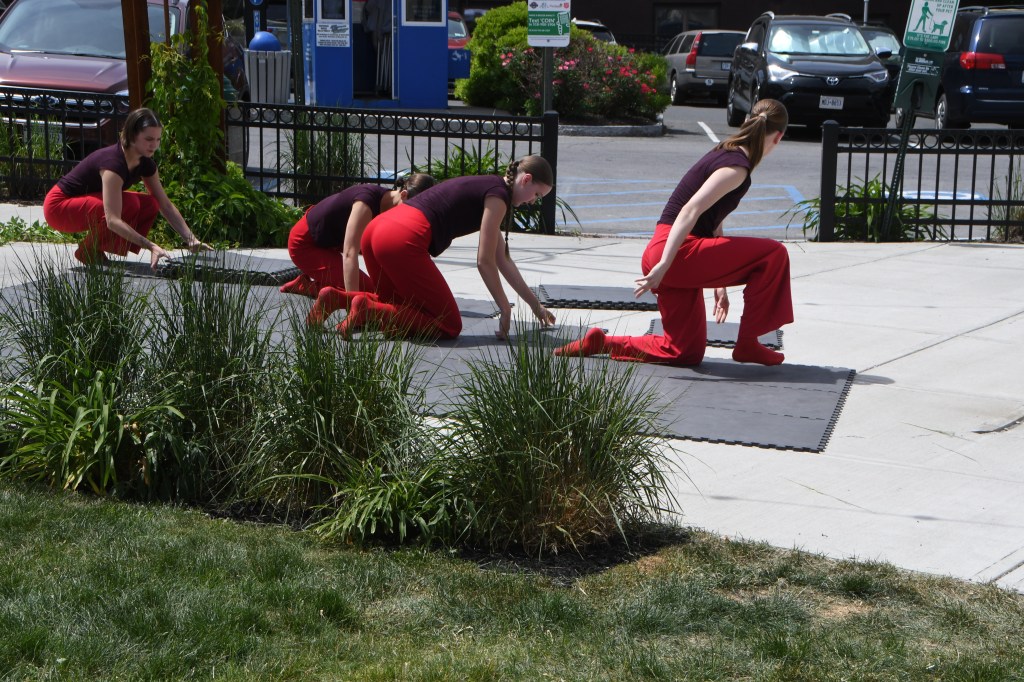
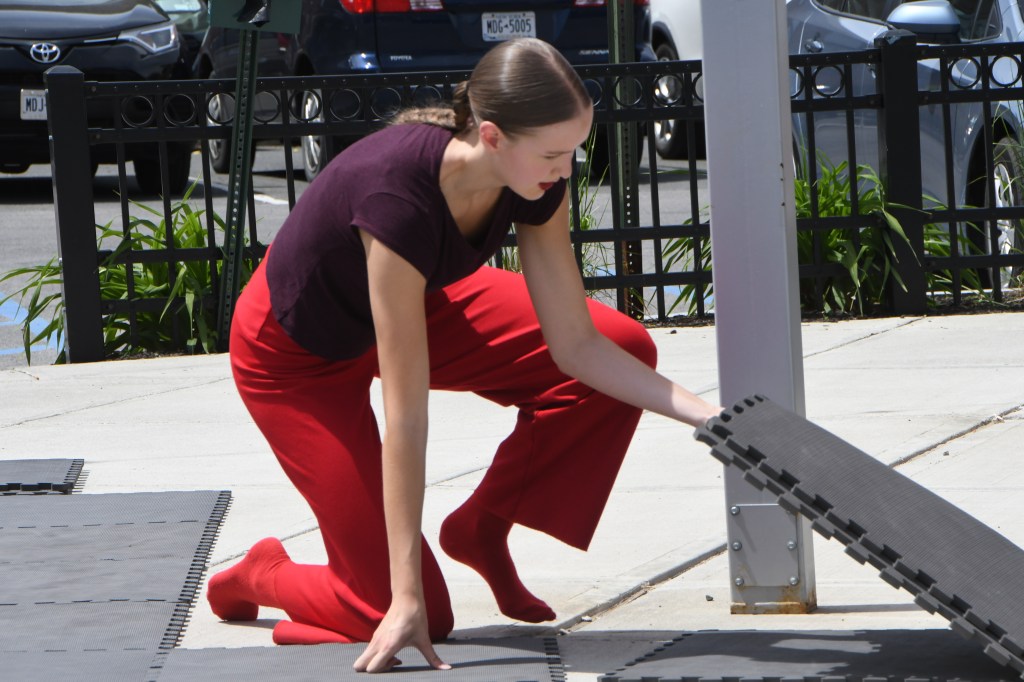
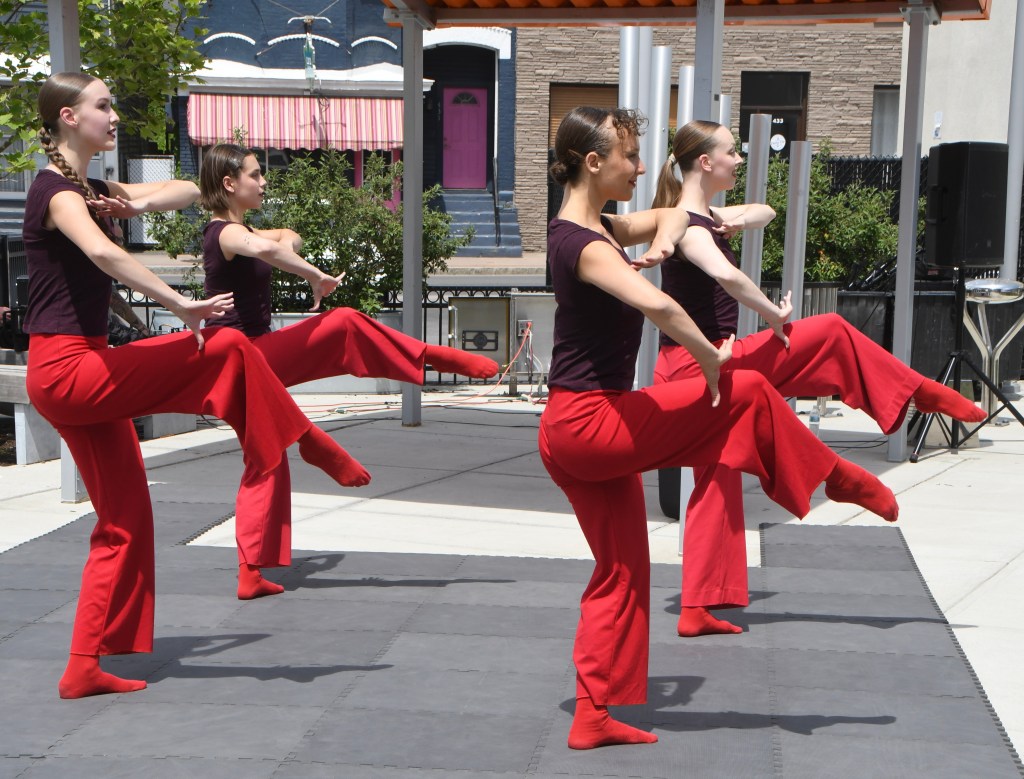
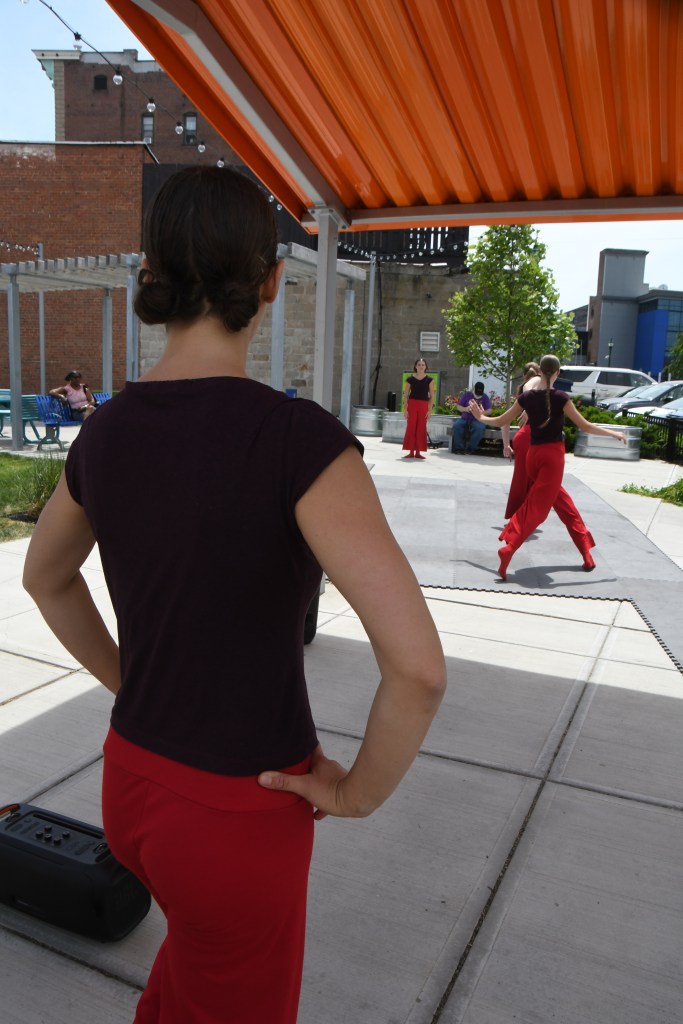
Bonus 1 – The Ellen Sinopoli Dance Company presented an impressive, varied and condensed (30 minutes) recital that began with the four dancers assembling their own dance-floor of interlocking rubber panels where the Union College Jazz Ensemble had just performed. This was both efficient and performative; music played as they worked. Sinopoli explained this was part of a 35-show summer series celebrating her company’s 35 years. She chose mostly jazz music, including works by local or regional artists, in a fitting and courteous choice.

Ellen Sinopoli, above; dancers below

Bonus 2 – Maestro Olsen, above, provided the full Union College Jazz Ensemble roster. He also noted Thursday’s show was the swan song of seniors soon to graduate. The ensemble will fire up after Labor Day. Thursday, it comprised:

Jonathan Deitchman, clarinet

Lily Eagen, soprano sax

Ryan Fusco, tenor sax

Zachary Lipyanskiy, bari sax

Angelina Martinelli, flute/alto sax

Eric Walentowicz, alto sax

Kent Angert, trumpet

Gael Landa, trumpet

Oliver D’Anna, trombone

Sammy Fenigstein, trombone

Evan Schieren, trombone/vocals

Chris Tompkins, trombone

Ryder Mollo, piano

Zion Schlussel, piano

Diego Fuentes-Alvarado, guitar

Jack Gold, guitar

Leo Weisberger, guitar/bass 

Nate Feinfeld, bass

Owen Santora, bass

Francesco Ciaramitaro, drumset/percussion

Ben Pistiner, drumset/percussion

Grace Schultz, drumset/percussion/vibes

Mollyjane Boyle, vocals

Ashley Callery, vocals

Sofia DeCola, vocals

Strahlia Durr, vocals

Georgia Keleki, vocals

Rosalind Lampert, vocals

Adrienne Long, vocals

Adrianna Miles, vocals

Melanie Thomas-Denaxas, vocals

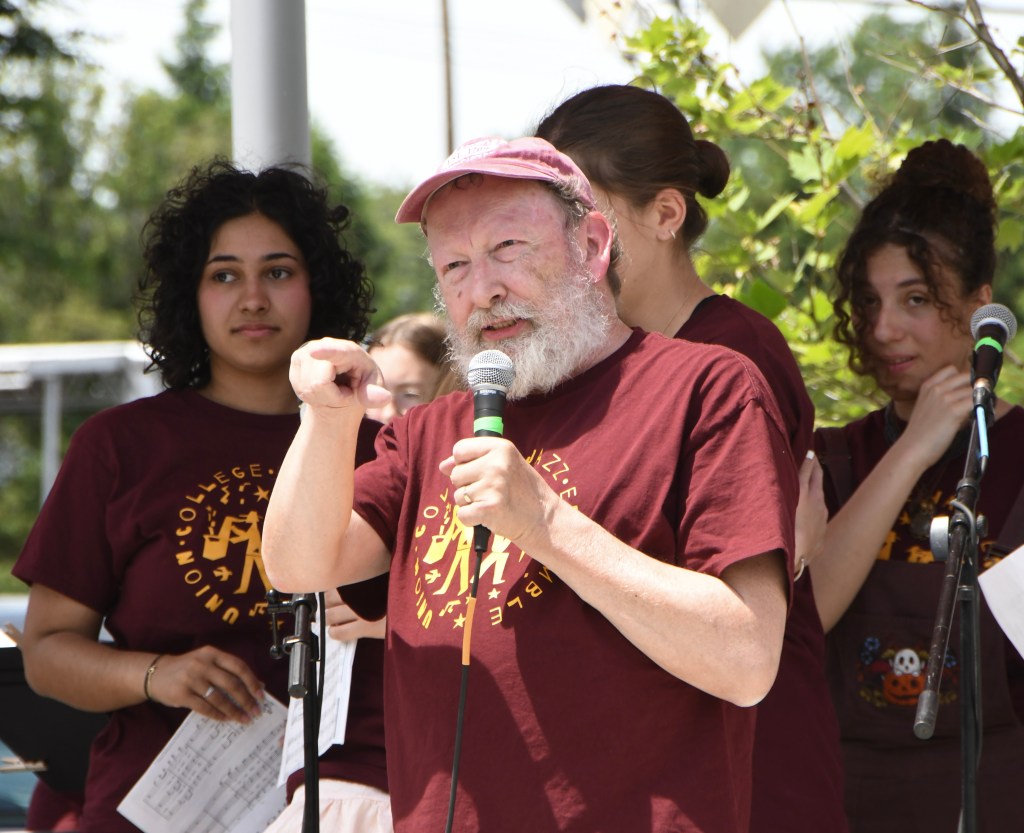
Tim Olsen, onstage, left of center, asks students who plays instruments

Union College Jazz Ensemble Opens Jazz on Jay Season Thursday at Noon

Union Professor and Ensemble Director Tim Olsen Leads Student Musicians

Six sax or clarinet players, two trumpeters, four trombonists (one also sings), two pianists, two guitarists (one also plays bass), two bassists, three drummers/percussionists and nine singers. That’s the Union College Jazz Ensemble, kicking off the Jazz on Jay season Thursday with the largest crew ever in this free series.

At 31 players and singers strong, the ensemble numbers nearly as many years as its director Tim Olsen has taught at Union as professor, composer, conductor, trumpeter, pianist and trombonist.

“I knew I wanted to be a musician from middle school onward,” says Olsen, citing trumpeters Louis Armstrong and Maynard Ferguson as inspirations, also composers, arrangers and bandleaders Duke Ellington and Oliver Nelson. Olsen formed his first band in high school, earning his first fee of $50 playing a St. Paul wedding. 

Tim Olsen plays a trumpet solo while leading his Big Band to open the 2024 season of A Place for Jazz. He also played piano and conducted the ensemble, which filled the stage at SUNY Schenectady County Community College Carl B. Taylor Auditorium.

Training intensively and at length, he earned his bachelor’s degree in music theory and composition at Washington University in St. Louis, a master of arts from the University of Minnesota (his home state), several more masters and a doctorate from Yale. After studying organ at the Royal Danish Conservatory of Music in Copenhagen as a Fulbright Scholar, Olsen found his place teaching and performing at Union in 1994.

He teaches in classrooms and practice rooms, directs a quartet, a quintet and a big band, records and performs original music. His 18-piece Tim Olsen Big Band, co-starring singer/wife Susie Olsen, opened the 2024 season at A Place for Jazz. He’s also launching Jazz on Jay’s season today, leading his students.

“I don’t really have an audition process the way a traditional orchestra, concert band, or choir might,” Olsen said. “Students show up at the beginning of the term. They sit in, and if they’re comfortable, they stay. If not, they go back to the practice room and work on technique and sight-reading.”

At Jazz on Jay Thursday, “We’re playing a wide spectrum of jazz and related pop music,” including the big band swing of Lionel Hampton’s “Flying Home,” the Andrews Sisters’ “Don’t Sit Under the Apple Tree,” cool jazz of Miles Davis and Gil Evans in “Boplicity,”  pop standards “Mack the Knife,” “Danke Schoen” and “Big Spender” – plus Raye’s contemporary sound in “Where Is My Husband.” In addition, Olsen predicted some groups in the Ensemble would play originals.

“We’re featuring our (nine!) vocalists at the end,” said Olsen. “There should be close to 30 people on the stage.” He checked the Jazz on Jay stage recently: “We think we can fit everyone.”

Jazz on Jay is presented by the ElectriCity Arts and Entertainment District. 

Sponsors are the New York State Council on the Arts, a Schenectady County Legislature Arts & Culture Grant, Downtown Schenectady Improvement Corporation and The Schenectady Foundation. We also receive support from Schenectady City Hall and this blog.

The series comprises 13 concerts, all presented free. 

Show time is 12 noon Thursdays at Jay Square opposite City Hall. If the weather turns too wet or warm, Jazz on Jay concerts move indoors to Robb Alley at Proctors.

NRBQ: Night 2 at Levon’s

On the second of a two-night stand at Woodstock’s Levon Helm Studios Saturday, NRBQ everything worked, it all fit and flowed faster and farther, better than Friday. The mood was up; tempos, too; also confidence, communication – unspoken, intuitive – and cohesion.

NRBQ, from left: Terry Adams, John Sebastian, Jake Edwards, Casey McDonough, Scott Ligon, Klem Klimek, Gene Oliveri

When they hit hard with the exuberantly rhythmic, joyful opener “Yeh Yeh,” fans smiled around at each other, exclaimed “WHOA!” and dance-clustered in the scanty open spaces, way more active than on Friday. Then “Terry Got a Muffin” shifted into an even higher gear, that trademark almost-frantic but somehow loose, happy groove, guitarist Scott Ligon’s voice soaring atop both rousing numbers. He and bassist Casey McDonough harmonized as the band relaxed a bit into “Rain at the Drive-in” about love behind fogged car windows. A slower tempo and cozier feel didn’t diminish the energy or momentum, just made it romantic. This perfectly set up the laid-back exorcism of “Blues Stay Away from Me,” cool saxophones of Klem Klimek and Gene Oliveri and John Sebastian’s baritone guitar conversing around the edges.

Then, the usual roller coaster, bumping the energy in the blithe strut of “Singin’ in the Rain,” Scott singing and Terry Adams’s piano erupting strong. “Magnet” rolled in a similar arrangement, but here Scott lit up the tune with a swaggering guitar break and burly vocal, sharing the spotlight again with Terry’s piano. 

Next came a slow-down three-song sequence; then an explosion.

“Daddy’s Gonna Tell You No Lie” reassured in a calm, contained way, Casey and Scott singing together. Scott nodded to Klem, cueing a hot tenor sax break; Klem shrugged off the mid-song applause with hilarious mock humility. 

Gene Oliveri’s chart tablet

Monk’s “Pannonica” did what the best Monk tunes do; Terry first portrayed one feeling, then layered on others so subtly the emotions blended, buzzed around together in successive revelations, each a surprise. This masterly piano excursion hypnotized, slyly nuanced but accessible right away; here the saxes had their subtle say, too. 

John sang “Richland Woman Blues” persuasively, in better voice than anything he sang Friday. Then Klem knocked everything sideways in the irresistible detonation of “Get a Grip,” sensational R&B fervor at top volume. A saxophonist, he sang like a human trumpet, roaming restlessly up front; Scott’s guitar break hit just as hot.

Klem Klimek, above; Scott Ligon, below

That four-song run felt like a peak, but then they kept things just that high right through to the end. “Please Don’t Talk About Me When I’m Gone” built from Terry’s quiet solo piano intro, expanded via his vocal, smoother, stronger than Friday. Then everybody built this happy groove together. Scott’s guitar first comped chords, then staccato single notes flew fast, Casey’s bass got busy, drummer Jake Edwards took his first solo all night, then the saxes took their turn. 

This outburst echoed the careening energy of the opening run, then “We’re Walking” and “We Travel the Space Ways” – Afro-Futurist mission statement of Sun Ra, one of the heroes Terry cited Friday in “Imaginary Radio” – celebrated happy motion, on foot, then planet to planet. Terry both sang and soloed big in “Walking,” while Klem cracked up Gene by ad-libbing about Christopher Walken. Scott’s solo here, though, was serious business, a gleeful note clatter. 

Introduced by Terry’s piano carving circular riffs, “Spaceways” looked into the future, but its groove reached back, to a powerful railroad-like momentum. Here, Scott detuned his guitar for sustained, bent-note glides under Klem’s hard-charging solo. 

The rueful confessional “That Makes Me a Fool” hit home in Scott’s heartbreaking/heartbroken vocal, saxes edging in between phrases, before things went comical again.

Casey McDonough


Casey’s vocal led the goofy shuffle “Yes, I Have a Banana,” affirmative reply to the familiar fruit denial. In the raucous, playful “Hit The Hay,” Sebastian shifted to banjo and the crowd shouted the refrain. These novelty numbers sandwiched the seductively tender “Things to You,” slower and seriously sweet. Again, Scott’s vocal brought this lovely lyric to poignant life.

Then came a happy-love pairing – ‘I Love Her She Loves Me” in simple sincerity and the pledge “Never Take The Place of You” – and an antique celebration of music itself: “The Music 

Goes ‘Round and Around.” Terry’s solo rang sweet and serene in “I Love Her” with Scott shifting to acoustic guitar and singing lead. He was back on electric for “Never,” John chiming in on harmonica and everybody chanting “Never!”

Saxes starred in the rollicking “Music Goes ‘Round,” Klem quoting “Pennies from Heaven” – as he’d quoted the recently deceased Woodstock resident saxophone colossus Sonny Rollins’s “St. Thomas” in a solo on Friday. 

Terry stood and donned his coat to signal the end and they went off, briefly. Then, as at the beginning, a run of their most joyful tunes hit as happy encores. “Little Floater” (refrain: “I’m in love with an automobile and I know that it loves me too”) cruised on Terry’s synthesizer glide. The careening “Howard Johnson’s Got His Ho Jo Working” raised the question of the next tune, “Do You Feel It?” The band was rightly confident of the answer. Terry led early with jaunty piano and vocal while Klem brought the crowd back up to its feet, happy unanimous. He didn’t bother calling out this invitation; he simply went to the front row and took two fans by the hand, the folks next to Fred and Mary from LA – you remember – and drew them to their feet so everybody got the idea.

“Green Lights” delighted with its sense of release, that all the barriers to love are gone, blown away – like Scott’s guitar solo did to everybody.

Terry Adams

While all the NRBQ players but Terry Adams have changed over half a century plus, the play itself never has. Virtuoso without stiffening into fussy, playful but with serious intent, their music combines highly idiosyncratic individual performance with unanimous joy in the audience. The particular reaches the universal. Fans become part of the thing.

Full of taste, touch and tuneful fire, Terry’s keyboards weld the pieces together, leaving plenty of oxygen for everybody. He leads with a light touch, or none: He sometimes simply starts a tune and the band jumps in immediately. Klem would recognize a song after the first notes and notify Gene, who’d scan his tablet for a chart, if necessary. More often, he’d launch right away, too.

Klem Klimek, left; Gene Oliveri, right

Terry Adams, at left, digs Jake Edwards’s drumming; stage tech deluxe John Krucke at center. Below: Jake Edwards

That includes even new drummer Jake Edwards, maybe half Terry’s age and from the same western Massachusetts area where Terry now lives. Jake swings more like NRBQ’s late longtime drummer Tommy Ardolino than his more rocking predecessors in between; Jake really has the feel. This works because Casey’s bass hits as sparsely and strongly as Joey Spampinato. Playing a bit behind the beat, he pushes the music forward.

Scott Ligon, above, twice; John Sebastian, below

Guitar ace Scott Ligon’s high-energy solos burst with confident bravado or settle into subtle musings; just as essential to the songs and the feel, he steadily supports the groove and his bandmates when they solo. ‘Q songs breathe in an inviting way, seams open for interjections and comments. It’s always a conversation and always open. Frequent guest John Sebastian showed last weekend he knows how to find those spots just as well as the regular crew. 

Wait, no – there’s nothing regular about NRBQ, maybe America’s most beloved band, revered by fans who pilgrimage across the country to see them.

Saturday, June 30

8:10 – 10:05 p.m.

Yeh Yeh

Terry Got a Muffin

Rain at the Drive-in

Blues Stay Away from Me

Singin’ in the Rain

Magnet

Daddy’s Gonna Tell You No Lie

Pannonica

Richland Woman Blues

Get a Grip

Please Don’t Talk About Me When I’m Gone

We’re Walking

We Travel the Spaceways

That Makes Me a Fool

Yes, I Have a Banana

Things to You

Hit The Hay

I Love Her, She Loves Me

Never Take the Place of You

The Music Goes ‘Round and Around

Encores: Little Floater

Howard Johnson’s Got His Ho Jo Working

Do You Feel It?

Green Lights

Note on Photos: Friday, I sat in a side section along stage right – the Terry side – but moved around some, in very tight quarters. Saturday, I roamed but mainly stood along stage left – the Klem side – and again moved around some.

Fred and Mary, from LA

Intermission, Between NRBQ Shows

Part 2 of 3

Thin rain flew sideways on wind so strong it earned warnings on the Kingston Rhinebeck Bridge over the whitecap-etched Hudson far below. On a rainy Saturday morning sentimental journey to the Bard campus, where my son, daughter and son’s wife all graduated, there was not a soul in sight. The art gallery was closed, everything seemed closed; but memories of happy dinner-time visits with my young ones, just an hour south of my Albany ad-and-pr agency office, echoed sweet. I remembered an Easter picnic at Blithewood, the mansion Bard had absorbed on a high bluff over the river.

The rain blew out of town as I recrossed the Hudson toward Woodstock.

The tie-dyed, pot-smoked town looks backward so strongly it’s become an easy target as a ‘60s cultural anachronism. But as skies brightened over my quest for parking, it felt cozy, charming.

Looking closer, it also seemed clamorous: many cars and people, and too many dogs, like the large, ill-managed and aggressive one that routed a woman from her bench by jumping on her repeatedly. 

She’d asked permission to occupy her spot from a throng gathered behind it to watch a band playing on the patio in front of a Haight- or East Village 60s-style boutique. The building bore a sign claiming Dylan hung out there when it was Cafe Espresso. The band had the vintage-jam sound in its pocket, stretching out on the Velvets’ “Sweet Jane” as I had walked from the Woodstock Artists Association and Museum art gallery through a bookstore visit. I found an empty folding chair just off the sidewalk by the boutique and watched the band ease confidently into Traffic’s “Feelin’ Alright” then segue into the Dead’s “I Know You Rider” over a relaxed half hour. Later came “Come Together,” “Turn On Your Lovelight,” complete with Pigpen-style rap, and “Sitting In Limbo” with all its Caribbean flavor bleached out, but rocking OK. “You’d almost think we’d rehearsed,” claimed the lead singer.

A woman offered her pre-rolled to the drummer. A pro, he toked without losing the groove. Later, the lead singer pulled a bourbon pint from his guitar case and passed it among the band. Google “Old Woodstock hippie” and you’d find the guy in white beard and big hair who approached the band and reached for the bottle. The singer hesitated a bit before laughing and handing it over for a hefty snort.

As they shifted to 80s gloom and started the Cure’s “Pictures of You,” I scanned the folks whose look and affect seemed Woodstock-perfect but might not work as well elsewhere. They looked and acted like stars; maybe some were, some I thought I’d seen onstage somewhere, with somebody. Was that guy in lots of turquoise Steve Stevens from Billy Idol’s band? Was that wide-shouldered, big-jawed guy behind me Donald Fagen?

Heading back to the middle of town, I stopped to buy the novel I’d knocked off the shelf earlier in the Golden Notebook, managed not to buy any record-label cassettes ($6, about what they cost new) in Woodstock Music Shop with its stacked amps, guitars hung on racks overhead and knee-to-ceiling shelves offering albums in crammed bins. Step-stools gave views of the highest strata. I sat in a park nearby reading, watching the scene change in the lowering sun as the sound turned up.

The municipal parking lot behind me – $10 all day, free after dinner – filled up with more vehicles than earlier. A lean gent in cowboy glitz with braided beard set up amp and mic on a small shop’s even smaller porch. His accompanist tuned his guitar, then unplugged and walked, still wearing the guitar, to grab something from his car. A woman who’d brought her djembe to the porch decided not to play after all, packed it up and left as another woman walked past, music stand in one hand, guitar case in the other and a ukulele in her backpack, headed for a gig somewhere.

The glitzed cowboy started to sing in a Tom Waits growl as a full band down the street started to rock “Statesboro Blues.” The place felt happily alive, but it was time to head back to Levon’s.

Woodstock remains a town made by music and other arts; but on the weekend of The Festival (mid-August, 1969), NRBQ played the Aerodrome in Schenectady. My brother Jim skipped Woodstock to see NRBQ instead, and they changed his life. In bands himself since fourth grade and later a frequent guest saxophonist with them, he felt amazed, charmed, by the possibility their freedom and fluency in any style of music showed him.

And that’s what they still do.

Like Friday and Saturday, in Woodstock.

NRBQ at Levon Helm Studios, Woodstock; Friday, May 29 (First of two nights)

Boarding their flight from Los Angeles to JFK, Fred and Mary compared destinations with a stranger across the aisle. “We said we were headed to Woodstock,” Fred recalled. “Oh, you’re going to see NRBQ,” said plane neighbor Mark Rowland, a writer who’d profiled the ‘Q’ decades before in Musician magazine. “Seeing NRBQ play…for the first time is a little like sauntering into an amusement park with all-new rides,” Rowland wrote then. “You’re happy to be in on the discovery, and you’re having fun, but it’s still a little uncertain just what is going on.”

Other fans I met or re-met Friday at Levon Helm Studios flew from Atlanta, Seattle, Dallas, Omaha. Or they drove from Chicago, Boston, or across town, as John Sebastian did to guest on both Friday and Saturday shows, the beloved band’s first in weeks and last until August.

NRBQ fans may be dedicated as Deadheads. Super fan “Johnny D” DeAngelis followed them for a full summer as a teen and has seen them hundreds of times since. But they’re far fewer. Both shows sold out immediately, but the Levon Helm Studios hold only 250: 100 seats plus standing room for 150. It’s closer than intimate: Front row fans sit about a yard from the monitors; balconies stack tall in the timbered space. 

Johnny D and friends

NRBQ Friday, from left: Terry Adams, Jake Edwards, John Sebastian, Casey McDonough, Klem Klimek, Scott Ligon; Gene Oliveri obscured behind Scott

Friday felt thrilling, spiced with scarcity, the tang of something much missed; but also raw at times, tentative and uncertain, like Rowland wrote. Saturday felt focused, sharp, soaring; as if Friday was practice, Saturday the pay off. Yet even if Saturday hadn’t happened, fans from far and near wouldn’t have complained. 

When I bumped into John Sebastian just before show time Friday, I asked how much he’d play. “I don’t know,” he laughed. “I never know.” Uncertain, but ready, he went onstage right away as old friend, NRBQ co-founder, leader, keyboardist Terry Adams waved him to right join. He strapped on his baritone guitar and checked his harmonica case as bassist-singer Casey McDonough, guitarist-singer Scott Ligon, young new drummer Jake Edwards and saxophonists Klem Klimek and Gene Oliveri took up their instruments.
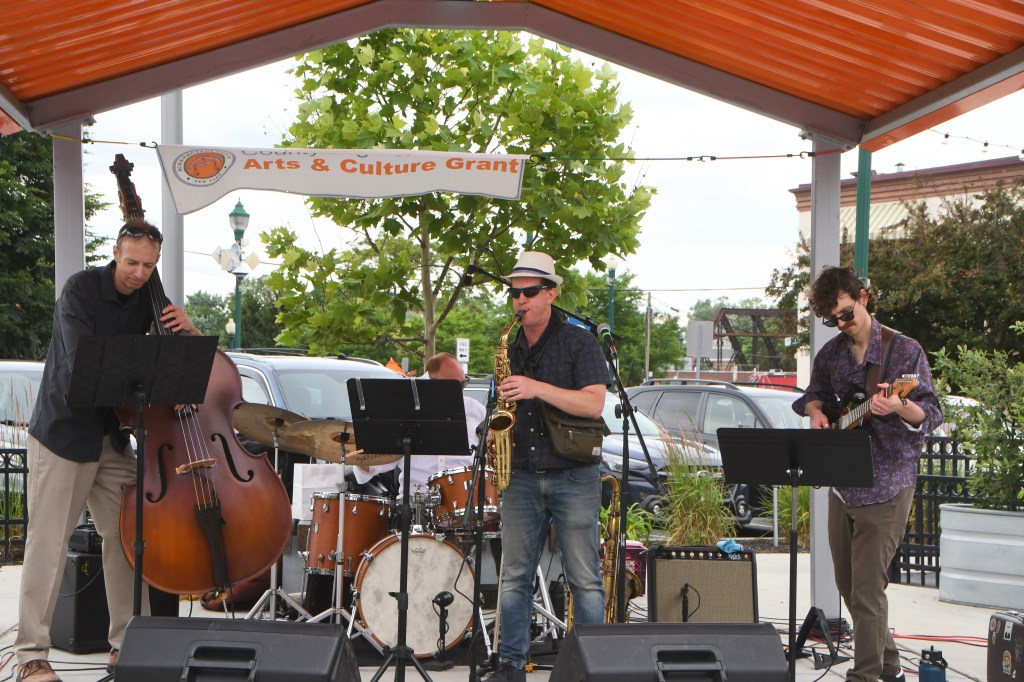
Terry Adams, above; John Sebastian, below

They bounced “That’s Neat, That’s Nice” as a jazzy hello, Scott singing lead and Terry taking the last solo after Klem, Scott and John – all compact statements without frills or fuss, drums signaling a stop-and-go coda. “Singin’ In the Rain” rolled at a similar upbeat tempo and feel, an agile strut, Oliveri taking his first yakkety bebop solo. Klem sang first in “You Got Me Going,” another happy rocker. 

Klem Klimek, left; and Gene Oliveri

Klem wields the ‘Q’s biggest, most extraverted personality and strongest voice while workmanlike Scott’s rings the prettiest, perfect on ballads and happy numbers. Casey shows off both low-range grit and sky-high falsetto. As Terry told me when Casey joined a decade ago, his voice links beautifully with Scott’s; both sing in Chicago’s Flat Five group. 

Casey McDonough, left; Scott Ligon, right

Friday, they sang tight on the joyous “End of the Road” and “Waitin’ On My Sweetie Pie” early on, then in both choruses and leads thereafter. Voices well worn, Terry and John left most leads to Scott, who once took over a tune mid-song when Terry’s voice faltered. John sang lead on his Lovin’ Spoonful classic “Did You Ever Have to Make Up Your Mind?” and his newer wistful “Passing Fantasy” on Friday; he chimed in happily in some bluesy guitar solos and the occasional harmonica break, and comped chords behind Scott’s skilled, often fiery breaks.

Terry Adams, left; and Jake Edwards

As usual, the show built in waves, both in the feelings powering the lyrics and the wonderfully wack mastery of many musical feels. Love songs worked because they felt sincere. “This Love Is True” and “Never Take the Place of You” expressed longing while “I Want You Bad” and “The One and Only” romped in romantic gladness.

As Johnny D rightly observed, years ago, “They make you feel young” – upbeat energy revving the comic “Wacky Tobacky” and “Get Down Grandpa,” the antiques “This Old House” and “The Music Goes ‘Round and Around” to end the set.

Quieter moods may be their most compelling, though. Adams’ soulful, understated piano gave the Monk classic “Ruby My Dear” a calm, sweet eloquence; his own “Tragic Magic” cruised on sci-fi weirdness and “Snowfall” mixed vintage melody with rock energy, updating this antique without bruising it.

On the quiet, nostalgic side, “Imaginary Radio” hailed Terry’s heroes in poignant words. He also revved up the comedy, leaving the piano to Casey and cautioning “Remember Your Name and Address” as if in a classroom.

The mood lightened then soared in the later songs, pulsating rockers “Magnet” and “Grandpa” setting up Clarence “Frogman” Henry’s funk shuffle “Ain’t Got No Home” with exciting Casey vocal and hot Scott guitar. That New Orleans mood bounced back to launch the encore with “Boozoo and Leona,” a happy zydeco chug. Monk’s “Well You Needn’t” held the mood, and momentum, through “Get Rhythm” to sign off.

Terry mostly chose the tunes early on, sometimes just starting up and trusting everybody to climb on board. He later looked around, accepting suggestions on the bandstand. Things flowed too smoothly for a rehearsal’s informality, with Klem quickly bringing newcomer Gene up to speed at each surprise. They blended well, both in section-like linked playing in harmony, soloing hot, or improvising parts together.

It all felt organic, made with fresh ingredients, as Terry has long described things. Tight parts crackled, loose stuff charmed in relaxed ways. The players all helped each other, listened and grinned. Fun reigned, and fans left wondering, in happy uncertainty, what surprises might happen Saturday.

Below, the song list on Terry Adams’s music stand; a menu more than a map. The actual set list is below this photo.

Set List Friday, June 29

8:12 – 10:25 p.m.

That’s Neat, That’s Nice

Singin’ in the Rain

You Got Me Going

End of the Road

This Love is True

I Want You Bad

Waitin’ on my Sweetie Pie

Never Take the Place of You

Wacky Tobacky

Ruby, My Dear

Passing Fantasy

This Old House

Howard Hughes

Tragic Magic

Remember Your Name and Address

The Same Old Thing

Did You Ever Have to Make Up Your Mind?

Too Much

Imaginary Radio

Snowfall

Magnet

Get Down Grandpa

Ain’t Got No Home

The One and Only

The Music Goes ‘Round and Around

Encores: Boozoo and Leona

Well You Needn’t

Duet for Cousins

Get Rhythm

Above, John Sebastian congratulates Casey McDonough on his hot vocal in “Get Rhythm.”

Below, Casey McDonough plays piano, at left, as Terry Adams cautions “Remember Your Name and Address.”

Next up: Intermission, Woodstock Between Shows