Some recent stories need clarifications and caveats
My Gazette story Jan. 31 on the Aerodrome brought lots of interest and input from readers: folks LOVED the place.
However, concentrating on the musical legacy of the place, I neglected to mention several key contributors to the venue and its activities on the business and bookings side. Fred Baye as assistant manager booked the bands that played there, leveraging his knowledge of music and the music business to hire both big and emerging acts. Fred worked with manager Bob Murphy, who founded the Ale House in Troy after the Aerodrome closed. At that time, Fred moved on to work with Gov. Mario Cuomo and evangelist Billy Graham while also fostering an alliance between rock and Gospel.
Many artists and fans also chimed in about bands they saw at the Aerodrome, often naming giant stars of the time. It’s happening everywhere: To Michael Eck’s Facebook post of a YouTube video showing Tim Buckley singing “Buzzin’ Fly,” William Rella posted, “Saw him at Aerodrome in Schenectady. Close to the last date ever there.”
But my musician brother Jim Hoke wrote me about “the mentioned-but-not-described band with the name ‘Aerodrome’ whose name appears often as opening act for more famous bands.” He wrote, “These guys were fucking great, and could play and sing rings around most of the bands they opened for.
“When we first played there, they were the Characters…I remember many a night at that place, watching the Characters open shows, playing impeccable covers of the hits of the day. They had a sax player with an electronic rig that would simulate, say, the strings on ‘I Am The Walrus.’ They were a couple years older, and many years better than my band (West Side Highway). Later, after the featured band was done, these guys would play the late last set for die-hard drunks and hangers-on. There’d be four people in the place, so that meant it was safe for them to play jazz and other deep weird shit and they were amazing musicians; we were awed. The story you told (and that a fan told to me) about one of the bubble-gum bands getting pissed off at the crowd and “playing Miles Davis” was likely a mis-remembrance of the Characters. Those galoots in The Ohio Express and their ilk couldn’t have played Miles Davis – they weren’t nearly that good.
“As the Characters became the default house band, part of the deal was the name change, to re-enforce the brand, I suppose…I never heard about them again, except that the sax player, Jack, went on to do a one-man-band act called The Mechanical Man.”
My story on www.nippertown.com announcing the discovery and posting of live Blotto sets brought these clarifying comments from Helena Binder, formerly Blanche Blotto.
“Thanks for this, Michael!” – she wrote. “I must correct a few things for the record,” she went on, “Keyboards on ‘I Wanna Be a Lifeguard’ and all the tunes on the ‘My Father’s Place’ recording were played by me, not Chevy Blotto. He joined after I left. And ‘I Love You Calvin Klein’ was written by me alone.” Blanche then wrote, “Great to have the publicity on the release of these recordings.”
So prolific, so hyphenated, he needs two names, jazz-pop saxophonist-composer-keyboardist-singer-bandleader-teacher Matt Steckler AND Matty Stecks sums up his past, jumps genres and looks ahead on four recent record releases.
The most recent and ambitious, “Long Time Ago Rumble” sums up everything so far in a varied career. Jumping around like a car radio on “scan,” it offers a a confident ride through hard-bop, found-sounds, contemporary (also not so contemporary) pop/R&B, world-beat and what once was called “new music.”
Stecks attributed the stylistic range of the new two-CD album to “the talent pool up there,” explaining the project in an email conversation. “Up there” is Brandon, Manitoba where he taught for three years, performed, composed and recorded.
In July, as the COVID pandemic shut the door on any extension of his teaching contract there, he returned to his home town – like millions of others whose lives turned upside down. He lives now with singer-wife Megan Demarest and their precocious eight-year old son Elliott in the suburban Niskayuna home of his artist-retired Union professor father Charles Steckler and his father’s wife Ginger Ertz, retired education chief at Skidmore’s Tang Teaching Museum.
So, how did a hometown Schenectady kid wind up in Manitoba, then back here?
The short answer: a confluence of academic, creative and performance endeavors, a path that echoes his father’s and that landed him in 2017 as Assistant Professor in Jazz Studies in the Brandon University School of Music. Stecks taught Jazz Composition, Jazz History, Aural Skills, a Graduate Seminar in Performance, Advanced Improvisation; Ensemble Coaching and ran the Saxophone Studio.
An even shorter answer: through a questing talent buffed bright by many mentors in technique and vision.
In the last graduating class (1992) at Linton High School (which became Schenectady High School when cross-town counterpart Mont Pleasant became a middle school), Stecks sang in the chorus Diane Warner led, studied jazz with bandleaders or private teachers Al Hollenbeck, Sheila Tebbano and Jim Orden; and saxophone with Emil Kalled, Nick Brignola, Conrad Kuchay and Chuck Fisher.
Vibraphonist Jay Hoggard was his advisor “and link to traditional jazz practices” at Wesleyan, where Anthony Braxton “was the visionary who opened my ears to composition and the avant garde,” as Stecks explained. He also drove into New York for sax lessons with Thomas Chapin and explored world music with T. Viswanathan, Abraham Adzenyah, Gage Averill and others. While playing a weekly quartet gig with Braxton, he also started what later became his band Dead Cat Bounce (hereafter DCB, mostly), first in music/poetry collaborations with his room-mate, then a growing fascination with the World Saxophone Quartet.
After Wesleyan, Stecks earned a Masters in Music in Jazz Performance at the New England Conservatory, studying with Jerry Bergonzi, Danilo Perez, Allan Chase, Paul Bley, Cecil McBee, Bob Moses and others, plus briefer stints with Gunther Schuller and Steve Lacy and other luminaries. DCB came into its own in the Boston area, too: three albums and three tours from 1997 to 2003.
More training, more gigs and a new band followed in New York from 2003 to 2014 when he made a fourth DCB album, plus two with Persiflage. Meanwhile, he earned a Master of Arts and a Ph.D. in Composition at NYU and studied with Jerica Oblak, Jim McNeely, Marc Antonio Consoli and Justin Dello Joio. Numerous Persiflage gigs included Lincoln Center Out-of-Doors and the Blue Note in New York, the Kennedy Center in Washington, DC, Cleveland’s Tri-C Fest and the Hennessy XO Jazz Fest in Shanghai.
In 2012 and 2013, Stecks presented the big-band series “Party Horns” in Proctors GE Theater, as his own music earned critical plaudits.
JazzTimes called DCB’s fourth album “Chance Episodes” one of its top 50 jazz CDs of 2011; Stecks composed the music on commission by Chamber Music America and the American Music Center’s Composer Assistance Program, but it’s anything but academic.
In the Boston Phoenix, Jon Garelick hailed DCB’s sound as “tightly arranged, swirling contrapuntal reeds and multi-part blues n’ roots-infused tricky compositions.” Mike Joyce reported in the Washington Post, “DCB revels in a reed-driven sound marked by sharply contrasting forms, textures and tones…strident, joyful, lush and strutting use of a horn section.”
Of the Party Horns series at Proctors, Stecks said, “Besides bringing (his own bands) Dead Cat Bounce and Persiflage there, I brought some other great New York City bands upstate,” including Red Baraat, Slavic Soul Party, Josh Roseman, Burnt Sugar the Arkestra Chamber and Brooklyn Qawwali Party. Stecks said, “(Proctors chief) Philip Morris has always had an open heart to trying new and creative ideas out.”
In a spring 2012 Gazette preview of the series, I described DCB as “inspired in about equal measure by the World Saxophone Quartet and Charles Mingus, plus Caribbean, Brazilian and West African echoes. It’s in nonstop intelligent motion but never feels hectic because the melodies are so pleasing, the beats so earthy. They go pretty far outside at times, but they know the way back and how to get there without a map. They’re well schooled but intuitive, individual in their soloing but also eagerly cohesive section players.”
In 2014, Stecks moved to Bennington with wife Megan and son Elliott. Stecks taught at the Dorset School and played regularly with Alex Torres and His Latin Orchestra including the New York State Fair in Syracuse and the Saratoga Museum of Dance.
Then in 2017, they moved to Manitoba on a three-year teaching contract. In the way that the best educators learn by teaching, Stecks refined both technique and artistic vision north of the border.
About technique, Stecks-the-professor said, “I realized at last the value of classical technique in getting young musicians to ‘put it all together.’” He added, “But equally important is training and trusting the ear and the body. So I’m both refining a skill set specific to my main instrument and becoming more holistic in experiencing music, through my voice and other instruments (piano, drums, production). Each side informs the other.”
Conceptually, “I’m no longer concerned with the loaded term ‘finding one’s voice,’” he said. “I realize now that the voice is Matty Stecks,” he explained, noting the moniker is a longstanding nickname among his friends, but now is also “a practical way to deal with having all projects under one roof.” He said, “The genre (is) merely the vehicle through which to express it. That’s very liberating.”
Credited to Matty Stecks & the Musical Tramps, the most ambitious project assembled under that roof is “Long Time Ago Rumble,” a two-CD studio project released on Ropeadope/Manitoba Film and Music. Stecks plays reeds and keyboards and sings, with singer-wife Megan Demarest, three other singers, guitars, bass, drums and percussion, keyboards, cello and clarinet.
“The cast of talented musicians I’ve assembled put their heart and soul into this effort, which began as a live world premiere concert, commissioned by Brandon Chamber Players in January 2019,” wrote Stecks in the liner notes. “Together, the ensemble is lovingly called Matty Stecks & Musical Tramps (named after the 1914 Chaplin film which I re-scored for the occasion.)”
He explained by email that he recorded the album in May and June of 2019 with producer Jordan Jackiew at Tailored Recording in Winnipeg. “The jazz stuff was tracked together live, the pop and film score was tracked; the rhythm section together plus overdubs and the collective improv stuff tracked together with electronic processing in post (-production).”
Leaving Manitoba in July as COVID shut down the world, Stecks “didn’t want it to be a lost year, so I made sure I had a creative outlet where I’m waiting this out in my home town. I’m presenting at music conferences online, consolidating that research. I had two album recordings in the vault (“Lucky & Live in STL” with DCB and “Night Cravings” with Persiflage) that I didn’t want to sit on any longer, so I released those on New Year’s. And I’m practicing a fair amount and writing and working on my production skills.”
While in Manitoba, Steckler also played a supporting role in “Suite 150: A Big Band Jazz Portrait” by the Winnipeg Jazz Orchestra as member of the reed section rather than a soloist. “Suite 150” collects 11 pieces, one each by 11 Canadian composers celebrating their homeland on its 150th year (in 2017; the album was released in 2018). It’s modern, bold and confidently played.
Steckler led the two retrospectives he released Jan 1.
“Live and Lucky in StL” shows DCB in full flight on a 2003 tour. These guys play music; it’s charged with youthful energy, but applied to veterans’ views of the tradition(s) they celebrate. The configuration – four saxes, bass and drums – feels both muscular and sparse without a keyboard or guitar comping chords. Its performing bravado matches a conceptual boldness that may shine brightest in its most familiar tune. Charles Mingus’s venerable “Goodbye Porkpie Hat” usually swings in a melancholy way, but here it’s rambunctious and zippy before settling into brawny section playing over a gleeful clatter. They close with a Second Line shuffle that might make you sprain something if you tried to shake with all its beats. Here, Stecker plays with fellow saxophonists Jared Sims, Felipe Salles and Charlie Kohlhase, bassist Garry Wicks and drummer Bill Carbone.
“Night Cravings” is a Persiflage studio date (2014). The band was elastic in its NYC gigs, often featuring name players. But by the end of Steckler’s Brooklyn residency, he’d solidified the lineup with Curtis Hasselbring, trombone; Todd Neufeld, guitar; Dave Ambrosio, bass; and Satoshi Takeishi, percussion. Generally leaner in its arrangements than the DCB release, it swings with a more muscular feel. It also explores fresh sonorities in the blend of sax, trombone and guitar. Some is feisty, some sweet, but always a confident, fun ride.
On these DCB and Persiflage projects, Stecks plays various reeds, ranging from pristine Jean-Pierre Rampal flute phrasing to edgy David Sanborn-like rawness on alto, his most fluent solo axe. And on ““Long Time Ago Rumble,” he also sings and plays keyboards.
Now Stecks stays busy solo or in collaborations. “While gigs are important and sorely missed at this time,” he said, “a permanently documented legacy is on my mind (recordings and compositions), as is the drive to collaborate more, in research-based ways and as a means to reconnect with friends.”
Stecks is working on “little one-off solo performances online; a concert band plus chorus piece commission (a setting of a Walter LeMare poem) for Manitoba’s Music Monday event (which hopefully one day will be performed!); a Christmas recording with Maxine Linehan, and holiday stream concert from RPI/EMPAC; and some socially-distanced performing with Megan (jazz & popular covers).” He has a grant application for a jazz quartet recording project back in Manitoba “when things open up;” he’s teaching a few students online, taking his turn at meal prep in a gourmet-rich household of four cooks and home-schooling his son. “Perhaps my biggest project is trying to tame and channel the raging musical talent that is my son Elliott. If he realizes that, he’ll be a force to reckon with.”
He also collaborates, online and asynchronously, with musical friends, often posting these songs to YouTube:
“One person sends a video to another to improvise to, and it’s synched in editing,” he said. “The pop songs that have collaboration just require remote file sharing, and patience!”
In this oblique or virtual way, Stecks maintains collaborations and community. In the “Long Time Ago Rumble” liner notes, he writes, “A special thanks to the ‘village’ of Manitoba – my adopted home these last few years – you’ve helped me gain perspective on what a music scene, and a community, can be in a different setting.”
He said by email recently, “I’m in touch with the DCB core members and am trying to figure out performing opportunities, though everyone’s in different places. The Persiflage project would be easier to play live as everyone’s based in NYC. Although both have been dormant, I’m never one to say definitively ‘this is the end.’ And I’ve used music from both projects in other performing situations (like the quartet up north I intend to record at some point.”
Hopeful, realistic, ready to create, wherever, he said, “I have a path now for creating wherever I end up. And I’ll never take the opportunity to create for granted ever again.”
Stecks was recently selected for a composing residency at the Millay Colony for the Arts at “Steepletop,” the historic home of poet/activist Edna St. Vincent Millay in Austerlitz at the edge of the Berkshires.
We’d climbed Gray’s Peak, then Torrey’s Peak near Georgetown together that morning, a day off for Fred from his wife Ann Hyde’s Institute of Design where he did whatever was needed to keep her fashion school in the Rockies humming. As all-purpose logistical support, he did everything for her, the staff and students. He became friends first with my wife Ellie, a teacher there, then with me when I started visiting her for weeks every summer. This made perfect sense to me; they’re two of the best people I’ve ever known.
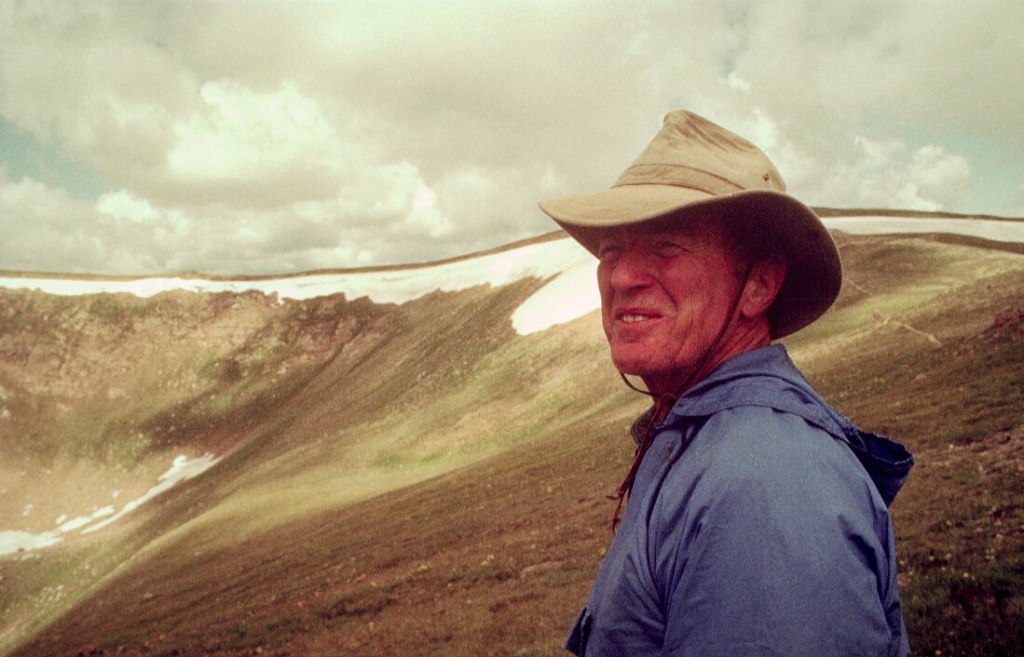
Fred looked country, a solidly made man whose slouch hat shaded twinkly blue eyes over a bent nose and strong jaw, mostly working in a smile. A retired oil executive, he’d taken Ann with him on exploration projects across Arabia, then went with her to Paris where she studied fashion. Of his former profession, he said simply, “Everybody needs oil, every day,” but he also said his in-laws had originally opposed Ann’s marriage to “oil trash.” While Ann’s elegance somehow seemed carefully cultivated, constructed in a patrician childhood, Fred’s was innate, but also blended with an old-school gentleman’s kindness. Plainspoken but cosmopolitan, he ordered Budweiser by its full name over lunch or dinner, but also knew his way around the wine lists of the top restaurants in Europe and America and the most complex music of the classical canon.
In his easy-going courtliness and interest in everything, Fred reminded me of my father in law, Alfred von Wellsheim. He was unflappably, dependably calm and kind where Ann was electric, charismatic and volatile. He radiated such affection for colleagues and neighbors there in Winter Park that you instinctively adopted them all as friends right away.
Most of all, Fred loved to roam the Rockies. This was great for me, to have a high-information guide with stamina to match; less great for Ellie who envied our hikes and rambles while she was stuck in daily after-class staff meetings led by the exacting, meticulous Ann.
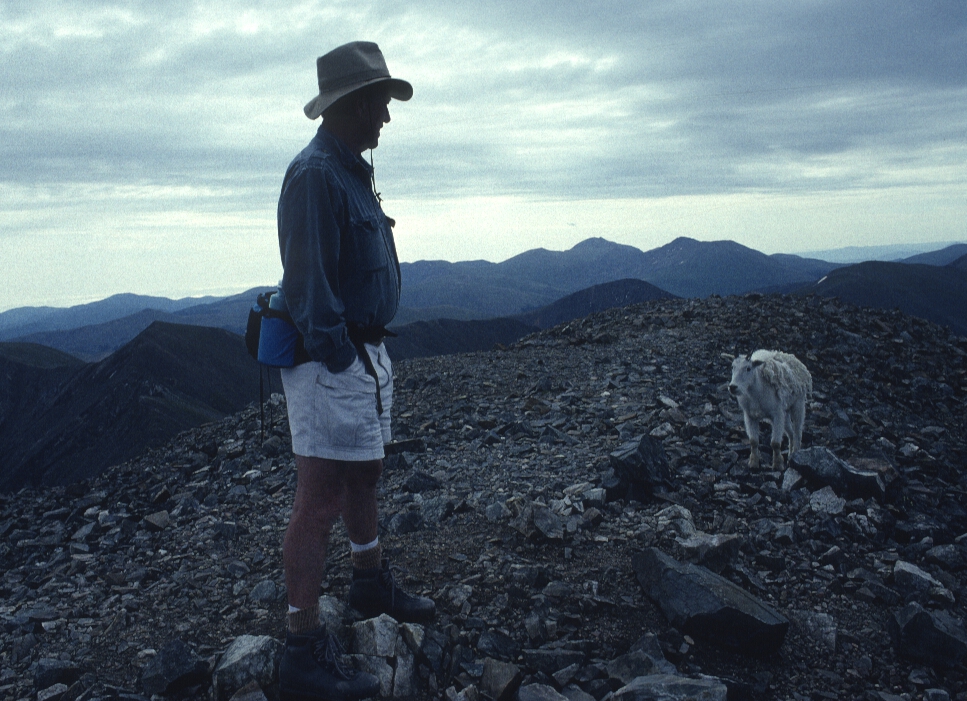
We’d park Fred’s sun-faded gray Datsun station wagon at a trailhead and go up, and up. At the beginning of every visit, before I became acclimated to the short oxygen supply at altitude, I’d make him do all the talking so I could catch my breath, and learn of his life. Both Gray’s and Torrey’s topped 14,000 feet, an “adult portion” as Levon Helm says of New York City in “The Last Waltz.” But I’d been in the mountains for a few weeks by the time we walked up one, then across a knife-edge ridge to the other. No technical climbing or safety gear, just a very steep walk on firm rock where friction and footing were no problem. We popped above tree-line before nine o’clock, peered down at a ramshackle cabin falling apart on a shelving ridge far below us and crunched through some snowy crusts on the trail, up high.
Then the goat came and I suddenly could barely breathe at all.
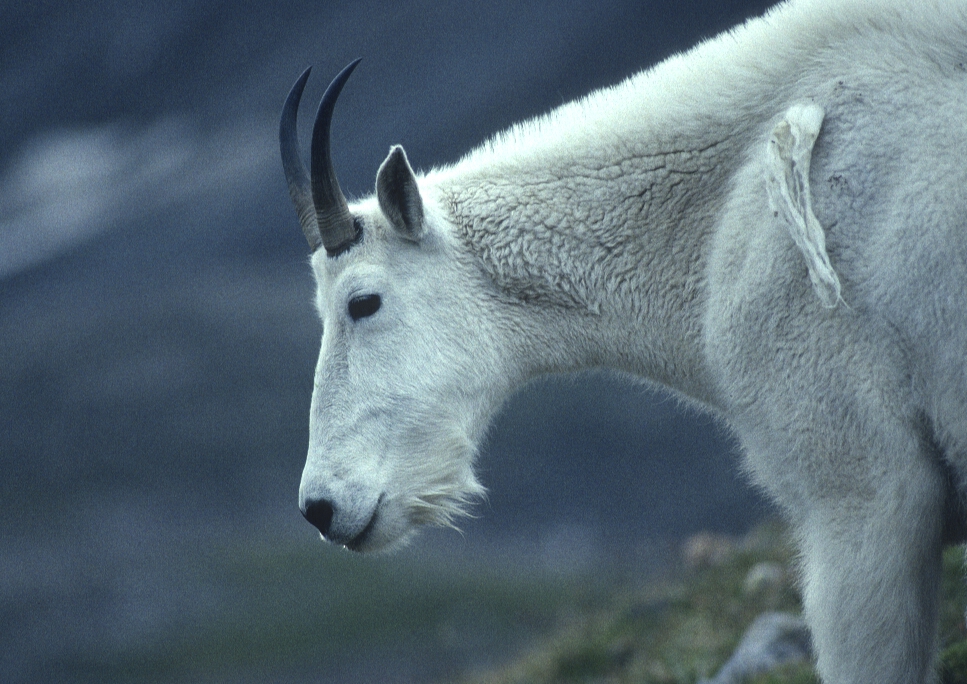
Two mountain goats, on Torrey’s Peak
I froze; Fred did, too. Pure white, short but exerting a presence beyond its size, its winter wool still peeling away on that August morning, it looked at us for a minute, maybe three. I raised my Nikon, loaded with Kodachrome, and shot a frame, hoping the shutter click wouldn’t spook it. No reaction, good; then the goat came toward me; then right up to me, and gently pushed my knee with its head – another click – then turned and walked off the summit; but gave me time to change lenses for a close-up first.
Half the fun of an experience like that is sharing the awe, and Fred was always perfect for that.
He knew the name of every flower that flourished up high, and liked hiking along on Ellie’s color-awareness field-trips to meadows where paintbrush or penstemon popped out of the ground in red or purple pointillist exclamations in the wind-waved grass.
When Ann closed her fashion school in Winter Park as Alzheimer’s began to change her life, Fred gave Ellie his Datsun wagon, the institute’s everyday utility vehicle. She drove it across the country with our son Zak and daughter Pisie, who’d come to see Fred as an auxiliary, bonus grandfather. They had the bad luck to follow flooding, and said later that was the stinkiest road trip any of them had endured. And, the air conditioning had stopped working. But that rugged car saved Zak’s life when a car ran a stop sign and T-boned it.
Ellie flew out to Colorado for a farewell to Ann and a last ramble there with Fred and other friends before his move back to Houston. They revisited many of the sights around Winter Park and other parts of Colorado, toasting Ann and her Institute in wines whose price tag made Ellie gasp.
On that trip, Fred sometimes surprised himself and Ellie by addressing her as Edith, a woman he’d met years after Ann’s passing and who’d enchanted him. He and Ellie laughed at this name substitution since he was so clearly smitten. Fred and Ellie also talked about a trip he hoped to take one day, a guided excursion through places crucial to the ascent of civilization, including Olduvai Gorge in Tanzania and archeological sites and ruins across Europe. As Fred and Edith grew closer, Ellie was the first person they told of their engagement and impending wedding. Fred was then near 80, but a teenager when he spoke of Edith.
They married, made Fred’s civilization-exploring epic trip as their honeymoon, and settled in Houston. Dstance grew between updates from them.
As time passed, and Ellie calculated Fred’s age, she’d wonder and worry about him.
So, when “Fred Birdsall” popped up on the caller ID of our landline phone on Saturday, my heart leapt. But a woman’s voice spoke to me, asking if she’d reached Ellie’s phone and if Ellie were available. When I explained that Ellie was in her sewing studio, a different building, the woman identified herself as Edith, announced in a calm voice that Fred had died and suggested she’d phone back another time. “No,” I begged her, “let me take the phone out to her,” as I searched around for snow-worthy footwear and headed for the door.
I knew the news would hit hard, so I stayed with Ellie as she and Edith spoke long and lovingly of Fred. They cried and laughed. Me, too; across the room.
They agreed that Ellie should miss the memorial this Tuesday in Houston, though Ellie promised to be there in spirit. A great spirit, like Fred, she can do that. She and Edith both seemed happy that Fred hadn’t died of COVID but of general wearing down and wearing out, the sum of a well-lived and long life. He’d have turned 94 this March, but always seemed younger, on a summit in the Rockies or over dinner. Edith said every day with Fred brought happiness.
And in those years he was here with us, he was a calm sweet source of delight for us all – even for that mountain goat.
The “Lovers Rock” episode of Steve McQueen’s “Small Axe” showed me again why I love reggae. (The series premiered on November 20, 2020 on Amazon Prime Video in the U.S. It won the Los Angeles Film Critics Award for 2020’s Best Picture.)
I admit I was once pretty insufferable about reggae.
“How about some Allman Brothers?” a visitor once asked me in my Hamilton Hill apartment. “No,” I said. “I only play reggae these days.”
Through that obsession, I knew the series title came from a Bob Marley song lyric: “If you are the big tree, we are the small axe,” a proudly determined assertion of underdog power. I recognized most of the songs on the funky soundtrack, and understood lots of the slang. New-to-me terms in the dialog, delivered in the lilting fluidity of West Indian/London language, delighted me with its fresh brashness. And in key ways, this hour-long celebration of Caribbean culture transplanted to Europe is much more than the vivid depiction of a party.
We see it from the set up, as men move furniture from a front room, others haul in and assemble a massive rock club-scale sound system. Women fix food in the kitchen, post a menu on the wall. Meanwhile, men and women dress and groom, discuss and joke about possible mates.
Then the music starts.
Guests eye each other warily and warmly, then pair off and dance. Couples form and fade, it’s profoundly sexy, a ro-dance that all but melts the screen as the music pulsates, throbs, bobs and booms. For every riff, every beat, a well-dressed body moves in sensual sync. Reggae rocks so many beats at once that all the motion on the screen amplifies the sound, and vice versa. It’s feedback, it spirals upward and it’s loudly joyful.
In that throb, “Lovers Rock” shows two extraordinary things happen.
During several songs, the DJ turns down the sound system, but the music continues. EVERYBODY sings, with harmony, and it’s so fun, so beautiful.
As the music intensifies, the dancefloor gender balance gradually shifts. Soon, the room seems full only of men, moving in more and more frenetic joy – until those men ARE the music.
Sure, there’s a story, a plot, moved forward with overlapping incidents and episodes. There are courtship vignettes, passionate pairings so hot that sweat in the sound-filled air condenses and runs down the wall. There are confrontations that arise, erupt, shift, resolve and fade, like songs. But McQueen’s always moving camera also shows peace-making, protectiveness and nurturing.
There is false and true love.
But the echo that “Lovers Rock” leaves in my soul is the ecstasy of the music.
The music.
That’s what I want music to do for me, to give me that ecstasy; it’s why I listen – not that I can imagine myself giving myself so joyfully, physically to it.
The best writing about music, and films showing the making of it, reach for that feeling. But, for me, “Lover’s Rock” comes closest of anything I’ve seen to showing how it feels.
The Denzel Washington-produced film of August Wilson’s play “Ma Rainey’s Black Bottom” shows how music can confer memories we don’t actually have for ourselves. Ruben Santiago-Hudson adapted the script from Wilson’s work and director George C. Wolfe staged it for film. Telling a story now a century old, the film and its music operate like a time machine to a specific time and place. But the force of the music removes the distance, the sense of otherness, and invites us back, or over there.
Compared to the immersive naturalism of “Lover’s Rock,” “Ma” feels arch and stagey at times. Since a play has to rely on talk, telling us its meaning, rather than the kinetic way a film shows us – and in two dimensions rather than three – Wilson’s words must carry the action. They do; with supercharged narrative force but also with nuance in close-ups of actors’ faces.
However, even those sections that show rather than explain feel enclosed. When a curious character repeatedly assaults a locked door, frustrated at not knowing what’s beyond it, the metaphor feels a bit too on the nose: The payoff feels blunted by the recognition he’s burst into another, even more confined space than what he left. The escape he sought, then won, shows us how impenetrable is his bondage. He stands in an airshaft. It’s walls loom high, unclimbable.
The play/movie’s conflict is about the power and freedom that same character restlessly seeks. He wants to make his own art, freed from the mercenary mission of accompanying another artist, the singer.
He faces a double confinement, concentric barriers. The singer’s power is the engine that brought him into the studio where the action plays out; and she is a force of nature played by Viola Davis. At her quietest, she is still calmly formidable. When she’s getting what she wants, she feels no need to rip anyone’s face off with a nuclear glance or volcanic words.
She has a clear map for her players to follow and resists their pencilling in alternate routes to their own self-expression.
She steamrolls dissent, insisting on her vision of her songs.
A subtler and more alien and therefore more unbeatable force is the business. White men own the means of production: the studio, the machines, the means of making money from talent they lack but think they own.
I’ve spoiled the story enough that I now worry I’ve waved you away from watching it.
But my intent is the opposite. I want you to see it.
Allowing for the not always perfectly realized effort to take a play to the screen, it is often simply and breathtakingly great, largely because of the casting and performances. The hype is correct. The late, great Chadwick Boseman’s last appearance may be his greatest and Viola Davis confirms again that she’s our most all-purpose powerful actor now.
They give life to the place and time and people that Wilson’s words sketch, framed in a skilled supporting cast. We see the limited and limiting world of art and artists in a mercantile world they inhabit. They have no hope of owning any of it except those moments when they perform. It is a lively cultural kaleidoscope, but also a period piece crackling with timeless concerns. The film-makers wisely waste little energy on atmosphere. Instead, word images of pride and creative energy at work create an engine of kinetic striving; voices in rooms build a world. Then, however, the imposed boundaries of what can be achieved even with tremendous talent add up to a heartbreak.
Well, several heartbreaks: Is the murder in “Ma Rainey” worse than the cultural appropriation – a new form of slavery – also shown?
Like the “Small Axe” in Bob Marley’s song and McQueen’s movie, the Black artists are underdogs whose triumph, if there is one, may come too late to benefit them and is almost always owned by others.
Think Van Gogh dying penniless while his works now make millions.
Think disputes over Prince’s estate.
And think – OK, spoiler alert – the horrifying last scene in “Ma Rainey’s Black Bottom” – like Pat Boone singing Little Richard songs.
Think of that “oh-shit” moment.
Pretend It’s a City
Another recent TV experience talks about music in ways I like.
While “Small Axe” celebrates the joy music brings, and “Ma Rainey’s Black Bottom” shows how the “business” of show business exploits and destroys it, Fran Lebowitz in the second episode of Martin Scorcese’s “Pretend It’s a City” documentary series provides both comic relief and a surprising reverence.
Interview segments have the hermetic intimacy of “My Dinner With Andre,” while scenes showing Lebowitz walking city streets suggest she’s finding much to annoy her.
A misanthrope celebrated for her cranky impatience with human imperfection, and just as uncompromising in admitting her own, Lebowitz talks in this episode of loving the crude, trash-flashy New York Dolls at the Mercer Arts Center. When that building literally falls down, it hits as a perfect New York episode of timelessness and decay fighting it out. After concert footage shows the Dolls’ raffish, pioneering fearlessness, Scorcese shows us Marvin Gaye, that suave Motown god. Unlike the Dolls, he’s unselfconsciously at ease with himself. The Dolls, and Lebowitz, perceive the world as cracked mirrors, but always aimed at them. Gaye sings alone, then with a band as he teaches a song to them, singing their parts like Paul McCartney still does.
After extolling Gaye and Motown, the conversation turns general as it shifts to a restaurant where Lebowitz talks at Scorcese. She tells him music “is centrally important to people. And they love the person who gave this to them…No one is loved like musicians. Musicians are really loved by people because they give them the ability to express their emotions and their memories. There’s no other form that does that. I think musicians – musicians and cooks – are responsible for the most pleasure in human life…music makes people happier, and it doesn’t harm them.”
And then she talks about the time Charles Mingus chased her down the street…
Use police, news and civilian video and facial recognition systems to identify criminals
Use cell-phone locator functions to identify criminals
Clean the Capitol
Sweep all spaces for electronic audio and video surveillance devices; also phone and intercom bugs
Fumigate and disinfect for COVID
Reset all communications networks and computer services
Sue all criminals to bankruptcy to cover costs, including the trump organization and family and republican campaign organizations
Establish workable security for U.S. government facilities
Impose Judgement
Fire Capitol Police “leaders”
Fire and indict as traitors all Capitol Police “leaders” or “officers” whose appearance in photos abetting incursions confirms complicity; National Guard troops also
Invoke the 14th Amendment, Section 3 to unseat any U.S. Rep. and Senator who supported blockage of state Electoral College confirmations
Abolish the Electoral College
Shorten presidential transition to 30 days
Criminalize as treason any failure to cooperate with transition requirements
Try all criminals for treason and/or sedition; imprison for life – including trump
The West Branch of the Sacandaga River winds in close curves, a tunnel of steep grassy banks. Its roof blooms overhead, a calming blue streaky-tattooed with feathery cirrus clouds. It’s narrow, one twist right after another, so you come upon another boat in a hurry and have to paddle in a laughing rush to miss colliding head on.
That ribbon of river is wonderfully disorienting, a world of its own, an atmosphere so strong it erases everything outside itself. You’re not lost there. You stop caring that you don’t know where you are in any precise way. You wind and you wander until that wonder-world widens. The banks flatten into reedy marsh, sun sparkles beckon you through a channel onto a shiny, waved surface. It’s called – really – Good Luck Lake. Around its low shore, camps hide among trees and dark hollows. Tents, fires, log lean-to’s, canoes and skiffs tugged up between rocks onto thin beaches. Some seem so permanent they might have been here all summer, decades or generations of summers.
My passport to the West Branch and Good Luck Lake was the place knowledge of my kayaker friend Tim Owens, the key was my Hornbeck canoe, a bit more than ten feet of yellow gold Kevlar with thin cherry-wood thwarts and gunwales I’ve stained a thin red that sheds drips from the two-blade paddle, like kayakers use. And, like kayakers, I sit low in the hull, unlike the raised cane seat of my previous boat.
Both my boats are gifts, showing how generous is my family and how stingy I am with myself.
At my 50th birthday party, I was blindfolded and handed a ribbon to follow from the picnic pavilion at the Girls Inc. daycamp Ellie had borrowed for the day, though pine-scented woods to a slope down to the spring-fed swimming hole so cool, all summer, they called it the Ice Bucket. The ribbon was tied to a thwart in a 16-foot fiberglass Indian River two-seater that I enjoyed for years.
At that party, my musician brother Jim reunited the Auratones, his high school band, to play tunes that brought tears to my eyes and got my parents dancing, gawking at the long-skirted hippie swirls of Kathy Kenney. At their first break, Ellie led us all along a path into a clearing where people started looking up; I didn’t know why until a biplane appeared. Aerobatic pilot Jeff Seckendorf performed dazzling dives and climbs, loops and rolls. His wife Karen guided him from the ground by radio. “No, go up again – you’re behind the trees.”
Afterward, but before the canoe gift, more music, barbecue picnic food and cold draft beers. Friends near and far had filled a 30 foot paper scroll with writings, photos and drawings, some jokey but most sincere, friendship tributes sweet and deep. One of Ellie’s girlfriends took her aside, Ellie reported later, and angrily hissed, “You BITCH! No party I’ll ever throw Ray will ever match THIS!” But I digress.
My 50th birthday banana-yellow fiberglass canoe mainly roamed the Mohawk River and Watervliet Reservoir which then had a public fishing area on the shore near the dam, at the end of a forest path from a parking lot. I took everybody I could on paddle trips there, partly to share the fun, partly to help carry its 75-pound hull, paddles, life jackets and water bottles through the woods from my car to the rocky-beach launch site and back.
Eager from the start, Zak and his friends never needed persuading or inviting twice, but some older friends of mine, nervously cited “Deliverance” misgivings.
A backwater passage on the Mohawk, from my Hornbeck
The Mohawk felt different, bigger, though the current was never much of a challenge except in the spring or after big summer storms. I could easily single-hand that boat upstream among the islands from the dock near the Community College (now SUNY Schenectady) and only had to paddle at top intensity rounding the last island right below Lock 8, Rotterdam on the left bank, Scotia on the right. Closest I ever came to dumping that boat was right there, looping upstream across the island into the full force of storm-water surging over the gates in a foamy, brown, roaring rush, then into the hissing water racing downstream where I felt I was paddling downhill. Otherwise, the Mohawk was a pussy-cat, but I still preferred the Watervliet Reservoir for its privacy. I almost never saw another boat there and only a few fisherfolk along the shore. I, or we, would paddle in between the south shore and the only sizable island in the whole lake; we called it Heron Island for the great blues that fished on the shore side of it. Bald eagles nest on its east end. Then, if Zak and the boys were with me, we’d cross the main deep bay to a clay bank on the north side and fill buckets with it.
The lake narrowed then, paddling west, into a passage with birches on both sides, before opening up again into a wide space along Rt. 20. Passing under the Rt. 158 bridge, we’d again paddle into narrower waters, the Normanskill that feeds the lake. I didn’t know it then, but this winding waterway was a preview to the West Bank of the Sacandaga years later. But here the banks rise and fall; ferny flats with few trees; or sandy banks that eroded one spring flood time to reveal a Model T Ford buried there.
Sometimes I’d paddle up the Normanskill until the hull scraped stones, passing secluded shacks and boats moored in the shallows or tugged up on shore. Once on the way back toward the reservoir from there, I sat still in the boat, resting, the paddle across my knees. A great blue heron lazily cruising upstream as I drifted down only spotted me from a few feet away and flapped frantically to fly over me; I could hear its gasping breaths under the wing-noise.
As I got older, fatter and less fit, I had trouble rounding up a crew or single-handing the boat. Lift the boat onto my car’s roof-rack; tie it down with webbing straps, bow and stern and over the hull; drive to the water; unstrap it; lift it off and onto my shoulders to carry it on the yoke. I’d tote it 100 yards through the woods, avoiding roots or mud-holes trying to trip me. At the end of the portage, I’d descend a steep sandy bank, not tall but treacherous. Then I’d take it off my shoulders and into the water and away I’d happily paddle; knowing I’d have to do the same thing twice more.
So, I sold it, before I ever got around to painting on the bow, as Zak and I joked, the Russian words for “Good Suitcase.” The thought of that always cracked us up even if we never painted it on there.
Selling anything feels difficult for me since I hate parting with any possession and always worry that I might not be delivering value for the money. But in this case, I didn’t mind that as much as usual since my family had – for a later birthday – gifted me a Hornbeck.
I knew about this, sort of – it was less a surprise than the first boat on my 50th. Ellie and I had visited the Hornbeck works in Olmstedville in the Adirondacks and determined what size boat I needed by test-paddling a number of them and seeing how my weight sat it in the water. Now, how it felt in the water was simply magical, after the heavier canoes and kayaks I’d paddled up to then.
It was efficient; a few paddle strokes set it moving fast. It had enough rocker (the keel rose at both ends from the center) that it turned almost eagerly, and if your strokes balanced, side to side, it tracked straight as if on rails.
When Ellie and our friend John snuck back up to Olmstedville and brought back my own Hornbeck, I was the happiest birthday boy around.
Hornbecks aren’t just fabled Adirondack water-craft, styled after John Henry Rushton’s legendary hull designs; they’re a life-changing joy. People almost never sell used Hornbecks, they list them in their wills.
One of the guilty pleasures of a Hornbeck is showing off its light weight. Watch somebody struggle to tug a kayak off a roof-rack and try not to feel and act smug, showing off by carrying a Hornbeck in one hand, paddle and provisions in the other.
They make paddle-trips SO easy. No need to recruit or cajole a paddling-and-portaging partner, and getting it into the water happens fast. In 20 minutes, I can pack the boat myself, drive to the Mohawk or Collins Lake – my main neighborhood paddle spots – unpack the boat, tote it to the water’s edge – smugly, one handed – and set off.
On Collins Lake, I’d count mossy-backed snappers and sleek painted or box turtles, spook giant gray carp, zippy bass or flat sunfish, admire water lillies and yellow blossoms whose names I haven’t bothered to look up yet.
On the Mohawk, I’d paddle into hidden passages so primordial in their quiet isolation they felt like pathways into other worlds. My favorite vanished years ago when hurricane floods reshaped the shore, must as they swept away snags where egrets, herons, ducks, geese and turtles sat in the sun. After one of those hurricane floods, I spotted bits of swept-away barns, including a room-sized square of thick flooring; a week later it was gone. A pair of bald eagles hung out in a giant oak on the Scotia bank, watching me, unafraid.
A great blue heron who didn’t care that I was there; he’d seen me before
I found the same serenity other paddlers sought in their Hornbecks, including Patrick Sisti, a print-shop salesman who visited my PR agency job. He was so quietly charming I steered any work I could his way. Lean, balding, beard to mid-chest, he took on a holiday persona as Father Christmas, nothing as crass as Santa Claus but a velvet-gowned, vaguely saintly apparition.
Sisti died at a remote pond after paddling there alone and putting his Hornbeck back on his car-top.
And the day after Christmas – Britain’s Boxing Day and the wedding anniversary of my late in-laws – Peter Hornbeck died, too; suddenly, with his boots on after a family hike, as his obituary states.
Hornbeck’s obituary also states, correctly, that “Over the years, Pete’s little boats have given thousands of people their , where they could watch birds, catch fish and just be.”
The ground was bare as my brother Jim and I walked into the now vanished Towne Tavern in Rotterdam, all those Christmas Eves ago – but it was cold.
Inside, everything was warm and ready for this rock ‘n’ roll bash. The stage was full of instruments, amps, lights and PA, a long buffet table offered mostly Italian foods, and the bar was busy, open and free.
I’d heard about this Christmas Eve musicians’ party for years but I guess I needed Jim’s presence to authenticate my invitation. He’d played with hosts Louie and Ralph Mauriello since they were all in fourth grade, rocking hundreds of high school dances and bar gigs and recording a few songs, before they graduated. Then the rest of the band had moved out to Oklahoma, where Jim studied music theory and composition, to resume playing together. That hadn’t worked out, but they were still friends. One night on a previous visit, we went to Allen’s on Rt. 50 where they were playing. Jim brought a sax, and in the middle of a song, he stood on his chair and started playing along.
On this particular Christmas Eve, he’d come east from Santa Barbara to visit family for the holidays; or maybe he came mostly for Louie and Ralph’s bash. The stage was as open as the bar: If you had the nerve and the chops, you’d just get up and jump into the song. Jim played some, mostly harmonica, I think. These old musical friends played with more cooperation than competition. The solos got pretty assertive at times, but people played mostly within the songs; old rock ‘n’ roll and blues songs for the most part. However, all kinds of people played various kinds of music, including a novice classical pianist who wobbled uncertainly through some Debussy. Everybody applauded everybody.
When the wingding wound down around 4 a.m., a new world waited outside: Two feet of snow had fallen. Even if it had fallen all at once, with a thud, the music inside was so loud we wouldn’t have heard a thing.
Jim and I dug out my old VW squareback station wagon – good in the snow, but with little or no heat in the cabin – and took nearly an hour to drive from Rotterdam to my home in Alplaus. My wife Ellie had left before the storm, heading west to join her big family (she’s one of 10) in the old farmhouse in the hamlet where she grew up. Called Newville, it’s closer to Little Falls than anywhere else familiar, but it really isn’t very close to much else at all. Newville is 12 or so houses and no businesses, just a church and a Grange. After two feet of snow, it’s a Christmas card,
Jim and I slept a few hours, bundled up again and hit the road on Christmas morning. Driving the 60 or so miles to Newville took two hours, over snow-drifted roads through beautiful white countryside that was equal parts Norman Rockwell and Stephen King. I don’t think we passed another car, in either direction, and if we had slid off the road, we’d have been stuck until spring.
The big white farmhouse stood quiet among the drifts as we skated up the long driveway. We clumped into the back shed on the back of the house and into the kitchen. There, the whole family stood waiting for us in a long line, with gaps for us. The family custom was to line up in age order and to march in procession into the living room with the Christmas tree and gifts; they had left spots in the line for Jim and me. While they waited, they had fired up the snowblower, grabbed shovels and cleared every driveway in Newville. They had also done some caroling: Sorry, but nobody in the family has much of a voice and they wouldn’t have lasted long onstage at Louie and Ralph’s party. It was a moderately big crew that year; maybe not as big as the 30-plus who celebrated Christmas there one year, when opening gifts (one at a time) took more than two hours. But it was big enough that Jim and I were both nodding off as gift after gift emerged to happy ooh’s and aaah’s.
Then it was time for dinner, then to watch “Amahl and the Night Visitors” – the whole family knew every word – and to play board games and do jig-saw puzzles.
It was as perfect a Christmas as anyone ever enjoyed, starting with the warm, loud welcome of a rock ‘n’ roll/open-bar/old friends’ get-together; the drama of a shock snowstorm and two harrowing drives; and the second warm welcome of finding our places in a big-family fandango scrupulously honored/awaited – and all those people were happy to see us.
Well, sort of… Even a wise-ass feels grateful, like now.
When…
When I lean over my plate to savor the aroma of handmade pasta with vodka sauce and discover, when the condensation fog on my glasses clears, that some kind soul at the table has filled my wineglass.
When I walk through an alley in my neighborhood with Zak – searching for features my hero-wife Ellie has photographed on her early morning walks in our daily “Find this!” challenge; and we find a discarded, obsolete but immaculate PC; Zak lugs it home, we connect it up and it boots eagerly to read old 3.5 inch floppies I’d found but despaired of ever reading again.
When a friend in Maine phones and reports his broken leg is healing better/faster than he and his doctor expected.
When another friend, incommunicado for months, breaks radio silence (and my anxiety) by reporting his creative impulse has dragged him into the studio for hyper-creative activity and/or hyperactive creativity.
When my brother in Nashville sends eight CDs of his ironically titled CD “Home for the Holidays” (aren’t we all?) album and I delight in his sweet or sassy virtuoso re-imaginings of holiday songs – then send seven to friends – and am reminded why Jim Hoke is my favorite musician.
When a snowstorm threatens but I remember – unlike other such early-winter episodes – to park near the street end of the driveway to reduce shoveling and to bring snow-brushes inside so I don’t have to sweep snow from the door-handles and get my gloves all wet-useless.
When gift packages arrive from friends and family near and far – and I realize we’ve sent gift packages to ALL of them.
When such stuff happens, the gratitude that arrives with Thanksgiving and stays until spring feels especially sweet.
When I was working, I’d look forward to that first winter afternoon when I’d leave my office to find the sun was still up. That was Sun-Up Day, to celebrate.
I don’t know if it’s worse or better that neither Greenwich-born country-folk singer-songwriter Hal Ketchum nor music super-fan Marianne Higgins Peruzzi Barone died from the damn plague.
Whatever; we just sadly lost both.
Marianne and I had been Facebook friends for years when we met just once, at an after-party for her high school reunion that our mutual friend Ray hosted. We discovered then that I’d likely bought tunes from her at Just A Song, a great vanished music Mecca on Albany’s Central Avenue, not far from the Blue Note and J.B. Scott’s. She kindly mentioned enjoying my Gazette reviews and columns. We also discovered we’d been at hundreds of the same shows. That’s no small thing among us boomers; a bond like Bruce Springsteen sang about in “Bobby Jean.” Imagine the Boss here, crooning in his most melancholy voice. “We liked the same music. We liked the same bands.”
Everybody liked Hal Ketchum songs and singing, as fans showed with a tribute-fundraising event nearly two years ago in one of his many adopted hometowns. He’d been diagnosed with Alzheimer’s and was no longer singing when I heard about the event, checked in with his former bandmate Bob Warren and the folks at Greune Hall down in Texas. Then I wrote this:
We don’t have to be Greenwich Central School grads or remember Hal Ketchum from teenaged gigs at St. Paul’s Parish Hall, the Oasis, the Curious Cat or Kayo’s to hail him as our voice of small town Saturday nights here.
And while we can’t get to the sold-out tribute-benefit show Sunday near Austin, we can contribute to his medical needs via GoFundMe and stream the show live as his musician friends pitch in to help him fight Alzheimer’s. At Gruene Hall in New Braunfels, “Raised by Wolves: Bound for Glory – A Texas Tribute to Hal Ketchum” sold out quickly.
After playing in the Greenwich area in the Norman Pumpernickel Choir, Ketchum moved to Texas in the mid-80s (when high school band-mate Bob Warren moved to Saratoga Springs) and began playing a weekly gig Sundays 4 to 8 p.m. at Gruene Hall. The Feb. 23 tribute fundraiser there will feature Bruce Robison and Kelly Willis, Lee Roy Parnell & Rob Roy, Walt Wilkins, Jesse Dayton, Slaid Cleaves, Waylon Payne, Kenny Grimes, Nico Leophonte, Los Mistiqueros and others.
Warren recalls meeting Ketchum in high school where he, Ketchum and Paul Foster harmonized in the band room on “Suite Judy Blue Eyes” and other soft-rock radio hits. As the Norman Pumpernickel Choir, they played songs by Cream, the Rolling Stones, Creedence Clearwater Revival and, of course, the Beatles. Ketchum drummed and sang, Foster played bass and Warren, guitar. They closed many shows goofing on “Hey Jude.” Warren said, “We stayed on a C-chord for the entire song including the long fade out.”
“Hal always had a little something extra in his voice,” said Warren, “a sweetness akin to that of the Everly Brothers….the stridency of Paul McCartney when he unleashed. You were thrilled to hear him sing!” Warren said, “His voice can sell a song whether it is mediocre or great. When he writes a great one it is something special!”
While Warren formed the Bob Warren Band as one of the North Country’s most versatile and powerful ensembles, Ketchum moved from Austin to Nashville and built mainstream stardom as the 72nd member of the Grand Ole Opry and a hit-making recording and touring artist. Soon, as Warren recalled, Ketchum’s hit “Small Town Saturday Night” was everywhere. Ketchum’s 1986 debut appeared on Austin-based Watermelon Records; later albums followed on Curb Records. His most recent (11th) release is on Music Road Records, “I’m The Troubadour” (2014). Curb also released compilations in 1996 and 2008. Ketchum’s Greenwich tribute “Small Town Saturday Night” was among 17 singles that charted on Billboard’s Hot Country songs; three reached number two.
Ketchum resumed making music, painting and carpentry work after recovering from acute transverse myelitis in 1998. He played The Egg in 2005, 2006, 2007 and 2010, often with former band-mates. “Inviting me to join him onstage at The Egg and lending his voice to a song from my ‘Clear Connection’ album at that time was very sweet and gracious of Hal,” Warren recalled.
Sunday, Ketchum’s (mostly Texan) musical friends return that sweet graciousness.
“We are very honored and grateful to all of the musicians who have stepped up to honor Hal with their presence and music,” read a statement from Gruene Hall, which also noted Sunday’s event will feature video of Hal performing with Kenny Grimes. The progression of Alzheimer’s prevents Hal from attending in person. “Thanks to all of the good folks who are donating their time to make this happen,” said Tracie Ferguson from the venue.
On Monday, my friend Tom Ciancetta Facebooked about paddling around Collins Lake in what felt like a suggestion and photography lesson. Tom is now retired into kayaking, grandfathering, fine Italian cooking and old scotch.
He posted such cool photos that I retrieved my beloved Hornbeck canoe from the basement, where I’d stored it for the cold months and headed to the same tame, teeming reverse island (wet, within dry) on Tuesday.
Apart from solid black devices with NIKON or CANON on the front, this 10-foot, 16-pound canoe may be the favorite thing I own, since it takes my eyes and cameras into places I otherwise couldn’t see.
I stuffed a mask into a pocket of the swimming suit I’d also stored away and had to dig out, then motored down Union Street, past cyclists on the Western Gateway bridge. I looped to the right, into the park past Jumpin’ Jacks; Our fun-food mecca in warm times, it’s now closed. They could have sold MOUNTAINS of grilled treats in Tuesday’s salubrious second-summer glow.
When I unstrapped the boat from the car top, I carried it in one hand, paddle in the other, past guys laboriously rigging a complicated pontoon boat and tugging a cumbersome kayak out and dragging it along the narrow beach.
The water was colder than I expected as I walked the boat in. But the sun warmed wet feet and legs as I set off onto mirror-y waters transformed by the season-change since my last paddle there, more than a month of cold wind and wild rainstorms ago. All the green, grasping vegetation that made the south bay a real challenges to paddle through earlier had died back away. Sadly, so had the water lilies that once decorated the lake. This left the water clear and sweet, the paddling easy. I slipped past reed and cat-tail forests in the south shallows, past a woman who sang out, “Is that a Hornbeck?” and said her beautiful canoe is a Slipstream, an emerald-green blade in the water.
I investigated two muskrat lodges and two beaver mansions – muskrats build domed islands out away from the shore in open water, beavers build right at the edge, like millionaires. Wild-life seemed surprisingly scanty with only one painted turtle visible swimming underwater, another sunning on a log. The air was cool enough that the latter sun-worshipper held its position rather than fleeing in those ploppy dives turtles usually make off their perches when I get within about ten feet. On a September paddle in the same waters, I counted nearly 50 turtles, including half a dozen dinosaurian, slow-swimming snappers. Some of the flight-splashes I saw might have been snapping turtles, or maybe carp, I couldn’t tell.
The great blue herons pair I usually spot there was gone, gambling in Atlantic City or snow-birding to Florida, winging past the hurricanes. I missed them, though the Canada geese in the east bay filled in for them, squawk-wise. One of those herons is laid-back, winging serenely, silently away as I approach. It somehow seems languid, even in flight. The other is noisy, yelling at me as it flees; sassy-ass kingfishers give me the same snark.
Relishing the ease of paddling anywhere, without water chestnuts to grip the paddle, slow the hull, I stayed in-shore a lot, spooking slate-gray carp that cruise the shallows feeding. When the water moved in a shady spot overhung with trees, I thought I was seeing the mellow, ancient snapping turtle I’d often spotted there, moss thick on its shell. As I got closer, I saw it was a carp, foraging in water so shallow its spine broke the surface, triangle head swinging restlessly right and left. Logs along the shore bore “W’ webworks of turtle-claw scratches.
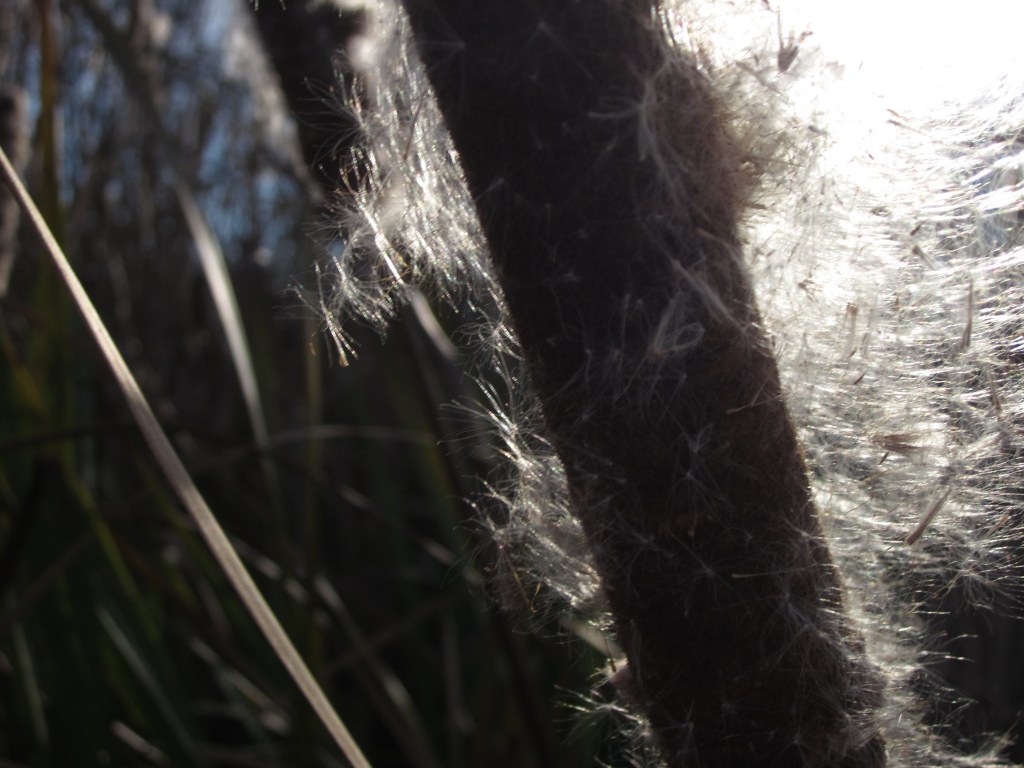
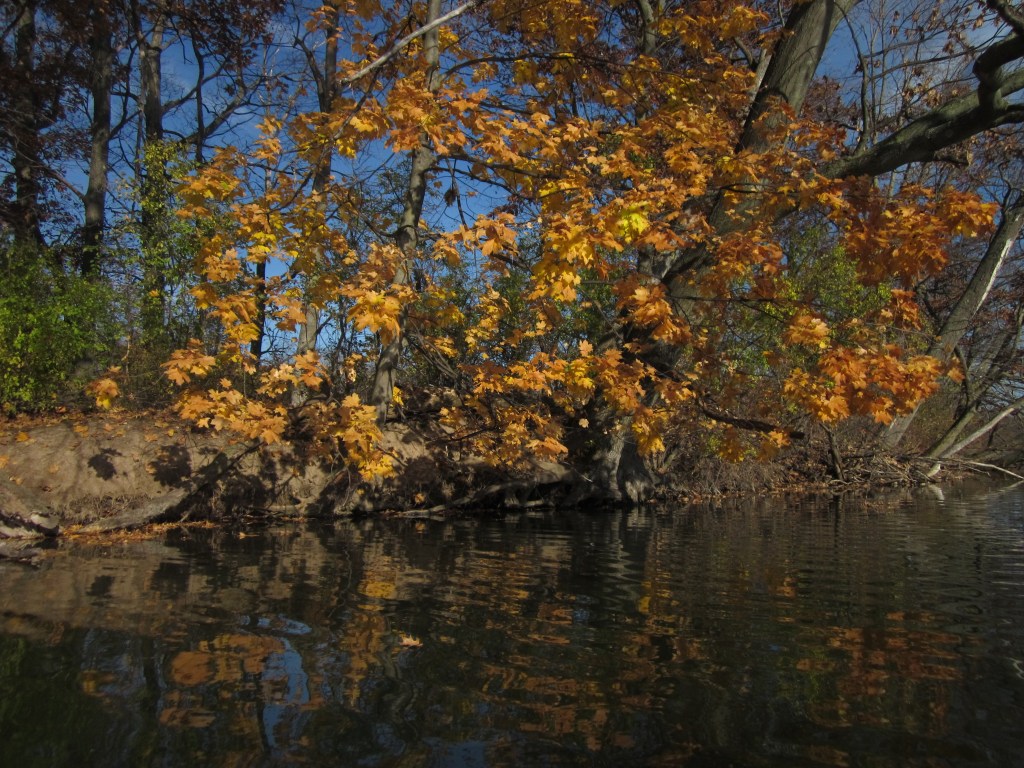
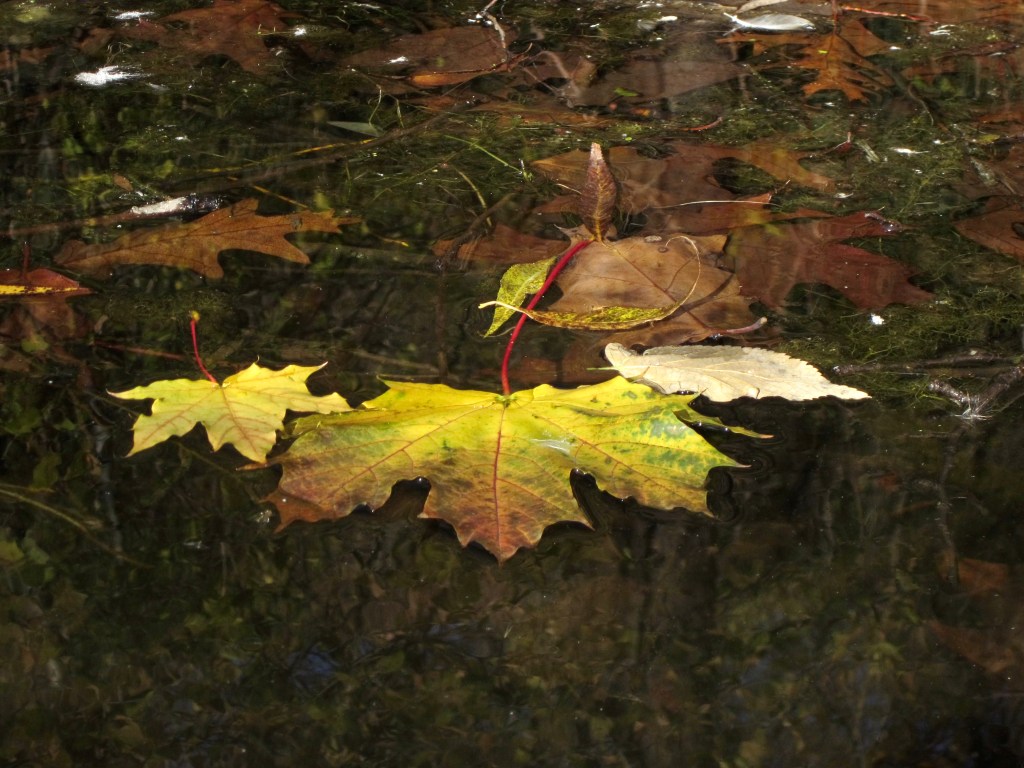
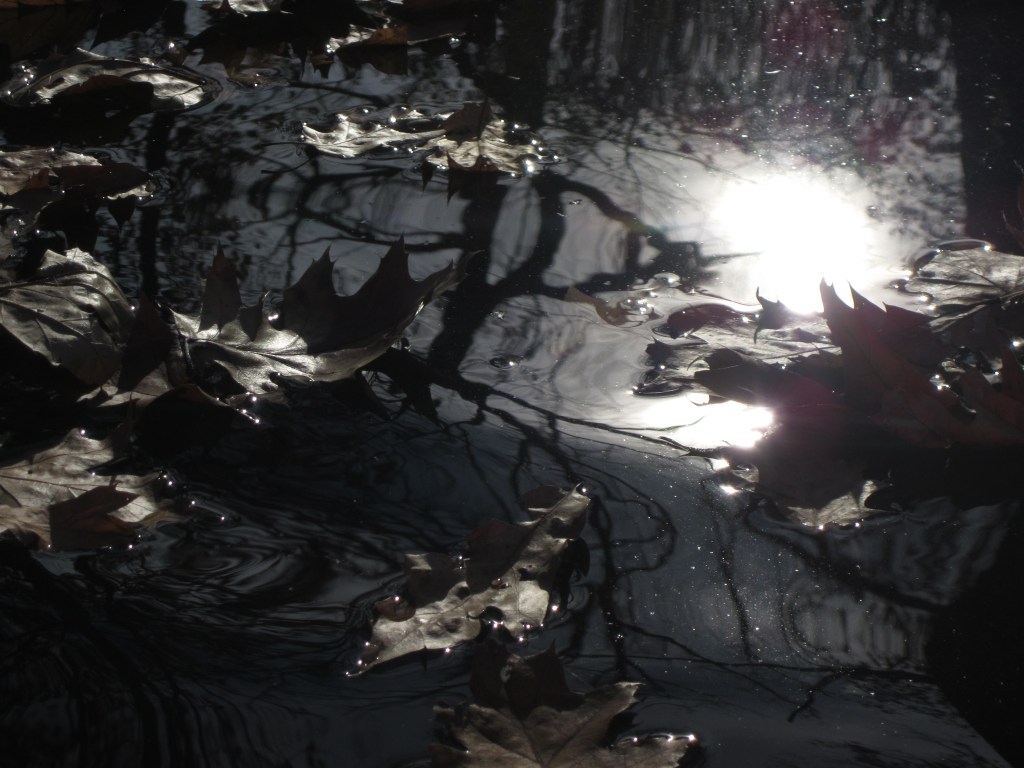
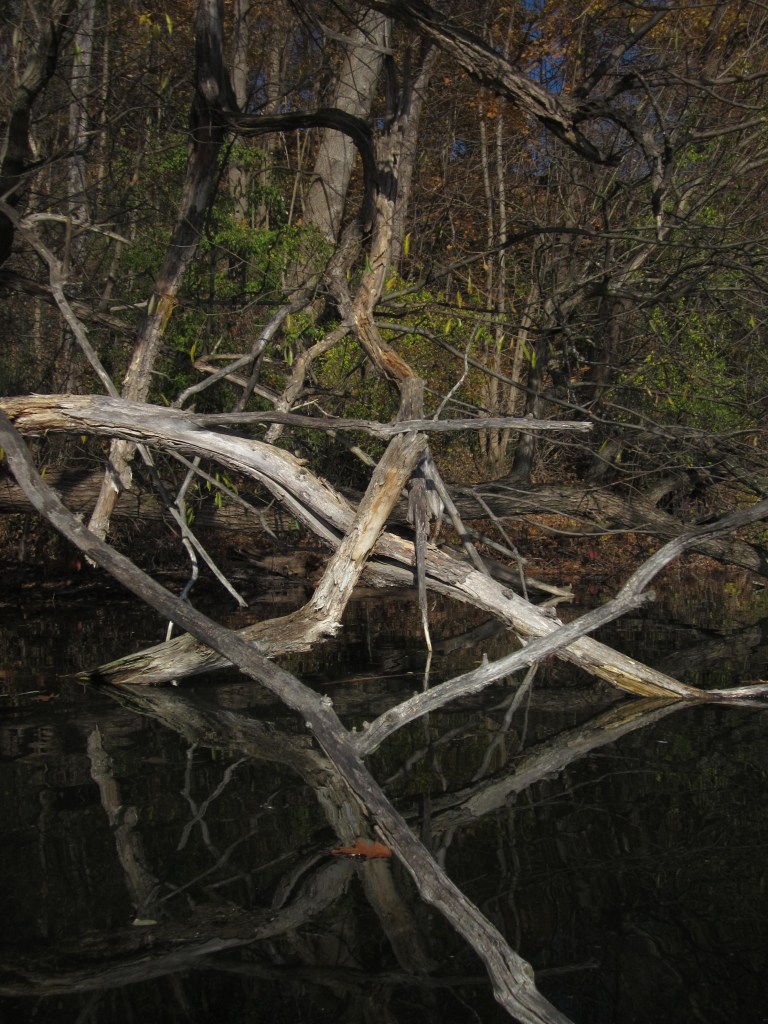
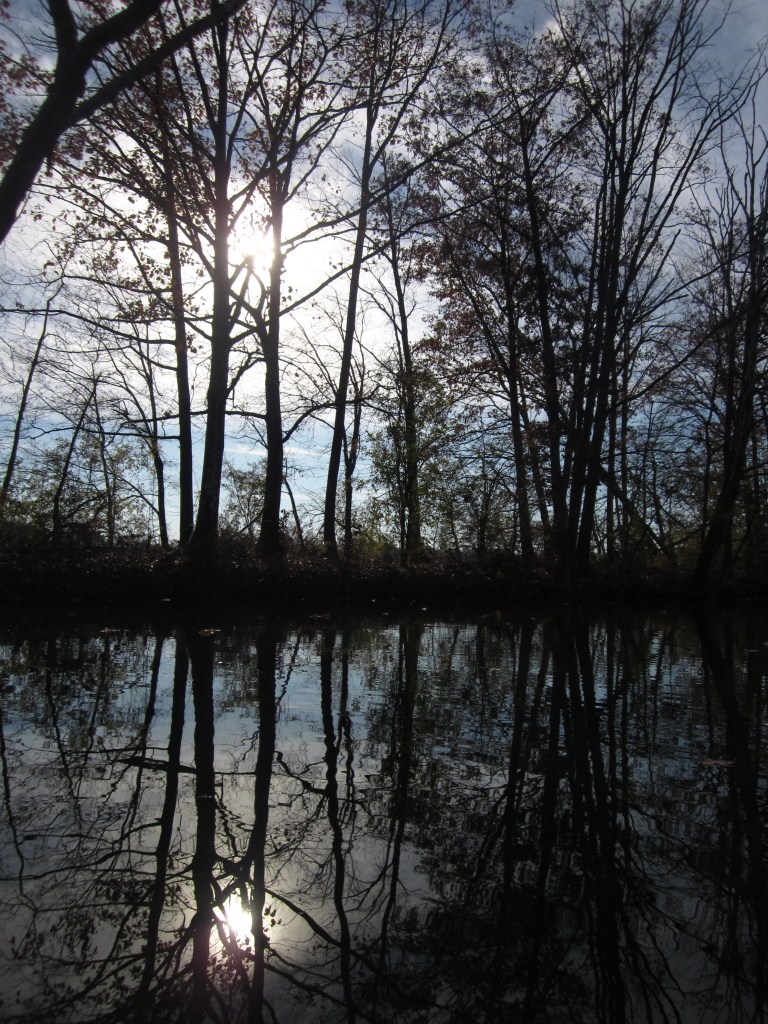
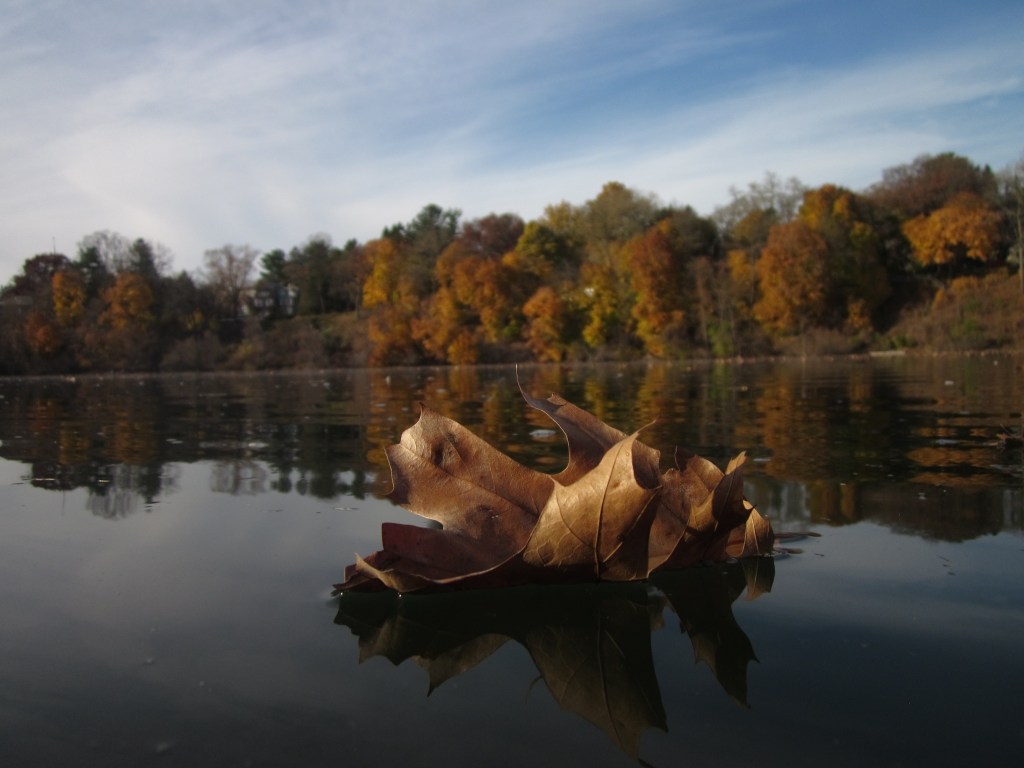
Fallen leaves carpeted the water under still-shedding shoreline trees, or sailed singly, like corsairs before the light wind, as if the feathery alto-cirrus clouds overhead were beckoning. As if proud to be strong still, despite the calendar, the sun spread wide within those clouds. Or maybe that glow signified this might be our last such day for months. Being there, loving the place, warmed me as much as the sun.








 Hoke's Jukebox