They’ve got it down! The 15th edition of “It’s a Jazz Christmas” brings top area jazz talents to Universal Preservation Hall Friday, Dec. 20 and Proctors GE Theater Saturday, Dec, 21.
This well-loved holiday musical favorite features the same cast of musicians and others as last year, including horns, a singer and a genial host. These join the original trio version of the jazzy holiday celebration Gleason first cooked up around pianist-composer Vince Guaraldi’s music for Peanuts holiday specials.
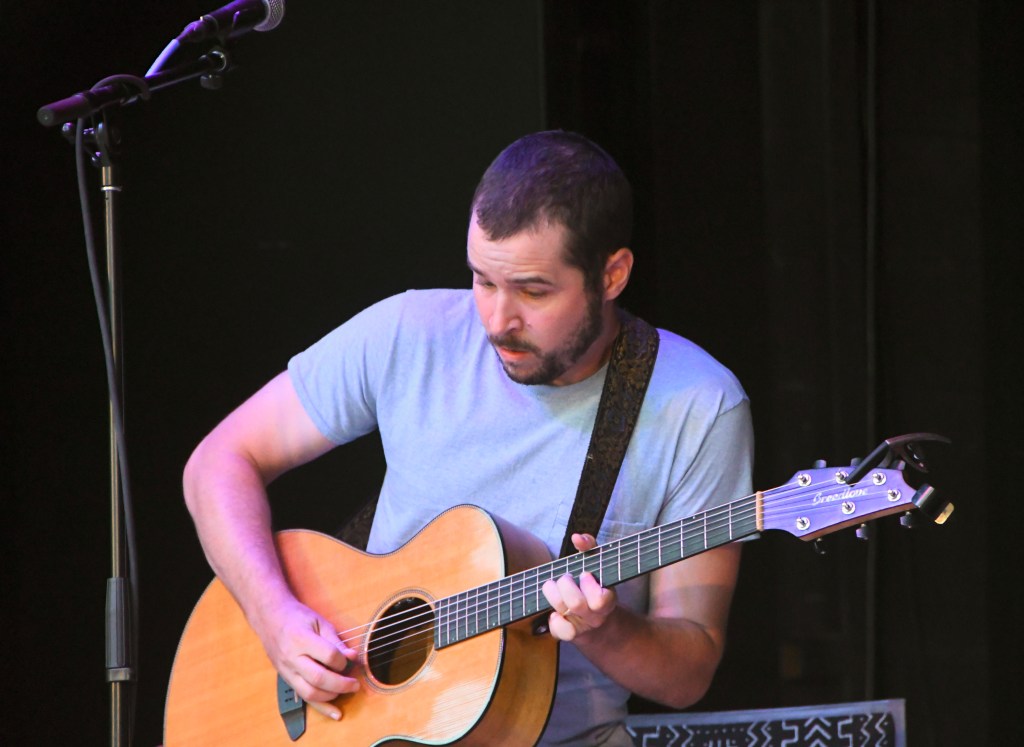
David Gleason. All photos supplied.
Gleason and then-chief of the Massry Center at the College of St. Rose Sal Prizio presented the first area Guaraldi-based holiday show, “…wrapped in the guise of a live old time radio show,” as Gleason has explained, a format that has endured.
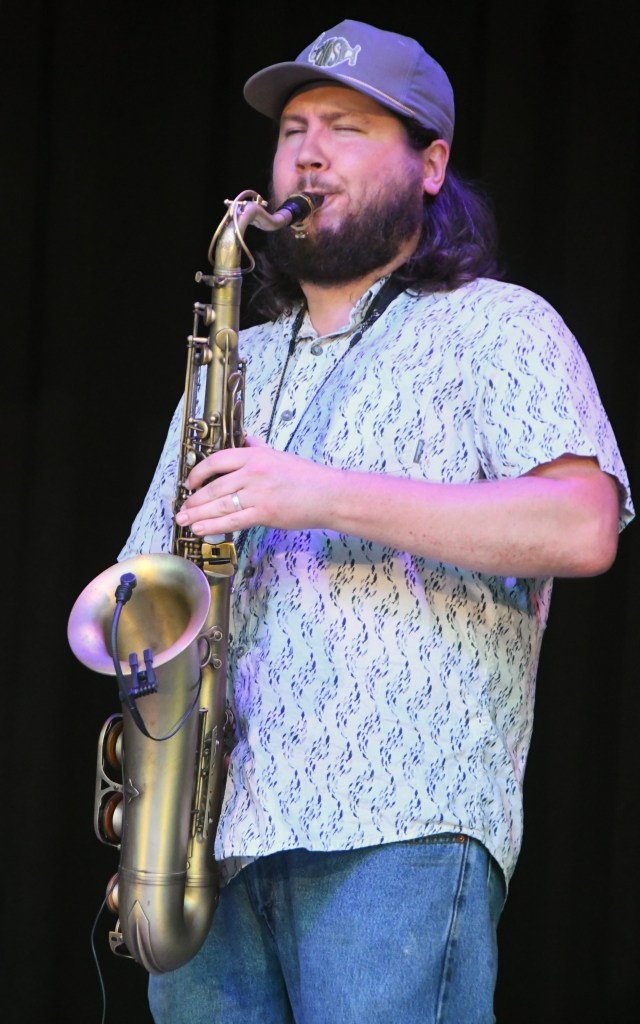
Over time, as he explained, Gleason added musical and spoken elements to his long-running Art D’Echo trio of bassist Mike Lawrence and drummer Pete Sweeney. Trumpeter Chris Pasin, reeds player Brian Patneaude and trombonist Ben O’Shea joined the line-up, plus singer Hannah Amigo and Mike McCord as the show’s radio host, expanding on Prizio’s original script.
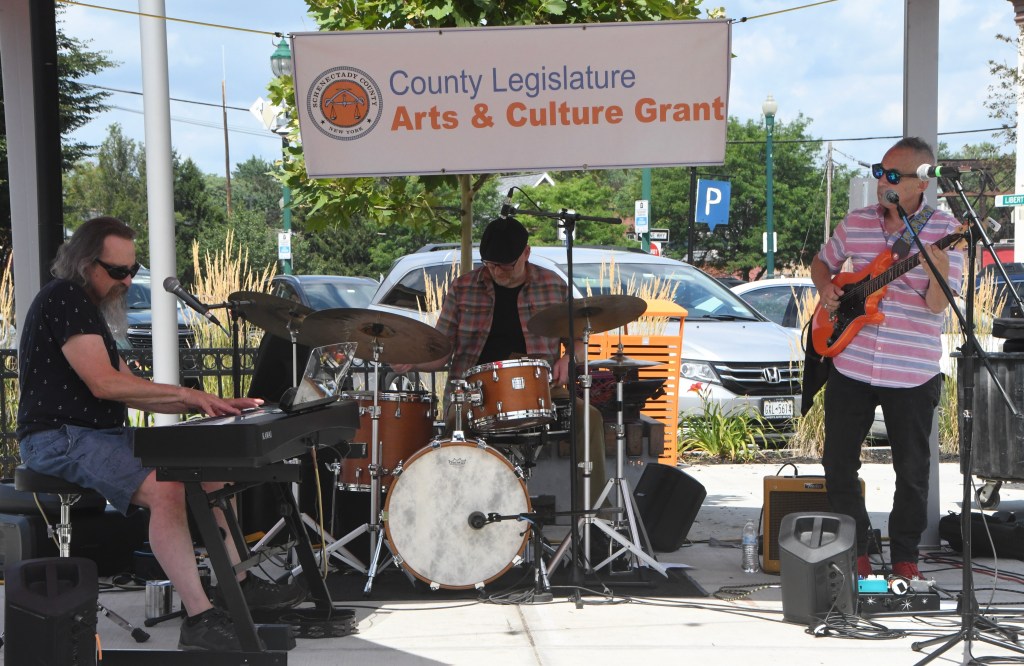
Art D’Echo Trio, from left, Mike Lawrence, bass; David Gleason, keyboards; and Pete Sweeney, drums
“Like most young musicians, I poked around at Christmas music every December,” Gleason has explained. He mastered “Jingle Bells” on his own before lessons brought additional holiday classics including “Have Yourself a Merry Little Christmas” – now a vocal/piano duet in “It’s a Jazzy Christmas” – into his repertoire.
Gleason suggested when we spoke about last year’s edition of this annual favorite, that this is more than just “jazzy,” like the adjective. It’s essential. He said, “It’s actual jazz…with plenty of room to stretch out.” He said, “We have full choruses of improvised solos, and each of the horn players has a feature.” Those features draw inspiration from jazz greats. They play a John Coltrane-style version of “We Three Kings,” for example, that trumpeter Chris Pasin arranged. Pasin is also a composer and arranger of note, a respected bandleader and valued sideman in his own right. So are all these players; they perform in and/or lead various ensembles.
The “It’s a Jazzy Christmas” horns, from left, Brian Patneaude, saxophone and bass clarinet; Chris Pasin, trumpet; and Ben O’Shea, trombone
Gleason began the project by adapting Guaraldi’s tunes to the Art D’Echo trio’s style, but soon arranged “Hark The Herald Angels Sing” into Oscar Peterson’s prolific attack. Also early on, he made a rhapsody of “Dreidel, Dreidel, Dreidel;” so, in this way, familiar tunes evolve. Now, “Jingle Bells” is a mambo and “The Grinch” theme a low rumble.
“Each year we add something new,” said Gleason last year.
This year, he promises, “Lots of Vince Guaraldi ‘Peanuts’ holiday tunes and my arrangements of classic holiday tunes.” He said, “There’ll be a few new things added since last year, but a lot of it is the same.” Gleason noted, “We are trying to do little things to change the show each year, but it’s essentially close to the same each year. The audience seems to like a little bit of both!”
In fact, the audience likes it in droves: Tickets are selling briskly for both shows.
The Proctors Collaborative presents “It’s a Jazz Christmas” Friday at Universal Preservation Hall (25 Washington St., Saratoga Springs) and Saturday at Proctors GE Theater (432 State St., Schenectady). Show time for both: 7:30 p.m. Tickets: $35 adults, $15 for children 17 and under. Box office: 518-346-6204.
PREVIEW – Tatiana Eva-Marie Sings 30s-40s French Gypsy Jazz at Caffe Lena Thursday
“Gypsy jazz” singer Tatiana Eva Marie arrives at Caffe Lena (47 Phila St., Saratoga Springs) Thursday as an import with impeccable pedigree, a supple voice, warm onstage charm and a crackerjack band.
Daughter of a Swiss-French composer father and Romanian violinist mother, she was born in Switzerland and raised there and in France. She came to New York and soon formed her Avalon Jazz Band, fine-tuning it to the agile, light-footed zip of classic Gypsy Jazz ala its inventors guitarist Django Reinhardt and violinist Stephane Grapelli.
Her violinist Gabe Terracciano also plays with the Turtle Island String Quartet including a summer show at SPAC’s recent jazz festival with Terence Blanchard’s expanded young band. Wallace Stelzer plays bass and Max O’Rourke plays guitar, sharing solo time with Terracciano.
Always ambitious, Eva Marie wrote the libretto for Swiss composer Gerard Massini’s opera “Eden Park,” and her latest album (of 10 since 2016) “Djangology” features lyrics she wrote for Reinhardt’s songs. Inspired by the Renaissance artist tradition, she earned a Master’s in medieval literature at the Sorbonne, and she designed the artwork for “Djangology.” She starred in Gerome Barry’s first feature film “Swing Rendezvous” based on her life in New York. And she is already performing live the songs for her next album – of songs from Disney films, sung in French.
Highly telegenic, like the young Maria Muldaur, Eva-Marie’s YouTube videos have generated 80 million views.
Thursday marks her first Caffe Lena performance. Elsewhere, she’s earned rapturous reviews.
The New York Times dubbed her “The gypsy-jazz warbler.”
Downbeat noted, “Tatiana Eva-Marie and her Avalon Jazz Band explored the connection between Paris and New Orleans,” where the Gambit Weekly “Best of New Orleans” praised her this way: “The soft tones and playful energy vocalist Tatiana Eva-Marie employs while tackling the hot jazz styles of the 1930s and 1940s has earned her plenty of accolades both nationally and in her adopted hometown of New York City, where the Avalon Jazz Band is becoming a staple of a thriving Gypsy jazz scene.”
And New York’s Village Voice reported she and her Avalon Jazz Band “…continue in the beloved steps of Django Reinhardt and Stephane Grappelli, but with a contemporary and delightful American twist.”
Their Caffe Lena debut Thursday is presented as part of the Jazz at Caffe Lena collection and The Bright Series, thanks to Kevin and Claudia Bright.
7 p.m. Tickets $34.71, members $30.37, students and children $17.90; plus modest fees. 518-583-0022 www.caffelena.org
REVIEW – Abdullah Ibrahim Trio at The Egg Swyer Theatre; Sunday, Nov. 17, 2024
Time waits for no one, but some artists stay actively creative at ages few of us reach.
South African pianist Abdullah Ibrahim turned 90 last month and needed help climbing on and off stage Sunday. His long fingers rested on his knees as much as they worked the keyboard in his trio’s 81-minute set. He sat still at the keyboard as reeds player Cleave Guyton and bassist-cellist Noah Jackson swung Duke Ellington’s “In a Sentimental Mood” and John Coltrane’s “Giant Steps” – dazzling duets that would largely carry the concert.
After those jazz standards, Ibrahim reached for the keys for the first time to sketch a sparse, slow melody that often recurred throughout to connect songs into a suite with brief pauses between, for applause. At times this repeating motif sounded like “Here’s That Rainy Day,” but maybe wasn’t as it changed shape. The show felt both unified by that repeating melody and a bit disjunct as Ibrahim played only sparingly and most often alone.
The show felt both unified by that repeating melody and a bit disjunct
That’s how he launched his own atmospheric “Nisa,” unaccompanied, lyrical and delicate; then he injected high arpeggios and fast bluesy runs. With no visible cue, but certain in their purpose, Jackson and Guyton rose from where they’d been waiting in chairs stage left to take over mid-song, building a bass and flute groove as Ibrahim offered comments periodically.
Then the trio, calmly business-like in black suits, briefly reverted to straight-ahead jazz tradition, putting a meditative spin on Thelonious Monk’s “Skippy” before Jackson and Guyton joined in again to continue exploring Ibrahim’s ideas through this bouncy bop.
His songs and ideas played out in an episodic organic flow, often without boundaries; like Bill Frisell’s Saturday show on the same stage where things flowed into other things.
Both Ibrahim and the Guyton-Jackson duo produced striking virtuosic displays, but the fireworks always fit the songs.
They performed without mics or amplification; acoustic purity that needed no electronics for solo clarity and smooth sonic blends.
Both Ibrahim and the Guyton-Jackson duo produced striking virtuosic displays, but the fireworks always fit the songs. They returned to their original shapes in codas echoing their themes (or not…); often Ibrahim played this role.
…he seemed most at home, and most engaging, playing in mellow, almost whispery meditations; autumnal, quietly melodic.
He mostly played quietly, as in the unifying motif between tunes, but revved to impressive speed at times in the prolific style of Oscar Peterson, one of his inspirations, or off-center rhythmic explorations like Monk, another influence. The seething energy of a cross-handed passage surged with adrenaline; so did a riveting interlude of sparse low runs against jittery hyperactive repeating figures up high. These were the flashier moves of a mighty master, but he seemed most at home, and most engaging, playing in mellow, almost whispery meditations, autumnal, quietly melodic.
Guyton and Jackson served up their own fireworks, well-suited to Ibrahim’s spare arranging style that allowed lots of latitude for solo statements. Guyton was most effective on flute, his main instrument Sunday, with clarinet and super-high piccolo for spice. Jackson supplied the swagger, bass lines bustling in witty syncopation. When they flew together, though, they flew fast and far, most impressively blending cello with flute in chords they steered fearlessly through songs.
They blended this way in “Mandiss” to close, Ibrahim sitting things out until the end as Guyton and Jackson looked over at him and he held the audience’s eyes and breath to reach his index finger slowly to strike a single note as coda, farewell and thanks.
As they rose to reap the standing ovation, Ibrahim urged Guyton and Jackson forward to harvest the applause individually, hands on heart, again and again.
The Sandi Trio opened in a short set that expressed the purpose of the sponsoring Resonance Series to explore connections among world musics through a South Asian lens. At stage right, Malian Yacouba Sissoko played West African kora, center stage sat Indian violinist Arun Ramamurthy and Tim Kyper played West African percussion stage left, mainly a large gourd with sticks for busy treble runs and with the heel of his hand for emphatic booms.
The blend worked well, occasionally in the alap-and-tal form of Indian ragas with airy tentative intros coalescing into propulsive unified riffing. Sissoko and Ramamurthy alternated in leading the trio, silvery short kora notes clustering in repeating figures as Ramamurthy explored, then swapping roles while Kyper decorated it all.
Abdulla Ibrahim Set-List
In a Sentimental Mood
Giant Steps
Nisa
Skippy
In the Evening
Peace
Water from an Ancient Well
Ishmael
Tuangura
Mandiss
Guyton kindly shared these song titles as he packed his gear after the show, paging backward through charts on his music stand, then adding, with reverence, “When (Ibrahim) soloed, he put in other stuff that we didn’t recognize.”
REVIEW: Bill Frisell Trio at The Egg Swyer Theatre, Saturday, Nov. 16, 2024
Bill Frisell Trio – From left: Luke Bergman, bass; Frisell, guitar; Rudy Royston, drums
“Dude, that was the longest song I’ve ever heard,” an awed fan told guitarist Bill Frisell after a recent solo show. Saturday’s seamless trio reverie at The Egg’s Swyer Theatre clocked 95 minutes. Apart from a pause between the set-closing “What the World Needs Now (Is Love Sweet Love)“ and the encore “You Only Live Twice,” they never stopped.
The setlist that sound engineer Kevin gave me listed 11 songs, but things flowed in an unbroken sweep of improvisation. (Note they swapped “What the World Needs” with “You Only Live 2x.”) What could maybe have been identified as separate songs felt like one piece; chapters in a novel, maybe, or a conversation among friends.
Frisell’s friends – that’s how he introduced them – were drummer Rudy Royston and bassist Luke Bergman, the latter in for regular Thomas Morgan. Kevin said this substitution warranted a set-list; Frisell usually doesn’t map his shows but instead expects bandmates to figure it out on the fly, as he told the TU’s astute R.J. DeLuke: “When we play, we’re just doing it all together.”
Hats off to Bergman for getting up to speed fast, joining the intuitive closeness Frisell and Royston have built. This was the sound of three minds thinking, moving six hands (and Royston’s feet) through a dance. Taking a bow afterward, Frisell noted he and Bergman wore identical shoes, wryly complaining about Royston’s different footwear.
Saturday’s sweeping suite evolved in linked episodes; first as a sound, then a song, then a groove. Frisell gradually mutated one melody into another via a new guitar phrase, beat or tone amid the ongoing one, like painting graffiti on a moving train. He never had to cue anybody, but Bergman recognized something new and shuffled his charts to stay current. Frisell smiled when Royston or Bergman responded in a way he liked, or tossed him something new to incorporate, turn inside out or upside down or simply hand back.
Their kinetic fluency was breathtaking to watch; their variety, spell-binding.
Royston often played the melody on his drums, hitting exactly on a Frisell guitar note; but he never neglected the push, the meter. His kick-drum alone would have given the trio all the rhythm it needed.
Most often, they made meditative mood music, but they rock-and-rolled, flew to the Caribbean, Iberia, west Africa, the Mississippi Delta and strolled into city blues bars or jazz clubs. They made a precise minuet, a dreamy ballad, a back-alley brawl, a classy cotillion, a rock and roll explosion spawned by shared restlessness. And there were quotes all over the place, complicating any Name That Tune try. “What Is This Thing Called Love” popped up in an airy groove, then “Autumn In New York” turned things bluesy.
Solid as Gibraltar or wispy as a mist, transitions felt elastic; you knew something fresh was coming, but the new flavor often came in subtly.
After this all original roller coaster, style shuffle with world-music spin-the-globe accents, Frisell moved into the familiar. This followed early mentor Sonny Rollins’s improvising with “music from his childhood…what he was hearing on the street…saw in a movie or whatever was going on around him,” as Frisell told R.J. DeLuke.
“What The World Needs Now (Is Love, Sweet Love)” formed organically, like everything else, from clouds of sound the three wove in the long jam. In fact, it grew from noisy eddies of a brusque looped-guitar scream-fest. Offering straight readings of its yearning melody, they then pumped fresh jazz freedom into the 60s hit.
Returning to encore, they stayed with the familiar, gradually forming the James Bond theme “You Only Live Twice” out of the silence, then running the changes.
Fans looked at each other: “I KNOW this, but what IS it?”
Another Frisell song, or part of Frisell’s long song.
For the longest song you might ever hear, Frisell leads his trio (Royston and regular Thomas Morgan) tonight at the Levon Helm Studios in Woodstock; then he plays Bombyx in Northampton in February with an expanded band. To Royston and Morgan he adds strings: violist Eyvind Kang, cellist Hank Roberts and violinist Jenny Scheinman, recently heard at Caffe Lena with folksinger Robbie Fulks.
NERD NOTES: A floor-level mic faced Royston’s kick drum, with two mics on stands behind him, one over each shoulder, facing forward. This delivered a full, clean sound from his snare, floor tom, two rack toms, hi-hat and three cymbals. Frisell flat-picked a Creston Sunburst Custom, using foot pedals sparingly for looping, sustain, fuzz-tone and other effects. He’d loop an electronic ostinato and solo on top. Bergman’s hollow-body Harmony bass guitar recalled the similar Gibsons Jack Casady (Jefferson Airplane, Hot Tuna) has played for decades; picking with his thumb, like Casady does. But Bergman’s sparse, beautifully-placed notes resembled the late great Phil Lesh (Grateful Dead).
A kind reader corrected my originally erroneous naming of Frisell’s guitar. This reference is correct.
REVIEW: Life is a Carnival: The Last Waltz Tour ’24
The Rolls-Royce of tribute bands, the Last Waltz tour (this edition branded “Life is a Carnival”) jukeboxed classic songs of The Band and more on Proctors Main Stage Thursday, bringing nostalgic warmth, right-now immediacy and confident punch.
Three times as big as The Band (or most cover bands), they made a massive sound. Stacked with stars who blended respect for The Band with honed skills, the revue felt more rocking than reverent, packing some modern touches.
At one extreme, former Heartbreaker Mike Campbell’s guitar faithfully emulated the pinched treble tones and oblique phrasing of The Band guitarist Robbie Robertson at times; also Eric Clapton’s bluesy attack in “Further On Up the Road,” which Clapton played in “The Last Waltz.” At the other, jazzy keyboardist John Medeski jammed glorious noise and churchy fervor all his own into “Chest Fever,” signature song of Garth Hudson, now the only surviving member of The Band.
Performers’ talents balanced well; everybody got at least one solo except bassist-bandleader Don Was. But for all the fire in voices and guitars up front, steady locked-in beats by Was and drummer Terence Higgins firmly supported everything. Benmont Tench (Campbell’s band-mate in Petty’s Heartbreakers and at Proctors Thursday) and Medeski also played right in the pocket support, plus some solos, sometimes sounding like The Band’s organist Garth Hudson and pianist Richard Manuel.
The Last Waltz surveyed The Band’s songbook and showcased musical pals; but some tunes Thursday came from outside The Last Waltz songbook; see below. Campbell sang Tom Petty’s “The Best of Everything,” then Ryan Bingham sang Bruce Springsteen’s “Atlantic City.”
Jamey Johnson and Bingham sang most leads, Johnson’s powerhouse baritone edged with Delta accent like Helm’s; Bingham, agile, expressive.
Johnson sang the jaunty “Up on Cripple Creek” strongly to start, Medeski’s percussive clavinet chiming funky.
The four Levee Horns joined Bingham to gang up on the breezy ironic lament “The Shape I’m In,” Campbell using wah-wah pedal to punch up his solo. Playing on almost everything thereafter and guided by New Orleans deity Allen Toussaint’s arranging style, the horns either grabbed the spotlight or jumped into songs’ creases to comment, add heft and texture.
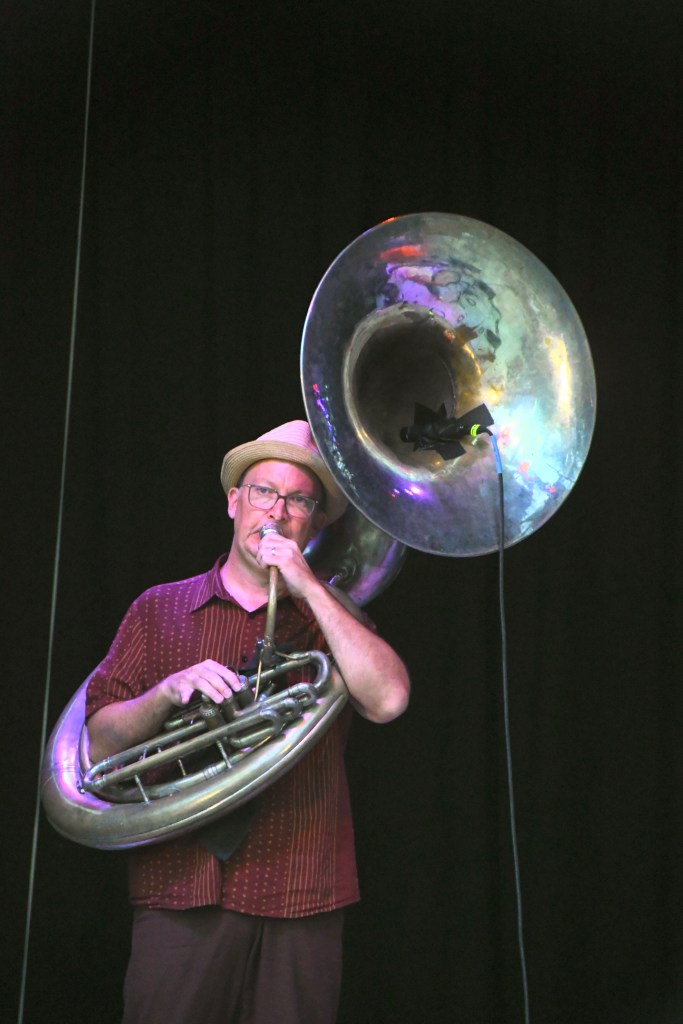
Who knew “Georgia On My Mind” needed a booming Sousaphone solo?
Campbell praised Robertson’s songwriting before noting Bob Dylan and The Band bassist Rick Danko wrote “Wheels On Fire,” not Robertson; he sang it himself, Shannon McNally in harmony.
Who knew “Georgia On My Mind” needed a booming Sousaphone solo? Matt Perrine, that’s who, following in surprising-for-a-big-horn grace along Johnson’s most soulful vocal of the night. No, wait, that was maybe in the deeply poignant “It Makes No Difference” right after “Georgia.”
Singer Dave Malone harmonized on “Difference” and stayed at the mic as Cyril Neville came on to lead the uptempo “Mystery Train” and “Down South In New Orleans.” “Train” built slowly until the horns punched it up. Both Malone (the Radiators) and Neville (with his brothers and uptown funk bands) are from New Orleans; so are the Levee horns whose leader Mark Mullins’s trombone solo pushed “Down South” into overdrive. Malone and Neville repeated this Crescent City one-two in the second set: Dr. John’s “Such a Night” and Bo Diddley’s “Who Do You Love” back to back.
“…like a bunch of cool, wacky things going on at the same time.”
Richly poignant mid-tempo tunes put a thoughtful spin on the first set; especially McNally in the dirge “Long Black Veil” and Bingham in “Atlantic City” before they lifted the mood in uptempo The Band faves “W.S. Walcott’s Medicine Show” and “Life is a Carnival.” As Mullins promised in an interview last week (See “Eternal Songs By The Band, Fresh Players and Singers” on this site) Carnival” rolled “like a bunch of cool, wacky things going on at the same time.”
Ward Smith’s baritone sax beautifully supported “King Harvest,” featuring a good Johnson vocal; then Johnson moaned all the lost-cause melancholy of “The Night They Drove Old Dixie Down” before the break.
After Medeski’s keyboard anarchy lit up “Chest Fever” to start the second set, Campbell name-checked fellow former Heartbreaker Benmont Tench, across the stage at the piano, noted Tom Petty wrote it, then sang it himself in a high Petty-like voice and uncorked a dazzling solo. Like “Atlantic City,”which Levon Helm claimed in his post-Band career, it’s The Band-adjacent: Robbie Robertson played on the record.
Like the first set, the second built on strong architecture of mood and tempo, easing from mid-tempo cruises – McNally was aces in “Evangeline” and Malone sang a pretty good Van Morrison echo in “Caravan” – into a valley of lush slower ballads with irresistible emotion.
Mid-set rockers brought big fun. Keyboards and horns charged up “Rag Mama Rag” behind Johnson’s punchy vocal, Bingham gave “Look Out Cleveland” a playful swing and Campbell went all Clapton in “Further On Up the Road.”
Comparing Thursday’s versions of The Band songs with the originals is tempting nonsense.
Seriously vulnerable classics “Helpless” and “Forever Young” bookended peppy New Orleans-romps “Such a Night” and “Who Do You Love” by Malone and Neville. Everybody wanted to sing “The Weight,” so everybody did. Then the yearning “I Shall Be Released” closed before “Don’t Do it” hit as upbeat encore.
Most songs brought joyful shouts of recognition from the happy, boomers crowd.
Comparing Thursday’s versions of The Band songs with the originals is tempting nonsense. But this band gave the songs their due by giving deeply of themselves, with smiles onstage and off.
The calm ease of The Band’s playing – Mullins told me it’s harder than it sounds – may set a lower bar than the singing, especially for veteran players with long experience together. The Levee Horns, for example, are all New Orleanians and Mullins and Perrine play together in Bonerama, while Campbell and Tench played for decades in Tom Petty’s Heartbreakers and Don Was plays with everybody. The Band also comprised fantastic singers Levon Helm, Rick Danko and Richard Manuel whose varying vocal sounds gave the songs matchless atmosphere and emotion. These voices always hit the note, as the Allman Brothers used to say, especially the extra-busy Johnson.
Life is a Carnival: The Last Waltz Tour ’24: Jamey Johnson, Ryan Bingham and Dave Malone, guitars and vocals; Cyril Neville, percussion and vocals; Shannon McNally, vocals; Benmont Tench and John Medeski, keyboards; Terence Higgins, drums; Don Was, bass and leader; Mark Mullins, trombone and Levee Horns leader; Matt Perrine, Sousaphone and euphonium; Ward Smith, saxophones; and Bobby Campo, trumpet and flugelhorn.
A helpful fan let me photograph the set-list (first set) he got from a roadie onstage. A crew member verified the second set songs for me.
The Songs, and Who Sang Them
First set, 7:34 – 8:34 p.m.
Up on Cripple Creek Jamey Johnson
The Shape I’m In Ryan Bingham
This Wheel’s On Fire Mike Campbell
Georgia on My Mind** Jamey J.
It Makes No Difference Jamey J., Ryan B., Dave Malone
Mystery Train Dave Malone, Cyril Neville
Down South in New Orleans Dave M., Cyril N.
Long Black Veil* Shannon McNally
Atlantic City* Ryan B.
W.S. Walcott’s Medicine Show Jamey J.
Life is a Carnival Jamey J., Shannon McN.
King Harvest Jamey J., Ryan B.
The Night They Drove Old Dixie Jamey J.
Down
Second set, 9:10 – 10:42 p.m.
Chest Fever Jamey J., Ryan B., Dave M.
Best of Everything* Mike C., Shannon McN.
Ophelia Ryan B.
Evangeline*** Shannon McN.
Caravan Dave M.
Twilight* Ryan B.
Rag Mama Rag Jamey J.
Look Out Cleveland* Ryan B.
Further On Up the Road Mike C.
Helpless Jamey J.
Such A Night Dave M., Cyril N.
Who Do You Love Dave M., Cyril N.
Forever Young Ryan B.
The Weight Everybody
I Shall Be Released Jamey J., Ryan B., Mike C.
Don’t Do It Jamey J.
Not in “The Last Waltz” film or various versions of its soundtrack albums
** In the show but in neither the film nor recordings
*** Not in “The Last Waltz” show but in the film and recordings
Less is more for both jazz masters playing The Egg this weekend; guitarist Bill Frisell Saturday and pianist Abdullah Ibrahim Sunday.
Both play with sparse, atmospheric restraint. Both are also busily prolific, and both play solo and with ensembles ranging from duos and trios to orchestras.
Bill Frisell. Photo by Peter Van Breukelen / Getty / The New Yorker
On Saturday, Frisell leads his trio of bassist Luke Bergman and longtime drummer Rudy Royston; just one of his several active bands.
He’s made 40-plus albums since 1983, earning six Grammy nominations with one win. They’ve appeared on a dozen-plus different labels, sure sign of a restlessly creative spirit. Fearlessly rummaging among bands, styles and traditions, he’s nonetheless consistent in his elegantly understated playing, likely influenced by early training on clarinet in his main hometown of Denver. You can almost hear the breaths in his phrasing, like a winds player, just as you can hear straight-ahead jazz, bluegrass and even psychedelic tones and structures.
Co-starring with fellow explorer John Zorn on New York’s combustible downtown scene, Frisell has recorded and performed in more or less traditional trios with Dave Holland and Elvin Jones (2001) and Ron Carter and Paul Motian (2006). By then he had already started intrepidly jumping around.
“Have a Little Faith In Me” (1992) celebrates John Hiatt (the title track) and other modern pop and rock songwriters.
“Disfarmer” (2008) forms the soundtrack for photos by the obscure outsider artist Mike Disfarmer, stark and simple images, like Frisell’s guitar. Two 1995 albums collect music for Buster Keaton films, and “Hunter S. Thompson – The Kentucky Derby Is Decadent and Depraved” (2012) takes its iconoclastic attitude from the gonzo journalist.
“Lagrimas Mexicanas” (2011) with singer Vinicius Cantuaria takes a beautifully rhapsodic journey into south of the border melancholy with vocals in Spanish. And, in that same year, Frisell released a sweet Beatles tribute “All We Are Saying” with one of his best bands: violinist Jenny Scheinman, bassist Tony Scherr, drummer Kenny Wollesen and Greg Leisz playing guitar and pedal steel.
Frisell pioneered what’s come to be known as Americana, arguably one of its first practitioners: “Nashville” hit in 1997.
Frisell’s latest release, the two-CD “Orchestras,” features the 60-piece Brussels Philharmonic.
And, as if that somehow weren’t variety enough he’s released 22 albums as downloads, mostly of live performances; plus four compilations; 19 collaborations with Paul Motion and Joe Lovano, 13 with John Zorn, nine with Naked City, eight with the Gnostic Trio; seven with Julian Lage and Gyan Riley and 22 one-off collaborations and dozens of shorter guest appearances.
Meanwhile, his “Unspeakable” (2005) won the Grammy as Best Contemporary Jazz Album.
And the thing, the big thing, is: you can tell it’s Frisell playing after about two notes.
The Bill Frisell Trio plays The Egg Saturday at 8 p.m. Tickets: $49.50 and $39.50. 518-473-1845 www.theegg.org.
Pianist Abdullah Ibrahim leads his trio at The Egg on Sunday; the Sandhi Trio opens.
Now 90 – Frisell is 73 – North African-born Ibrahim has released 72 albums and been hailed as a 2019 National Endowment for the Arts Jazz Master along with composer and big-band leader Maria Schneider, writer Stanley Crouch and singer pianist Bob Dorough.
A mixed-race “coloured” person under apartheid racist rules, Ibrahim is the son of a church pianist. Hymns were an early influence as he began playing in Capetown and Johannesburg with small bands including the Jazz Epistles who recorded the first-ever full-length jazz album by Black South Africans.
Abdullah Ibrahim. Photo by Dr. Minari Umari / Downbeat
Apartheid inspired a globe-trotting exile through Europe and the Americas, landing in Europe in 1962 and New York in 1965; he’s lived and worked in both places since, plus South Africa.
During his international musical wanderings, Ibrahim found a major mentor in Duke Ellington, arguably America’s greatest jazz hero after Louis Armstrong and a composer of both intimate and large-scale works. Then known as Dollar Brand, Ibrahim and singer-wife Sathima Bea Benjamin moved to New York in 1965, playing the Newport Jazz Festival and substituting for the ailing Ellington in five shows leading the Duke’s Orchestra. Studies at Juilliard and playing with such leading creative forces as John Coltrane, Pharaoh Sanders, Cecil Taylor and Archie Shepp broadened Ibrahim’s power and ambition.
On a brief return to South Africa in 1968, Ibrahim converted to Islam, leaving his birth name behind. He returned to New York after the Soweto Uprising in 1976, founding his own record label Epaka and the band Ekaya while also composing music for film and television and launching the M7 music academy in Capetown after the apartheid ended.
Ibrahim returned again to perform at Nelson Mandela’s inauguration as their nation’s first-ever Black president in 1994. Mandela hailed Ibrahim as “our Mozart,” which seems entirely apt as the pianist’s ambitious “Mannenberg” (1974) had become an anti-apartheid anthem.
Like Frisell, Ibrahim has performed and recorded with groups large and small including drummer Max Roach and the Munich Radio Philharmonic Orchestra in the 1990s. Also like Frisell, Ibrahim plays in a sparse but eloquent style instantly recognizable as his but also evoking his heroes Ellington, Thelonious Monk and Fats Waller.
He has continued to perform solo and to lead Ekaya and other ensembles.
The Sandhi Trio opens for Ibrahim’s Trio, an ambitiously international group mixing West African and South Asian styles. The Sandi Trio comprises Malian kora master Yacouba Sissoko, South Indian violinist Arun Ramamurthy and a percussionist, likely Silk Road Ensemble percussionist Shane Shanahan.
Ramamurthy also curates the Resonance Series that explores musical connections with South Asia with other world musics and sponsors Sunday’s concert. The Michele L. Vennard Hospitality Grant Program of the Albany County Convention and Visitor’s Bureau Fund (AKA Discover Albany), a fund of the Community Foundation for the Greater Capital Region finances the series, along with an Arts Thrive & Grow Grant of the Art Center of the Capital Region, funded by New York State.
Show time for Abdullah Ibrahim Trio and the Sandhi Trio is 7:30 p.m. Tickets: $55, $45.
PREVIEW: LIFE IS A CARNIVAL: LAST WALTZ TOUR ’24 at Proctors Thursday
The eternal songs of The Band and Allen Toussaint’s horn charts meet onstage Thursday at Proctors in a Mississippi-mighty flow of sound and feeling.
Mark Mullins, the New Orleans trombonist and leader of Bonerama, leads the horn section in “Life Is a Carnival: Last Waltz Tour ’24,” latest iteration of an all-star tribute that’s celebrated The Band since 2016. Garth Hudson, sole surviving member of The Band, played with them at Albany’s Palace Theater in 2017 when guitarist-singer Warren Haynes and singer keyboardist Michael McDonald were featured players. Then as now Mullins runs the horns, speaking in Allen Toussaint’s very distinct arranging language.
Mark Mullins. Kevin Stiffler photo
“I was always a huge Allen Toussaint fan,” Mullins said from the road last week, after the tour kicked off in Los Angeles with guests including Van Morrison, Eric Clapton and Trey Anastasio.
“Being from New Orleans and knowing what Allen was and what he did for New Orleans music is immeasurable,” said Mullins. When he’d learned Toussaint wrote the horn charts for The Band’s live “Rock of Ages” album, he found them “brilliant,” deceptively complex. Learning to play them, he said, “It sounds simple…but then you realize how complex it is.” Mullins marveled, “It’s very complicated stuff but it doesn’t sound complicated. That’s the beauty of how Allen was able to write.”
Mullins said. “As a trombone player growing up in my teens, being in a school band I would still go home and listen to Led Zeppelin and Bob Dylan and everybody that you were supposed to be listening to at that time.” (His band Bonerama released the hugely entertaining “Bonerama Plays Led Zeppelin” in 2019.) Mullins listened to New Orleans styles; but “I would always go back to the Bruce Springsteen records and play trombone along to Clarence Clemons’ saxophone solos or Pink Floyd albums that didn’t even have horns,” Mullins recalled.
He couldn’t remember when he first heard The Band. “Their stuff was sort of around forever…everywhere,” he said. “As I got into Bob Dylan and started learning more about who The Band was, then it was like, ‘Oh. There’s this whole other thing that started to blow me away.” While he played some of their songs in high school groups, learning their songs for the 2016 Last Waltz tour opened his ears.
As he learned with Allen Toussaint’s horn arrangements, “complexity that sounds simple” describes The Band. When Trey Anastasio chose “Unfaithful Servant” for the recent tour kick off show, “Of course, Trey would pick the hardest song,” Mullins laughed, “so fragile and so delicate, quiet and exposed…probably my favorite Band song.”
…a bunch of cool, wacky things going on at the same time…
“Life Is a Carnival” – title of the tour that hits Proctors Thursday – is another. “When you listen to it, you try to find where the downbeat is, where ‘one’ is,” said Mullins. “Its got a quirky cool intro, the way The Band has it, and then Allen (Toussaint’s horn section) comes in on top of it with this very cool layered, structured, unorthodox horn part. Almost everybody is playing something kind of different….the whole song sounds like a carnival…like a bunch of cool, wacky things going on at the same time. It really paints a picture. That’s one of my favorites to play every night.”
Playing every night with the all-star crew bassist Don Was assembled and leads “seems just infinite,” said Mullins. “There’s so many songs,” and they may change each night.
“With the version that we’ve been doing on the tour, with Mike Campbell and Benmont Tench from the Heartbreakers and Ryan Bingham, Jamie Johnson – we’ve still brought some stuff in that we haven’t done on previous Last Waltz tours so that’s a really cool thing about this version of the group.”
“It’s a full-blown rock band with Mike Campbell up there,” said Mullins. Citing his guitar sound, Mullins said, “I’ve been hearing it on the radio since I was a kid on all those Heartbreakers hits. There it is right in front of us and it just sounds so great.” He said, “Ryan Bingham, I’m a huge fan already,” also praising Jamie Johnson who “brings the house down every night.” All the players share “the same mutual respect for The Band and (main songwriter) Robbie (Robertson) and the compositions and that really makes it special.”
New Orleans, in The House
Many also share New Orleans backgrounds with Toussaint: Mullins and the three other Levee Horns, singer-percussionist Cyril Neville, singer-guitarist Dave Malone (the Radiators) and drummer Terence Higgins. The Levee Horns are Mullins, trombone; his Bonerama bandmate Matt Perrine, Sousaphone and euphonium; Ward Smith, baritone, tenor and soprano saxophones and clarinet; and Bobby Campo, trumpet and flugelhorn.
The band also includes singers Ryan Bingham, Jamey Johnson and Shannon McNally, keyboardist John Medeski and leader and bassist Don Was, who also runs Blue Note Records and plays in the house band for the Americana Music Awards.
Mullins said, “Some of the songs we’ve been doing that just work so well – ‘The Shape I’m In,’ of course ‘The Weight,’ ‘I Shall Be Released’ – all the ones that you’d expect, and some of them change from night to night.”
Mullins also recognizes how important The Band’s fans are to the show.
“The audience is right there with it because the songs have such an emotional connection,” he said. “You see people crying, smiling and they’re standing up and they’ve just got this expression of joy on their faces.”
Show time: 7:30 p.m. Tickets: $219.50 – $40.50. www.proctors.org 518-346-6204
BONERAMA – Future File
Mark Mullins hopes to record new Bonerama music soon and looks to live shows.
“We have a really cool New Year’s Eve gig,” he announced, noting they seldom play that night. “We’re going to play in Jackson Square…with Tank and the Bangas…right in the heart of New Orleans to ring in 2025, so that’s going to be exciting.”
Bonerama also sets sail on The Big Easy Cruise, “a New Orleans-music-themed cruise,” Mullins explained. The week-long January run out of Fort Lauderdale features Trombone Shorty, Papa Gros and others, “a whole lot of really cool New Orleans acts. So we’re excited about that.”
As for Jazz Fest in New Orleans this spring, Mullins said, “Everyone thinks that we’re always going to be there, but I never take Jazz Fest for granted.” Noting the profusion of new young acts available (and laughing when I included the Rolling Stones among them), Mullins said, “I sure hope so, because it’s so much fun.”
Bonerama has played several area venues, graciously inviting young Schenectady trombonist (natch!) Alex Slomka to sit in at the Parish Public House in a 2017 Halloween show. Mullins is shown at left; Slomka, right.
Bonerama at the former Parish Public House, now Ophelia’s; Mullins is second from left
Bria Skonberg Quintet at A Place for Jazz; Friday, Nov. 1, 2024
Trumpeter and singer Bria Skonberg reached back to the heyday of New Orleans Friday at A Place for Jazz, celebrating Crescent City street parades, saints and sacred songs before the volunteer presenting program’s biggest crowd.
Bria Skonberg and Quintet Take a Bow. From left, pianist Chris Pattishall, Skonberg, bassist Mark Lewandowski, reeds player Julian Lee and drummer Darrell Smith
She also roamed more modern jazz archives, and a 70s pop in one instance, for tunes well suited to her classicist approach. As in past shows here – A Place for Jazz in 2014, for example – her sincere reverence and fiery skill came engagingly packaged in an adroit entertainer’s warmth.
Her new COVID-era album “What It Means,” a truncated version of the Crescent City classic “Do You Know What It Means to Miss New Orleans,” supplied most of the tunes and much of the mood Friday, an upbeat survey of early jazz seen through a contemporary prism.
She sang this antique ballad three songs in Friday, after her own “Elbow Bump” and (New Orleanian reed man) Sidney Bechet’s “Petit Fleur,” both launching from march beats by drummer Darrell Smith and bassist Mark Lewandowski into bluesy reveries. Chris Pattishal’s piano carried beat-parade energy to the horns up front; Skonberg blaring wide open or modulating her phrasing with a plunger mute, reed man Julian Lee impressive in hearty tenor blasts or clarinet decoration around Skonberg’s phrasing..
Her first vocal in “Do You Know What It Means to Miss New Orleans” blended nostalgic affection with melancholy at a mellow tempo, Lee’s tenor circling her voice as his clarinet had earlier. Then things bounced uptempo again for “Sweet Pea” with a bit of skat-singing before very Louis Armstrong hesitation phrasing from her trumpet as Smith contributed to its vintage flavor, resting one stick on his snare head and tapping it with the other.
Skonberg spoke of her upbringing in Chilliwack, BC, Canada, praising the public school music program that inspired and nurtured her before admitting she was stalling before tackling “a very intricate Louis Armstrong number.” His spry “Cornet Chop Suey” proved no problem at all, another vintage march-beat launch into confident fireworks. After one tricky run, though, she gave an “I made it” shake of her head.
After musing on parenthood – she’s a recent mom – she sandwiched John Lennon’s sentimental “Beautiful Boy” around the Count Basie favorite “A Long Way to Go” in smooth seques without seams or hesitation.
The rhythm section shone next in another New Orleans-sounding swing number I didn’t recognize. After Skonberg’s fluent plunger mute solo and fine Lee tenor break, Lewandowski signaled a takeover alongside Smith’s swaggering drums and Pattishall’s piano, proving that trio could credibly play their own gig.
Chris Pattishall
Mark Lewandowski
Darrell Smith
A nice loose moment came in their first-set closer “I Remember April” as Skonberg looked around as if asking “Who solos now?” Pattishall gave a good answer, stepping up big before Skonberg cued a brisk duet with Lee to close.
Her second set offered more variety, from Skonberg’s lively hockey-inspired “Hip Check” to open with tenor-trumpet cross-talk and a pulsating vamp. Then came two intense surprises.
Citing the 2016 post-election women’s march, Skonberg didn’t need much political intro to frame “Villain Vanguard” as a debate, both trumpet and tenor going vehement in spirited argument. Things flowed hotly in opposition rather than dialog, before resolving in a welcome mood of peace. But even this reconciliation erupted in spiky snark before going tranquil.
As conciliatory and tender as the preceding tune was contentious, “Mood Indigo” soothed like delicious, torchy romance. Skonberg’s voice flowed slow and sweet over Pattishall’s piano before Lee’s tenor walked in as if offering a bouquet; best ballad all night. Another mainstream jazz antique “It’s Alright With Me” felt like a perfect fit in its uplifting melody at a fun tempo.
Next, Skonberg ushered everyone offstage except Pattishall whose unaccompanied energetic take on Willie “The Lion” Smith’s “Music On My Mind” flowed like a highlight film from emphatic staccato chords to delicate, unabashedly pretty phrases.
Skonberg dubbed the full band’s return as going from the sublime to the ridiculous, but “Comes Love” was fun without being cheap-funny. It toted its own New Orleans raucous street-parade bounce with a zesty upshift into Latin bustle, peppy breaks by Lewandowski’s bass and Smith’s drums under up-front surges by Skonberg’s plunger-muted trumpet and Lee’s agile soprano sax.
While Skonberg’s vocal in the show-closing “The Night Time Is the Right Time” sounded somewhat tame compared to commanding versions by Aretha Franklin and Ray Charles, her trumpet more than held its own in another very Louis Armstrong-like solo. Here she engaged the crowd in clapping and singing along so the thing felt unanimous and joyful.
A Place for Jazz President and concert host Bill McCann thanked fans filing out, and vice versa, greeting many by name. He also offered shout-outs during intermission to writers R.J. DeLuke (Times Union), J Hunter (RadioRadioX) and me.
A Place for Jazz now goes quiet until Friday, April 25, 2025 when its spring membership concert brings together saxophonists Scott Hamilton and Harry Allen in a tribute to Al Cohn and Zoot Sims.
Half a minute into “New Potatoe Caboose,” I got it.
Listening to the first side of “Anthem of the Sun” after Phil Lesh died, I got it.
There on the Grateful Dead’s second and trippiest album, the jam on “The Faster We Go the Rounder We Get” had faded into delicate guitar filigree.
Then a nine-note Lesh bass guitar line opened the door into what came next. The chiming treble stuff before felt serene and relaxed. But this, this was it – a gentle string of notes so peaceful and consoling that I felt I understood, once again and completely, what the Grateful Dead were and did. As Lesh developed the song from underneath, they followed his map.
In the Grateful Dead’s mission, to get people and places high by shaping feeling states in sound, Lesh was uniquely central. As the bridge between beat and melody, he played around with time, so the band swung; and he brought a classically-trained harmonic sophistication to jams. He came to the Grateful Dead, to the electric bass guitar, via violin and trumpet, through orchestras and jazz big bands, so his musical mind was a big tool box. Lesh nudged the voices, guitars and keyboard in new directions, whether they were all in full flight or dank doldrums in need of a fresh idea. He had the key.
Phil Lesh onstage at the Knickerbocker Arena; March 26, 1993
Lesh played with a pick, phasing with clean, percussive articulation. He seldom played very fast; his grooves were restrained, sparse – but also propulsive, powerful when he pushed things. You can hear the urgency, the glee, in every note.
Put on “New Potatoe Caboose” and you can hear all of that, and might find yourself hanging out, as I did, in Phil’s section of the bus, listening to the song especially to hear what he did with it.
“Anthem of the Sun” and “Aoxomoxoa” (1969, the year after “Anthem” and same year as “Live Dead”) may feature Lesh’s spaciest, out-there playing, ethereal and abstract. But his best-known composition “Box of Rain” (from “American Beauty” 1970) reaches just as deep in the opposite direction, mourning his father’s passing in earthy, emotionally accessible simplicity.
After Jerry Garcia died in 1995, Phil was part (or not…) of successor bands that formed and faded. After 30 years of mostly knowing who the Grateful Dead were (except for keyboard players and some guests), things got murky amid rumors of power struggles.
Some of those bands were cool despite all that, and I mostly liked them because each, under whatever name and however briefly, managed that joyous Grateful Dead powerglide.
I saw the Grateful Dead nearly as much as I’ve seen NRBQ; including shows at SPAC, in Albany and Troy.
Thank you, ticket-generous longtime Dead publicist Dennis McNally!
Diving into nostalgia, let me recall some extra-fine Dead shows. When I caught them with the New Riders at the Agora in Columbus in November 1970, I was blundering lost around America after leaving the Navy and years spent overseas. They brought me back home, in the same city where I was born.
The Grateful Dead at Knickerbocker Arena, March 24, 1990. From left: Phil Lesh, Bill Kreutzmann, Bob Weir, Mickey Hart, Jerry Garcia, and Vince Welnick
They brought their “Wall of Sound” monster PA to Hartford’s Dillon Stadium in July 1974 and played three full sets. They bonus’ed us with Phil’s break-time set with Ned Lagin in “Seastones” – a surging space-rock torrent of electronic noise. In this deep-exploration interlude – and the whole five-hour marathon – Phil’s bass shook the ground.
Another bonus: When the Rolling Stones played the former Rich Stadium in Buffalo, third date on their 1981 tour, their publicist Ren Grevatt graciously provided press tickets, then offered, “Want to see the Grateful Dead the night before? They’re at War Memorial Auditorium.” Yes, yes, please. My fellow Capital Region writers and I – Don Wilcock, Troy Record; and Steve Webb, Knickerbocker News – got to see the most musically coherent and powerful Dead show of the 50 or so I’ve caught over the decades. They’d actually been rehearsing, before touring Europe, and were razor-sharp; WAY better than the Stones.
But I never saw them play Phil’s heavenly segue from “The Faster We Go the Rounder We Get” into “New Potatoe Caboose.” I never saw Phil play onstage the warmly comforting peace of those nine perfect notes.
Now I’m glad I can hear them on the album any time. And I need them now in these fear-filled, ugly times. Miles Davis’s “Kind of Blue” is my healing music for solace in the dentist’s chair or cardiac fixes. But those nine notes really do it for me, too.
On my walk yesterday, I spotted a pickup down the block with a big blue and red banner flying from its bed. I groaned a bit, fearing a particular flavor of ugly campaign graphic. But I felt relieved when a breeze lifted and unfurled it so I could read: “Presidents are temporary but Wu-Tang is permanent.”
PREVIEW – Bria Skonberg Quintet Friday at A Place for Jazz
You can hear Bria Skonberg’s love for Louis Armstrong about two notes into her first solo; her mastery of the great maestro’s sound and style rings that clear.
The Canadian-born trumpeter and singer brings her Quintet to A Place for Jazz Friday, final show of the season. In this latest in a decade-deep string of area shows, Skonberg will likely express more clearly than ever her love for Armstrong’s fill-the-horn-and-heart gusto, his micro-precise hesitation phrasing that’s the very essence of swing.
Bria Skonberg at Skidmore’s Zankel Music Center. Michael Hochanadel photos
Skonberg’s post-COVID new album “What It Means” features top New Orleans players including drummer Herlin Riley, banjoist Don Vappie and sousaphone player Ben Jaffe. Jaffe leads the Preservation Hall Jazz Band, which his parents founded in 1961. The band plays March 8 at The Egg. “I’ve seen the band many times, and have been lucky enough to sit in,” Skonberg says on her website, noting this powerful credential of acceptance by New Orleans masters.
Just as Skonberg explores more modern trumpet approaches that have evolved since Armstrong mapped the future for jazz soloists, she reaches past New Orleans antique tunes onstage and on record. “What It Means” presents both vintage numbers and John Lennon’s “Beautiful Boy” – she’s a parent now, herself – and Van Morrison’s “Days Like This.”
Skonberg’s previous area shows include A Place for Jazz in 2014, at that time presented in the Unitarian Universalist Society “Whisperdome;” Skidmore’s Zankel Music Center and the Troy Savings Bank Music Hall. Her previous A Place for Jazz show brought a thrilling, generous moment: Charmed by the middle school students playing offstage in the Society’s dining room during intermission, she invited them to join her band on the main stage.
Her new album expresses both her warm kinetic reverence for Satchmo-soul swing and swagger and her joy at emerging from COVID’s isolation. That’s what “What It Means” means. Her title is the core of that essential Crescent City anthem “Do You Know What It Means to Miss New Orleans” and she’s dedicated to taking us there. The album features her regular touring pianist Chris Pattishall plus bassist Mark Lewandowski, drummer Darrell Smith and reeds player Julian Lee.
The Bria Skonberg Quintet plays A Place for Jazz Friday, Nov. 1. 7:30 p.m. in the Carl B. Taylor Auditorium of the SUNY Schenectady Community College School of Music. $25 at the door. http://www.aplaceforjazz.org.