The David Byrne/Spike Lee film “American Utopia” (HBO) offers a brilliant, highly caffeinated jolt of hope when we really need one.
Lee mostly gets it right visually; and Byrne has changed up the production only slightly since its Palace Theatre presentation in September 2018 awed me with its choreographed and detailed, perfectionist precision, righteous polemical power and joyous musical punch.
However, the world has become distinctly more dire since then, so Byrne’s message has grown more necessary and vital. Just as sound, lyrics aside, Byrne and his constantly moving 11-piece band offer compelling arguments for immigrant assimilation, for vital multiculturalism, the defeat of racism and exploitation and the focused power of close cooperation.
It’s a band of moving parts, barefoot members in matching gray suits, as if the Big Suit Byrne wears in “Stop Making Sense” has diffused into a hive-mind organism that breathes and moves as one.
Layer on lyrics of strong, if sometimes oblique, persuasion, and the thing packs an irresistible message.
To explain how sweet-hard this hit me, let me cite the home-video back-story at our place that perfectly prepared me for it.
First came an Aaron Sorkin double-header:
The reconstituted cast of “The West Wing” (NBC 1999-2006) performs on a nearly bare stage the “Hartsfield’s Landing” episode. It shows a frightening collision between the crucial necessity of intelligent governance (imagine!) and the possibilities for further disaster or positive change that electoral politics present in our own terrifying fork-in-the-road time. This reunion event benefited “When We All Vote” and urged that we do.
“The Trial of the Chicago 7” recalls events in an America as divided as now. Though things seemed somehow less frightening then – a time of federal dirty tricks against progressives – its echoes in our own time feel heartbreaking.
Similarly, the non-Sorkin “A Family Thing” (scripted in part by Billy Bob Thornton) argues for racial harmony across agonizing, generations-deep hard secrets of kinship and acceptance.
Looking back further, and more directly at the stage, I recalled the intelligence and buzz of Talking Heads shows at UAlbany’s Page Hall, Albany’s Palace Theatre and Saratoga Performing Arts Center, where Byrne also led his horn-powered 10 Car Pile-Up; then Byrne band shows at The Egg. After the SPAC Big Suit show, I got to speak with Byrne backstage where he answered every question I asked, in paragraphs, but with an at first disconcerting delay.. He paused so long that I thought at first he hadn’t heard me or had simply spaced out. No, this was a very deliberate thoughtfulness that felt, finally, like the deepest sort of courtesy.
So, I was really ready for the David and Spike show to lift me up.
It did.
Like Jonathan Demme’s “Stop Making Sense” film of the Big Suit tour (whose fantastic SPAC show was delayed by a would-be jumper on the Dolly Parton Northway bridge over the Mohawk) the new “American Utopia” production gangs up gradually on the viewer/listener.
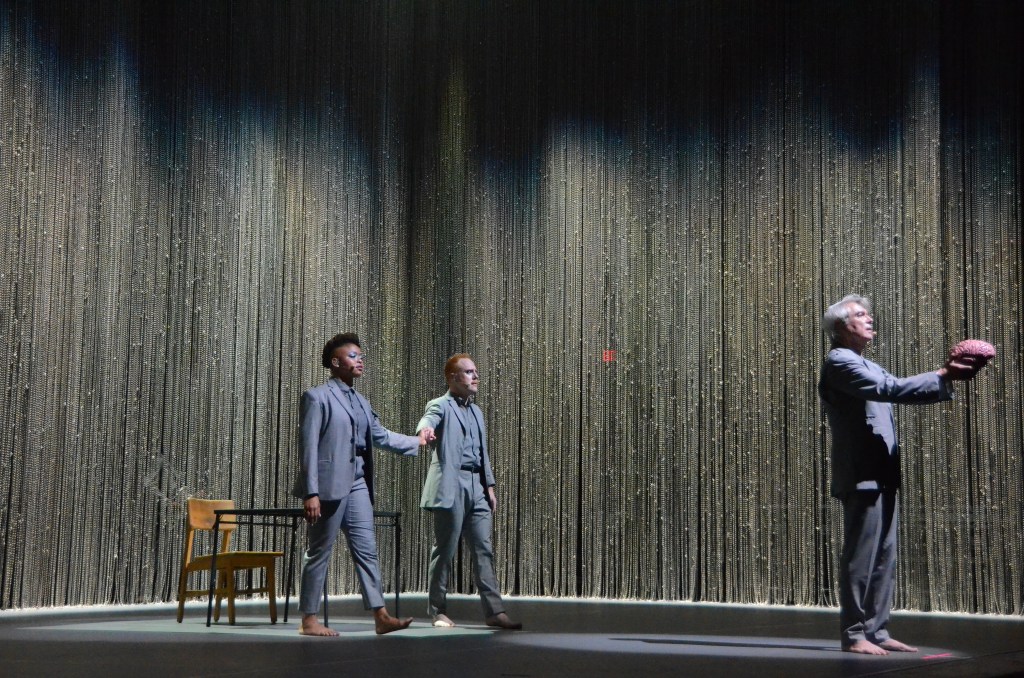
The band grows from stark, cryptic, quiet small-scale musings. Byrne sits alone at a table and speaks, then rises to speak some more. Like Hamlet contemplating Yorick’s skull, he muses on a pink model of a brain, as music seeps into the shimmery silver three-walled space around him. It’s serene as a library at first, then alive with sound and motion, evolving in shrewdly paced stages. Singers and players congregate around him, always in motion since their instruments – the drum set is split among five mobile percussionists – connect wirelessly to unseen amps. The effect is of fluid grace, a moving gang of growing sound. Early on, Lee places the camera overhead in the lighting grid as bodies below go all geometric in an ever-shifting human landscape and the music itself swells. Later, Byrne remarks to both crowd and camera that looking at humans is more interesting than looking at a bag of potato chips or, by extension, any product.
David Byrne, and brain, and the first inklings of the band growing behind him at Albany’s Palace Theatre in September 2018. Michael Hochanadel photo
Tunes jukebox together from both the newish, fairly straight-ahead rock album that gives the production its name and from the electric funk of the augmented mid-80s Big Suit era Talking Heads. When a song from this bygone, boomer-fond era emerges, the crowd goes happily bonkers.
In a show with a previous band at The Egg the evening after Barack Obama was elected president, Byrne told us, “Now everything changes.” More would and should have changed; but Byrne’s current hope for change in “American Utopia” is hard-won, but real – and not naive at all. It is comprehensive and quietly fierce. (Check out his Reasons to be Cheerful: https://reasonstobecheerful.world/.)
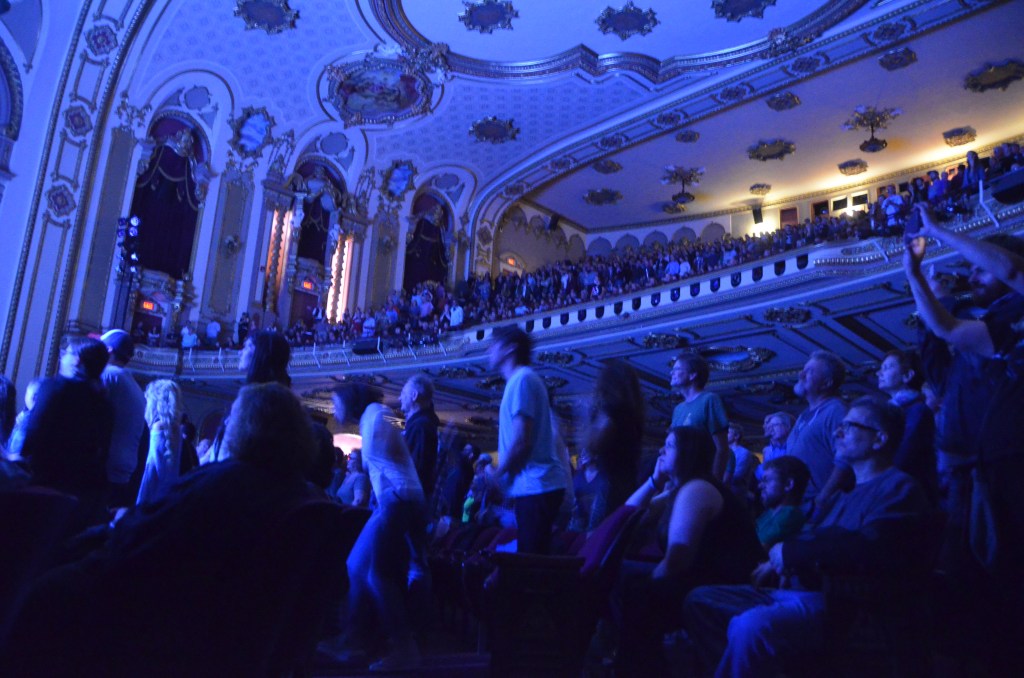
The Palace Theatre crowd at David Byrne’s “American Utopia” production at Albany’s Palace Theatre. Michael Hochanadel photo
In its honed confidence, its slick packaging, its nonstop action, the music packs unarguable urgency, culminating in Janelle Monae’s angry-compassionate “Hell You Talmbout” (Byrne asked her permission) that climaxes in a litany of mourning slain Black people. This perfectly follows “Burning Down the House,” thematically and musically. After each victim’s face appears projected behind the band, Byrne and band command “Say his (or her) name!”
Yes, say their names. And hail the names of David Byrne and Spike Lee for expressing the vivid mixture of daily dismay and battered hope that anyone with a functioning brain and moral sense must feel in these troubled and troubling days.
Thanks, gentlemen; and the men and women you assembled on the stage to dazzle us on our screens.
Jon Landau’s famous quote – “I’ve seen the future of rock and roll and its name is Bruce Springsteen” – mostly gets it right. But that Schenectady show was as much about where Springsteen was coming from as where he was going.
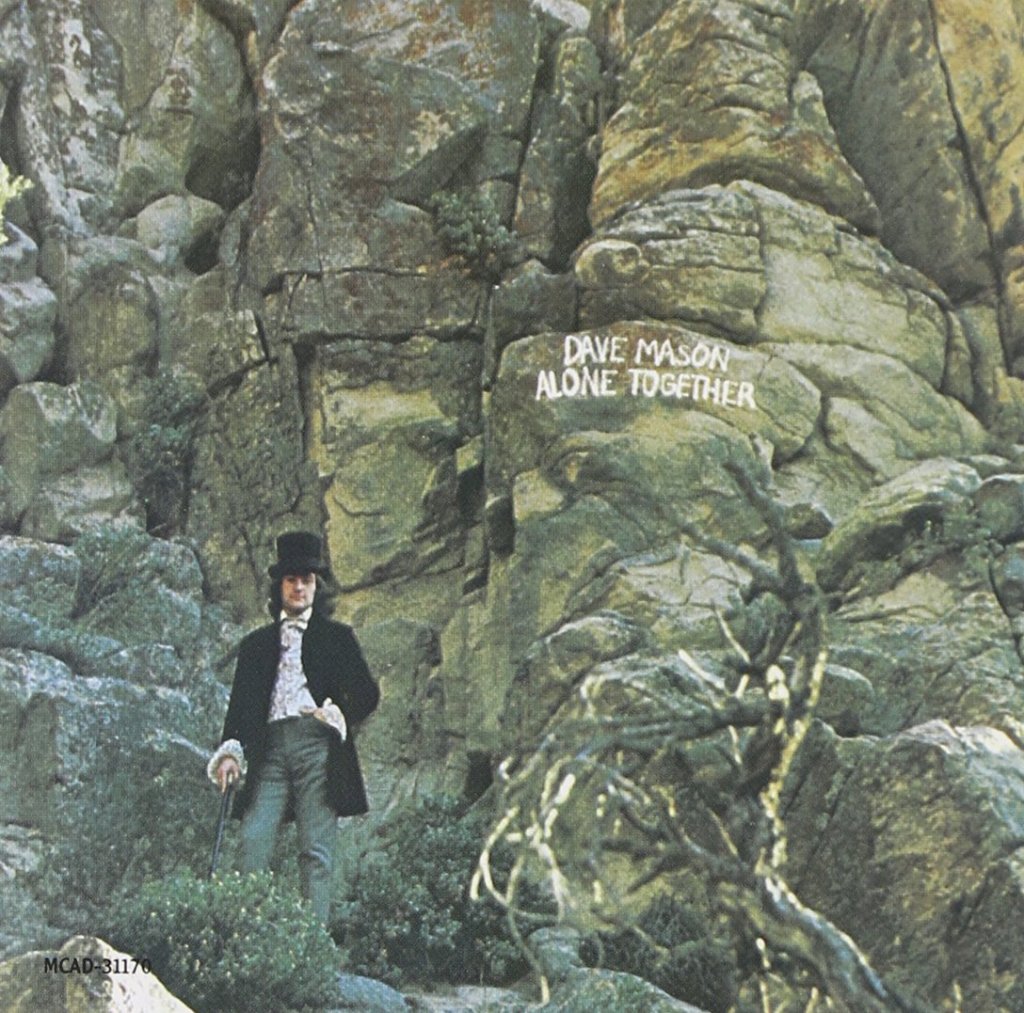
Dave Mason’s “Alone Together” (1970) leapt off the shelf at me, and not just because it’s on marble vinyl and Mason autographed it when he played downtown Albany’s Alive at Five summer freebie concert series. Maybe because I think it’s his best.
Mason recorded “Alone Together” after touring with Delaney & Bonnie, an influence as clear as the earlier (mid-1960s) smash impact of Chicago blues on the Rolling Stones, Cream and other British bands. In fact, it’s a perfect echo that Eric Clapton personifies, as a member of blues power trio Cream, a touring member of Delaney & Bonnie and Tulsa shuffle enthusiast himself.
“Alone Together” hit early in Mason’s up-and-down solo career, usually with solid but unremarkable bands. Meanwhile, he periodically stepped into a brighter spotlight with top-shelf collaborators, then just as quickly stepped back out.
The mercurial Mason joined and left Traffic three times, recorded on “Electric Ladyland” with Jimi Hendrix, then toured with Delaney & Bonnie and Friends, all in the 1960s. In the early 70s, he recorded with George Harrison, who’d also toured with Delaney & Bonnie, as did Eric Clapton. A few years later, Mason became second guitarist in Derek & the Dominoes with Clapton but quit after recording a few songs and playing a single live gig before Duane Allman replaced him. After making solo albums and leading his own bands in the 1980s, he joined and left Fleetwood Mac in the mid-1990s, then quit a tour with Ringo Starr & His All Starr Band after rehearsals.
Mason’s 15 studio albums, six live sets, 12 compilations, plus several Traffic albums, include a full-album project with Cass Elliott, a song with Phoebe Snow and dozens of other sessions, most in the 1970s.
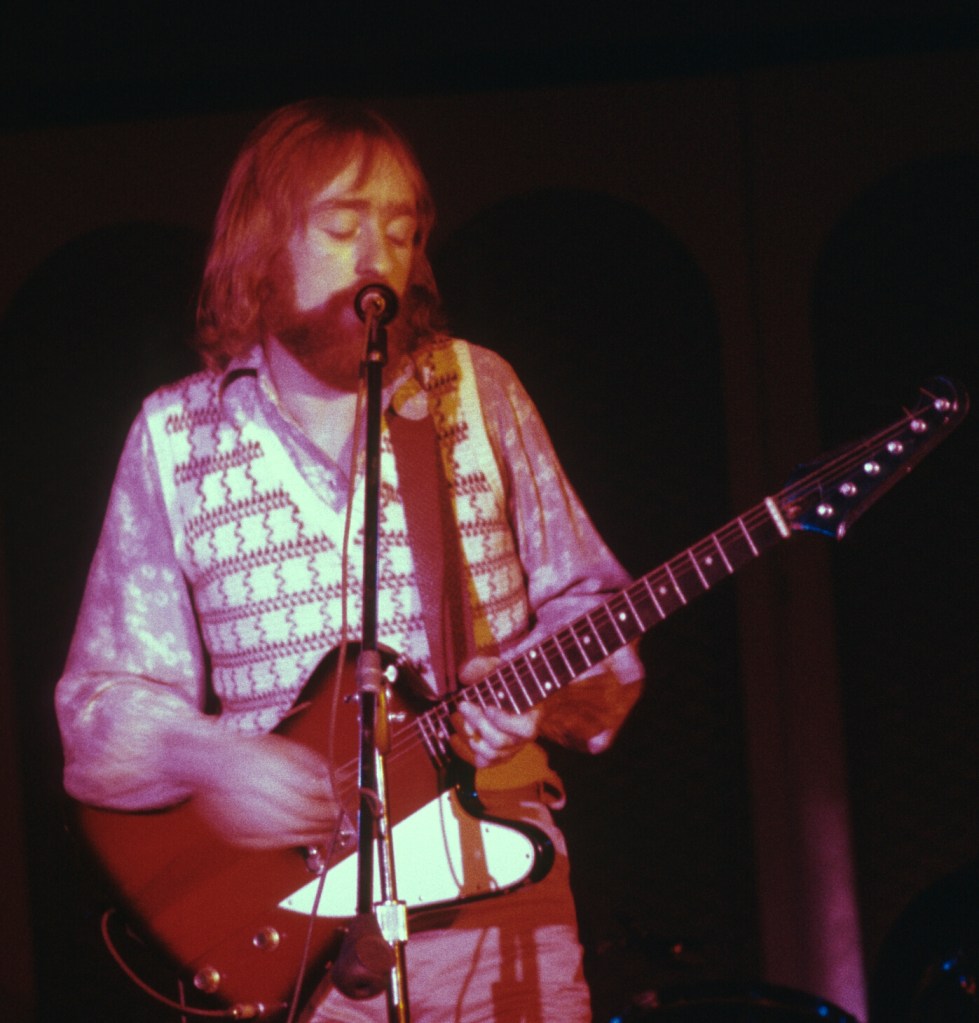
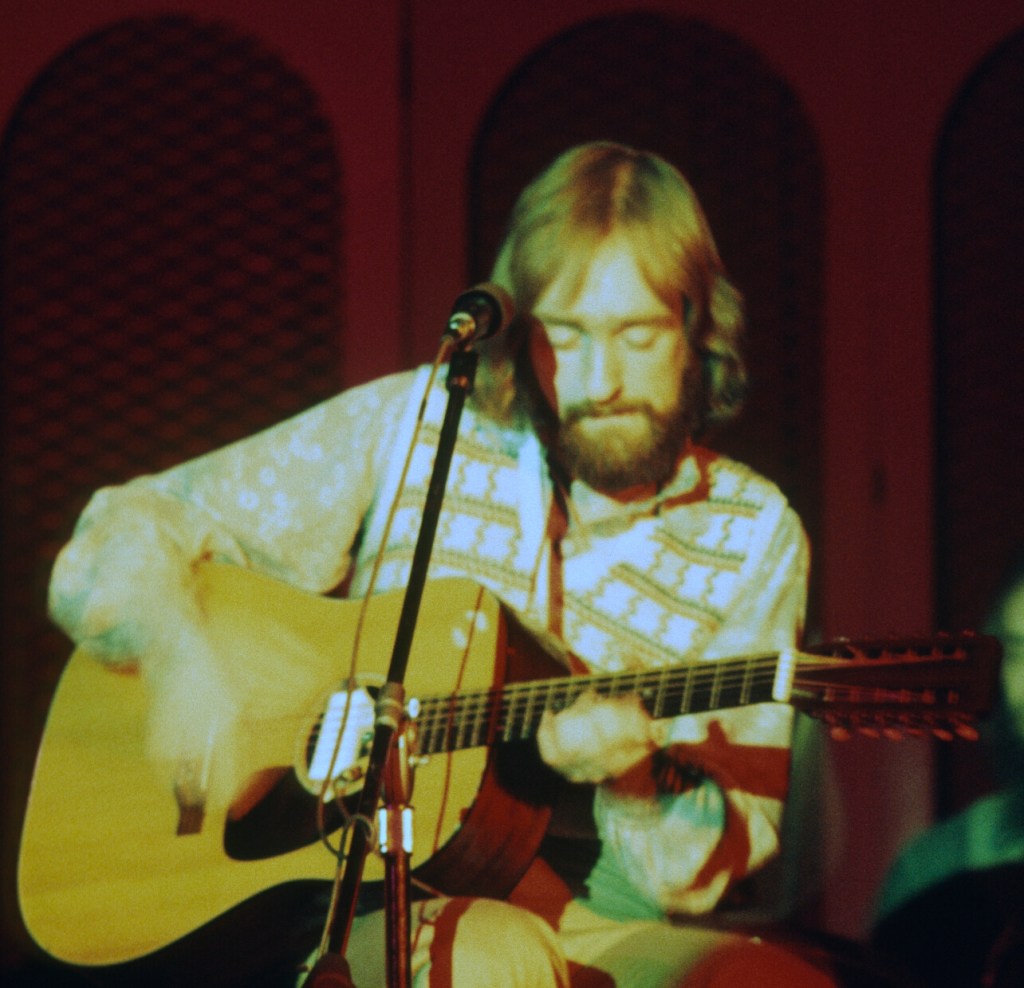
Dave Mason played the Union College Memorial Chapel in Schenectady, NY, in October 1972; six years after Jimi Hendrix played the same stage. Michael Hochanadel photo
The “Alone Together” album credits (using original spellings and with selected credits added) list Leon Russell (Delaney & Bonnie’s bandleader), Delaney & Bonnie themselves, Jim Capaldi (Mason’s bandmate in Traffic), John Simon (The Band’s producer), Jim Keltner (every great LA pop-rock record of the 70s, the Traveling Wilburys, Little Village), Jim Gordon (maybe as many top sessions as Keltner, Derek & the Dominoes), Chris Ethridge (the International Submarine Band, the Flying Burrito Brothers), Carl Radle (Delaney & Bonnie, Derek & the Dominoes, Mad Dogs and Englishmen, the Concert for Bengladesh), Larry Knectel (soon to found Bread), John Barbata (Jefferson Starship), Rita Coolidge and Claudia Lennear (both members of Delaney & Bonnie and Friends), Don Preston (Frank Zappa’s Mothers of Invention), Mike DeTemple, Jack Storti, Lou Cooper, Mike Coolidge, and Bob Norwood.
Eric Clapton isn’t in these credits or on the album, confusing listeners who thought Slowhand had played the guitar solos; no, it’s Mason.
Mason produced “Alone Together” with Tommy LiPuma, and recorded in Los Angeles at Sunset Sound and Elektra Recording Studio with engineers Bruce Botnick and Doug Botnick; mix engineer was Al Schmitt.
“Alone Together” seems to zig-zag stylistically among Tulsa -time rockers (the Delaney & Bonnie/Leon Russell influence), bluesy pop (ala Clapton), quiet troubadour tunes and psychedelic guitar (Hendrix). Song by song, and most could have been hit singles, it traces a troubled emotional through-line in perhaps a single relationship.
“Only You Know and I Know” – The album opens with this cautionary tale as mid-tempo Tulsa shuffle. A kicking bass line sets up laced guitars including a discrete interstitial acoustic, then an electric guitar solos with repeating triplets into a chorus with fine harmonies. As coda, an even better electric guitar solo revs up all the cool stuff from the first.
“Can’t Stop Worrying, Can’t Stop Loving” – Lush acoustics beckon us into a dark night of the soul where dreams are hammered low and the troubles we try to leave behind crawl into the suitcase anyway.
“Waitin’ On You” – Tulsa time again, with beautifully-balanced keys and guitars; then harmonies carry us toward hope that is not easily won. There’s a cheerful, spunky break, then a chorus pledges to build happiness, if possible…
“Shouldn’t Have Took More Than You Gave” – Another chiming keys and guitars tag-team, but also another roller-coaster accusation, in a stately build. Then a wah-wah electric guitar injects a mournful feel as the drums shift things up. Guitar and vocal join in a fatalism that edges into guarded optimism that the despairing opening returns to ice up again – beautiful pain.
SIDE 2
“World in Changes” – A crisp, meshed-acoustics intro, with organ edging into a fat-back groove. The vocal declares love a two-way street, like an announcement of something new. Then a powerful, surging organ solo pushes an upshift, cueing a falsetto vocal with exuberant whoops.
“Sad and Deep as You” – Slower, contemplative and just as emotionally complex and soft-spoken without drums or bass, this layers a gentle vocal on a firm piano line, positing the eyes as metaphor, tool and weapon.
“Just a Song” – Another warning, this soft-rock cautionary tale cruises mellow, a mid-tempo stutter-step shuffle spiced with banjo. Sweet women’s voices repeat Mason’s phrases declaring consolation and independence and “oooh” beautifully in the seams.
“Look at You Look at Me” – What a great build! Organ and piano chug under a plaintive vocal, then guitars shimmer to pick up the beat, the piano catches up and the vocal opens like a heart. The chorus – “I’m feeling, up I’m feeling down…but now my feet are on the ground for everyone to see” – curls with riffs that carry into an “All Along the Watchtower”* groove. Mason plugs in and hits full flight under the unguarded vocal admitting “I need you every day.” Mason takes it back down to acoustic guitar and piano before the electric edges in, takes over and guides the band’s lift-off echoing both “Sad and Deep as You” and “Can’t Stop Worrying, Can’t Stop Loving.” Mason’s beautiful tone and graceful phrasing carry such emotion you want the fade to keep going since it soars to a ghostly but serene voice at the end.
Dave Mason at the Union College Memorial Chapel, Schenectady, NY. Michael Hochanadel photo
If the early songs feel edgy, like rocky waters, “Alone Together” glides into shore in a satisfying, mature resolution, noisy and proud. But, what else lurks on that misty island, that emotional land-fall?
Mason is entitled to evoke “All Along the Watchtower.” He played acoustic 12-string guitar on Hendrix’s immortal Dylan cover the year before he made “Alone Together” and recorded it himself on “Dave Mason” (1974, reissued 1995). On “Alone Together,” he echoes the ecstatic acoustic guitar chug that helped push Hendrix’s version. Also, check the new composite tag-team Playing for Change cover, featuring numerous artists who’ve played here including Warren Haynes, Cyril and Ivan Neville, Bombino and Amanda Shaw.
Hats off to the Gazette’s Brenton Blanchet for digging out such cool stuff about the Rolling Stones’ Palace Theatre shows, April 29, 1965.
In the Sept. 24-30 Ticket, he nailed perfectly the excitement of that British Invasion uproar coming to town. Fans’ memories and artifacts helped him tell that vivid story.
Also, I was there, in one of four press seats for reviewers that night. And the show was way better than I’d dared hope. In fact, I got the review assignment in part because none of the other Gazette music writers wanted to go.
We all thought they were done. And we were wrong, in a big way.
And as magnetic, powerful and totally commanding – in short, magnificent – as the Stones were that night, the 13-piece (!) Alejandro Escovedo Orchestra was even better, earlier that same week, playing Brown’s Brewing Company’s Revolution Hall in Troy.
Just couldn’t let the entire Jazz on Jazz season blur past without catching some sounds, so I hied myself to where Jay Street t’s onto State on September 18 for the Tarik Shah Trio, last in the regular free street jazz series. Had such a cool time, I then re-hied myself back for the three-band Jazz Appreciation Month concert there a week later.
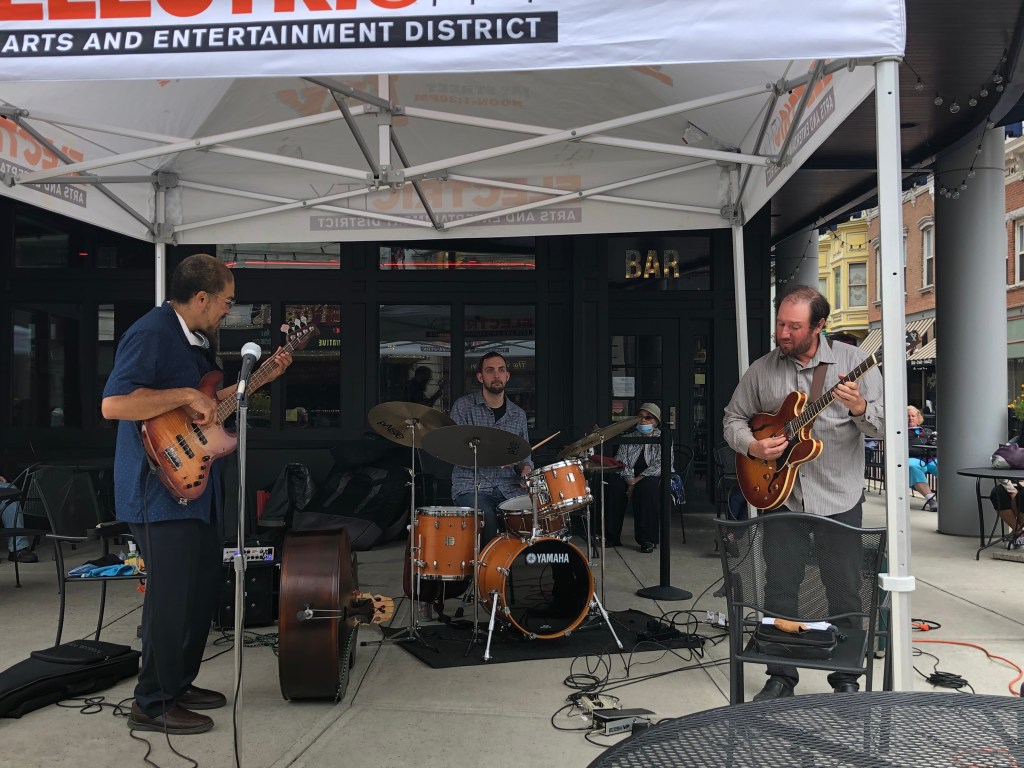
Shorn of the dreads he sported at Jazz at the Spring with guitarist in pre-plague days (early February), bassist Shah, guitarist Luke Franco and drummer Matt Niedbalski balanced standards with originals to inviting effect.
Warm day, warm music.
They’d already started when I arrived, a bit late from an appointment and being distracted by the Open Door Bookshop window. So I may have missed something, but I felt grateful to catch the hearty funk of “Sunday’ Hardship Blues” – a family-mentoring tale where Shah clearly led, there on Jay Street, while his compadres kept up, held their own and pushed their own ideas into Shah’s original. In Quincy Jones’s “Quintessence” (no, not the late, great New Scotland Avenue bistro), Shah swapped his acoustic bass for an electric four-string and ganged up on the beat all by himself with a hard-hitting right thumb.
Tarik Shah Trio
In the Duke’s “Caravan,” Franco’s guitar punched the rhythm, especially when Shah laid out and Franco and Niedbalski went A-versus-B before Shah joined in to swap fours with everybody, then slapped a feedback coda on the whole sly and syncopated thing. More syncopation popped in Mal Waldron’ “Soul Eyes” and the band hung with the groove into the theme from “Black Orpheus” – a thrilling bossa-funk foray with Franco’s guitar swinging the melody while Shah and Niedbalski hit an exuberant double-time clip.
“We’re gonna swing some,” Shah announced at their closing number, cueing up “My Shining Hour” to take us home. Warmed up from the first notes I saw, they hit top cruising altitude here.
Shah’s crew gauged the audience well, noting that lawn-chaired fans (all masked) at times barely outnumbered folks passing through, toting lunches from Jay Street eateries back to offices across State. The trio didn’t challenge, but they didn’t condescend, either. It was jazz for real, and for real fans.
Postponed from April, the official Jazz Appreciation Month, sponsors the Schenectady-Amsterdam Musical Union, Local 85-133 and the Music Performance Trust Fund patiently brought back this three-band freebie last Thursday (September 24) when the world felt safer.
Noisier, too, let’s note here. Sirens screamed, Harley hogs rapped their pipes, drivers honked horns. The three bands – the Dylan Canterbury Quintet, the Patti Melita Quintet and Cliff Brucker & New Circle – had to fight through way too much distraction. But they did it.
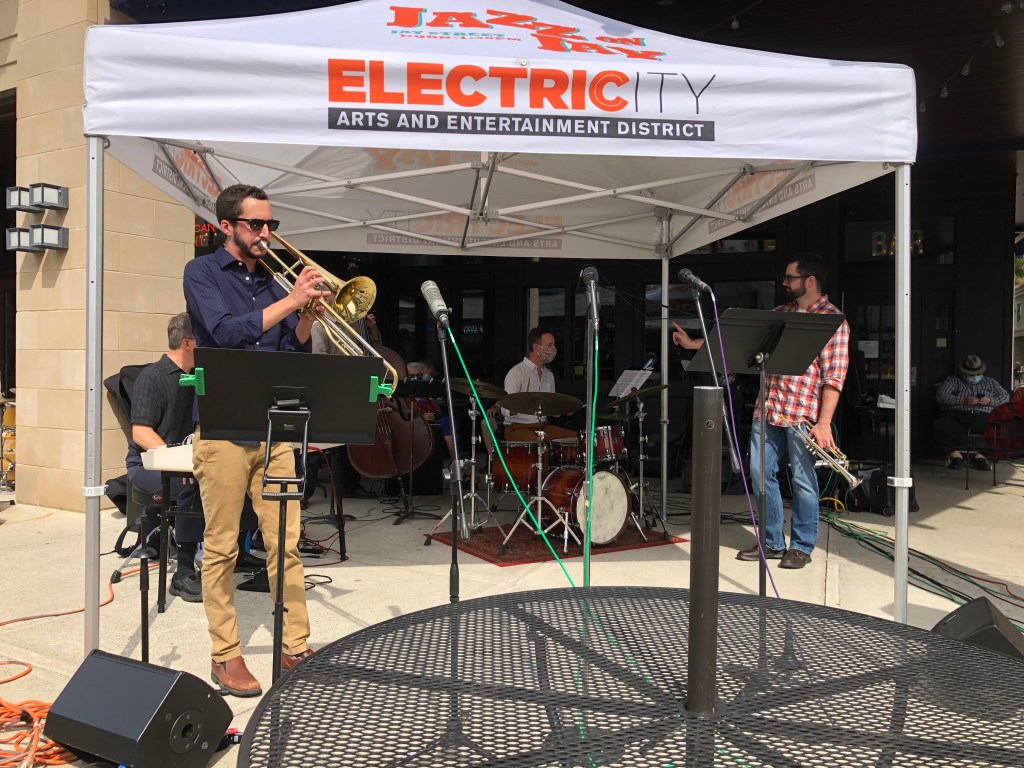
Paying tribute to a single artist can feel confining, monochromatic. Trumpeter-leader Canterbury’s ingenious arrangements and first-class playing by everybody highlighted the variety and verve of Thad Jones’s compositions which comprised the entire setlist. They played with an easy, mellow swagger; bluesy in “61st and Richard,” Latin-dancey in “Bossa Nova Ova, and even when they went dissonant, everything had swing. Canterbury and valve trombonist Tyler Giroux usually harmonized to state the theme, then one yielded for the other to solo, then they swapped roles. Pianist Wayne Hawkins, bassist Lou Smaldone and drummer Graeme Francis played ferocious or sensitive in support and ambushing their own solo spots with gusto. They balanced jaunty up-tunes – “Fingers,” a hot-rod welded onto the frame of “I Got Rhythm” took my breath away, and theirs – with the mature sweetness of “Consummation” – best ballad all day.
Dylan Canterbury Quintet
Patti Melita aimed her ageless voice and the solid, unassuming ease of her quintet at charming standards, appropriately noting they were playing on “On The Sunny Side of the Street” early on. Tenor saxophonist Jim Corigliano always took the first solo, echoing Melita’s elegance but adding fast-moving decoration at times, too. Keyboardist Peg Delaney played organ and vibes effects in “On the Sunny Side of the Street” and “Let There Be Love,” but mostly relied on regular piano tones. Bassist Bill Delaney and drummer Tim Coakley linked tight in both their crisp phrasing and droll asides, having fun, giving fun to the music.
Patti Melita Quintet
Extra credit to these local heroes for honoring one of our most heroic giants, the late, great Lee Shaw, closing with Shaw’s syncopated bossa nova “My Holiday” that felt festive and fine.
Leading a stripped-down version of the Full Circle band he’s led on two albums and several years of shows, drummer Cliff Brucker closed Thursday. His New Circle trio – keyboardist Pete Levin and guitarist Chad McLoughlin – went all bebop in an agile, imaginative set reaching into jazz history and the future with equal aplomb.
Sound engineer Rob Aronstein, an ace keyboardist in his own right, mixed both front of house and stage monitors by himself, with problems marring only the early part of New Circle’s set. Backing off from the kinetic energy of their zippy opener, they soothed big time in Brubeck’s “In Your Own Sweet Way,” McLoughlin caressing the melody until Brucker engaged the guys in brisk riff swaps.
Cliff Brucker’s New Circle
Levin made mighty organ sounds, listening closely and beautifully to his bandmates. He shared every idea, climbed aboard every melody and was always right on the money rhythmically, most spectacularly in “Afro Blue.” After early hesitancy, they found their way into Sonny Rollins’s “Oleo” and their usual confidence, McLoughlin etching fast scales across this familiar structure and reclaiming the head after bouncy, feisty, short riffing. “Just Friends” found McLoughlin at his best – Brucker and Levin, too; a melodic bop hymn of energy and tenderness.
As coda of a very strange summer, with music moving online and into strange places or going away altogether, both these jazz events on Jay Street felt fun and welcome, despite distractions. Both pointed the way, we can only hope, to quality jazz by familiar faces in familiar places.
One death lost to this plague, any death, is one too many.
But it’s hitting musicians especially hard, stealing both lives and livelihoods with the hiatus on live concerts.
The list is too sad to recite here; it doesn’t stop with John Prine. Now another singular talent has gone. Frederick “Toots” Hibbert of Toots and the Maytals died Friday in Kingston, Jamaica, at 77.
While he arguably named the rock-steady Caribbean style he helped invent in the early 1960s with “Do the Reggay,” the singer also reached past his island style to Memphis soul. Raised by strict Seventh Day Adventist parents, he learned to harmonize in church and ever after packed a preacher’s moral force in a voice with the sonic kick of Otis Redding.
With fellow Maytals singers Jerry Matthias and Raleigh Gordon and a deep-grooving band, Toots scored hit after hit in reggae’s early to mid-70s heyday: “Six and Seven Books.” “65-46 That’s My Number,” “Monkey Man,” “Pomp and Pride” and more. The trio was then reggae’s dominant format: the original Wailers, the Heptones, the Wailin’ Souls, Culture, Black Uhuru, the Mighty Diamonds, the Meditations, the Paragons, Justin Hines and the Dominos. Soon, white British musicians including the Rolling Stones, Eric Clapton and the Clash adopted Caribbean syncopation and liberation politics, spurring reggae’s popularity. However, like the earlier appropriation of rocking Chicago blues, they arguably seldom matched the joyful bounce of its beat or the fervor of its message as practiced by its founding Jamaican giants.
The loudest version of any Toots hit I ever heard was in Buffalo’s Rich Stadium where the Stones boomed Toots biggest hit, “Pressure Drop,” in its 1981 tour pre-show music. But Toots’ own performance at UAlbany’s MayFest the following June stands out as a commanding peak of exuberant mastery. The inimitable reggae DJ Sir Walford grabbed my arm before the show and tugged me aboard Toots’ tourbus for an interview that was really a reunion of old friends.
Nobody expressed or gave more joy onstage than Toots, despite challenges including a 1967 prison sentence for marijuana possession and cancelling a 2013 tour after being struck onstage by a thrown bottle.
Ellie and I played his “Sweet and Dandy” at our June 1977 wedding, a time when I seldom listened to anything but reggae for fun. Toots’ albums “Funky Kingston,” “In the Dark,” “Reggae Got Soul” and “Toots in Memphis” are still in heavy rotation, and I was just discovering his comeback album “Got to Be Tough.”
This one hits hard, like a pressure drop to the heart.
I heard it first. It woke me – a wavering high hiss with a low hum like a culmination or intensifying of the hiss.
Right on time, I thought, looking at the clock as I got up and headed to the bathroom. Hurricane Isaias was forecast to pass over Chincoteague and Assateague islands on Virginia’s eastern shore around 8 a.m. The power quit half an hour later, the hiss and the hum rose in waves of roar.
Between the balcony of our second floor rented apartment and the Assateague lighthouse a mile east, white chop scalloped three bands of water and combed two stretches of marsh; brilliant green in yesterday’s sunlight, they were vanishing under water racing right to left, south to north. A gull walked on the dock below; where we’d waved at crabbers the past two afternoons it was empty of people now. I saw the bird tense its body as gust-hiss rose, tuck its wings tighter and spread its feet to stay upright. Other gulls rode the fast-moving water; some seemed to fight it, but only by flying low on frantic wings could they move through the roar.
A brown rectangle ten or fifteen feet long zipped into view on the nearest race of water, an upside-down skiff, barnacled and bobbing, vanishing faster to the north than its motor could ever have pushed it.
Ellie told me the hum was from the metal legs of the balcony table Zak and I had inverted onto its top the night before when we brought the chairs inside and stacked them behind the sliding glass doors. When I held my camera against the glass to steady it for a shot, the tall panes throbbed with the wind, which clawed the screen loose from its frame.
The far channel nearest the lighthouse sprouted tall clouds of flying wet, like snow drifting in a blizzard. Then clouds rose over the nearest waters over waves scalloped in curves from bank to bank, as if the land were hanging onto the water, slowing it at the edges.
Waves slopped over the dock, three feet off the water at high tide, as dark brown weed-clumps drifted past, torn from the shallows. The chaotic sky lightened here and there, sometimes brightening to clear-day cloud white then switching off.
From across the table, Zak offered to scramble me some eggs. He elaborated, “I can scramble the eggs, but I can’t cook them for you.”
Lunch, and everything else, was improvised, cold; and I had to wait a day for my coffee.
We shared gratitude that Ellie’s niece Maggie had set her wedding for Friday, not that tempestuous hurricane Tuesday.
Then, more gratitude as the winds waned. They tore white, then blue, holes in the gray veil-wall of tumult overhead.
As we watched the sky clear, a hummingbird flew up from below, hovered in mid-air to and swiveled its head from me to Zak and back: was it drawn to the red in the Sundazed Records logo on my T-shirt?
The tide turned, rolling in a fast ebb north to south, left to right. Standing waves formed as remnants of surge fought the tide. A brave surfer could have ridden them, until the wind carried him to Maine. Two guys ventured onto the dock below and crossed to the edge, tugging crab traps out of the water, hand over hand on taut lines. A girl of about eight returned a little later, looked at the small sea turtle we pointed out to her and again tugged the crab trap up to study its residents.
I wondered about the crabs’ experience of all this; crammed into rectangular wire prisons as the water went wild around them. Like us, in the dark rented apartment above.
* * * * * *
The power was off all day; lunch was peanut butter and jelly, dinner a salad heaped with tuna. Downed trees lined the roads to Trish and Stacy’s house a mile and a half away; we found the power was back on there. As the world dried from battered grasses to wild skies where winds still ripped and rolled the clouds, the surfers in our crew impatiently checked the Assateague National Seashore website: Is the beach open? No, came the disappointing answer: downed electrical wires were sparking, arcing on the road. We got busy in Trish and Stacy’s yard, taking saws and long-handled clippers to a downed 30-foot cedar in Trish and Stacy’s yard. We swept pine cones and needles into fragrant heaps we toted to the woods. The cedar had considerately, fortunately fallen along Patty and Craig’s fence and pergola next door, touching neither. When Zak and Alex severed its multiple trunks, the root-ball sprang eagerly back into the ground, looking as if nothing had happened except its tree had vanished.
A shed near our apartment had collapsed in a heap of joists, cracked framing and bent walls, and tree limbs lined the roads and heaped on lawns.
Everybody learned at once when the electric lines downed on the beach road were cleared the next day. The usual parade began, compressed and intensified. Golf carts, SUV’s and motorcycles piloted by browned guys with surfboards in one hand, throttles in the other, jammed the road. Bicycles single-filed alongside, some competently ridden, but many barely in control of riders who hadn’t been on two wheels this century.
Beachgoers mostly distanced themselves, and many wore masks trudging past to where they set up tents, dropped and opened coolers and settled in for the day.
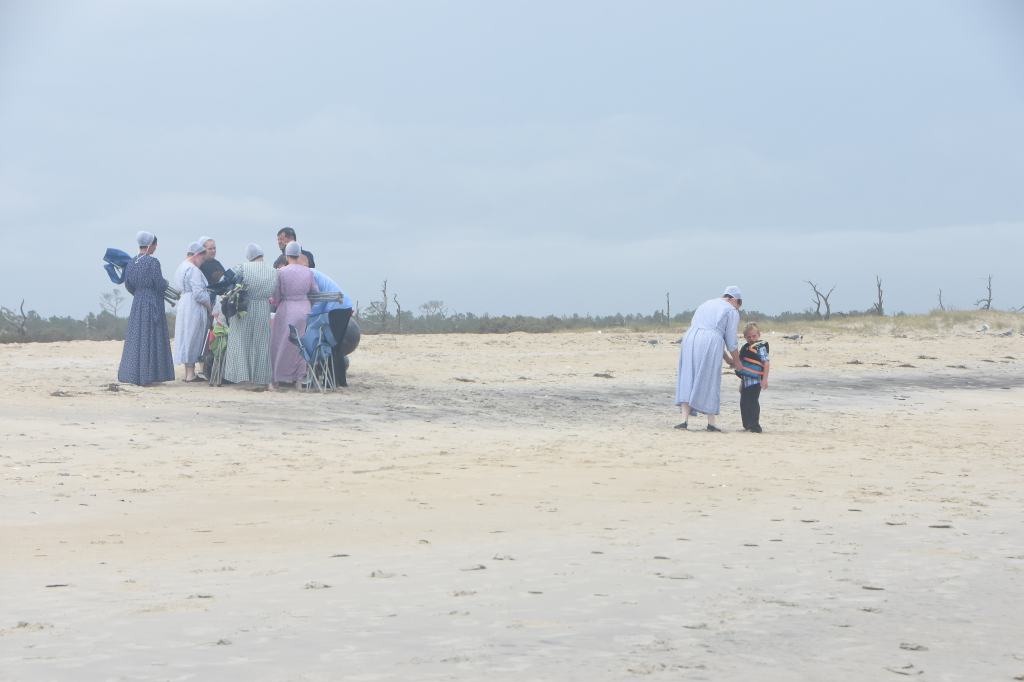
More Mennonites in long dresses and bonnets pilgrimaged in this beach parade than Black people, a reminder that Blacks were exiled from the islands in the 1950s to Horntown (formerly, openly, N*****rtown), a mainland enclave near the Wallops Island NASA base.
Up and down Chincoteague, Isaias had shredded and blown entirely away some trump signs from lawns: a message from aggrieved nature? Was she a Democrat?
Hey! Hurricane!- c’mon back and finish the job!
* * * * * *
We’ve beach-vacationed in Chincoteague since Zak, now 39, was two; thanks to the hospitality of Trish and Bill who’ve opened their homes to us even when they’re away.
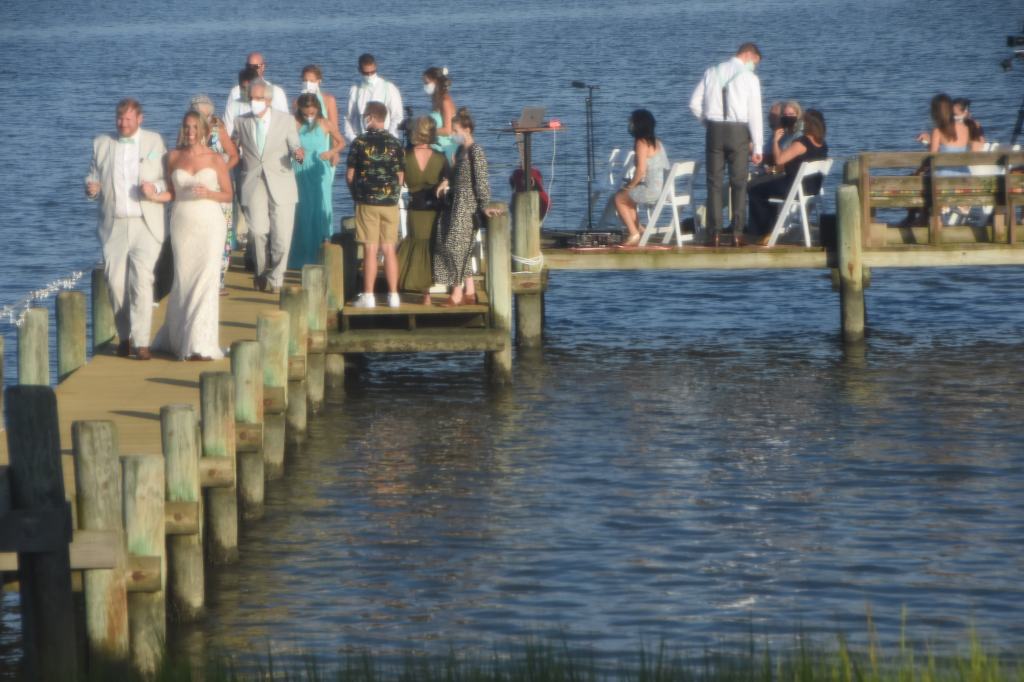
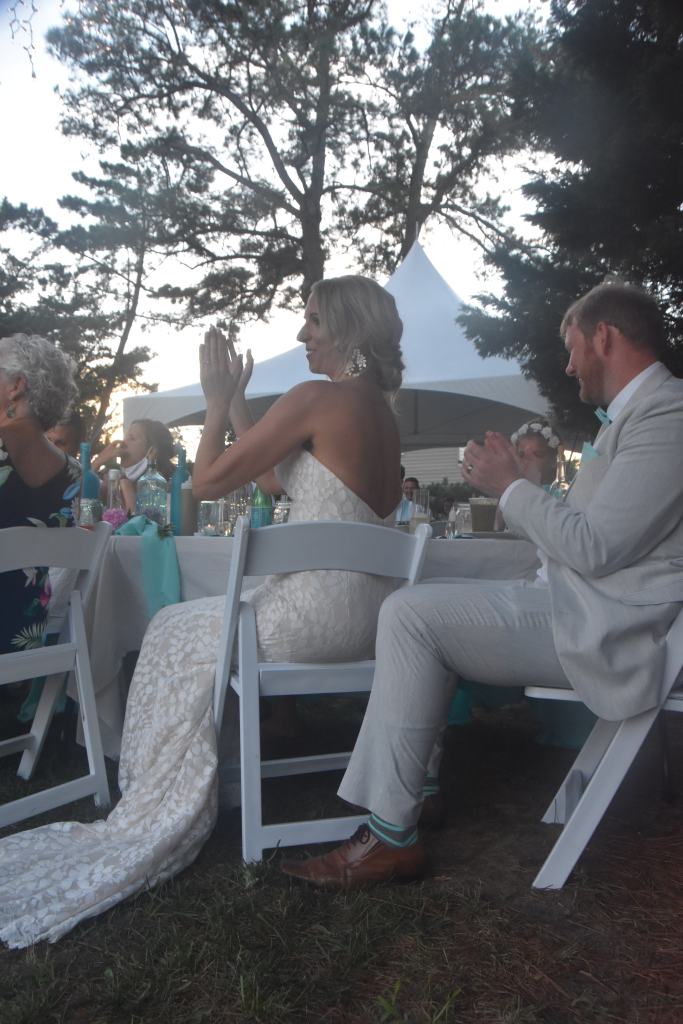
We’ve attended weddings of their three children nearby, two on the island itself including Ellie’s niece Maggie earlier this month on the “beverage dock” in Little Oyster Bay behind Trish and Bill’s place.
This celebration for 30 was scaled down from a giant blow-out originally planned for 350: wedding ceremony in the Island cinema, reception in the community center where Maggie’s brother Max’s reception brought us all together two summers ago.
Ellie and Zak and I got tested for the plague before committing to the trip to Maggie’s fandango. We got virus-clean results, we packed the car.
We missed daughter Pisie and son in law Tony who joined us in Chincoteague by ZOOM, busy with full time jobs in Kentucky and preparations to move to Nashville.
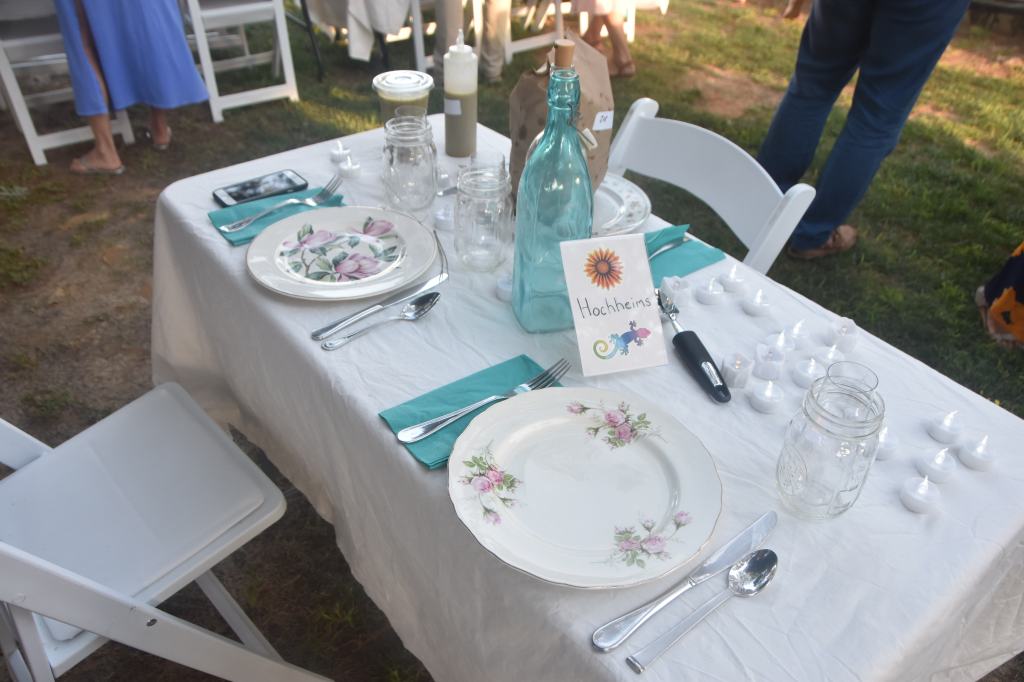
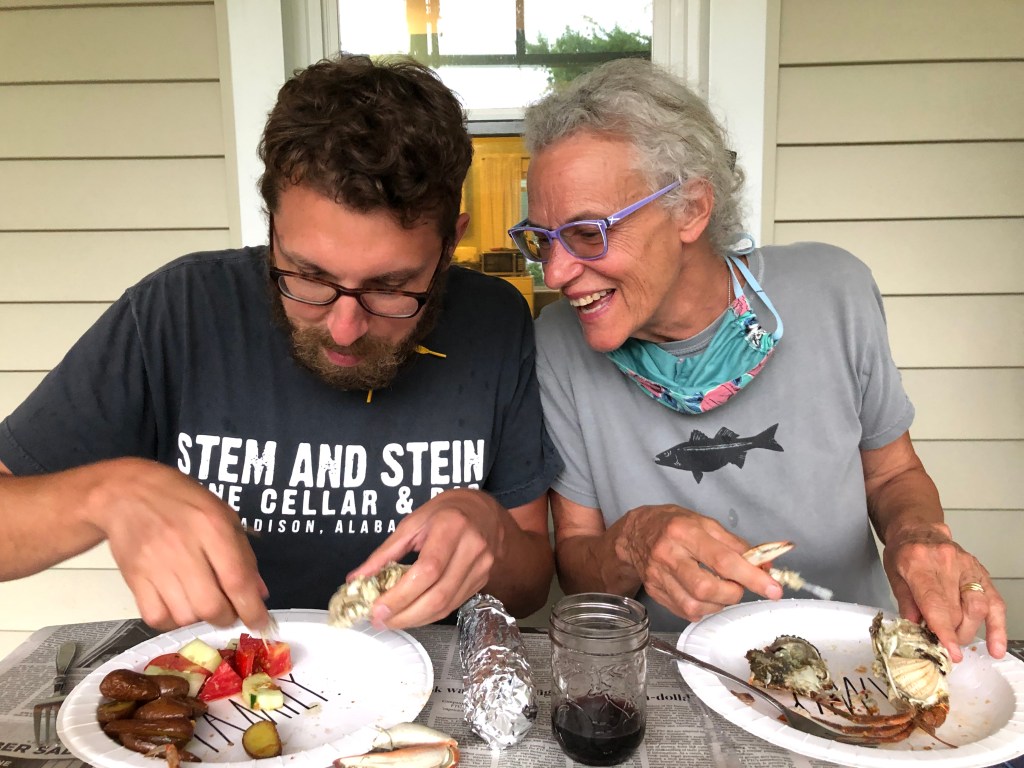
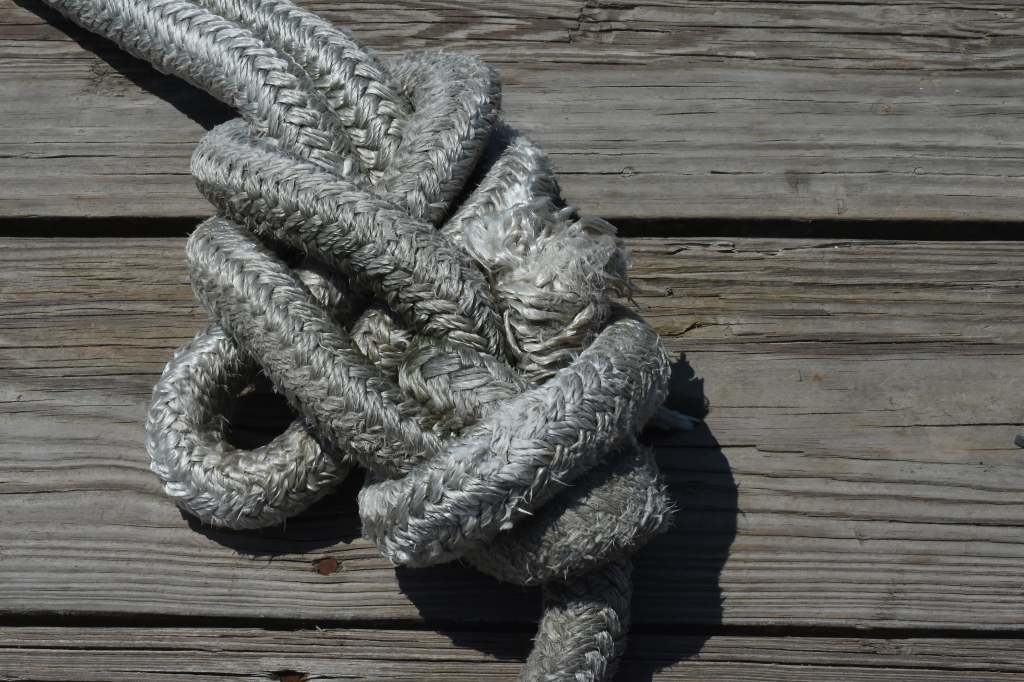
At the wedding, we were masked, we were distant, we were relieved when the weather turned way nicer than the forecast. Food was from Maggie and husband Alex’s favorite Mexican food truck, bountiful as it was delicious; we took leftover guacamole, chips and relish home to Schenectady. There were touching toasts, and rope tricks by the father of the bride. Raised in Tucson and proudly cowboy-hatted, he found in recent genealogical research that his family originally landed nearby from England before moving west.
We’ve seen the island and town change over time: the fishing culture has waned, with growing boutique-izing and condo-conversion of the place – symbolized by the replacing of the town’s quaint drawbridge entry by a multi-lane high-speed causeway. Many of the tiny houses remain, though, that were barged across the channel to Chincoteague when the feds took Assateague Island for wildlife refuge and national seashore in a land grab many locals still curse.
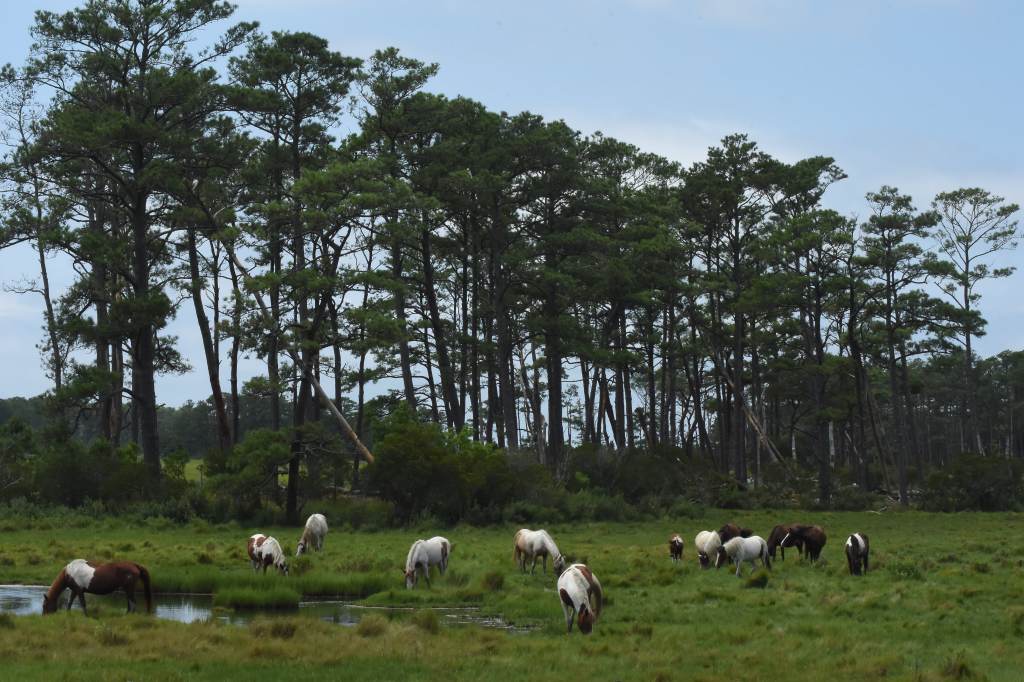
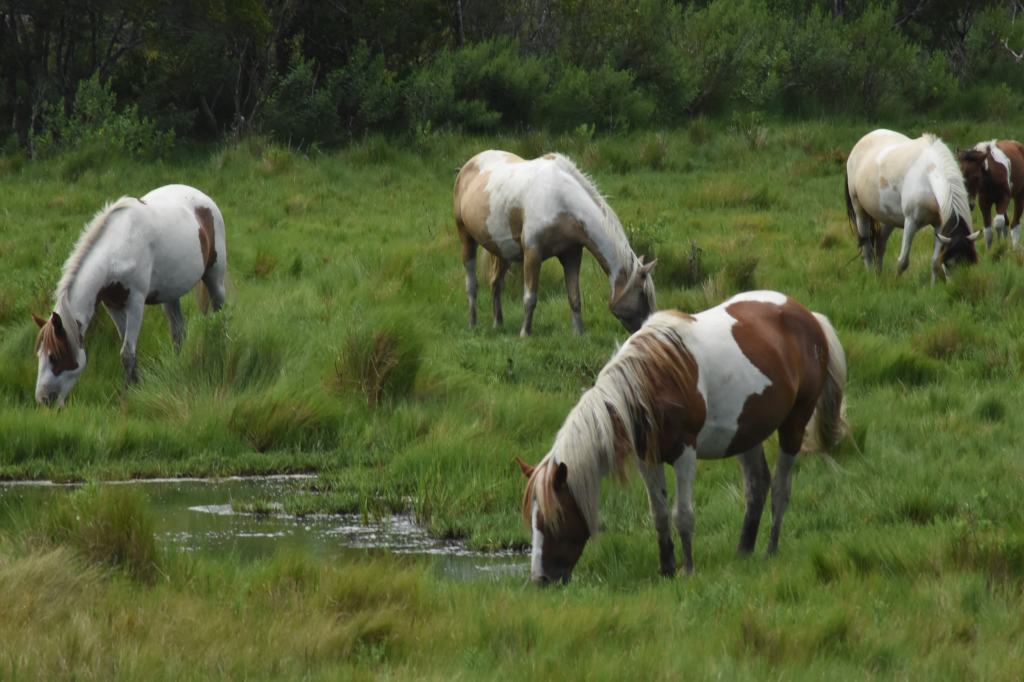
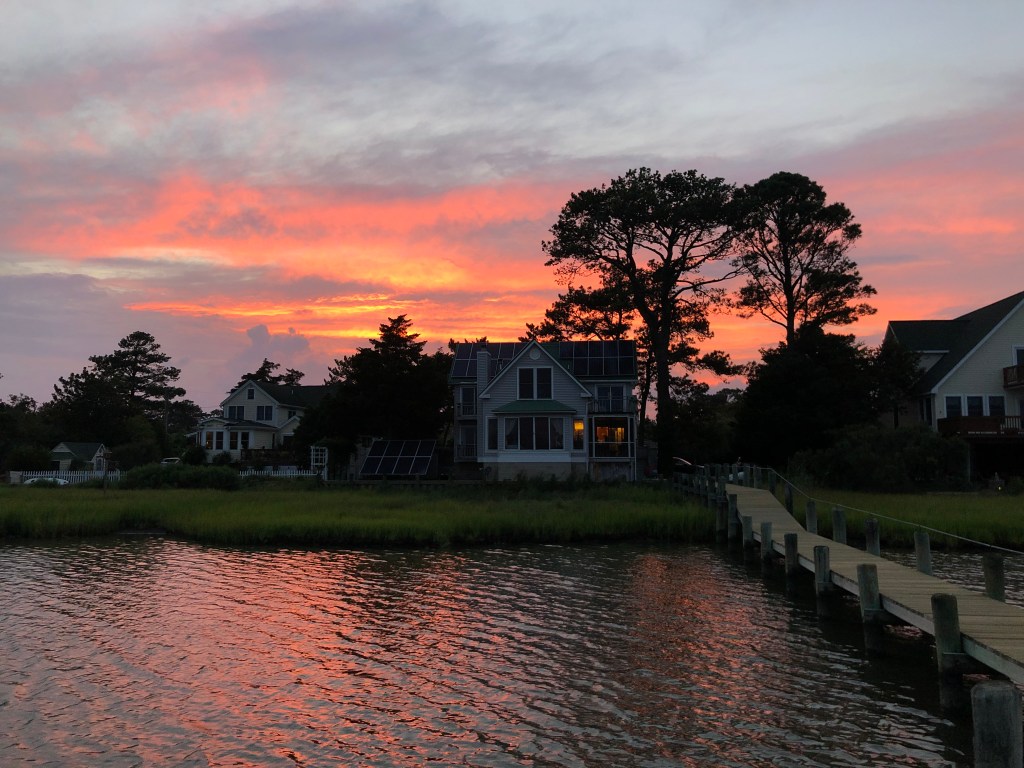
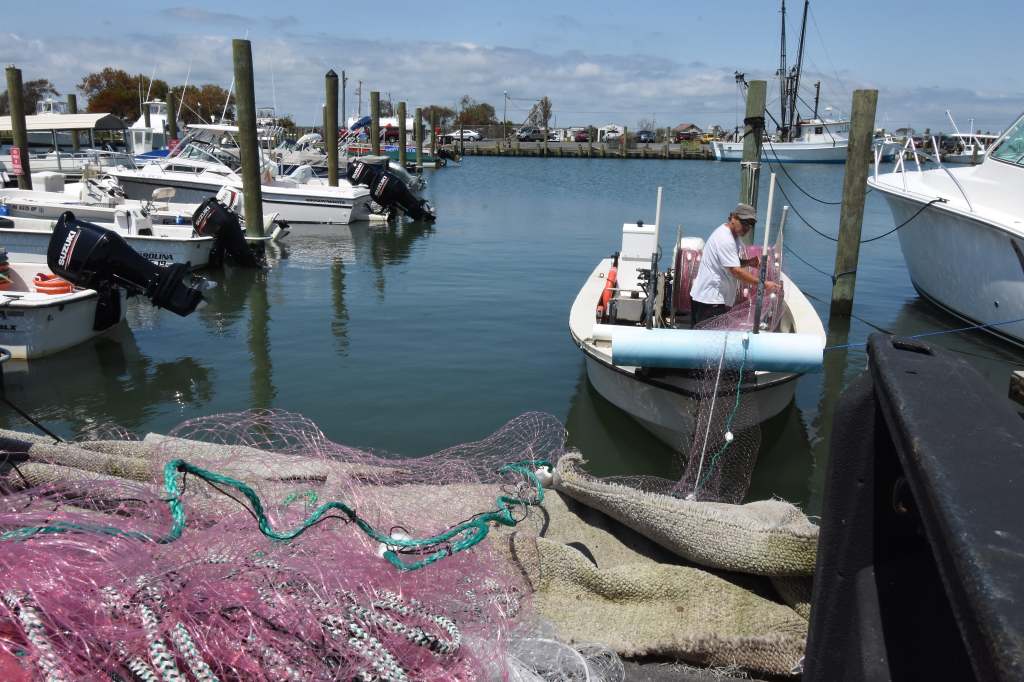
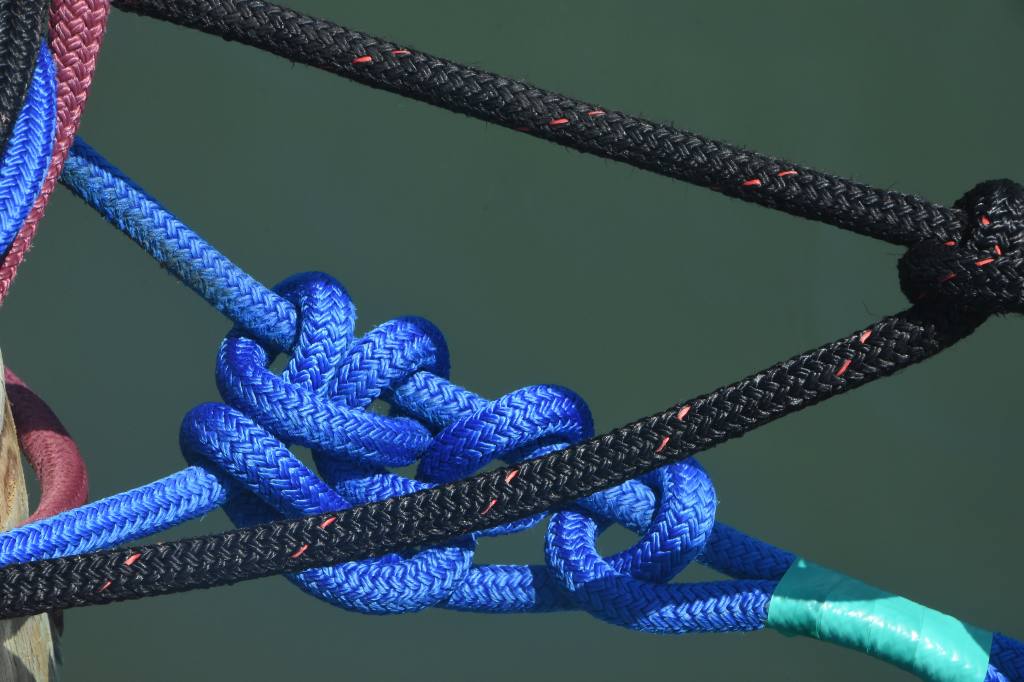
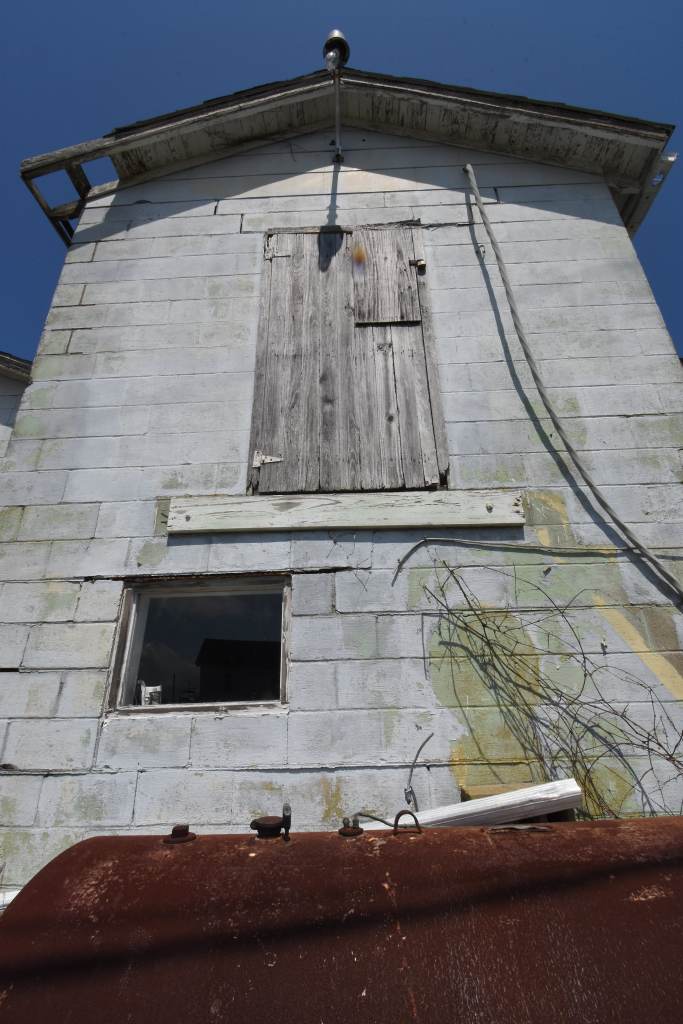
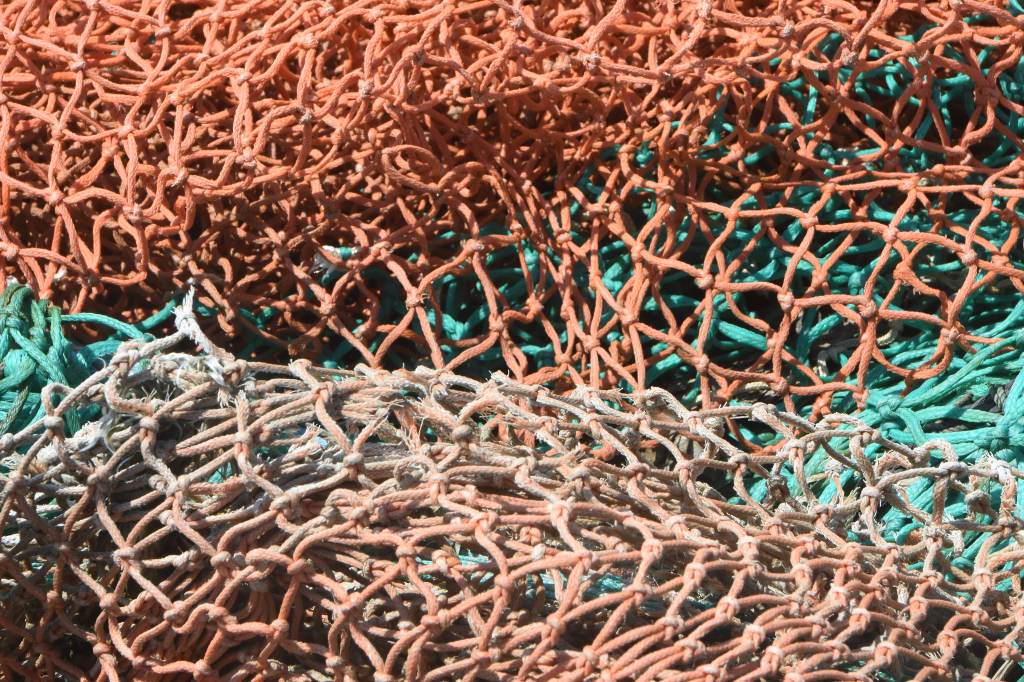
These photos are from a week-long visit when I steered away from shooting views I’ve photographed many times, since the days of film.
I first heard of Chincoteague in the early 1970s from Schenectady friend Lee Bowden, a film-maker who grew up there but escaped into hippie-pacifism from its strictures and social hangovers. Drafted in ‘Nam time, he won conscientious objector status and did medical research at Walter Reed Army Medical Center in Washington.
On a steamy summer evening that his friends here still recall with awe, Lee shocked them by insisting they all leave, forthwith, for Chincoteague since its famous festival “Pony-Penning” was the next day.
They boarded what Lee delighted in describing as a “softly-sprung highway cruiser” and drove all night. On arrival, his mom made crab-cakes for everybody.
Everything is strange about Pony-Penning. Surf cowboys ride into marshy pastures on Assateague Island, round up its famed herd of wild ponies and herd them (swimming) across the channel to Chincoteague where the volunteer fire department auctions colts off to whomever. Before common sense vetting began, clueless buyers would shove ponies into station wagons and drive hundreds of miles back to wherever, blissfully ignorant of what a wild animal might need in a car or a suburb in New Jersey or Michigan.
A century ago, Chincoteague fisherfolk and merchants found secession inconvenient for business and therefore ignored it, continuing to ship oysters, clams and crabs on ice to Philadelphia and New York. Sidestepping the Civil War, they didn’t lack for strife, though. A “religious” cult, the “Sanctified Band,” took root there, outraging the more mainstream “christians” with polygamy and otherwise objectionable ways. A 1970s Playboy article praising Assateague as a nude beach brought an angry echo of this town-wide shit-fit. Back then, there was blood: gunfire complications. In fact, Lee, that same Chincoteaguer (“‘Teaguer” for short)-turned-Schenectadian lost his grandfather in the town’s religious war, shot dead while sleeping in an upstairs apartment – like Legs Diamond was, in a Dove Street Albany apartment William Kennedy owns as his in-town place.
I once went with Kennedy’s son Brendan, a work colleague on my last PR gig, to “see my parents” in Averill Park, a village above the Hudson’s east bank, after a video shoot. He shot, I directed. We found the elder Kennedy (past 90 and still a pistol of lucidity) in a funk, struggling to write a talk for 20 journalism students at the University at Albany where his MacArthur Fellowship spawned the New York State Writers Institute. Now, THAT’S a writer: somebody who can agonize over any assignment. Brendan and I cheered him up pretty easily, just by asking about the authors whose books filled floor to ceiling shelves in his study. I asked about Peter Matthiessen, an early Writers Institute speaker whom I phone interviewed before his visit and met at his reading. I pulled out Matthiessen’s novel “At Play in the Fields of the Lord” about colliding forces in a South American jungle: tribal, commercial, corrupt government and religious. It has about the best account of the psychedelic experience I’ve ever read, plus other virtues. Bill jumped quickly from the book to the film, a pretty OK adaption that includes a slow dolly shot toward the spectacular sight of Daryl Hanna nude on a riverbank, and a raffish portrayal by Tom Waits of a mercenary pilot. Waits also acted in Kennedy’s own “Ironweed” adaptation which is full of friends of mine. But I digress.
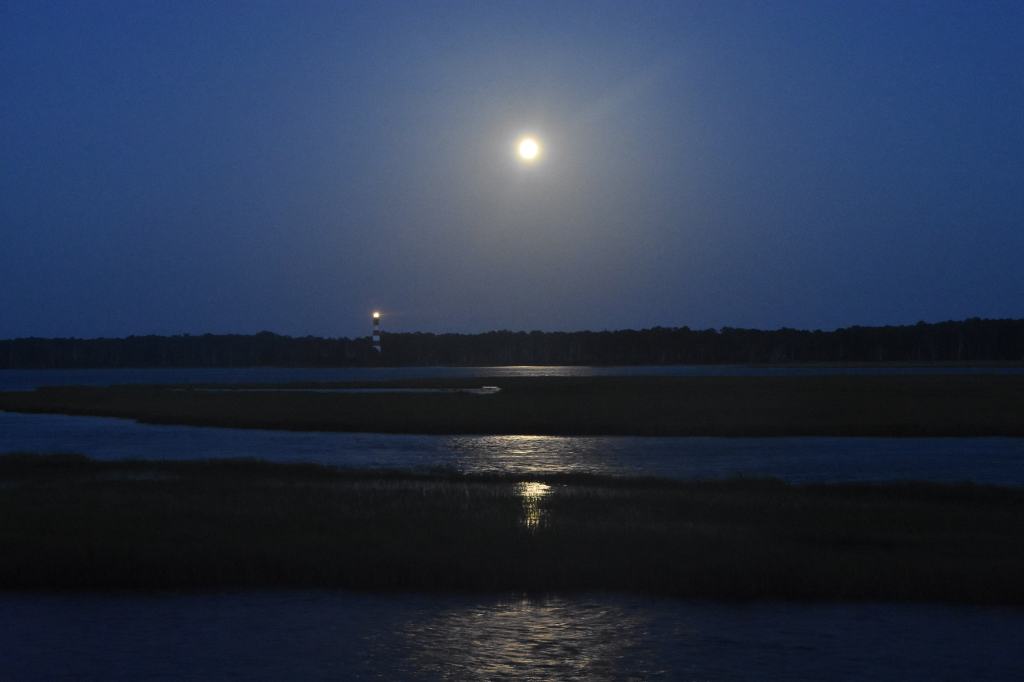
Lighthouse moon
Once Lee was in Chincoteague when we also were. He showed us around and took us to the fishing harbor to meet his cousin Ernie who built his boat, the 40-foot Barbara B, in his backyard. The Barbara B replaces one that sank under him. He swam to a buoy and clung tight in a gale so strong that he – raised on the water and operator of sure sea legs – vomited nonstop for hours until rescued by the Coast Guard. One season, he did so well by selling sharks’ fins to Manhattan restaurants for soup that he bought his wife (the Barbara B) a Jaguar sedan on eBay. Lee is 6’3″ and not thin, but Ernie is 6’8″ and burly and hug-swung Lee around like a stuffed toy.
When I went back to the fishing harbor after the hurricane, I found the Barbara B winched out on shore, growing rust stains and for sale.
‘Teaguers speak a twangy drawl unlike any accent I’ve heard elsewhere, and a tweaked vocabulary. Folks who arrived after the War for States Rights (which, as noted, they ignored) are “Come-here people,” and the unit of weight for buying produce is pronounced something like “powhng.” Any water-craft is a scow and every lawn and driveway has one parked in it. Pickups outnumber all other wheeled conveyances on the island about five to one.
Chincoteague has one brew-pub but no other bars outside of restaurants, a gaudy plastic water-park, a reggae-themed food-court called Woody’s (I sent a T-shirt promoting the place to my old friend Judge Woody Smith [Ret.] in Albuquerque), two ice-cream shops. We still miss the late lamented Muller’s but still have the T-shirts; ‘Teaguers ruefully nod or hang their heads when they spot us wearing ‘em. There are three churches, a funeral home, two vegetable stands and some shops vending T-shirts and souvenirs (one’s sign read “SOUVINIERS”) to visitors.
Those who visit the sun-blasted grassy edges of the road to the beach on Assateague, bringing big beer coolers but no shade, and fish for crabs with chicken necks on strings are called “chicken-neckers.” Neckers never go to the beach.
Surfers, nudists willing to walk half-way to Maryland to doff their kits, picnickers, kite flyers, sand-diggers and molders, squinting readers, skin-bakers with insufficient sunscreen and parasailers all do.