Until recently, I greeted news of every death with the hope that it wasn’t COVID. This was a strange superstition about how our dreaded plague somehow drowned out the possibility of anything else deadly happening around here.
Not so, obviously.
Am I more pissed off that John Prine died of COVID than that Charlie Watts died, at all?
I truly don’t know. Both hurt.
Charlie’s passing hit hard.
For context, the first show-biz death I truly mourned was Nat King Cole, Feb. 15, 1965; and I never got to see him sing except on black and white TV.
I’ve only seen three Rolling Stones shows; and the last one, at Albany’s Times Union Center in Sept. 2005, was by far the best.
That was right after Charlie beat throat cancer, and relief at this reprieve uplifted the whole band. That feel, that unified force they projected, proved how central he was to their sound, their energy, their power.
In all three of those shows, though, Keith visibly relied on Charlie not just for the groove but for everything. He often drifted back on the stage to stand facing Charlie and away from the audience. He’d sync his rhythm guitar slams with Charlie’s snare or kick-drum, deep in the pocket.
Imagine digging the Grand Canyon with two hands and two feet: That’s what Charlie did, every night.
Charlie, Ringo, Earl Palmer from New Orleans then the Wrecking Crew in LA and Clyde Stubblefield in James Brown’s band; those guys are IT in rock and roll drumming.
Bluesman Albert Cummings Rocks the (happy) House, Wyld Blu Opens
Each concert venue reopening in this second plague year brings its own particular joy – a general feeling of relief and reunion, but spiced with its own particular atmosphere and energy.
At Music Haven in Schenectady’s Central Park Sunday night, it was diversity, dancing and an almost dizzying uplift of shared exultation. We were together again, in a well-loved place. I met folks I hadn’t seen since the last show there, two summers ago.
Before Wyld Blu started the music, impresario Mona Golub started the feeling. She issued a happy welcome, thanked the series sponsors, encouraged raffle-ticket buying and announced this was her birthday party. Also mine, but I digress. Her father Neil interrupted in the best possible way, presenting her a bouquet and birthday wishes, there at the mic – but the show was a gift to all of us.
Shrugging off some opening-night nerves, Wyld Blu set the table with a feast of mostly mid-tempo shuffles. They played blues as good time tunes, revved to blow away bad times with rocking riffs.
The quartet twice represented our region at the International Blues Challenge in Memphis and was Blues Artist of the Year at the 2019 Eddy Awards (when I won as Music Journalist of the Year, but I digress). So they hit the stage with growing confidence in their original tunes, sturdy songs welded together of familiar elements in western boogie, big-city R&B and crunchy power glide grooves.
Alana Wyld sang center stage in tall boots, wyld (excuse me) hair and fuzzy scarf behind a guitar she kept busy with spiky solos and supportive chording under Rick Surrano’s harp honks and wails. Longtime drummer Phil Nestor locked on the one with (new) bassist Mike Persico. “Set Me Free” peaked their 45-minute opener, simmering from an easy amble, slower than most of their tunes and with a good Wyld guitar solo. But then an upshift into their more customary shuffle tempo brought an even better one.
By his second song, sweat gleamed in the V of headliner Cummings’s western shirt, and he sang without words as if the feel out-ran his lyrics. While Wyld Blu played things fairly short to introduce as many original songs as possible, Cummings put the stretch on.
Looking like a beefier Woody Harrelson under a black stingy-brim, he took his tunes to the gym and worked them hard. Like Wyld Blu, he built his songs of time-tested materials. And he declared his intentions right up front, in the blistering blast of “I’ve Got Feelings Too.” Like the essential paradox that singing the blues makes you feel less blue, this statement of vulnerability was as much muscle as misery. And his solo speared into outer space, past the half moon peaking through the clouds.
Cummings also made moves to engage the (very big) crowd. He rewarded an impromptu singalong in his opening number with a second solo that soared higher than the first, gas on the fire.
“Barrel-House Blues” rolled and rolled, stretching so fast and far it seemed to cause doubt for a minute. “You guys OK with this?” he asked. Again, he took spark from his fans’ applause, climbing behind the wheel of “500 Miles” to drive and drive, singing of a hoped-for reunion.
Drummer Warren Grant really revved here, coiling on his stool like a cobra, grinning in incandescent glee that powered shoulder-high snare shots. Bassist Scott Sutherland played less flashy all night, maybe one note for every five, or fifty, Cummings blasted into the night; but they were the right notes. Son Zak recognized before I did when Cummings solo drifted out of his lane like an over-excited trucker into Peter Frampton’s “Do You Feel Like I Do.” Cummings explained he’d been recording at Frampton’s Nashville studio.
For all the happy anticipation of “500 Miles” and the jokey moment of “Feel,” Cummings sang most often of betrayal, of love shaken by disillusionment.
Things got fierce in “Cry Me a River” and “Up Your Sleeve.” In these (and other) tunes, Cummings steered closest to the aggressive open-road Texas styles of Freddie King (the “Texas Cannonball”), Stevie Ray Vaughan (whose debut album was “Texas Flood”) and ZZ Top (self-styled “Lil’ Ol’ Band from Texas”). Cummings clearly likes those hot-pavement highways and this helped carry everybody with him.
Cummings hailed Glenville-based blues journalism giant Don Wilcock (first editor I ever wrote for, but I digress), crediting him for early career support and encouragement. Check Don’s review of the show on http://www.nippertown.com.
As usual, mega-fan Steve Nover was among the first to filter up front through the crowd to dance among the photographers clustered below the stage. Soon others joined in, alone, in pairs and clusters. By the time Cummings closed with the obvious but compelling declaration “Blues Make Me Feel So Good,” folks filled the space between stage and seats.
He sent us home hoping he’d given us “something to take home that you can keep.” This seemed to work just fine as happy people picked up chairs and remnants of picnics and headed home through the cool dark.
Liraz Charhi, who performs as Liraz, continues the Music Haven concert series on Sunday, Aug. 22. The Iranian (by way of Israel) singer-actress combines the musics of both homelands on two albums; “Zan” (Persian for “women”) is the latest. On these projects she collaborated with Iranian musicians clandestinely, as they are barred from working with Israelis. The Palestinian instrumentalist Firas Zreik, now based in Brooklyn, opens. He plays the many-stringed harp- or dulcimer-like kanun.
They’re all dads: trombonist/leader Ben O’Shea, pianist David Gleason, saxophonists Brian Patneaude (tenor) and Dave Fisk (tenor and alto), bassist Mike Lawrence; and drummer Andy Hearn.
Their Dadtet band name signifies parenthood more than any oblique reference to Louis “Pops” Armstrong. It serves instead as a convenient, collective marquee label for these established area jazz cats. A prior name, the Ben O’Shea Quintet, confused a woman who came to a gig expecting an Irish St. Patrick’s Day vibe.
However, she stayed for most of that gig, just as everybody stayed for the Dadtet’s Jazz on Jay show Thursday under a pounding sun. And they did play “Summertime,” a song Satchmo famously recorded with Ella Fitzgerald.
Four of the dads – O’Shea, Gleason, Patneaude and Fisk – played regularly with Keith Pray’s Big Soul Ensemble before it went on hiatus during the plague. In Pray’s 17-piece crew, all adopted workmanlike personas. Thursday, however, O’Shea flexed his funny bone at times in a relaxed and self-deprecating way.
This gave the noontime gig a cool, easy feel; not because it was too hot to play fast or hard but because the guys shared the confident flair of walking through the tunes together, swinging everything.
Meanwhile, fans arriving for the show fled the sun’s hot glare for the shady side of Jay Street.
“Summertime,” indeed.
The Dadtet’s slow, dramatic early-set take on this classic featured strong solos by Fisk, whose statement of the familiar melody launched from a higher register than usual; Gleason, with an energetic rhythmic authority, and Patneaude running the changes with his typical grace and aplomb. O’Shea modestly soloed last, and with clarity and drive, before Fisk took the tune back to the head.
“Summertime” followed “Filthy McNasty,” one of the great song titles and first song by or about Horace Silver in the Dadtet’s mostly upbeat, hard-bop-inspired set. O’Shea took the lead here in a mid-tempo swing mood that built like a storm surge to crest then signal short swapping riffs that set each player in turn against Hearn’s drums. Unshielded by the tent over the rest of the Dadtet, Hearn was rescued from the sun by Jazz on Jay chief Betsy Sandberg or one of her volunteers, holding a beach umbrella over the otherwise melting percussionist.
“Ladybird” kept things breezy; another swing-time stroll where Patneaude especially shone but Lawrence also made the most of his first solo of the day; again, solos flowed before riff-swaps stacked up brisk and brash short cameos.
After “Summertime” came “In Walked Horace” by J.J. Johnson – O’Shea made sure to let us know the composer was also an eminent trombonist – where Fisk’s alto led the way but section playing sparkled, too. This brought smiles all around, on the bandstand as much as in the crowd.
(Saxophonist/trumpeter) Benny Carter’s “A Walking Thing” started almost like a reprise of “Summertime” in its sassy stroll beat that soon picked up heft as the soloists ganged up on it. This felt too short since it swung with such charm, especially when Gleason ping-pong’ed playfully with the horns.
Gleason intro’ed “What Is This Thing Called Love” as a brash bossa blast, but O’Shea gave this chestnut its biggest push and highest polish and the all-in resolution really rocked the place.
Then came blues-time in the well-paired “Blues in the Closet” of (bassist) Oscar Pettiford, then “Mo’ Bettah Blues” by (another bassist) Bill Lee for his son Spike’s film. In “Closet,” a walking bass line summoned first drums and piano then the horns, into a powerful swing-bus that picked up everybody. Patneaude was brilliant here, conducting a two-part conversation with himself. Slower and steady, “Mo’” mellowed things out in slow-drag fashion; low-pressure, maybe; but not low-energy.
They closed with (pianist) Horace Silver’s shimmering, simmering “Nutville,” a mid-tempo swing number like the earlier songs in the set. All the horns got good solos, then welded together in a brassy farewell.
Throughout, the soloists cooked quotes into the songs, as both spice and ingredients. The Dadtet not only knew the tunes in this 90-minute set inside out, they also knew how to distill, deconstruct and decant them into new containers.
The usual suspects showed up on Jay Street and had a fine time. That natty dude in black from shiny shoes to fedora set aside the Bible he’d been studying, tracing the words with his finger, to crouch before the band to shoot some video. A wiry woman of a certain age took over the dance floor all by herself in “In Walked Horace.” She had the moves and, like the band, she had the confidence, holding all eyes until she waved herself off as the crowd applauded.
Jazz on Jay continues Thursday, Aug. 19 with the precocious (college student) saxophonist Henry Fernandez and his Quartet.
“Schenectady is a-a-a-a-ll right,” said Dylan Perrillo late in his quintet’s Jazz on Jay show Thursday. The sunny noontime concert was also very a-a-a-a-ll right.
Perrillo said this without irony; the bassist-bandleader wields a wry wit and was often pretty funny at the announcer mic. But he clearly meant this, and he and his guys worked hard to make it so. While he brought serious respect to vintage tunes, he also showed a playful zest for reinventing them and for composing often terse tunes with strong flavors of his own.
He first served up Duke Ellington’s “C-Jam Blues” (later retitled “Duke’s Place” as longtime A Place for Jazz chief Tim Coakley confided at our table). The thing swung plenty, and the immediacy of its energy eclipsed altogether any sense of an antique museum piece. Alto sax-man Adam Siegel and pianist Tyler Giroux – he later grabbed his more familiar valve trombone at times – carried the solos capably. But guitarist Brad Brose, newly arrived from Paris, pumped the song to starting effect both in a fast-strum solo and comping behind his band-mates.
Playing an electrified acoustic guitar that could have come from Django Reinhardt’s caravan, Brose phrased aggressive accompaniment in the muscular but supportive style of Freddie Green in the Basie band. The resonance of his pleasing, organic sound came from the wood, not from his amp.
His two-chord vamp flowed from a fanfare start into Perrillo’s original ballad “A Pleasant Day on the Krumkill,” then Siegel guided his alto all the way to the top in feisty jabs that somehow never burst this cozy tune’s serene spirit.
In bassist-composer Charles Mingus’s swinging “Peggy’s Blue Skylight,” Giroux grabbed his valve trombone, blended tight with Siegel’s sax in harmony statements through stop-and-go riffing, then got red-faced in a romp of a solo. Serene looking at the keyboard, Giroux went wild and wild-looking here. And, just as he’d responded to Brose’s guitar in “Krumkill,” Siegel reached convincingly for the high bar Giroux set here.
“Snowfall” – a favorite with both our own late, great Lee Shaw and rambunctious rock-jazz band NRBQ – got a beefier reading than customary for this Claude Thornhill classic. First it rocked, then it swung, with Giroux back at the keyboard and Siegel having fun.
Perrillo selected “Buckingham Pond” from his collected impressions of Albany green spaces, a short and sweet waltz, followed by another whose title I didn’t catch. Brose and Giroux shone on both. The leader announced his original ballad “Syracuse” depicted the one in Italy, a ballad so pretty I didn’t try to sort out if he was joking about the title.
Teamwork was again key in “Tricotism,” Brose strong in zippy chords behind Siegel’s inventive sax lead. Then Perrillo took a questing, imaginative solo himself, adopting the freedom Siegel had just shown. The solos, by everybody, flowed so fast and seamlessly that Perrillo joked afterward that everybody got half a chorus.
If Perrillo’s “Buckingham Pond” affectionately portrayed an Albany park in pastoral terms, his indignant “Homewrecker” dove deep into a way darker mood. Brose’s guitar emulated a mandolin to suggest the Italian character of “the Gut,” the working class neighborhood leveled to build the Empire State Plaza. They slowly, sadly mourned that destruction, then Siegel’s sax sang out hard anger.
Back to the trombone for Giroux in “Caravan,” intro’ed first by a raucous drums clatter by the ever-steady and explosive-whenever-he-wanted Nick Anderson. Then Brose and Perrillo joined the fun before the horns climbed on this familiar theme. They did what everybody does with this classic: ride the riff together, then gallop off in all directions across the desert sands for solo jaunts. Everybody said their piece with panache, Giroux going all raspy.
While Siegel swung “Out of Nowhere” to graceful effect, Brose soloed every bit as well, completely unaccompanied while everybody else laid out; then he and Perrillo traded short riffs, really swinging it.
The only time Perrillo bowed his bass was in “Baseball with Drum Solo,” a slow, sparse melody with an inviting open feel; and at the end, he and Anderson (playing just toms) swapped riffs.
Perrillo then slapped the bass to pump the energy of “I Got Rhythm” and they surely did. Siegel soloed first, next came a terse Perrillo bass break, Giroux roamed the keyboard with hot hands, then Brose’s crackling foray mixed chords and single-note runs. Back to Siegel, hotter in his second solo than his first and then, most rhythmic of all, Anderson soloed on just his snare.
More than most jazz players of his generation, Perrillo looks back with both evident affection and a spry willingness to mess with things. In his originals, always interesting and well-thought-out, he could actually stretch a bit more, so that moods also incorporate more movement. But in honoring those who came before, he steered a clear and confident course, of taste and tunefulness.
Check Rudy Lu’s typically cool photos of the show on Nippertown.
Jazz on Jay continues July 29 with keyboardist Jon LeRoy’s Trio.
The Dylan Perrillo Quintet plays WAMC’s The Linda on Sept. 3.
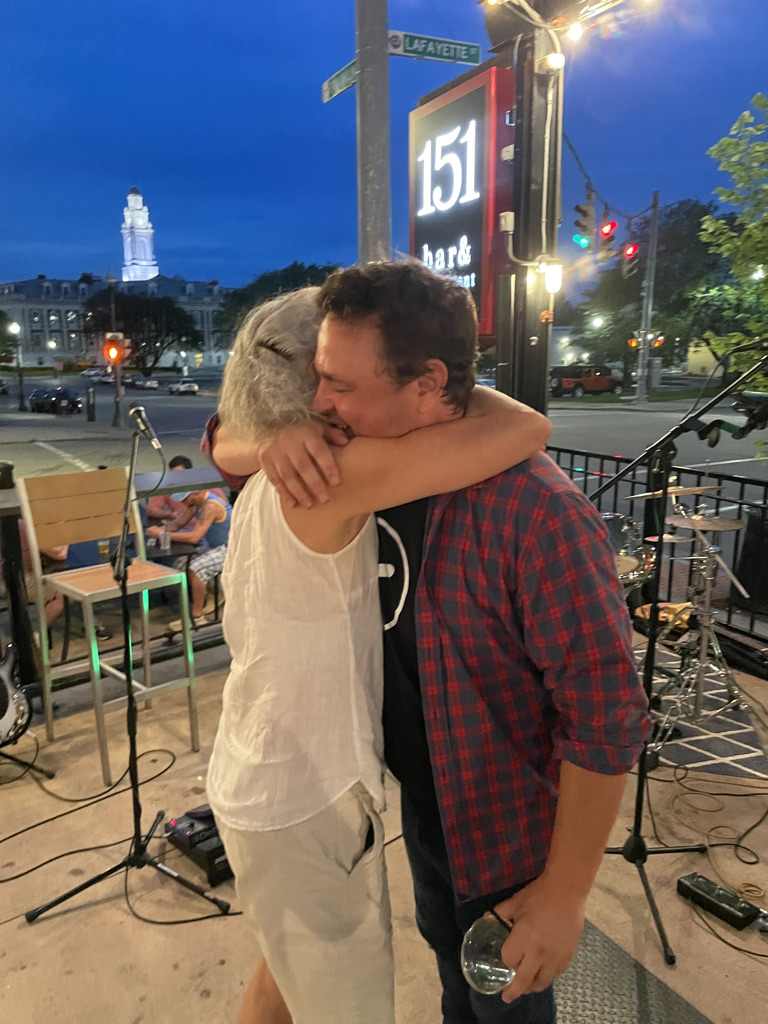
At 151, the restaurant-bar on Lafayette Street, we met and hugged friends, we heard live music, we enjoyed food and drinks.
151 sits two blocks north of long-gone St. Joseph’s, middle school for my brother Jim and me, and next door to Great Flats Brewery; these two new-ish businesses sharing what once was a tire store. A high-tech box of dark metal, 151 invites folks, most in shorts and Ts that night, to dine in a dark tables-and-chairs area, get drinks at a long rectangular bar and do both on a sun-bright two-level patio, partially under a translucent roof.
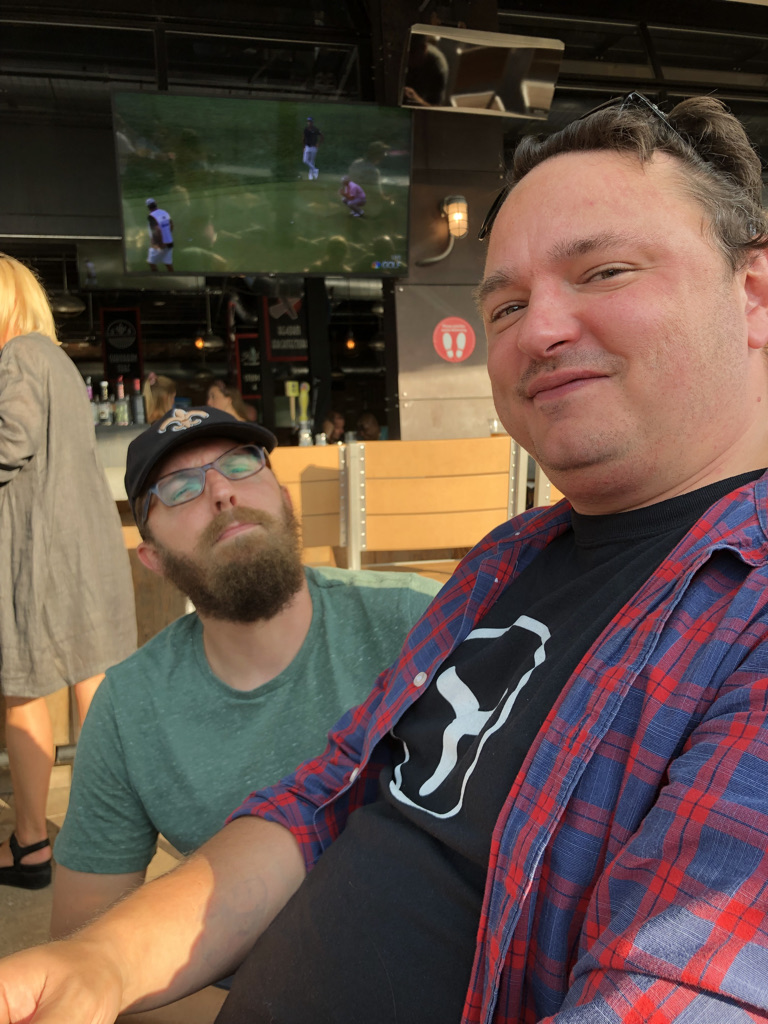
Zak and Dave
The Yankees played on one above-the-bar TV, the Mets on the other.
Zak and Lea
For Ellie, Zak, Lea – the woman he just started seeing – and me, just being in a bar brought a cozy feeling of connection we had long missed.
In the corner of the upper patio, instruments awaited players; we found those guys at the bar.
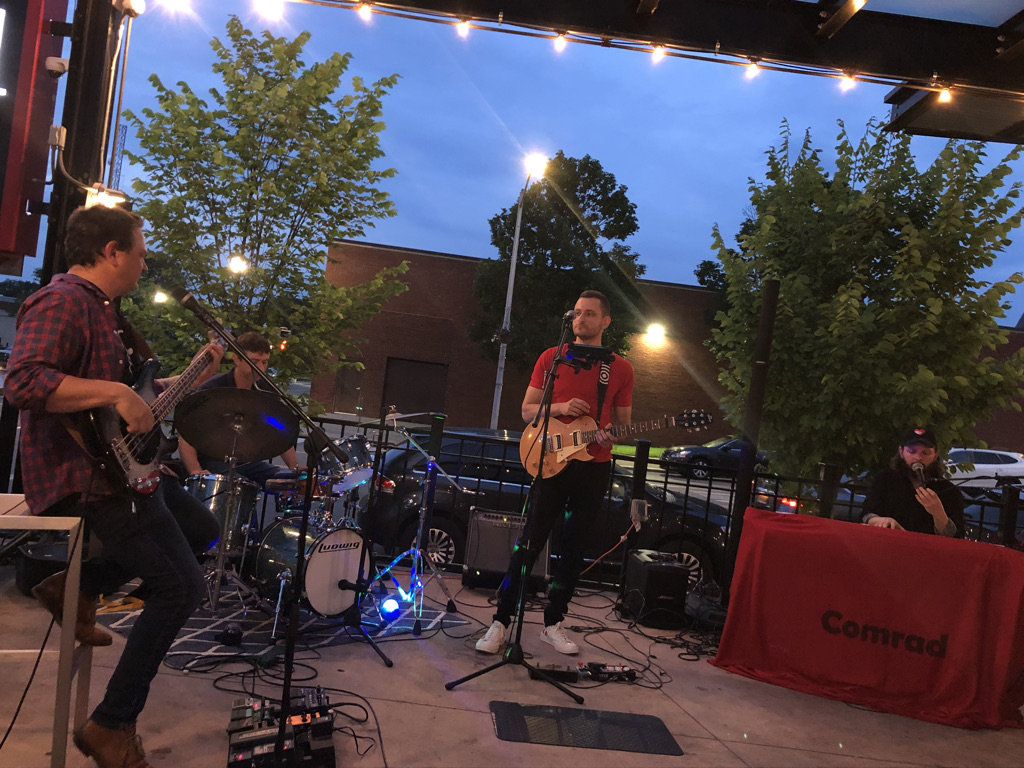
The electric bass on the bandstand was Dave Parillo’s, Zak’s friend since pre-school at Brown School when it was still on Rugby Road. Boston-based Dave was there to play with friends from Niskayuna High School and Ithaca College. Their quartet Comrad had practiced together online until recent all-vaccinated rehearsals in Brooklyn where most of them live.
Dave’s parents Jack and Cindy soon joined us at a front table that the owner, also a Niskayuna grad, reserved for family. They’d driven in from their farm in Buskirk near Bennington, and brought Dave’s sister Elizabeth who’d flown in from Bozeman for her brother’s gig.
At our table in bright sunlight – now, that didn’t feel exactly normal – we ordered drinks and pub-food dinners. The place was hopping but efficient. People kept coming in, being seated and served.
No notebook, no camera; I was off-duty; and the music was maybe even more fun for the players than for us. I was SO far off-duty, I never bothered name-checking the guys (besides Dave), never jotted down a song title or who soloed; no notes on tempos or arrangements, themes in the lyrics.
Comrad
They played without looking at their hands, everybody was off the book.
Band-mates since grade school, Dave and the drummer built the beat of straightforward materials. Singer-songwriter Arthur, who wrote their songs, wielded the words and minded the mood, also a keyboard and most lead vocals. The guitarist played colors, cool solos and bright bridges. They were unified, the groove rocked. Lots of tunes moved at waltz-time, but rather than being confined within three-beats, they took off at times. If all this could be dubbed shoe-gaze, those feet moved.
Apart from the refreshed and refreshing novelty of simply being with other humans, longtime friends and strangers alike, the main delight of the evening was watching Dave – remember, we’ve known him since he was three – enjoy making music with his friends, as we listened with our friends.
Looking around the place, I saw few masks – which felt unnerving at first; then, normal. Or at least normal in Schenectady where and when most are vaccinated against the-damn-plague.
Ellie and Dave
We earned that delicious night in the sun, in the bar, in the music, in the company of friends.
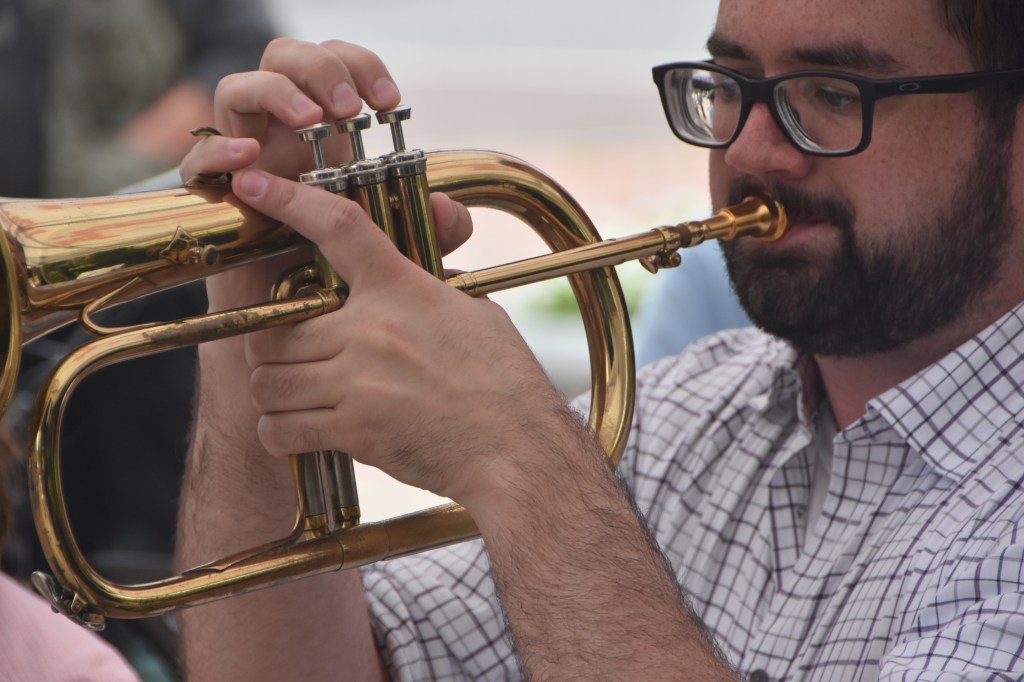
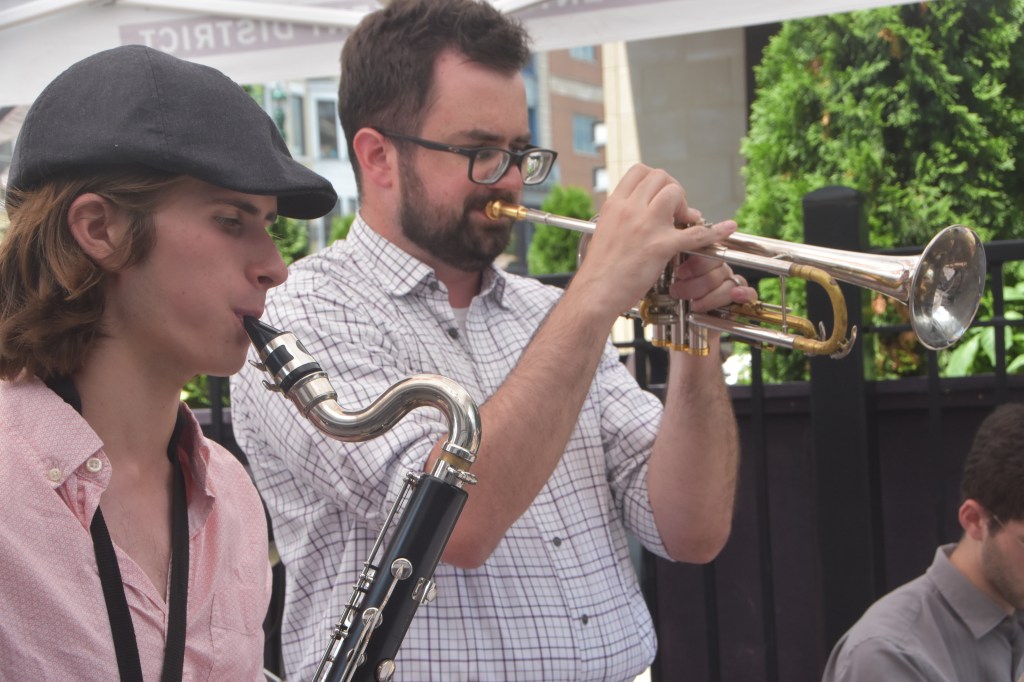
“I’m not used to being the old guy in the band,” said Dylan Canterbury, the (still dark-) bearded “old guy,” late in Center Square’s set at Jazz on Jay Thursday. “But it’s fun playing with these young guys, kicking my butt.”
Dylan Canterbury
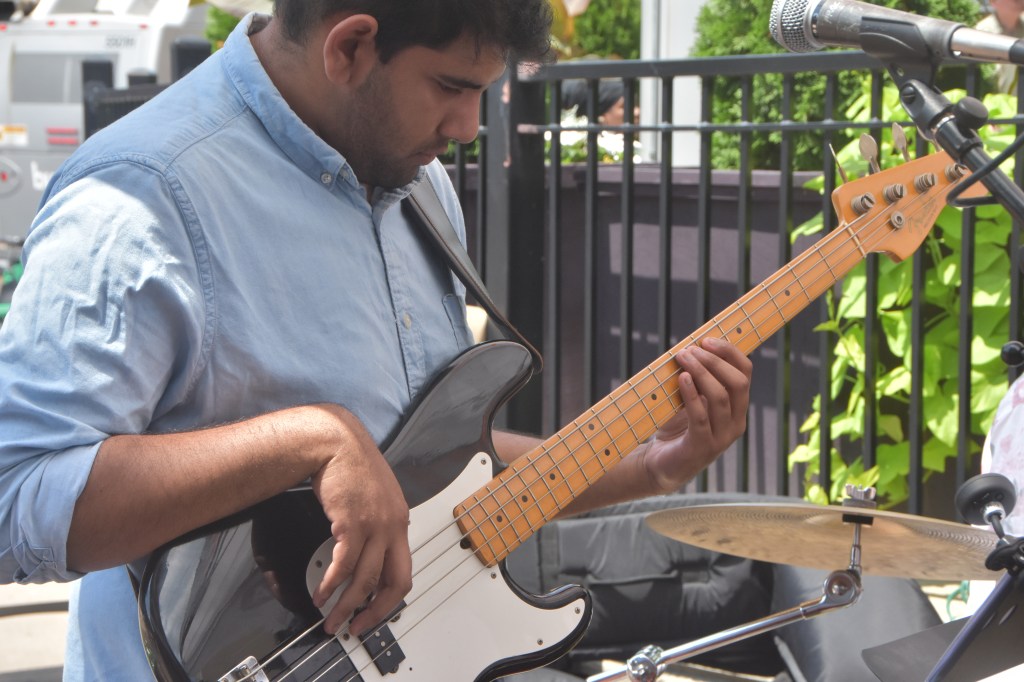
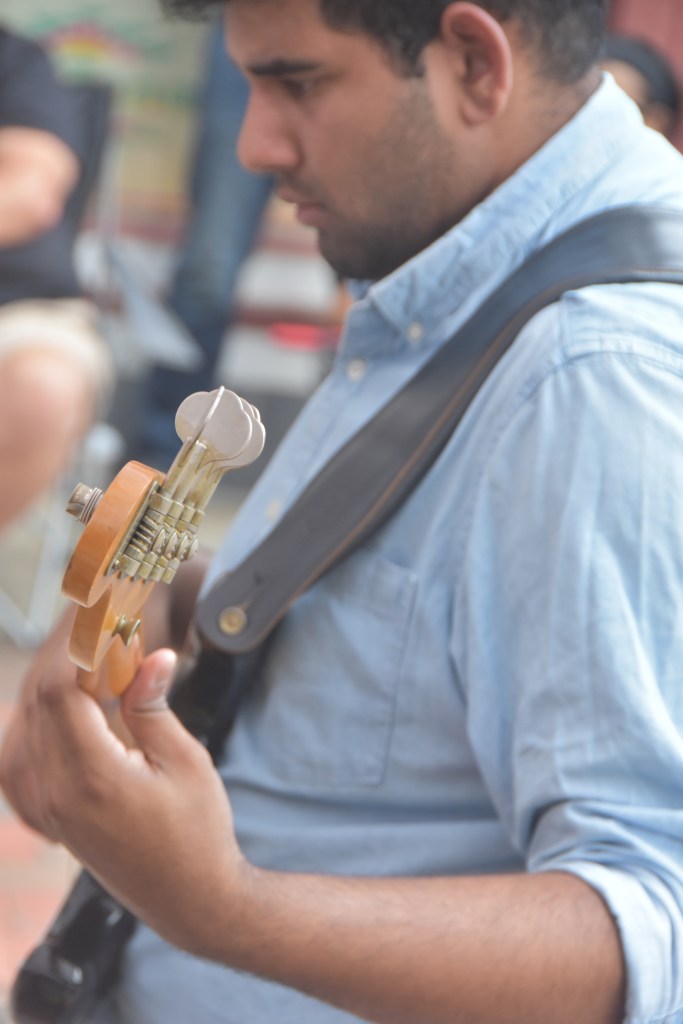
The trumpeter and flugelhorn player was actually first among equals, though bassist Nicholas Dwarika (a graduate of Jazz on Jay’s December Student Showcase) was nominally the leader. And Canterbury kicked plenty of butt himself. But this wasn’t “Dylan and the kids;” the free, sun-splashed, well-attended show had better balance than that.
Nicholas DwarikaBodhan Kinal
Saxophonist Bohdan Kinal (who just completed sophomore year at Guilderland High School) said afterward the quintet had practiced several times before Thursday’s show, but it was still a reading gig as the players relied on charts. Even while navigating tricky cadences and swift shifts in beats and chords, they held it all together. In their best moments, they swung and rocked as the tunes demanded.
There was seldom a studious, sight-reading vibe on the tented bandstand; the guys were intent and intense, but also clearly having fun, especially in the 100-minute set’s funk numbers.
If there was a lesson to be heard in the precision playing of these high school and college-age musicians, it was: When players know what to do, they know what to do together.
Another lesson: Young musicians can survey the entire history of jazz and echo those parts of the tradition that best suit them. What suited Center Square Thursday was the 1960s post-bop of the Jazz Messengers, the Adderley brothers and Miles Davis’s quintets.
Their happiest, fun-est tune, dated from a bit later, 1973: drummer-composer Billy Cobham’s “Red Baron: from his tremendous “Spectrum” album. Center Square built this classic fusion number from the bottom up, in dense slabs of funk, but with solos celebrating up top, first Canterbury, then Kinal honking strong on tenor, Josh Klamka roaming the keyboard and Dwarika going bump and thump at the bass in sync with drummer San Hatfield’s kick while his snare shots bridged high and low.
Sam Hatfield
In fact, it was drummer Sam Hatfield who unfolded the tune’s roadmap before the others chimed in. He clattered up a snare pattern that forecast the tune as accurately as looking up at the sky predicted rain here almost every day.
This followed a mostly-originals string of well-made, well-played tunes of which “Onomatopoeia” was the trickiest, “Upon A Dream” the most bossa-est and “Beagleson Cage Aret” the most obscurely titled.
“Red Baron” seemed to put the band in full flight, confidence bristling in the three songs that closed the set.
The episodic “Clouded Sky Piercing Moon” mastered two moods: a meditative ballad intro as Canterbury conducted, while playing sweetly, with dips of his flugelhorn before an upshift exploration that resolved into a drone with bass clarinet. They gave the drummer some in this one, a solo with all the complexity of the harmony horn parts earlier.
Josh Klamka
In the gospel/soul “The Way You Say It,” Canterbury’s trumpet blended in microtonal perfection with Kinal’s alto. Pianist Klamka introduced his own “Ethos” as the closing number – another bop-y blitz with tricky cadences and Canterbury in top form with flugelhorn fireworks that drew a grinning, admiring glance from Kinal. After a teasing stop-and-go pause, they all climbed on the riff and rode it home.
Center Square at Jazz on Jay
SETLIST:
Exposition
Penelope’s Revenge
Beagleson Cage Aret
Onomotopoeia
Upon a Dream
Red Baron
Clouded Sky Piercing Moon
The Way You Say It
Ethos
Jazz on Jay continues next Thursday, July 22, with bassist Dylan Perrillo’s Quintet.
Thanks to old friend Ray Simboli for suggesting a photo safari on a soggy, gray day when rain fell about every 15 minutes and I might otherwise not have dragged my camera out into the wet.
I’m posting these despite believing – as I told Ray – he might have shot all the good ones.
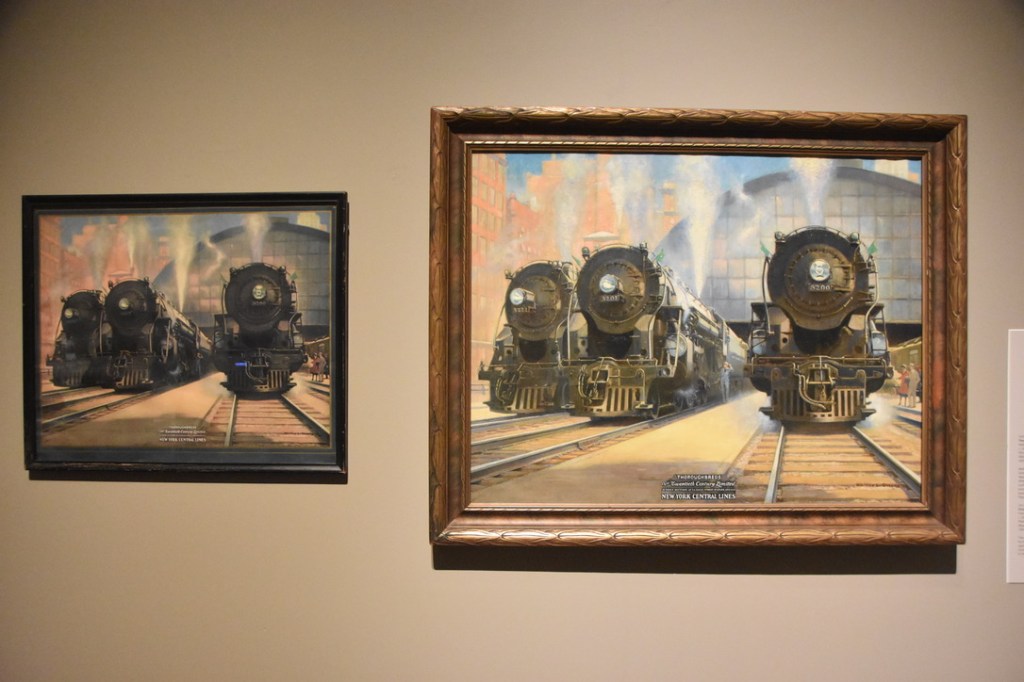
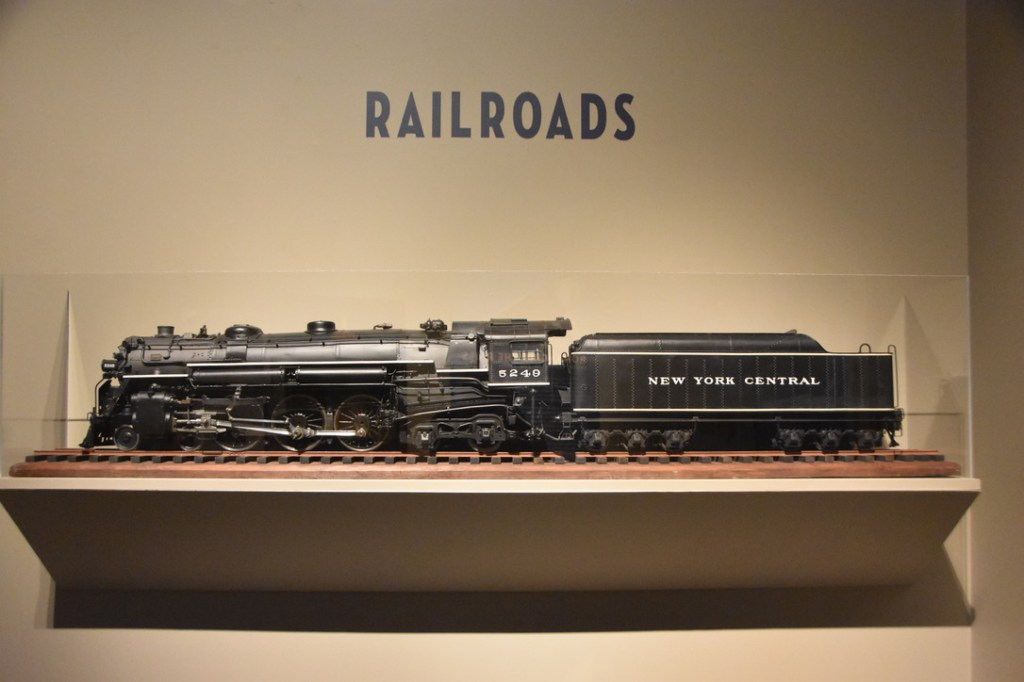
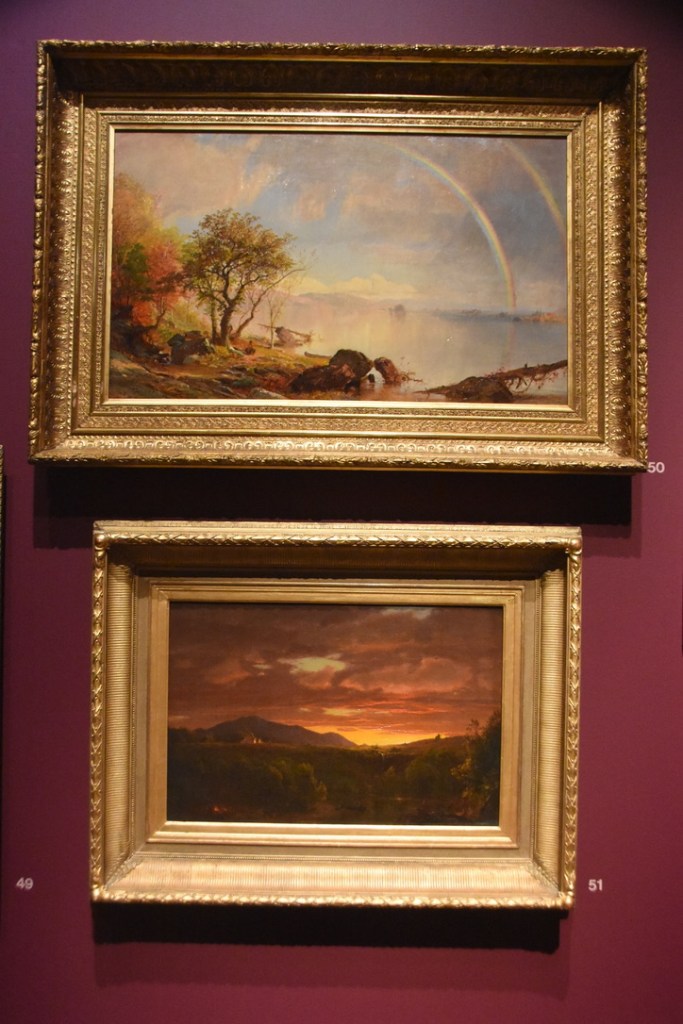
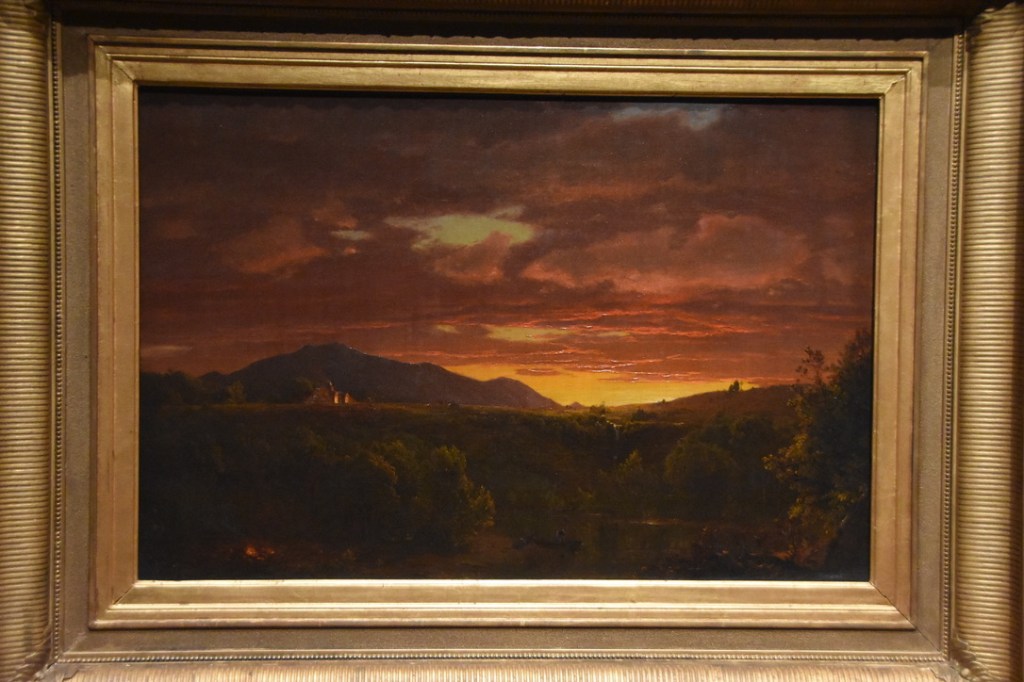
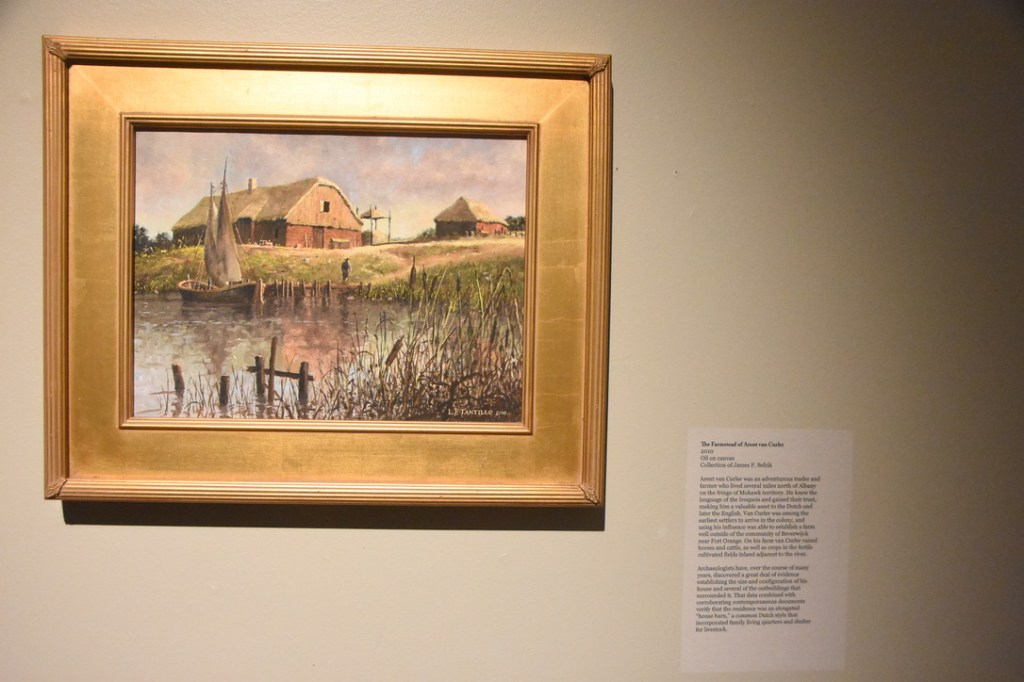
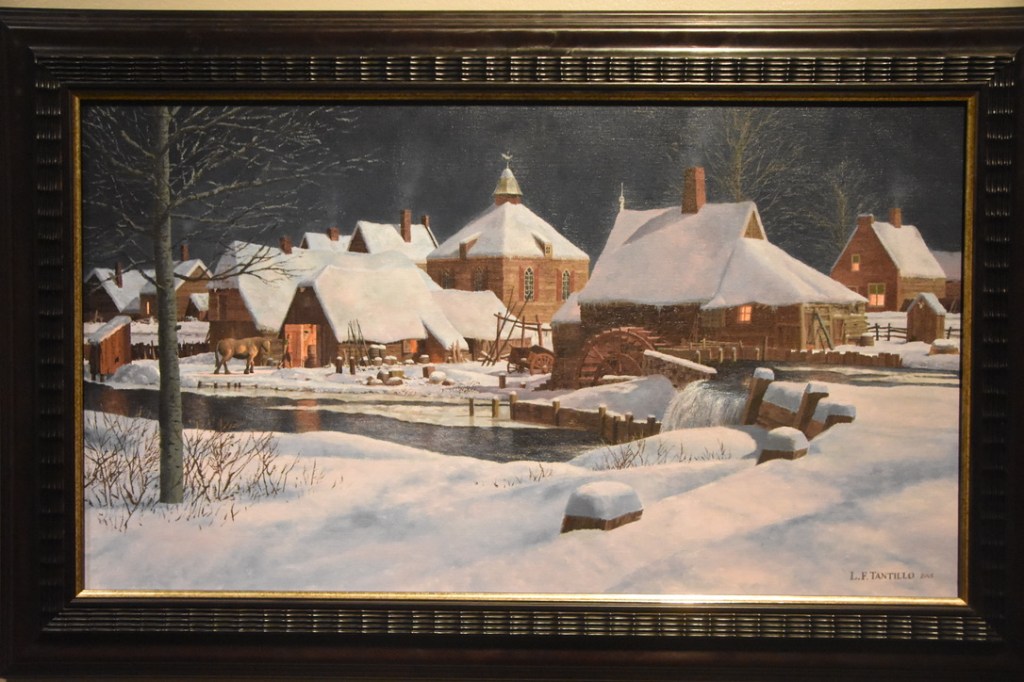
Here’s where we went: At the Albany Institute of History and Art (whose chief Tammis Groft I met on Cuttyhunk Island years ago and who just announced her retirement) we saw cool railroad art, the ‘Tute’s impressive Hudson River School landscapes and historic views by Len Tantillo.
The railroad collection features artworks and artifacts including dining car dishware, menus and photos – EVERYBODY is dressed up, EVERYBODY is smoking – also advertising posters next to their hand-painted originals. I gravitated to a gleaming-black model of an ALCO (American Locomotive Company) engine and tender. Our family came to Schenectady when my dad took a job there.
Then the Hudson River School landscape masterpieces worked their usual magic, transforming places we might know into mysterious marvels where fact and imagination don’t so much fight it out as conspire to awe.
I had to share this tasty Tantillo: I live on Van Curler Avenue…
…in Schenectady
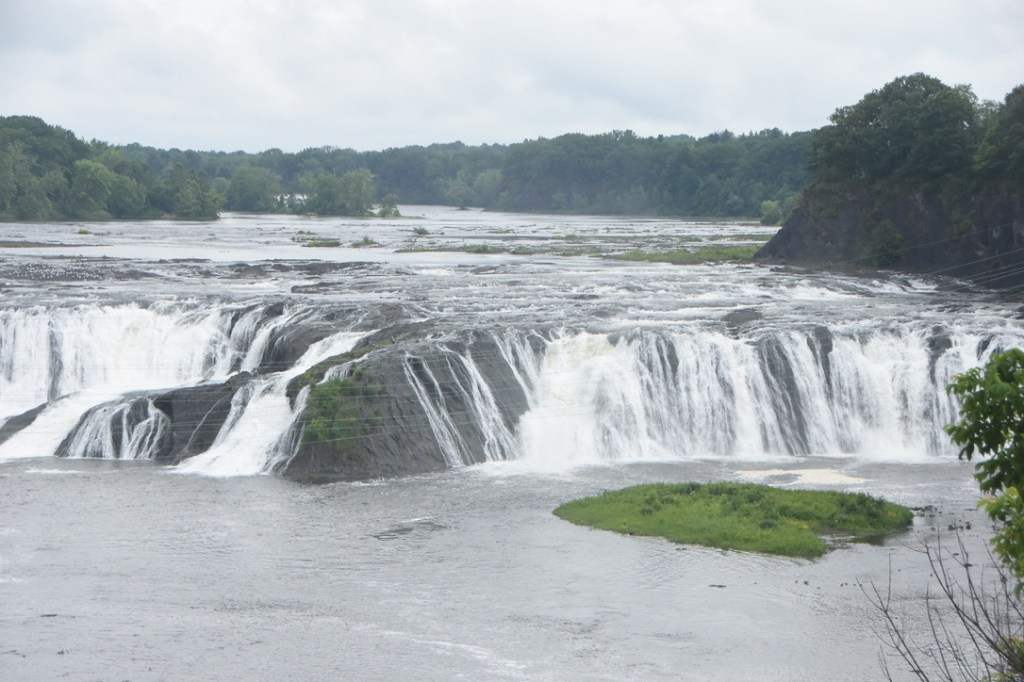
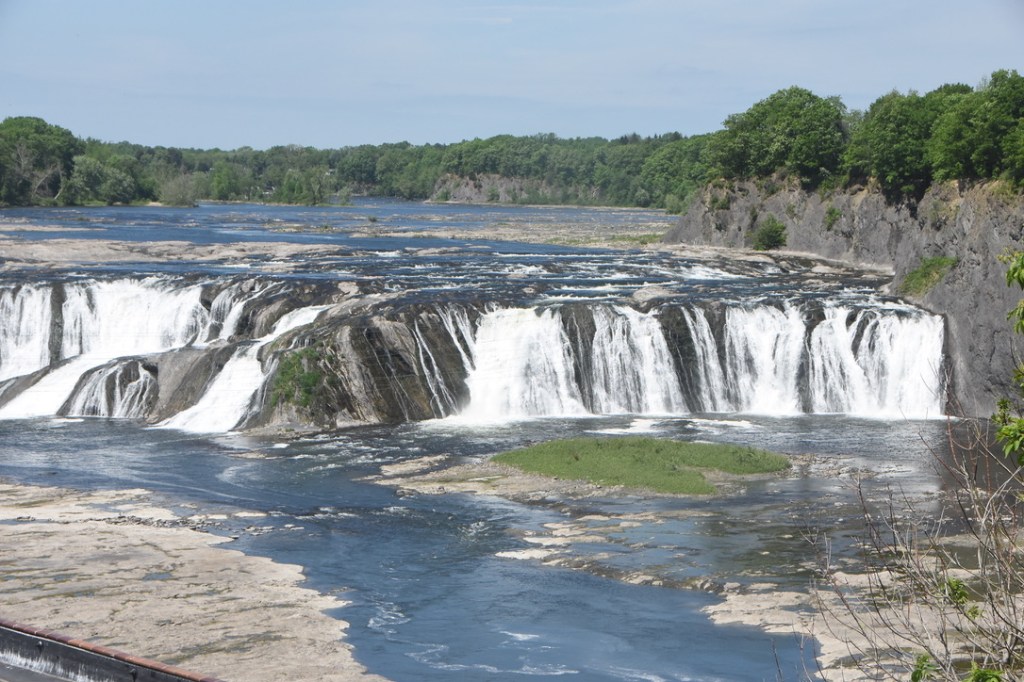
Then we headed to Cohoes, to gawk at the famous falls, and grumble about the power lines
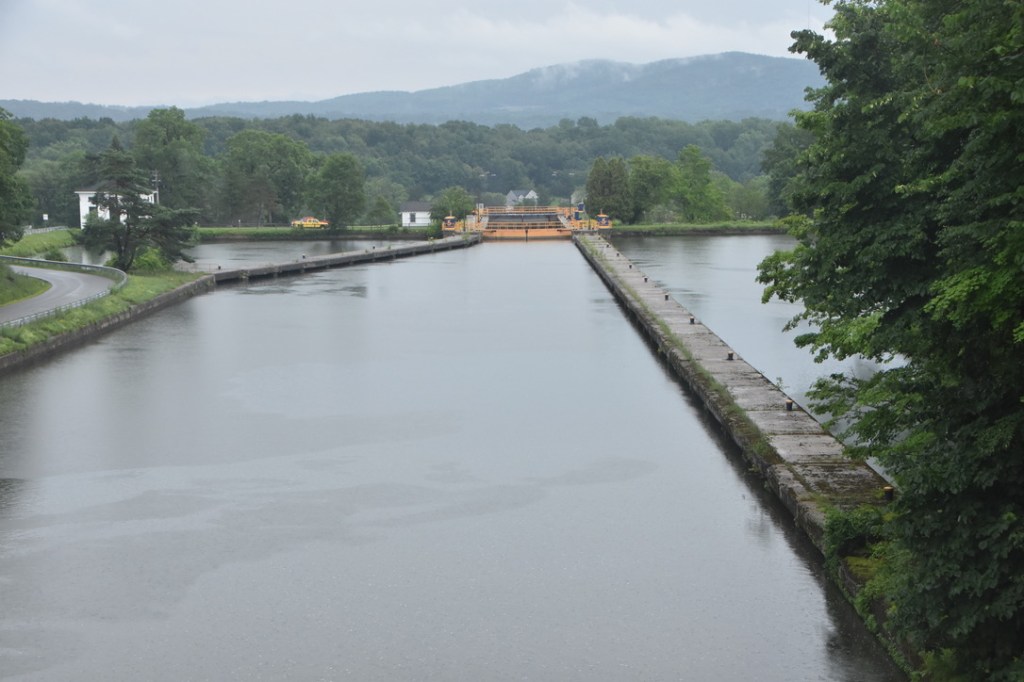
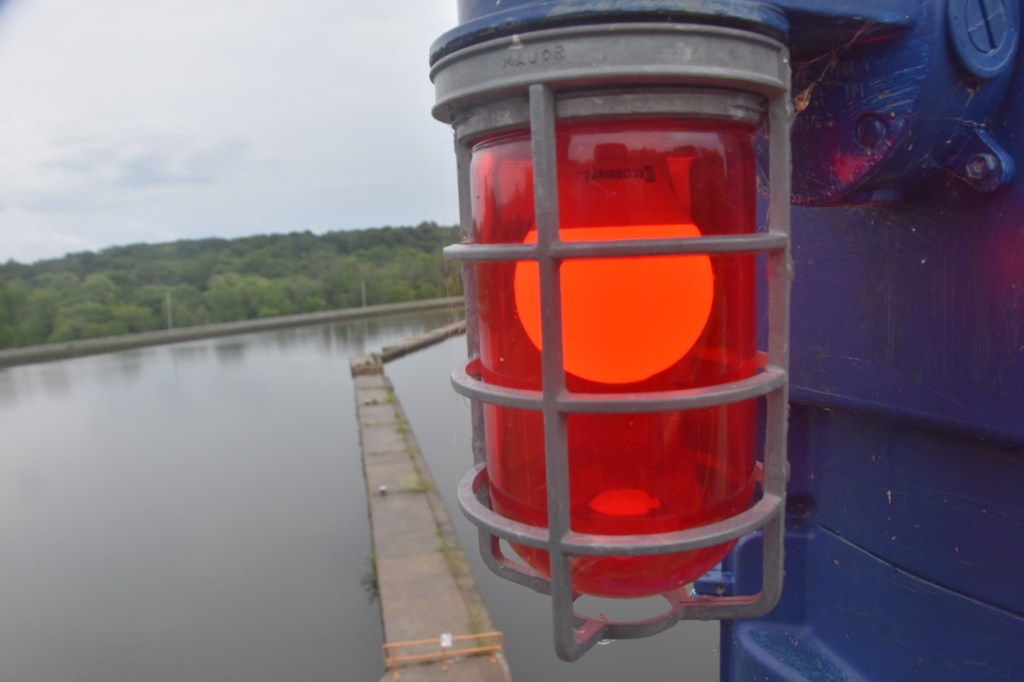
After blundering around Waterford’s confusing – even to GoogleMaps! – streets and Canal-scapes, we found some locks; no bagels, however.
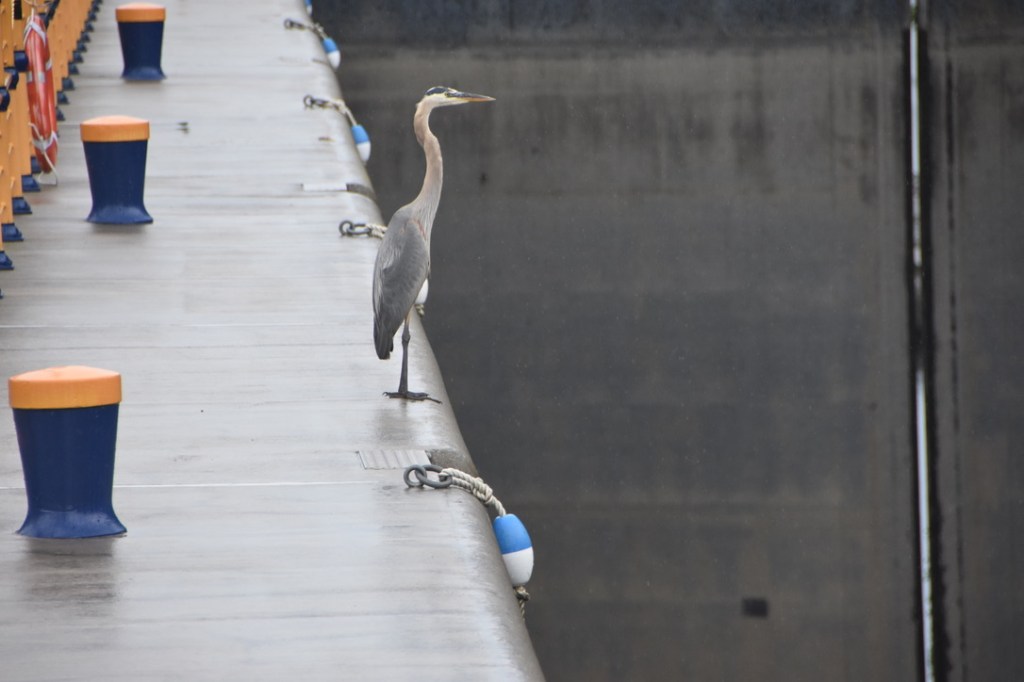
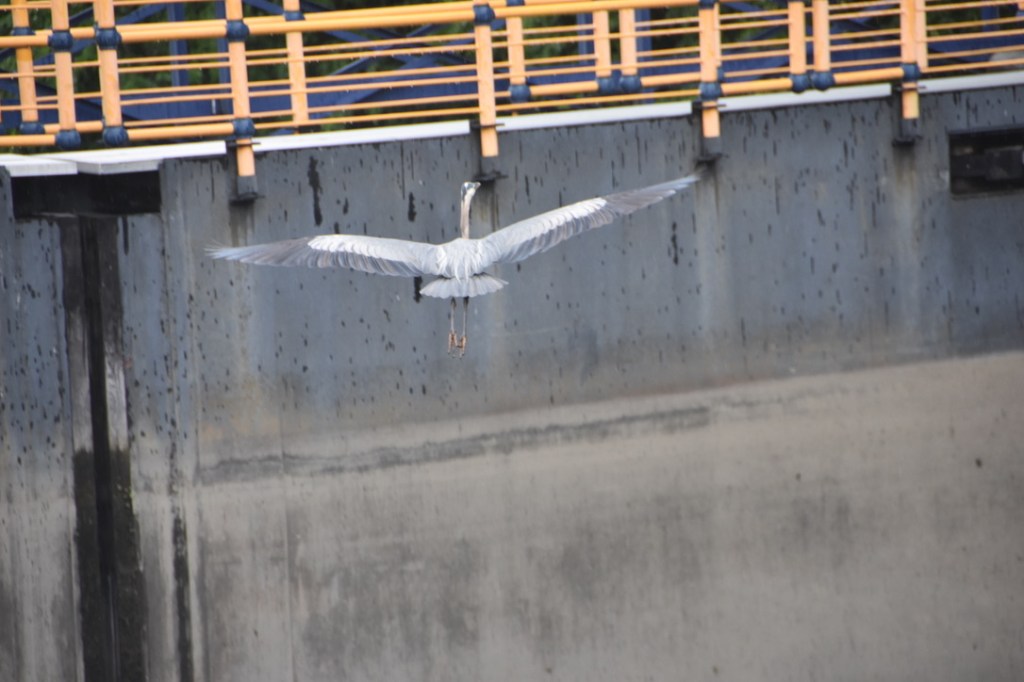
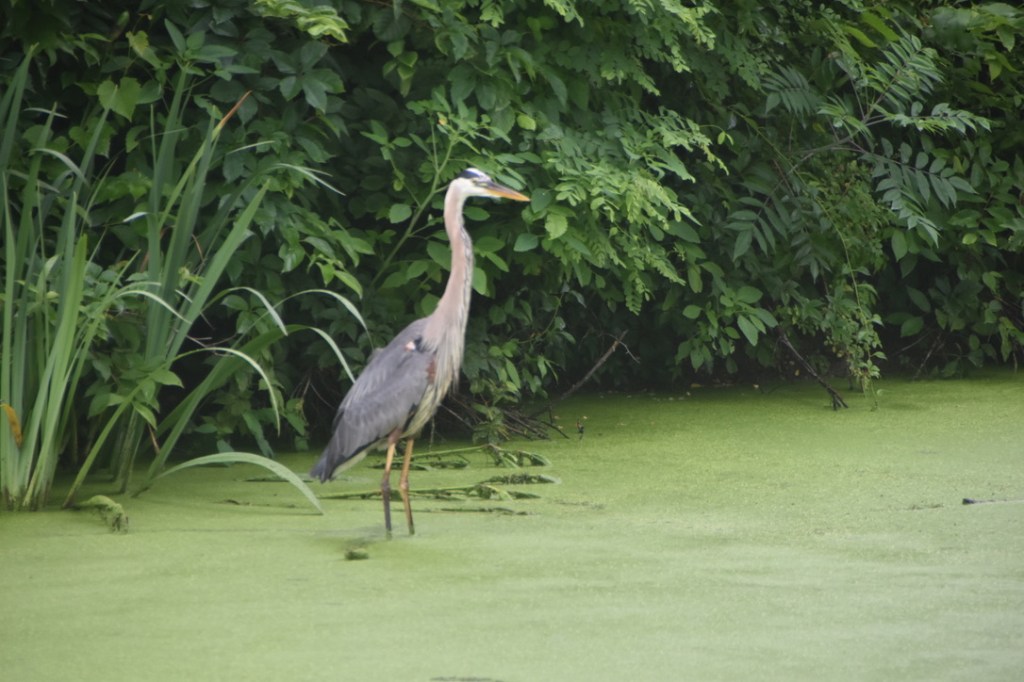
And the super-green, super-swampy Vischer Ferry wet-scape showed us another Great Blue Heron
A few weeks before, Zak and I roamed the same territory – except for the Albany Institute of History and Art, and in drier weather; grumbled about the power lines then, too.
How fun to re-visit cool places, in good company – and good weather: ALL weather is good weather in cool places
Files of marching mist-men, wraiths robed in fog, stalked the valleys of the Green Mountains as I drove to Brattleboro Saturday. They seemed spooky, spectral; until I decided they were the ghosts of the plague, leaving town, and unease turned to relief.
I was going to see NRBQ for the first time in way too long, so driving through the rain on roads twisty-slick as a wet corkscrew was part of a happy pilgrimage.
NRBQ at the Stone Church July 3, 2021; from left, saxophonist/singer/accordionist Klem Klimek, guitarist-singer Scott Ligon, bassist-singer Casey McDonough, drummer/singer/guitarist John Perrin, and leader, co-founder, keyboardist and singer Terry Adams
Brattleboro’s Stone Church is just that, a former Unitarian church minimally modified by adding a bar, sound and lights. Its website merchandise page offers the usual shirts, caps and mugs, but also face-masks and rolling papers.
My brother Jim Hoke suggested I see the sound check; a guest on hundreds of NRBQ shows and a dozen albums, he knows. The crew, led by longtime stage manager John Krucke, had set up amps, mics and monitors. Saxophonist/singer/accordionist Klem Klimek fitted a reed to his alto and greeted me as casually if I’d been there the previous night for the ‘Q’s first show in 15 months. Next came bassist/singer Casey McDonough, a Chicagoan like guitarist Scott Ligon and drummer John Perrin. McDonough said, “It’s wonderful!” to play together again. “I can’t believe it’s happening!” Ligon and I shared our relief at being back together again at a gig. “It’s good to BE,” he said. Pianist/co-founder-leader Terry Adams came in, hugged me, called me Brother Mike, then tended to piano and clavinet.
“At sound check, they’re musicians,” Jim had said. “In the show, they’re performers, and there’s a difference.” I saw that as Klimek squeezed out a vaguely Latin accordion riff. The guys listened, not for very long, and fell into a tune that wasn’t there minutes before. They quickly had it, so they stopped. Klimek called it “Mexican Puck Dance.” Puck is his dog. I think he wants people hearing him call it to think he’s yelling something else.
The sound-check version was fresher and more fun than the version in the show, but I digress.
Downstairs in the dressing room, we could hear fans filing into the Church as we talked of the plague. Everybody stayed busy. Klimek played with bands and singers on Cape Cod. Ligon and McDonough finished a Flat Five (their other band) album in Chicago. Adams lovingly compiled the last recorded work of founding ‘Q guitarist Steve Ferguson. But Adams also said the isolation felt productive only to a point. “I couldn’t see anybody, I didn’t see anybody!”
Back upstairs, I was surprised to see many fans and staff wearing masks, although Vermont has highest vaccination rate of any state. But, this was The Stone Church’s first show in more than a year. Then, gradually, many masks came off, and I recognized fans from decades of ‘Q shows across New England.
From the first beat, it was clear the guys had been practicing.
They started with a perfect choice; “Do You Feel It?” Did we ever! Everybody loved them, felt 14 again and got happy. The ‘Q was in a great mood so it had that feedback loop thing where a happy crowd inspires a happy band and vice versa, until you think the whole building would levitate. It felt like an adrenaline tornado in a funhouse.
Folks eased into dancing, doing the Writhe, the White Youth, the Octopus, the Hippie With A Touch of Arthritis, the Frat-house Drunk, the Peyote Temple, the Tennis Elbow, the Magic-Mushroom Monster Mash.
Song by song, it went like this:
“Do You Feel It?” A great greeting-invitation-affirmation. And, yeah, we did
“This Flat Tire” Wry ‘Q whimsy, with big lift-off in Ligon’s guitar solo
“Wouldn’t It Be Nice” Terrific vocal from McDonough on this Beach Boys classic; he sang it on a Brian Wilson tour
“Call of the Wild” Adams sang this seduction tune, plaintively but proudly
“Flat Foot Flewzy” Adams starred here, too, but with a blistering piano break, first tune that hit that irresistible caffeinated rockabilly groove
“This Love is True” Then it was sweet time; Ligon crooning the vocal and Adams’ octave piano runs on the coda the essence of swing
“Let’s Keep This Love Going” Cruising upbeat with the same sentiment, this also had the same strengths vocally and instrumentally
“Moonlight Serenade” Adams recounted his parents’ anniversary-vows renewal to intro this mellow Glenn Miller slow-dance serenade, then etched a Valentine of a piano solo
“Can’t Wait to Kiss You” An upbeat love-song, Ligon strong at the mic
“Leavin’ It All Up To You” Harmony vocals lit up this vintage country hesitation waltz
“That’s Neat That’s Nice” Two heart-pumping Perrin drum breaks and Klimek’s tenor solo bounced this upbeat rocker behind Adams’ vocal
“Hobbies” An oblique melody, and plenty strange
Jim Hoke put it this way: “…The tune of it – especially those first five ‘ah’s – are in a different key than…the instruments… It’s very hard to sing. I’ve never figured it out and would have a hard time singing it even if I knew what the notes are…You could refer to that tune as being poly-tonal, from a different neighborhood….”
“Turn Turn Turn” Yeah, the Byrds’ classic, with three-part harmony and Ligon echoing that familiar chiming guitar sound
After a break, they came back upstairs to happy cheers and did this:
“Shaggy Dog” Perrin strapped on a guitar and sang this upbeat rocker, and pretty well, while Ligon jumped on the drum kit
“Rain at the Drive-In” A teen-romance recollection with right-now sweetness
“Mouthwaterin’” Klimek’s tenor sax starred in this rollicking instrumental
“Don’t Ever Change” This began a very pretty run of three love songs
“Things to You” McDonough sang at his sincere, plainspoken best in this original ‘Q masterpiece; their simplest melody ever, and most simply beautiful
“All I Have to Do is Dream” The Everly Brothers’ timeless love-as-salvation tune; this is the B-side of the new NRBQ single – yes, a single! – “I’m Not Here”
“Howard Johnson’s Got His Ho-Jo Working” McDonough at the mic again in this careening, joyful romp
Then came an instrumental I didn’t recognize, built on the same chords as “Ho-Jo”
“Never is a Long Long Time” This love song in turn had the same momentum as the instrumental just before
“Yes I Have a Banana” McDonough sang this deceptively straight, turning “Yes, I Have No Bananas” inside out
“A Smile and A Ribbon In My Hair” Adams sang this with just the right antique swing
“Don’t Talk About My Music” Ligon howled this warning with fiery rock and roll defiance
“You Got Me Goin’” Klimek sang powerhouse lead here
“The Great State of Texas” Wow. The saddest waltz, ever. Ligon took over the stage to sing this alone at the piano, a surprise punch-line lament written by his brother Chris and heard on a Flat Five album
“Honey Hush” How amazing that Ligon could recover from “Texas” to rub righteous rock and roll mojo all over this classic, a chestnut stretched by an energetic Adams piano romp, Klimek’s tenor blast and Ligon’s stun-strum guitar blitz
“Ain’t it Alright” Ligon also lit up this rockabilly romp with fast-spinning wheels and loud exhaust
“I Want You Bad” Like the love-song trio in the first set, this overdrive run built momentum song to song. This had standout fast-clatter drumming, an insistent vocal from Ligon and the same deep-groove energy as the previous two high-octane tunes – a dynamite set-closer.
By-now-crazed fans seemed to know the dressing room was directly downstairs; everybody stomped on the floor, hard, in time, for an encore.
They came back and Adams led off “Magnet” with a big piano intro, like Chopin getting the blues, then McDonough sang it strong. They let us down easy with “Be My Love” – yeah, the dramatic 50s ballad; all intimate, cozy.
Then Adams announced, “That was our last song” and they headed off. But the crowd went intensely bat-shit, boo-ing or laughing. So the guys stopped to confer at the edge of the stage. After a few minutes, Adams announced, “We talked it over, and yeah – that was our last song” and they resumed their march off-stage.
But then they stopped, turned around, grabbed up their instruments and did “Next Stop Brattleboro” with super-tasty Adams piano.
The pained “Playing With My Heart,” “Chicken Hearted” with its rueful “I should have been honest” refrain, and the touching paean to fidelity “Boozoo and Leona” built as beautifully as the two previous three-song suites.
Looking for the familiar set-list format? (They don’t use one: Adams calls the show song by song or sometimes just starts playing a tune without cueing the boys. But I digress.) Here you go:
Encore 1
“Magnet”
“Be My Love”
Encore 2
“Next Stop Brattleboro”
“Playin’ With My Heart”
“Chicken Hearted”
“Boozo and Leona”
NRBQ plays Friday, Aug. 27 at the Bearsville Theater outside Woodstock.
Before the plague, NRBQ was matchless musical fun. No other band was as agile, as magical; so playfully capable of tugging any tune, any style, from a bottomless top hat of inspiration and boisterous, bouncy zip. And no other band so visibly, so credibly, meant every note and nuance, played from and directly to the soul.
Now, the plague is receding; no fateful robed wraiths came in sight as I drove in the wet dark from Brattleboro to my friends’ home in Northampton. There, good company and a nice bourbon awaited, my first overnight visit in more than a year.
And NRBQ is still that band. There may be no more hopeful sign of the world waking up, and maybe none could ever sound as good.
Indulging his inner “jazz nerd,” saxophonist Matty Stecks said he and his quartet The 518 would install new chords in the familiar “East of the Sun And West of the Moon.” After this jaunty moon-shot under Thursday’s bright sun, he noted his bassist Rich Syracuse had played this standard many times with Stecks’ teacher, the late, great Nick Brignola.
Blending imagination and tradition, experience and exploration, the quartet played the best yet Jazz on Jay lunch-hour in this free series on Schenectady’s shopping and hospitality side-street.
Rich Syracuse
Always a friends-rich environment, this one felt extra welcoming thanks to (yet another!) perfect weather experience, shade-tents added by merchants, and with a growing sense of ease and social energy in a waking world.
Matty Stecks, alto sax
As applause greeted almost every solo, it had the feel of a jazz club of aficionados.
“March Nor’Easter” launched in slow-drag funk mode before easing into a bossa. Stecks led with increasingly aggressive alto runs, pianist David Gleason seethed in the second solo spot, Syracuse supplied confident undertow and drummer Dave Berger steered the beat. In nine tunes over 90 minutes, they moved more efficiently than restlessly. They always went deep enough to avoid that Baskin & Robbins pink-spoon sampler feel. They gave big scoops, flavorful and cool.
Matty Stecks, tenor sax
“Begging the Beguine” rendered its source in the standard “Begin the Beguine” barely recognizable, Stecks slippery on soprano sax at first, brisk on flute later, as Gleason followed Syracuse’s repeating riff into explosions over Latin beats by Berger.
Stecks moved to tenor in the cheerful “Polaris Commune,” holding the mood, and the same horn, in Ron Carter’s driving “Eighty One.” Then their first full-on ballad “The Chrysalis” celebrated springtime in gentle terms.
Gleason proved an especially supportive accompanist here, then a sweet-sound soloist. A close-listening co-pilot on the changes with Stecks all the way, he also forged strong links to the rhythm section.
David Gleason
“MB Blues” both acknowledged Stecks’s three-year stint in Manitoba and spun the globe to New Orleans. When Berger set up an energetic Second Line clatter, Stecks (playing gruff tenor here) turned and smiled “I like THAT!” and later nod-cued a solo by the resourceful drummer. A highlight, this roamed prairie-province expanses at times, but also got way down with street-parade energy. Everybody starred in this one, enjoying its sunny tambourine swing and grooving high.
Dave BergerDrummer Dave Berger, left nearest the camera; pianist Dave Gleason, far left; saxophonist Matty Stecks; and bassist Rich Syracuse, right
Stecks called his “East of the Sun” mutation “Vegas Mode,” an agile mid-tempo swing number with Stecks’ alto leading in section-like swaps and echoes.
“I’d Know It if I Heard It” went playful/busy, Stecks’ soprano sax carrying everybody fairly fair up and out, then cruising back to earth.
Wayne Shorter’s “Speak No Evil” featured Stecks leading both its expansive melody and stop and go cadence with tasty tenor sax licks in an episodic exploration.
After the set, Stecks pointed out the subtle Miles Davis vibe implicit in the set, with covers by bassist Ron Carter and saxophonist Wayne Shorter; both alums of Miles’ mid-1960s crew.
In their easy unity and crisp all-in ensemble riffing that framed confident solos, Stecks and crew echoed the swagger of Miles’ band and other landmark modernist post-bop crews.


















 Hoke's Jukebox