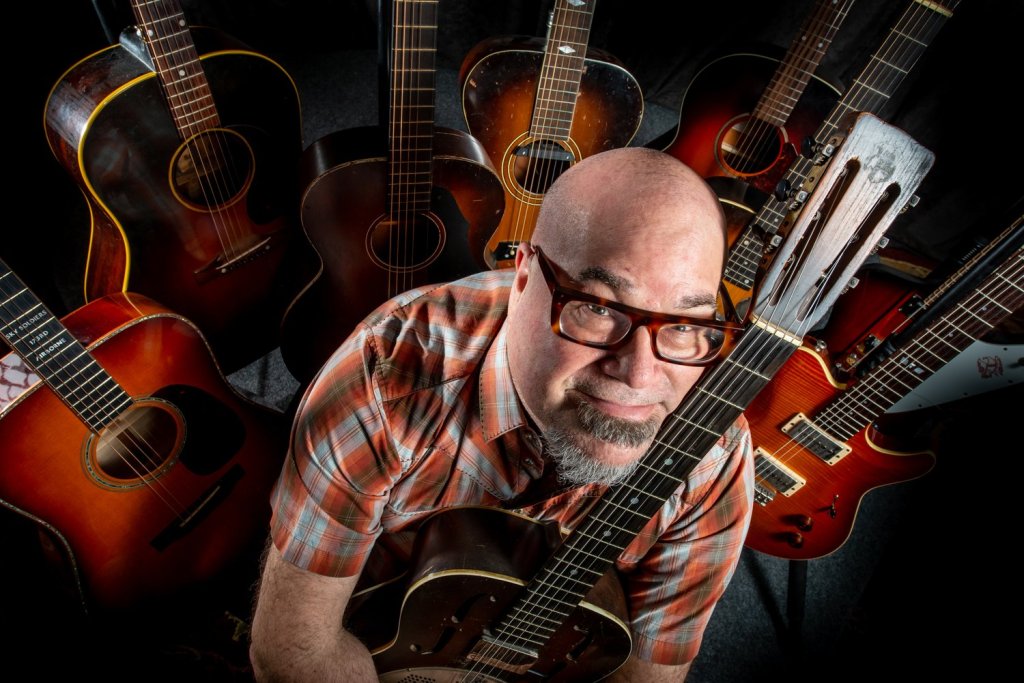
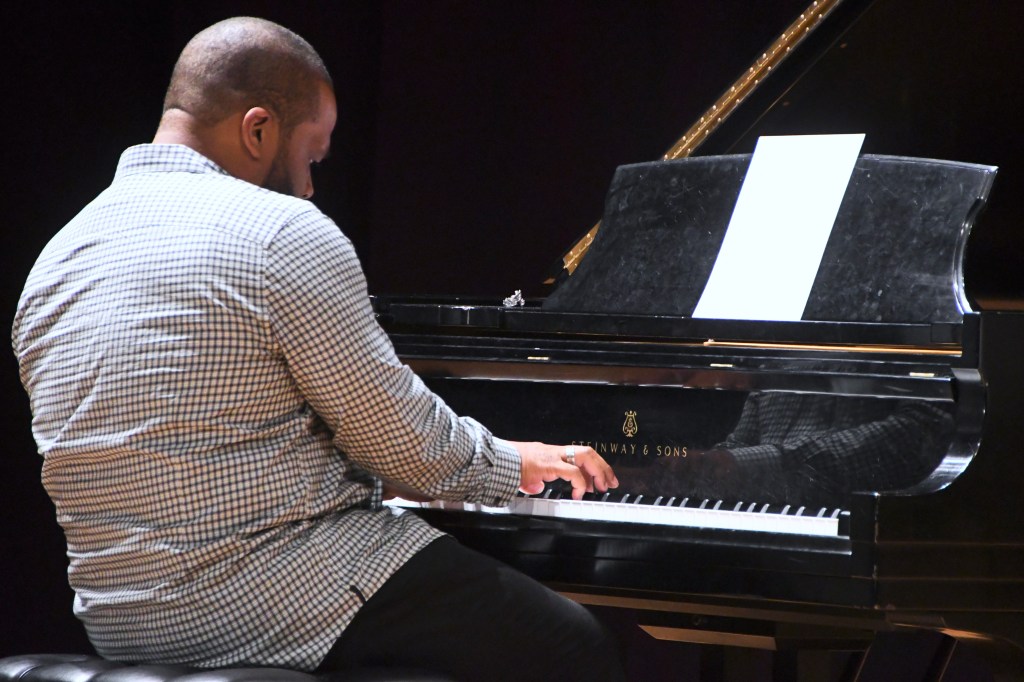
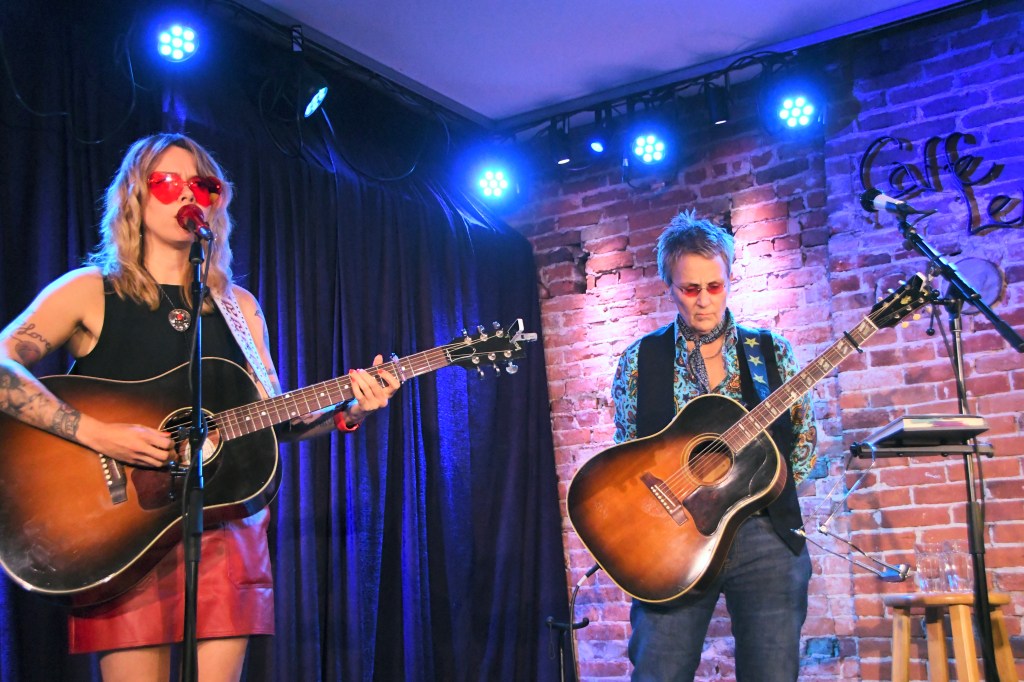
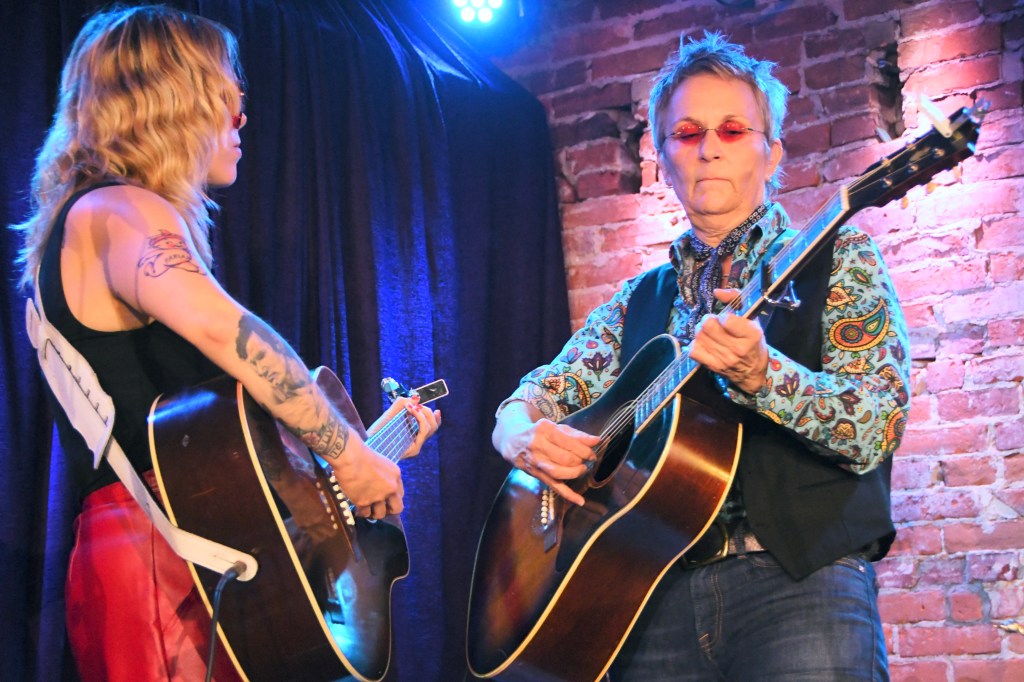
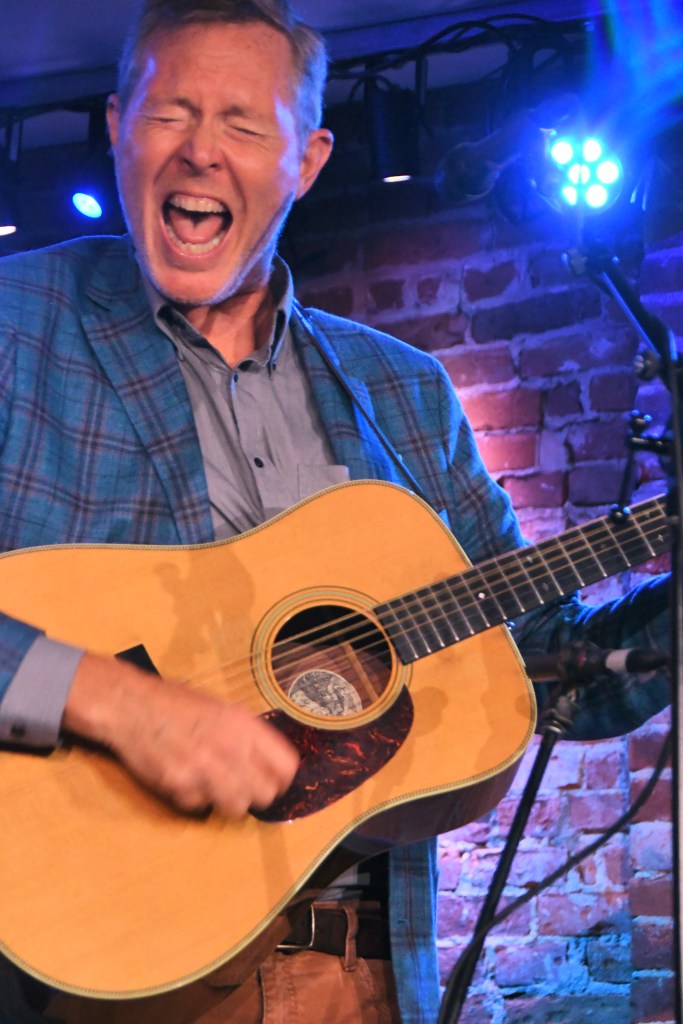
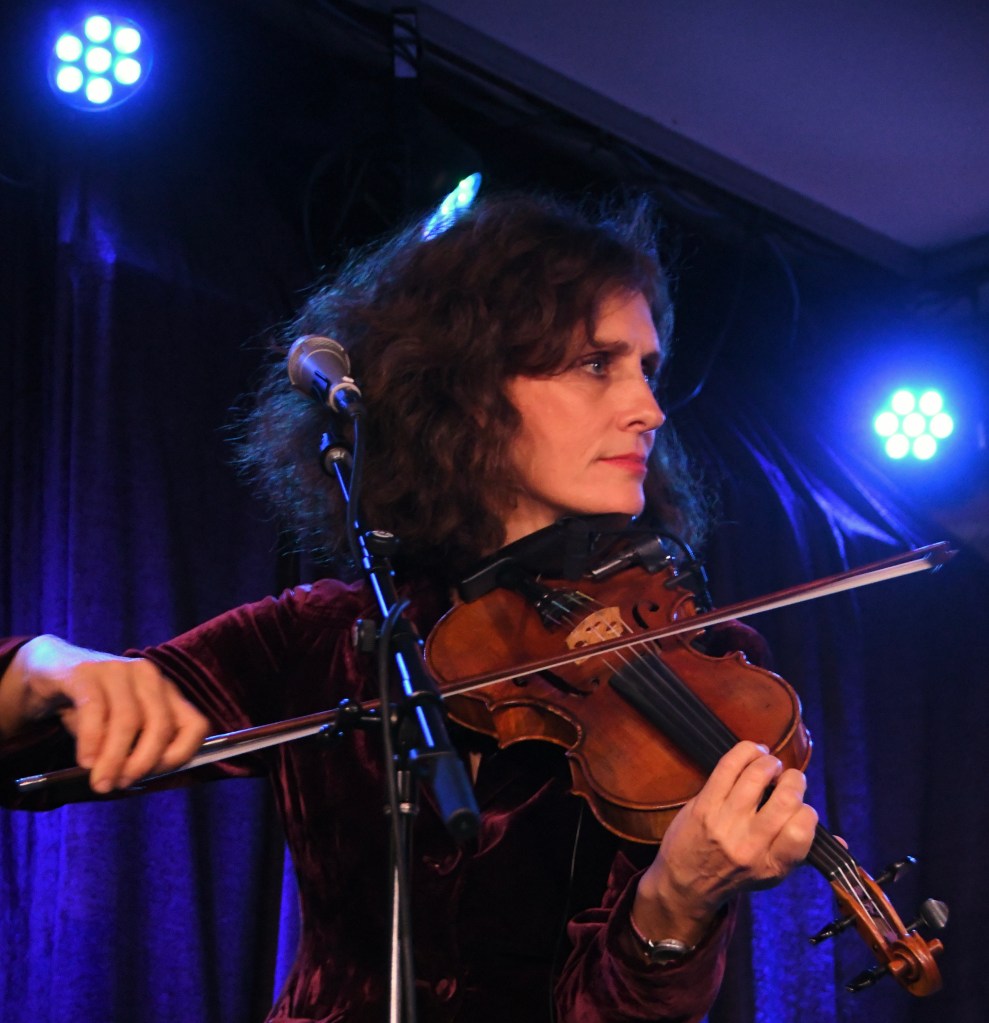
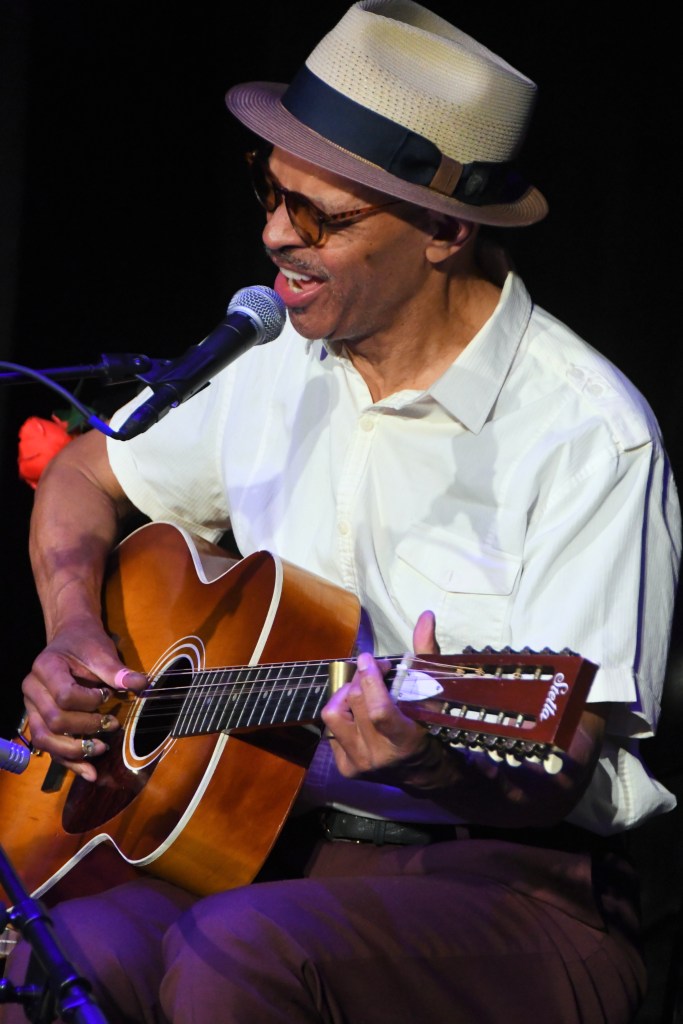
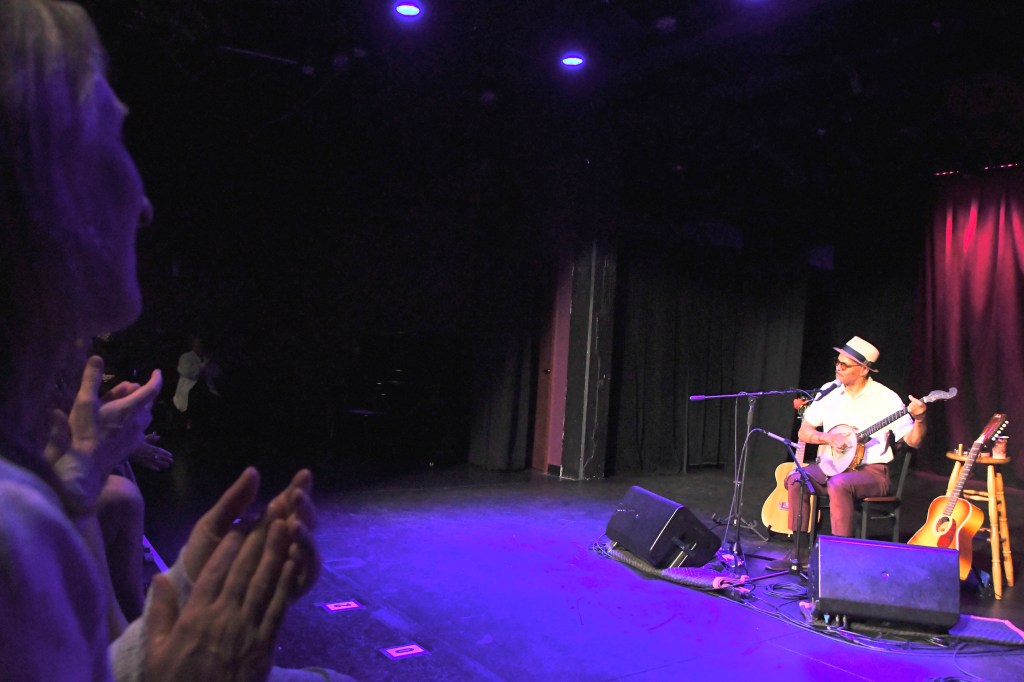
When master guitarist Matt Smith hits town, he hits with a big, rocking, joyous noise.
Raised here and a longtime star with top rockers Interstate and E.B. Jebb, the currently Austin-based picker, bandleader, songwriter, producer and teacher is, not surprisingly, a man with two bands.
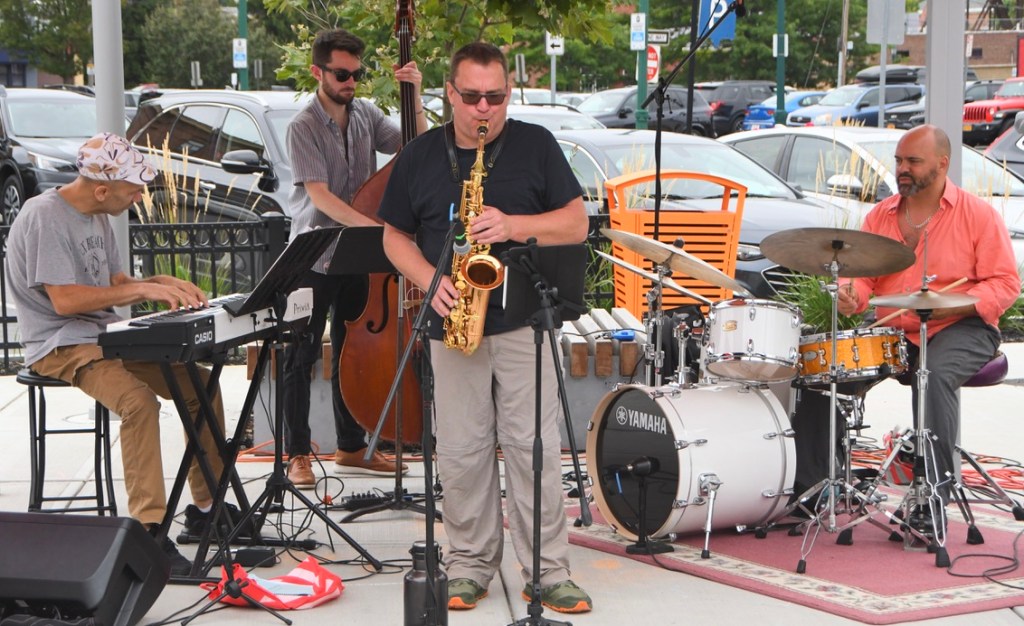
There’s the hometown crew he leads here this week: Thursday at Ophelia’s, Saturday at Putnam Place. (Details below) It’s fellow local heroes: Tony Perrino, keyboards; Chris Peck, bass; Pete Sweeney, drums; Brian Melick, percussion; and Charlie Tokarz, saxophone. The latter two are relatively new (since 1994); the others are longtime bandmates (since 1988).
Smith also leads an Austin band since he spends most of his time there these days, running the 6 String Ranch for recording, teaching, producing and running instructional clinics.
Both bands bear the name Matt Smith’s World, a musical geography easily spanned by Smith’s wide-ranging musical mind. Two bands: one fearless approach to personal but accessible music-making. Geography has never stopped Smith, who presents workshops in every U.S. music center, plus the UK and Germany.
Before his visit last year, Smith told me, “After spending 15 years in New York City and 14 years in Austin, the capital district is still my hometown. I have so many great friends here.” He’s earned them; his two most prominent blues-based but sometimes country-flavored rock bands Interstate and E.B. Jebb played everywhere here, and all the time.
Since Smith is working on his 20th album back in his Austin studio, he’s likely to pack new tunes in his shows here, following up on the strong recent efforts “Being Human” (2020) and “In The Light” (2023).
Matt Smith’s World plays Thursday, Oct. 3 at Ophelia’s (388 Broadway, Albany 518-587-3000 http://www.opheliasrocks.com) 8 p.m. $15; and Saturday, Oct. 5 at Putnam Place (63 Putnam St., Saratoga Springs 518-886-9585 http://www.putnamplace.com) 9 p.m. $10. That’s about what Interstate and E.B. Jebb used to charge. And for those who want to make a full pilgrimage of this Matt Smith Eastern run, head to the Bitter End Friday, in between those two local shows. The self proclaimed New York City’s Rock Club is in the Village, 147 Bleecker St. 212-673-7030 http://www.bitterend.com. 6:30 p.m. $15.
Deep tradition and high hopes meet onstage when the Van Dyck Music Club reopens October 5 in its “Jazz is Back” celebration starring many top area performers. Onstage its Michael Benedict (drums, vibes), Cliff Brucker (drums, piano, vibes), Kaitlyn Fay (vocals, baritone saxophone), David Gleason (keyboards), Mike Lawrence (bass), Chad McLaughlin (guitar), Chris Pasin (trumpet), Keith Pray (saxophones, organ), Awan Rashad and Lee Russo (saxophones).
For generations, “Van Dyck” has meant jazz; plus other musical styles, but mainly jazz.
Stella Pasta Bar & Bistro, 237 Union St., Schenectady, reopens the Van Dyck Music Club on its second floor with “Jazz is Back” on Saturday, Oct. 5. Times Union photo
“This is our first big music show upstairs here,” said owner Chris Sule. “The Van Dyck is ready to welcome live music back upstairs with open arms.”
When Sule’s Stella Pasta Bar bought the 237 Union Street building in 2022 from the McDonald family as Covid shuttered many eateries and clubs (including both Stella and the Van Dyck), Sule intended to resume live jazz events in the venerable landmark. Small jazz groups have played in the downstairs Stella Pasta Bar since it reopened. The larger upstairs music room remained dark and quiet – apart from a newly launched comedy series – after hosting both large regional bands and national acts drawing large audiences. It presented monthly shows by Keith Pray’s Big Soul Ensemble, for example.
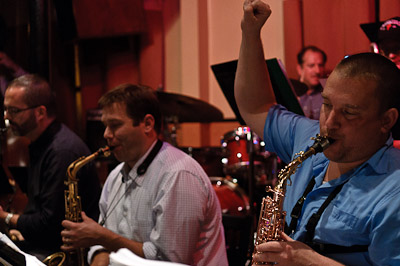
Keith Pray’s Big Soul Ensemble – Pray, with arm raised here, led his big band in monthly shows at the Van Dyck. Rudy Lu photo
“With his extensive history here, I’m so happy Keith is on the bill for ‘Jazz is Back,’” said Sule, noting Pray returns for the first time since the Big Soul Ensemble last played the room.
“After over a year of Saturday night jazz downstairs at Stella (dining room), this show is the kickoff for what feels like the natural next step for our music programming,” Sule added. He said, “We’re looking to launch our ‘Thursday Night Jazz’ program upstairs…later this fall,” plus holiday events and possibly karaoke.
Looking ahead, Sule said, “We’ve got an amazing show on November 2nd: The Brighton Beat,” thrilled to present the Afro-beat ensemble he saw at Troy’s No Fun. “I was absolutely blown away; one of the most high energy, wildly fun sets I’ve ever seen.” He noted, “Literally during the show, they mentioned how they wanted to play more here in the Capital Region, and I took that as a sign.”
“The October 5th show feels like it’s happening at the perfect time for where we are now.”
Sule is open to artist residencies and alliances with such supportive organizations as A Place for Jazz and said the once-dormant facility is ready. The first floor Stella Pasta Bar kitchen and Seven Points Brewery behind the main building will offer food and beverage service. On show nights the menu will likely be limited to appetizers and signature desserts, special cocktails and craft beer offerings.
The upstairs sound system has been cleaned and tuned while the malfunctioning lighting system was replaced and the new rig has worked well in early events. Nathan Schied who has operated sound systems at WAMC’s The Linda, Jazz on Jay and other venues will engineer the sound, following Ace Pankhurst and Pat Tessitore from the Olsen and McDonald eras. “We’re thrilled to have him here for our first big night at the Van Dyck Music Club,” said Sule.
“The October 5th show feels like it’s happening at the perfect time for where we are now.”
Show time for “Jazz is Back” is 7:30 p.m. at the Van Dyck (237 Union St., Schenectady’s Stockade Historic District). Doors at 6:30 p.m. $15 advance, $20 door. Reservations recommended.
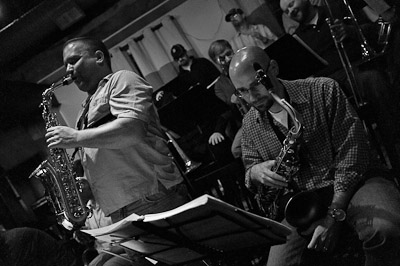
Keith Pray stands to blast an alto sax solo. Rudy Lu photo
A PLAYER’S NOTES – Keith Pray on the Van Dyck. Pray’s Big Soul Ensemble recently released “Wolf Song,” a powerful virtuoso album featuring many songs that became fan favorites in the band’s monthly Van Dyck shows.
Asked how it feels to be going back to the Van Dyck stage, the saxophonist, organist, composer, bandleader and teacher had this to say.
“The Van Dyck is such an important part of the history of jazz in the capital region. So many greats have played there throughout its long history. When I first moved to the area in the early 90’s, I started going there to hear music downstairs and began sitting in, getting my feet wet. Eventually, while living in NYC in the early 2000’s, I was asked to bring my own group which was a great feeling. Then of course my big band began playing there regularly for over 10 years. The upstairs venue is one of the last real listening spaces in the Capital Region, as far as clubs go; so it feels good to know it’s back in action and I am glad I can help it get started again.”
Of his colleagues onstage on Oct. 5, Pray was full of praise.
“I have always been aware of the strong local jazz scene and am honored to know so many great players in this area. What’s great is everyone has something different to offer, no one sounds alike. That was such an important aspect of jazz throughout its history. In todays jazz many players sound similar, but in the Capital Region we are lucky to have (so many) individual voices for such a small area.”
He explained how the Oct. 5 show will organize a stage-full of bandleaders and composers, as well as ace performers.
“For the show, the front line musicians (horns and vocals) picked a tune to be featured on and there will be at least a couple tunes that everyone plays on.”
For more on the Van Dyck’s storied musical history, see my 2022 Nippertown story.
The all-star all woman band Artemis plays Friday at A Place for Jazz, the night before the Van Dyck’s reopening. Artemis is founder-pianist Renee Rosnes, trumpeter Ingrid Jensen, saxophonist Nicole Glover, bassist Noriko Ueda and drummer Allison Miller; several also lead their own groups.
Since organizing in 2017, Artemis won Jazz Group of the Year in the 88th Downbeat magazine Reader’s Poll and released several successful albums. Show time is 7:30 p.m. in the Carl B. Taylor Auditorium of the SUNY Schenectady Community College Music department. $25, students $10. www.aplaceforjazz.org
A MODEST VAN DYCK PHOTO GALLERY
TEN BY TWO – NRBQ pianist Terry Adams, left, with Sun Ra Solar Arkestra saxophonist Marshall Allen, bassist Pete Toigo and NRBQ drummer Tom Ardolino (RIP) played the Van Dyck in 2004. Several of my photos from that show appear in the CD booklet for the original version of the Adams & Allen album “Ten By Two.” NRBQ also played the Van Dyck.
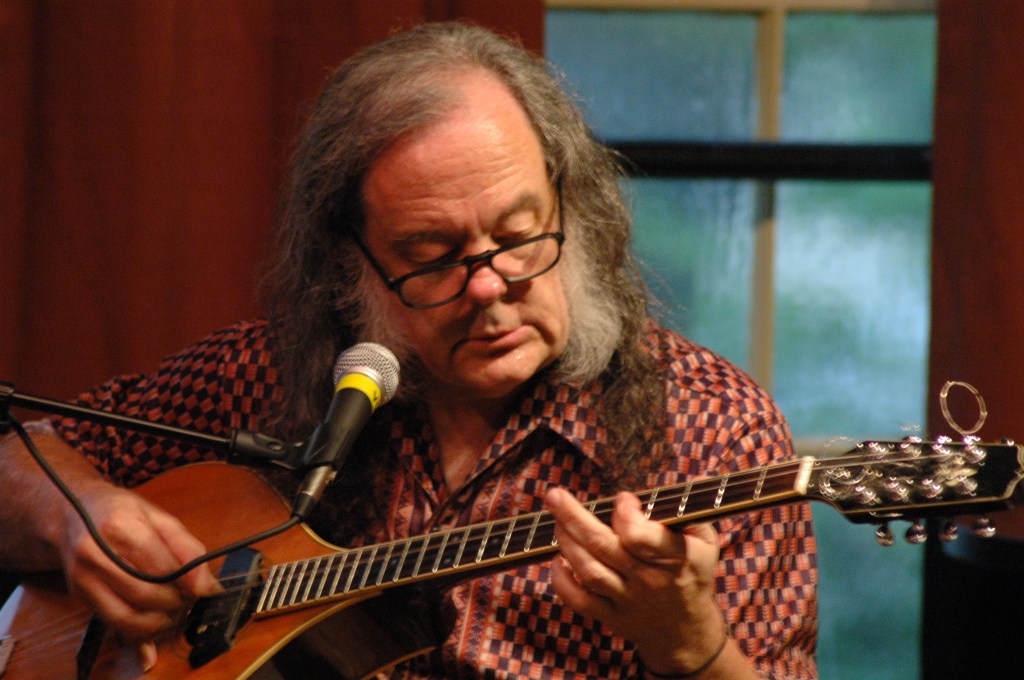
DAVID LINDLEY (RIP)– The longtime sideman with Jackson Browne and others – also leader of the vivid rock band El Rayo-X – Lindley played the Van Dyck in 2014. His stage full of of stringed things included this eight-stringed cittern.
BOBBY PREVITE – The drummer, center in this photo, played the Van Dyck with area stars, from left, Rob Lindquist, piano; Bobby Kendall, bass; Alex Slomka, trombone; and Keith Pray, alto saxophone.
Any writer-for-publication appreciates how engaged readers write back to us with comments and even corrections – though we might wish corrections were necessary less often.
Jazz fans may be among the most passionate and best-informed of any cultural community; and therefore the most likely to dialog – as when my review of the Warren Wolf/Joe Locke show last Friday at A Place for Jazz got some things wrong.
Among the several who reached out to me, one corrected the venue where Wolf and Locke participated in a vibes summit, and filled in some song title blanks. This knowledgeable, astute fan and reader pointed out, “I am pretty sure they said they played at the Detroit Jazz Festival.” (I thought it was Chicago.) “Also, the tune starting the second set I believe was ‘Whisper Not’ by Benny Golson” (who died at 95, the day after the A Place for Jazz show); and went on to say, “Can’t swear to when ‘Whisper Not’ was played. They also did a great version of ‘Just in Time.’”
Other readers noted an early version of my post got wrong a Hoagy Carmichael song title: It was “Slylark.”
Thanks for this, and keep those cards, letters and emails coming!
Also, the next show at A Place for Jazz is the all-woman all-star crew Artemis on October 4.
And, the next night, just a few blocks away, the Van Dyck Music Club reopens in the second floor of what’s now Stella Pasta Bar, presenting an all-star band of local heroes. More to come on this, but for now, we know the line-up: Michael Benedict (vibes or drums), Cliff Brucker (vibes, drums or piano), Kaitlyn Fay (vocals or baritone saxophone), David Gleason (keyboards), Mike Lawrence (bass), Chad McLoughlin (guitar), Chris Pasin (trumpet), Keith Pray (saxophones or organ), Awan Rashad (saxophones), and Lee Russo (saxophones). Hosts: Bill McCann (WCDB, A Place for Jazz president) and Tim Coakley (WAMC).
In a sunsplashed mobile, multi-venue version of the jazz-club feel that warmed A Place for Jazz Friday, Porchfest 2 on Saturday couldn’t have been more pleasant – and not just because the weather sparkled (unlike last year) and I could report it all on foot.
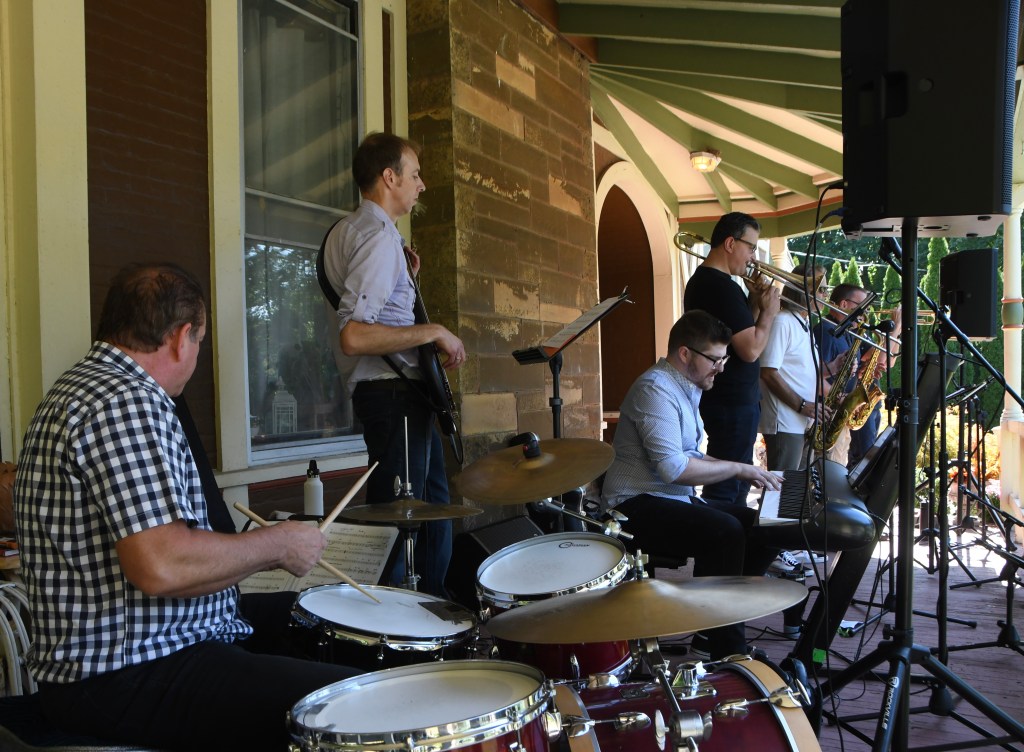
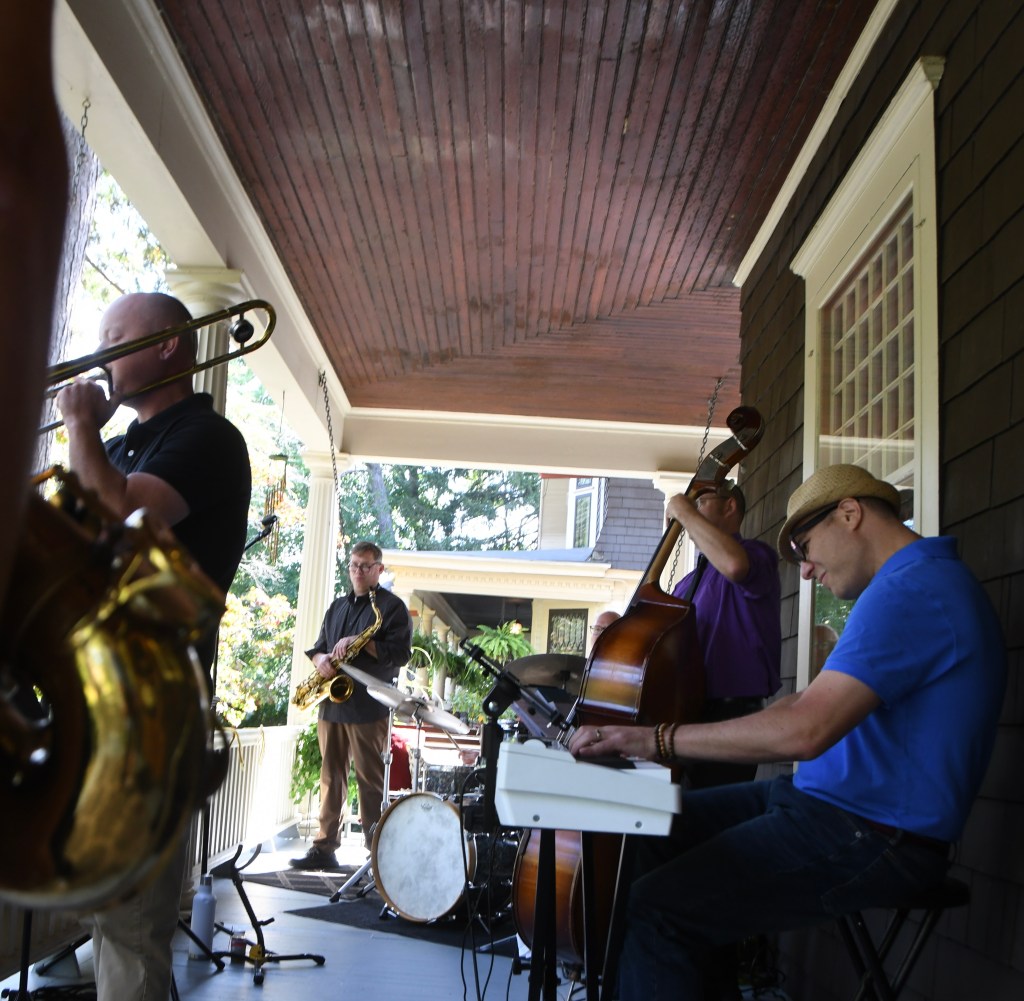
Kevin Carey Group at 1226 Wendell Ave.: Bob Halek, drums; Dave Shoudy, bass; Kevin Carey, drums; Phil Pandori, trombone; Eric Walentowicz, tenor saxophone; Keith Pray, alto saxophone; Jon Bronk, trumpet
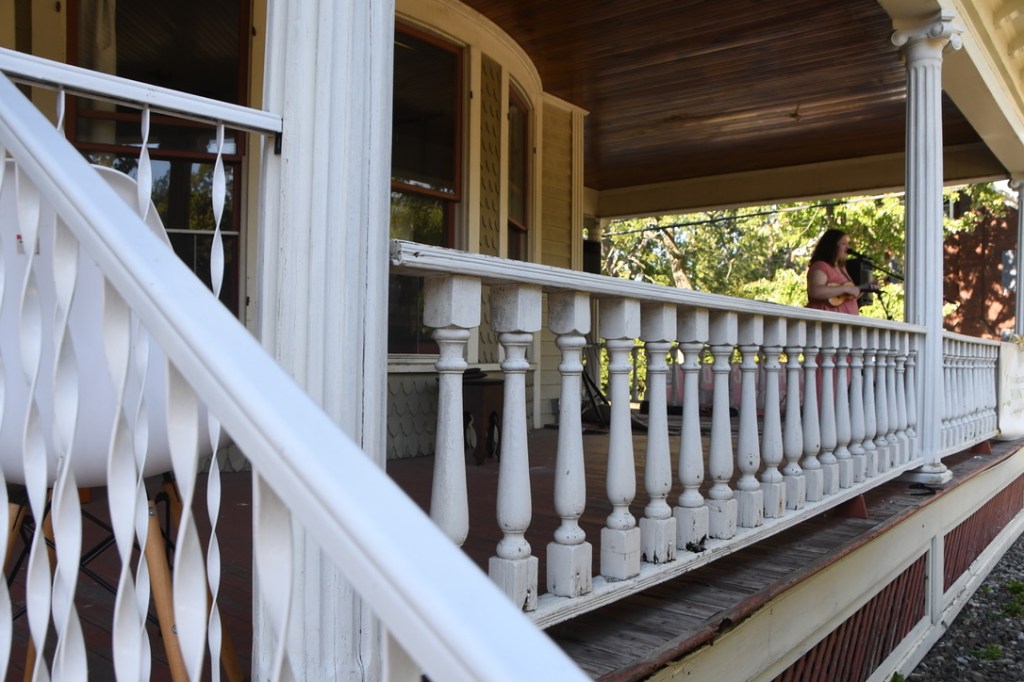
The eight (of 14) acts I caught on five (of six) porches Saturday included mainly jazz bands, but also brass ensembles and a troubadour singing solo with a ukulele.
Porchfest artists rewarded the tough choices any multi-stage event requires, whether fans chose known artists, expecting to enjoy the familiar; or gambled on unfamiliar performers hoping for surprises.
Dadtet: Brian Patneaude’s tenor saxophone; Ben O’Shea, trombone; Dave Fisk, tenor saxophone; drummer Andy Hearn’s face and eyeglasses; Mike Lawrence, bass; and David Gleason
Walking to 1204 Rugby Rd., I first enjoyed one of several jazz crews that could have played under the “Usual Suspects” moniker, starting at noon. WAMC jazz DJ Tim Coakley introduced the Dadtet – all fathers, most teachers: David Gleason, piano; Brian Patneaude and Dave Fisk, saxophones; Andy Hearn, drums; Mike Lawrence, bass (one of his three gigs Saturday); and Ben O’Shea, trombone. They swung easy, guided perhaps by the title of their first tune, “Step Lightly,” in the confident way these veteran players always do, in whatever configuration they combine forces.
Dadtet: Andy Hearn, drums; Mike Lawrence, bass (obscured by pillar), saxophonists Dave Fisk and Brian Patneaude; keyboardist David Gleason (obscured behind Patneaude) and trombonist Ben O’Shea
Walking east on Rugby to the corner with Ardsley, I found the Dominant 5 Brass Quintet enjoying their way through the Beatles’ “When I’m 64,” then a medley of NPR themes and jingles – like a classical recital with conservatory chops and a sense of humor.
Dominant 5 Brass Quintet at Ardsley and Rugby Rds.
Furthest geographically from Rugby/Ardsley, at 7 Douglas Rd., the almost identically configured Brass Abbey applied a similar attack to TV themes before Duke Ellington’s “Caravan.” This was the opposite of de-construction: they CON-structed often unexpected flourishes and fine-tuned improvisations onto familiar fare. A tuba part, for example, arguably improved “The Addams Family” theme, and “Caravan” seldom gets busier than these cats honked it.
Brass Abbey at 7 Douglas Rd.
Between those two brass bands at opposite ends of Porchfest, time-wise as well as geographically, Kaitlyn Fay sang with her Quartet at 1183 Stratford Rd. The first of drummer Cliff Brucker’s gigs, with bassist Dave Shoudy and pianist Wayne Hawkins, this found Fay in an exploratory mood unlike artists who relied on favorites. Between the swing classic “Day By Day” and a bouncy “Señor Blues,” she introduced her own lyrics to Milt Jackson’s “3000 Miles.” After “Blues,” she uncorked “The Love In Your Eyes,” a collaboration with keyboardist David Gleason to whom she supplied words and assigned “Make it music.” He did: it’s a winner.
Kaitlyn Fay sings at 1183 Stratford Rd.
Kaitlyn Fay Quartet, from left: Wayne Hawkins, piano; Dave Shoudy, bass; Cliff Brucker, drums; and Kaitlyn Fay, vocals
7 Douglas Rd.
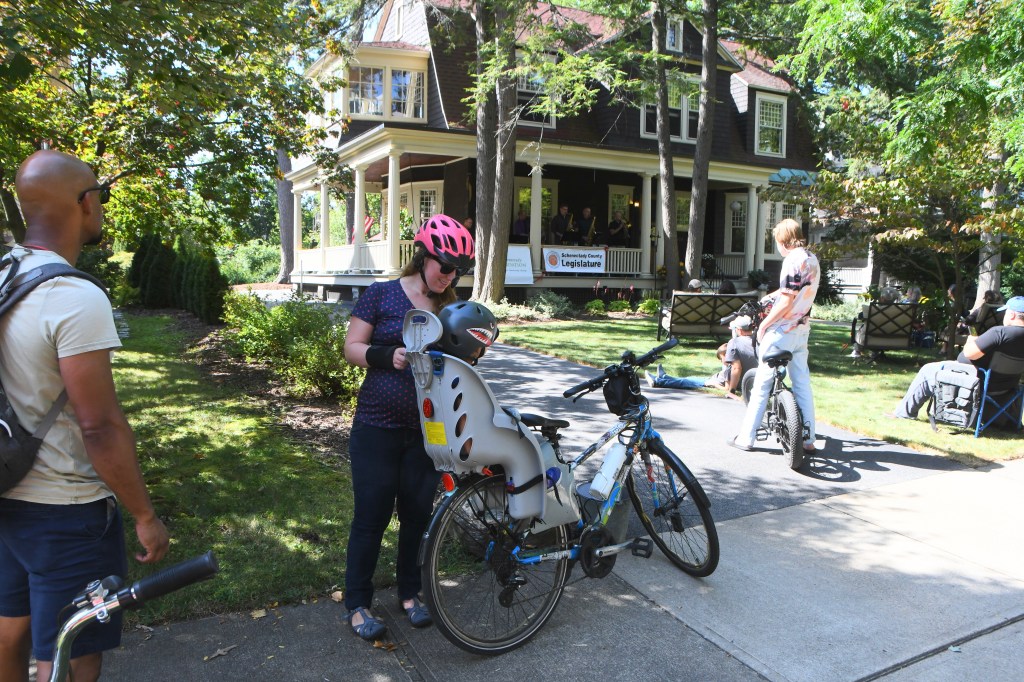
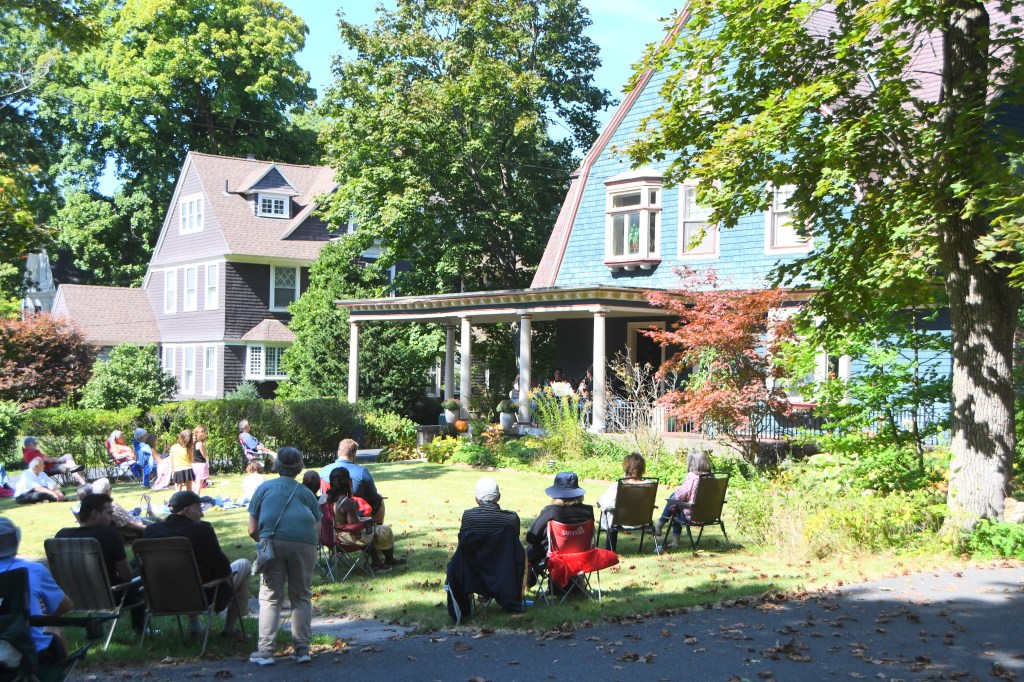
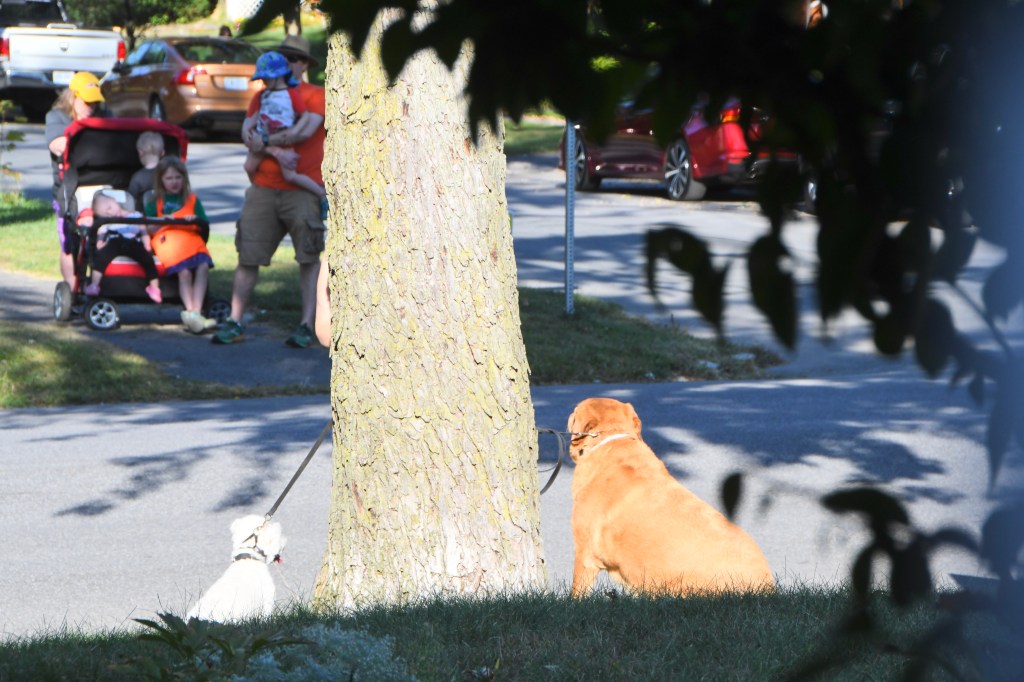
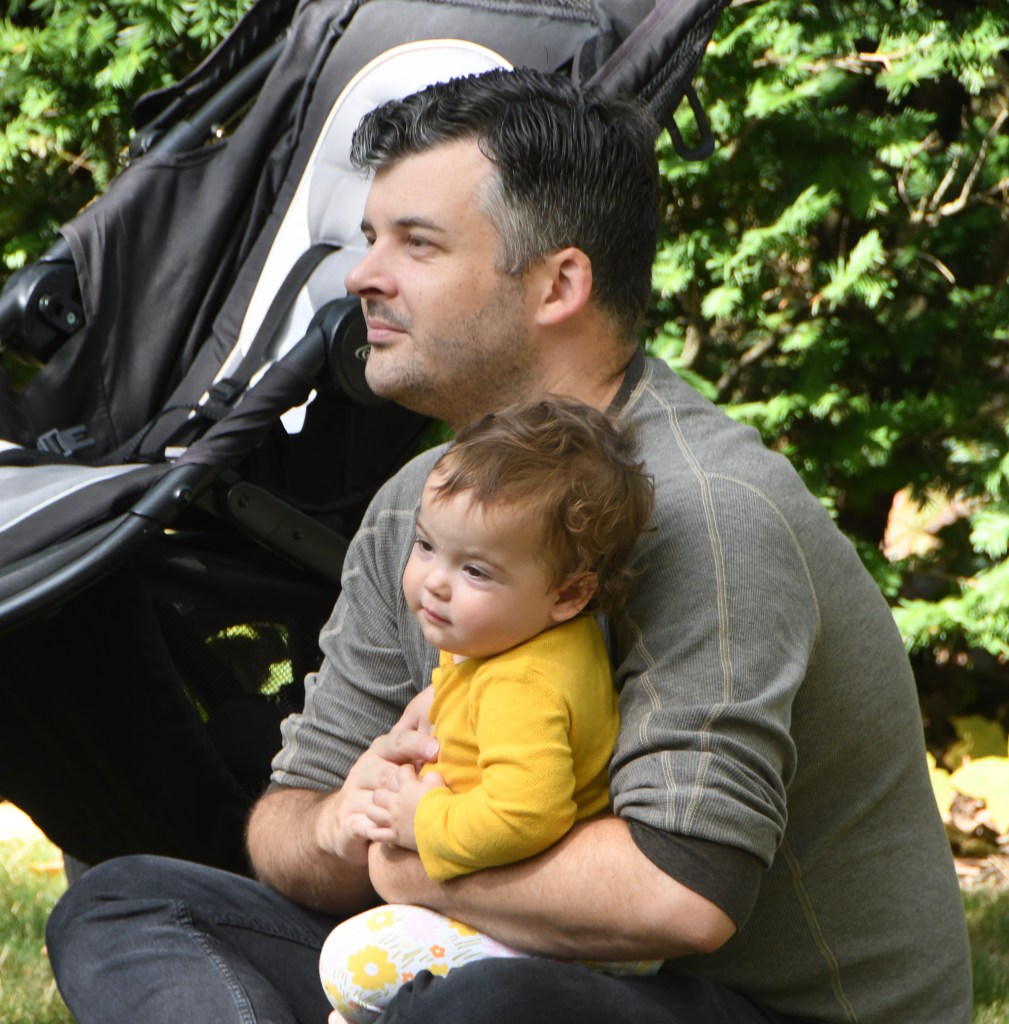
Seeking shade, fans set up their lawn chairs across Stratford and, like last year, made nice in all directions, introducing their children to neighbors’ offspring; also their dogs. Porch hosts set out chairs, even sun umbrellas, for guests. Enterprising neighbors not hosting music got into the welcoming spirit with lawn sales or donations signed FREE STUFF, while a church on Rugby offered free lemonade, coffee, restroom access and scripture.
1226 Wendell Ave.
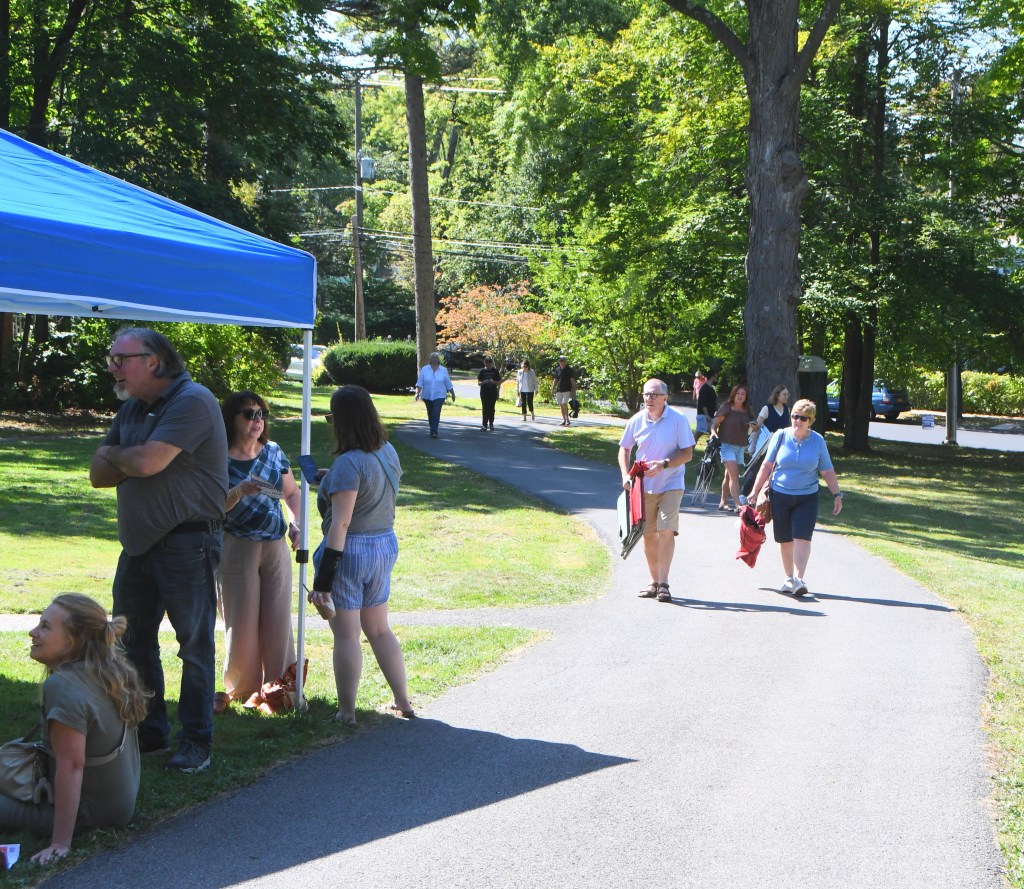
From Fay’s quartet gig on Stratford, the Kevin Carey Group played around the corner at 1226 Wendell, a new venue this year. I missed the Epilogue chamber-jazz trio there Saturday, although I’d enjoyed them last year. Wendell was the biggest lawn and Carey’s was the biggest band: two saxophones, trumpet, trombone, piano (Carey), bass (Shoudy, in his second of three shows) and drums. Fans flowed in from other porches, seeking shade under both tall trees and a blue pop-up tent. The all-star septet exploded with Monk’s “I Mean You,” then shifted into Carey originals “Easy and Blue” (well-named) and others. Each showcased strong section playing and aggressive soloing, especially by Keith Pray, alto; Eric Walentowicz, tenor; drummer Bob Halek and Carey himself.
Kevin Carey Group at 1226 Wendell Ave., from left: Carey, Phil Pandori, trombone; Eric Walentowicz, tenor saxophone; Keith Pray, alto saxophone; Jon Bronk, trumpet
Cliff Brucker’s New Circle at 1204 Rugby Rd., from left: Brucker, drums; Rich Mullins, bass; Kevin Barcomb, tenor saxophone; Pete Levin, piano; Chris Pasin, trumpet
Catching Cliff Brucker’s New Circle on Rugby meant leaving Carey’s gig early, a tough push-pull that felt better as their “On Green Dolphin Street” tugged me around the corner. New Circle means players change: Saturday’s crew was Brucker, drums; sometime members Chris Pasin, trumpet; Kevin Barcomb, tenor saxophone; and Pete Levin, keyboards; plus newcomer Rich Mullins, bass. No rough edges marred “On Green Dolphin Street,” however; nor Pasin’s New Orleans-funky tribute to the Meters, “Meter Made.”
Cliff Brucker’s New Circle, from left: Brucker, Mullins, Barcomb; obscured; Pete Levin and Chris Pasin
Chad McLoughlin Trio at 1183 Stratford Rd., from left: Dave Shoudy, bass; McLoughlin, guitar; Cliff Brucker, drums
Afterward, Brucker bundled up his sticks and walked around the corner to Stratford where the kit he’d played with Fay awaited, plus guitarist Chad McLoughlin and bassist Dave Shoudy who’d also played there with Fay, then with Carey on Wendell. They started mellow with McLoughlin’s original shuffle “No One’s Blues,” but lightning guitar runs erupted from its gentle swing. “Stella By Starlight” flew faster than most play it, as did “Sunny” which McLoughlin played in tribute to Pat Martino. Brucker came forward to assure fans the guitarist actually played slowly on occasion. Sure enough, McLoughlin’s mellow “High Bridge Waltz” ambled through a graceful melody before caffeinated explorations bumped the energy.
Angelina Valente at Ardsley Rd., corner with Rugby Rd.
No contrast all day felt so stark as that between McLoughlin’s trio and troubadour Angelina Valente, one of two Porchfest closers. Her solo set on Ardsley was my choice over Mike Benedict’s Jazz Vibes (featuring three-set iron man Mike Lawrence) since I saw Benedict’s band recently, but I hadn’t heard Valente since the Eddies in April when she and I both won.
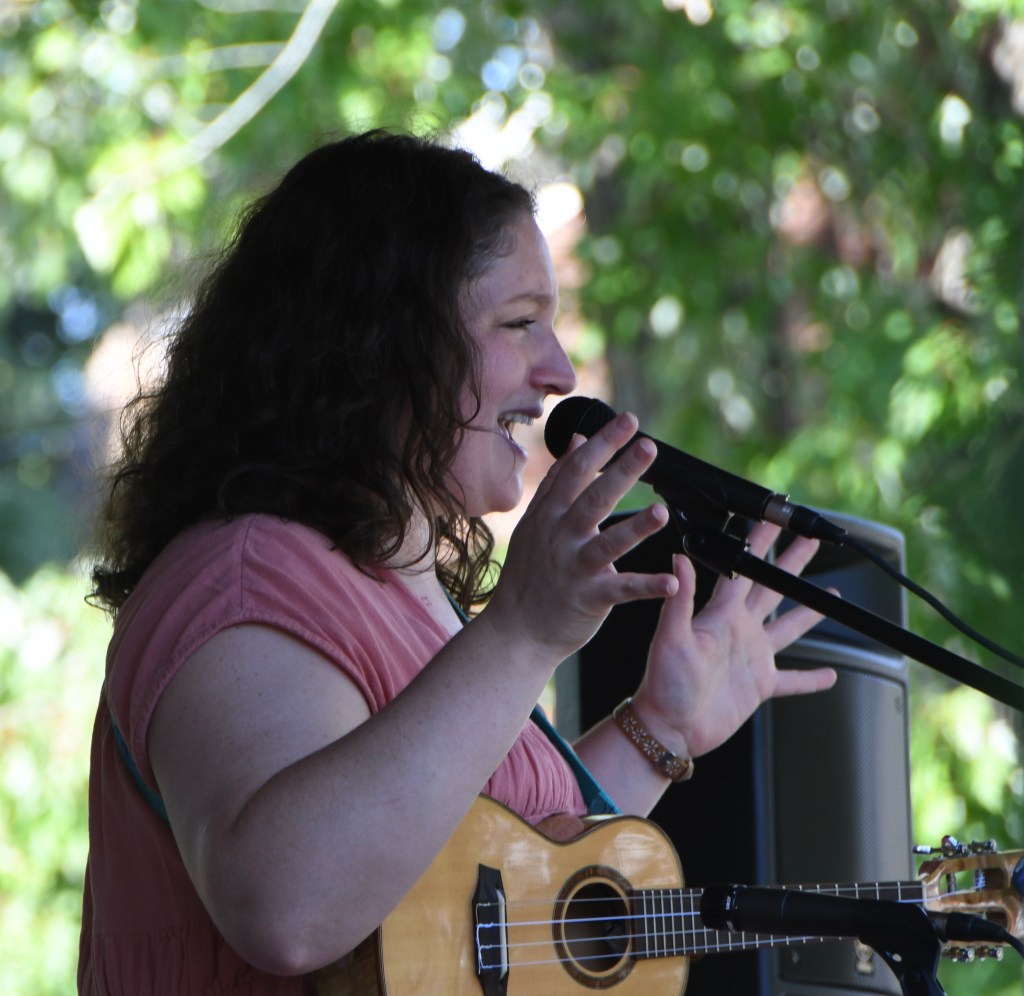
Her high, expressive voice soared over the loudest traffic noise anywhere at Porchfest. Late in her set, she noted an Amazon delivery van’s back-up-beeps were in the same key as her voice and ukulele. She sang all originals, all candidly personal and all strongly effecting, turning life lessons and challenges into hopeful messages. Crowds had dwindled as Porchfest neared its five p.m. end; and Benedict’s Jazz Vibes three blocks west on Rugby is among the more popular area jazz groups. Nonetheless, Valente enlisted fans in singalongs for “Take Me Back” and “Light,” both uplifting in calmly supportive ways. So was her hopeful closer, “Charting A Course” after the confiding waltz “Protect Your Heart.”
On that same porch, just before Valente, came Porchfest’s most powerfully poignant moment. Nice Hockey bassist Chad Rogers came down with COVID Saturday morning, but I heard later that he managed to play anyway. He set up his bass inside the house with his amp outside where his bandmates played on the porch, his porch. Informal Sunday morning acoustic jams on that same porch during COVID provided the idea for Porchfest, with its wonderfully generous idea of giving away music to anybody who wanted to come hear it.
People drove, bicycled, skate-boarded, pushed strollers and walked from porch-stage to porch-stage – a (many-) block party.
I also missed the Oneida Middle School Guitar Club; fans’ videos showed teens shredding Black Sabbath and Nirvana nice and loud, with their teachers in support. And my only sense of Backyard Brass was spotting its trumpeter and Porchfest organizer Steve Weisse in the band’s trademark lederhosen and Tyrolean hat as he buzzed around paying the musicians with funds he’d secured through grants. Hats off, a squeeze of the sunscreen tube and a toast with a cold one to Weisse, the funders, the porch-hosts and especially the musicians and fans of Porchfest 2.
Street scene: Dogs in charge, Rugby and Ardsley Rds.
Fans fan out on 1226 Wendell Ave. lawn
Keith Pray, alto saxophone, with Kevin Carey Group at 1226 Wendell Ave.
To give fun, musicians first have to feel it themselves. Friday at A Place for Jazz at SUNY Schenectady, the Warren Wolf/Joe Locke Quartet delivered epic fun in a thrilling show. They played classic songs with a joyful immediate enthusiasm – engaging, electric, deliriously dynamic. They were so loose they freelanced their second tune, falling into “Up Jumped Spring” to virtuoso perfection despite not having planned or rehearsed it at all.
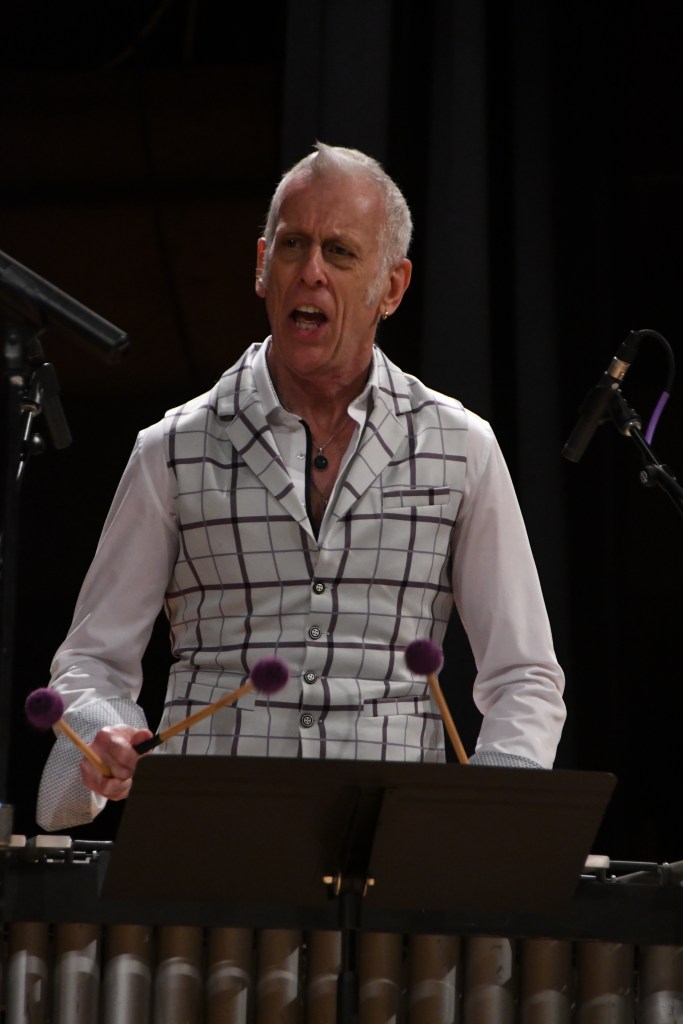
That followed a propulsive cohesive “Hot House” as opener, both Wolf and Locke playing vibraphones arranged in a V, facing each other with the open side toward the audience and drummer Eric Kennedy and bassist Blake Meister behind them.
From left, Warren Wolf, Blake Meister, Eric Kennedy, and Joe Jocke
They played in this configuration much of the two-set show, but tried on other formats in what felt free and spontaneous. For “Up Jumped Spring,” for example, Wolf went to the piano and locked as tight into its waltz-y swing as Locke, across the stage. Things turned thoughtful, softspoken in Carla Bley’s “Lawns;” Locke launching this meditative number in the trio before Wolfe jumped in.
Wolf soloed mostly with two mallets but accompanied Locke’s solos with four mallets, which was Locke’s approach throughout. They’ve played together enough – including in a four-vibes group at the recent Chicago Jazz Festival – that they’re closely intuitive; so were Kennedy and Meister Friday. That thinking-together closeness allowed for an effortless swing. They clearly loved making things up as they went along. Yet the sturdy classic songs they chose held their basic contours while evolving constantly, like a forest on a familiar hillside, with shifting tree shapes flickering in the breeze.
The thing was seriously beautiful, the bright mercury shimmer of two vibraphones up front – or the Modern Jazz Quartet configuration of vibes, piano, bass and drums – while Meister’s bass made gorgeous tones and Kennedy employed cymbals so subtly that all that shiny treble sound never felt oppressive.
The shape-shifting – they could have called their thing the Wolf/Locke Musical Chairs Quartet – increased throughout, imparting surprise and showcasing unexpected skills, combinations and arrangement possibilities.
After the three opening ensemble numbers, Locke spoke reverently of Billy Strayhorn to introduce “Lush Life” as an unaccompanied solo, lovely and lyrical. At one point he struck a note and created vibrato not in the usual way with the pedal below but by holding his mouth low over the bar and opening and closing it to shape the reverberant air.
Meister got one of his rare solos in a high-flying number I didn’t recognize; fortunately Don Nania came by to identify “Firm Roots” – an all-in blast of roller coaster energy: Gravity? What gravity!?
They seemed to pocket its gleeful glide as they left the stage, then tugged it out again on return and let it fly.
I should have sought Nania out to name-that-tune after intermission, a swaggering bop number that perfectly set up “Maiden Voyage” with Wolf at the piano, until he swapped with Locke. This got deliciously loose, Locke falling into Miles’s immortal “So What” riff at the vibes after re-swapping, accompanying Wolfe’s piano exploration with emphatic drive.
A gorgeous one-two of “Chelsea Bridge” and “Naima” brought more migration/mutation as the players moved around freely. Meister went to the piano, Wolf stayed on the vibes until Locke smilingly gestured to him to go play bass instead. Laughs all around, but Wolf kept the pulse as strong on four strings as on 88 keys or 37 metal bars of the vibraphone.
This ever-changing stuff was never just tricks for tricks sake; this was ace music-making by thought-sharing virtuosos having and giving a wonderful time.
In one of the biggest surprises all night, Kennedy sang “Skylark” – first drawing amazed gasps, then inviting everybody inside its lyric and sentiment as if into a sumptuous easy chair. It felt like he’d handed us all a cocktail.
Even in things that might have been obvious in other hands, things felt fresh. I mean, a two-vibes quartet playing (vibes-master) Milt “Bags” Jackson’s “Bags Groove” – who wouldn’t have expected that? This was cliche free, reshaped by fresh imagination and pure joy.
The quartet didn’t need much standing ovation support to come back to encore big with “Bud Powell.”
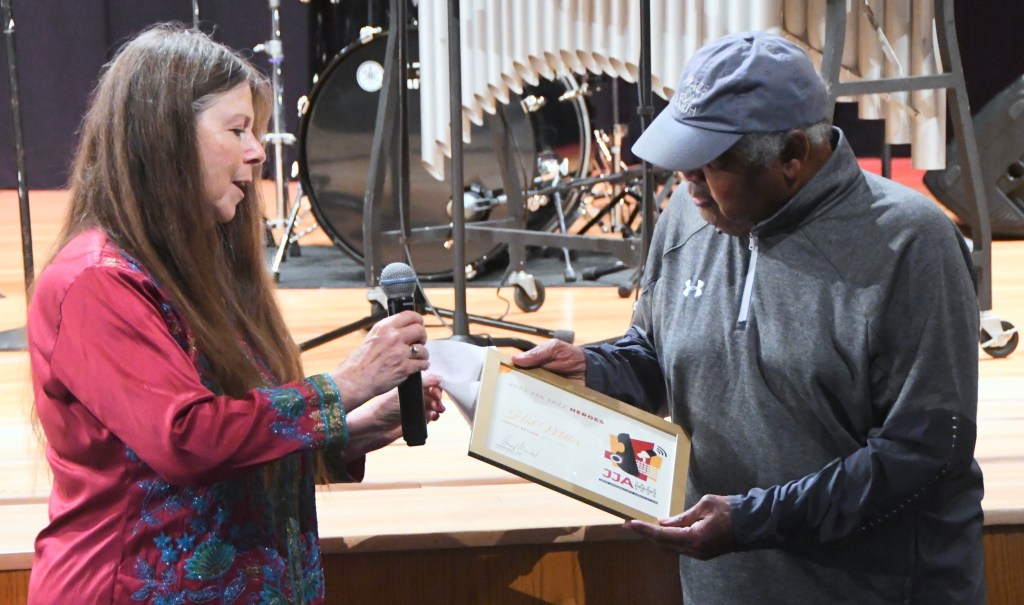
Susan Brink and Hal Miller
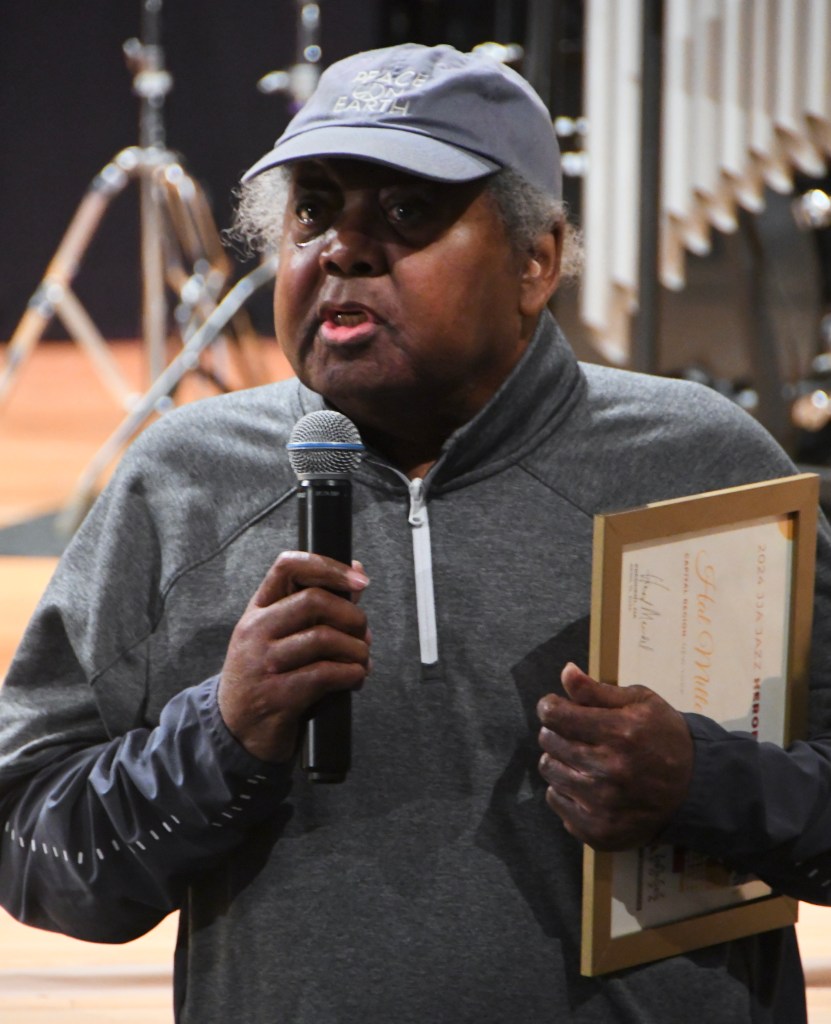
Before the show, Susan Brink of the Jazz Journalists Association presented the association’s Jazz Hero award to Hal Miller, the Albany jazz drummer, super-fan, teacher and video archivist. He celebrated his jazz-rich New York childhood and spoke of seeing the greats there. And he embraced his fellow fans in a community – “the chosen ones,” he called us; “because we know.”
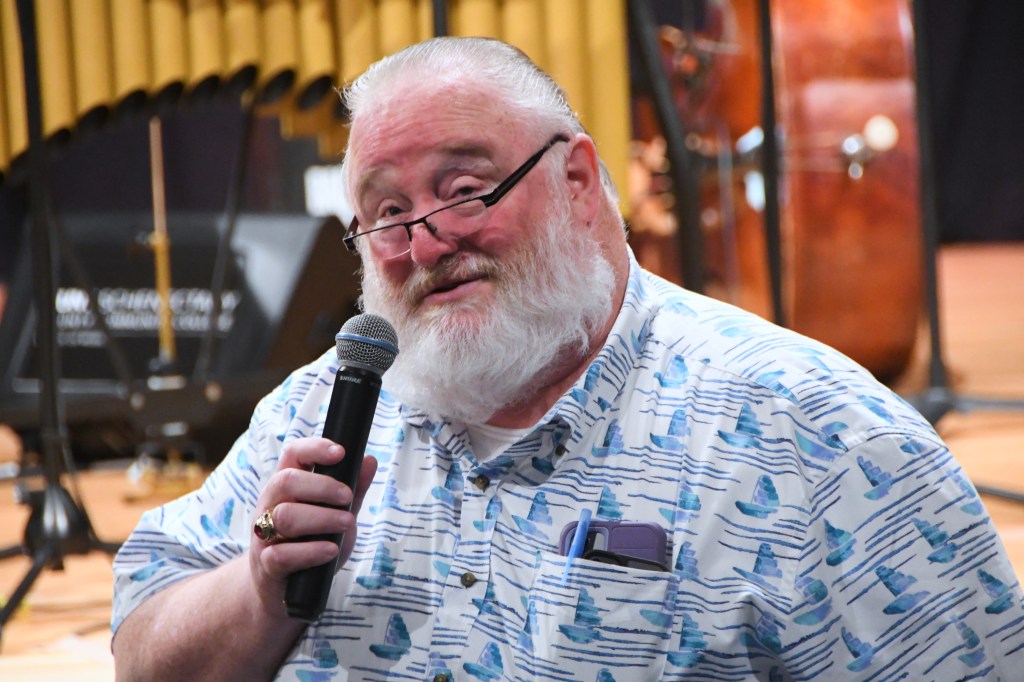
At intermission, AP4J President Bill McCann spotted me lurking near the stage with camera and notebook and invited me to say a few words about this blog. I have no idea what I said, but hope I gave the URL correctly and feel seriously grateful to Maestro McCann for that shout-out deluxe.
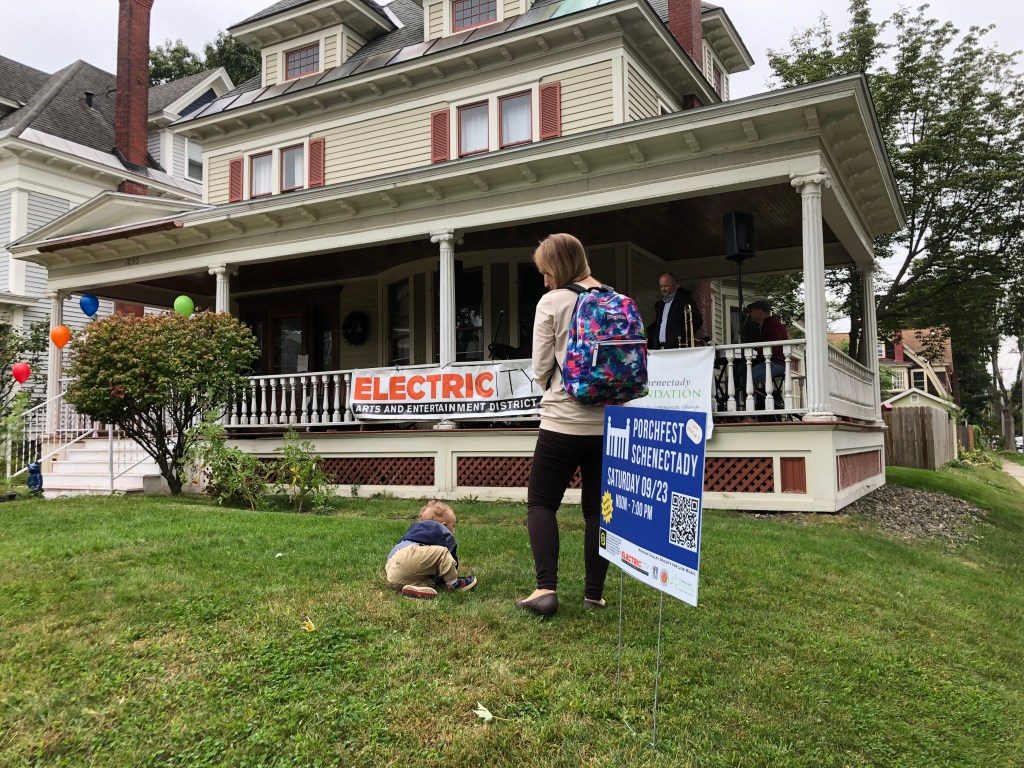
Signs on porches and fences across Schenectady’s north side proclaim the second PorchFest hits on Saturday: 14 acts playing on six porches in and around the GE Plot.
Last year’s inaugural fest was mobile musical fun despite intermittent light rain.
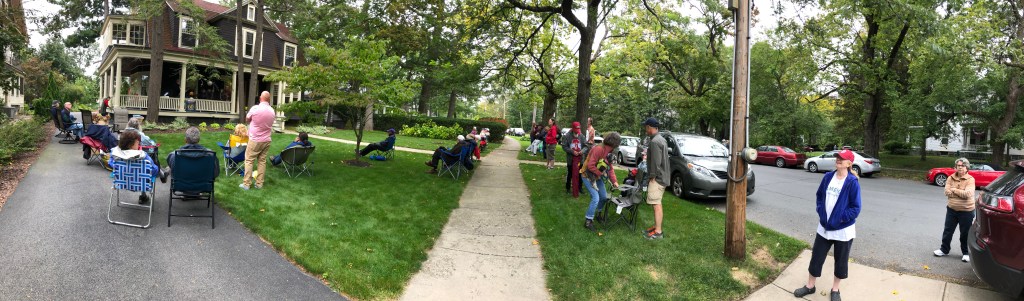
2023 Panorama view on Rugby Road
Like last year, It’s mostly jazz and enticingly local, both in its regional music-makers and convenient, compact locations. I live only about a mile from the most distant of those porches – some owned by friends – and plan to migrate from porch to porch and band to band.
PorchFest presents some tough choices between simultaneous sets. Last year, I clocked 11,000-plus steps trying to see some of everybody. Fortunately, however, fewer sets overlap this Saturday than last year.
From 2023: Cliff Brucker’s New Circle in the groove on Rugby Road; from left: Wayne Hawkins; piano; Don Nicholson (behind pillar, mostly), trombone; Brucker, drums; Rich Syracuse, bass; Chris Pasin, trumpet
Busy bassist Mike Lawrence will play, as he posted on Facebook, “with the Dadtet at noon, OMS guitar club students at 3pm and Mike Benedict’s Jazz Vibes at 4pm.” He messaged me a few days ago about the Oneida Middle School Guitar Club: “We’ll have 8th and 9th graders playing ‘Iron Man’ and ‘Smells Like Teen Spirit.’ I know there’s a lot of great music that day!”
Indeed – Let’s look at the porches.
1204 Rugby Rd.
12 – 12:45 p.m. Dadtet
2 – 2:45 p.m. Cliff Brucker & New Circle
3 – 3:30 p.m. Oneida Middle School Guitar Club
4 – 4:45 p.m. Mike Benedict Jazz Vibes
1183 Stratford Rd.
1 – 1:45 p.m. Kaitlyn Fay Quartet
3 – 3:45 p.m. Chad McLoughlin Trio
1226 Wendell Ave.
12 – 12:45 p.m. Epilogue Trio
2 – 2:45 p.m. Kevin Carey Group
1050 Avon Rd.
11:30 a.m. – 12 p.m. Backyard Brass
7 Douglas Rd.
1 – 1:45 p.m. Brass Abbey
3 – 3:45 p.m. Hansbrough-Quigley Flute and Guitar Duo
1095 Ardsley Rd.
12 – 12:45 p.m. Dominant 5 Brass Quintet
2 – 2:45 p.m. Nice Hockey
4 – 4:45 p.m. Angelina Valente
Food service is by the Broken Inn and 518 Wood Fired.
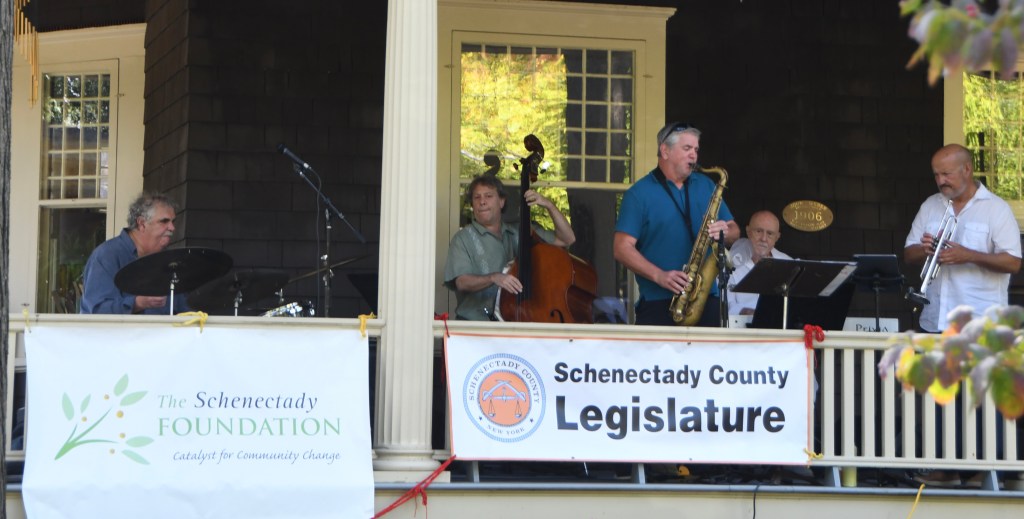
In addition to the hosts/porch owners, sponsors include the New York State Council on the Arts, the Arts Center of the Capital Region, Mohawk Valley Society for Live Music, Electricity Arts and Entertainment District, American Federation of Music, Schenectady County and the Schenectady Foundation.
Last year, it went like this. (There’s more, but these are my general comments.)
“The music invited neighbors and visitors to listen, walk around and talk, and likely made visitors covet homes in the comfy, well-treed GE Plot that hosted the fest. Any event that makes us feel better about neighbors and neighborhood deserves community love. Add a cool soundtrack and the gentlest of rain and that event wins big.
“Part of its charm came from the fact that it wasn’t big; none of the four porches drew as many as 100 people. Crowds were fluid, flowing from porch to porch. Musicians gazing at sparse throngs wondering “Where is everybody?” soon got their answer as parades of lawn chairs showed up. Hosts deployed chairs, some handed out blankets, and a balloon-festooned sidewalk birthday party on Ardsley spilled over generously into Porchfest, sharing cake, custom mock-tails and a block-party welcome feel to music-fan strangers.
“Two women, one visibly and happily pregnant, pushed a stroller bearing two toddlers together and led three well-behaved dogs on leashes. They and many other children spotted at porch after porch changed my view of the neighborhood’s demo, definitely skewing younger.
2023: Extra-young fan on the corner of Ardsley and Rugby
“The neighborhood was busy at times with the hammering sounds of carpentry; almost NEVER on the beat, though. A curious woman drawn by the music but unaware it would be happening walked up to join the Rugby crowd in paint-spattered clothes. She wiped paint from her hands with a rag and said the music was more fun than rehabbing her porch.
“I was sorry to miss the (bassist) Linda Brown Jazz Project on Douglas with guitarist Mike Novakowski and violinist/singer Teresa Broadwell, as I’ve known Linda since we both worked at the Gazette; so did both parents and brother Gary. But no way I could race from Ardsley down to Douglas and back to Ardsley when there was no scheduled break between Dylan Canterbury’s Quintet and Nice Hockey back to back on Ardsley.
“Among people-powered vehicles were maybe a dozen bicycles, several skateboards and a tandem.
“I spotted a purple WWOZ (New Orleans NPR station) cap in a porch-to-porch commuting crowd clad in everything from aloha shirts and shorts to parkas.”
MORE JAZZ – SUNDAY IN TROY
Drummer/composer/bandleader/cultural sparkplug Joe Barna says farewell from performing this fall, presenting his Fall Into Jazz Festival Sunday at Alias Coffee (219 4th St., Troy). The tireless Barna soon begins a full-time gig with Destination Kia, promoting this festival as his swan song, with only a few club shows remaining in his hyperactive onstage career here.
In late August, Joe Barna, right, led a different version of Sketches of Influence to close the season at at Jazz on Jay; from left, Ian McDonald (sitting in for David Gleason), keyboard; Jason Emmond, bass; Keith Pray, alto saxophone; and Barna, drums and cymbals (as he prefers to be credited.)
Fall Into Jazz begins with dinner service, with dessert, then live music by three groups.
Guitarist Justin Hendricks leads his trio to start at 6 p.m.: Ian MacDonald, organ; Nick Anderson, drums.
Next up, at 7, Jeanine Oudewrkirk sings and plays piano with Shaun MacCarthy, guitar; Mukund Rangaswamy, bass; and Barna, drums and cymbals.
Barna’s Sketches of Influence closes, starting at 8, an elastic band that features these cats on Sunday: Stacy Dillard, saxophones; Fima Chupahkin, piano; Malik McLaurine, bass; and Barna again, drums and cymbals.
He’s played with everybody, supported everybody, booked many shows for many bands in venues all over Troy and deserves a great send-off.
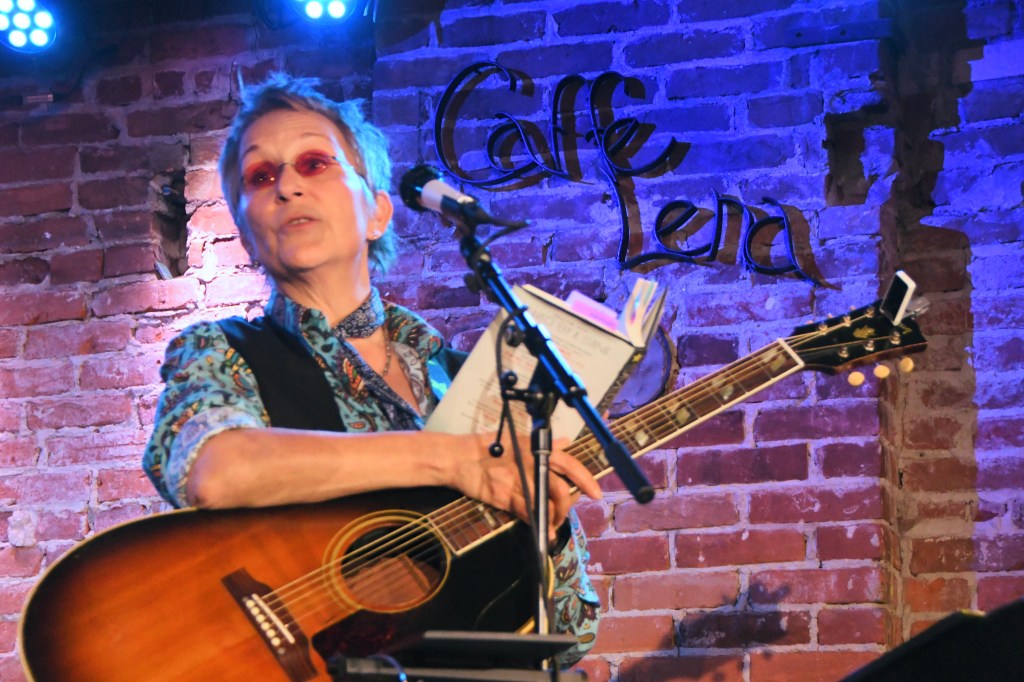
Four sad songs in on Sunday at Caffe Lena, Mary Gauthier rightly noted “We got the melancholy going,” but later posited music as its antidote and saving grace in a well-paced headline set. On taking the stage for the evening half of a double-header, she had nodded to opener Robbie Fulks, exclaiming, “How do you follow THAT?”
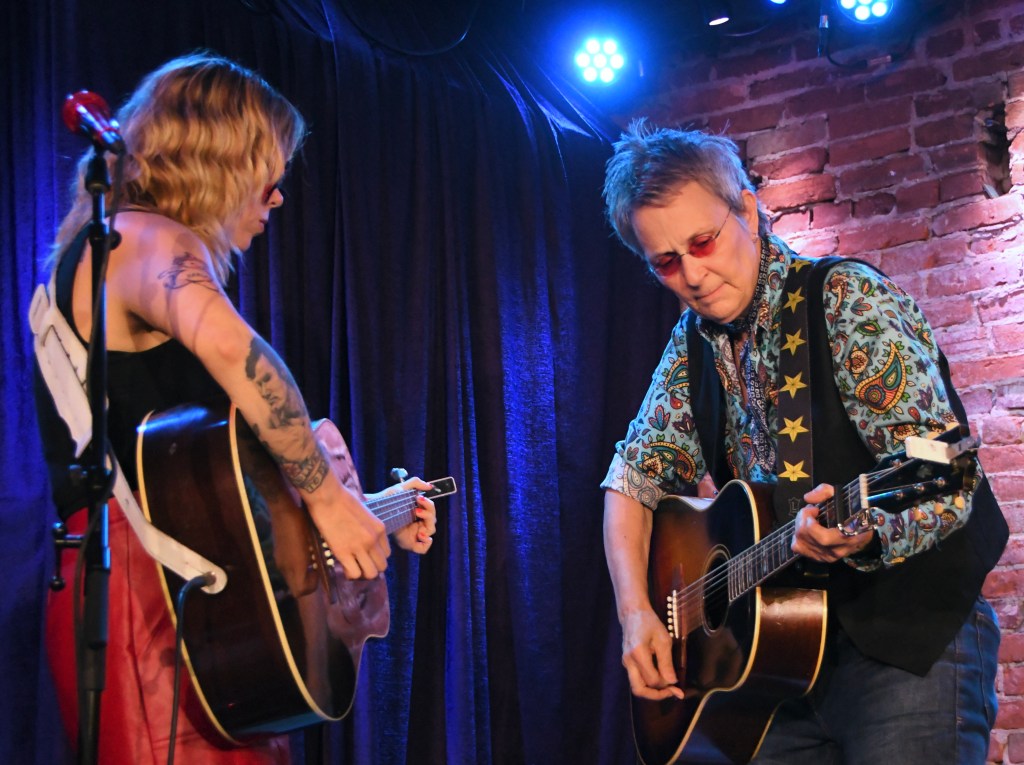
Mary Gauthier, right; and Jaimee Harris
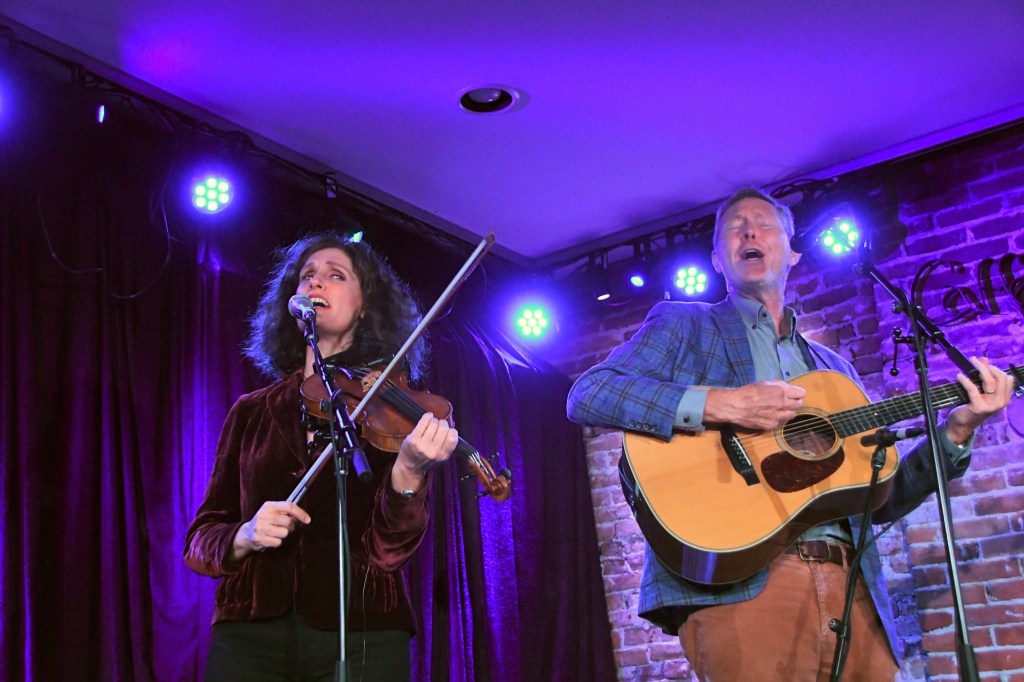
Robbie Fulks, right; and Jenny Scheinman
So we’ll start there, and bounce around – as Fulks did in his 50-minute opener in the sixth show (in five days) with Gauthier.
Both Gauthier and Fulks brought accompanists – Jaimee Harris played guitar and sang alongside Gauthier with a mentor/protege feel while Jenny Scheinman played violin and sang with Fulks more as equals.
Both sounded southern and wrote and sang of southern places; New Orleanian Gauthier singing much like fellow Gulf Coaster Lucinda Williams, with every bit as much hard-won character, and Virginia-raised Fulks echoing up-hollow and Tidewater vibes. Gauthier wrote from the Carson McCullers Spanish-moss gothic wing and Fulks stirred up that same melancholy flavor in a zesty cocktail with goofball observations. She: earnest/moody; he: more mixed, pained or pointed, edgy/witty.
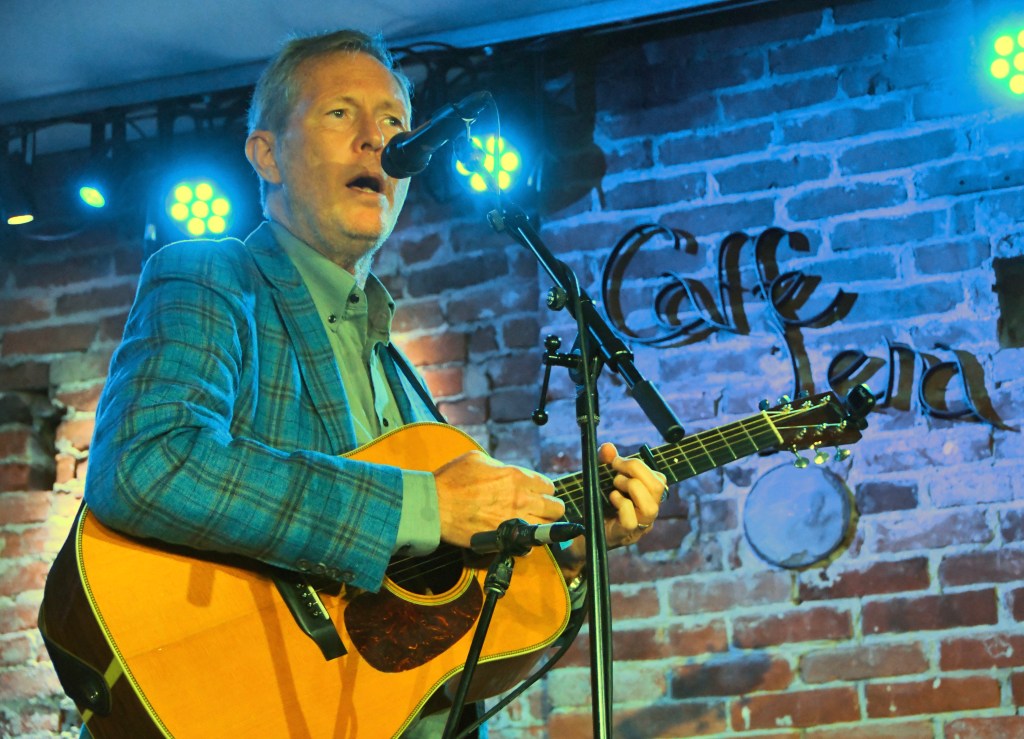
Fulks and Scheinman started sincerely in the self-questioning emotional travelog “Long I Ride” and stayed sentimental with “Molly and the Old Man” about family music-making. Famed for sardonic writing, Fulks flat-picks a mean Martin six-string; not flashy but plenty fast and always clever-logical. Comfortable everywhere from jazzy sophistication to bluegrass rips, Scheinman filled in the blanks, perfectly taking each lyric’s emotional temperature and fitting beautifully in sense and sound.
Determining that none in the near sold-out crowd had also seen the first show, Fulks quipped that he could therefore phone it in, “saying the same shit between songs.” Of course he didn’t, but this suggests that soon things might go wry. No, not awry, but humorous, and pointed.
“Cigarette State” lampooned local loyalty (though he did self-censor a dick joke from its lyric) and “Seventies Jesus” – you can guess what this anti-hymn proclaimed – proved Fulks’s aim is true and his lance is sharp.
They sandwiched those Zappa-meets-Prine skewerings of cracker cliches around Scheinman’s sweet-but-complex lovesong “The Littlest Prisoner,” just as “That’s Where I’m Coming From” followed “Seventies Jesus,” showing affectionate snapshots of a south Fulks previously portrayed as very mixed. “Busy Not Crying” romped and stomped like Buddy Holly primal rock in a set-closing romp, all straight-ahead teen-dream energy.
How to “follow that,” indeed – but Gauthier and Harris shrewdly started soft and slow with “The Meadow,” a wistful lost-love meditation. Its somber-fatalistic tone deepened in “Between the Daylight and the Dark.” They went even further into loss-and-leaving in “Dark Enough to See the Stars;” and – almost unbelievably, given the poignance that went before – deeper still in “Cigarette Machine.”
Gauthier turned to Harris to lighten the mood with the hopeful “Love is Gonna Come Again” as a solo – a ray of sunlight compared to the darker material on Harris’s albums mourning addiction, suicide and the death of mentor Jimmy LaFave.
Gauthier then went elegiac in the tender tribute “The Last of the Hobo Kings” before riding the rails again in “Some Times” – history as seen, blurring past, from the dining car of the Orange Blossom Special.
“’Til I See You Again” had the same loving prayerful flavor as John Martyn’s similarly generous “May You Never,” and Gauthier offered this in tribute to hero John Prine – “the Mark Twain of songwriting,” she said.
She then opened her book “Saved by a Song” to describe her life-saving songwriting mentorship of troubled veterans, work she said proves music is more than entertainment; that it’s magic, alchemy.
She then extolled the Caffe as church and orphaned churches bereft of their congregations as community centers. And she introduced her timeless paean to forgiveness “Mercy Now” as “the last of this service.” And it felt holy.
Like Prine’s, Gauthier’s best songs are simplicity itself, musically; sung in conversational style with sparse guitars, Gauthier mostly strumming, Harris picking. Harris also sang high-harmonies in the style of another Harris, Emmylou – whom she’ll accompany tomorrow in a Nashville retrospective honoring Gauthier as part of the Americana festival.
Also coming up: Scheinman told me backstage she has a new album in the works with jazz drummer Alison Miller, with whom Scheinman played at Freihofer’s Saratoga Jazz Festival several summers ago.
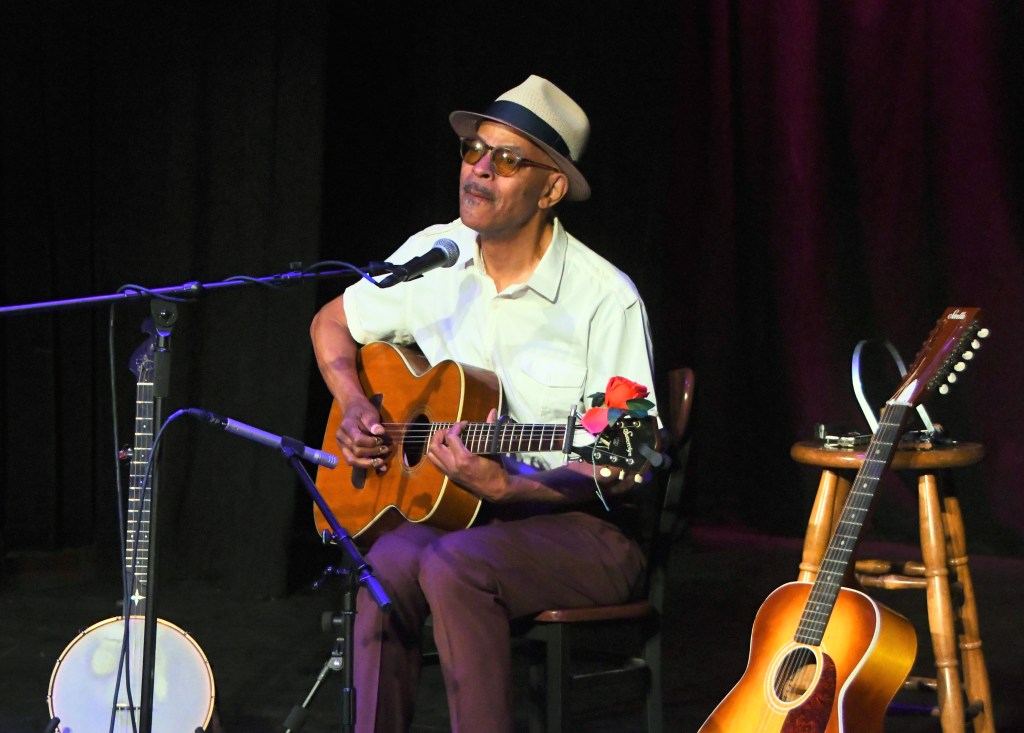
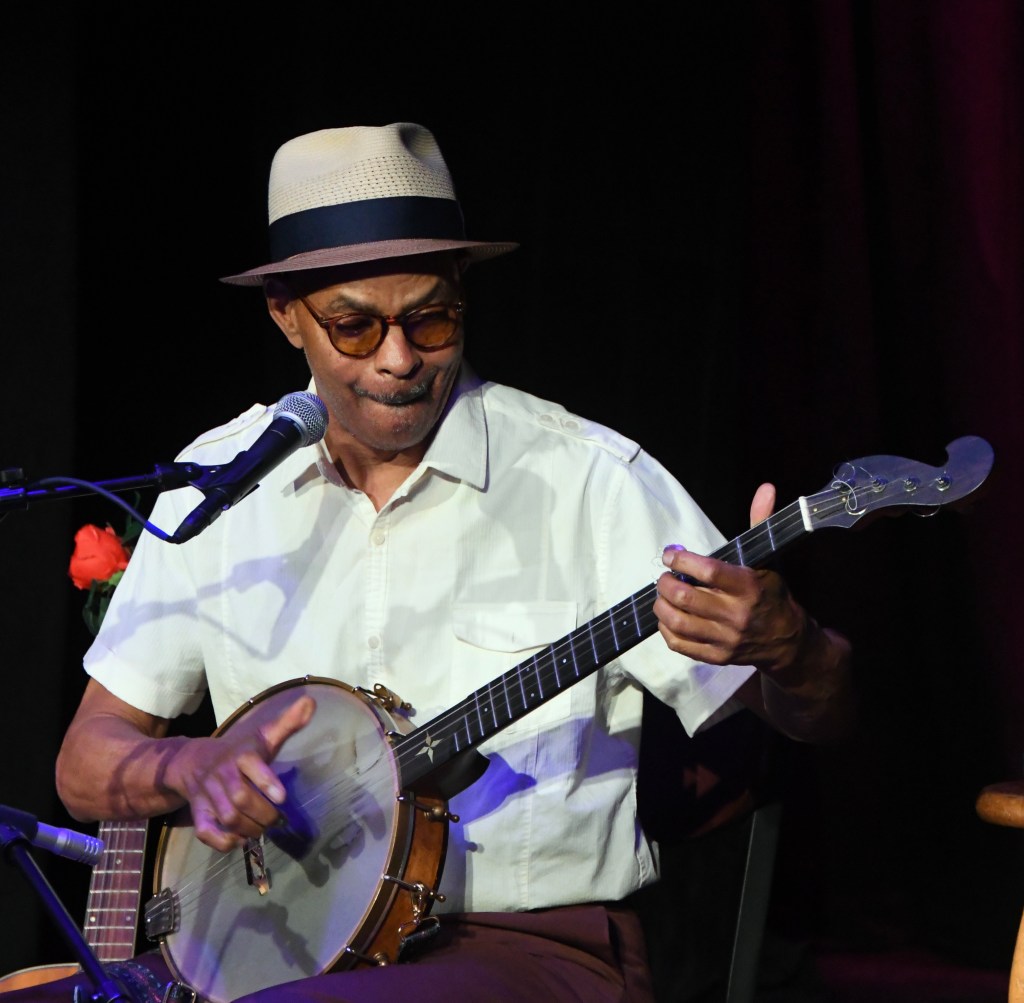
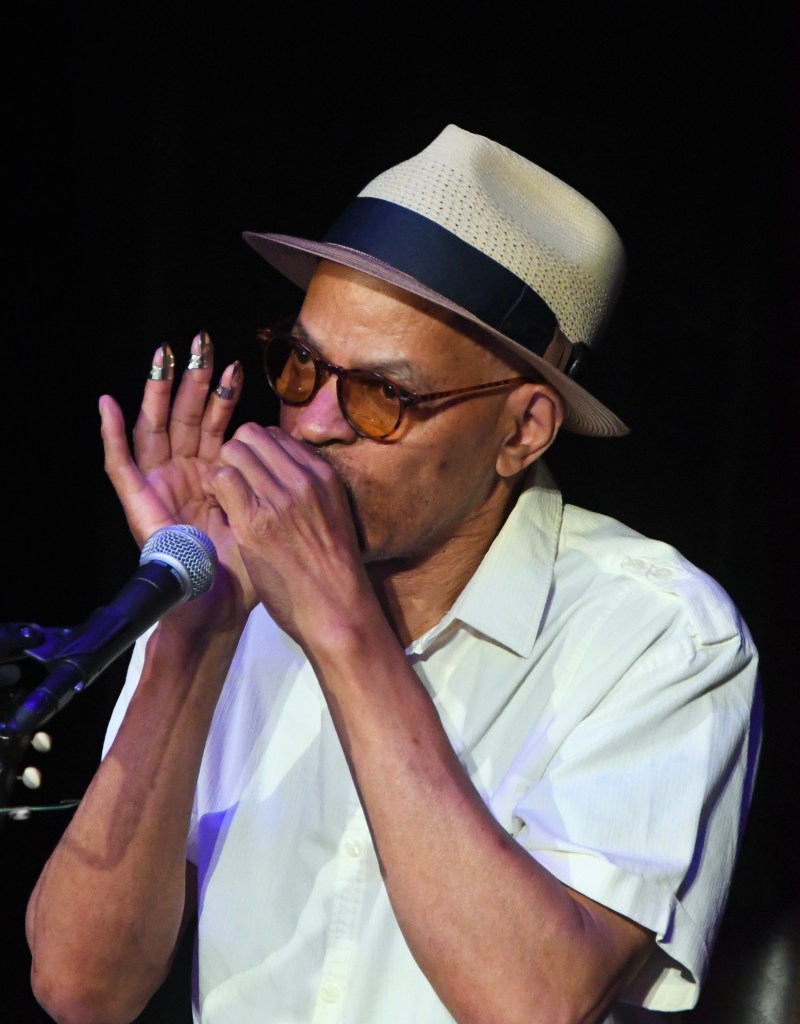
Longtime favorite at the Proctors-based Eighth Step Coffeehouse, the ambitious, deeply rooted troubadour Guy Davis reached way back Saturday into both family history and the venerable music styles long favored for fables of death and enduring, of love and betrayal.
Davis learned to craft a creative life from celebrated actor parents Ossie Davis and Ruby Dee; and how to link history to art in the folk music summer camp Pete Seeger’s brother John operated upstate from Davis’s Manhattan upbringing.
Before all that, Davis’s people were southern folk, and Georgia relatives told of a woman murdered there, a woman they knew and whose killer they suspected and feared.
Saturday before a small, rapt, happy-to-sing-along crowd, Davis showed no fear, decrying crimes then and now, with interludes of love and lust to sweeten and spice things.
The vintage “Driving Wheel” drove us back in time before Davis told his recently-written tale of murder in “Sugarbelly,” his concocted name of the victim and title of his new CD and a stage play under construction. He sang it in both his actor-sharp story-teller’s perfect diction and several character voices, including God’s.
So it went in his two-set show; weaving together bedrock blues he acknowledged stealing and his own fresh-made story songs that shared their simplicity as strength.
He finger-picked six- and 12-string guitars and frailing banjo, and some harmonica, sometimes using a holder; and tapped beats on the stage. He soloed some, but mostly played like a songwriter; the notes carried the tunes. He radiated expression with an actor’s gestures, his face an instrument as much as his fingers or voice.
Songs paired or stood alone; the old earthy love-lust of “Shaky Pudding” setting up Dylan’s ethereal “Just Like a Woman” then a hearty singalong in “Kisses Sweeter Than Wine” and a fervent “Shelter From the Storm.” All showed off shades of love in the first set; all were “stolen,” but Davis easily claimed them all.
However, he closed in on intermission with the new-album originals “Long Gone Riley Brown” and “In the Evening Time,” getting a good singalong on the latter.
Step impresario Margie Rosenkranz intro’ed the second set noting Davis was launching the venerable coffeehouse’s 57th season. He did so with the same confident mix of new and old as in the first. A particularly effective example: His slow folkie secret-lover lament “Got Your Letter In My Pocket” led logically to the timeless “Statesboro Blues” – Taj Mahal style, not Allmans’.
Davis, in fact, built the whole show on Taj-like confident authenticity of sound and soul, but also managed to update. While lampooning 45 with scatological joke-songs felt a bit petty, Davis took real risks by mourning victims on both sides of the Gaza war, seeing the tragedy through the grief of mothers on both sides. This deep, sad blues for right now reached confidently for the moral power Pete Seeger, Woody Guthrie and Bob Dylan pioneered. Here Davis was both timeless and immediate.
The Eighth Step season continues at Proctors: The Tannahill Weavers Sept. 22; David Roth & Anne Hills Sept. 27; Kate Campbell with John Kirk Oct. 4; Gunning & Cormier Oct. 27; Whispering Bones Oct. 31; Cheryl Wheeler with Kenny White Nov. 1 and others to be announced. http://www.8thstep.org. 518-346-6204
Even sandwiched among jazz festivals, Saturday’s show at The Linda by Cliff Brucker’s Full Circle boasts the unique attraction of area sax giant Leo Russo.
Leo Russo, tenor saxophone, at top left, then clockwise: Cliff Brucker, drums; Mike Novakowski, guitar; Otto Gardner, bass; Dylan Canterbury, trumpet; Larry Ham, keyboards
Multi-band leader Brucker formed Full Circle to showcase Russo’s tenor sax skills after the two had already played together for decades; Russo becoming both band mate and mentor to the younger Brucker. They’ve recorded two albums, played everywhere and spawned a spin-off, New Circle.
Nearing 90, Russo now limits his performances, so saxophonist-son Lee will play most of Saturday’s show. However, as Brucker notes, “Leo will be in attendance and will join us for a few tunes.”
Music as the family business-heritage includes numerous notables: two generations of Coltranes (John, and Ravi), of Pizzarellis (Bucky, and John), Johnny Cash and daughter Rosanne (playing Universal Preservation Hall on Saturday with husband-accompanist John Leventhal), four Hokes (my brother Jim, his wife Lisa and their genius kids Austin and Sari); Steve Earle and (the late) son Justin Townes Earle, also multiple Scruggs, McCourys, Louvins, Everlys. Davies (Kinks), Gallaghers (Oasis!) and Levins (keyboardist Pete plays often with Brucker); and moe. drummer Vinnie Amico and his jazz trumpeter father Sal. OK, there are many more, but that’s enough for now.
Saturday’s show at the Linda features the original Full Circle line-up: Brucker at the drum-set, trumpeter Dylan Canterbury, bassist Otto Gardner, guitarist Mike Novakowski and keyboardist Larry Ham, Brucker’s classmate at the Crane School of Music – plus two Russos.
“The music is interpretations of some of the classic jazz standards that musicians have been playing for decades plus one original composition written by the trumpet player (Canterbury) titled appropriately enough, ‘Full Circle’,” says Brucker.
“Leo will be in attendance and will join us for a few tunes.”
Leo Russo will play on several songs, reducing the full sextet to more compact quartets or trios.
Showtime is 7 p.m. for Cliff Brucker’s Full Circle Saturday at WAMC’s The Linda (339 Central Ave., Albany). $20 general admission. 518-465-5233. http://www.thelinda.org.
Brucker also leads the Brucker-Weisse-Canterbury Jazz Orchestra, which played the Linda in July, and Cliff & Friends, in Sunday residence at Stony’s Irish Grill.
Brucker’s New Circle played Jazz on Jay in June; and will play Saturday, Sept. 21 at Schenectady Porchfest; a free, nomadic neighborhood concert series presenting mostly jazz bands on six porches in or adjacent to the GE Plot.
MORE JAZZ – A WEEKEND FULL OF FESTIVALS
Albany Riverfront Jazz Festival hits Saturday at noon at Jennings Landing in the Corning Preserve on the Hudson shore in downtown Albany and ends just about when Brucker and crew start uptown at the Linda. Riverfront features Bright Dog Red, Melanie Charles, Snacktime, Matthew Whitaker, and Nate Smith.
And Jazz at the Lake presents music ashore in Shepard Park Thursday (welcome party for friends and supporters, with music), Friday, Saturday and Sunday evenings plus a Sunday jazz cruise aboard the Mohican – presenting too many artists to list here.
Tim Olsen Big Band at A Place for Jazz, Friday, Sept. 6, 2024
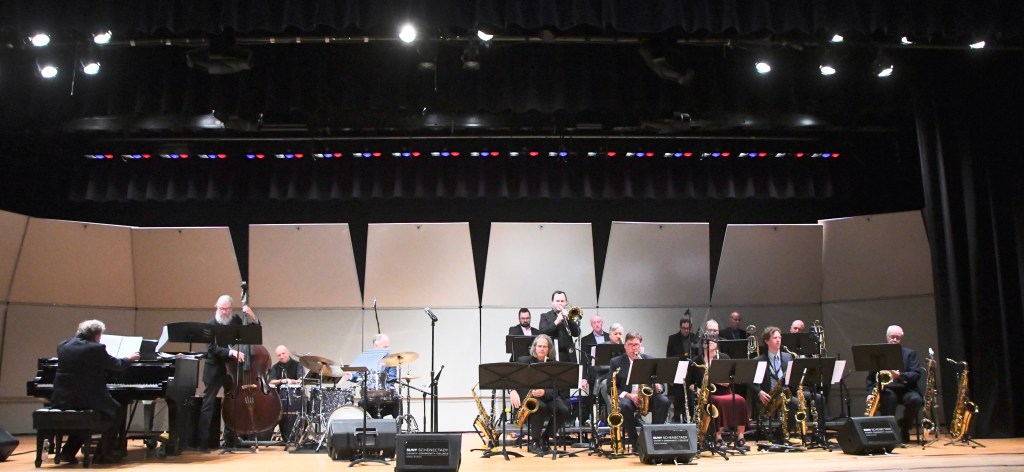
The Tim Olsen Big Band crowded the symphony-sized stage of SUNY Schenectady’s Carl B. Taylor Auditorium Friday to kick off the new A Place for Jazz season. Largest ensemble in the five-show fall season, the 18-piece juggernaut made a glorious noise with precise section playing and fiery free-flowing solos – all focused through leader Tim Olsen’s clear artistic vision.
The Tim Olsen Big Band
A Union College Professor of Music, Olsen honored jazz tradition in two ways. His straight-ahead approach to classic tunes felt distinctly non-academic Friday; it swung, it had soul. More often, though, he mutated classic-tune elements into new forms, sometimes with echoes of the originals. So the two-set 18-tune concert mixed resonance with exploration, just as his new “Obsidian” album collected ten Olsen originals from as far back as 1985 and as recent as last year while the six covers dated from the 1930s.
Tim Olsen, piano
Olsen conducted from center stage or the piano, stage right among with the rhythm section, while the horns played in rows, stage left: four trumpets at the rear, four trombones (including Dan Cordell’s bass trombone) in the center and five reeds up front, Tom Gerbino mainly playing baritone or bass clarinet, everybody else wielding flutes, clarinets, altos or tenors.
“Winter Journey” comprised all fresh ingredients to start, Eric Walentowicz’s tenor in the main solo slot, Olsen keying the coda at the piano; while “Portnoy’s Complaint” (not about Philip Roth’s groundbreaking novel, instead paying tribute to a St. Louis-based colleague) formed around “So What” as its frame or launching pad. Steve Lambert soloed well here, but drummer Pete Sweeney seemed busier, playing brushes in one measure, sticks in the next, then back to brushes.
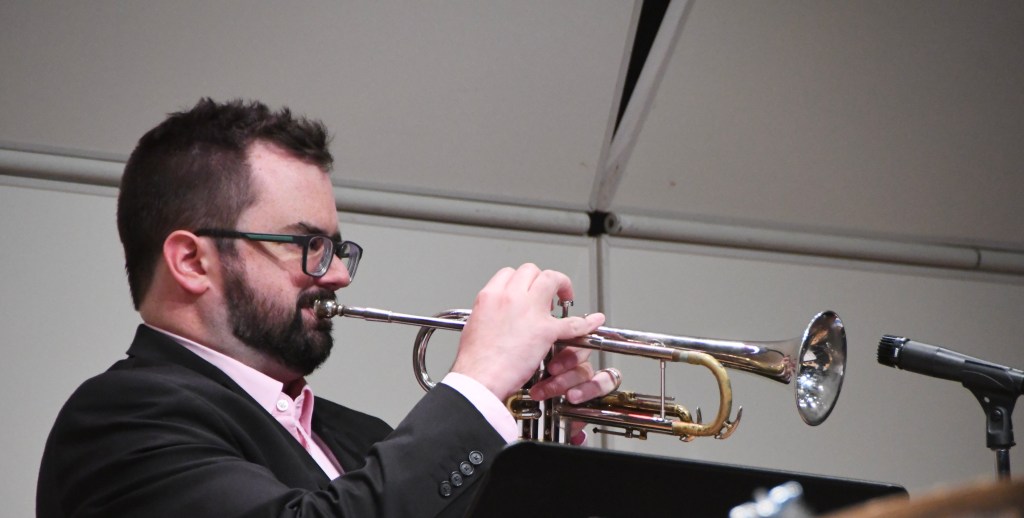
“Dutch Treat” sped things up some, appropriately as it told a chapter of family history about Honda minivans, and gave Sweeney, bassist Lou Smaldone and percussionist Brian Malick – EVERY band should employ Melick and most do – some trio swing time.
Lou Smaldone, bass; Brian Melick, percussion; Pete Sweeney, drums
Melick, Sweeney, Smaldone and others onstage Friday play in more then one ensemble, since our region boasts maybe more big bands than most of its size and musician population. Everybody brought their A-game Friday, hanging tight as cohesive sections and often going red-faced fierce while soloing.
Echoes abounded, mostly subtle. The bluesy “Obsidian” recalled Fats Waller’s “Black and Blue,” more thematically than melodically; “Leonine” packed propulsive “Blue Rondo Ala Turk” clusters, “Why I Fancy Nancy” cruised on “Pink Panther” cartoony glee and “Fur Ellis” eulogized Ellis Marsalis in Strayhorn-ian melancholy. The title “Morning in Morocco” made things obvious. OK, anybody? Right: “A Night in Tunisia.”
Olsen invited guests aboard, a Union student guitarist and trombonist in “Two O’Clock Jump,” a rambunctious, swinging blues in which Olsen promised 97 solos. It actually comprised only nine, but the joyous way the whole crew swung that trademark downhill riff was just as exciting. Those students had just met in class for the first time 48 hours before Olsen tossed them into the deep end.
Susie Olsen, vocals
Olsen’s singer wife Susie, joined in for “Lullabye of the Leaves” and “Caravan” in the first set and “Stardust” in the second, projecting strong, though pitchy at times to these ears, and with skilled mic technique.
Matt Steckler, soprano saxophone
Kristine Johnson, alto saxophone
The ballads bled feeling, Matt Steckler (soprano saxophone here) all poignant-lyrical in “Ballade” and Kristin Johnson likewise in “Fur Ellis.” The jump tunes, mostly classics, surged in right-now energy; Walentowicz (tenor and clarinet), trumpeters Dylan Canterbury, Steve Lambert and Jon Bronk going pedal-to-the-metal to exciting effect while Sweeney did great Gene Krupa in a terrific “Sing Sing Sing.” In that and the other classics “Take the A Train,” “Caravan” and the climactic “Two O’Clock Jump,” also Olsen’s “No Parsley (Only Pears),” everybody swung for the fences.
Dylan Canterbury, trumpet
The reed players got to show off their versatility, though solid team player Tom Gerbino stayed mostly low-down with baritone sax and bass clarinet.
Tom Germino, bass clarinet
Everybody played from charts, including Olsen, but nothing felt the least bit stiff. His arrangements took full dynamic and sonic advantage of his players’ skills, with muted brass in “Obsidian” and “I’m Tired,” wah-wah-style plunger mute in the trombones for “Dutch Treat,” for example; and a congas explosion in “Caravan.”
However, this was always in service of the songs rather than any “young-persons’-guide-to-big-band” educational agenda – though lots of students attended.
A Place for Jazz continues Friday, Sept. 20 with the Warren Wolfe/Joe Locke Quartet in the Carl B. Taylor Auditorium at SUNY Schenectady. Show time is 7:30 p.m. $25. http://www.aplaceforjazz.org.
Set List
Winter Journey*
Portnoy’s Complaint*
Dutch Treat*
Obsidian*
Lullabye of the Leaves***
Caravan***
I’m Tired**
Park Avenue**
Sing Sing Sing***
Leonine*
Ballade*
Why I Fancy Nancy*
No Parsley (Only Pears)*
Take the A Train***
Stardust***
Fur Ellis*
Morning in Morocco*
Two O’Clock Jump***
from “Obsidian” album
** Olsen original
*** cover
The Tim Olsen Big Band:
Saxophones: Dave Fisk, Kristina Johnson, Eric Walentowicz, Matt Steckler, Tom Gerbino
Trumpets: Jon Bronk, Dylan Canterbury, Steve Lambert, Mike Banewicz
Trombones: Rick Rosoff, Elias Assimakopoulos, Ken Olsen, Dan Cordell
Bass: Lou Smaldone
Drums: Pete Sweeney
Percussion: Brian Melick
Vocals: Susie Olsen
Tim Olsen conducted and played piano and trumpet (in “I’m Tired”)
Most are local, as Olsen noted, although Stecker came from Vermont and Assimakopoulos from Long Island.