The red barn seemed to greet me in every going-home commute from Albany from behind the Thruway fence. A house squatted nearby, in the same sun-faded red paint. I liked how a white wooden ladder hung horizontally on the barn’s gable end wall, across a square window frame painted the same white.
I stopped once on the Thruway, trying to read road signs, anything, to tell me where it was, how to find it so I could bring the camera. But I wound up wandering around, half-lost on back roads, until I found the place: I recognized the red.
I toted my heavy tripod, big view camera and bag full of 4 x 5 film holders and light meter around the house into the back yard and set up, using the tripod bubble level to get everything square and plumb.
I heard the screen door squeak and slam and turned to see an old gent come toward me from the house: slow steps, beat-up cap, well-aged jacket, work pants and boots. He seemed relaxed, curious and not angry, a dog beside him walking as calm as he was. When he got close, I said hello, explained how I admired the barn and wanted to photograph it. He agreed, on one condition: “Don’t give me any prints. I have enough already on my ice box from another photographer or two.”
No problem, I agreed, kind of disappointed that others had discovered and photographed it before me. I got busy, quiet; so he started talking, telling me about a long life he’d enjoyed. He said his name was Matt Norray and I told him mine. He said he’d been an Adirondack mountain guide, leading well-heeled visitors who’d come from away to do business at GE in Schenectady. He’d worked there, too, he said, at what he called “the main plant.” That was before he guided Edison, Henry Ford and other captains of industry around the mountain lakes to fish, play cards, sail and drink.
When I asked him to stand by the barn, to be in a photo, he nodded. He saw where my camera was pointed, walked into my scene and reached up to hold the ladder and stood quietly looking back at me.
He said he was 92, the only thing around older than the barn.
And he said he’d been married, a long time, but his wife had died, years and years before.
His friends had urged him to re-marry, find another wife to take care of him in old age.
“Fuck that noise,” he told them, startling me with hard words, vehement and strong.
“I got a dog instead,” he explained.
“I got a dog and I called her ‘Sweetheart,’” he told me.
She heard her name, looked over at us, and she wagged her tail, just one time.
This feels new to me: pairing a picture with words in this direct way. It also feels complicated: Should an image be able to – or required to – stand alone without explanation?
Having already explained this one some – before showing it – I might as well go further. I recall admiring the calmly expository flavor and simple, nonjudgemental humanity of profile stories Patrick Kurp contributed to the Gazette, years and years ago.
I offer this in that same spirit and first of an open-ended series.
Looking back, any area jazz Mt. Rushmore needs far more than just four faces.
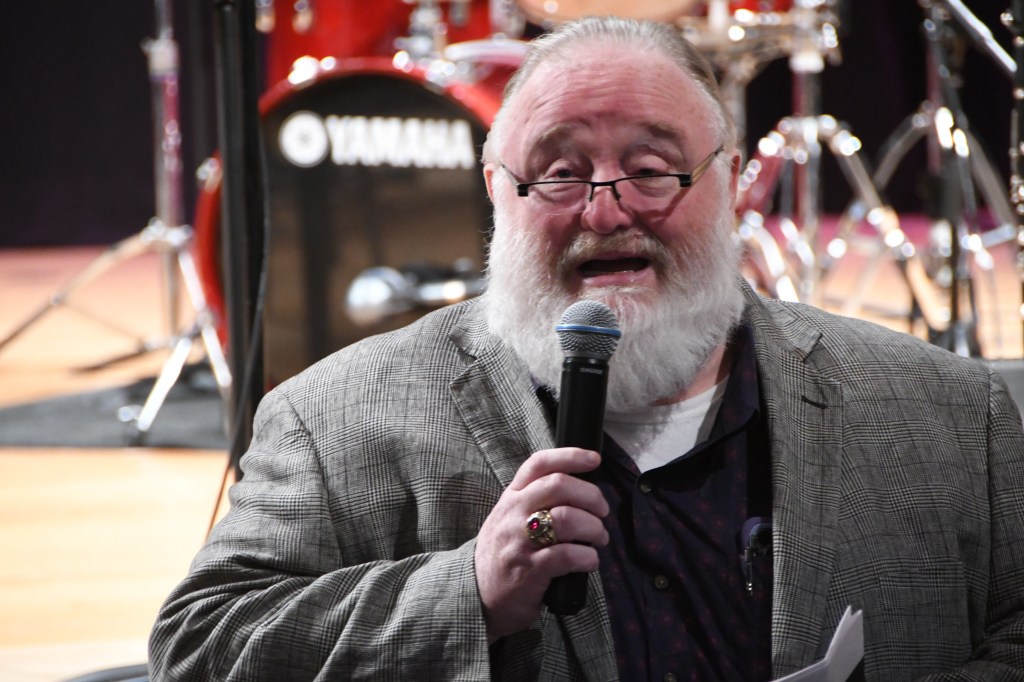
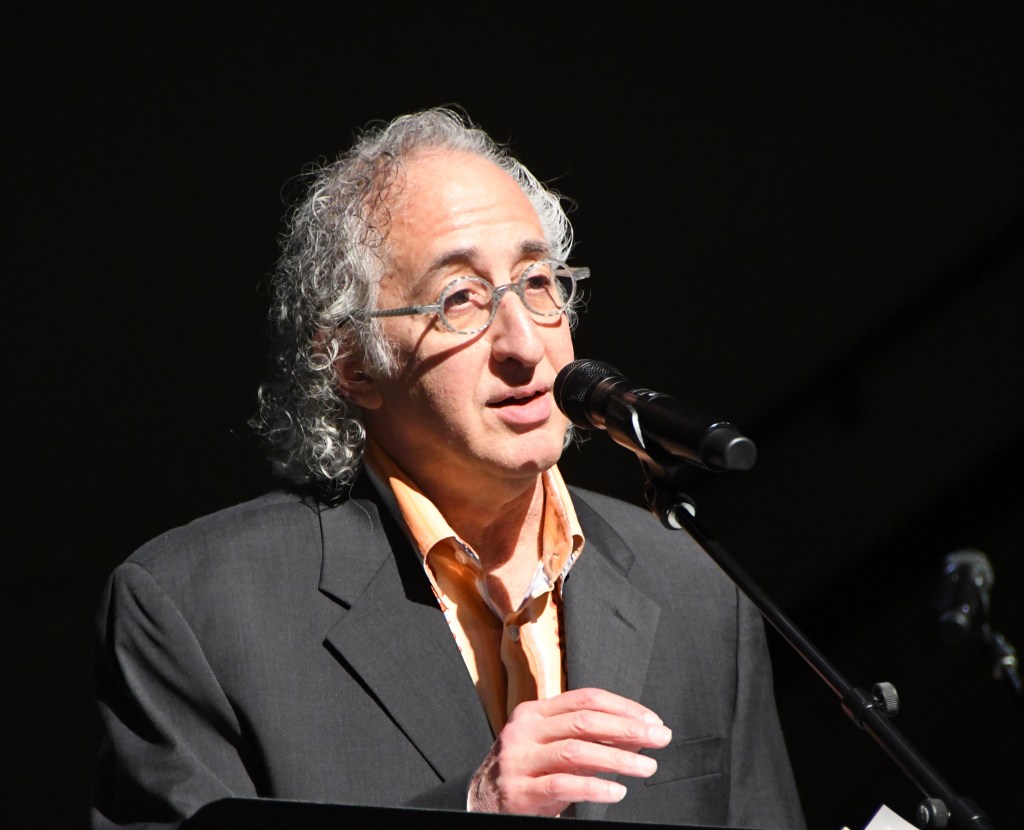
Bill McCann at the mic – his natural habitat – at A Place for Jazz. Michael Hochanadel photo
And one would be the bearded, most often smiling visage of Bill McCann who celebrates 40 years at the WCDB mic on Saturday, Apr. 5 in a free two-stage show. The day-long celebration features 16 bands comprising 80 of his closest friends, or more than a full day at SPAC’s Saratoga Jazz Festival presented by GE Vernova, this summer on June 28 and 29.
Who else might appear on that exalted area jazz pantheon? Glad you asked.
The players might start with Nick Brignola, Lee Shaw, Hal Miller, Leo Russo and George Mastrangelo. And those supporting the music from behind the bar, in print and on radio must include Marvin Friedman, Georgia Urban, Tim Coakley and McCann.
The latter two radio stalwarts are still with us though Coakley just hung up his microphone at WAMC after 38 years, a departure promoted by health concerns.
Tim Coakley, left; and Bill McCann. Photo provided
McCann filled in for Coakley for several weeks before Coakley retired earlier this month; he’d present Coakley’s show on Friday night, then his own Saturday morning marathon.
That’s a lot, even for the energetic McCann.
“It’s hard for me to believe,” he exclaimed this week. “The 40 years feels like it has gone by in a flash.” Looking ahead to the Apr. 5 celebration concert, he predicted “an absolutely epic day of jazz here in the Capital District, the likes of which has never been seen, and likely may never be reproduced.” Looking even further ahead, he mused, “Who knows, we may have to do two days and 30 bands if I make it to 50 years on WCDB!”
The Jazz Journalists Association awarded McCann its “Jazz Hero” Award in 2012 (https://www.jjajazzawards.org/p/jazz-heroes.html), the recently revived Metroland (now “The Metroland”) has honored him several times as Best Jazz D.J., and he’s earned multiple nominations for The Eddies.
McCann is president and member of the board of directors of A Place For Jazz, a 501(c)(3) not-for-profit corporation promoting jazz in the Capital District with concerts and educational programs. (aplaceforjazz.org). He introduces AP4J performers with the same enthusiasm and knowledge as on radio, invoking jazz history with favored phrases. He cites deceased performers, for example, as “now playing in that great 52nd Street in the sky,” the long heralded New York City clubland address.
He is also a board member of the Swingtime Jazz Society, a membership-based organization promoting concerts by regional jazz artists. (swingtimejazz.org).
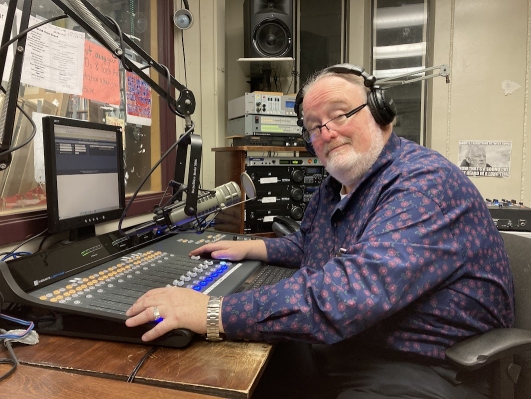
McCann at WCDB
Every Saturday morning, McCann totes heaps of selected records into the WCDB studio, introduces and spins them with trademark improvised ease, essentially jamming with the greats and greats-in-the-making.
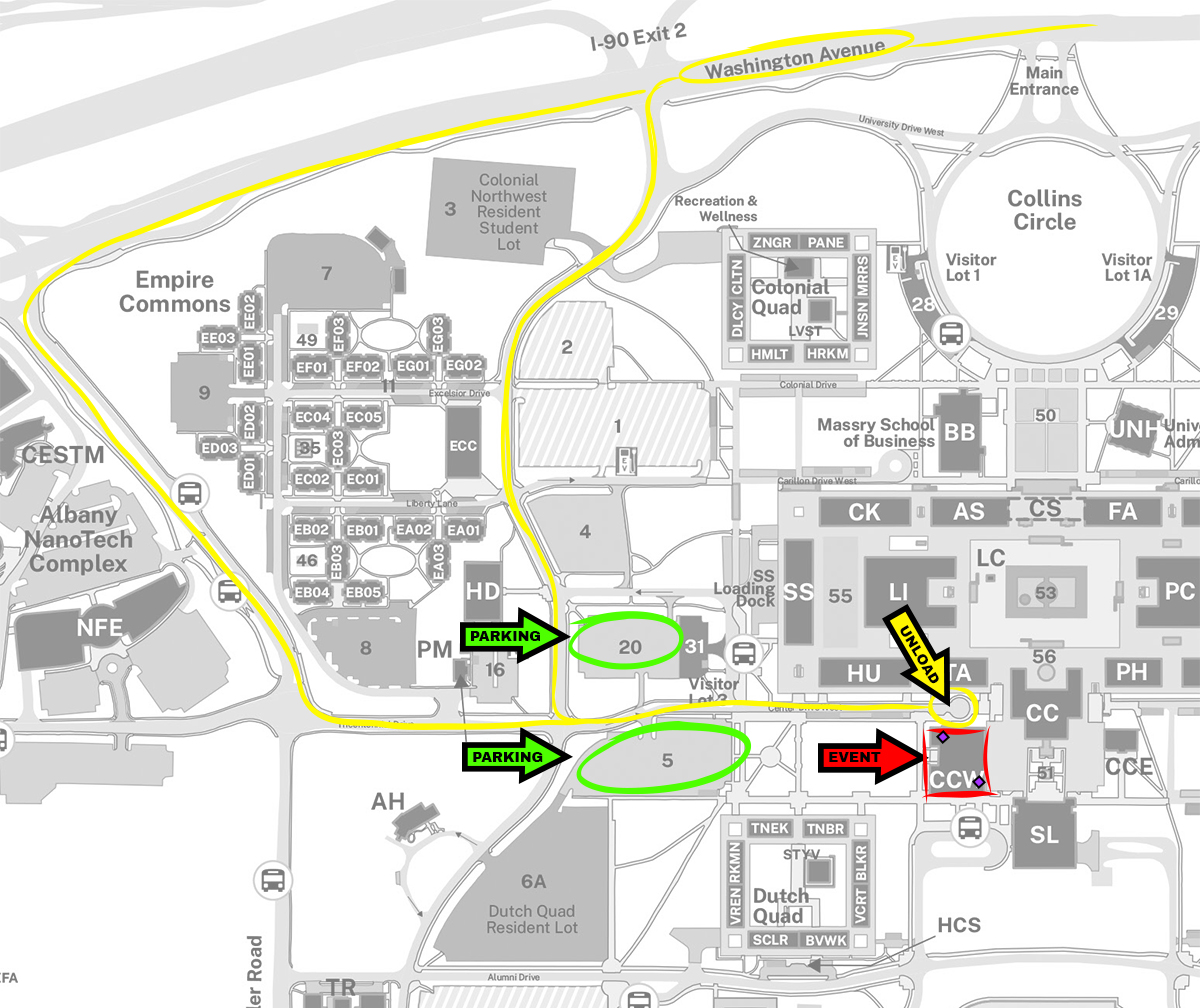
To honor area jazz artists, to celebrate four decades at the WCDB microphone, and to support Jazz Appreciation Month, McCann has assembled a two-stage showcase dubbed “The UAlbany Jazz Appreciation Month Festival, Celebrating Bill McCann’s 40th Anniversary on WCDB.” This 16-band, two stage show starts at noon on Saturday in the uptown Campus of UAlbany’s Campus Center West building (https://wcdb.org/jazz).
Each group will play for 50 minutes with a 10 minute changeover.
2 p.m.: The Arch Stanton Quartet (Roger Noyes, guitar; Terry Gordon, trumpet; Chris Macchia, bass; James Ketterer, drums)
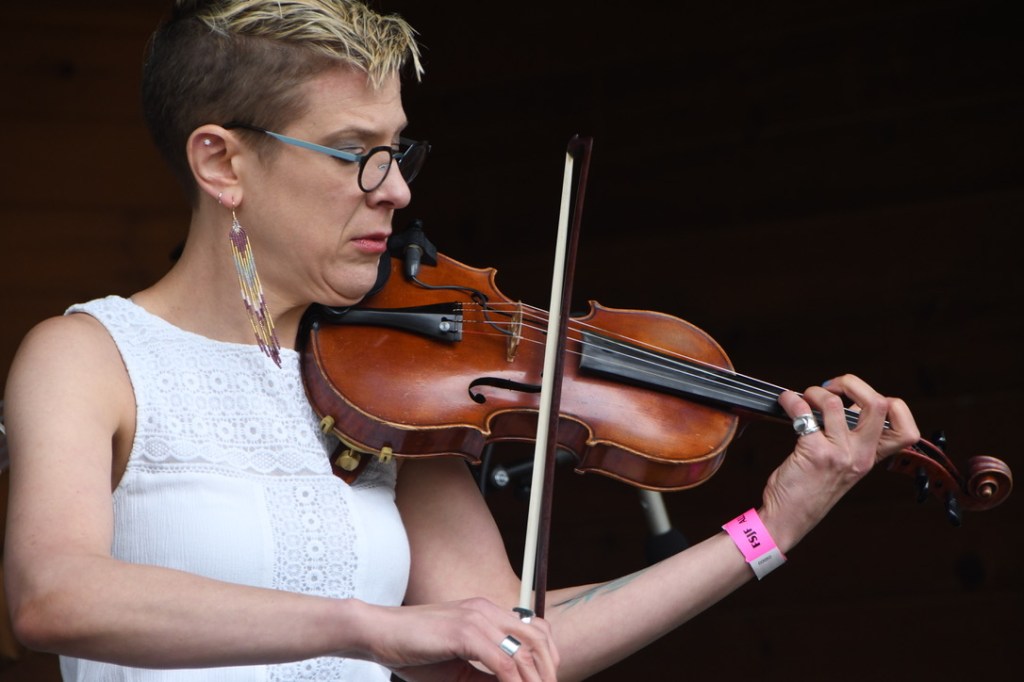
3 p.m.: The Teresa Broadwell Quartet (Teresa Broadwell, vocals/violin; Leo Russo, sax; Michael Novakowski, guitar; Pete Toigo, bass)
4 p.m.: The Justin Henricks Trio (Justin Henricks, guitar; Ian MacDonald, organ; Nick Anderson, drums)
5 p.m.: The Awan Rashad Quartet (Awan Rashad, saxophone; Luke Franco, guitar; Tarik Shah, bass; Matt Niedbalski, drums)
6 p.m.: The Pete Levin Organ Trio (Pete Levin, organ; Steve Raleigh, guitar; Cliff Brucker, drums)
7 p.m.: The Chuck Lamb Trio (Chuck Lamb, keyboards; Rich Syracuse, bass; Jeff “Siege” Siegel, drums)
MULTI-PURPOSE ROOM STAGE
12:45 p.m.: The Steel Pier Jazz Band (Woody Strobeck, trombone; Dave Lambert, clarinet; Steve Lambert, trumpet; Glenn Hankle, banjo; Ernie Belanger, tuba; Jeff McRae, drums)
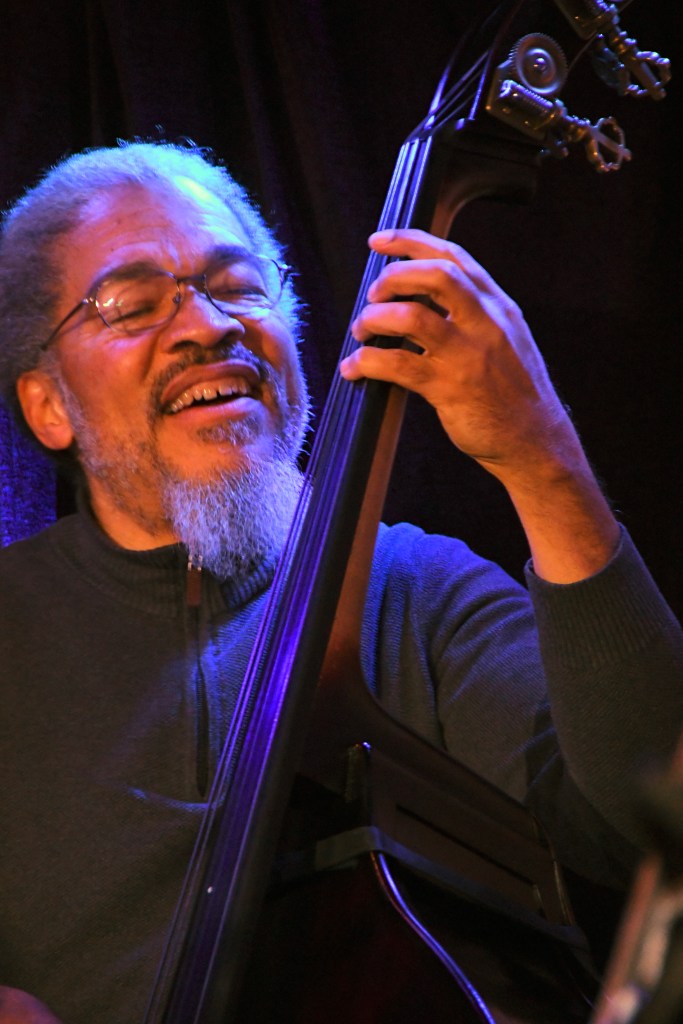
1:45 p.m.: The Linda Brown Jazz Project (Linda Brown, bass; Jody Shayne, vocals; Larry Ham, keyboards; Laura Andrea Leguia, saxophone; Peter O’Brien, drums)
2:45 p.m.: Michael Benedict Jazz Vibes with the Art D’echo Trio (Michael Benedict, vibraphone; David Gleason, keyboards; Mike Lawrence, bass; Pete Sweeney, drums; plus Joe Finn, guitar; and Brian Melick, percussion)
3:45 p.m.: The Keith Pray Soul Jazz Revival (Keith Pray, saxophone; Pat Perkinson, bass; Vinnie Martucci, keyboards; Doug Bierend, guitar; Bob Halek, drums)
4:45 p.m.: Colleen Pratt/Peg Delaney Ensemble (Colleen Pratt, vocals; Peg Delaney, keyboards; Bill Delaney, bass; Gene Garone, drums; Jim Corigliano, saxophone; Steve Lambert, trumpet and flugelhorn)
5:45 p.m.: Joe Barna and Sketches of Influence (Joe Barna, drums; Stacy Dillard, saxophone; Greg Glassman, trumpet; Fima Chupahkin, keyboards and Malik McLaurine, bass)
6:45 p.m.: The Brian Patneaude Quintet (Brian Patneaude, saxophone; Rob Lindquist, keyboards; Justin Henricks, guitar; Jarod Grieco, bass; Danny Whelchel, drums)
7:45 p.m. The B.W.C. Jazz Orchestra: (18 piece big band led by Cliff Brucker, Steve Weisse and Dylan Canterbury featuring Jim Corigliano, Paul Evoskevich, Dave Fisk, Kevin Barcomb, Kaitlyn Fay (+ vocals), Wally Johnson, saxophones; Steve Weisse, Chris Pasin, Kathleen Ehlinger, Nikola Tomic, trumpets; Ben O’Shea, Rick Rosoff, Travis Malone, Shaun Bazylewicz, trombones; Jon LeRoy, piano; Dave Shoudy, bass; Cliff Brucker, drums; Dylan Canterbury, trumpet and conductor)
The day-long event is free to the public through the support of sponsors: The UAlbany Alumni Association; The UAlbany Foundation; The University Auxiliary Services at Albany (UAS); The UAlbany Division of Student Affairs and Enrollment; The Albany Musicians Union, Local 14 of the American Federation of Musicians; The Schenectady-Amsterdam Musical Union, Local 85-133 of the American Federation of Musicians; The Music Performance Trust Fund; The Nania Family – In Memory of Sheldon and Carol Pitkin; Canon Kay C. Hotaling; A Place for Jazz; and WCDB.
In addition, commemorative T-shirts will be available free while supplies last. And pairs of tickets to the Saratoga Jazz Festival, presented by GE Vernova, will be given away through support by the Saratoga Performing Arts Center.
McCann hosts “The Saturday Morning Edition of Jazz” Saturdays from 8 a.m. to 12 noon and the program is re-broadcast Sundays from 10 a.m. to 2 p.m. On air at 90.9 FM, online at wcdbfm.com.
WAIT, THERE’S MORE
Bill McCann presents plenty of jazz to appreciate in just one huge bash; but Jazz Appreciation Month also happens in other venues as this menu suggests. (This list is likely to be only partial, produced partly in a post-insomniac fog…)
The Albany Musicians Association Free Jazz Appreciation Month Concerts
Apr. 4: Nancy Donnelly Quartet – Albany Institute of History and Art 5:30 p.m.
Preview: The Capital Region Vocal Jazz Vanguard on Saturday March 8 at the Van Dyck Music Club
ALSO, see MORE JAZZ, below
Three singers – Kaitlyn Fay, Jeanine Ouderkirk and Tyler Thomas – who blend their voices under an ambitious-sounding group name – perform a one-night-only show Saturday at the Van Dyck Music Club (237 State St., Schenectady). “Our voices work very well together,” Fay said by email over the weekend. “I sing soprano; Jeanine, alto and Tyler. tenor/baritone,”she said, then explained how their trio formed.
Kaitlyn Fay. Photo supplied
Fay and Thomas met in the NYSSMA All-State Vocal Jazz Ensemble, directed by Kim Nazarian of the New York Voices. In 2016, they added Ouderkirk: “I loved her sound,” said Fay. They played Speakeasy518 and One Caroline that year, but disbanded when Thomas left to continue his training at University of North Texas. They reunited when Thomas returned here in 2024 to teach at Galway CSD.
Tyler Thomas. Photo provided
All the Capital Region Vocal Jazz Vanguard singers are also teachers: Fay at Waterford-Halfmoon Jr./Sr. High School and Ouderkirk at St. Gregory’s. Most of their rhythm section Saturday, too: pianist David Gleason teaches at Schenectady CSD while drummer Bob Halek is a retired teacher; bassist Dave Shoudy works at GE Global Research.
Jeanine Ouderkirk. Photo supplied
The singers are otherwise busy, too. Fay plays baritone saxophone with both the Keith Pray Big Soul Ensemble and the Brucker-Weisse-Canterbury Jazz Orchestra; she also guests with the Art D’Echo and Michael Benedict Jazz Vibes and released “Curiosity,” an album of jazz standards in 2013. Both Ouderkirk and Thomas play piano and Ouderkirk sings solo and in duos, while Thomas conducts jazz education workshops across the U.S.
“Our show at the Van Dyck on March 8th is designed to be a celebration of vocal jazz,” said Fay. They’ll sing together at times, “but the majority of the event will feature each vocalist in solo sets with the rhythm section.” Fay said, “We are all multi-instrumentalists and vocalists, so we just might bring our horns along for this show.”
She said, “For our solo sets, each singer has selected from their repertoire” and will include jazz standards, Great American Songbook favorites, bossa nova, and several originals. “For our group pieces, we bounce ideas off of each other and agree upon arrangements to try out or select.”
SUNY Schenectady County Community students will open Saturday’s Van Dyck Music Club’s show. Cami Sepulveda, Nat Mussman, Vinny Marotta, and Isaac Nokes will play 6:45 to 7:15 p.m. Doors at 6:30. And, Fay said, “We will have a special guest vocalist joining us for one of the full-group numbers. (It’s a surprise!”) Tickets are $15 in advance (online) and $20 at the door. 518-630-5173. http://www.stellapastabar.com
Kaitlyn Fay Upcoming Shows
April 5: 7:45–9:00 p.m (vocals and baritone sax) with the BWC Jazz Orchestra at the “UAlbany Jazz Appreciation Month Festival,” celebrating Bill McCann’s 40th Anniversary on WCDB at the Campus Center West Extension of the UAlbany Uptown Campus
April 13: 2–3 p.m.(vocals) with the Art D’Echo Trio at the Shaker Heritage Society Meeting House, Latham (Jazz Appreciation Month concert, sponsored by MPTF and AFM Local 14)
April 19: 6–9 p.m. (vocals) with Michael Benedict Jazz Vibes at Stella Pasta Bar and Bistro, Schenectady (dining room downstairs from the Van Dyck Music Club)
Jeanine Ouderkirk Upcoming Shows
March 14: 9 p.m. (vocals) with bassist Evan Jagels at the Bourbon Room, Glens Falls
April 28: 5 p.m. (solo) at Duke’s at Rivers Casino, Schenectady
MORE JAZZ
Tarik Shah Headlines New UPH Series
Tarik Shah. Michael Hochanadel photo
Bassist Tarik Shah leads his quartet Sunday at Universal Preservation Hall, launching the new Sunday Jazz at UPH series. Since relocating from New York, the protege of Slam Stewart and veteran of numerous jazz and R&B groups has become both bandleader and sideman here and is now polishing his debut solo album “Solitary Refinement.” The Tarik Shah Quartet is Tarik Shah, bass; Luke Franco, guitar; Awan Rashad, saxophone; Matt Niedbalski, drums. They’ll play a mix of standards and originals. Note the early start time: 4 p.m. $25 advance, $30 day of show. 518-346-6204. www.proctors.org
New Orleans Masters Bring the Heat
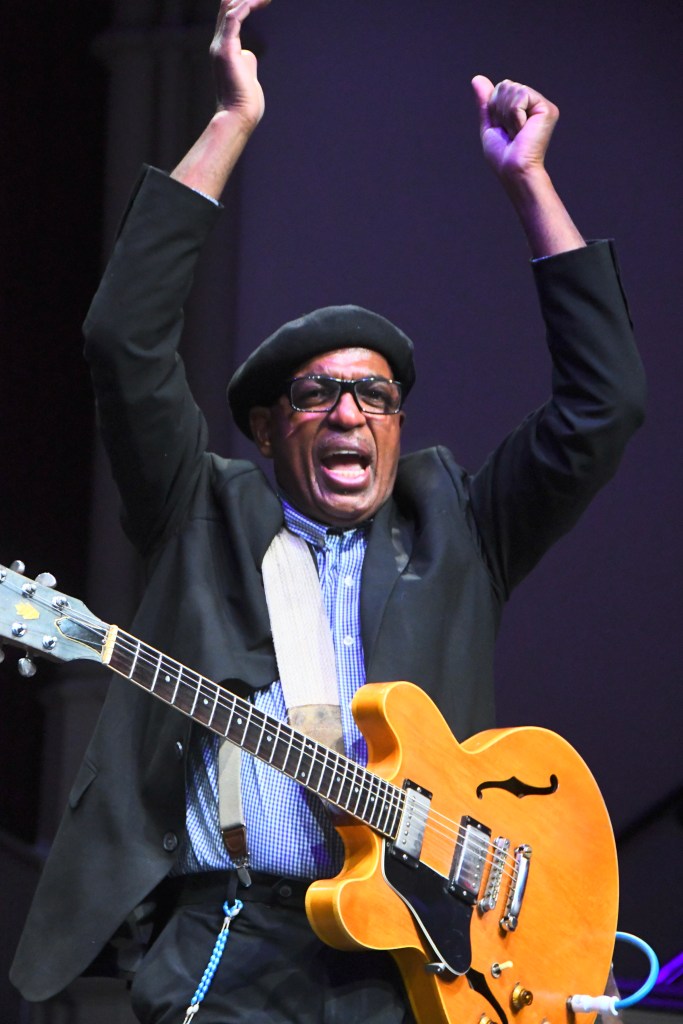
A long-tenured repertory company preserving New Orleans traditional jazz, the Preservation Hall Jazz Band (PHJB) feels anything but antique when they swing vintage street-parade tunes, blues and vintage pop. Sousaphonist Ben Jaffe, son of the revered couple who founded it in 1961, leads the crew whose somewhat elastic lineup often features 92-year-clarinetist Charlie Gabriel, who released his debut solo album “89” at that venerable age. (Sun Ra Solar Arkestra saxophonist Marshall Allen released HIS solo debut album at 100, and guested with NRBQ at The Egg some years back. But we digress.)
Preservation Hall Jazz Band, touring edition. Photo supplied
On the road, PHJB stars skilled younger keepers of the flame including trombonist Ronell Johnson, trumpeter Clint Maedgen and pianist Kyle Roussel. The Preservation Hall Jazz Band plays The Egg (Empire State Plaza, Albany) Saturday. 8 p.m. $59.50, $49,59, $39.50. 518-473-1845 www.theegg.org
Cliff Lyons Comes Home
Cliff Lyons. Photo from All About Jazz
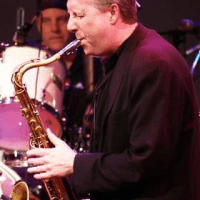
Saxophonist Cliff Lyons played with every horn band hereabouts before moving to New York to play with national-caliber acts including the Ed Palermo Big Band (who played a fiery 2017 show in Proctors 2017 Party Horns series), numerous Broadway shows and the Average White Band, his current gig.
Tuesday, Lyons guests with the (pianist) Chuck Lamb Trio in the JAZZ at Caffe Lena (47 Phila St., Saratoga Springs) monthly series. 7 p.m., doors 6:30. $37.96, members $33.62, children and students $18.98. 518-583-0022. www.caffelena.org
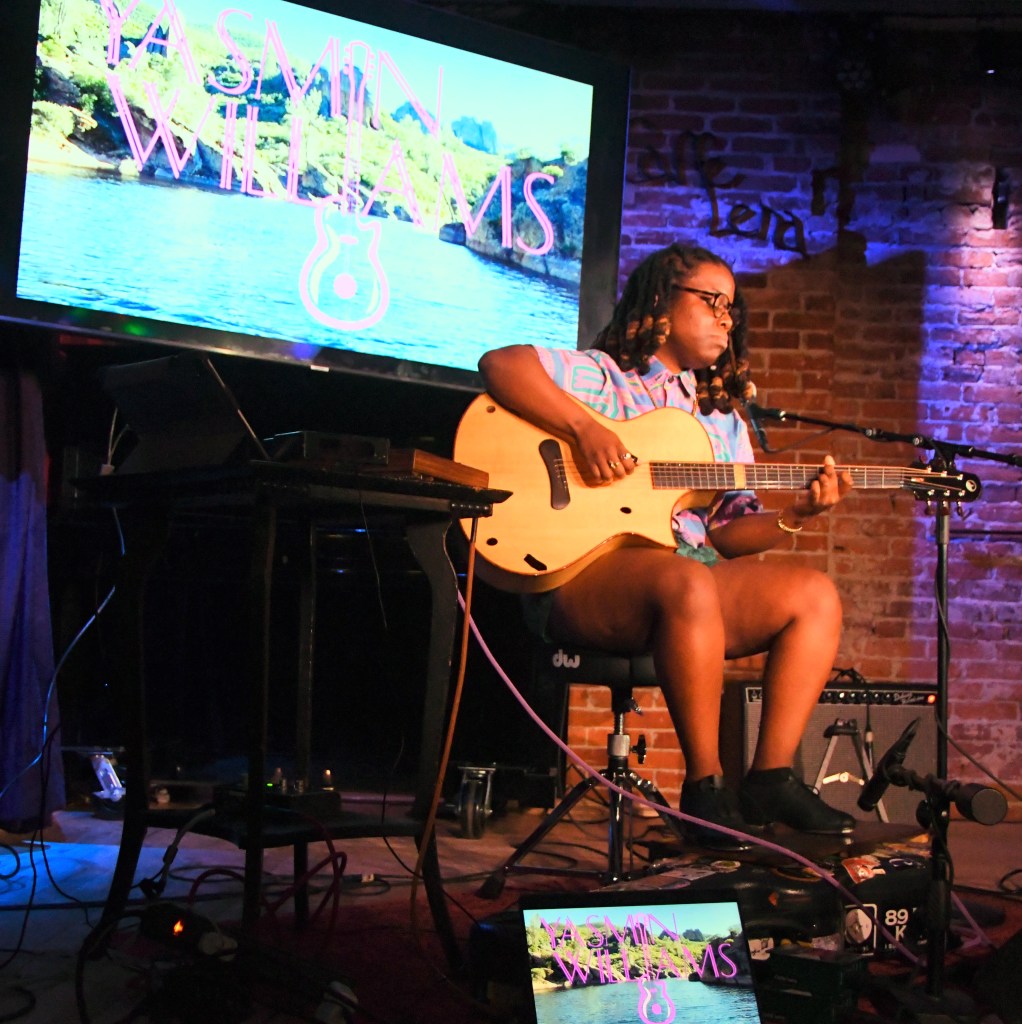
Review: Solo Guitarist Yasmin Williams at Caffe Lena, Wednesday, Feb. 12, 2025
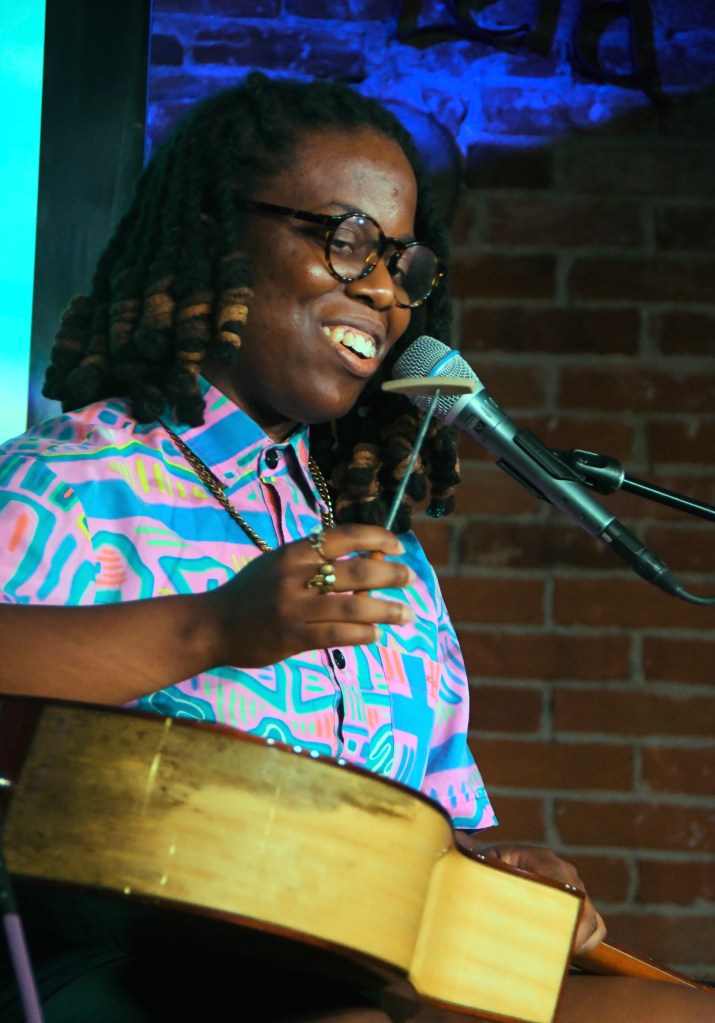
Guitarist Yasmin Williams tossed off that humble, inclusive invitation casually at Caffe Lena Wednesday; then the innovative virtuoso played rare, wondrous sounds.
She traced her novel development from virtual to real guitarist in two sets of pristine playing; at once introspective and expansive, feelings expressed in beautiful sounds.
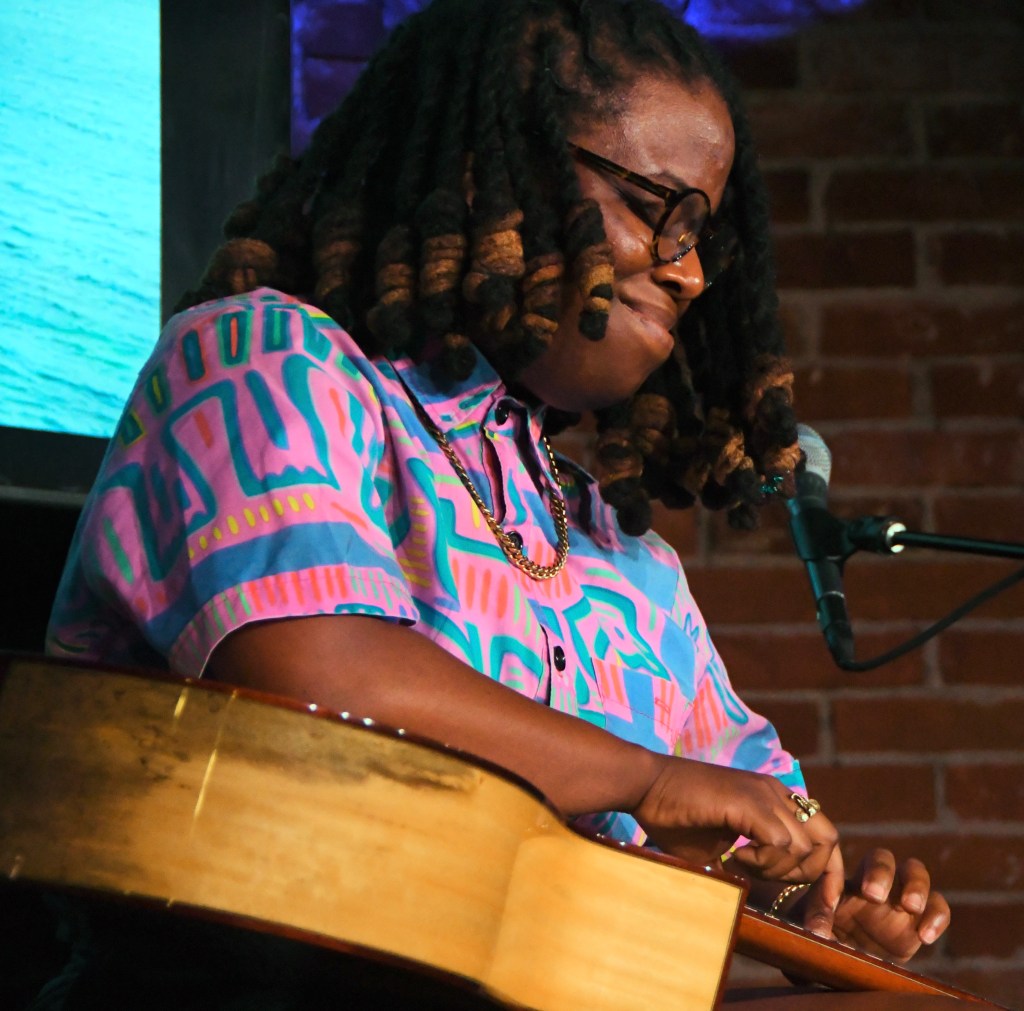
When she beat the online virtual Guitar Player 2 game at 12, her parents got her a real guitar. She found her victorious technique of tapping downward on the game controller across her knees also worked on a real instrument.
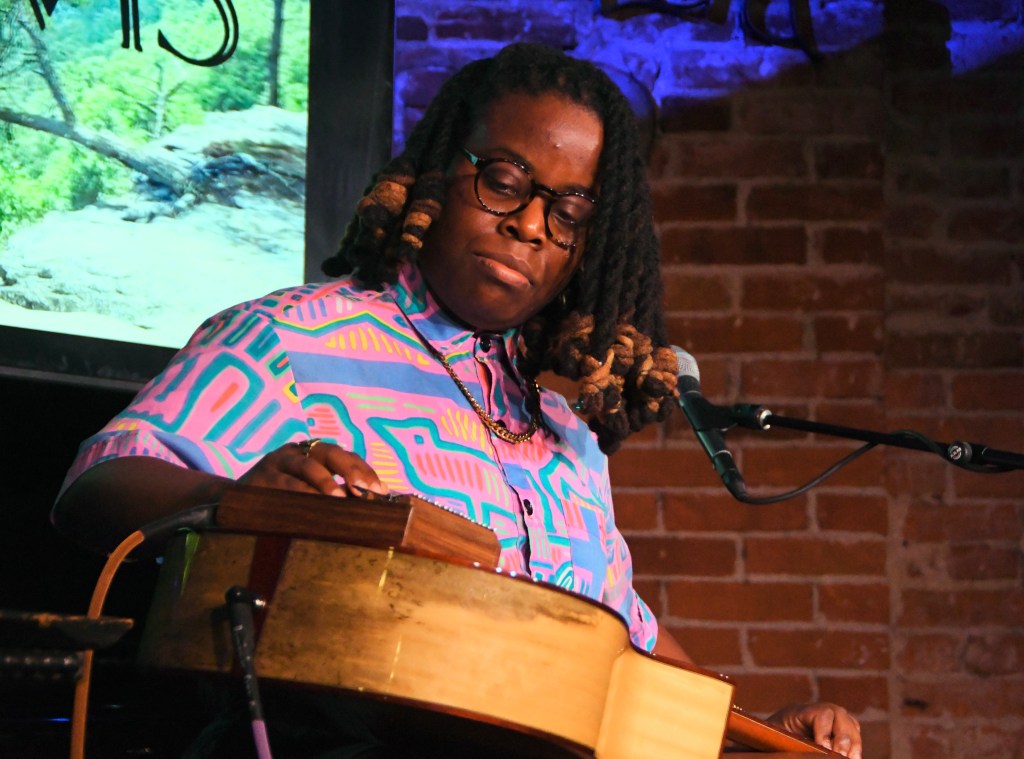
Dobro players hold their resonator guitars across their laps, as Williams does, but typically play with a slide; Williams used only her fingers Wednesday, but slid them at times to slur and glide notes.
She may have known how to play before deciding what to express. Then theory and composition training at NYU shaped technique into a questing, innovative vision: more Stanley Jordan (who played the Caffe recently), Michael Hedges and Adrian Legg, say, than John Fahey or Leo Kottke.
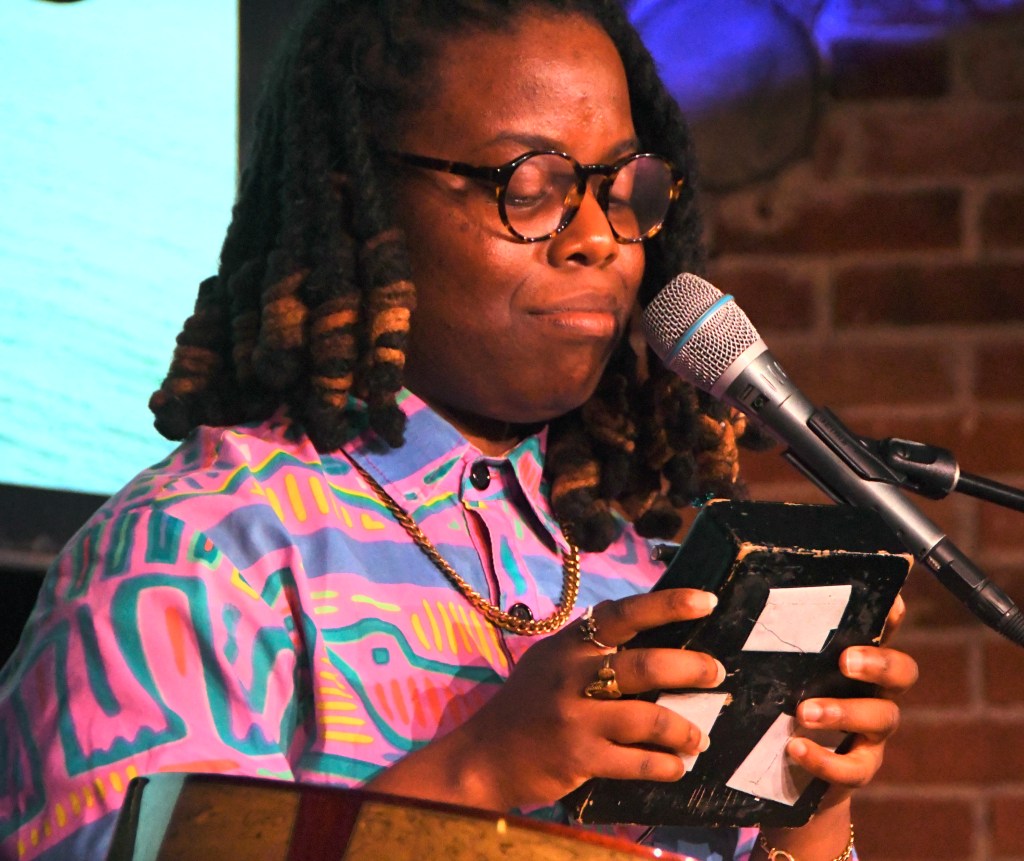
A screen above and behind Williams showed a narrow green river valley; later it held moving waters; and the natural world shaped the pastoral grace of her opener “Cliffwalk” from her new (third) album “Acadia.” At first, she held her Skytop acoustic in a conventional posture and picked cleanly, thumb pick hitting downward and fingers plucking upward. Lowering the guitar across her knees, she tapped the strings with both hands, right hand below the left that ranged over the neck, a kapo at the fourth or second frets. Meanwhile, she tapped the beat with metal tap shoes on a wide wooden board across her guitar case.
Those techniques served her well in “Juvenescence” with its jewel-like melody; in fact, at times, she had to explain emotional content counter to the sheer prettiness of steel-on-wood tones and graceful melodies.
“On A Friday Night” sounded stately and graceful, for example, as Williams lay the guitar flat across her lap – “lap-tapping,” she called this – and tapped the strings with a dulcimer hammer or smacked the body in a two-beat with her right hand as her left tapped the strings higher on the neck.
Afterward, she recalled how loneliness on arriving in the big city made her miserable. Later, she noted how becoming the first NYU freshman to win a campus talent contest brought friends and visibility, She followed “Friday” with “High Five” that celebrated those friends with spry, happy melodies.
“Through the Woods” again referenced the natural world, and introduced the kalimba, which she took up after watching an Earth Wind and Fire video. This busy, percussion-powered number featured hammer taps, left foot tapping the off-beat.
Playing kalimba – “You could call this a thumb piano…but you shouldn’t.”
Her first-set-closing mini-suite “Hummingbird” packed ironic content like “Friday.” She explained it portrayed time spent unhappily in Pittsburgh but started with a pretty finger-picked melody before hard-strummed explosions. Lowering the guitar from standard hold to across her knees, she launched an episodic deconstruction of the melody, a reprise charting the way back to it, then a speedy coda.
More irony in “Sisters,” a celebration of a mountainous Oregon stretch whose lack of turn-outs annoyed her while the view inspired the tune. Here she finger-picked circular riffs, then activated a recorded backing track, adding instruments like a sleek vehicle picking up hitchhiking harmonica, bass and strings. The melody mutated through insistent, minor key grumbles into a glorious chord-strum crescendo whose beautiful repeats formed the coda and brought a smile to Williams, awe in the near-capacity crowd.
“Virga” also relied on recorded backing tracks, the linked voices of Darlingside framing pretty guitar lines. The title refers to an ambiguous meteorological anomaly: rain falling through air so dry the drops evaporate before hitting the ground. The music felt mysterious, too; voices fading after her guitar went quiet.
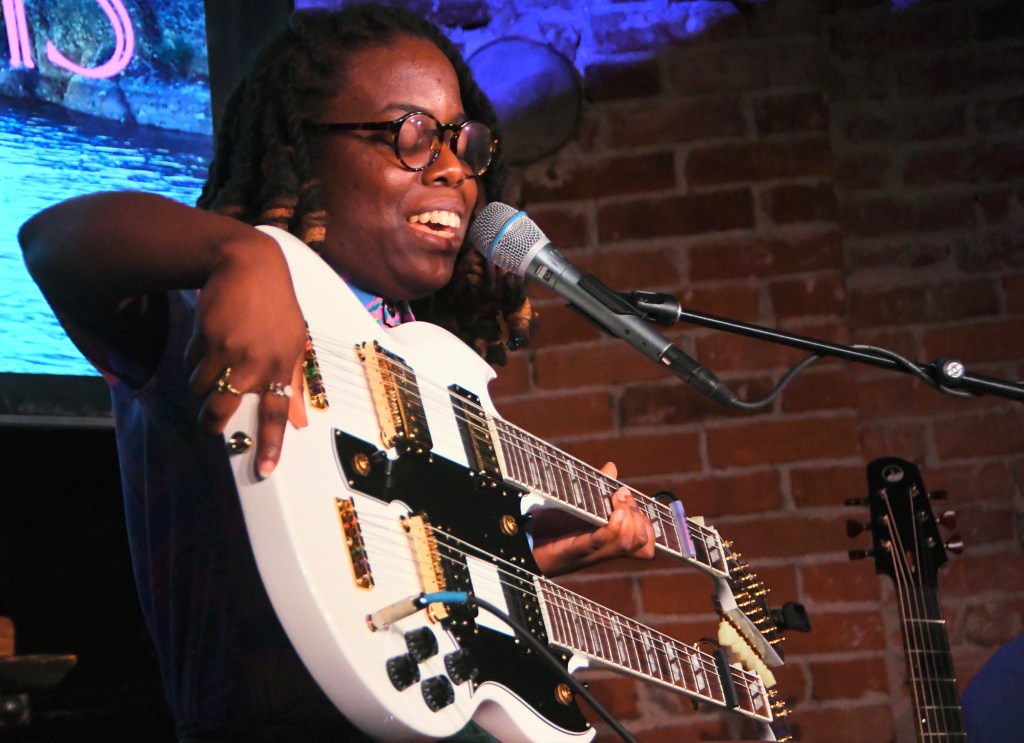
For “Nectar,” she switched to a gleaming electric twin-neck she said she’d simply requested from Gibson and the company obliged. Masters Jimmy Page (Led Zeppelin) and John McLaughlin (Mahavishnu Orchestra, Shakti) play this combined six- and 12-string instrument one neck at a time; Williams played both at once, leads on the 12-string neck with her left hand, right hand tapping bass lines on the six-string neck.
“Song for Alex” featured her familiar single-neck six-string acoustic, finger-picking a tender melody that grew wings as she turned to spry lap-tapping and ringing harmonics to close.
She added kalimba again for “Skippin’ (Song for Bri)” – tapping with fingers and feet – then closed with “Restless Heart,” right hand tapping the body of the guitar, left hand tapping the strings.
Although all instrumental, without vocals, the show wasn’t just for guitar nerds since Williams entertained with a humble affect and a wide warm smile like the great violinist Regina Carter, a virtuoso stylist half a generation older.
Showing Her Skytop Guitar – Twin sound-holes on the side
SET LIST
1 – 7:38-8:15 p.m.
Cliffwalk
Juvenescence
On a Friday Night
High Five
Through the Woods
Hummingbird
2 – 8:30–9:30 p.m.
Sisters
Virga
Nectar
Song for Alex
Skippin’ (Song for Bri)
Restless Heart
Playing kalimba right-handed, tapping on guitar strings with her left
Review – The Soggy Po’ Boys at Caffe Lena; Saturday, Feb. 8
Elbow to elbow on the cozy Caffe Lena stage, the Soggy Po’ Boys played just that tight Saturday in a wide-ranging soulful survey of New Orleans music.
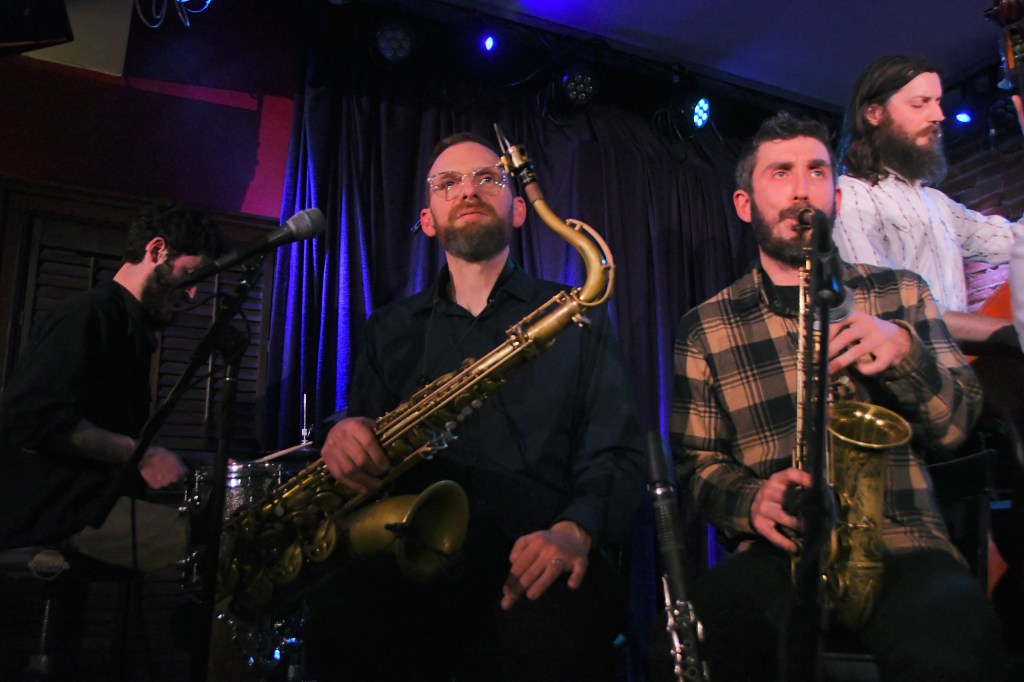
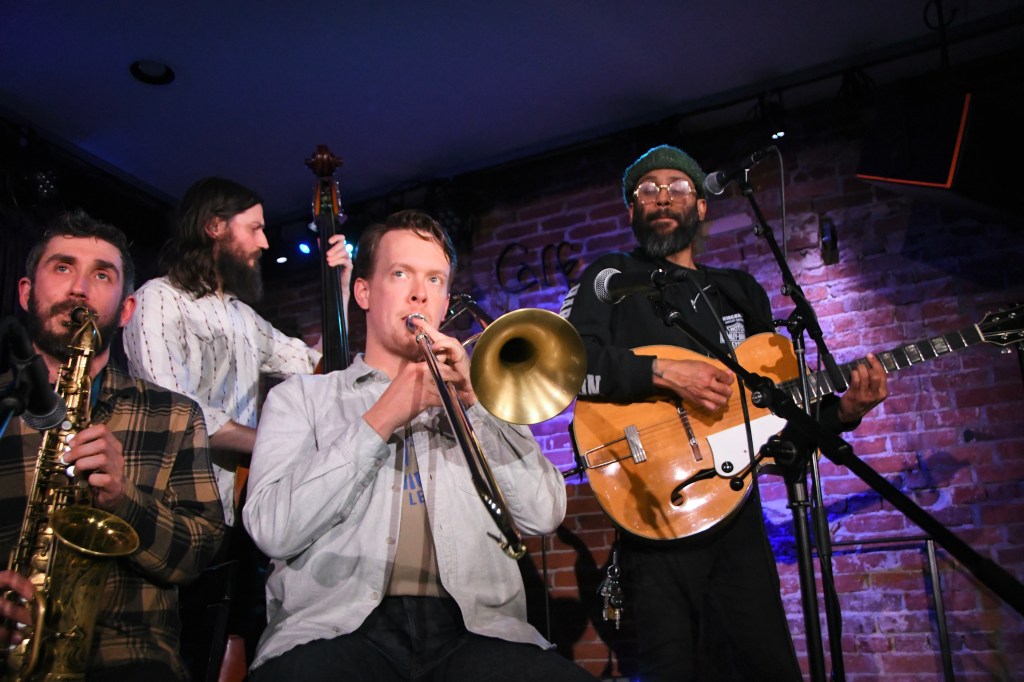
The stage-full of young New Englanders, all bearded but trombonist Josh Gagnon, played more than the traditional sounds. They also got the soul, the spirit and the swing of street-parade chants, classic blues, rocking rumbas, even calypso, noting New Orleans is the northernmost Caribbean city.
The Soggy Po’ Boys, from left: Brian Waterhouse, drums; Mike Effenberger, piano (both with back to the camera); Scott Kiefner, bass; Nick Mainella, tenor saxophone; Eric Klaxon, clarinet, alto and soprano saxophones; Josh Gagnon, trombone; Stu Dias, vocals and guitar
They also scored extra points by playing the Earl King/Professor Longhair funk romp “Big Chief”* – but NOT the too-obvious/almost obligatory “When the Saints Go Marching In.”
As it happened, WAMC played an “American Roots” episode on my drive up, spotlighting New Orleans clarinetists including Evan Christopher (he’s also played Caffe Lena, plus SPAC’s Jazz Festival and the Cock ’N’ Bull), Sidney Bechet, Michael White, Doreen Ketchens and others. This tuned up my ears for fine work Saturday by Eric Klaxon, who also played alto and soprano saxophones, jammed between Gagnon and tenor saxophonist Nick Mainella.
In a return visit after their well-received 2023 Caffe Lena at SPAC set, they boldly opened with an original, the ominous “Waiting On the Bomb to Drop.” Like most tunes Saturday, they riffed a massed-horns intro to set up a dynamic Stu Dias vocal; then horn solos, a wrap-up vocal and killer all-aboard coda.
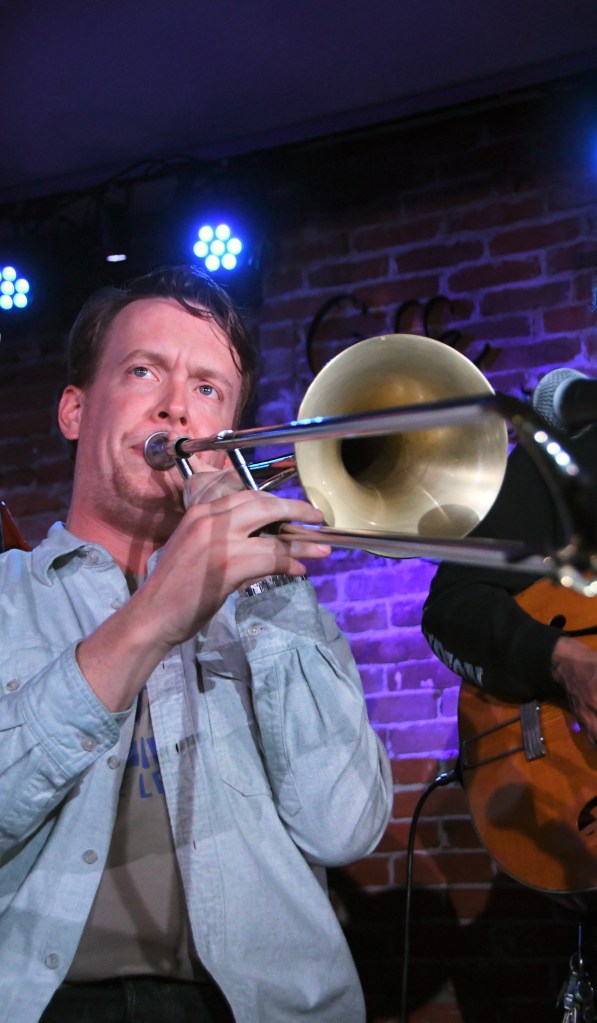
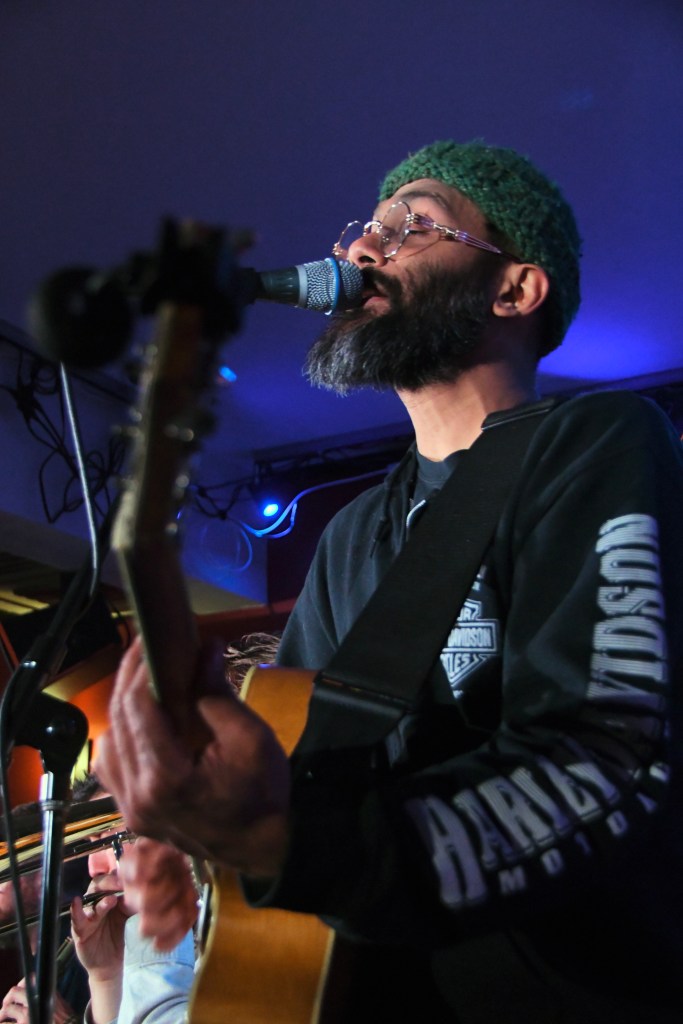
When I visited a close-up seat briefly, I needed two shots to include everybody. Top, from left: Brian Waterhouse, Nick Mainella, Eric Klaxon and Scott Kiefner. Bottom, from left: Eric Klaxon, Scott Kiefner, Josh Gagnon and Stu Dias. (Mike Effenberger is behind Kiefner.)
“By and By,” a standard New Orleans shuffle, followed “Bomb,” then they went tropical with “Gin and Coconut Water,” all the horns getting a piece of this happy calypso. Next, Klaxon owned “Joshua Fought the Battle of Jericho,” earning claps and whoops for his agile alto solo.
Jumping from gospel antique to the vintage-sounding “Weary Blues” felt natural; in fact, song sequences worked well all the way through. For something spunky to set up “Big Chief,” the upbeat “Weary Blues” was just right. The coda on “Chief” had loose, unanimous horn anarchy. Then Professor Longhair’s playful “Tootie Ma Is a Big Fine Thing”** mixed sentiment and sensuality perfectly.
While pianist Mike Effenberger and bassist Scott Kiefner were hard to see behind the horns, they floated to the top sonically in the bluesy groove “A Dirty Job,” Effenberger playing a muscular intro and Kiefner making the most of his first solo all night.
After “Serpent Miagre,” a Caribbean polka with a strong Gagnon trombone break, Dias sang at his mournful best in “It’s Raining,” an Allen Toussaint tune Irma Thomas still sings to stunning effect. Effenberger’s piano shone here, too, in a trio interlude with Kiefner and ever-steady drummer Brian Waterhouse.
The Mighty Sparrow’s calypso classic “Dorothy” launched the second set; wry, twisted-love tunes dominating the late run. In the kiss-off “Baby Would I Lie to You?” Mainella’s tenor set up Dias’s vocal beautifully.
Below: Nick Mainella
Josh Gagnon
Eric Klaxon
They played the calypso “Miss Tourist” as a fan’s request, then it was back to the blues with Bessie Smith’s cautionary “Moan, You Moaners,” Gagnon’s trombone bringing gospel fervor.
Two all-in rumbas – “Touloulou” and “Carmona AD” – bookended “Battle Hymn of the Republic,” a surprising choice in a straight, non-ironic read. Sidney Bechet’s “Shag” showcased Klaxon’s persuasive soprano sax, then a stop-and-go coda brought all the horns into dramatic dialog.
Stu Dias
They shrewdly chose the defiant shouter “It Ain’t My Fault” as sole singalong all night, then cruised “down In New Orleans” – key lyric of “Bourbon Street Parade” – as quick-hit encore.
Unique among concert merch tables, they offered chocolate made by friends back in New Hampshire; each bar earned the buyer an album download.
My preview noted 37 minutes drive time from home to Caffe Lena; snow slowed things, homeward bound, to more than twice that. And worth it.
* Dr. John played guitar on the original 7” single (Watch Records 1965) along with 15 other New Orleans studio stars. Covers include Dr. John’s 1972 version and others by the Neville Brothers, Jon Cleary, the subdudes, the Wild Magnolias, the Meters and the Dirty Dozen Brass Band.
** The Preservation Hall Jazz Band (at The Egg March 8) plays a terrific version on “This Is It,” produced by My Morning Jacket’s Jim James, a big fan.
This came by email from the Soggy Po’ Boys’ office
Set 1 Waitin on the Bomb to Drop By and By Gin and Coconut Water Joshua Fit the Battle of Jericho Weary Blues Big Chief Tootie Ma A Dirty Job Serpent Miagre It’s Raining
Set 2
Dorothy Rascal The chief Would I Lie to You? Miss tourist Moan You Moaners Touloulou Battle Hymn of the Republic (I believe we added a tune here.. Carmona AD, I think) Shag It Ain’t My Fault
Review: Nathan and the Zydeco Cha-Chas at Universal Preservation Hall; Friday, Feb. 7, 2025
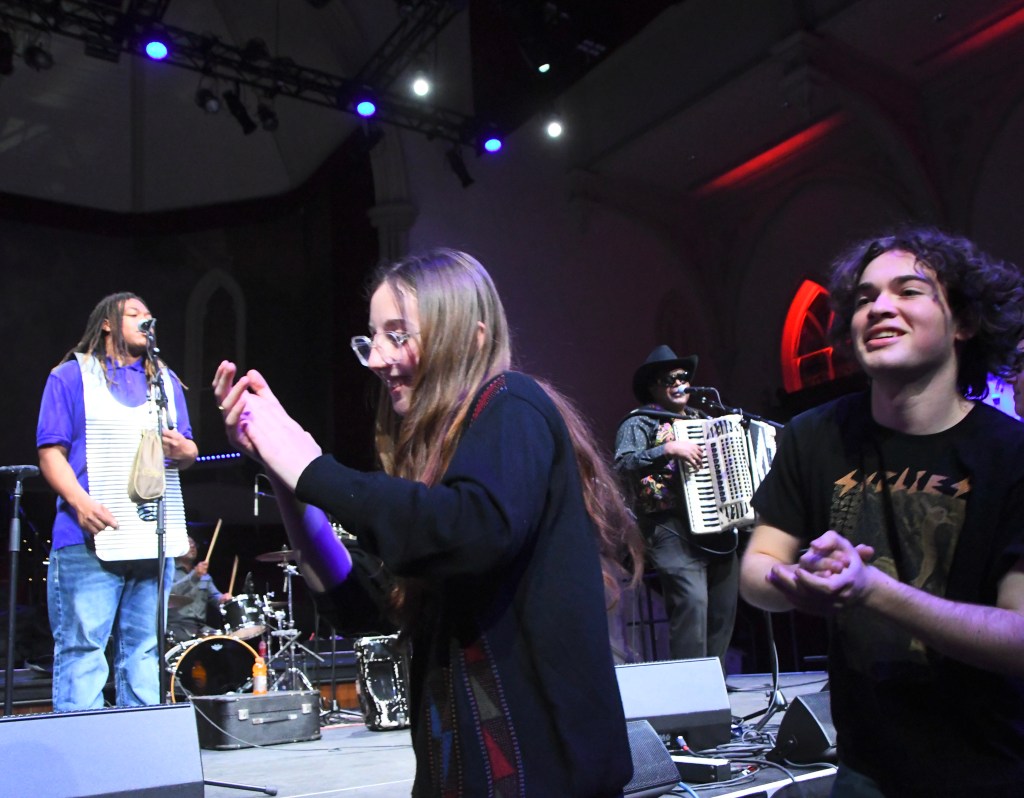
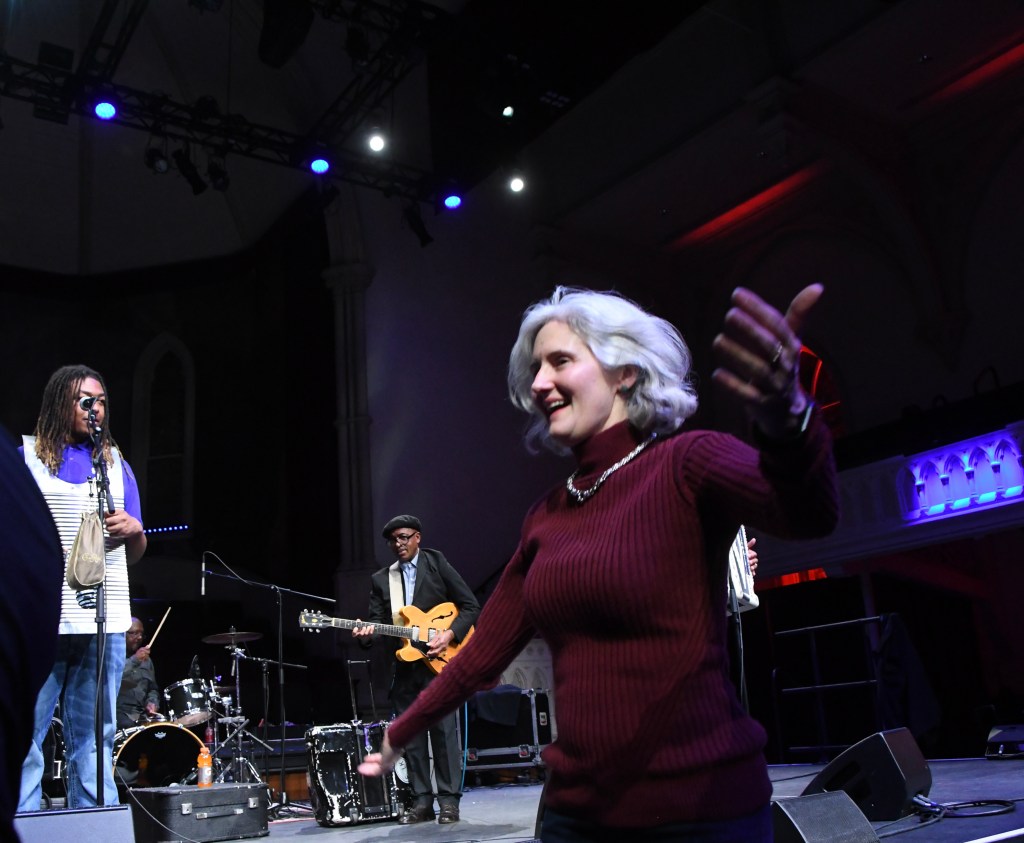
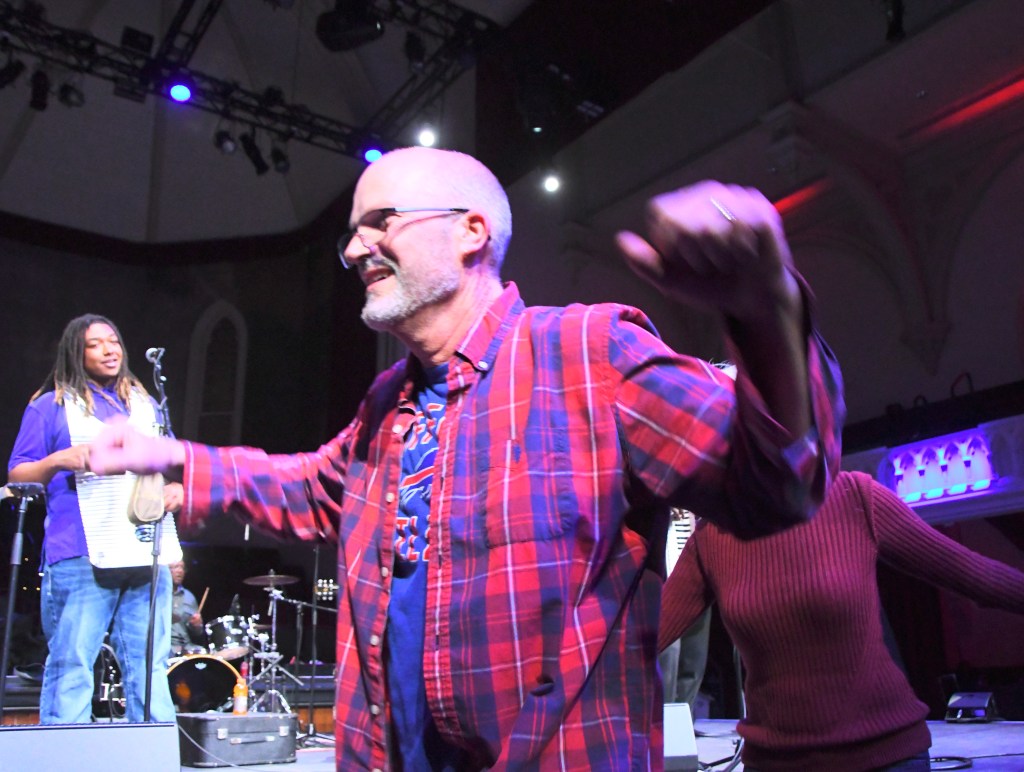
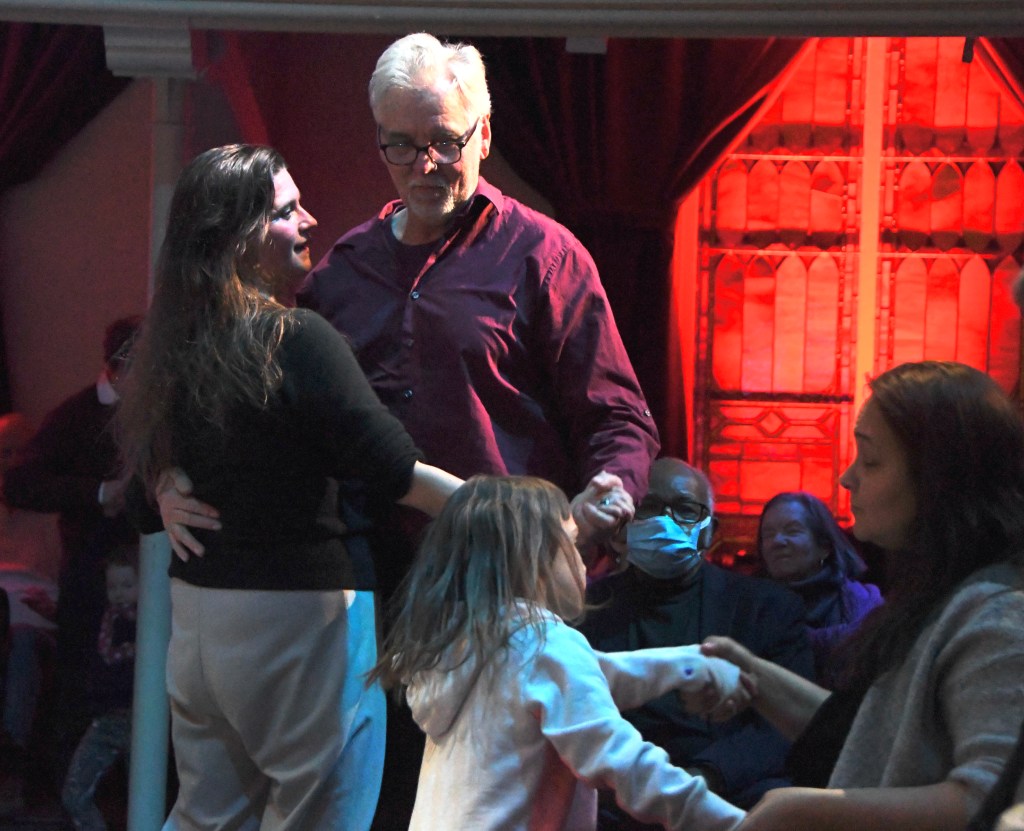
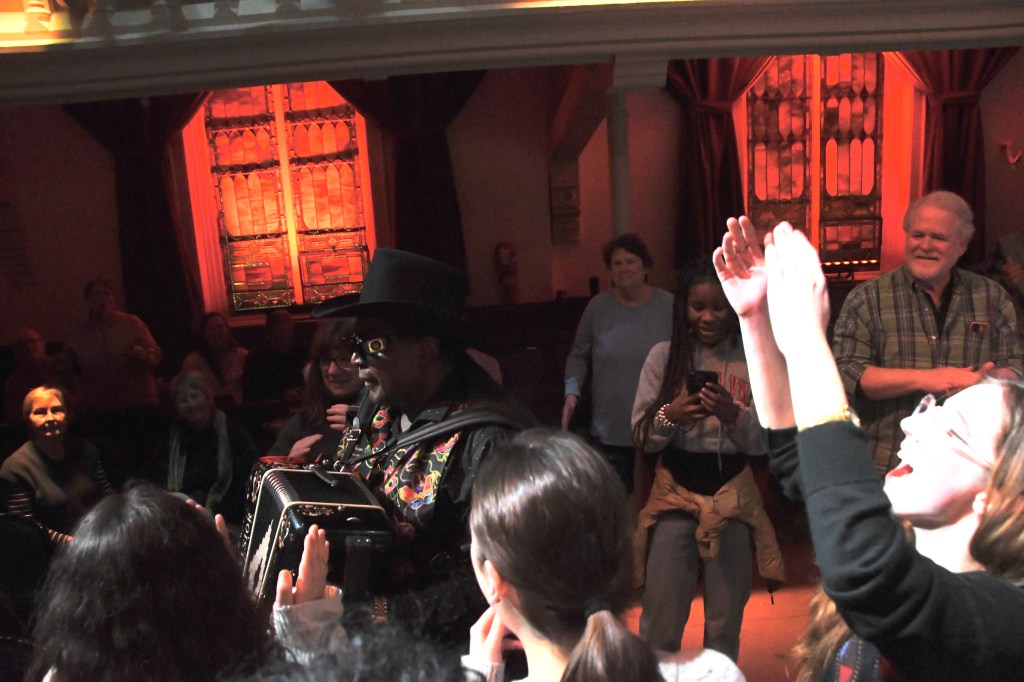
Three conga lines blurred into one as fans formed an unbroken loop through Universal Preservation Hall Friday night in the joyful geometry of zydeco on the loose.
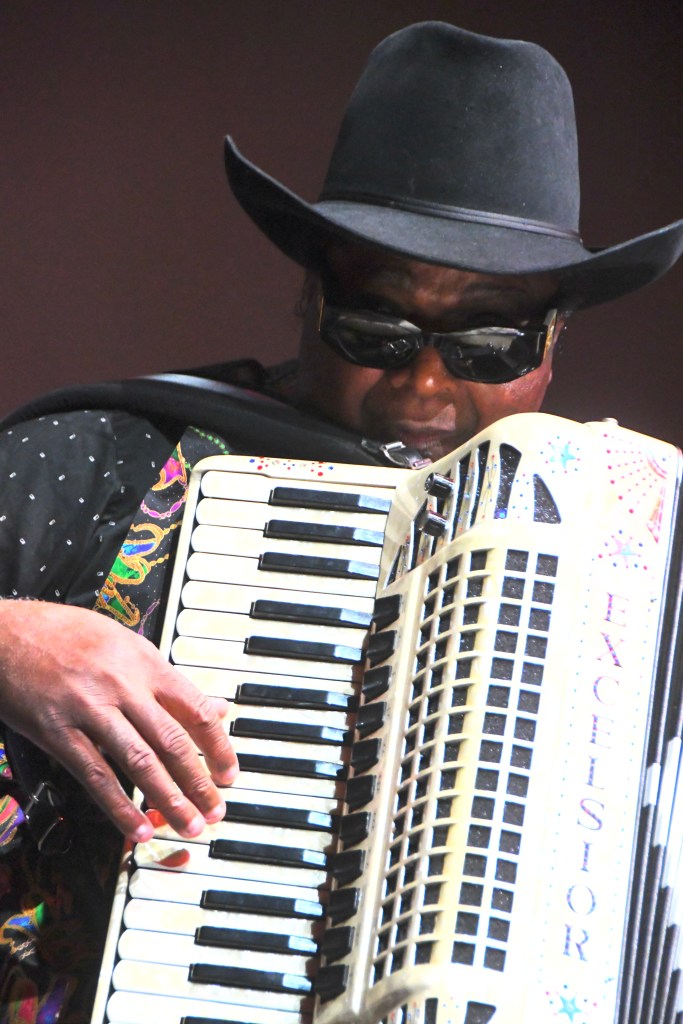
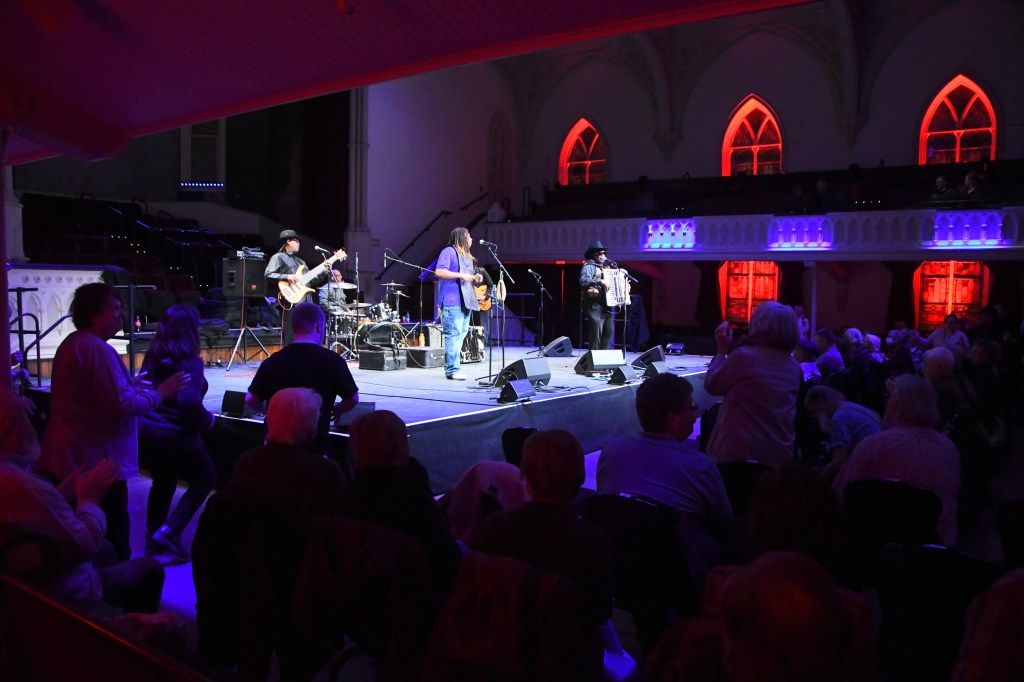
In the kinetic near-capacity tweens to boomers crowd: unanimous smiles, waving arms, clapping hands and shuffling feet. Onstage: the five virtuosos of Nathan and the Zydeco Cha-Chas, throwing it down.
Obstacles stacked up against such unanimous fun.
Bandleader Nathan Williams’s brother Sid (El Sid-O, in song titles and the sign on his Lafayette club) passed last week; and of course there was the forbidding chilly weather. So accordion ace, gruff-voiced singer and spark plug bandleader Nathan needed a party as much as anybody. The weather never had a chance as big warm filled the place, though some dancers never took off their coats.
The band set fire to zippy two-steps, waltzes fast or slow, and a chill-out cha-cha or two – one called “Zydeco Cha Cha,” of course. Nathan sang in English or French and traced his musical roots back to where “crawfish got soul and alligators get the blues.” After most tunes, he playfully asked, “Was that all right to you?” – and reaped the affirmation it deserved.
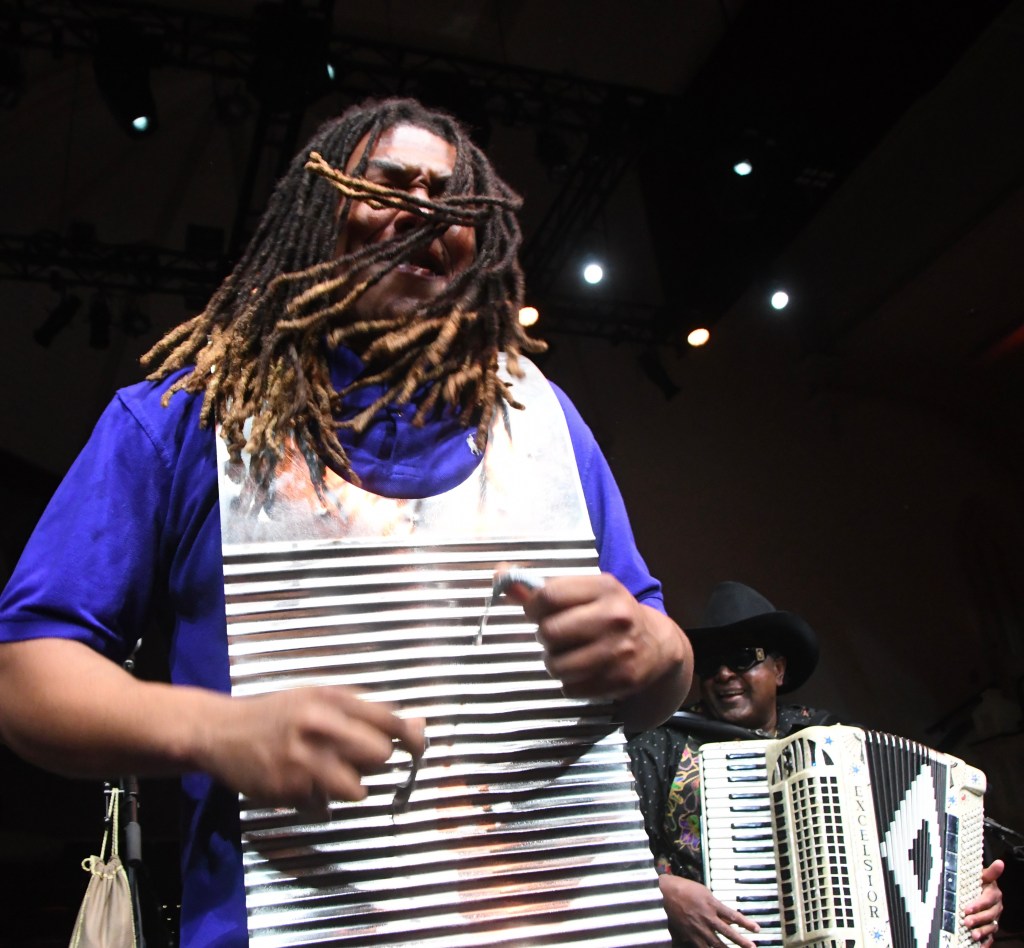
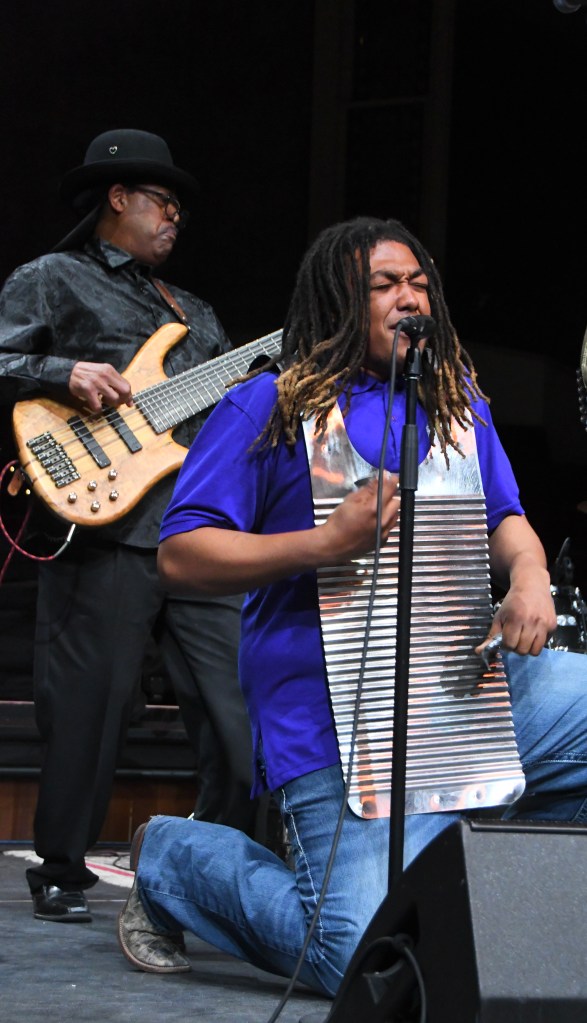
“Zydeco Boogaloo” hit early (and repeated later), but a tune based closely on “Bring It On Home to Me” showed the band’s flexible strength. When Nathan’s brother Dennis Paul Williams broke a guitar string, Nathan revved his accordion riffs to fill in the blanks while (Nathan’s nephew) Jason George welded his rub-board scratches even closer to Keith Sonnier’s snare-drum hits and Nathan’s cousin Alan Williams’s bass lines hit harder, too.
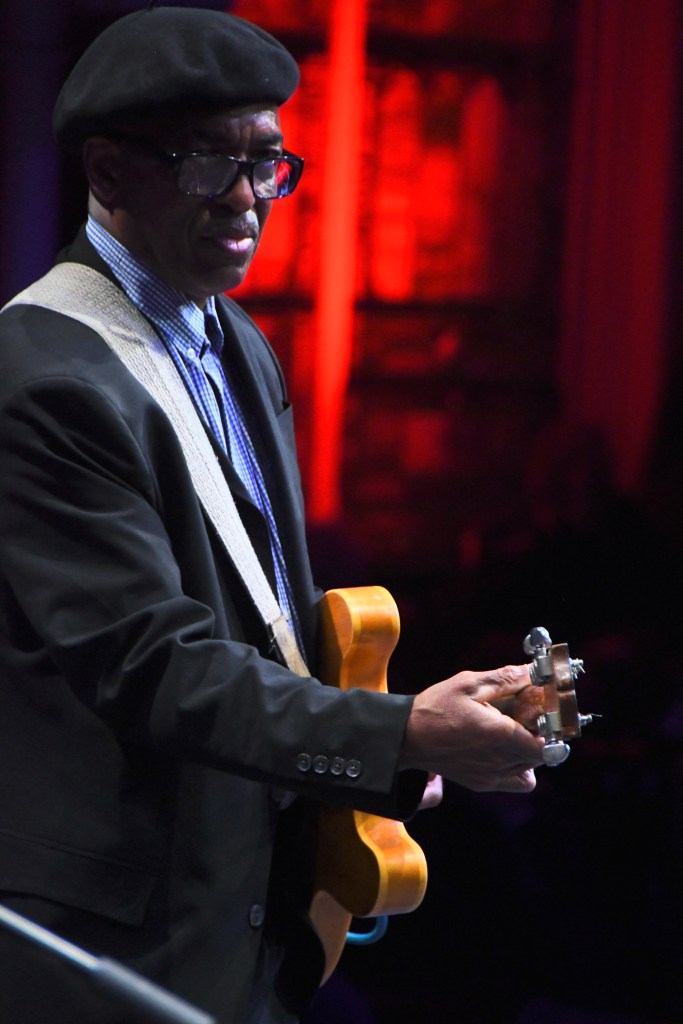
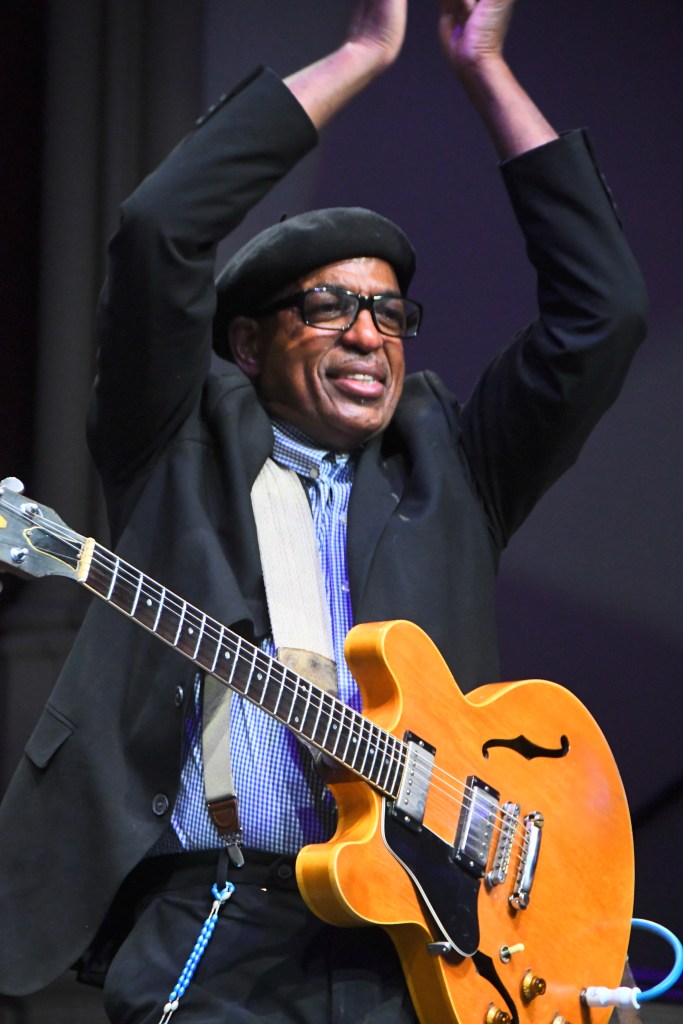
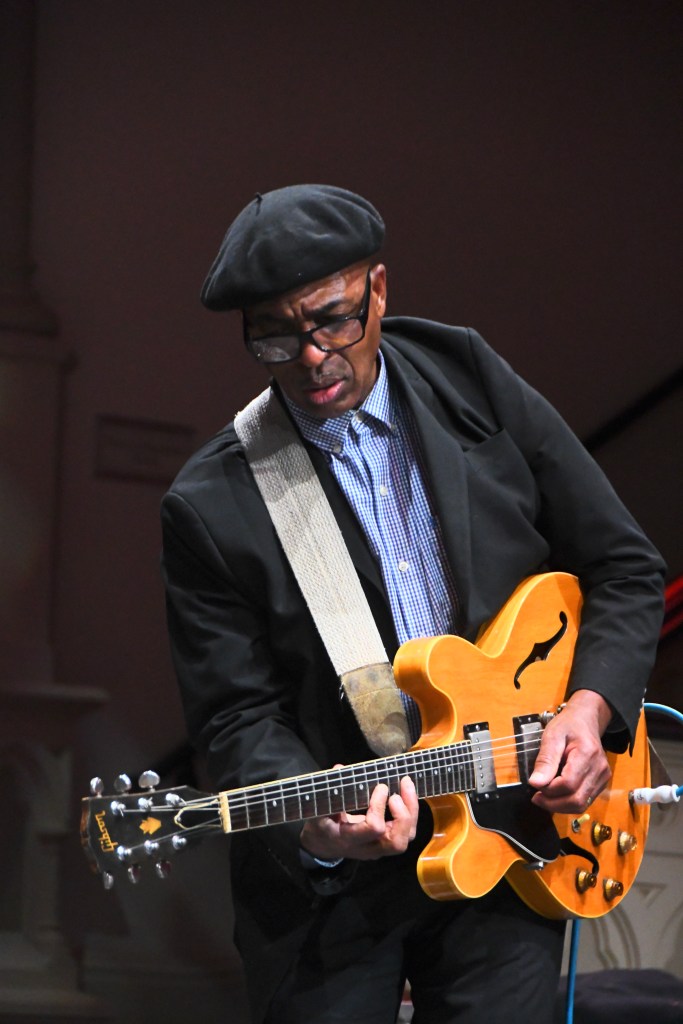
Dennis Paul Williams, and fat Gibson
Gaston George, left; and Nathan Williams
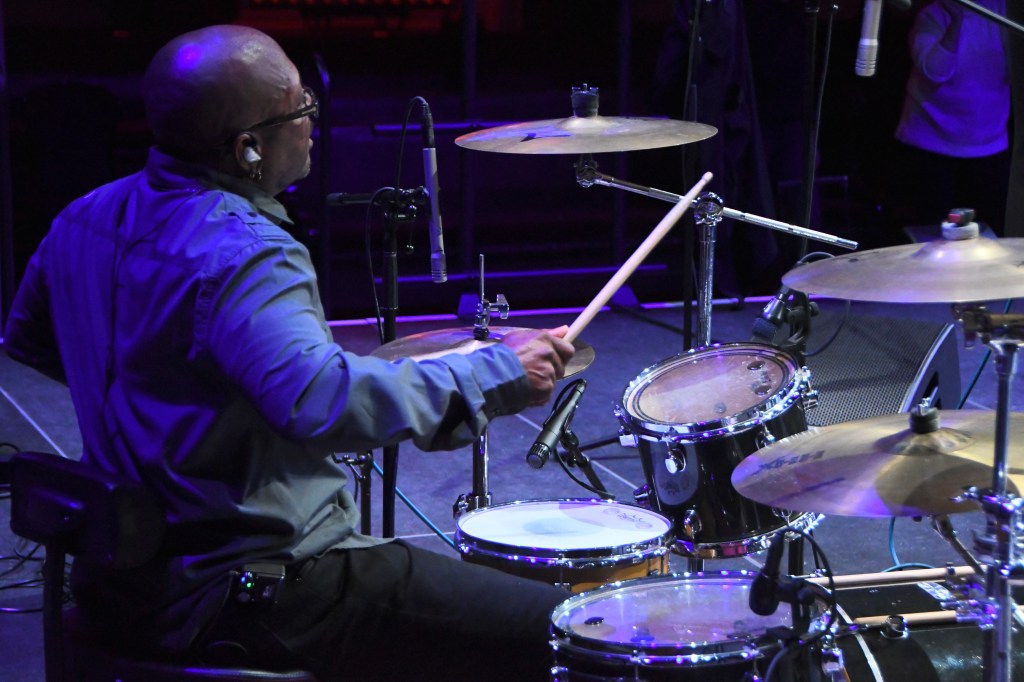
They mostly played at full strength, but some sparser, more subdued interludes showed they could have played the whole show as duets, especially Dennis Paul Williams’s relentless Snooks Eaglin-style rhythm-guitar chords. He didn’t have to solo much to deliver soulful strength. George scratched the steel furrows of his shoulder-mounted rub-board with spoon handles bent away from the bowls. Sonnier’s snare-and-kickdrum beats stayed simple since so much was happening above, notably Alan Williams’s hyperactive repeating bass runs that pumped and pushed with centrifugal force.
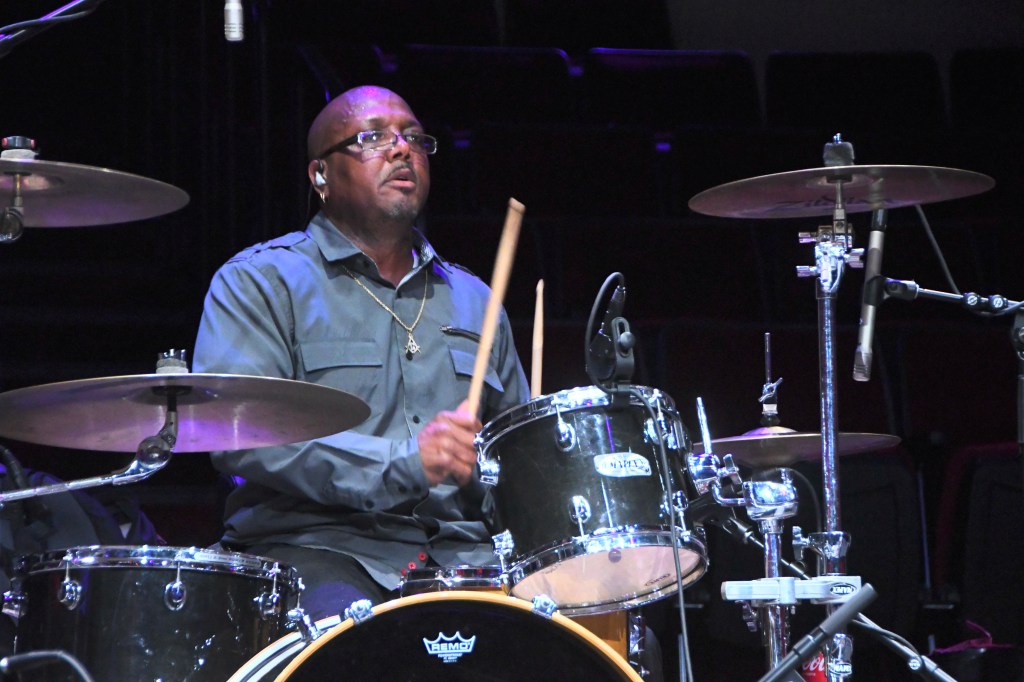
Keith Sonnier
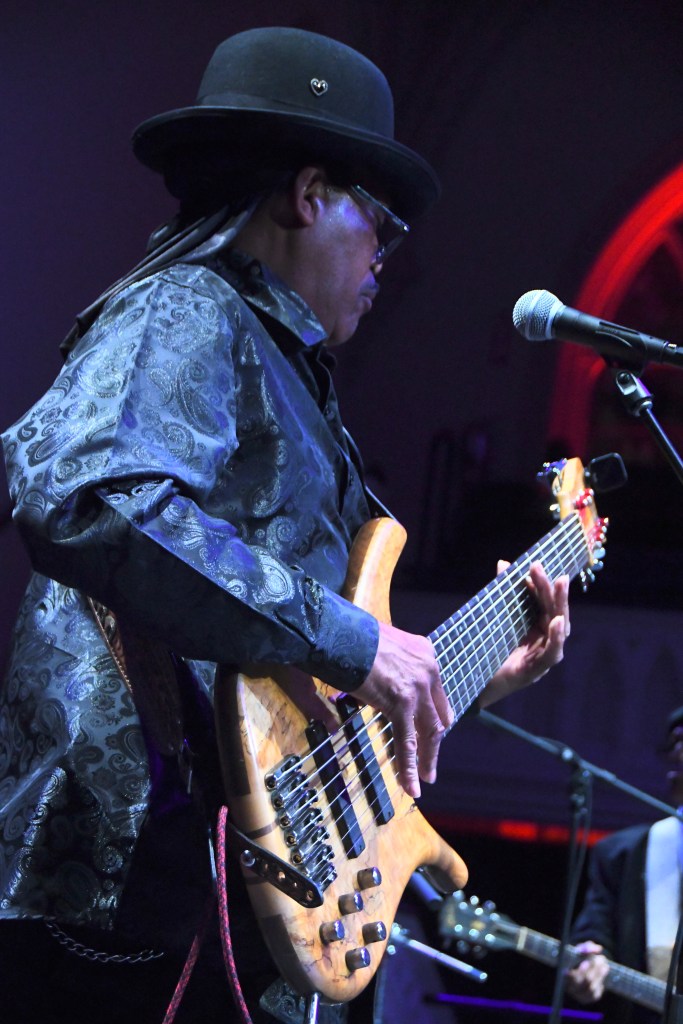
Alan Williams, and seven-string bass
The songs didn’t have to say much, so Nathan’s vocals felt like another instrument; they changed up the tempos and beats more than the formidably dense arrangements. The shuffle “Follow Me Chicken” jumped into a subterranean groove whose title I didn’t catch, then the two-step “Your Mama Don’t Know” eased into the waltz “Too Much Wine.”
Nathan paid tribute to his mentor Buckwheat Zydeco in another waltz, Buckwheat’s “Take Me To the Mountaintop,” a soulful, seductive bluesy guitar solo stirring things up and going call and response with Nathan’s voice.
The energy of “I’m Looking Forward to It” organized the dancers into conga lines; then, impressively, they built the energy back up that had been dissipated some by a problematic shift from piano accordion to diatonic “button” accordion.
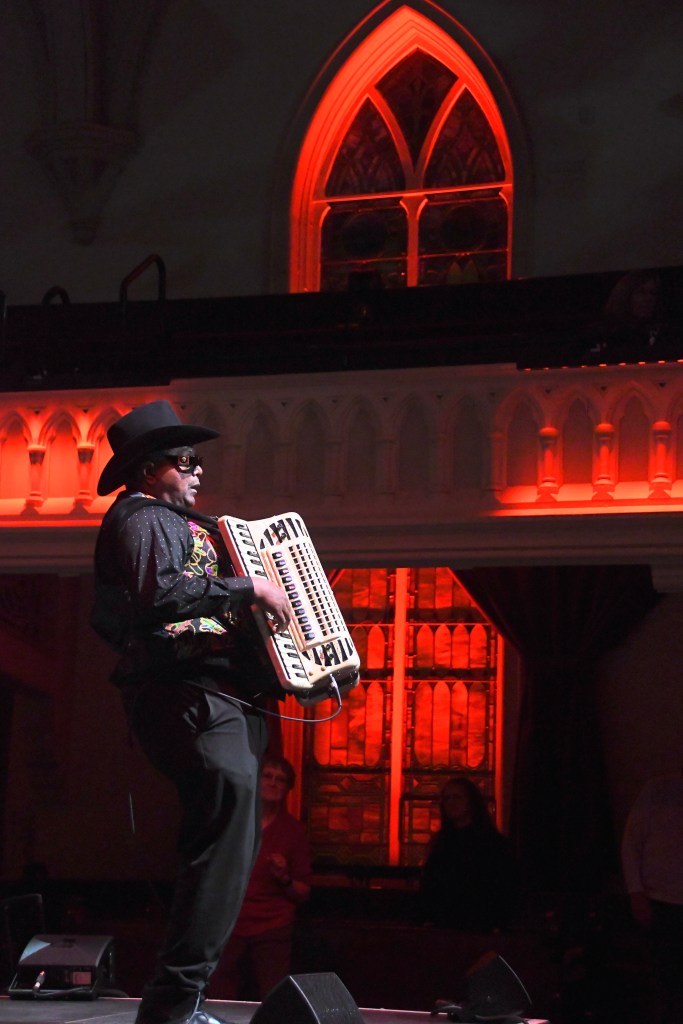
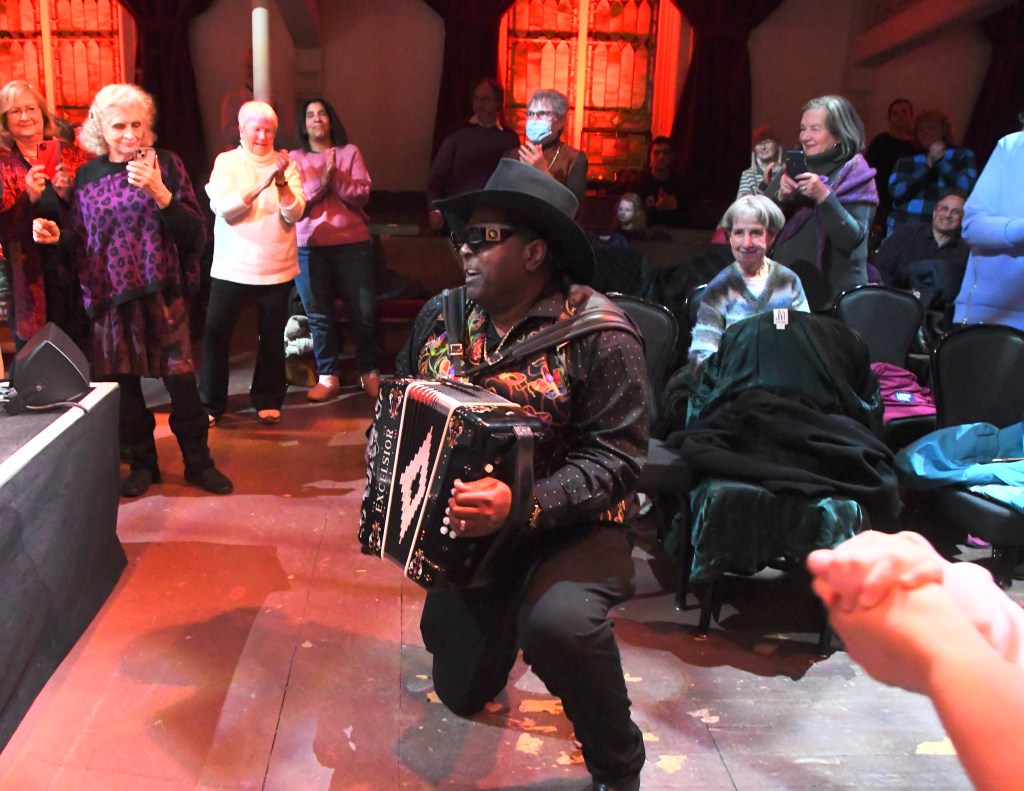
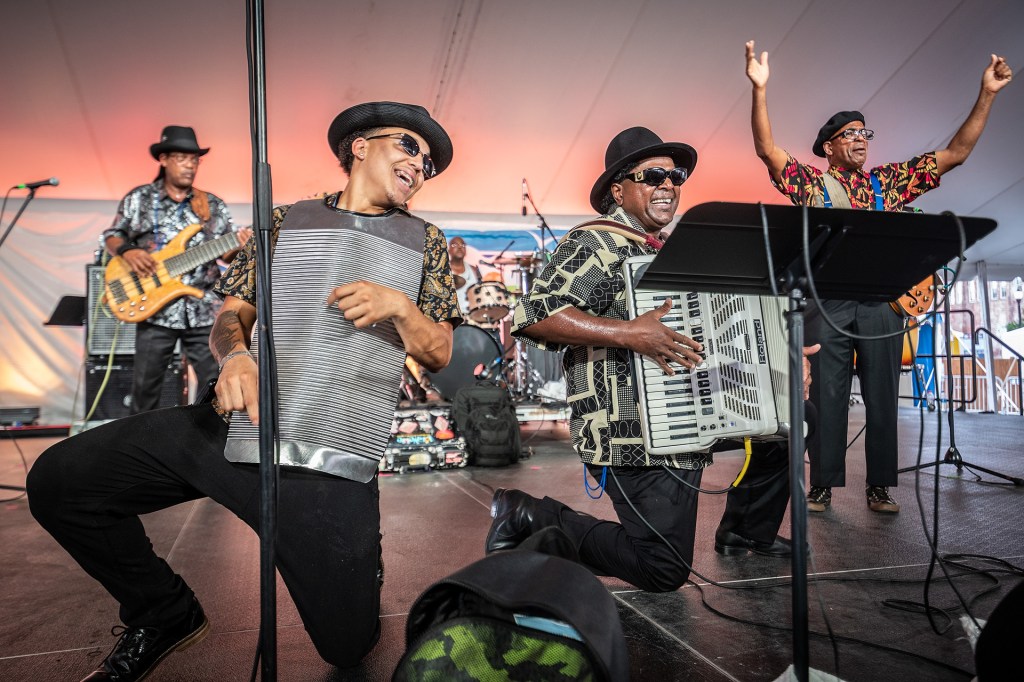
No problem: “Sid-O’s Zydeco Boogaloo” – or was it the other “Zydeco Boogaloo”? – re-energized band and fans as Nathan went wireless and wandered the house, playing, grinning, sitting down among his fans, dropping to one knee to acknowledge dancers by the stage.
Everybody, everybody, was in the show.
Set List – fuhgeddaboudit!
Nathan made up the show song by song, sometimes announcing tunes to band and fans, sometimes not. It was 92 minutes of fine, fierce, focused force.
New Orleans is 21 hours drive time from my house, five hours by air via Albany Airport.
Music erases travel: Nathan and the Zydeco Cha Chas play Friday at Universal Preservation Hall 39 minutes from my house, and the Soggy Po’ Boys play Saturday at Caffe Lena, 37 minutes away.
The Zydeco Cha Chas are mostly family; and Williams named the band after a tune by 1960s zydeco pioneer Clifton Chenier, an early inspiration. Williams first recorded for his brother Sid’s label at 21 and played weekly at El Sido’s Zydeco & Blues Club in their hometown of Lafayette, ground zero of zydeco and Cajun music. Williams bought his first accordion from mentor Buckwheat Zydeco, who also recommended his young protege to Rounder Records.
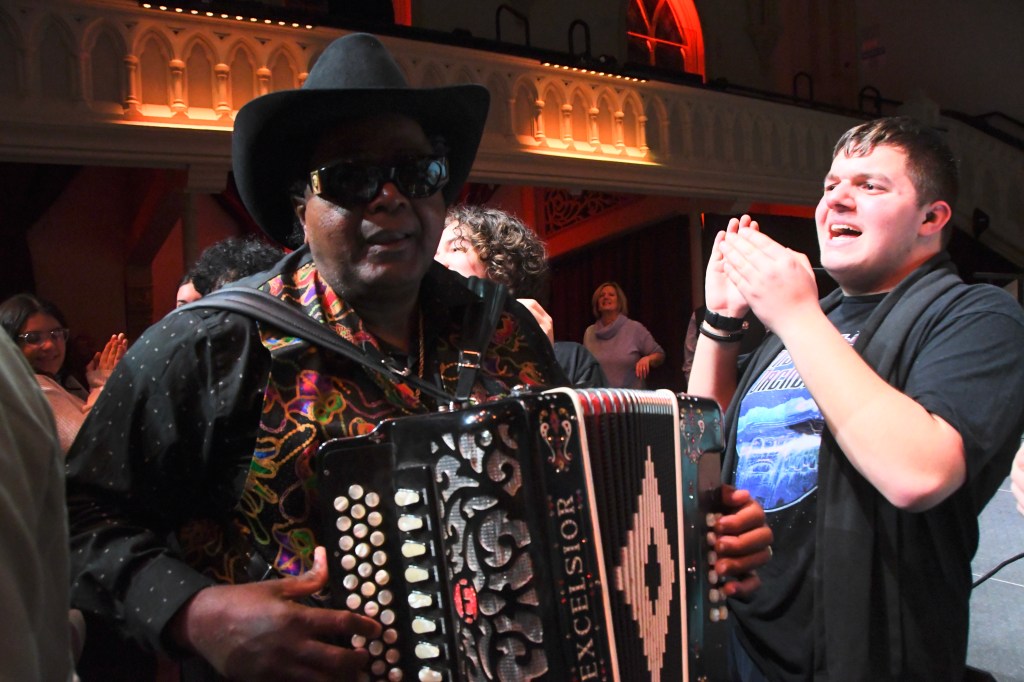
Nathan Williams Squeezes Big Fun from his Accordion, with the Zydeco Cha Chas. Photo Provided.
Since Williams and his Zydeco Cha Chas first played the New Orleans Jazz and Heritage Festival in 1988, they became regulars at New Orleans’ Rock ’N’ Bowl in 1988, recorded their live album “I’m A Zydeco Hog” there in 1997 and helped celebrate the venue’s 30th anniversary in 2018. They’ve also played Lincoln Center, the Kennedy Center, the Grand Ole Opry, top European venues and Jazz Fest after Jazz Fest.
On record, they earned a 2023 Grammy nomination for “Lucky Man” after collaborating with Cajun superstar Michael Doucet on “Creole Crossroads” (1995).
Zydeco – zippy, blues-deep but happy dance music – works best onstage. Its two-steps and waltzes aim beats at the feet, vocals and solos for the roof. The Zydeco Cha Chas feature accordionist-singer Nathan’s guitarist-brother Dennis Paul and bassist-cousin Alan Williams, plus rub-board player Jaston George and drummer Keith Sonnier. Pedigree is no guarantee of quality; but this band’s proof is in their swing.
Show time for Nathan and the Zydeco Cha Chas Friday, Feb. 7 at Universal Preservation Hall (25 Washington St., Saratoga Springs – 39 minutes from my place) is 7:30 p.m. 518-346-6204 www.proctors.org. Like Michael Doucet back in the fall, this is a Proctors Passport Series presentation
Geography is no barrier to love and mastery of music from elsewhere.
The Soggy Po’ Boys formed in Dover, New Hampshire for a Mardi Gras party in 2012. You can get a po’ boy* at NaNola and other places, and a muffuletta at Perreca’s – and good music travels just as well.
The Soggy Po’ Boys. Photo Provided.
Zydeco pumps down-home flavors, Creole country music; the Soggy Po’ Boys play more urban traditional jazz and street parade chants.
A brass-band, Soggy Po’ Boys echo Second Line struts, vintage jazz and late-night funk ala the Meters. New Orleans is the northernmost Caribbean city, and these guys play a distinctive island bounce.
The Soggy Po’ Boys pack more brass-band boogie than Nathan and the smaller Zydeco Cha Chas, with reeds (Eric Klaxon), trombone (Josh Gagnon) and tenor sax (Nick Mainella) plus Stu Dias, vocals and guitar; Mike Effenberger; piano; Brian Waterhouse, drums; and Scott Kiefner, bass. Their seventh album “Leave the Light On” hit in October.
Show time for Soggy Po’ Boys Saturday, Feb. 8 at Caffe Lena (47 Phila St., Saratoga Springs – 37 minutes from my place) is 8 p.m., doors at 7:30. Tickets $27.12, members $23.86, students and children $13.56. 518-583-0022. http://www.caffelena.org. It’s part of the Peak Jazz Series, supported by Joseph & Luann Conlon in memory of Corrine Simonds.
They return hereabouts on March 2, playing the cozy Parlor Room in Northampton.
CUISINE AND HAPPINESS NOTES
* A po’ boy is an iconic New Orleans sandwich on crusty French bread with shrimp or meat and cheese; topped with mayo, lettuce, pickles and tomato, it’s “full dressed.”
Sympathetic food purveyors reputedly developed it to support an early 20th century labor action, to feed “those po’ boys out on strike.”
Once at Jazz Fest in New Orleans, I ordered a sausage and shrimp po’ boy at a food stand I hit at every Jazz Fest I can get to. “I see the sausage, but where’s the shrimp?” I asked, confused. “Yeah, that’s IN the sausage.” And OMG.
Another warm spring Jazz Fest day, I was walking from one stage to another. There are 12, but I don’t remember now and didn’t care then who I was going to see next; it was enough that I was among unanimously happy multitudes. A cold Pilsener Urquell in one hand and a Cajun duck po’boy in the other, I realized this is one of the happiest moments of my life.
That’s why I’m going back this spring, my first return since Covid, and to Louisiana in Saratoga Springs Friday and Saturday, Feb. 7 and 8.
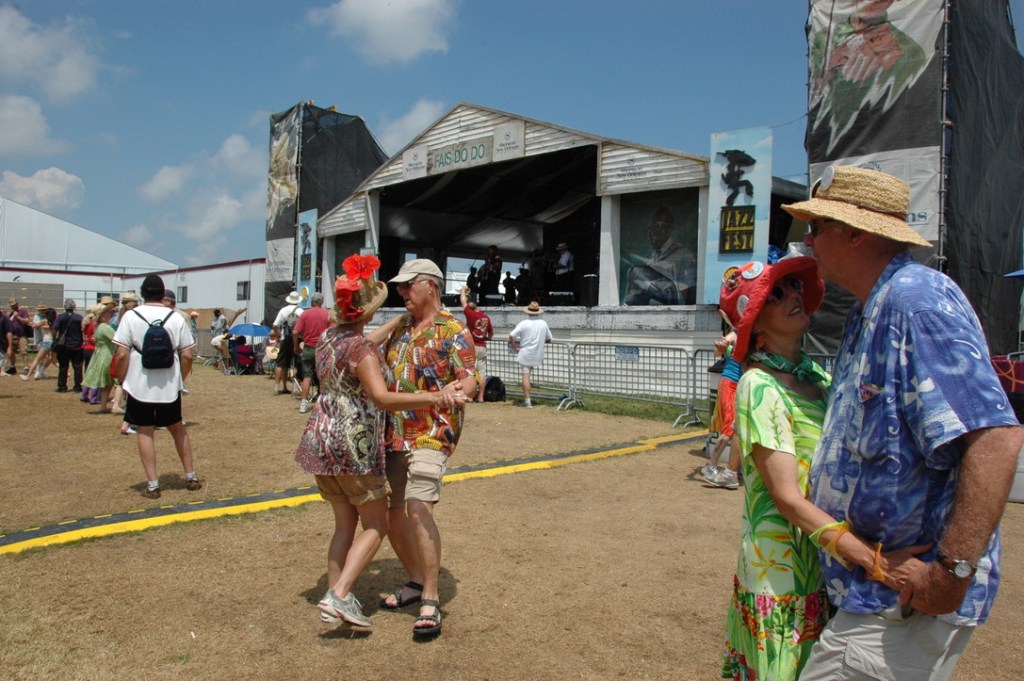
Dancing at the Fais-do-do Stage. Michael Hochanadel Photo
REVIEW: David Greenberger and the Huckleberries Perform “Universal Preservation” Sunday, Jan. 19, 2025 at Universal Preservation Hall
Spoken word artist and archivist of the old (among many creative activities) David Greenberger and his Huckleberries preserved and celebrated universal human truths Sunday at Universal Preservation Hall in a compelling talk-with-music presentation of the same name.
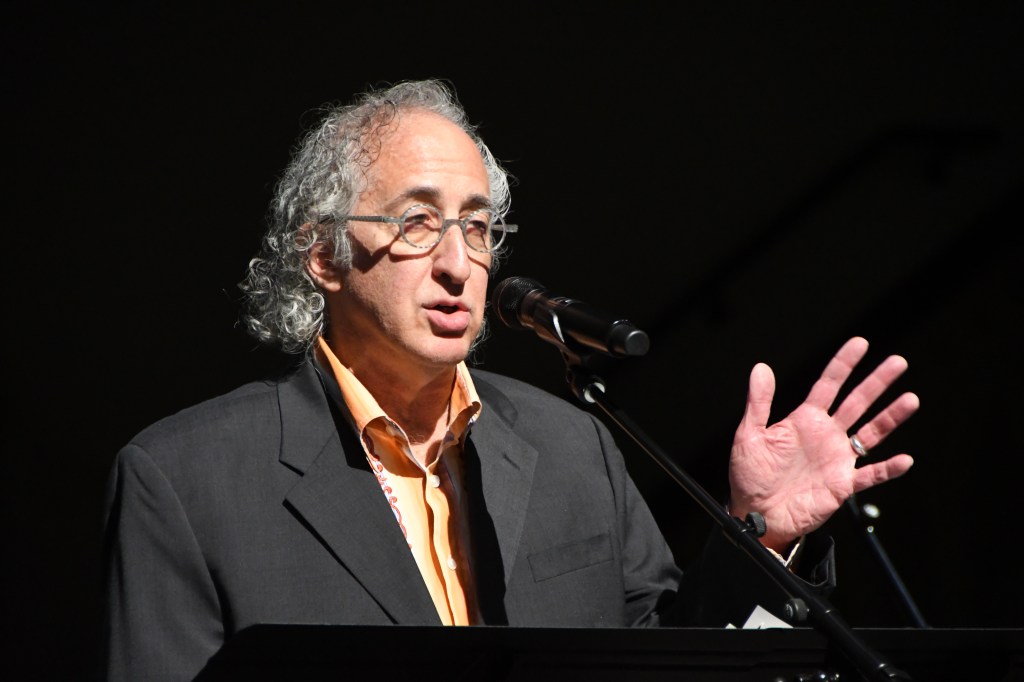
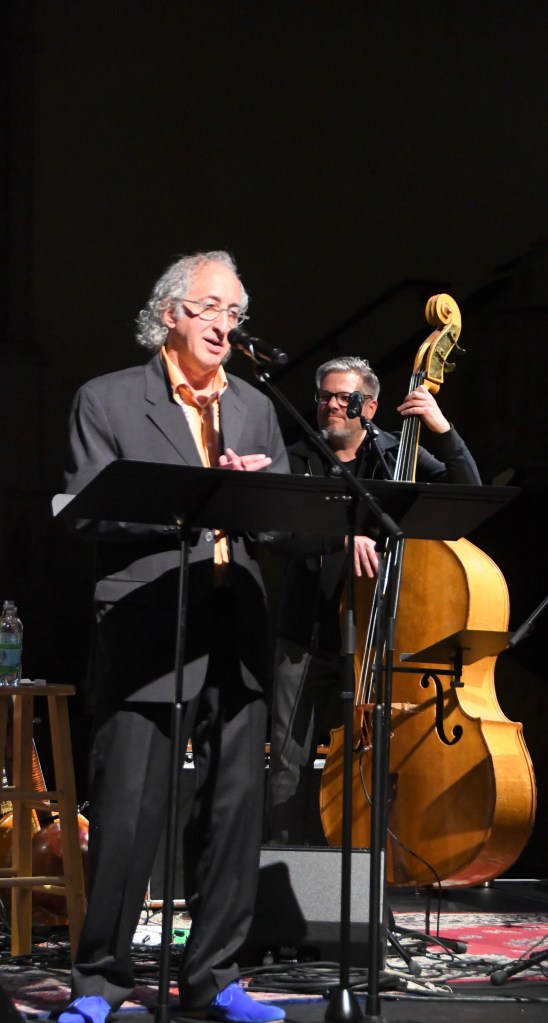
David Greenberger, center, and the Huckleberries, from left: Chris Carey, Sam Zucchini, Greenberger, James Gascoyne, and Peter Davis. Photos mine
Proctors impresario Philip Morris commissioned the project, recorded in 2019 before Covid stopped everything, including a planned performance celebrating the reopening of the Universal Preservation Hall, a Saratoga church repurposed as venue. Revived half a decade later and re-sharpened in recent rehearsals for the stage, “Universal Preservation” combined elements that each could have stood alone. The words Greenberger collected in conversations with area oldsters – a work of preservation and appreciation he began in 1979 as “The Duplex Planet” – fit well with new music by a capable quartet.
Combined on Sunday, it felt unified and organic. Sometimes Greenberger words fell right on the beat from the quartet behind him, and short solos fit his pauses at the mic. But it all mainly worked as a matching of moods, and those evolved in the 75-minute performance.
First came pure fun; a mellow soft-jazz groove as Greenberger recited words of Frank Nelson recalling his father’s alacrity at handicapping horses. “Dad and the Horses” opened both the two-CD recording and Sunday’s show; the light-hearted piece took on a poignant weight as Greenberger noted afterwards that Nelson had died since their conversation in a Saratoga care home. So had several others since Greenberger collected their words and he recorded them with the Huckleberries before Covid.
Many of the mostly short words-and-music constructions carried this message, that we all age, if we’re lucky, that good times are to be cherished and that fate serves them up to us unpredictably.
An immigrant story followed “Dad and the Horses,” at a slower tempo for a more serious feel. Then a gentle bossa beat underlined a recitation of a long career in caring from a retired nurse who lamented how workaholism limited his cultural opportunities. Then, back to fun in “A Great Story About a Bike,” an ironic tale Greenberber warned would be louder and was, a lively sax-flavored rocker with a stop-and-go cadence and a cozy coda that stopped in mid air.
Here we have to give the whole band some.
As noted, they could have played the whole show without words and still richly entertained the rapt audience. Drummer Sam Zucchini played the pulse, closely grafting his beats to bass (electric) from musical director Chris Carey, who also played keyboard and mandolin, or James Gascoyne (acoustic), who also played guitar and gourd banjo. Stage left stood Peter Davis who played keyboard, banjo, alto sax, low-whistle and alto dobro.
Sam Zucchini
As versatile as they were skilled, they echoed Frank Zappa’s jagged bass-heavy rock-jazz in “A Great Story About a Bike,” Paul McCartney-like piano punch in “The Future Is Great,” a blues stroll in “Lobster Bagpipes,” reflectively quiet banjo under “Fishing Poles,” while “Albany Girl” cruised on a bluegrass acoustic feel. Two rollicking keyboards ganged up on “Zucchini, Heat, Pipes and Bass” and maybe most direct influence by a single example, “Outdoor Person” packed the dignified simplicity of The Band.
Chris Carey, playing a Fender bass as well-loved and -used as Pete Donnelly’s (The Figgs)
If jazz was the dominant flavor, with rock and folk as spices, it also felt sophisticated as an episodic concerto or oratorio; Deep Truths over Discreet Charm, maybe.
David Greenberger, left, and James Gascoyne
Peter Davis
Between songs, Greenberger shared information, straight and off-kilter. Naming the sources of his monologs in conversations with Saratoga oldsters, some now deceased, he also lightened up with fanciful facets of a restless creative mind. He said he’d named the band behind him partly after a line in “Moon River” but mostly after Huckleberry Hound, noting he’d joined the cartoon character’s fan club as a kid. He rummaged among band names he’s obsessively devised for decades, collecting in notebooks such gems as “Being Yelled At” and “Little Pieces of Paper.” And he applied alphabetical numerology to band members names in intros as clever as those of Darlingside, another conspicuously clever crew that’s played Universal Preservation Hall.
The show had arc, development; mixing the humorous with the profound early on, though the line between them blurred often. Aging itself increasingly became the theme, mostly in satisfied musings over well-lived lives but also mourning loss at times: the lamented ends of long marriages, cherished homes or fulfilling work.
Ultimately, though, Greenberger managed to sequence and build his monologs to serene and sweet effect, with well-matched music framing, underlining and spicing his words.
David Greenberger’s blue suede shoes – an affectionate echo of Nippertown founder Greg Haymes’ love for publishing performers’ footwear
Earlier comments here on Saratoga Jazz Festival artists announcement felt incomplete without giving the full schedule. So here’s the full line-up for the 22 acts on two stages over two late June days/evenings.
First let’s parse how the list below – copied and pasted from the news release – translates into a schedule and, later, becomes a plan.
In short, the listings for the two stages are in reverse chronological order.
Saturday, saxophonist Kenny Garrett plays first on the Amphitheater (Main) stage where pianist Michel Camilo and his Trio follow; then blues guitar flamethrower Gary Clark Jr. closes Saturday’s music.
Meanwhile, the String Queens open on the Charles R. Wood “Discovery” Stage (formerly the Gazebo, and which I call the Wood, for brevity), followed by C.J. Chenier & The Red Hot Louisiana Band. All woman modern jazz crew Artemis closes there.
In one of the improvements that have made the festival increasingly fan-friendly over its nearly 50 years, the sets on the two stages are now staggered some. So fleet-of-foot fans can catch more music on the two stages and have less difficulty choosing which stage to hit when.
Moreover, only in the past few years have start times been announced beforehand; that will happen in the coming weeks. For years, those crucial planning essentials were closely held until just before show time.
Music wraps up on the Wood while the sun is still up, a convenient dinner break, while it continues on the Main.
Facility improvements also make the festival more welcoming including a tent over (much of) the audience area at the Wood; refurbished, relocated and expanded restrooms and food service areas – the latter a great place to meet strangers, always worthwhile.
Fans who prefer the lawn can still bring in their own seats, blankets and tents, unlike the shows Live Nation Entertainment presents, but must remove them after Saturday’s music. This facilitates cleaning of the grounds and ensures everyone gets a fair shot at prime or favorite positions on Sunday.
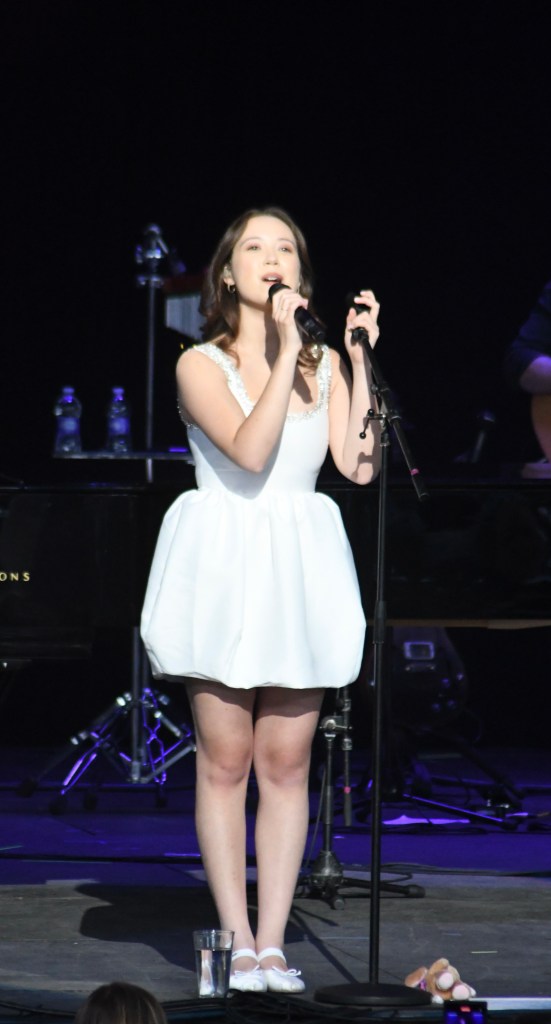
And, since I noted Laufey in my previous comments and included a photo of her rapt fans, here’s an onstage photo of the young Icelandic pop singer who swelled the crowds last year by expanding the festival’s young audience.
Laufey sings at the 2014 Saratoga Jazz Festival, the last sponsored by Freihofer’s. Water glass and teddy bear are at her feet.
SATURDAY, JUNE 28
Amphitheater:
Gary Clark Jr.
Gregory Porter
Lettuce
Veronica Swift
Michel Camilo Trio
Kenny Garrett
Charles R. Wood “Discovery” Stage:
Artemis
Nicole Zuraitis
Keyon Harrold
Julius Rodriguez
C.J. Chenier & The Red Hot Louisiana Band
The String Queens
SUNDAY, JUNE 29
Amphitheater:
Trombone Shorty & Orleans Avenue
Cory Wong
Cassandra Wilson
Al Di Meola Acoustic Band
DJ Logic & Friends featuring Vernon Reid, Cyro Baptista, Emilio Modeste, James Hurt, Felix Pastorius & Terreon Gully
Charles R. Wood “Discovery” Stage:
Gary Bartz
Bria Skonberg Quintet
Brandee Younger Trio
La Excelencia
Skidmore Jazz Institute Faculty All-Stars Celebrate their Heroes
featuring Clay Jenkins, Jimmy Greene, Steve Davis, Dave Stryker, Bill Cunliffe, Todd Coolman & Dennis Mackrel
A word about these guys and the special flavor of their shows.
In recent years, local acts have joined the national and international attractions playing the Festival, notably the late, great pianist Lee Shaw, the Hot Club of Saratoga, and Garland Nelson’s gospel-soul ensemble. This year, the Skidmore Jazz Institute Faculty All-Stars represent as the only home-grown artists on the schedule. All are skilled individual players, and their ensemble plays wonderfully well together.
Each summer, they select a jazz giant or two as the focus of virtuoso tributes, including both original arrangements and fresh reworking of vintage classics by these players themselves. Bassist leader Todd Coolman delivers the wittiest, most entertaining introductions we’re likely to hear, all festival. When the uniformly T-shirted Institute students take their customary places at the front of the Wood audience. You can feel their excitement, their happy energy, as their teachers offer glittering examples, inspirations, onstage.
As noted previously, tickets go on sale to SPAC members Feb. 21 and to everyone Feb. 24 at space.org.