
Jon Dee Graham reportedly disliked the label often applied since his passing: “Greatest songwriter you’ve never heard of” – but it’s still likely true.
Thanks to the Austin Chronicle for the photo here, by Jana Burchum, and some facts in this post.
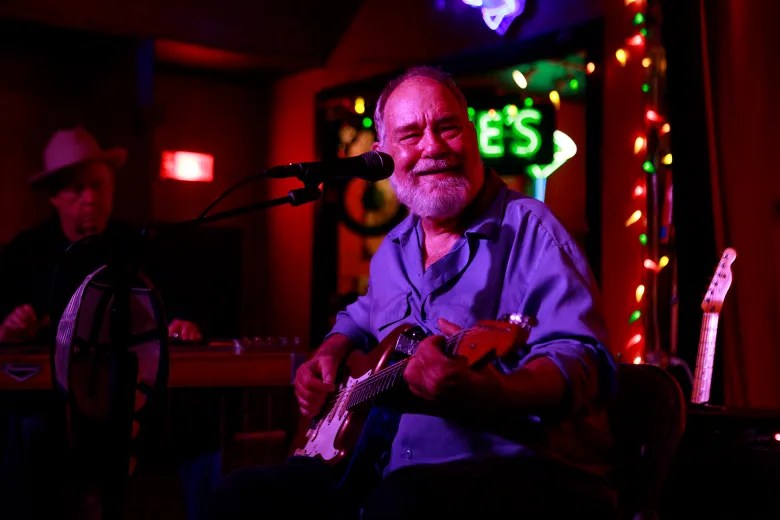
More influential than famous, the Austin music master died Friday after numerous health challenges that sometimes made him miss his three-decades deep weekly residency at the Continental Club. His son William would cover for him on dates he couldn’t make, and was by his side when the 2005-2006 Austin Music Awards honored Graham as its Musician of the Year. Father and son recorded an album together more recently; release date unclear.
With semi-star bands the Skunks, and the True Believers (with brothers Alejandro and Javier Escovedo), Graham was widely credited with helping weld punk brute force to rootsy country lyricism in a late-90s amalgam that inspired dozens of bands. He released his debut solo album at 38 in 1997, when True Believers broke up.
My own sole exposure to Graham onstage came when he toured with the Alejandro Escovedo Orchestra, the vast performing force led by Graham’s former band mate in the True Believers.
They played Troy’s Revolution Hall, filling the stage from end to end, just days before the Rolling Stones played what’s now the MVP Arena on their 2005-2006 A Bigger Bang tour.
That came 20 years after I’d last seen them play a ragged show (Buffalo) and a somewhat better one (Syracuse); so I really didn’t want to go. Neither did anybody else around. I tried to hand off the review assignment, mainly because the Alejandro Escovedo Orchestra was set to play Revolution Hall – and I knew that would be great.
I really didn’t know HOW great though.
That spring night, I stood in the tech booth at the front of the Revolution Hall balcony, above the stage but no more than 40 feet from it. The Orchestra was 13 pieces strong, including two cellos and two violins; Mark Andes (from Spirit!) played bass, and both Graham and Escovedo’s longtime band mate David Pulkingham played guitar.
The Orchestra was celestial, earth-shaking, brain-melting deluxe. But first, two opening acts.
Michael Eck opened; he’d once operated a cash register at Austin’s Watermelon Records, right next to Alejandro Escovedo’s; they were old friends. Eck stood below the stage, on the audience-level floor of Revolution Hall. He sang and played solo; strong and authentic.
Graham played next, and I doubt anybody knew or cared who he was. But, then, he took over the place so completely, all by himself, that jaws dropped open. Everybody shut up in utter awe and disbelief, and clapped our hands raw after that first song.
Graham stalked to the front of the stage. He planted his hands on his hips. He scanned us with blazing eyes and allowed, “Well, I should think SO!”
After that, who cared about the decrepit, decadent old Rolling Stones?
As noted, I grumbled my way to that gig because nobody else would take the assignment.
I picked up my press ticket – $351 worth, and one of only four press tickets granted for this show. And I watched those decrepit, decadent old Rolling Stones tear the roof off.
Everything worked. The room was right-sized: 15,000, versus the ridiculous-for-music scale of Buffalo’s Rich Stadium and Syracuse’s Carrier Dome. The music completely filled it and then some. Not just volume, either – energy and commitment. This was the tour right after drummer Charlie Watts’s cancer scare and they all seemed grateful that he was alive and they all were, too. They managed to communicate that glorious feeling with the music.
The two best shows here that year, and probably for three to five years or more in either direction, had happened in just three days.
Now Charlie is gone, and Jon Dee Graham, too.
So, the lesson is: Go to the show.
Yeah, go.
 Hoke's Jukebox