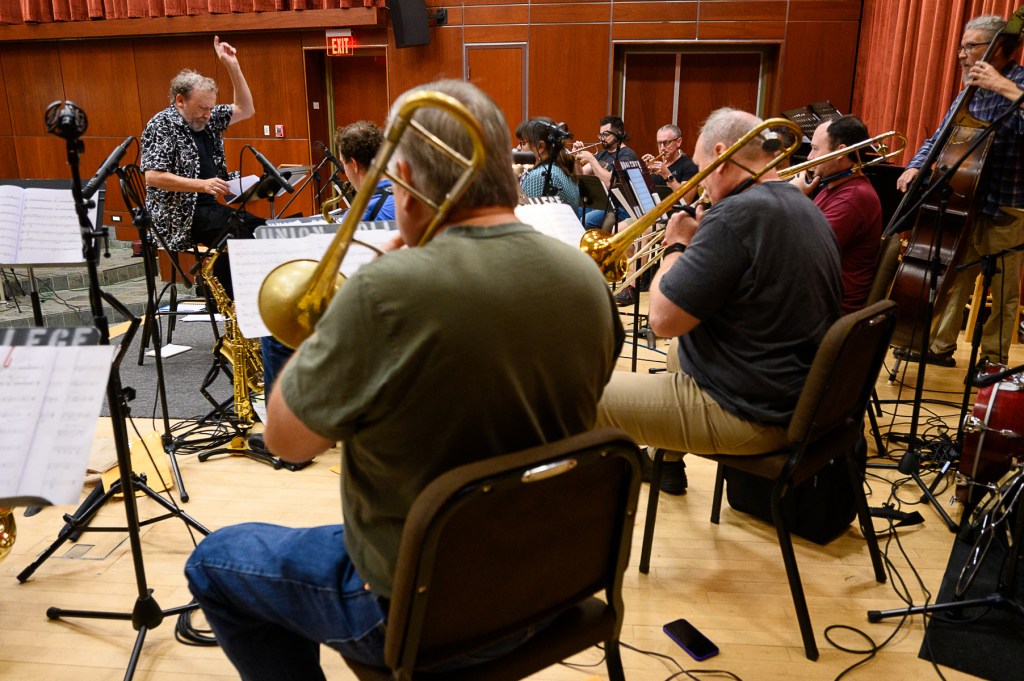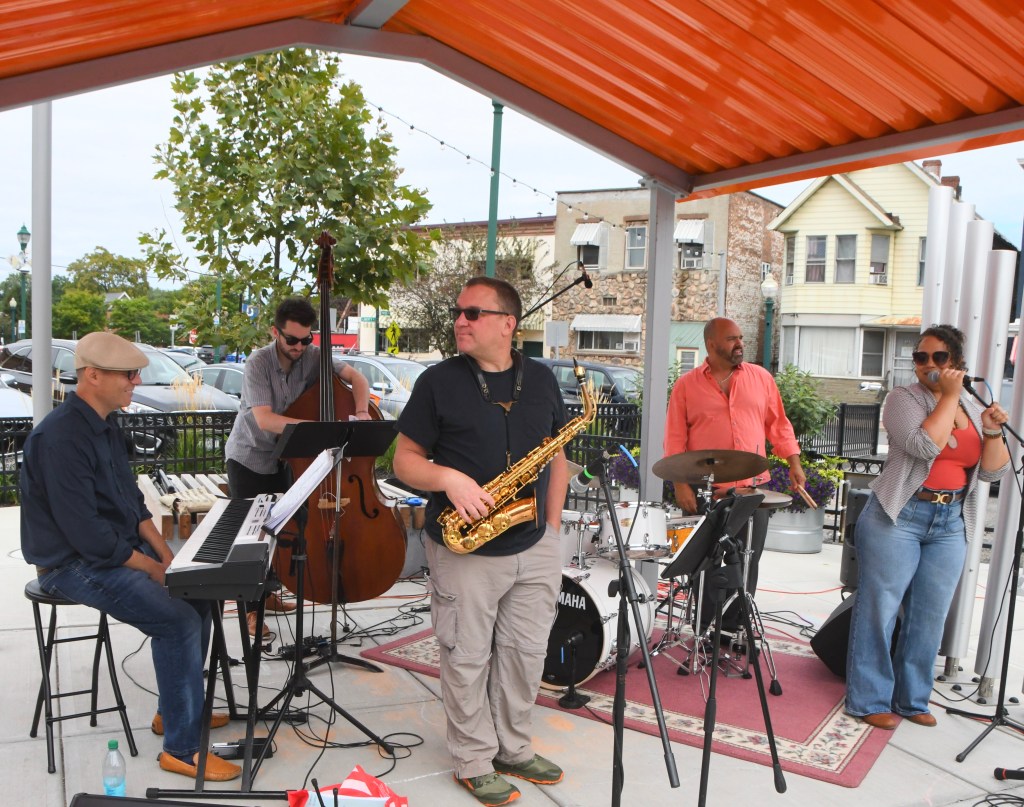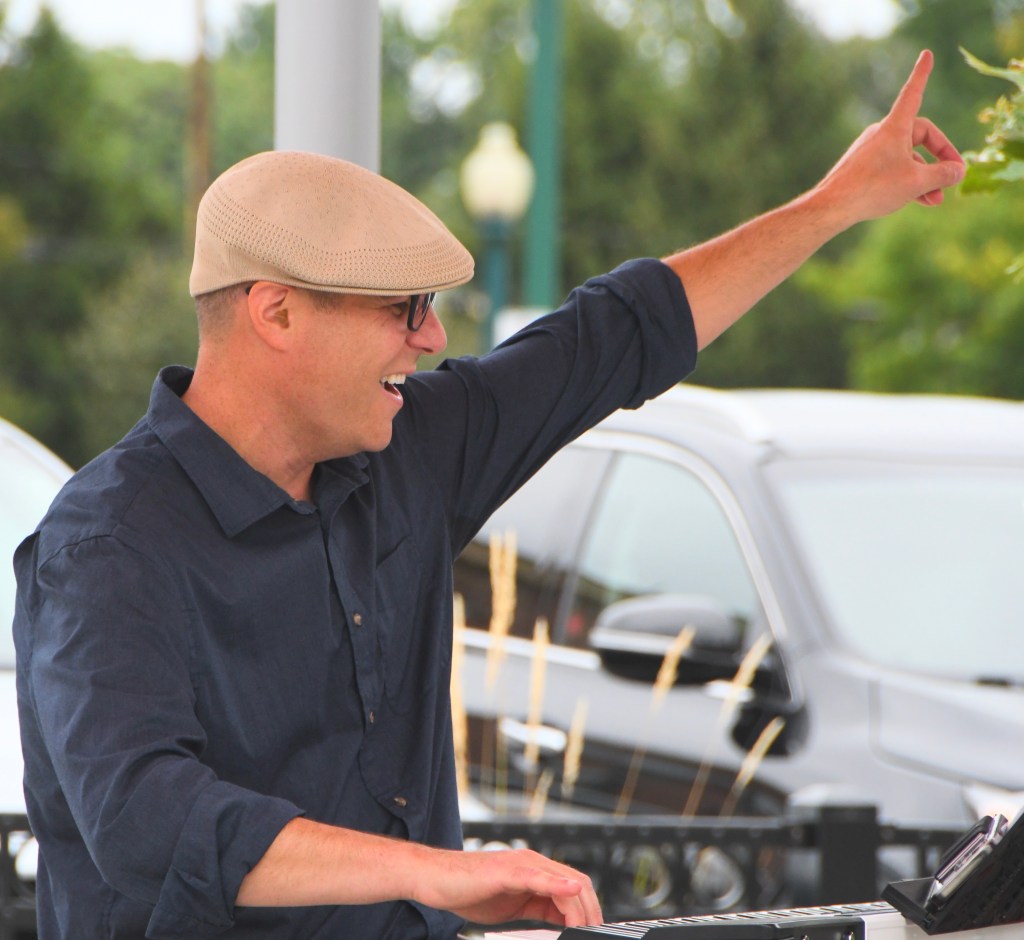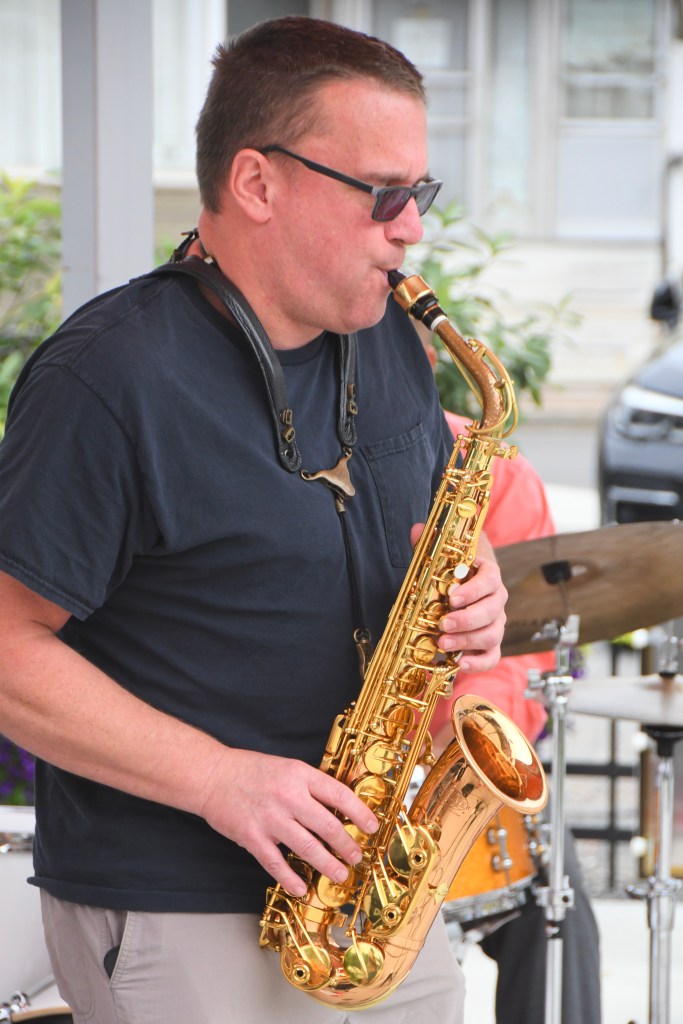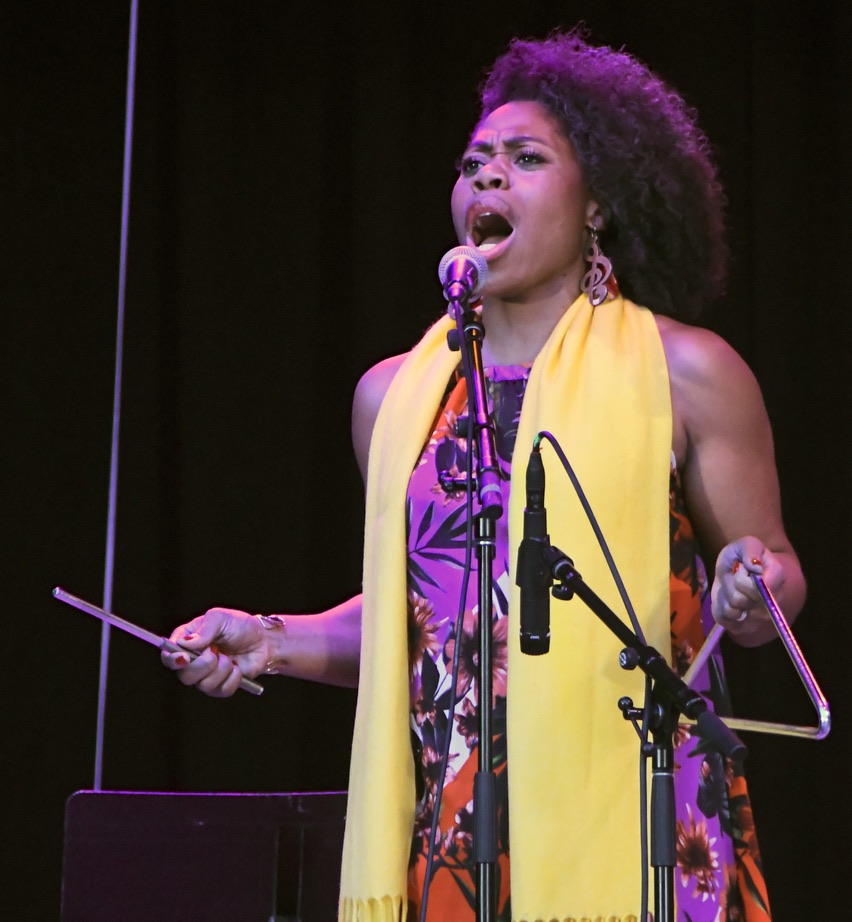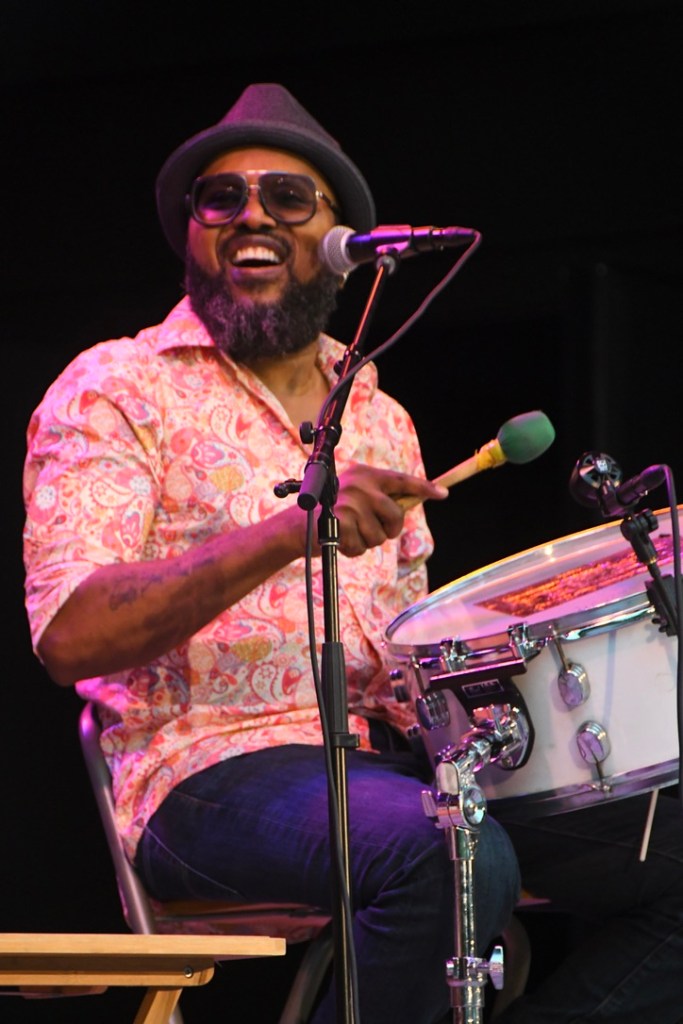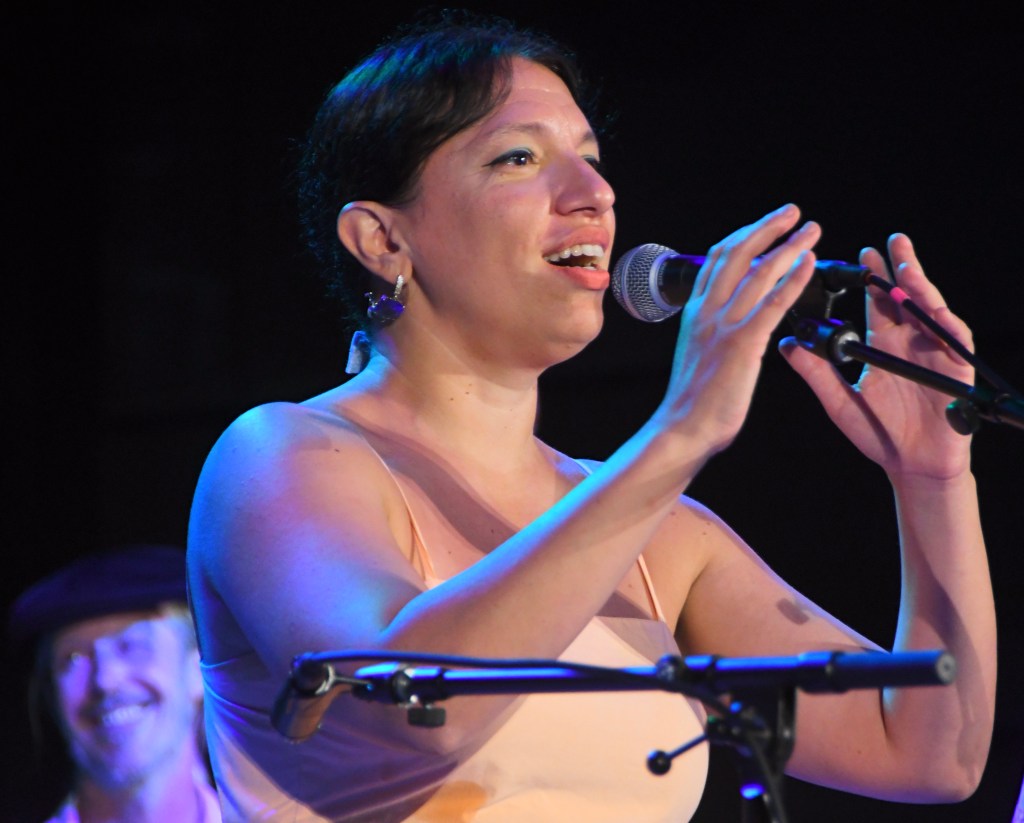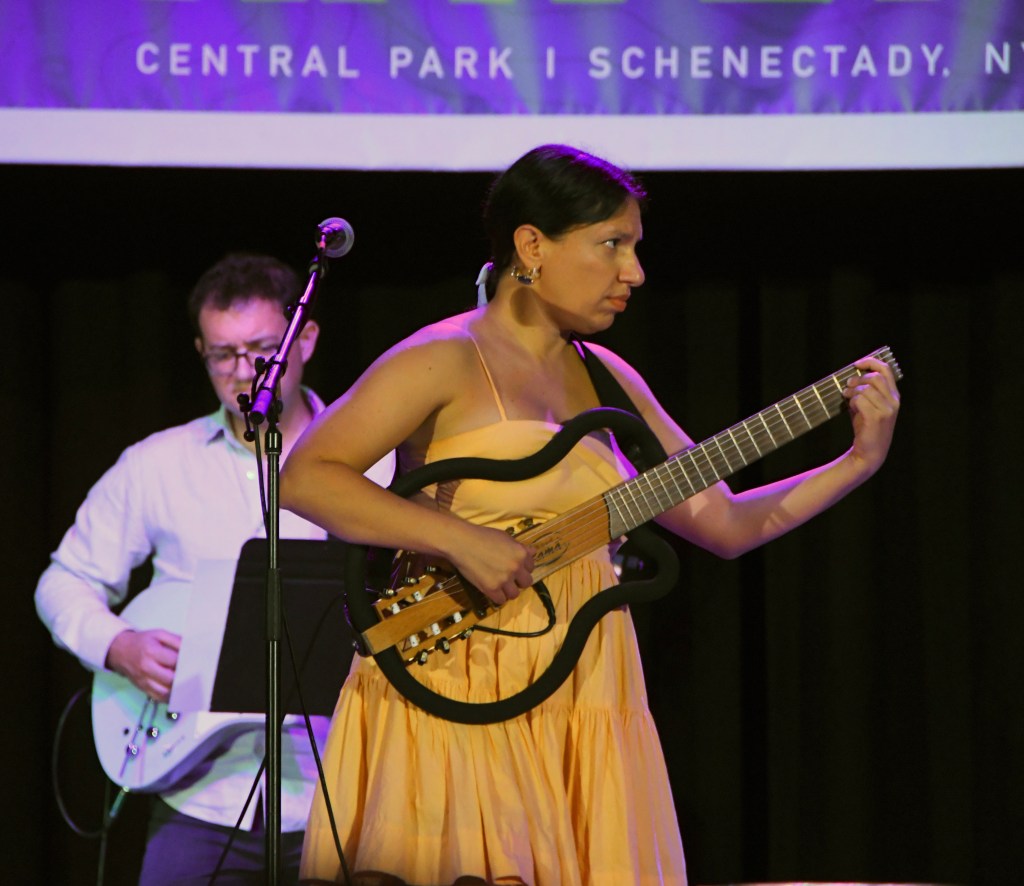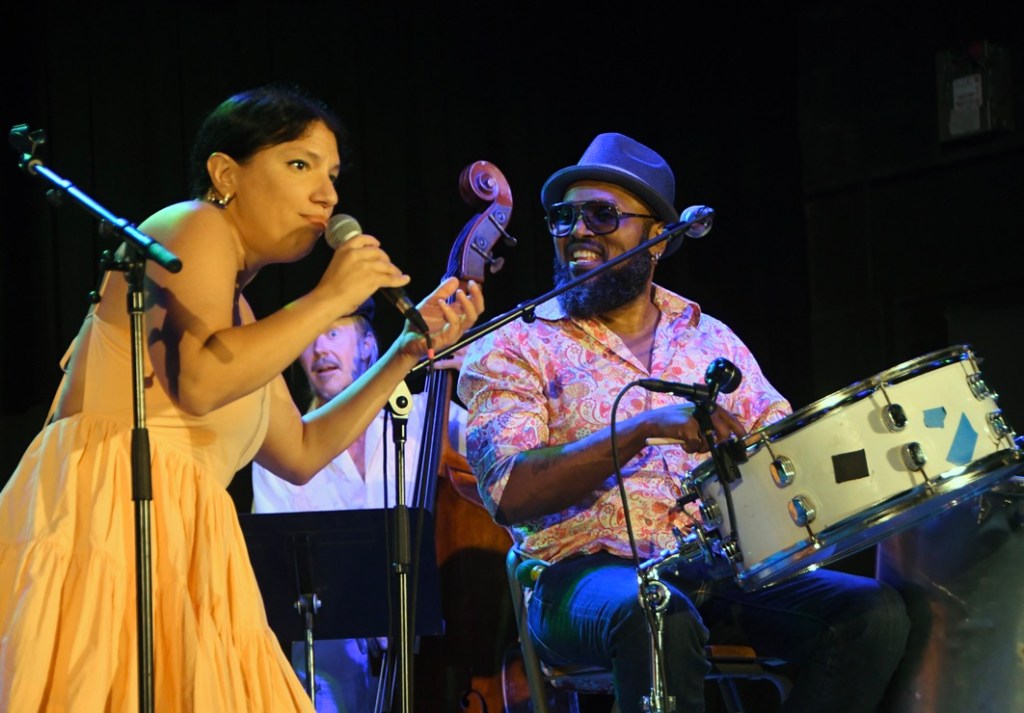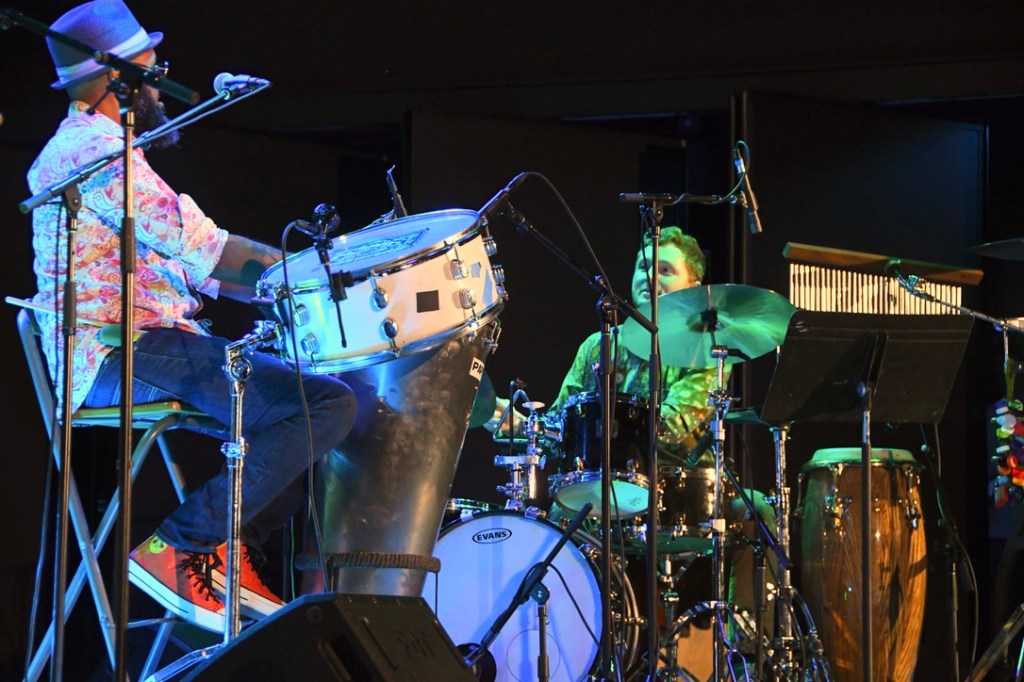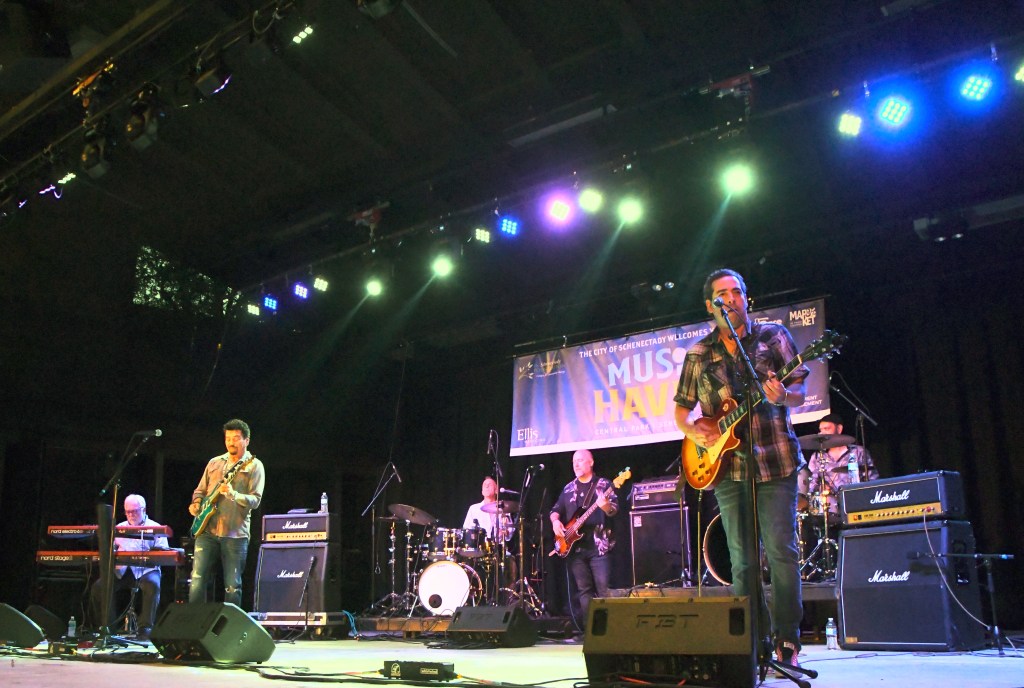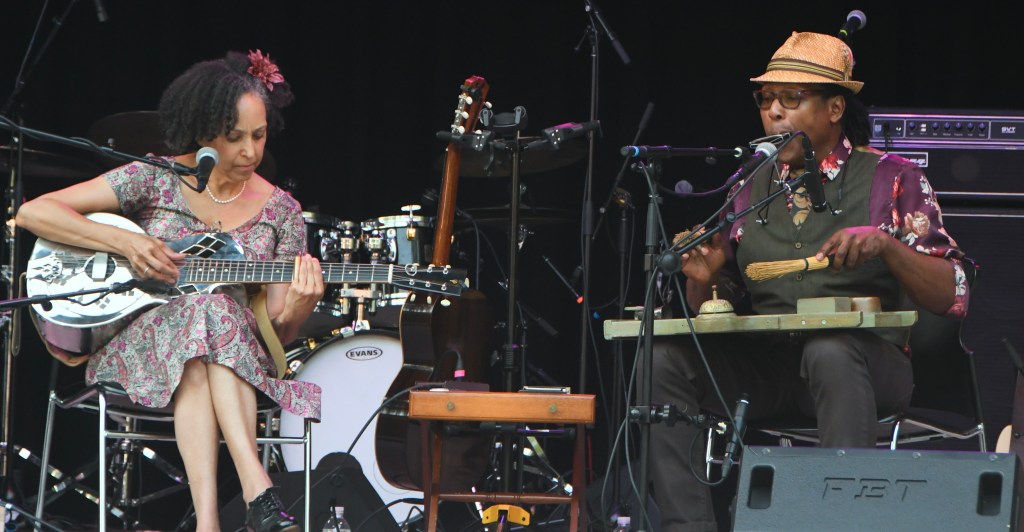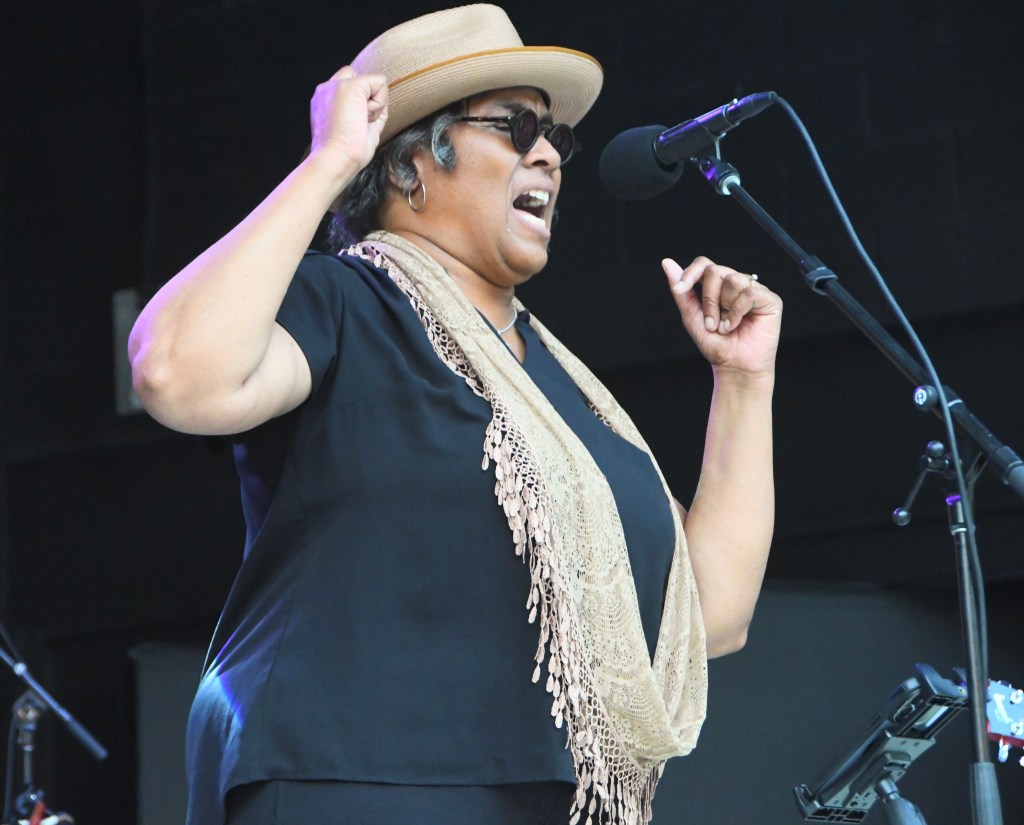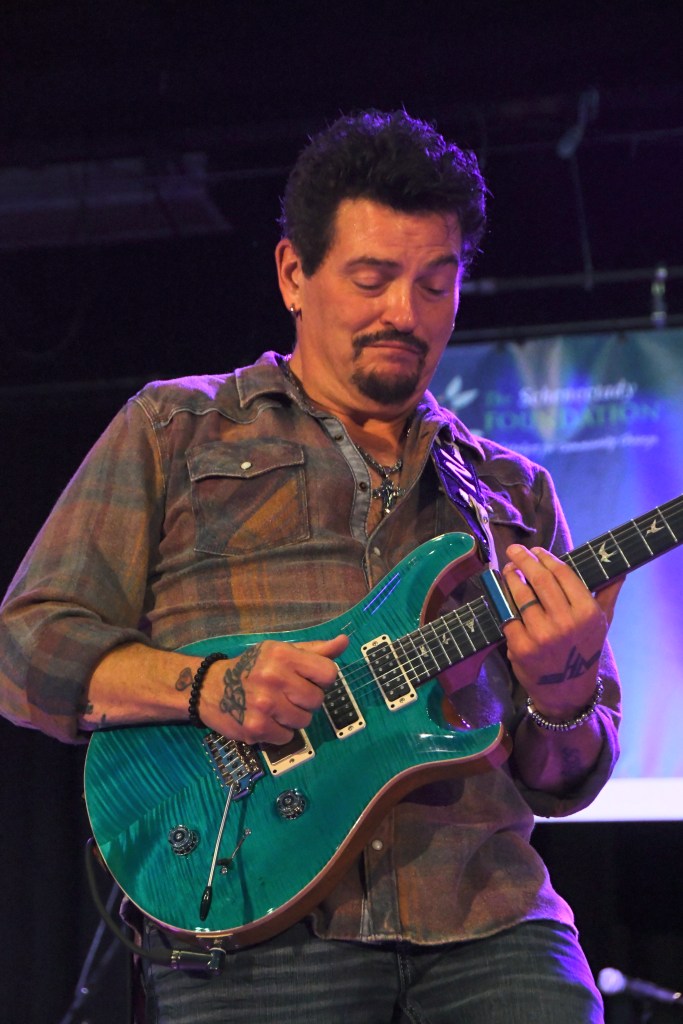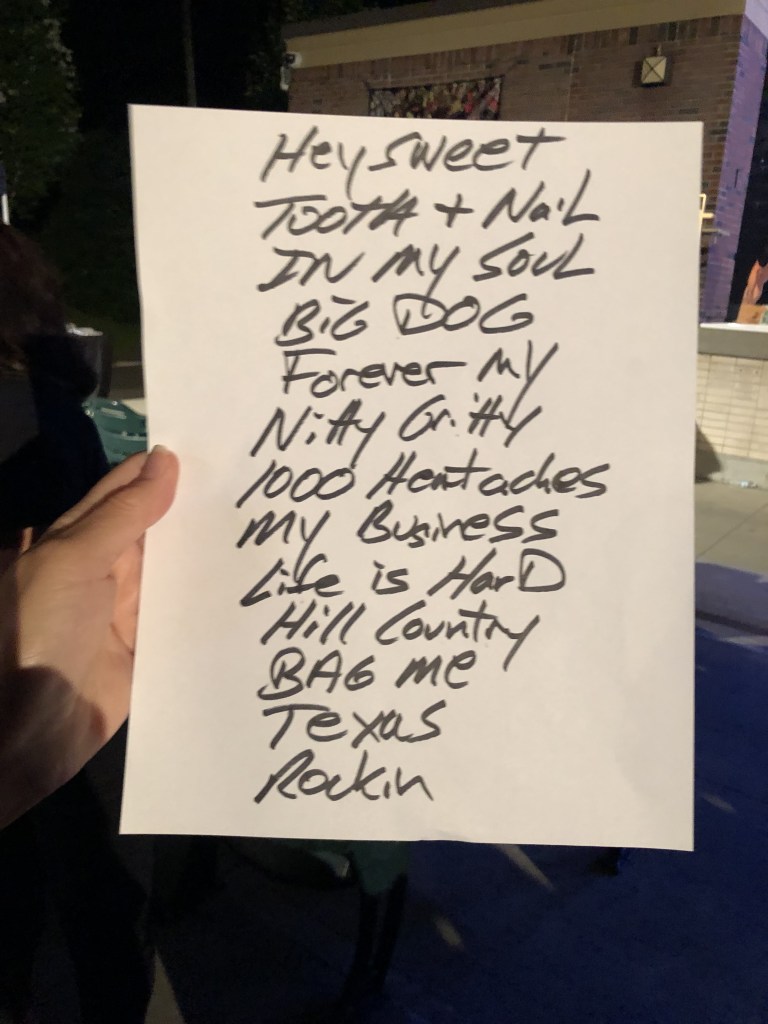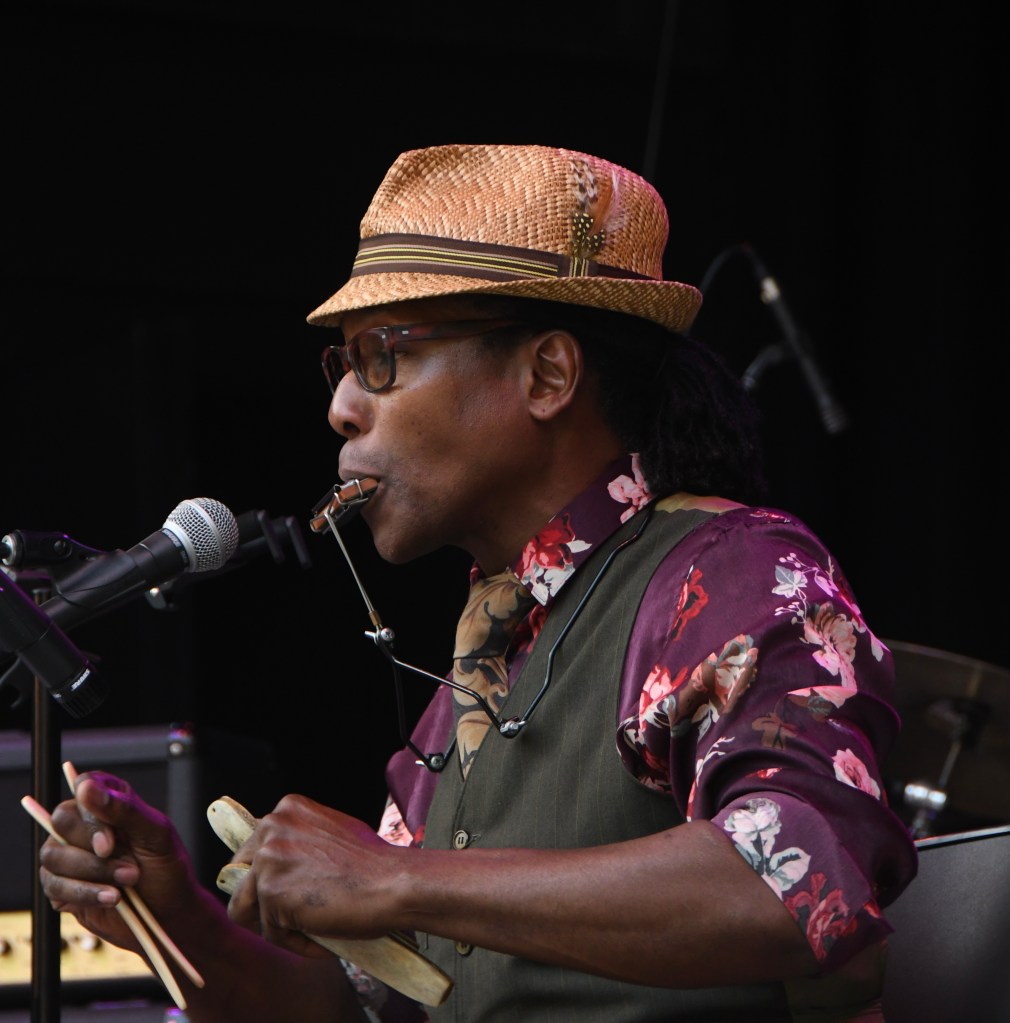
The only things that went wrong Thursday were a worst-possible-time rain storm; a last minute venue change from Jay Square outdoors into Robb Alley at Proctors; a siren-noisy, flashing-lights fire drill and a lot of rambunctious crowd noise.
But, no problem: hard bop uplift by Terry Gordon’s Quintet simply overcame.
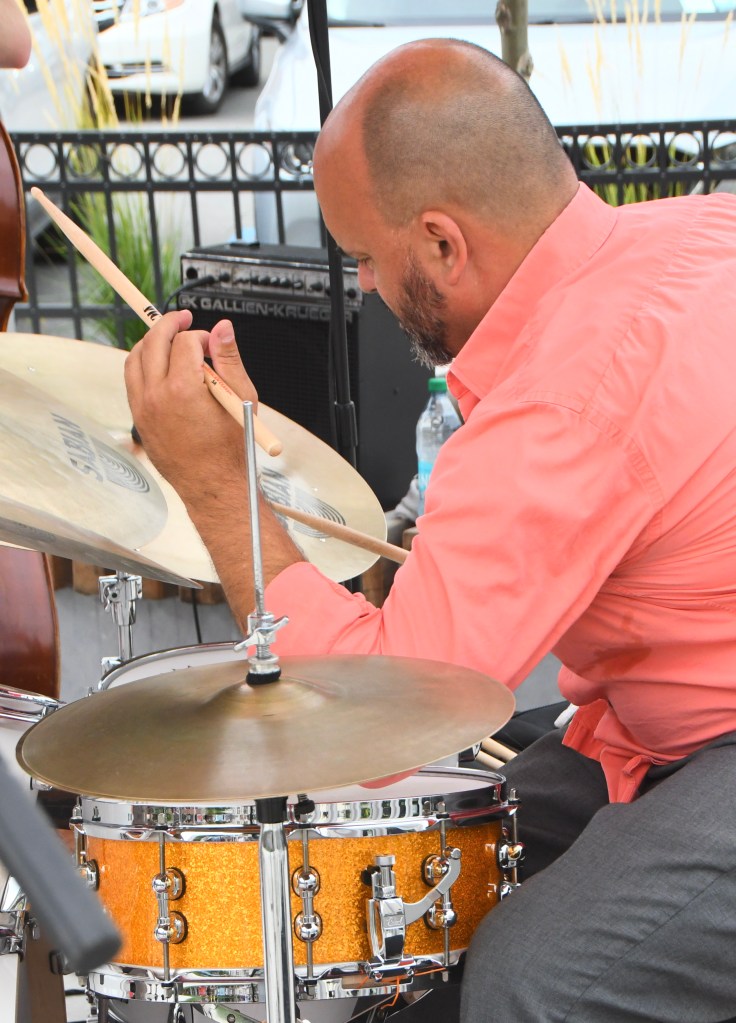
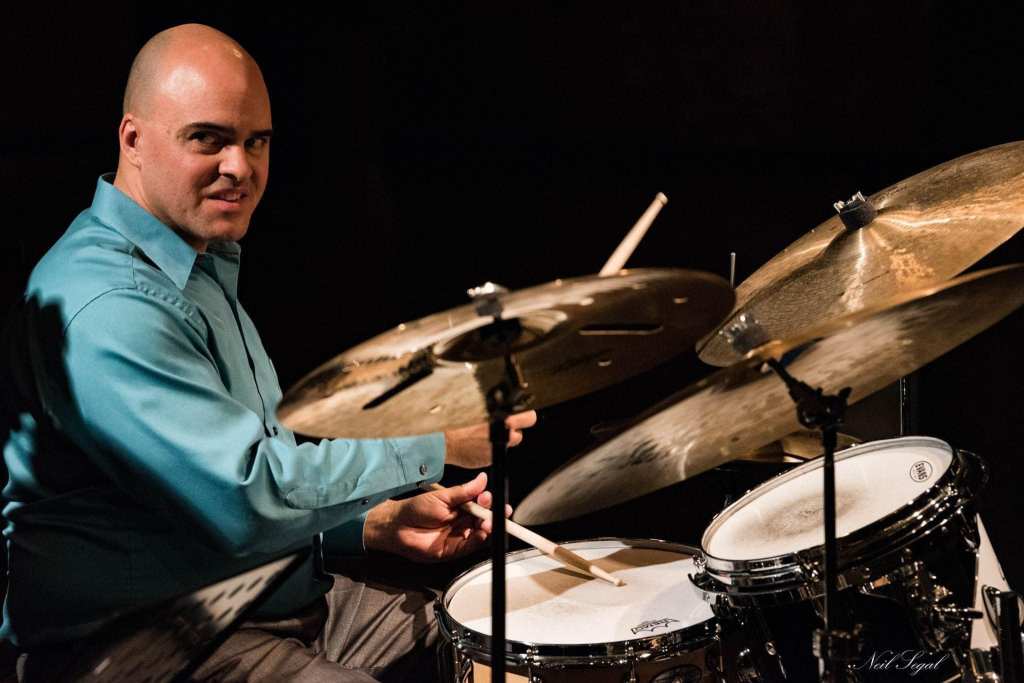
Band and crew set up efficiently; with amps only for Joe Finn’s guitar and Lou Smaldone’s double bass. Drummer Pete Sweeney, saxophonist Eric Walentowicz and leader-trumpeter/flugelhorn player Gordon played on the natch, without PA. Again, no problem – their balance was superb from when Gordon gave the downbeat at 12:25 and the guys charged into “Configuration.”
Playing all originals can be a nervy move, especially after delays and as a theater-school class flowed into Apostrophe on a noisy break. The bluesy bop of “Configuration” got over anyway, an assemblage of abrupt hard-edged riffs that resolved into an upbeat ending.
The slower “Looking In” earned its introspective title in a thoughtfully brooding start. Gordon played flugelhorn (like a trumpet that needs to go on a diet, with a lower range), as Walentowicz blended in his tenor sax at first but switched to soprano for his solo, a compelling meditation that set up tasty breaks by Finn and Gordon as they built a sunnier mood than at the start.
“Homeward Bound,” on the other hand, started happy and stayed there, Walentowicz’s soprano echoing Gordon’s trumpet near the open, then later flying free and high.
Gordon’s trumpet opened alone in “Quarantine” (a Covid tune, as he explained), before Walentowicz’s tenor commented and went further outside; further, that is, until Gordon went raspy in his own solo before playing clean and clear again.
From those fireworks, they eased into the alert mellow calm of “Until Then,” tender flugelhorn and tenor sax effective in this ballad change of pace.
Changing the mood and dynamic yet again, they surged back into hard-bop heat for “Amagalgatorium,” powered, and that’s the right word, by rhythm fire. Smaldone and Sweeney were rocks at all times, and here they paved a fast funk highway for everybody to follow, Finn joining the fun by emphatically thumbing chords. For contrast, the rhythm section laid out for tasty two-horn interludes in the middle and at the end. Fine interplay here, too; trumpet with guitar, alto sax with bass, then Sweeney took a strong solo and it all came home.
The blues-swing of “Noname” (like salami or edamame) led off with bold trumpet echoed by tenor riffs, a brief conversation that opened into succeeding heads-up excursions.
Slower and softer flowed “Flowers That Beckon,” so soft that when photographer Rudy Lu sneezed in his front-row seat, Sweeney looked up from his drums to say “Bless you.” Quiet laughs all around. Playing mainly on toms, with mallets, Sweeney popped a more assertive groove as Gordon conducted a correction to the blend, then his flugelhorn pumped the melody hard as he revved everybody to follow.
Of course, “Knot So Fast” was an ironic title, another full-flight, speedy hard-bop blitz, a burst of smart adrenaline that melted away to let Sweeney’s drums carry the groove before horns and guitar took over.
There’s a good reason these guys – whom Gordon recruited to play his originals in this quintet – are in such demand. Skilled individually, they know how to cook together and cruise at any tempo, to blend and burst out into space.
Finn returns to Jazz on Jay on Thursday, Aug. 15 with his trio. Singer Maggie MacDougall’s Bossamba follows on Aug. 22; then Joe Barna wraps the series on Aug. 29.
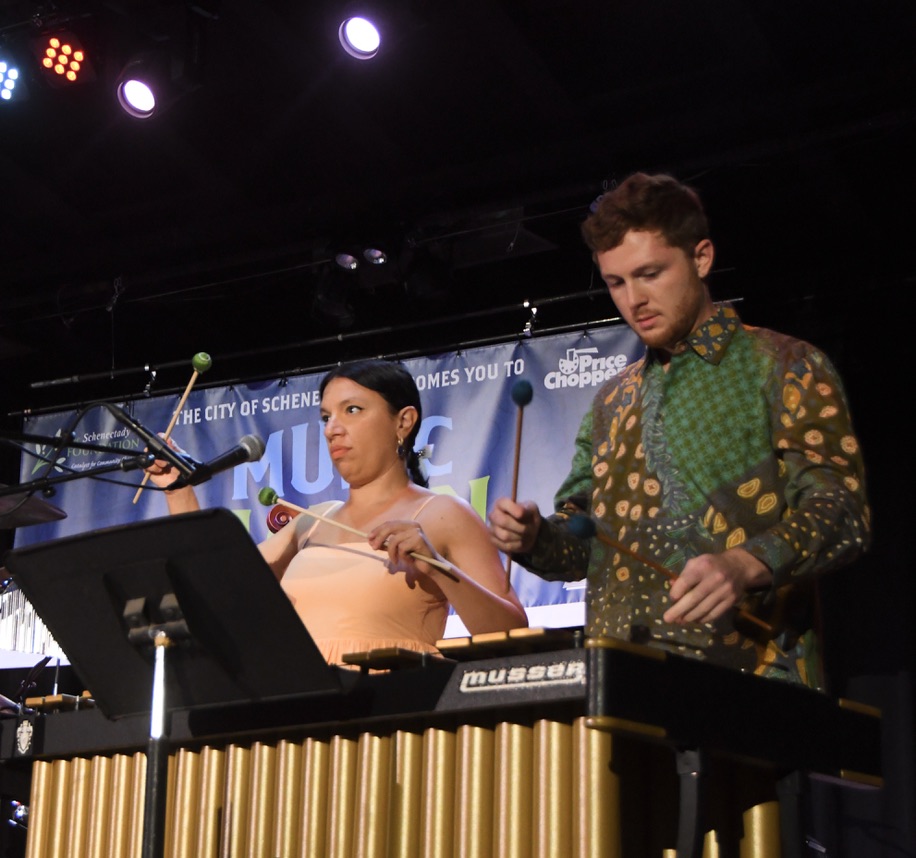
Trumpeter, flugelhorn player and composer Terry Gordon could call his quintet the In-Demand-Crew as its members are among the area’s busiest jazz masters. It’s a purpose-built band on a mission – playing the ninth concert of the 12-show free-concert season.
“Formed around 1993 as an outlet for original compositions, it has maintained that focus ever since,” says Gordon. A prolific composer, Gordon plays trumpet and flugelhorn with Eric Walentowicz, saxophones; Joe Finn, guitar; Lou Smaldone, bass; and Pete Sweeney, drums. They’ve played together for years: Smaldone off and on since the mid-90s, Walentowicz since 2000, Finn since 2003 and Sweeney since 2012.
Gordon also plays with the Arch Stanton Quartet, Alex Torres, Brass-O-Mania and in a duo with guitarist Roger Noyes; Walentowicz with the New York Players and Brass-O-Mania; Finn as leader and sideman – he plays Jazz on Jay with his trio on Aug. 15 – Smaldone with Keith Pray’s Big Soul Ensemble (where Gordon was an early member), and Sweeney with Michael Benedict’s Jazz Vibes (at Jazz on Jay June 20) and the Art D’Echo Trio.
Son of a church organist mom, Gordon studied with Dr. Harold McNeil at Houghton College and Dr. Michael Galloway at Mansfield University. His main influences are Woody Shaw, Chuck Mangione, Miles Davis, and Freddie Hubbard.
Gordon has played professionally since he earned $40 at an 1984 New Year’s Eve country club gig.
These days, with his Quintet, “We play pretty much all originals,” he says – chosen from his albums “Wakeup Call” (1997), “Contemplations” (2002), “Homeward Bound” (2006), “Tomorrow Calling” (2013), and “Tangents” (2023). He explains there’s “much room for improvising.”
Gordon will be busy the rest of the summer with the Quintet, the Arch Stanton Quartet, the Gordon & Noyes Duo, and Alex Torres. Check his schedule at https://terrygordonjazz.com/upcoming-live-music/.
Jazz on Jay free concerts are noon to 1:30 p.m. at Jay Square, the new park space opposite Schenectady City Hall. The rain site is Robb Alley at Proctors, 432 State St., Schenectady. Seating is provided indoors at Robb Alley, but patrons are invited to bring their own seating and refreshments to Jay Square.
Jazz on Jay is presented by the ElectriCity Arts and Entertainment District and sponsored by the New York State Council on the Arts, a Schenectady County Legislature Arts & Culture Grant, Downtown Schenectady Improvement Corporation, The Schenectady Foundation, Price Chopper/Market 32, MVP Health Care, Schenectady County, Schenectady City Hall, and Proctors Collaborative.
SUNY Schenectady Jazz Faculty Combo with Guest Delfeayo Marsalis at Music Haven, Monday, Aug. 5
When Delfeayo Marsalis came to town, the music and menu changed.
Guesting with the SUNY Schenectady Jazz Faculty Combo Monday at Music Haven, the trombonist brought New Orleans tunes while the school’s food truck served gumbo, muffulettas and beignets.
Scion of jazz royalty back home – son of pianist-teacher Ellis, brother of trumpeter Wynton, saxophonist Branford and drummer-vibes player Jason – Delfeayo fit well with the locals Monday.
Delfeayo Marsalis
Christopher Brellochs
Inspired as if working with an eminent visiting professor, the SUNY Schenectady music teachers played at their best. Dean-saxophonist-host Christopher Brellochs hoped the show would “prove we know what we’re doing.” It did, in top music-making by everybody including four young grads.
Marsalis brought expert trombone work, top tunes, amusing, song introductions and a supportive attitude.
Mia Scirocco
Each of the two sets (the first ran 55 minutes; the second, 45) began with strong, uptempo vocals from Mia Scirocco. Marsalis came on after her upbeat “You’d Be So Nice to Come Home To” and framed his original “Jazz Party” in a family tale: His grandfather built a music club in his New Orleans motel. Coincidentally called Music Haven, it lasted just one night. Nobody came, so he closed it.
At Schenectady’s Music Haven, pre-show rain may have reduced the audience early, then clearing skies brought in normal numbers.
Brian Patneaude
Marsalis soloed impressively in every tune; our guys had their shots, too; saxophonist Brian Patneaude* and guitarist Kevin Grudecky (almost invisible behind a big music stand and the curve of David Gleason’s grand piano) in the rambunctious “Jazz Party.”
They slowed the pace in “If I Have You,” then came “Softly As In a Morning Sunrise,” a deja vu moment for Gleason and anyone who saw him play the same song on the same stage Sunday with the Art D’Echo Trio. As on Sunday, this flowed faster than most play it, with lively cross-talk.
David Gleason
Next, Brellochs summoned four music school grads: tenor saxophonist Awan Rashad, vibraphonist Niko Nieman, bassist Nelly Cordi and drummer Rocco Gigante. Each soloed in the hard bop “Cedar’s Blues.” Rashad and Patneaude (Rashad’s teacher) both played Jazz on Jay earlier this summer, as did Jarod Greico (one of two bassists, alternating with Eric Johnson) who played in Patneaude’s quintet.
Awan Rashad
Marsalis cued the set closing “When the Saints Go Marching In” with wry mentions of New Orleans decadence and Saints football; then played a happy aggressive solo in the almost unavoidable New Orleans classic. Patneaude and trumpeter Dylan Canterbury followed; and Canterbury conducted much of the second set.
Dylan Canterbury
Marsalis followed Scirocco’s second-set-opening “Orange Colored Sky” with an adventurous excursion through his respectful/lively “Raving On the Mingus House Party.” Citing the brilliant/cantankerous Charles Mingus, he echoed his composing style, stacking melodies in colliding combinations. Grudecky’s guitar cut through this note-crowded number beautifully.
Marsalis often acknowledged hot or sweet riffs by his one-night band mates. On his “pit stop in Schenectady,” as Brellochs noted, Marsalis detoured into Music Haven en route to New York with his big band. Knowing he was in good company here, he fist-bumped Canterbury in “Mingus” and pointed to players who’d uncorked extra-cool solos, with Patneaude in “I Found a New Baby,” for example.
This worked both ways: Patneaude smiled wide when Marsalis’s solo peaked in “Mingus,” then repeatedly tapped his heart at the trombonist’s tender melodic grace in “Do You Know What It Means to Miss New Orleans.”
In Gleason’s quiet “Four Moral Freedoms,” Canterbury and Marsalis both played with mutes as everyone went softly expressive.
Delfeayo Marsalis and Dylan Canterbury
Marsalis introduced his “Valley of Prayers” citing an initially unsuccessful visit to his bank, a frustrating episode redeemed by meeting there the minuscule (and ironically named: he’s 5’2”) Jerome “Big Duck” Smith – a revered Civil Rights hero. In this hearty funk march, drummer Bob Halek released his inner Shannon Powell and the thing swung like mad. Its middle section had the freshness of something invented on the spot, Marsalis repeating a two-note figure behind Patneaude and Canterbury.
The SUNY Schenectady Jazz Faculty Combo: Christopher Brellochs, tenor and baritone saxophone; Brian Patneaude, tenor and alto saxophone (he played alto when Brellochs played tenor); Dylan Canterbury, trumpet; Kevin Grudecky, guitar; David Gleason, piano; Bob Halek, drums; Eric Johnson or Jarod Greico, bass. Guest artist: Delfeayo Marsalis, trombone.
Bet these guys could hold their own in a battle of the bands with the Skidmore Jazz Institute Faculty All-Stars, who played the last Freihofer’s Saratoga Jazz Festival in late June. (The Festival continues – don’t worry – Freihofer’s has ended its decades-long sponsorship.)
Rain dotted my windshield, driving home; nice timing, like when it stopped before show time.
More Marsalis music: Saxophonist Branford’s quartet plays Troy Savings Bank Music Hall Jan. 16 – and Jason played the Saratoga Jazz Festival in June.
Set List
You’d Be So Nice to Come Home To (vocal, Mia Scirocco)
Anat Cohen’s Quartetinho and Art D’Echo Trio + One at Music Haven, Sunday, Aug. 4
Who knew Antonin Dvorak had the blues?
The great jazz clarinetist Anat Cohen, that’s who.
She turned “Going Home” (based on a slow movement of Dvorak’s Symphony No. 9*) into a bass clarinet blues Sunday at Music Haven, echoing both the classical composer and jazz giant Eric Dolphy.
Cohen and her skin-tight Brazil-inspired Quartetinho (“little quartet” in Portuguese) made a glorious jazz explosion that proved less can be more. The Quartetinho distilled the power of her Tentet big-band (a hit at the 2018 Saratoga Jazz Festival) into a little big band of extraordinary power, nuance and lyricism. Earlier in a quite wonderful evening, the Art D’Echo Trio went the other way in a fine opener, adding a player; but I digress.
Staffed with members of her Tentet, the Quartetinho proved hugely satisfying largely because it allowed more space for Cohen to flex precise technique, unfettered soulfulness and a playful physicality that put the audience in her pocket right away. Fresh from a triumphant Saturday set at the Newport Jazz Festival, they went full incandescent on Sunday.
After an episodic, jittery intro, “The Night Owl” found its straight-ahead groove, Cohen’s clarinet soaring high and strong over a tight weave of James Shipp’s vibraphone, Tal Mashiach’s double bass and Vitor Gonçalves’s piano. Later, everybody shifted around: Cohen to bass clarinet and (briefly) ukulele; Shipp to drums, then tambourine; Mashiach to acoustic guitar; Gonçalves to accordion – that, in particular was a trade-up.
In “Trinkle Tinkle,” a walking bass line set a bebop mood with Cohen bending notes, riding the abrupt cadences behind her and challenging Shipp in mid-vibraphone solo, hand on hip and smiling as if to ask, “THAT all you got?” Everybody had more, as things turned out. Later she noted that such Thelonious Monk tunes can be colored every which way – and she and the boys tried out many – but always sound like Monk.
Shipp introduced his “Coco Rococo” in mock-professorial words that its cheerful Brazil beat soon belied, an especially exuberant Cohen solo sparkling here, ranging from Rio to Rampart Street.
The new “Paco” had a flamenco feel via Mashiach’s guitar that blended tight with Gonçalves’s piano – one of many instances when the quartet sub-divided beautifully into duets. Also new was the slow, sweet ballad “Vivi & Zaco” – eloquent and elegant – written by Mashiach for his relatives, some of whom were present Sunday. Shipp, who had played cajon in “Paco,” switched to tambourine in “Valsa Do Sul,” intricate and crisp. Cohen took only the briefest of pauses to smile wide here before restoring her embrochure and going for it.
When a fan requested “Stardust,” she graciously declined, asserting the next selection shared many of the same notes by way of compensation. “Going Home” did that and more, Shipp’s vibes easing into the familiar melody, accordion and bass joining closely. That set up maybe the most breathtaking moment all night as Cohen’s bass clarinet formed a deep, thick chord with Gonçalves’s accordion. Then, Cohen mutated the theme into a graceful blues before coming back to the main melody.
Before closing with the upbeat “Boa Tarde Povo” (“good night, people”), she spoke of the heaven we experience when going inside music together. That, clearly, is the strength of hers: She goes inside, finds and celebrates the feel, and she takes you right in there.
Local heroes the Art D’Echo Trio ably set the table for Cohen’s riff-feast; adding everyone’s favorite percussionist Brian Melick to the line-up of half a dozen years: David Gleason, piano; Mike Lawrence, bass; and Pete Sweeney, drums.
Both Sweeney and Melick play plenty of notes, hot and busy at times; but things fit nicely. Melick swirled and surged all over, mostly on congas, to introduce “Sofrito” with its stop-and-go tempo changes and a tremendous piano solo. He bookended “Softly As In a Morning Sunrise” with zippy triangle. In most songs, both Gleason, then Lawrence, took the solos, Lawrence playing both double bass and electric. But Sweeney got some spotlight time in the peppy Caribbean beat shuffle “Matanzas 1958” before Melick joined in for what sounded, briefly, like the Grateful Dead’s complex “The Eleven.”
The trio honored the Latin theme of the evening, but sounded fresh and original, too – very much themselves.
* Looking forward to seeing the Philadelphia Orchestra play Dvorak’s Symphony No. 8 and his Humoresque in G-Flat major, plus, Bartok’s Concerto for Orchestra at SPAC on Aug. 15 – my birthday, also Mona Golub’s, and Jimmy Webb’s.
Anat Cohen Quartetinho Set-list
The Night Owl
Trinkle Tinkle (Thelonious Monk)
Coco Rococo (Shipp)
Frevo (Antonio Carlos Jobim; from the “Quartetinho” album)
Paco (from “Bloom,” due next month)
Vivi & Zaco (Mashiach; also from “Bloom”)
Valsa Do Sul (Cohen; from “Quartetinho”)
Going Home (based on a Dvorak melody; from “Quartetinho”)
Boa Tarde Povo (Cohen; also from “Quartetinho”)
Art D’Echo Trio Set-list
Sofrito (Mongo Santamaria)
Softly As In a Morning Sunrise (Sill, Hammerstein. Romberg)
James (Pat Metheny)
Matanzas 1958 (original, based on “Afro-Blue”)
Armando’s Rhumba (Chick Corea)
Before Cohen’s set, Stockade resident Susan Brink, right, awarded her the Jazz Journalist Association’s 18th consecutive Clarinetist of the Year honor
Dancers rushing down the aisles to the front, everybody clapping accurately on the one, the biggest chorus I’ve heard, or joined.
Now, that doesn’t often happen at orchestra concerts.
Benin-born, Paris-based singer Angelique Kidjo inspired all that on Friday at Saratoga Performing Arts Center, and could likely do that anywhere, any time – orchestra or no orchestra. However, her “African Symphony” co-starred the Philadelphia Orchestra in a song cycle of Afro-pop numbers, new and old, by her and other songwriters, all more than ably orchestrated by Derrick Hodge.
Miguel Harth-Bedoya enthusiastically and fluidly conducted as the orchestra began each half of the program with Marquez’s Danzon No. 2 (first half) and Barroso’s “Brasil” (second half) as overtures. The first could well be re-titled Danzons, plural, as it flowed numerous dance rhythms together in an episodic survey, from sedate samba to muscular swing, serene waltz to energetic riff waves. The second both echoed a song from the first half and foreshadowed a final delightful, departure-less encore.
After Danzon, No. 2 acoustic guitarist Dominic James of Kidjo’s touring band and percussionist Jacqueline Acevedo (who’d never played with Kidjo previously) joined the orchestra, followed by Kidjo in pink turban and floor-length vivid print dress. She instantly took over the place.
The song cycles that followed – eight tunes in the first half including a three-song medley billed as one; then nine in the second – shared the episodic structure of Danzon, butHodge’s orchestrations united them as cohesively as the power and passion of Kidjo’s voice. Each unfolded as a separate musical unit, and applause rewarded these love songs, protest songs, lamentations and exultations, sung in a handful of languages. Hodge’s orchestral language framed their emotional content, taking advantage of their thematic variety to play with the orchestra: lush Brahms-like strings here, bold Strauss-ian horns there, serenely unhurried Debussy-ish development under the next tune. In other words: basically late-Romantic, though it often felt more modern than that because the songs did. A bassist himself, Hodge gave the four double-bassists stage left plenty to do.
The players seemed intent on their scores, perhaps suggesting scant rehearsal; but they played with typical Philadelphians’ precision, and with the spirit as well as the sound of the songs.
Femi Kuti’s “Lady” led the way, a feminist message in a man’s words, as Kidjo told me in a recent interview from Paris. It quickly answered the questions any pairing of pop with orchestra might prompt: Does it fit? Does it balance? Is the meaning clear? Yes, yes, and yes.
The orchestra surged in majestic grace through “Lady,” and Kidjo’s voice matched it, emotion riding sonic power. “Nongqongqo” (dedicated to departed heroes, Kidjo told me) moved more slowly and quietly; not sad, but strong, poignant.
In Hugh Masekela’s “Soweto Blues,” solo guitar spiced with percussion gave way to low strings without losing its bluesy feel, primal and precise at once, and sung in English.
Most songs weren’t, so more generous introductions and song explanations would have helped clarify Kidjo’s message, like her spoken statements on justice and freedom framed Manu Dibango’s familiar “Soul Makossa.” In the same composer’s “Angola,” Kidjo linked her voice closely to the orchestra; at other times, she stretched or compressed the rhythm, creating tension she always resolved in succeeding verses.
In “Carnaval de Sao Vicente,” Latin rhythms and sonorities sang as Kidjo liberated her mic from the stand and danced free while singing strong. A magnetic performer, she commanded eyes as well as ears throughout.
Noting her support for younger Afro-pop artists, she medleyed tunes by Burna Boy, Rema and herself to close the first set; an effective strategy for flowing declamatory into insistent into bold, happy.
The second set structurally echoed the first: overture, then song cycle – but added an explosively joyful element of unanimous jubilation that reminded me of a glorious 1980s Jimmy Cliff reggae blast at the late, lamented Lenox Music Inn.
First, however, Kidjo and orchestra built a well-paced, elegantly-shaped suite: the subdued “Folon,” strings in warm support of its reticent mood; Masekela’s upbeat “Bring Him Home” that launched from a funk march to a big finish via trumpets in Afro-pop staccato; the intimate guitar-and-voice-only “Malaika;” the dance-glowing “Jerusalema” in ecstatic waves; here, Harth-Bedoya’s baton locked in with an emphatic snare drum. The mood built even stronger in “Agolo” – when everything broke way loose.
Dancers, mostly women, surged down the aisle to the front in happy dozens, most emulating Kidjo’s moves. The song carried everyone along, and Kidjo shrewdly built the wave under us. After extolling how music feeds our shared humanity (a favorite phrase of Mona Golub introducing international acts at Music Haven), Kidjo challenged “Are you ready to sing with me?” Her anthemic “Afrika” lifted the place higher as everyone stood, danced and sang. Some dancers stayed with the mood in Miriam Makeba’s “Pata Pata” with the orchestra positively rocking.
Few sat down as Kidjo and the orchestra uncorked a departure-less encore. Before any player could leave the stage, Harth-Bedoya signaled the question “One more?” with a raised finger, like at a rock show.
Another Latin romp wrapped things up beautifully; “Carnaval de Sao Paolo;” an obliging trumpeter furnished the title as we met walking to the parking lot.
No, all that surely doesn’t happen very often at orchestra concerts. As the late, great Greg Haymes would have said, it was marvelous.
The Songs:
Danzon No. 2
“Lady”
“Nongqongqo”
“Soweto Blues”
“Soul Makossa”
“Angola”
“7 Seconds”
“Carnaval de Sao Vicente”
“Anybody”/“Calm Down”/”Shekere” medley
“Brasil”
“Folon”
“Bring Him Home”
“Malaika”
“Jerusalema”
“Agolo”
“Afrika”
“Pata Pata”
“Arewa”(?)
Carnaval de Sao Paolo”
Angelique Kidjo’s African Symphony was the third of 12 Philadelphia Orchestra performances through Aug. 17.
On Wednesday, Aug. 7, SPAC presents “An Evening With John Legend: A Night of Songs and Stories with The Philadelphia Orchestra.” 7:15 p.m. Limited tickets available in the amphitheater and on the lawn. 518-584-9330 http://www.spac.org
You know how wine (and maybe other things) are said to improve with age. Betcha nobody reading this has tasted a 92-year-old vintage, but drummer Joe Sorrentino celebrated that milestone a few weeks ago. At Jazz on Jay Thursday, he provided a steady pulse to the quartet that bears his name and features players far younger.
Actually, they played Jazz NEAR Jay: Heat drove this week’s edition of the free concert series indoors. And, since the rain site in Robb Alley was in use, the show moved into Proctors adjacent GE Theatre. Aggressive air-conditioning maybe contributed to a restless, high-traffic crowd, busily moving in and out. Jazz fans who stayed enjoyed a mellow-swinging small group confidently and ably tackling vintage tunes – some possibly as old as Sorrentino. Seated behind a tiny kit – hi-hat, snare and a single stand with two cymbals – he impressed with tasteful ease. “That steady meter, that’s right there,” said drummer/player of many other things Ricardo Hamright.
They relaxed into their 90-minute set, Bobby Kendall’s walking bass-line setting up “C-Jam Blues,” guitarist/front-man Crick Diefendorf tapping his head to cue the re-cap after his own tasteful solo after those by keyboardist Tyler Giroux and Kendall. Back trouble kept Kendall’s acoustic bass at home and he played a Fender electric as venerable as Diefendorf’s hollow-body Guild jazz box.
Diefendorf sang in “Sway,” first of several Latin numbers, as Sorrentino played aggressively with sticks on the snare frame. (He mostly played with brushes.) The quartet thereafter alternated between instrumentals and vocals. “Blueberry Hill” (yeah, the Fats Domino stroll) got a slow blues treatment and a nuanced Diefendorf vocal. Sorrentino introduced “Nightingale” with a march beat by himself and later chimed his hi-hat with the metal ring on his brush handle as Diefendorf ganged up on the beat, first in fine filigree notes, then brash chord strums.
Things sped up further in “Route 66,” a swinging vocal number played faster than usual and with riff-swapping at the end, everybody taking turns with Sorrentino.
Another Latin tune followed, “El Cumbanchero” swung with lots of energy, Sorrentino precise and sharp in its many tempo shifts and Giroux soloing strong.
He launched “All of Me” in an exposed solo and the tune proved the most interactive of the set. Sorrentino caught the energy of the applause and smiled wide, then Diefendorf rode the crowd’s claps into a spirited riff eruption. He stayed hot in “Besame Mucho,” although Kendall’s bass solo matched Diefedorf’s guitar explorations. Diefendorf then claimed praise for skipping the cha-cha-cha ending that many players (he included himself) append to Latin numbers
He cited, but didn’t explain, life changes that he said added emotion to “There’ll Be Some Changes Made” and aimed a good-natured gibe at A Place for Jazz leader emeritus Tim Coakley, a longtime bandmate in the late Skip Parsons’s Riverboat Jazz Band. Coakley shot back that he, for once, wasn’t the oldest drummer in the room. Kendall caught the mood, wryly inserting “Sweet Georgia Brown” into his solo, then joining in a riff-swap with everybody taking a bite of the melody.
The venerable Juan Tizol/Duke Ellington classic “Caravan” (four years younger than Sorrentino) got a fresh Latin treatment that fit and swung. Diefendorf cued a zippy riff swap with his most electric break of the show. They slowed for “Moonlight in Vermont;” Diefendorf intro’ed and sang it, but Giroux took the hottest solo in this sweet ballad. Then they revved up again for “Brazil,” Sorrentino soloing the intro himself before Kendall slid a soft bass-line underneath and everybody climbed onboard.
Tunes and tempos felt mostly mellow, familiar; but nobody coasted. Everybody played accompaniment under all the solos, except in song intros, and nobody enjoyed the songs and the swing more than Sorrentino.
Comfy sofas and easy chairs welcomed fans at the front and kids and others danced at times. Afterward, the cats packed up to move on to their evening gigs.
Jazz on Jay continues next Thursday, Aug. 6, with trumpeter Terry Gordon’s Quintet.
Goitse leader and bodhran player Colm Phelan joked that he practiced for hours to pronounce “Schenectady;” so we owe him this much: “g-WITCH-ah.”
Long past those days when Irish traditional music mainly meant the Chieftains, then everybody else, Goitse charmed a large, happy crowd at Music Haven Sunday. Working with traditional tunes and tools, songs and sounds, they modernized only slightly by crafting fresh tunes that sounded like venerable old ones. They played and sang them in blends so seamless that no one bothered to play Name That Tune or decipher the seques and instead went along for the ride. However, dancing was disappointingly scanty, even with Steve Nover in the audience.
Rhythmically, Irish music hails from the opposite end of the groove world from funk. Rather than settle in for hypnotic effect, beats flow along, usually for just a short while, then mutate, usually to speed up.
Goitse’s arrangements brought a fresh feel to dance tunes by aligning Conal O’Kane’s strummed acoustic guitar with Phelan’s bodhran (circular hand drum) played with several different-sized sticks; as Alan Reid’s banjo set up a cheerful, treble bridge between. Daniel Collins beefed up the beat when he shifted occasionally from keyboards to accordion, going low on the chord buttons while fingering melodies on the piano side. A late fill in on this tour, fiddler and singer Joanna Hyde proved highly compatible, confident and commanding. Soloing on most tunes, she sparkled at the mic also, going poignant in “Ireland’s Green Shore” early and later wryly introducing “Belfast Love” as one of few happy Irish tunes.
The dance tunes, rolled strong with smooth riffing punctuated with tempo shifts, as in the peppy “Months Apart” with a crackling accordion break and “Morning, Noon & Night” – its headlong momentum climaxing in a hard stop.
They eased the tempo some, both in the love songs Hyde crooned and the lullaby waltz “Write Me Down” that Phelan quipped afterward got a reggae spin. His intros often brought a laugh, as when he set up “Biggest Little Journey” with a wandering tale of travel travails he later admitted might have been the biggest little song introduction.
In the slow “Henry Joy,” Hyde warned they’d take their time, stretching to eight minutes; but then pointed out Queen’s “Bohemian Rhapsody” was even longer, so why not? She kept the laughs coming by inviting a singalong on tough-to-remember lengthy vocal phrases; some in the crowd actually managed to follow.
In fact, all their songs engaged this way: Inviting melodies, played with tight, shared expertise. All their songs, that is, except Phelan’s right-before-the-end unaccompanied bodhran solo. If this sounds dubious – a solo played in just one drum when full-kit drum solos earn yawns – Phelan made it work by changing the pitch by pressing the drumhead from inside – like Steve Amedee of the much-missed subdudes, the Jimi Hendrix of Cajun percussion.
Hair of the Dog turned the place into one big pub maybe better than leader-singer-guitarist Rick Bedrosian feared. The quartet’s 45-minute opener felt rushed as songs blurred hastily together and Bedrosian noted time racing against their set list. Nonetheless, they entertained effectively with expert Celtic rock that took off from traditional jigs and reels and wound up with the anthemic “All Of the Hard Times Are Gone,” a staple of both Hair and McKrells shows.
Everything worked, confident grooves from backbeat drummer Gene Garone and finger-picking bassist Dan Samson, Larry Packer’s flashy fiddle and Bedrosian’s high vocals and acoustic guitar strums. Traditionals, including a spunky “Whiskey In the Jar,” had late-night-in-the-pub spirit, earning fans’ attention when they slowed the tempo.
GOITSE SET LIST
Invasion
House on the Hill
Ireland’s Green Shore
Months Apart
Trusty Messenger
Write Me Down
For Good Measure
Morning, Noon & Night
Henry Joy
Biggest Little Journey
Cave of the Wild Horses
Belfast Love
Tall Tales
Queen of Argyll
Bodhran Solo
Transformed
Dog Reels
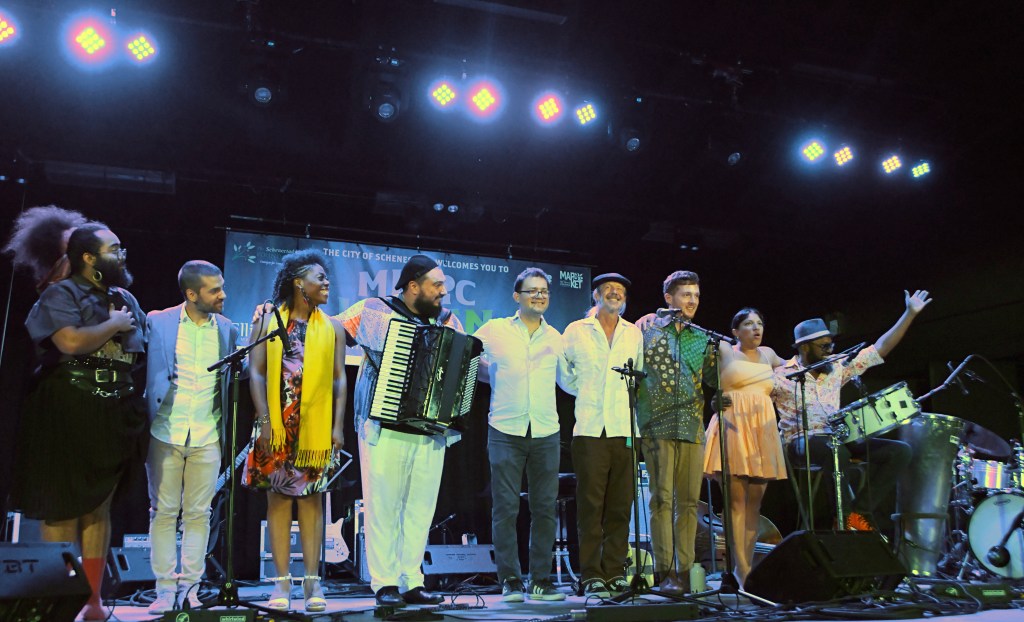
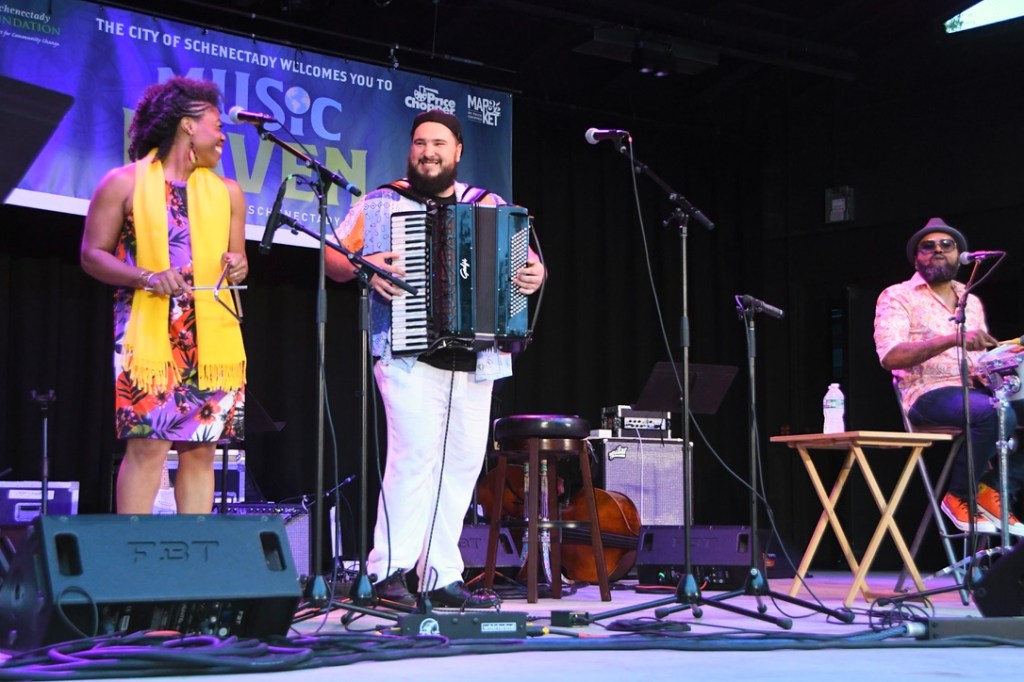
Music Haven gets extra-busy with jazz next week. Clarinetist Anat Cohen leads her Brazilian-inspired Quartetinho Sunday when locals Art D’Echo Trio (plus percussion leprechaun Brian Melick) open. Monday, the SUNY Schenectady Jazz Faculty Combo features guest trombonist Delfeayo Marsalis (brother of Wynton, Branford and Jason; all sons of Ellis).
If saxophonist Awan Rashad hadn’t told me beforehand that the quartet he led at Jazz on Jay Thursday had never before played together in that configuration, I never would have believed it.
The four – Rashad, tenor sax; Tarik Shah, double bass; Ian MacDonald, piano; and Matt Niedbalski, drums – charged up vintage tunes with impressive, happy tightness; sharing fresh ideas quickly from player to player.
The virtue of playing older tunes is that everybody on the bandstand knows them. The cats proved it Thursday by hanging in even when wind blew charts off their stands; MacDonald at one point anchored an elusive sheet with his shoe, while Rashad reached over to secure Shah’s with a clamp.
The hazard of playing older tunes is that everybody in the audience knows them, too – and feels we all know what to expect. Not a problem for this creative crew.
Rashad’s musical heart beats with 50s bebop and its 60s successor, hard-bop. They refreshed these familiar forms in waves of friendly immediacy. Shah and MacDonald shared a warmly tight connection in echoing riffs back and forth, while Rashad did this with all his band-mates.
“Time to Smile” lived up to its happy title in a mid-tempo swing excursion to start the set, everybody soloing hot but Niedbalski, but he later got his shot in riff-swapping with each band-mate in turn.
Rashad eased into “Lullabye of Birdland” through an unaccompanied intro, then did the same in “Everything Happens to Me.” Each cooked up its own flavor: “Lullabye” jaunty and “Happens” gentle, with Niedbalski understating the beat, brush in one hand, the head of a mallet in the other, while Rashad, who’d started it mellow and slow, took it for a faster ride to close.
Benny Golson’s “Shades of Stein” brought an upbeat feel, framing Niedbalski’s drum solo.
In “Around the Corner,” Rashad led everybody on a similar path to “Lullabye” – a spirited start, then explosive rapid runs to bring it home.
He promised to slow things down in “It’s Alright With Me.” Well, not so much, as Shah in particular didn’t get the memo and pushed things hard, faster than “Corner.” Nonetheless, Rashad quipped about this “nice slow tune.” MacDonald romped here, too, jumping octaves, charging hot into minor key mutations, then pumping fat chords.
The guys really dug into the happy tunes Thursday, Shah’s walking bass positively swaggering in “On The Sunny Side of the Street,” he and Niedbalski swinging it from the bottom. The rhythm section also shone bright in “Jim Dunn’s Dilemma,” a peppy bop-and-go rip.
When Rashad dedicated “Big Foot” to Shah, the bemused bassist pointedly looked down at his feet. At first it flowed mellow, but then flexed harder as if the guys took this Charlie Parker classic to the gym.
To give fun, a band first has to have fun itself, and these guys did.
Like trumpeter Bria Skonberg (returning to A Place for Jazz Nov. 1), Rashad served up a survey of his instrument’s capabilities and history, though he was never obvious and seldom pushed its range down to low whomps or high cries. He delivered some Johnny Hodges mellowness, some rapid-fire Sonny Rollins arpeggio runs and tastes here and there of John Coltrane – always respecting the antiques he revived from former times.
Early on, he acknowledged how seldom he emerges from his “cave,” but said he’s always happy to find folks waiting to hear him play when he does. And no wonder.
The Songs
Time to Smile (Freddie Redd)
Lullabye of Birdland (George Shearing)
Everything Happens to Me (Tom Adair and Matt Dennis)
Shade of Stein (Benny Golson)
Around the Corner (Barry Harris)
It’s Alright With Me (Cole Porter)
On the Sunny Side of the Street (Jimmy McHugh and Dorothy Fields – though some say Fats Waller wrote it)
A Great Orchestra Supports a Tremendous Voice in a Symphony of Songs
In the current trend of non-classical artists singing with orchestras, Angelique Kidjo leads the way.
Angelique Kidjo. Photo provided
Last season, R&B singer Ledisi sang with the Philadelphia Orchestra just weeks after playing SPAC’s Jazz Festival. This season, pop giant Beck sang with the Boston Pops at Tanglewood on Tuesday, July 23 and pop-neo-soul artist John Legend sings with the Philadelphia Orchestra at SPAC August 7.
Five-time Grammy-winning. Benin-born singer Angelique Kidjo’s August 2 SPAC concert with the Philadelphia Orchestra focuses a fierce artistic intent powering unprecedented achievement across oceans and musical styles.
This is not her first symphony – and it stands as a significant milestone in a career four decades deep and marked by ambitious, bridge-building projects.
Phoning from Paris last week, she said of her new African Symphony, “I wanted to celebrate my 40 years in music, celebrate the African artists from my childhood and the 60s to today.”
She chose songs for their moral and social messages, working with Derrick Hodge to orchestrate them. “I was absolutely flabbergasted by his work,” said Kidjo. “It’s so beautiful, it’s amazing the composition that he does.” Hailing his cooperative approach, she said, “It’s very rare to find people who are so flexible and so available, in music circles.”
Derrick Hodge. Photo provided
When questions arose, “”Pretty much everything I said, he took into account how to do this.” Said Kidjo gratefully, “Whatever you want to do, he’s willing to write it in that direction.”
On Friday, August 2, after the Philadelphians play an overture, Kidjo will sing “Lady” by Afro-pop force-of-nature Fela Kuti, first of the songs orchestrator Hodge wove into symphonic form.
“Lady,” as Kidjo explained, supports women’s empowerment and equality – in a man’s words, she carefully specified. “It’s followed by a song (Miriam Makeba’s “Nongqongqo”) paying tribute to the ones who have died before; for causes, for freedom,” said Kidjo, “women, men, who have died through conflict, through war, for us to be free today.”
“…always be your own agency, the best of yourself, and what you don’t want anybody to do to you, don’t do to anyone.”
Kidjo learned self-determination and tolerance from her parents, and by standing up to her seven brothers.
“The thing that I learned from parents was always be your own agency, the best of yourself, and what you don’t want anybody to do to you, don’t do to anyone.” She resisted her bossy brothers’ attempts at dominance by threatening to scare off their girlfriends.
Her parents supported her musical aspirations – her desire to BE James Brown and to emulate Aretha Franklin – but were also uncompromising critics, video-taping and assessing her performances. Kidjo’s mother told her, “The only people who tell you the truth are the people that love you.” In the face of this tough love, Kidjo proved tough, too.
“When I grow up I want to be James Brown.”
A self-proclaimed tomboy and “pain in the butt,” Kidjo proclaimed, “Anything my brothers do, I’m gonna do. They’re going to climb a tree? I’m in. They go to the motorcycle, I’m doing it. They’re playing soccer? I’m playing it. And my mom asked, ‘Are you a boy or a girl?’ I don’t care: When I grow up I want to be James Brown.”
Kidjo learned English to emulate Brown, and Aretha Franklin, whose “Amazing Grace” album gave Kidjo “the idea, the possibility, that a woman could be on the cover of an album.” She said, “I want more women on the covers of albums, especially Black women.”
Soon, Kidjo was on the covers: 17 albums since 1992, including a tribute to Puerto Rican soul-salsa diva Celia Cruz and a song-by-song remake of Talking Heads’ “Remain in Light.”
“If I’m not inspired, I won’t do it; but if I’m inspired, I will do it.”
Kidjo’s acclaimed early albums took her to New York where she sang at Carnegie Hall in shows with Philip Glass, Lou Reed, Patti Smith and other cross-cultural giants. When David Byrne came backstage to meet her, “We had a great conversation and I’m looking at him and I’m like ‘This guy, he knows too much about the music of West Africa; he’s not really American, is he?’”
She loved Talking Heads’ “Remain in Light” album despite dismissive friends’ claims that it wasn’t African enough. “It’s African for me,” Kidjo defended. Overruling her team’s doubts, she resolved, “Guys, I don’t care what you say; I’m going to do this album track by track…Don’t worry: If I’m not inspired, I won’t do it; but if I’m inspired, I will do it.”
She did, inspired by a complicated muse that combined homegrown wisdom with Heads’ songs.
“For me, ‘Born Under Punches’ (a song on “Remain in Light”) meant we are born under the punches of corruption,” she said. “If corruption did not exist at the level that it is, we would have money for everybody to have a decent life…not that many homeless people and not that many who can’t go and have decent health care.” If money lost to corruption were invested in people, dictatorships would not exist,” Kidjo maintained. “We might not all be happy, but we would have less tension, less conflict, less war.”
Talking Heads’ song “Burning Down the House” had a similar moral resonance. “Fire is mesmerizing,” said Kidjo. “Starting a fire is easy, but when you start burning everything down and if you don’t know how to stop, it will burn you, too – and kill you.”
When I commented, “Every song seems to have a meaning that comes from far inside you,” Kidjo replied “Yep” with simple, quiet emotion.
I asked, “Talking Heads reached out to Africa, you reached back…This new symphony is also about reach, isn’t it?”
She agreed once again, and it became clear that her music builds bridges to reach across continents, from feeling to feeling and moral message to moral message – regardless of the form it takes.
“I know nothing about you, but your voice is something else.”
“My adventure with an orchestra started way back, almost 10 years now,” said Kidjo. It began, like her Talking Heads project, with a fortuitous meeting. A neighbor in New York told Kidjo, ”There’s somebody from the classical world who wants to speak with you.” That “somebody” was Timothy Walker, artistic director of the London Philharmonic. He told Kidjo, “I know nothing about you, but your voice is something else.” When Walker suggested she play with an orchestra, she wanted to know what he’d been smoking before their meeting. “He said you should be singing (British composer Henry) Purcell, ‘Dido’s Lament’!”
“I realized I had to be a part of the orchestra.”
When Walker re-introduced her to Philip Glass, he told Kidjo the prolific New York minimalist “was thinking what we need to do is write a symphony.” Glass worked with a poem Kidjo wrote in Yoruba, translated into English and French and wrote out phonetically “for him to get the rhythm and the tone of the language.”
“Angelique, together we have built a bridge that no one has walked on before.”
Kidjo recalled, “A year after, he wrote the first symphony for me.” Glass’s “Ife Songs” premiered in 2014, Kidjo singing with the Orchestre Philharmonique Du Luxembourg. (KIdjo later sang on Glass’s Symphony No. 12, using music by David Bowie and Brian Eno.) Glass told Kidjo, “Angelique, together we have built a bridge that no one has walked on before.”
Now, Kidjo is ready to walk another bridge.
“That’s how I started in the classical world,” she said. “Once I started working with the Luxembourg Philharmonic…I realized I had to be a part of the orchestra.”
“My voice is like an instrument, and in order for me to be part of that, I need to hear the orchestra with my body and with my ears and be absolutely part of the whole thing.“
Angelique Kidjo sings her African Symphony with the Philadelphia Orchestra Friday, August 2. 7:30 p.m. Saratoga Performing Arts Center, 108 Avenue of the Pines, Saratoga Springs. $117.75-$48.75 amphitheater, $38.75 lawn. 518-584-9330 www.spac.org
THE AFRICAN SYMPHONY
Based on African songs, vintage and contemporary, and orchestrated by Derrick Hodge, Angelique Kidjo’s African Symphony comprises these movements:
Márquez’ Danzón No.2 (Orchestra only)
Lady (Fela Kuti)
Nongqongqo (Miriam Makeba)
Soweto Blues (Hugh Masekela)
Soul Makossa (Manu Dibango)
Angola (Jah Bouks)
7 Seconds (Youssou N’Dour and Neneh Cherry with Cameron McVey and Jonathan Sharp)
Carnaval De San Vincente (Cesaria Evora)
Medley (Anybody/Calm Down/Shekere)
(Credits for above medley: Burna Boy/Rema/Angelique Kidjo)
INTERMISSION
“Brazil” by Ary Barroso (Orchestra only)
Folon (Salif Keita)
Bring Him Back Home (Hugh Masekela)
Malaika (guitar and vocal only; written by Adam Salim in 1945, first recorded by Fadhili William)
Jerusalema (Master KG, the original features singer Nomcebo)
Agolo (Angelique Kidjo)
Afirika (Angelique Kidjo)
Pata Pata (Miriam Makeba)
Kidjo said she chose these songs as “the meaningful ones, the ones that have issues of our times, that have been there before… and that are still there.“
She said, “Songs are simple yet complex, like human beings are. Because they’re the mirror of our emotions. Since we are complex, the music has to be simple and complex at the same time.”
CONDUCTOR MIGUEL HARTH-BEDOYA
Peruvian-born Miguel Harth-Bedoya earned his Bachelor of Music from the Curtis Institute of Music and his Master of Music from the Juilliard School. He recently concluded a seven-year tenure with the Norwegian Radio Orchestra and 20 years with the Fort Worth Symphony Orchestra.
On more than 25 recordings over 30 years of conducting, Harth-Bedoya has released albums on Deutsche Grammaphon, Decca, Naxos and other classical record labels. He now teaches and conducts at Baylor University.
KIDJO
A five-time Grammy Award winner, Kidjo performed at the 2023 Saratoga Jazz Festival and has also played the Troy Savings Bank Music Hall.
Time Magazine has called her “Africa’s premier diva” and named her one of the 100 most influential people in the world for 2021. The BBC listed her among the continent’s 50 most iconic figures, and in 2011 The Guardian honored her as one of their Top 100 Most Inspiring Women in the World. Forbes Magazine has ranked Angelique as the first woman in their list of the Most Powerful Celebrities in Africa. Numerous awards honor her advocacy work: the 2015 Crystal Award of the World Economic Forum in Davos, Switzerland; the 2016 Amnesty International Ambassador of Conscience Award, the 2018 German Sustainability Award, the 2023 Vilcek Prize in Music, and the 2023 Polar Music Prize.
In 2014, Kidjo published her memoir “Spirit Rising, My Life, My Music” (Harper Collins) with co-writer Rachel Wenrick. It features a preface by Desmond Tutu and forward by Alicia Keys.
THAT GUY
Kidjo speaks very fast English, accented with both Yoruba and French. At one point, I missed a few words over the phone and asked her to repeat; “Philip Somebody,” I guessed. She replied, “Philip Glass” – who composed her first symphony.
When she repeated his name, I said, “Oh, THAT guy!” She said, “I don’t think anybody has ever called him ‘THAT guy,’” and laughed the greatest laugh – sounding like Odetta.
Saxophonist Awan Rashad plays Jazz on Jay Thursday, July 25 – a week after his longtime teacher, Brian Patneaude.
Patneaude’s show was his only performance this summer as a leader, and Rashad’s concert Thursday is just as unique.
Awan Rashad. Photo provided
“This will be the first time all four of us have played together,” Rashad says. His quartet is Ian MacDonald, piano: Tarik Shah, double bass; Matt Niedbalski, drums and cymbals; Rashad plays tenor. He played Jazz on Jay in September 2021, and Shah played the free series in July 2023.
Rashad’s grandfather played bluegrass guitar, “but that had nothing to do with my musical path,” Rashad says. “I always say the sax was forced into my hands in third or fourth grade.”
“The first person to actually mean something to me musically was Cannonball Adderley,” says Rashad who studied with Dwayne Bass at New Covenant Charter School, then with Patneaude from age 12 to 20.
Rashad won the Jazz High School Competition at the 36th Annual New England Saxophone Festival and Competition, earning the opening spot on a Yosvany Terry show. He was also selected to the All-State Instrumental Jazz Ensemble and the Symphonic Band of the New York State School Music Association (NYSSMA).
After graduating from Christian Brothers Academy, Rashad attended SUNY Schenectady County Community College then completed his bachelor’s degree at SUNY Purchase. “My college teachers were Ralph Lalama and Gary Smulyan,” says Rashad, who now combines teaching with performing.
At Jazz on Jay, his quartet will play bebop and hard bop tunes. “Mostly standards, maybe one or two originals,” Rashad says, listing composers Freddie Redd, Victor Feldman and Sonny Rollins.
“I just play the tune; I don’t think too hard about it,” he explains, adding the band enjoys “a LOT of room” to improvise.
Awan Rashad. Photo provided
Jazz on Jay free concerts are noon to 1:30 p.m. at Jay Square, the new park space opposite Schenectady City Hall. The rain site is Robb Alley at Proctors, 432 State St., Schenectady. Seating is provided indoors at Robb Alley, but patrons are invited to bring their own seating and refreshments to Jay Square.
Jazz on Jay is presented by the ElectriCity Arts and Entertainment District and sponsored by the New York State Council on the Arts, a Schenectady County Legislature Arts & Culture Grant, Downtown Schenectady Improvement Corporation, The Schenectady Foundation, Price Chopper/Market 32, MVP Health Care, Schenectady County, Schenectady City Hall, and Proctors Collaborative.