
Baklava Express continues Proctors Passport Series Friday in its GE Theatre; multi-cultural explorations of rare imagination and creative energy. Its four members explore in several directions; their wide interests never outrun their skills.
Oud player Josh Kaye’s transatlantic background and Brooklyn upbringing prepped him to lead a quartet with violinist Daisy Castro, bassist James Robbins and percussionist Jeremy Smith. They rummage among Jewish, Arabic, Turkish and jazz traditions to make something new, music whose deep roots and right-now virtuosity recall Jordi Savall*.
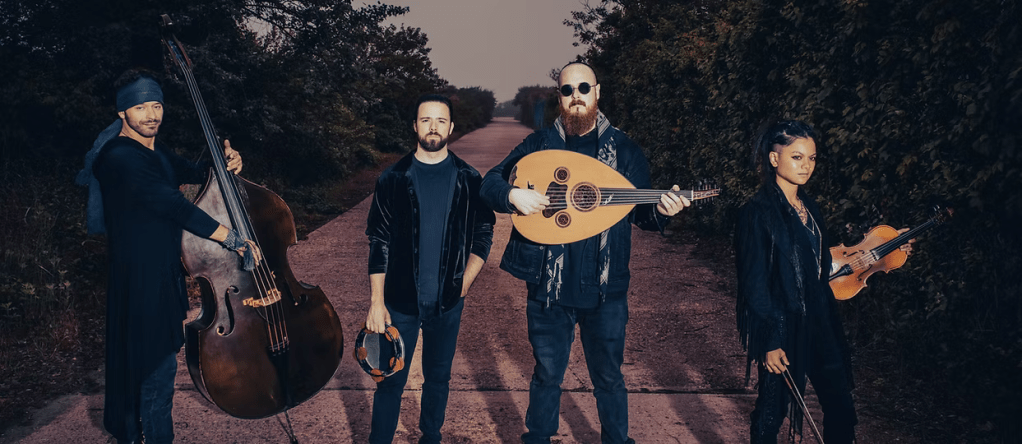
Baklava Express. Photo provided
Some definitions via Wikipedia (which I support with donations).
Baklava: a layered pastry dessert made of filo pastry, filled with chopped nuts, and sweetened with either syrup or honey.
Oud: a Middle Eastern short-neck lute-type, pear-shaped fretless stringed instrument, usually with 11 strings grouped in six courses (pairs).
Talking about a new album due next month – and likely to contribute to Friday’s repertoire – Kaye cites Mizrahi and Ashkenazi Jewish communities among prime musical sources.
Again, Wikipedia clarifies.
Mizrahi: Jewish communities originating from the Middle East and North Africa,
Ashkenazi: a major Jewish diaspora population descending from medieval Jewish communities in the Rhineland (Germany) and Northern France, later migrating to Eastern Europe.
London-born Kaye came here at 13, studied philosophy at Hartford College before abandoning his Ph.D. program at New York’s New School to play heavy metal electric guitar before joining French guitarist Stephane Wrembel’s acoustic gypsy jazz band. When Kaye first heard an oud in a Brooklyn barber shop jam session, he invited himself in, bought an oud and began to explore Middle Eastern sounds. The fretless oud allows more complete tonal control than a guitar whose fretted neck steers players into conventional scales.
Daisy Castro started playing Suzuki method violin at six; then a family trip to France at 12 brought her into contact with the same Django Reinhardt and Stephane Grapelli gypsy jazz tradition Kaye explored. Before leading her own jazz band and joining Baklava Express, she played in her family band Infidel Castros. In addition to Baklava Express, she also plays with Wade Schuman’s hybrid multi-traditional crew Hazmat Modine and the Latin rock Gonzalo Bergara Quartet.
Bassist James Robbins – not to be confused with DC punk stalwart J Robbins (Jawbone and other hardcore crews) – played mainstream jazz with stars including Clark Terry, Billy Taylor, George Benson and Freddie Hubbard before joining Baklava Express. He also plays with the Colombian electro band Delsonido and rockers Thank You Scientist.
Percussionist Jeremy Smith also hybridizes in several directions including the Afro-Peruvian band Festejation, Mr. Ho’s Orchestrotica big band, and the Knights, the classical ensemble that played Troy Savings Bank Music Hall last month.
In other words, they can go in any direction as their 2023 debut album “Davka” demonstrates on nine songs starting from “Kosher Bacon,” a delicious oxymoron.
Baklava Express expands tradition in cozy, tasteful explorations; clear melodic statements spin out, jazz-like, from repeating patterns that prepare the listener for detours and delights.
Friday at 7:30 p.m. $34.51 518-346-6204 www.proctors.org
After Friday’s Baklava Express show, Proctors Passport Series – a project of Music Haven – wraps up with Colombian cumbia accordionist Yeison Landero on Thursday, May 14, also in Proctors GE Theatre.
* Jordi Savall is a Spanish-born musical explorer, genius-level viola da gamba player and longtime leader of ensembles from compact chamber size to symphonic. His “Orient-Occident” and “Istanbul” albums are multi-cultural favorites in a career as prolific as Bill Frisell’s: Savall released nine albums in 2011 alone.
Yeah, OK. Viola da gamba: a bowed and fretted string instrument that is played da gamba (i.e. “on the leg”). It is distinct from the later violin or viola da brachia…one of the earlier viol family of bowed, fretted and stringed instruments with hollow wooden bodies and pegboxes…to adjust the pitch of each of the (five to seven) strings.
 Hoke's Jukebox