International, Deep in the Heart

Review: Baklava Express Friday, March 13, 2026 at Proctors GE Theatre, Passport Series

The refreshing foreign-ness of the lively international music Baklava Express made at Proctors GE Theatre Friday was only part of the picture – or the map.

The quartet spun together musical traditions from Europe to Western Asia in a tight, kinetic Middle Eastern weave: Jewish (both Ashkenazi [European] and Mizrahi [Middle Eastern/north African) – and Muslim (both Arab and Turkish). That all sounds academic, analytical – but it felt like a rush of skill and swagger, energy and intelligence.

It was country music, but from several countries; tight as chamber music, free-flying as jazz – and it felt, most inspiringly, like friendship in sound.

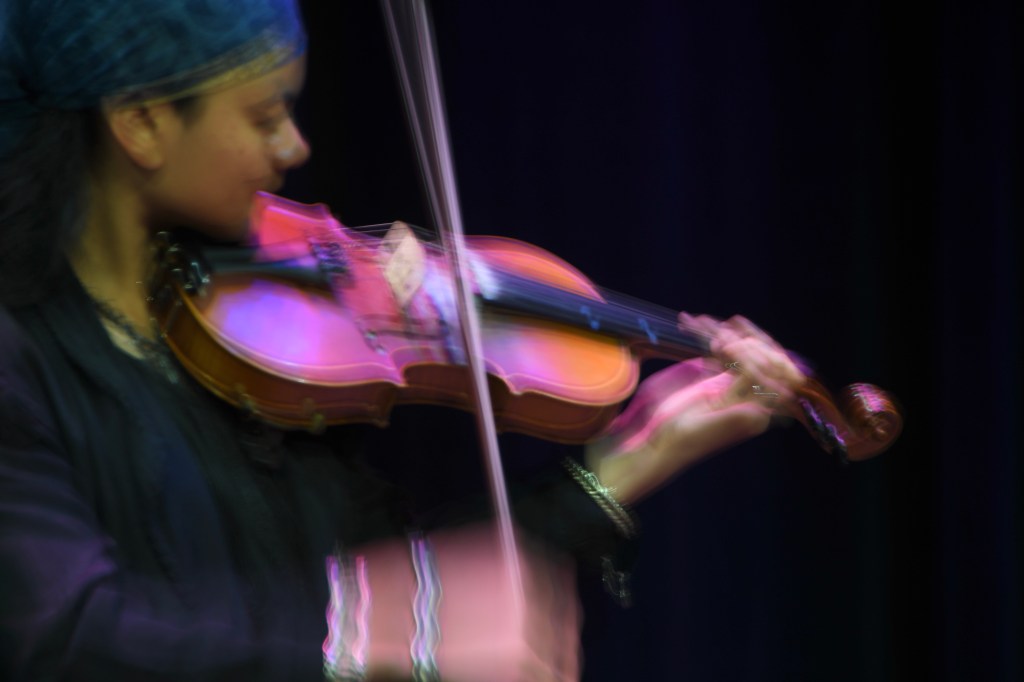
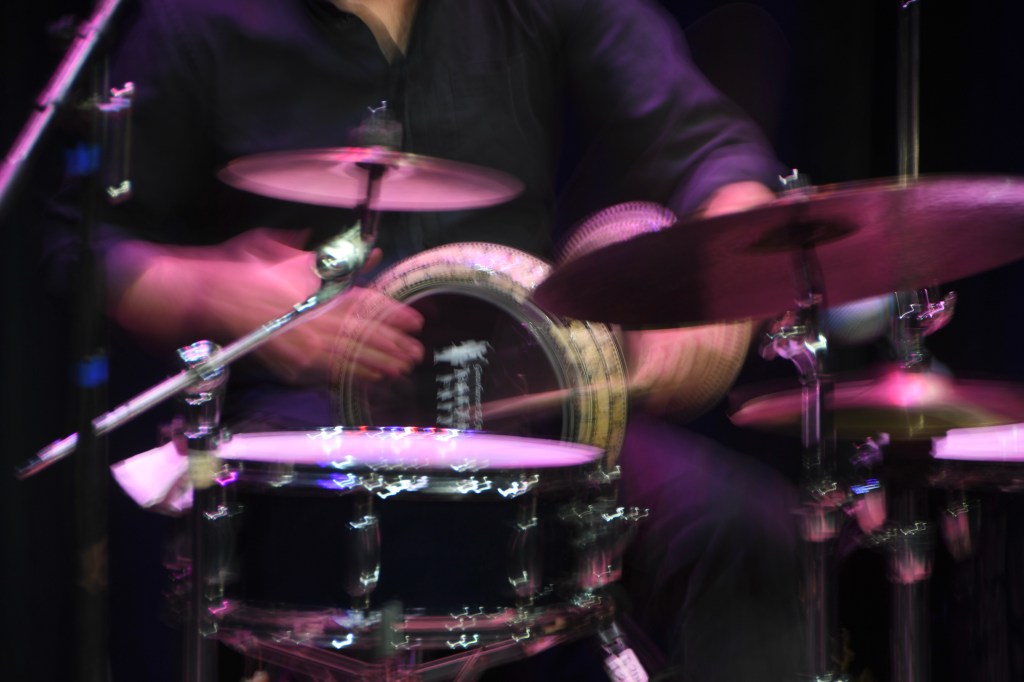
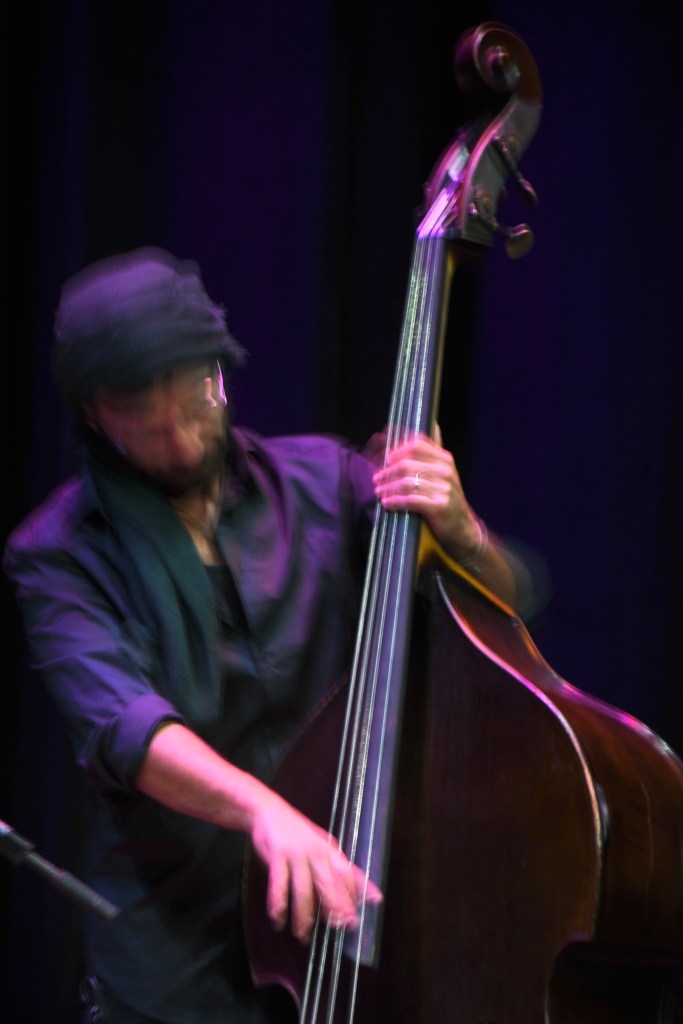
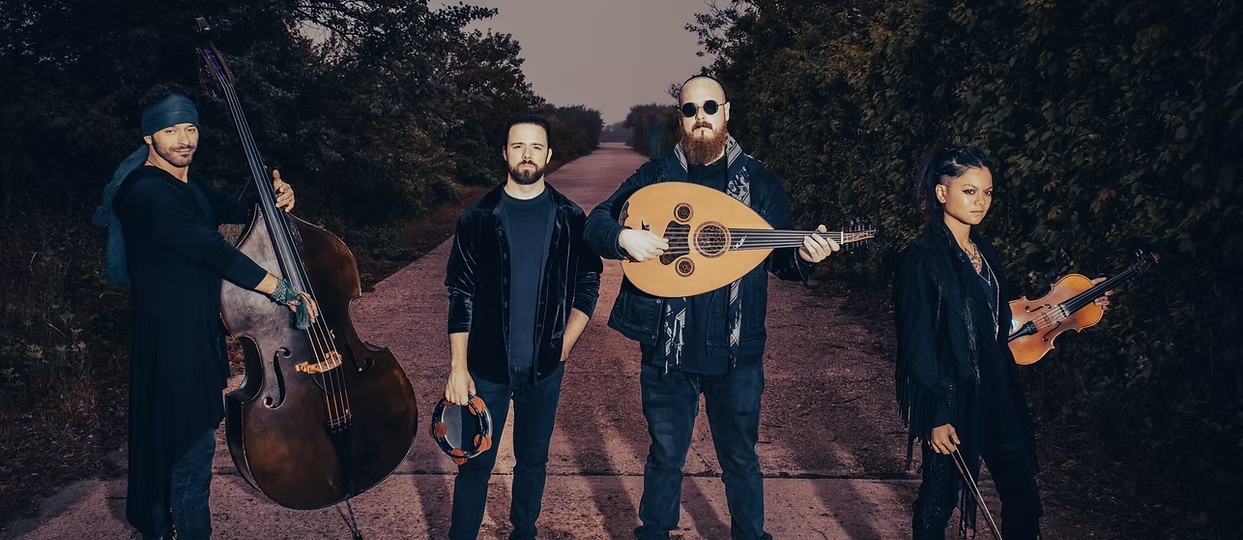
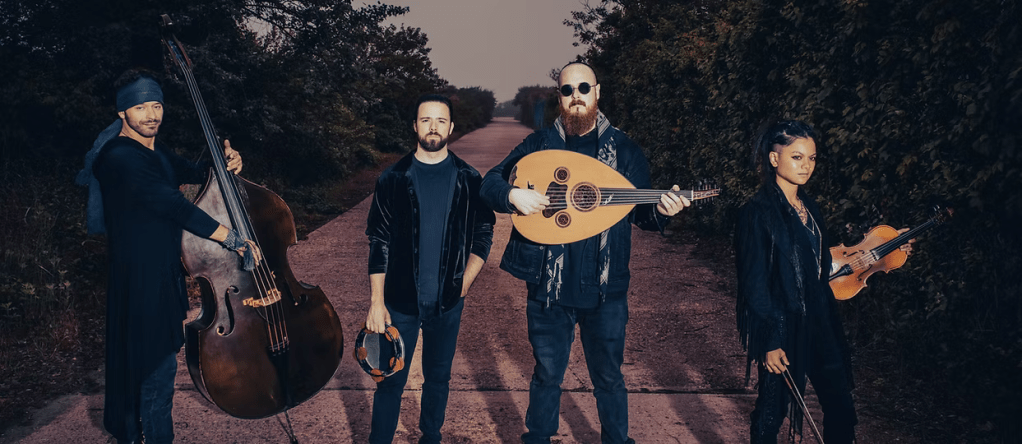
Leader/composer oud player Josh Kaye and violinist Daisy Castro made the melodies, stage right; opposite percussionist Jeremy Smith and bassist James Robbins. Most often, Kaye started his tunes with an ostinato in clipped percussive tones, like guitarist Jimmy Nolen in James Brown’s band. Then Kaye and Castro formed melodies together, violin etching long melodies over staccato oud phrases. Then they swapped, and swapped back again, one reeling out rhythms, the other telling tune-full tales. Smith held a djembe on his knee, clamping its body with his elbow to change the tone, like story-telling African drummers or as the subdudes Steve Amedee does with his fingers pressing the skin of a tambourine. Smith tapped the djembe head with one hand, aiming sticks or mallets at snare, toms and cymbals with the other. Just as Kaye and Castro often sounded like one musical mind with four hands, jazz-trained bassist Robbins linked tight with Smith’s busy gliding clatter.
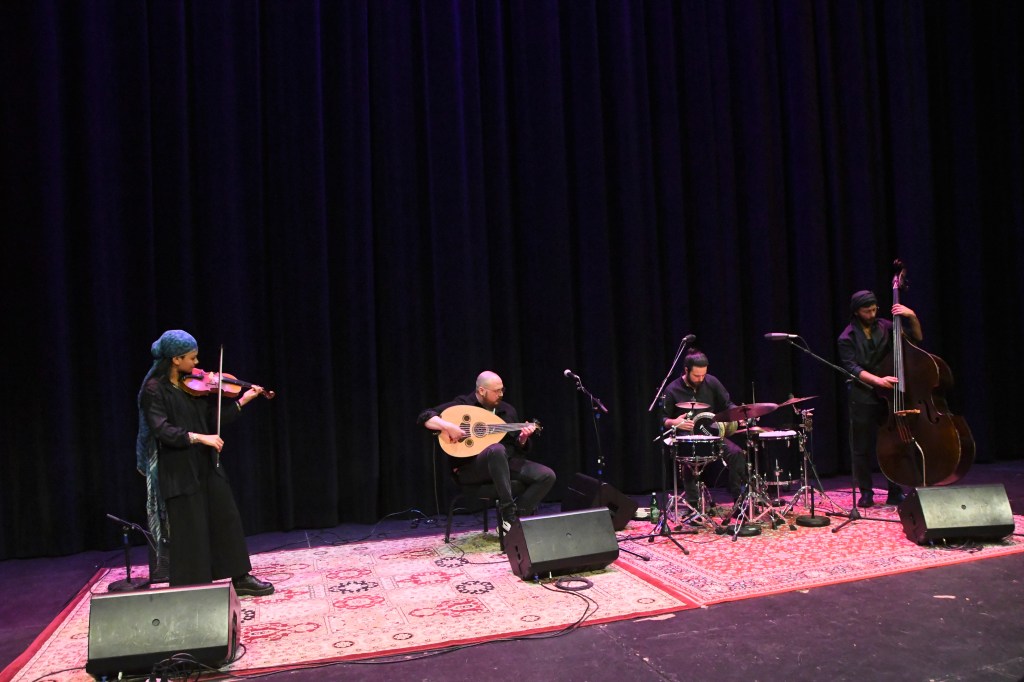
Baklava Express, from left: Daisy Castro, Josh Kaye, Jeremy Smith and James Robbins

They played tight and loose at once, like bebop, like bluegrass. Dense and driving, it felt free as they left spaces between the notes; like what Art Neville of the Neville Brothers once told me was their “secret groove; what I don’t play.”

What Baklava Express did play were Kaye’s original compositions on their two albums, “Davka” (2023) and “Sababa,” due next month; advance copies sold fast at the merch table.

Kaye writes sounds from over there to express feelings from right here, as a British-born Jewish expatriate who discovered both gypsy jazz and Arabic music in Brooklyn. And it swung, from the misnomer-named “Kosher Bacon” to their self-named closer 80 minutes later. 
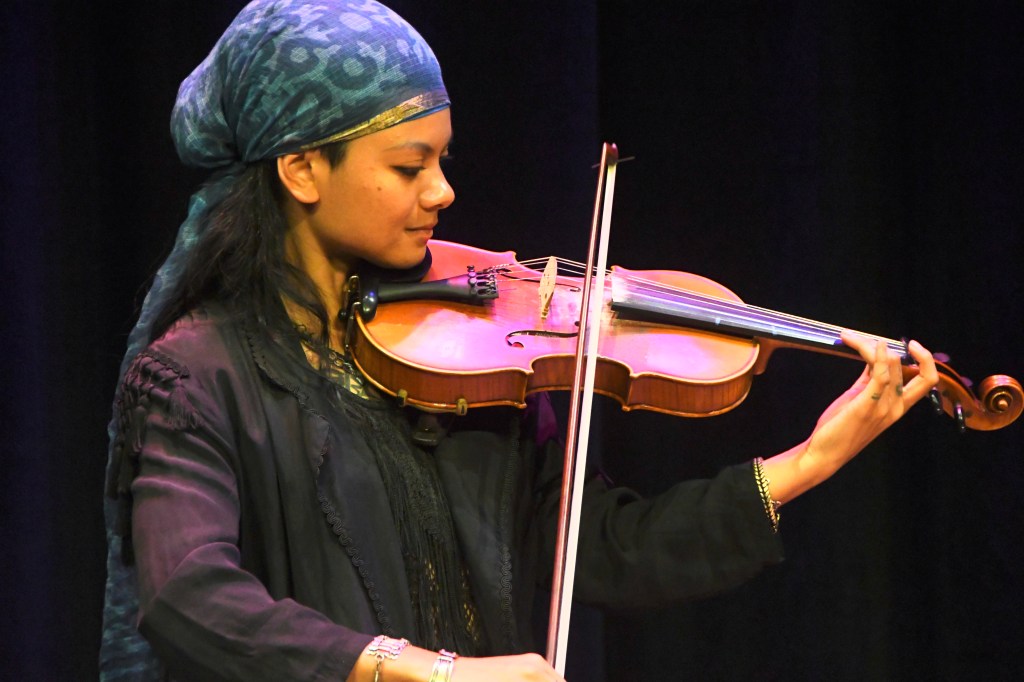
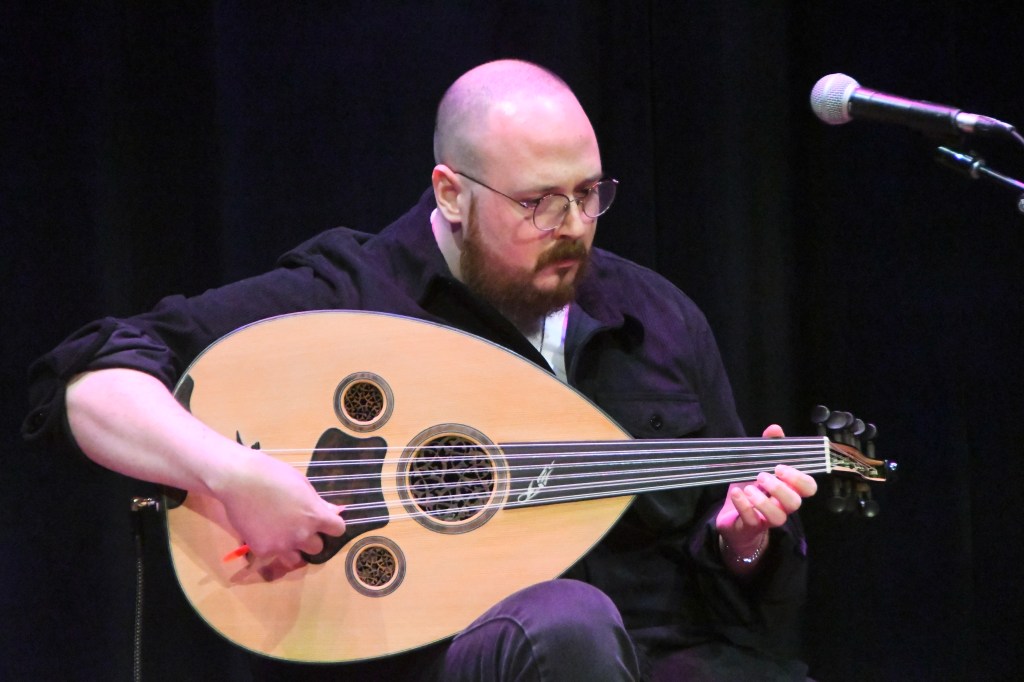
Daisy Castro, above; and Josh Kaye, below
“Kosher Bacon” introduced their episodic groove-with-solos performing style, Castro bowing long-line melody over Kaye’s staccato oud chops to fit, then pushing and pulling the beat in his own solo. The faster, dance-y “Davka” felt even more rhythmic, speeding and slowing to a hard stop. The new “White Sauce Hot Sauce” honored a Brooklyn halal food truck – Kaye told us where to find it – a delicious menu of melody and busy beats that alternated clear speedy runs with trance-y drones.

Flowing slower, the mood piece “I’ll Figure It Out” found Castro and Kaye in close parallel, forming waves that built and subsided into a repeating coda. Both “Figure” and “Nistar,” which Kaye explained in his quiet English accent meant hidden or concealed, addressed a period after “Davka” and before “Sababa” as he realized he had to write more songs, whose purpose initially felt hidden from him.

Clarity arrived quickly enough – easy for us to say, in the audience – in the abrupt cadences of “Nistar;” compact, emphatic, in crisp formation by oud and violin. A stop-and-go groove pushed the solos then settled into a calmer section until a hard stop slammed the door.

“Salt and Paprika” also cruised close to home, though it could have come from anywhere between Istanbul and Cairo. It referred to the gray starting to emerge in Kaye’s red beard, with an apt, complex pointillism in short punchy passages, notably a sizzling oud and violin duet.

Kaye called an audible before the cosmologically titled “Turtles All the Way Down,” stretching his intro on repetition first, then exploration that Castro followed. Then she led, then followed again until they arrived at the coda together, then repeated it, Kaye at double-time.

He explained he wrote “Begin Again” as the first of the new songs on “Sababa,” but it appears last on the album and near the end Friday. Sparse and syncopated at first, it grew wings in Castro’s solo, then an especially strong oud break, climbing and climbing.

The new album’s title track featured short-but-cool breaks by Robbins, then Smith, who otherwise played supportively beneath oud and violin. Shorter than most tunes Friday, “Sababa” got to the point quickly.
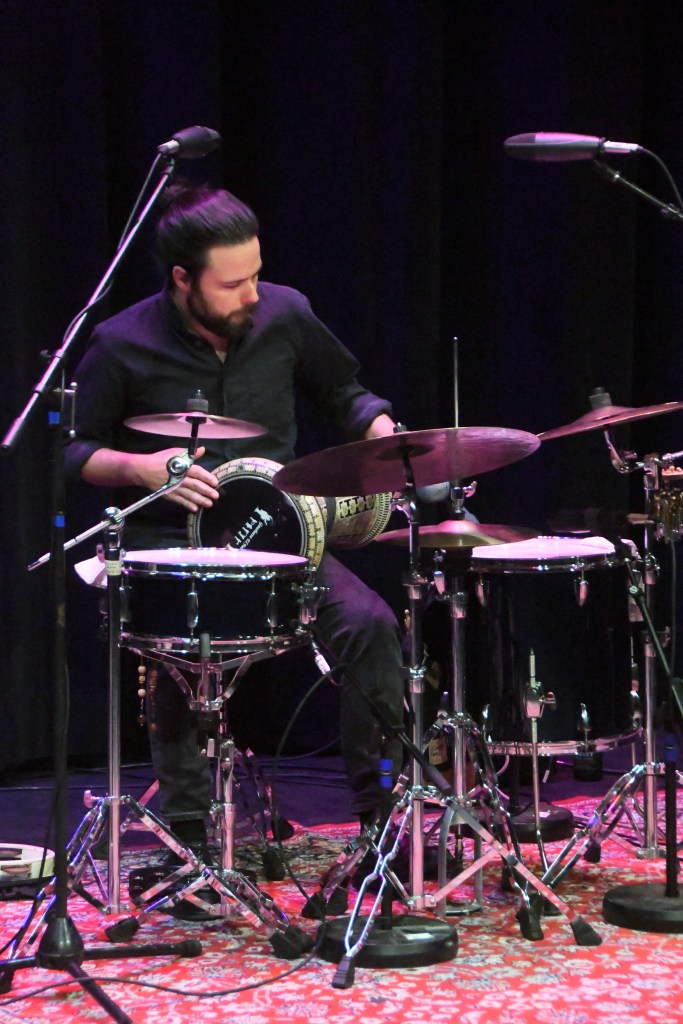
Jeremy Smith, above; James Robbins, below
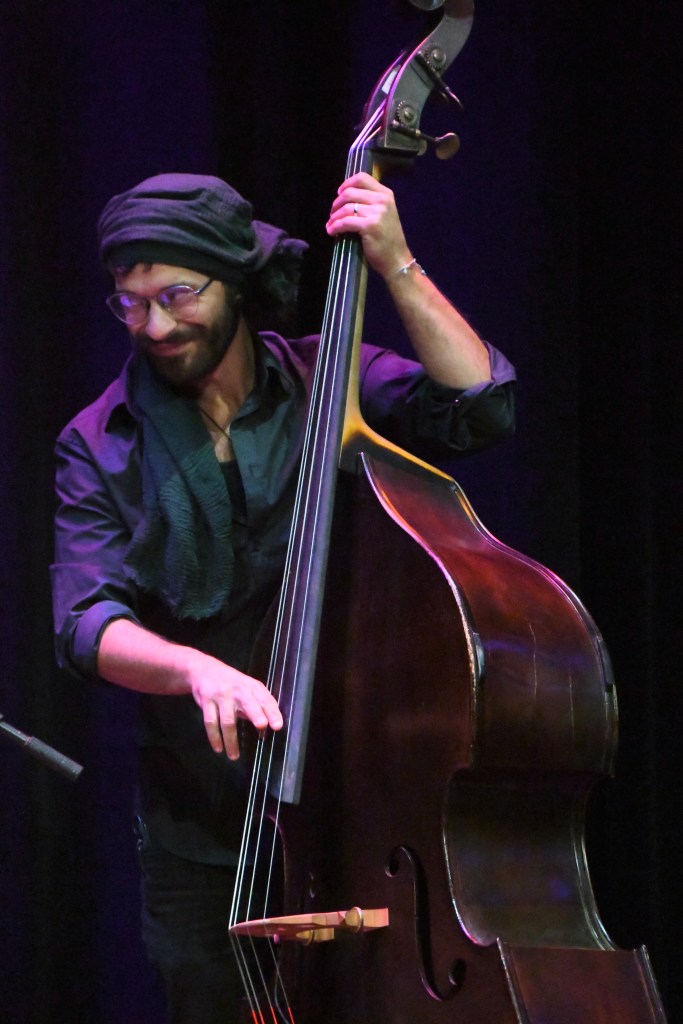
Their namesake closer “Baklava Express” did the opposite. It stretched through syncopated episodes, dense then sparser, Castro taking the last solo then cueing the B-section again as the coda. They took their bows then looked out at the crowd on its feet, glanced at each other, took up their instruments again and revved up the melody in a brief, hard-hitting departure-less encore.

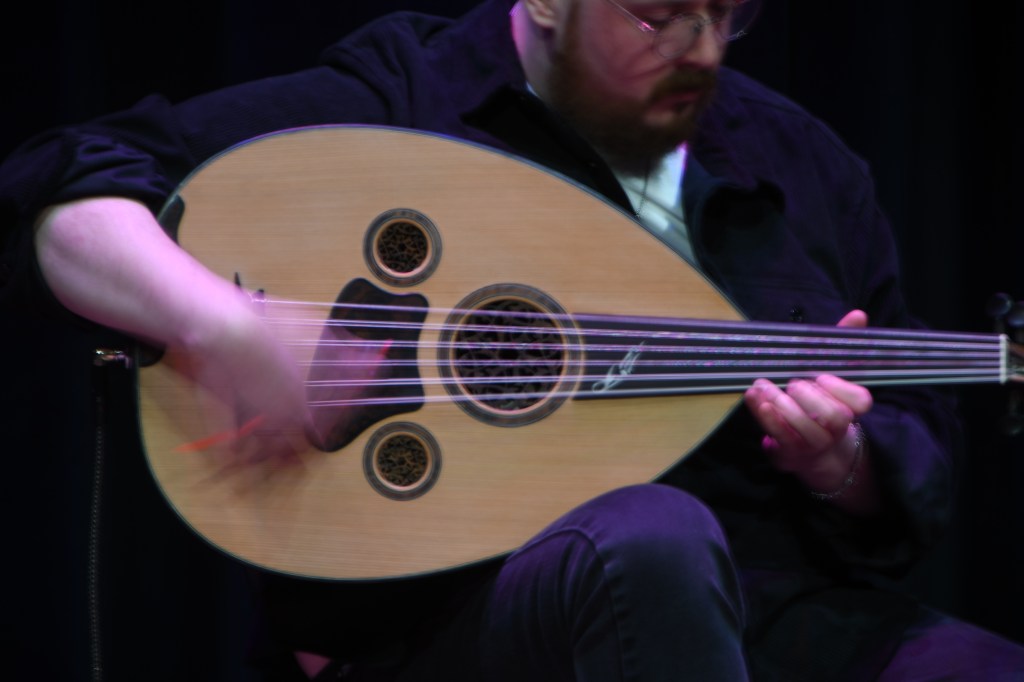
Wielding a stick-like pick, Kaye relied on the oud’s deep double-stringed resonance in early-song melodic statements, then spun out in widening patterns, jazz-like, as he sped up his phrasing, like Jerry Garcia speed strums.

Tiny, the scarf around her head stretching to near her ankles all of five feet below, Castro played powerhouse, punchy passages or, as in “I’ll Figure It Out,” lyrical, relaxed musings. At times, she echoed European jazz violinists Jean-Luc Ponty or Michal Urbaniak; just as Kaye (more distantly) evoked Django Reinhardt occasionally.

Proctors Passport Series of international artists is a co-presentation with Music Haven which presents similarly globe-spinning fare summers in Schenectady’s Central Park. The Passport Series concludes May 14 with cumbria accordionist Yeison Landero. While the Proctors Passport Series offers full-season passes at a discount, Music Haven Central Park concerts are free.
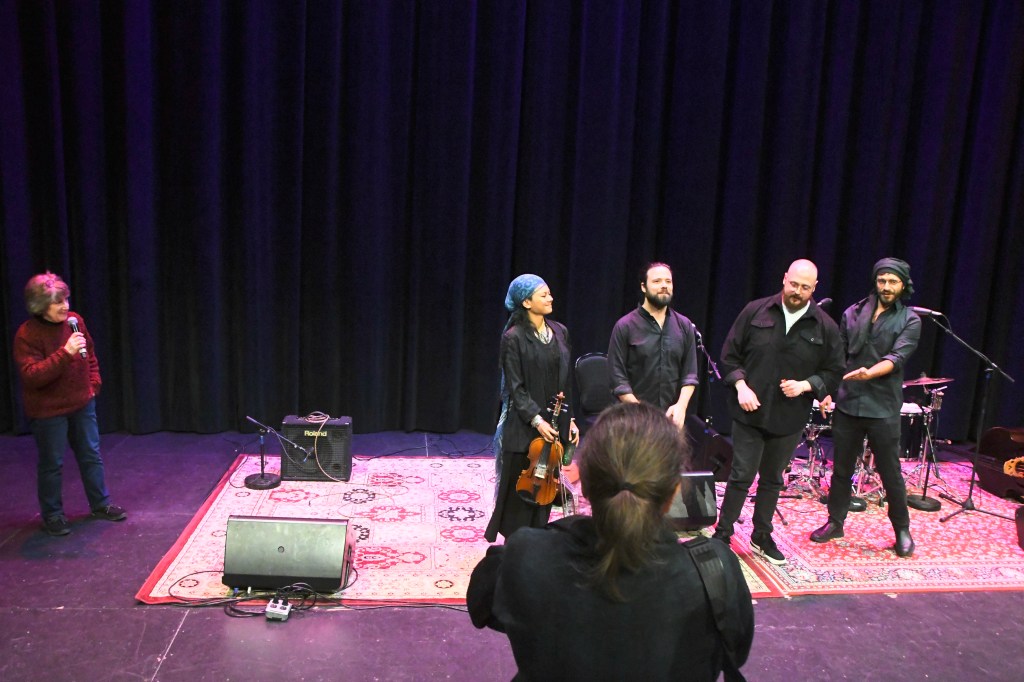
Music Haven impresario Mona Golub, at left, hails Baklava Express

SONGS

Kosher Bacon

Davka

White Sauce Hot Sauce

I’ll Figure It Out

Nistar

Salt and Paprika

Turtles All the Way Down

Begin Again

Sababa

Baklava Express

GALLERY
Country Joe McDonald, a Voice of Conscience Stilled

Spring 1968. Morning inspection at the Defense Language Institute in Monterey, California. Hundreds of my fellow students stood in uniformed rows below: Army, Navy, Air Force Marines. 

A pretty good Russian student, I wasn’t really on board with the uniform stuff. Years later, my annual performance review noted, “Militarily, Hochanadel remains basically a civilian.”

On a second floor barracks balcony above that inspection, I placed speakers connected to a borrowed stereo inside.

I cranked it all the way up and dropped the needle. A rock band boomed and loud words drawled, “For it’s one, two, three; what are we fightin’ for? Don’t ask me, I don’t give a damn. Next stop is Vietnam.”

Below me, angry shouts and rapid footsteps running up the stairs urged all due speed as I ran to the far end of the barracks, sped down the fire escape, slid fast down the slippery ice-plant slope and ran.

I got away clean, my laugh felt like a song.

I didn’t know music could do that, make The Man anger-scream and chase me.

Joe at 75. Photo by Steve Read, from the crew of the BBC documentary on the Summer of Love.

Years later, when Country Joe McDonald was headed east to play the Van Dyck, I told him how he and his band the Fish had protested morning inspection with their “I Feel Like I’m Fixin’ to Die Rag” and he laughed over the phone. A Navy vet, himself; he knew what that meant.

Country Joe McDonald went silent Saturday, March , dying of Parkinson’s at home in Berkeley at 84.

Country Joe and the Fish may have been the most overtly political of all the San Francisco bands that played the Monterey Pop Festival the previous June, and I enjoyed seeing them many times during my year-long language training. 

Their sun-splashed mid-afternoon show in a beach-side Santa Cruz pavilion was maybe the most quintessentially California experience of that complicated, mostly wonderful time. But Joe didn’t remember the Berkeley Community Theater show where dancers on roller skates, wearing lights on their bodies in the dark behind a scrim, moved in sci-fi grace as he and the Fish played in front.

Joe came by his activism honestly, a “red diaper baby” raised by socialist parents who named him after Stalin, as the New York Times reported in his obituary, which provides other information noted here. 

His rock-star status flowed directly from his activism as his first recordings were audio inserts in his political magazine Rag Baby. While his producer barred “I Feel Like I’m Fixin’ To Die Rag” from the May 1967 Fish debut album “Electric Music for the Mind and Body” (source of my first music column title), he let slide “Super Bird,” lampooning LBJ.

He led the F-word Fish cheer solo before his biggest-ever crowd, at Woodstock; two years, later he led 250,000 protesters in the same cheer-and-song protest at the Capitol in Washington DC. This chant and “Rag” earned him a place on Richard Nixon*s enemies list, got him cancelled off the Ed Sullivan show and fined for obscenity onstage.

War was the obscenity to Joe, and he protested it all his life, supporting Vietnam Veterans Against the War, Swords to Plowshares, Vietnam Veterans of America and other organizations. 

After the Fish disbanded in 1970, McDonald recorded a blues album with Jerry Garcia and paid tribute to protest-folksinger Woody Guthrie. And he continued protesting in “Vietnam Experience” (1986) and slammed the Iraq War in “Support the Troops.” 

He sang both protests and love poems at the Van Dyck, the last time I saw him, as I reported in the Gazette.

There’s nothing nostalgic about his indignation. He updated “Yankee Doodle” into an anti-nuclear broadside on penny-whistle, followed “The Fish Cheer” and the anti-Vietnam-War tirade “I Feel Like I’m Fixin* To Die” with “Support the Troops,” which focused a similar outrage on the Iraq War. The same compassion for those fighting it and those who love them powered “Picks and Lasers,” a science fiction epic decrying the destructive waste of a war fought on Mars for mining resources. It sounded like a movie plot as folk murder ballad. Before launching into “Support the Troops,” which criticizes the Iraq War as being fought over oil, but “not in my name,” McDonald dedicated the spell-out-“Fish Cheer” – using another F-word – to George Bush.

The show wasn’t all billboards and broadsides, however.

“Janis” was genuinely tender, as was “Come With Me,” written for the first of his five children, named Seven Anne. He followed this with “All My Love In Vain” and “Waited in Vain,” paired lost-love songs of aching poignancy.

I think we all know what Country Joe McDonald would sing about the horrifying news today.

“Gimme an ‘F’…”

PREVIEW: Baklava Express Friday, March 13 at Proctors GE Theatre – Passport Series

Baklava Express continues Proctors Passport Series Friday in its GE Theatre; multi-cultural explorations of rare imagination and creative energy. Its four members explore in several directions; their wide interests never outrun their skills.

Oud player Josh Kaye’s transatlantic background and Brooklyn upbringing prepped him to lead a quartet with violinist Daisy Castro, bassist James Robbins and percussionist Jeremy Smith. They rummage among Jewish, Arabic, Turkish and jazz traditions to make something new, music whose deep roots and right-now virtuosity recall Jordi Savall*.

Baklava Express. Photo provided

Some definitions via Wikipedia (which I support with donations).

Baklava: a layered pastry dessert made of filo pastry, filled with chopped nuts, and sweetened with either syrup or honey.

Oud: a Middle Eastern short-neck lute-type, pear-shaped fretless stringed instrument, usually with 11 strings grouped in six courses (pairs). 

Talking about a new album due next month – and likely to contribute to Friday’s repertoire – Kaye cites Mizrahi and Ashkenazi Jewish communities among prime musical sources. 

Again, Wikipedia clarifies.

Mizrahi: Jewish communities originating from the Middle East and North Africa,

Ashkenazi: a major Jewish diaspora population descending from medieval Jewish communities in the Rhineland (Germany) and Northern France, later migrating to Eastern Europe.

London-born Kaye came here at 13, studied philosophy at Hartford College before abandoning his Ph.D. program at New York’s New School to play heavy metal electric guitar before joining French guitarist Stephane Wrembel’s acoustic gypsy jazz band. When Kaye first heard an oud in a Brooklyn barber shop jam session, he invited himself in, bought an oud and began to explore Middle Eastern sounds. The fretless oud allows more complete tonal control than a guitar whose fretted neck steers players into conventional scales. 

Daisy Castro started playing Suzuki method violin at six; then a family trip to France at 12 brought her into contact with the same Django Reinhardt and Stephane Grapelli gypsy jazz tradition Kaye explored. Before leading her own jazz band and joining Baklava Express, she played in her family band Infidel Castros. In addition to Baklava Express, she also plays with Wade Schuman’s hybrid multi-traditional crew Hazmat Modine and the Latin rock Gonzalo Bergara Quartet.

Bassist James Robbins – not to be confused with DC punk stalwart J Robbins (Jawbone and other hardcore crews) – played mainstream jazz with stars including Clark Terry, Billy Taylor, George Benson and Freddie Hubbard before joining Baklava Express. He also plays with the Colombian electro band Delsonido and rockers Thank You Scientist.

Percussionist Jeremy Smith also hybridizes in several directions including the Afro-Peruvian band Festejation, Mr. Ho’s Orchestrotica big band, and the Knights, the classical ensemble that played Troy Savings Bank Music Hall last month.

In other words, they can go in any direction as their 2023 debut album “Davka” demonstrates on nine songs starting from “Kosher Bacon,” a delicious oxymoron.

Baklava Express expands tradition in cozy, tasteful explorations; clear melodic statements spin out, jazz-like, from repeating patterns that prepare the listener for detours and delights.

Friday at 7:30 p.m. $34.51 518-346-6204 www.proctors.org

After Friday’s Baklava Express show, Proctors Passport Series – a project of Music Haven – wraps up with Colombian cumbia accordionist Yeison Landero on Thursday, May 14, also in Proctors GE Theatre.

* Jordi Savall is a Spanish-born musical explorer, genius-level viola da gamba player and longtime leader of ensembles from compact chamber size to symphonic. His “Orient-Occident” and “Istanbul” albums are multi-cultural favorites in a career as prolific as Bill Frisell’s: Savall released nine albums in 2011 alone.

Yeah, OK. Viola da gamba: a bowed and fretted string instrument that is played da gamba (i.e. “on the leg”). It is distinct from the later violin or viola da brachia…one of the earlier viol family of bowed, fretted and stringed instruments with hollow wooden bodies and pegboxes…to adjust the pitch of each of the (five to seven) strings. 

Review: Joel Harrison Quartet at the Van Dyck Music Club, Friday, March 6, 2026

Joel Harrison proclaimed his love for two-guitar bands Friday at the Van Dyck Music Club, extolling the Grateful Dead, the Allman Brothers, Joe Pass and Herb Ellis, Ralph Towner and John Abercrombie. Fans chimed in with their own favorite pairings in what felt like a seminar for a minute, though nobody noted this also describes the Beatles. But Harrison demonstrated that respect even more vividly than words in a dynamic show with his own two-guitar band.

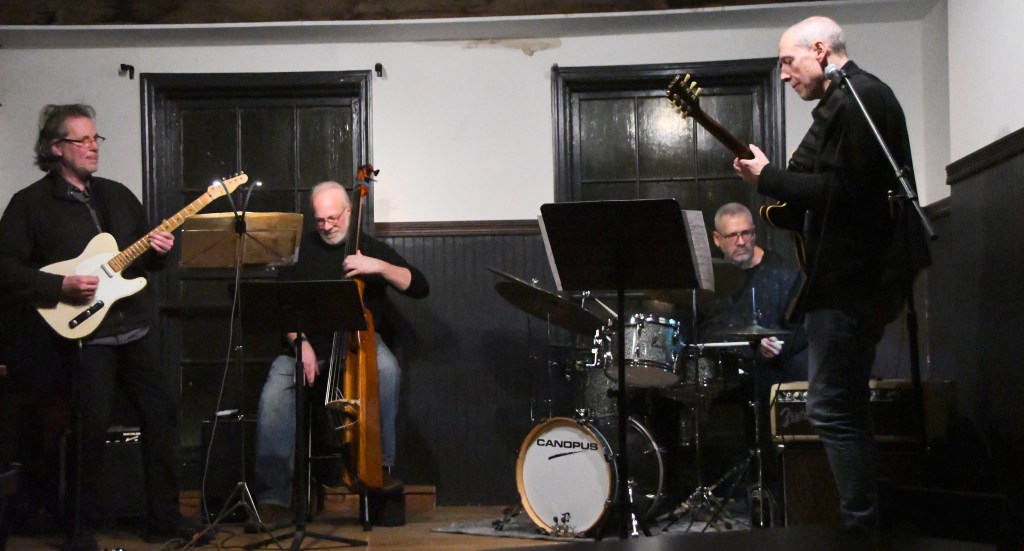
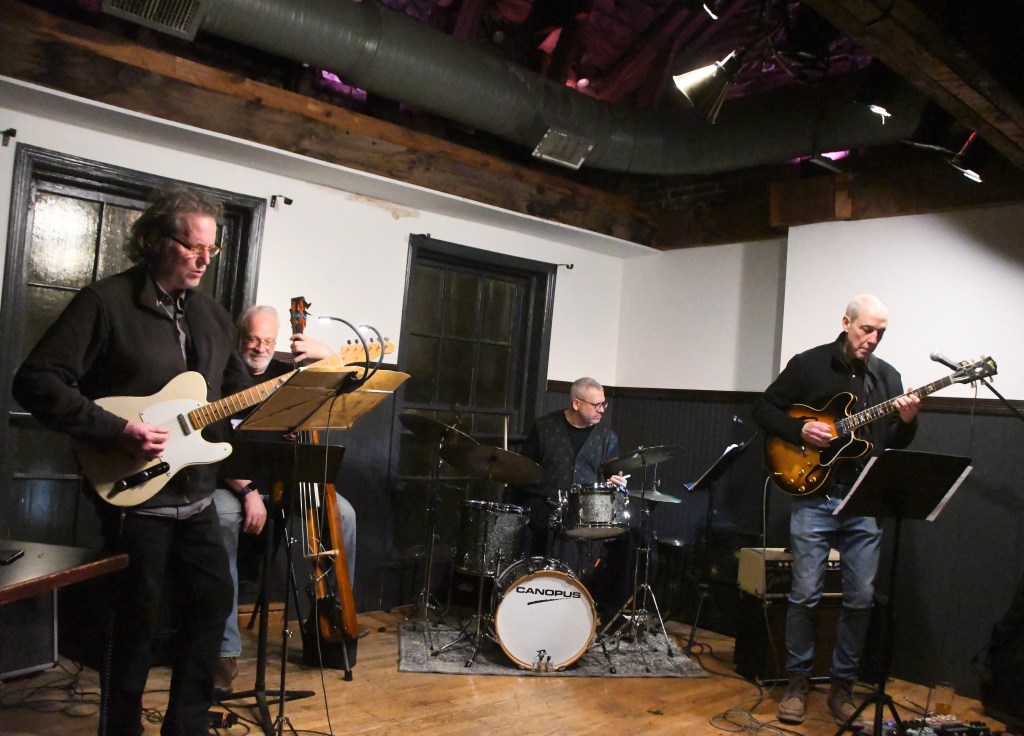
Joel Harrison Quartet. From left: Mark Dzuiba, Rich Syracuse, Jeff Siegel, Joel Harrison

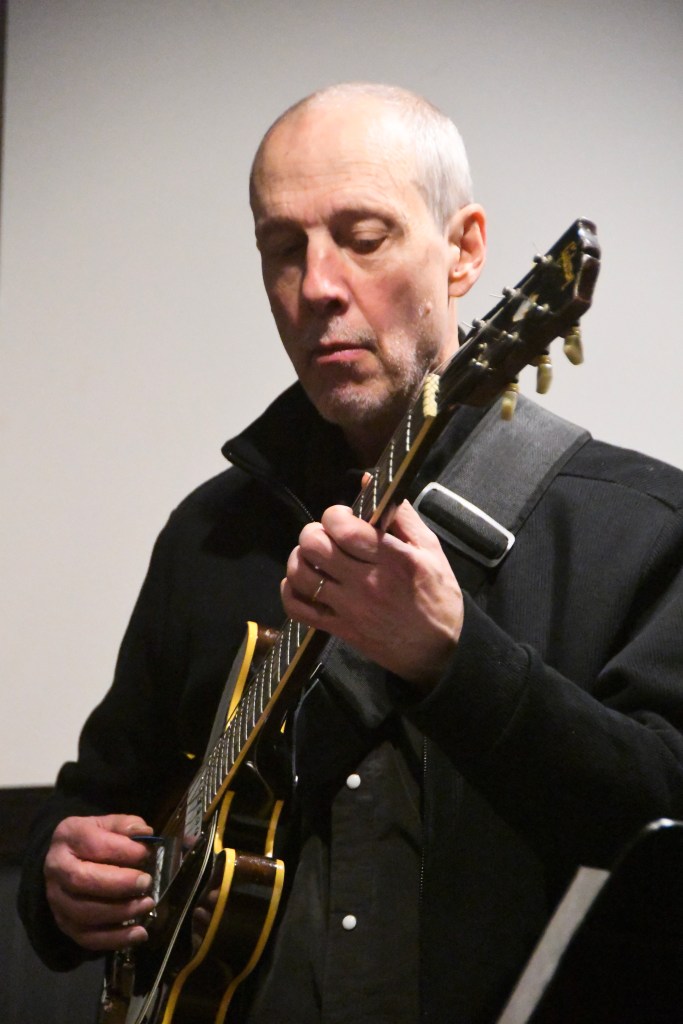
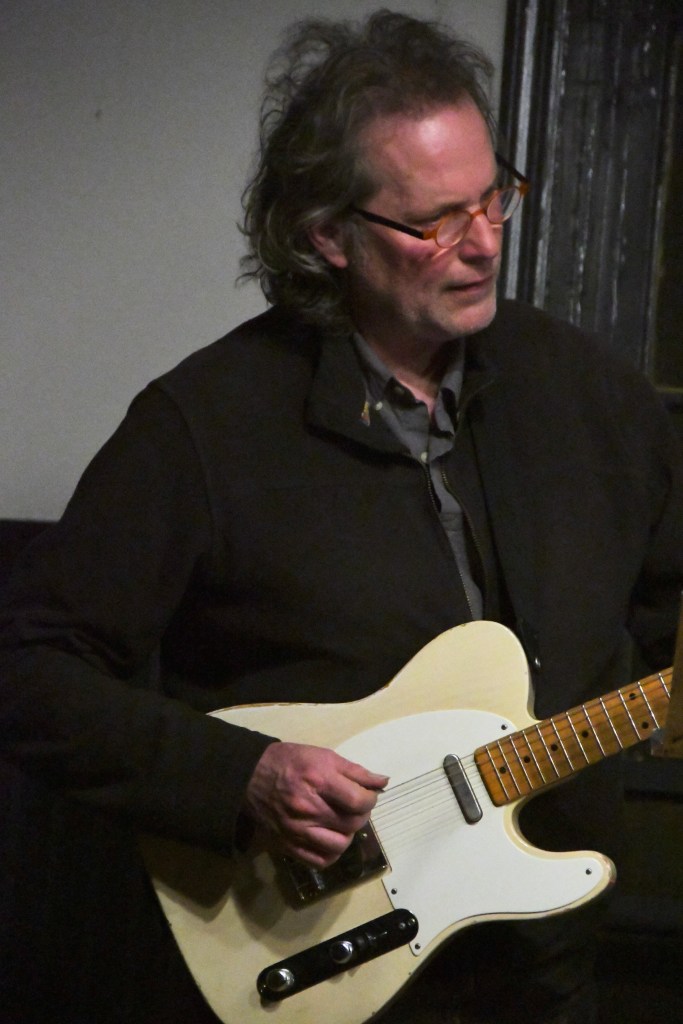
Harrison and fellow guitarist Mark Dzuiba played off each other in harmony, counterpoint, echoes near and far, comments straight or playful; Harrison flat-picking a skinny Gibson hollow-body, Dzuiba flat- and finger-picking a Fender Telecaster solid-body. Bassist Rich Syracuse and drummer Jeff Siegel – the Sly and Robbie rhythm section of our regional jazz stars – crafted firm foundations under everything, from earthy blues shuffles to high-altitude bebop flights.

“Doxy” spun the spotlight around at everybody onstage in turn, a fun funk shuffle with spry solos all around. This wasn’t a warm-up; all four were at full operating temperature, though Harrison’s second solo was the tune’s hottest and his duet with Dzuiba wrapped the thing like a gift.

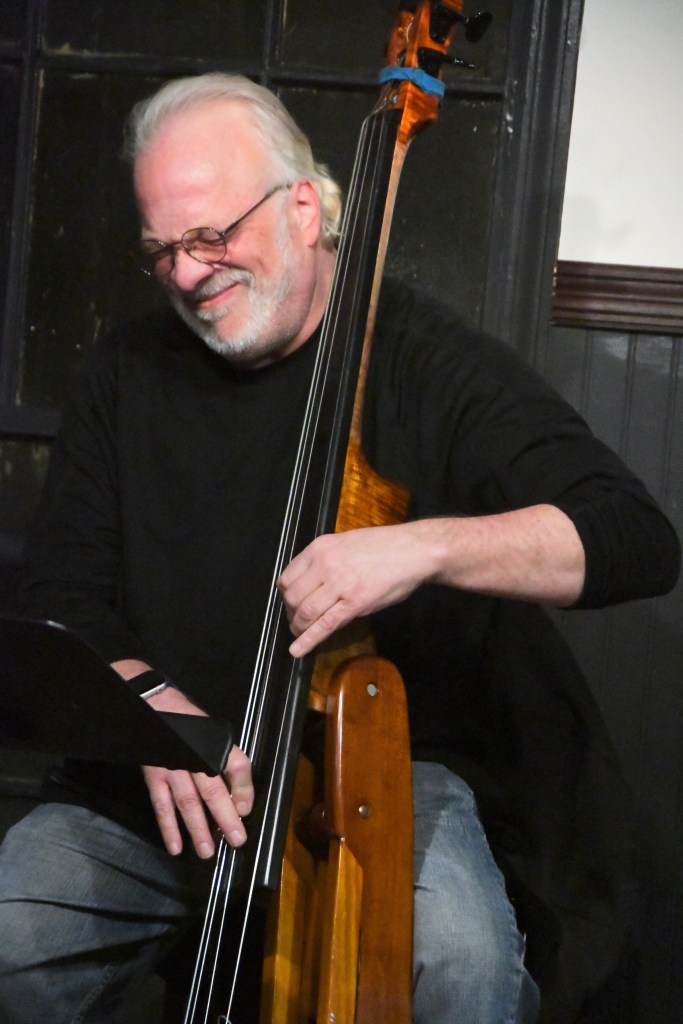
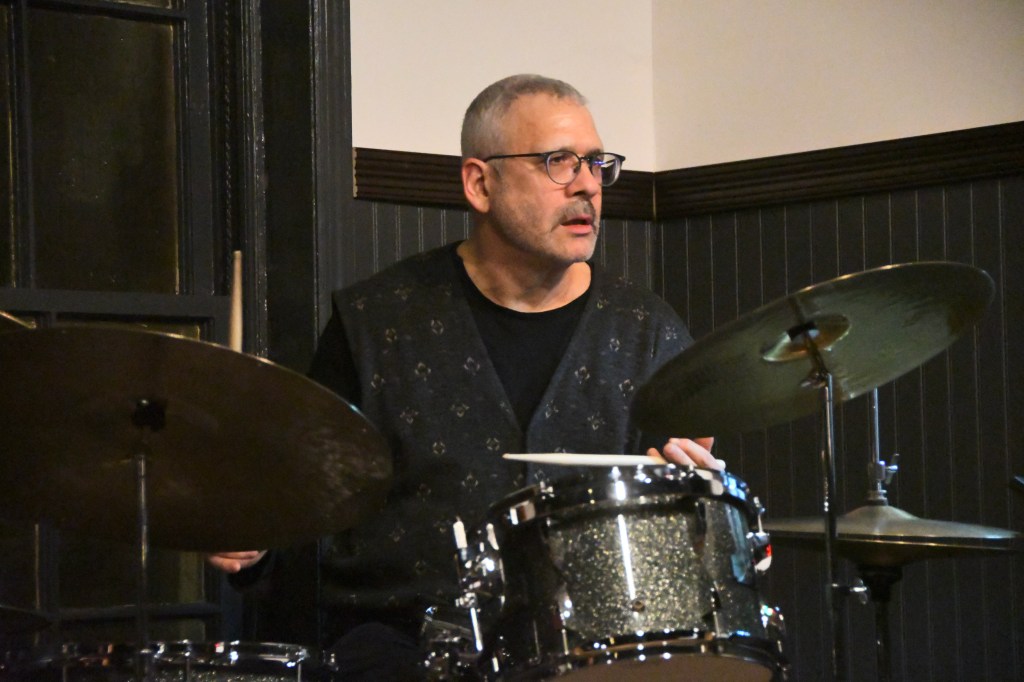
Rich Syracuse, above; and Jeff Siegel, below – the Sly and Robbie rhythm section of our regional jazz stars

Harrison’s own “Sunday Night With Vic” for fellow guitarist Vic Juris felt like pals out fishing or raising glasses on a shady porch, peaceful and slow – guitarists sunny up top in a smooth cruise but complex beats below, uniting in a stately coda.

The set simmered and soared in a simple, strong shape. “It Falls on You” from Harrison’s 2021 “Guitar Talk” album of duets felt like a sibling to “Vic” in its grace before the intense, at times menacing “Survival Instinct” scrambled with dangerous energy to a hard-stop, all hot drama and force before dramatic silence. They kept the energy high with “Webb City,” brisk bebop bounce spiced with a strong swing under Dzuiba’s solo like a seminar in tones and phrasing styles. Syracuse shone here, too, turning a walking bass line into a strut.

“Body and Soul” grew from a guitars-only glide into melodic reverie, elegant and graceful; then “Bird Song” cruised from similar sparse musings into a meditative melody, Siegel’s tasty hand percussion spicing the mood. 

Siegel also starred in the bebop blast of “Solar,” erupting free in a groove that flowed jagged and jaunty by turns; guitars echoing licks at the end.

Another “bird”-titled tune followed – Harrison’s “Migratory Birds” – introduced by his spoken environmental alarmism that translated musically in double-time drums and clattering solos on top before a coda fade.

Two Guitars: Joel Harrison, above, and Mark Dzuiba, below

Things peaked in maybe the 90-minute set’s least-likely song choice, the pop classic “Wichita Lineman.” A high-flying exploration of this (overly?) familiar melody, this showed Harrison and his quartet at their cohesive, intuitive best. Everybody knows the tune, but they all brought something personal, powerful and fresh to it while ensuring everything fit – as Harrison’s repeating riff underscored Dzuiba’s solo, for example. Syracuse sparkled here, too.

Harrison noted “Anthem of Unity” was a “good title for these times we’re living in,” and their closer shone a sunny happy funk groove around the room, loose in a fun way. Harrison set the mood with a repeating riff that grew wings as a cozy R&B groove.

Throughout, they showed a confident cohesion, though they read parts from charts. Everybody played nearly all the time, listening and helping out. So sparser sections took on a distinctive drama. The two guitars glowed in both cohesion and contrast, in lead or rhythm roles, Harrison using more sustain than Dzuiba whose usually terse, clipped phrasing fit perfectly. 

SONGS

Doxy” (Sonny Rollins)

Sunday Night with Vic (Harrison)

It Falls on You (Harrison)

Survival Instinct (Harrison)

Webb City (Bud Powell)

Body and Soul (Johnny Green, Edward Heyman, Robert Sour, Frank Eaton)

Bird Song (Paul Motion)

Solar (Bill Evans)

Migratory Birds (Harrison)

Wichita Lineman (Jimmy Webb)

Anthem of Unity (Harrison)

MORE GUITARS

Bluegrass/Newgrass acoustic guitar master Tim O’Brien plays tomorrow, Saturday, March 8, in a duo with wife Jan Fabricius at Caffe Lena (47 Phila St., Saratoga Springs). O’Brien had already built an imposing reputation as an immaculate and propulsive picker with Hot Rize and other bands before his wife Jan Fabricius began playing mandolin and singing around their home in what became a duo. 7 p.m, doors 6:30. $37.96 members, $43.38 general, $21.69 children and students. 518-583-0022 http://www.caffelena.org.

Guitars may seem almost incidental to the creative powers of brilliant singer-songwriters John Hiatt and Lyle Lovett, playing Wednesday at Troy Savings Bank Music Hall (30 Second St., Troy). But six-string acoustics shape their songwriting just as they underline the songs. Their duo shows combine tunes and tales, jokes and jams as well as anyone onstage these days. They’re old pals at play. 7:30 p.m. Few seats remain: $67.50, $55. 518-273-0038 http://www.troymusichall.org.

Gypsy-jazz acoustic jazz master Stephane Wrembel plays Caffe Lena with his quartet on Friday, March 13. French-born, Wrembel studied in Europe before enrolling at Berklee in Boston on scholarship. Composing and recording hot-swing instrumentals for Woody Allen film soundtracks brought a deservedly ever-expanding audience. 8 p.m. doors 7:30. $34.70 members, $39.04 general, $19.52 children and students.