
Telling specific deep truths about particular people and places in universal ways, they make distance and differences disappear.
Friends since high school in East LA, they developed a powerful hybrid style blending acoustic folk-based Mexican music of celebration and south-of-the-border blues with a high-impact rock style. It’s Latin and it’s rock, folk and funk; it feels home-made in a living room but packs arena-scale power.
As the late, great Greg Haymes wrote of their 2012 MASSMoCA show, “There are few bands that can entertain an audience as holistically as Los Lobos, and even fewer that have played with such gusto and imagination for so long. The multiple Grammy Award-winning band from East L.A., who appeared at Mass MoCA in 1999 for the venue’s grand opening celebrations, returned to North Adams for a sold-out acoustic show last Thursday that appealed to the mind, booty and soul.”
In a MASSMoCA courtyard walled in brick and glass they were magnificent that sunny afternoon, May 30, 1999. Among many area shows, they played one of the last concerts Mona Golub’s Second Wind crew staged in Washington Park, Aug. 4, 2004 and opened multiple times for the Tedeschi Trucks Band at SPAC.
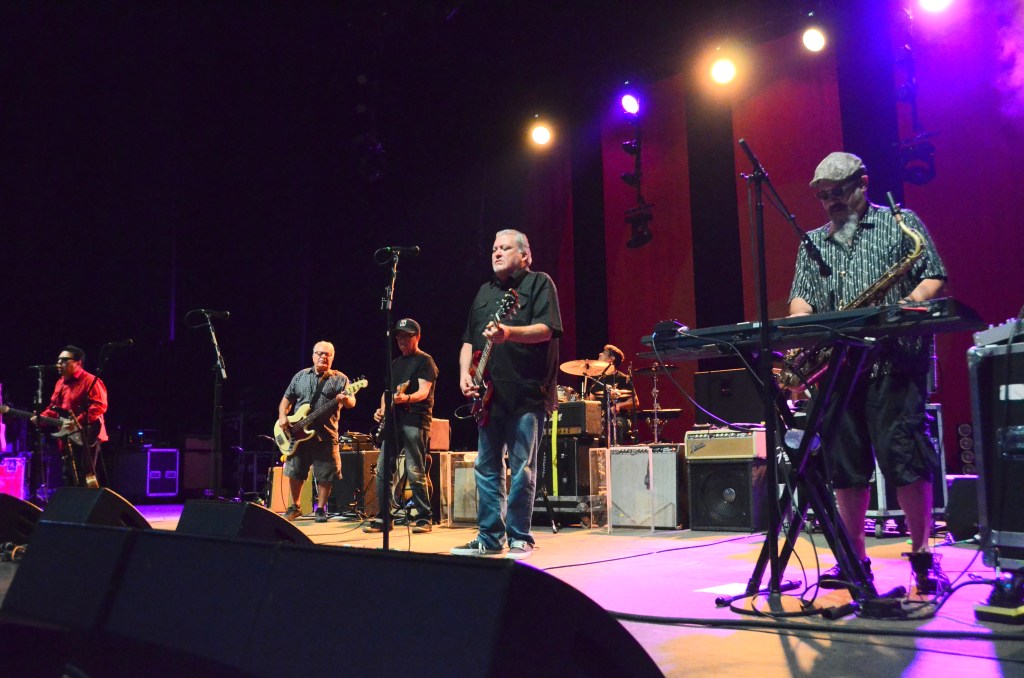
Los Lobos opening for Tedeschi Trucks Band, July 13, 2016. From left, Cesar Rosas, Conrad Lozano, Louie Perez, David Hidalgo, Alfredo Ortiz, Steve Berlin. Michael Hochanadel photos
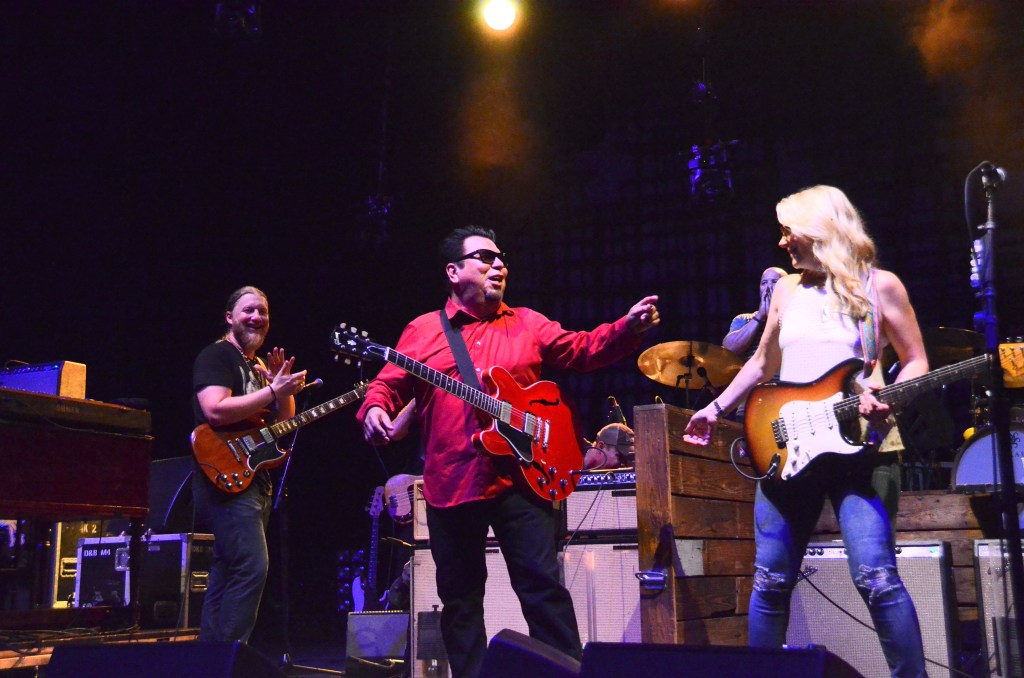
Cesar Rosas, center in red, guests with Derek Trucks, left, and Susan Tedeschi
My favorite of their albums “Colossal Head” (1996, their 8th) swaggers confidently among styles, from frantic, high-impact “Manny’s Bones” and “Mas Y Mas” (the latter in Spanish) to stoic-serene “Can’t Stop the Rain,” anthemic proclamations in “This Bird’s Gonna Fly,” and their “Little Japan” borrows far-Asian sounds as persuasively as Dave Brubeck’s “Koto Song” and McCoy Tyner’s “Valley of Life.”
Masters of mutation in motion, their voracious appetite for variety and variation spins from thoughtful to ferocious, from gravitas to gleeful, wild to wistful. Their sounds spin from folkloric/acoustic to propulsive, plugged-in rock, agile dances including waltzes to heartbreaking blues.
Powering their sound, ambitious compelling song craft has inspired covers by outlaw country star Waylon Jennings, Brit rockers Robert Plant and Elvis Costello, even polka patriarch Frankie Yankovic; and they toured opening for Costello, Bob Dylan and the Grateful Dead, whose “Bertha” they covered on record and play often live.
While their 17 studio albums (plus seven live albums, three compilations, two live DVDs and two EPs) earned 12 Grammy nominations and notched four wins, they may be the most prolific and versatile one-hit wonders in rock history.
At arguably their greatest commercial success, they topped the Billboard Hot 100 with “La Bamba” (1987). But then, they followed with the gutsy, commercially risky move of making the Spanish language “La Pistola y El Corazon” (1988).
In his NPR review of “The Ride” (2004), our he-does-everything culture hero David Greenberger – also a Los Lobos collaborator – sheds some light on this.
He hails the album for mixing folk, blues, rock and Latin rhythms so intrepidly that the rock world doesn’t know what to do with them, noting they’re out of step, powered by positivity while remaining true to their roots.
Greenberger notes their many collaborators on the album include The Band’s Garth Hudson; soul diva Mavis Staples; British guitar god Richard Thompson and countryman Elvis Costello, Panamanian bard Ruben Blades, soul man Bobby Womack, and Dave Alvin and Tom Waits, compadres on the L.A. roots-punk scene that nurtured Los Lobos in the 80s. The review also notes how Womack imaginatively grafted the Los Lobos song “Wicked Rain” onto his own “Across 110th Street.”
Pointing out how these high-profile guests simply became part of the band, Greenberger hails their blend of old and new, of tradition with creative exploration, suggesting this follows their dedication to “do what is right for them.”
Like their against-the-commercial grain return to the Spanish-language folkloric style on “La Pistols y el Corazon” after their star making success with ‘La Bamba,” the fact that their albums appear on eight different record labels since their 1978 debut “Los Lobos del Este de Los Angeles” reflects a defiant independence.
Following their muse is the path to greatness for Los Lobos whose main songwriters David Hidalgo and Louie Perez made the music for Greenberger’s Duplex Planet release “Growing Old in East L.A.” (2006). Their music supports his spoken monologues in a project supported by the California Council for the Humanities.
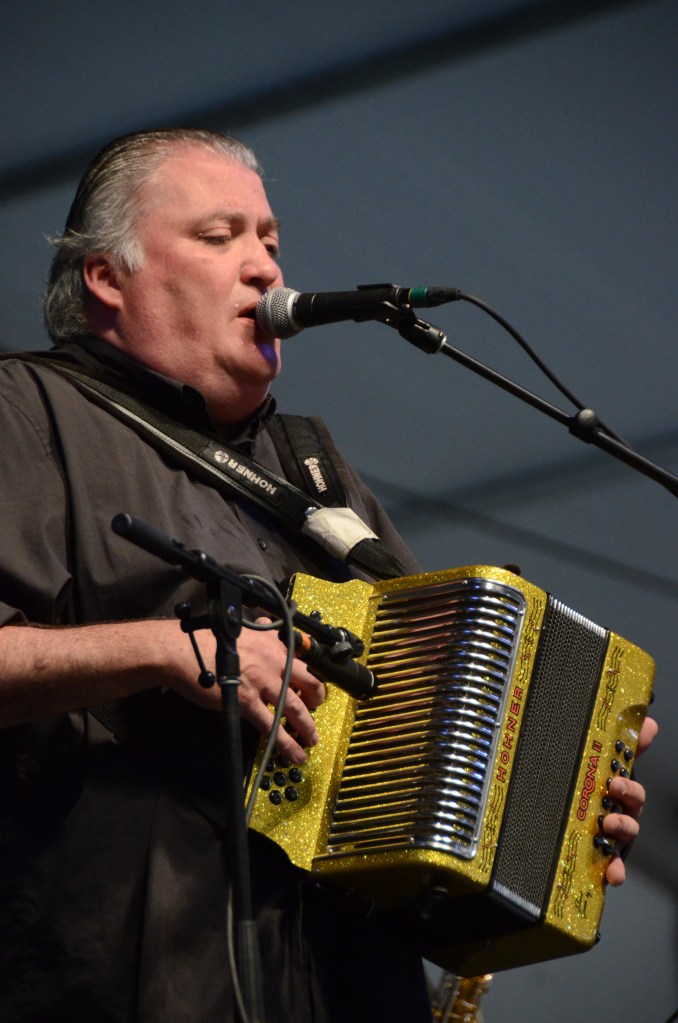
Los Lobos is guitarist-singer and accordion player Hidalgo, left-handed guitarist-singer Cesar Rosas, bassist-singer Conrad Lozano, guitarist-singer and player of acoustic folkloric instruments Perez, saxophonist and keyboard player Steve Berlin and drummer Alfredo Ortiz; Perez also plays drums occasionally.
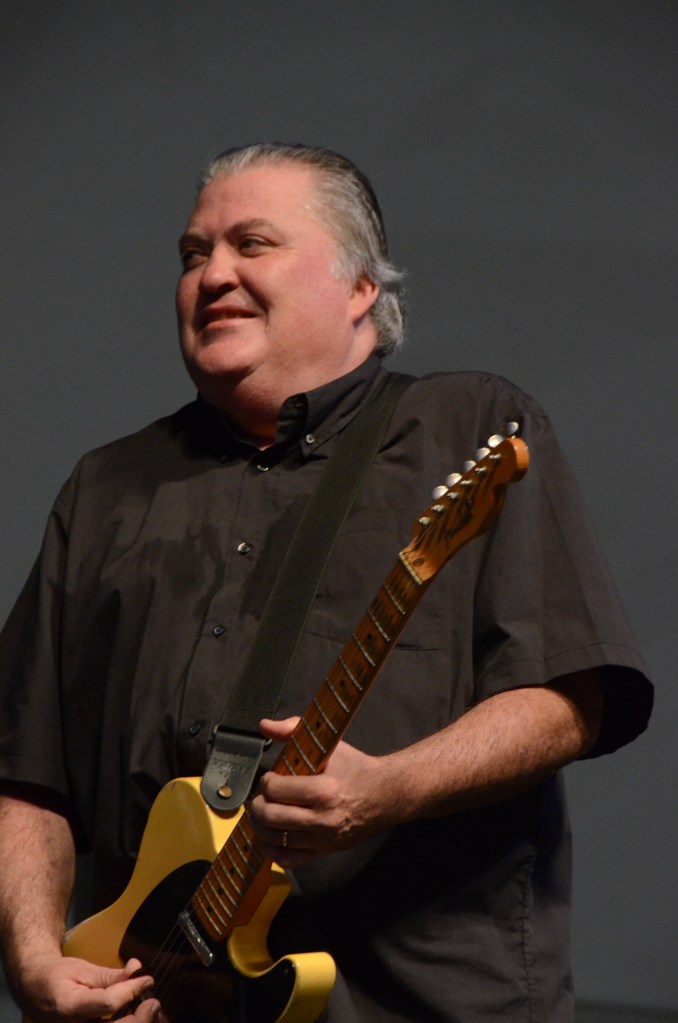
David Hidalgo, above and below, at New Orleans Jazz and Heritage Festival, April 2015. Michael Hochanadel photos
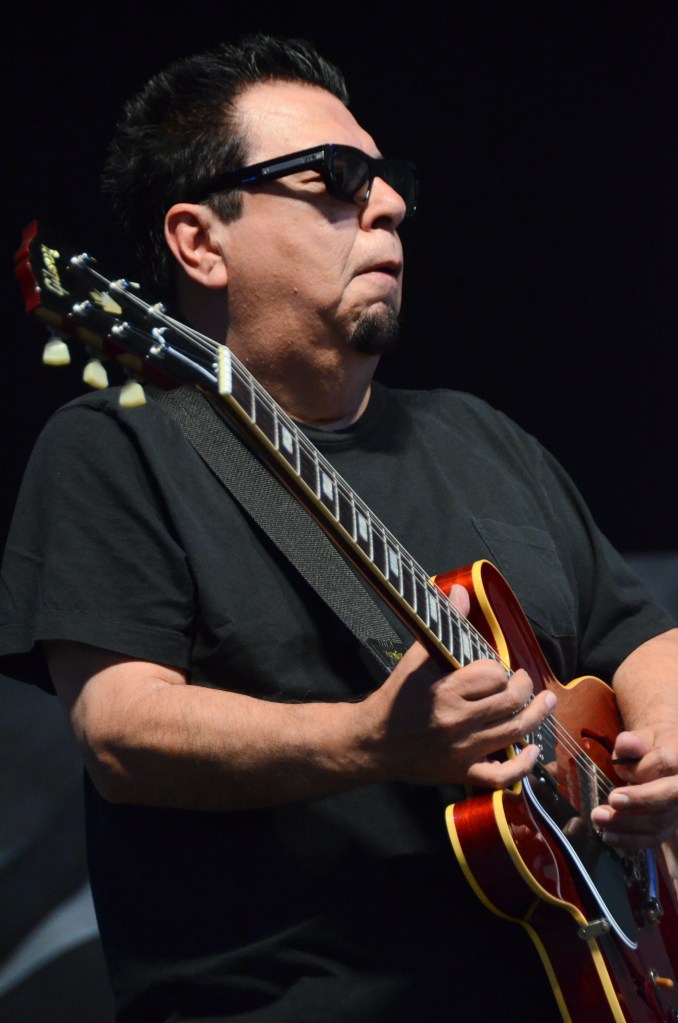
Cesar Rosas, above, Conrad Lozano, below
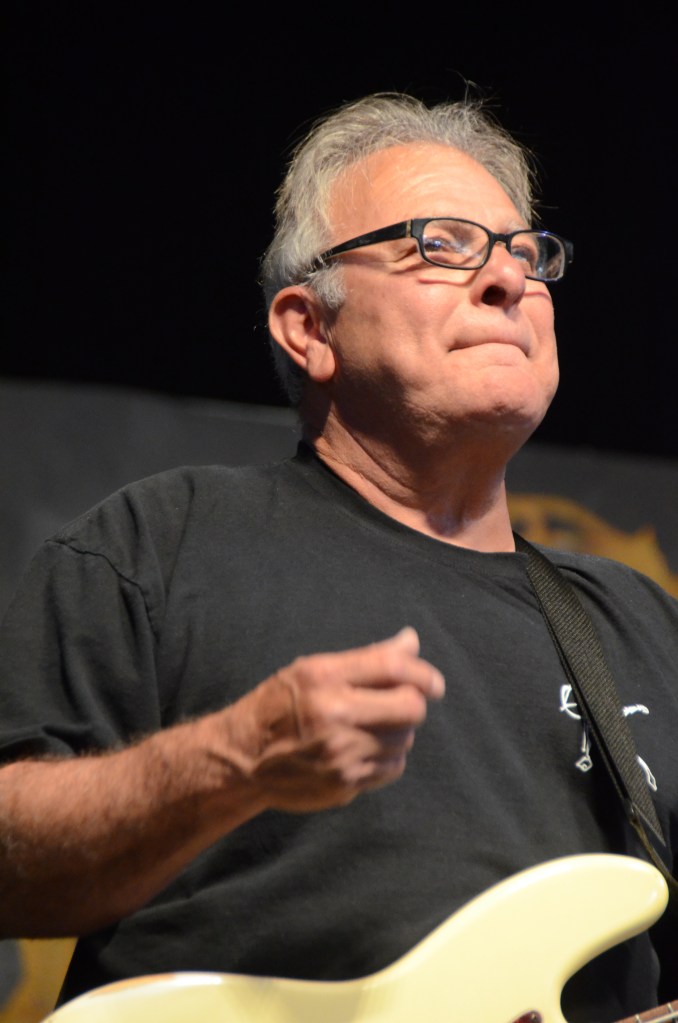
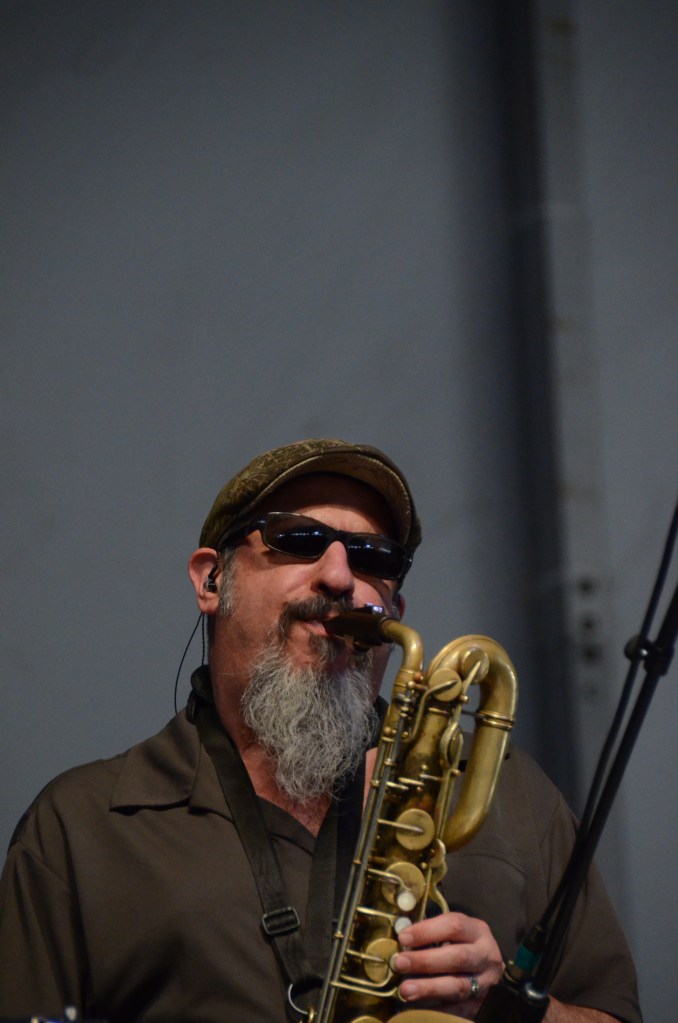
Steve Berlin
Los Lobos plays Sunday at 7:30 p.m. at Universal Preservation Hall (25 Washington St., Saratoga Springs). $56.93, $79.93, $114.43. 518-346-6204 www.atuph.org
EXTRA NAME-DROP SPECIAL
In an early 80s LA visit, after dinner in Beverly Hills with BeeGees’ producer Albhy Galuten, Nancy Lyons (Albhy’s Schenectady-born then-wife Nancy Lyons, a friend), Don Felder (Eagles), Jimmy Pankow (Chicago) and their wives, Galuten took me to the Country Club bar in Reseda to check out Lone Justice and its singer Maria McKee for Clive Davis at Arista Records. Los Lobos opened, followed by the Eric Martin Band; Martin was later a member of Mr. Big. Los Lobos was the best of the three, though McKee, then 19, got the most attention. After their set, Dolly Parton came into the dressing room where bassist Leland Sklar, whom I’d met at Proctors playing in James Taylor’s band in a Union College concert, introduced us. Parton praised McKee, who broke into tears. My best name-dropping night so far.
 Hoke's Jukebox