Los Lobos – playing Sunday at Universal Preservation Hall – stands among our greatest rock bands.

Telling specific deep truths about particular people and places in universal ways, they make distance and differences disappear. 

Friends since high school in East LA, they developed a powerful hybrid style blending acoustic folk-based Mexican music of celebration and south-of-the-border blues with a high-impact rock style. It’s Latin and it’s rock, folk and funk; it feels home-made in a living room but packs arena-scale power.

As the late, great Greg Haymes wrote of their 2012 MASSMoCA show, “There are few bands that can entertain an audience as holistically as Los Lobos, and even fewer that have played with such gusto and imagination for so long. The multiple Grammy Award-winning band from East L.A., who appeared at Mass MoCA in 1999 for the venue’s grand opening celebrations, returned to North Adams for a sold-out acoustic show last Thursday that appealed to the mind, booty and soul.”

In a MASSMoCA courtyard walled in brick and glass they were magnificent that sunny afternoon, May 30, 1999. Among many area shows, they played one of the last concerts Mona Golub’s Second Wind crew staged in Washington Park, Aug. 4, 2004 and opened multiple times for the Tedeschi Trucks Band at SPAC.
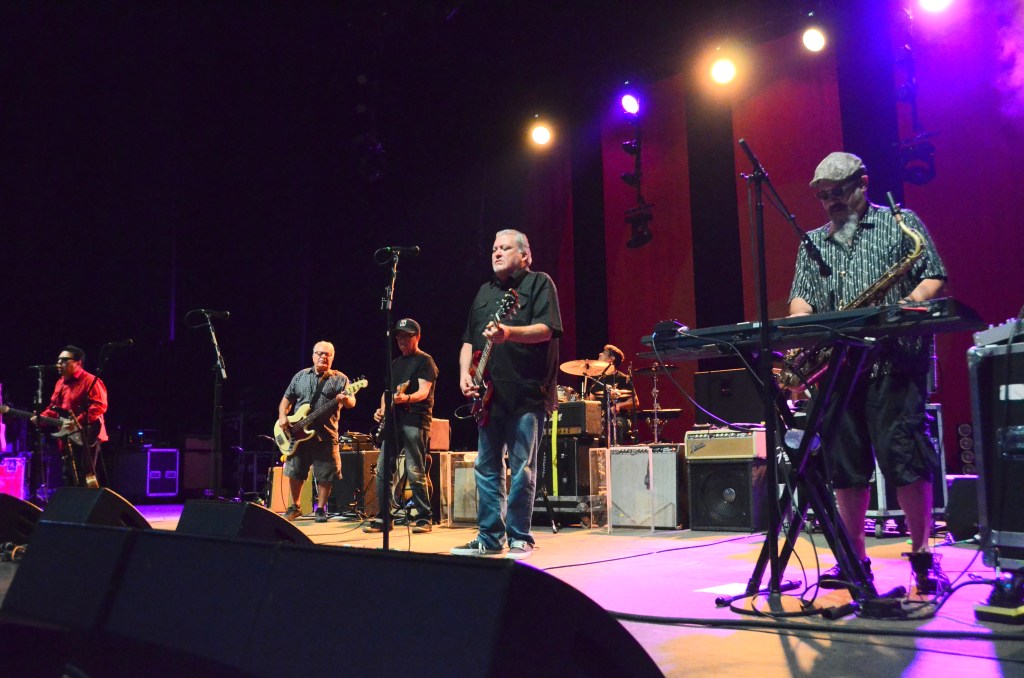
Los Lobos opening for Tedeschi Trucks Band, July 13, 2016. From left, Cesar Rosas, Conrad Lozano, Louie Perez, David Hidalgo, Alfredo Ortiz, Steve Berlin. Michael Hochanadel photos
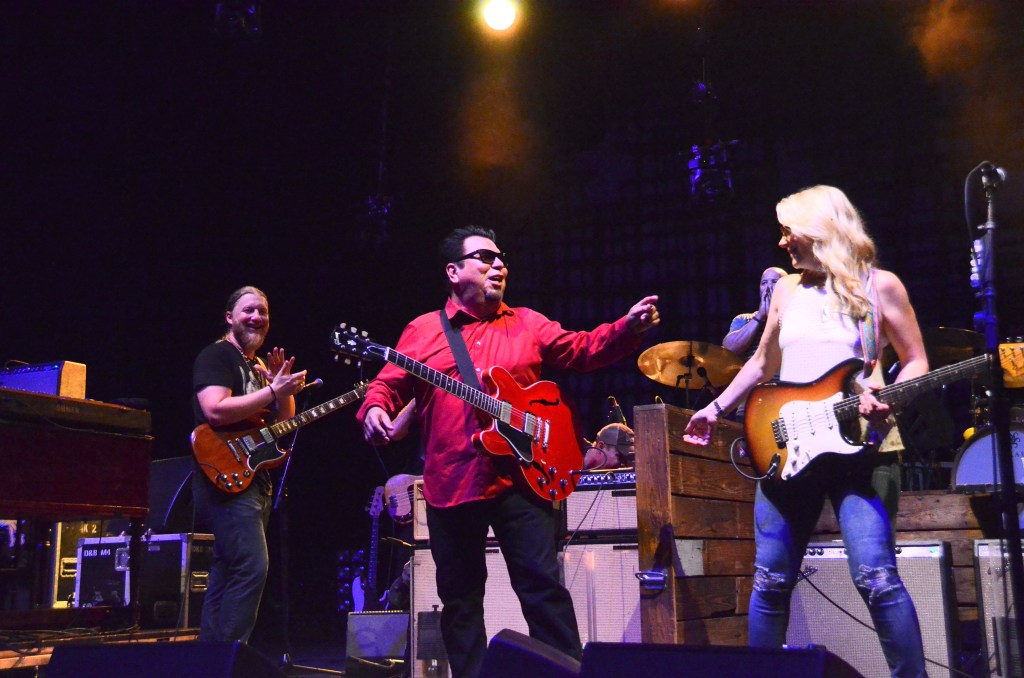
Cesar Rosas, center in red, guests with Derek Trucks, left, and Susan Tedeschi

My favorite of their albums “Colossal Head” (1996, their 8th) swaggers confidently among styles, from frantic, high-impact “Manny’s Bones” and “Mas Y Mas” (the latter in Spanish) to stoic-serene “Can’t Stop the Rain,” anthemic proclamations in “This Bird’s Gonna Fly,” and their “Little Japan” borrows far-Asian sounds as persuasively as Dave Brubeck’s “Koto Song” and McCoy Tyner’s “Valley of Life.” 

Masters of mutation in motion, their voracious appetite for variety and variation spins from thoughtful to ferocious, from gravitas to gleeful, wild to wistful. Their sounds spin from folkloric/acoustic to propulsive, plugged-in rock, agile dances including waltzes to heartbreaking blues.

Powering their sound, ambitious compelling song craft has inspired covers by outlaw country star Waylon Jennings, Brit rockers Robert Plant and Elvis Costello, even polka patriarch Frankie Yankovic; and they toured opening for Costello, Bob Dylan and the Grateful Dead, whose “Bertha” they covered on record and play often live.

While their 17 studio albums (plus seven live albums, three compilations, two live DVDs and two EPs) earned 12 Grammy nominations and notched four wins, they may be the most prolific and versatile one-hit wonders in rock history.

At arguably their greatest commercial success, they topped the Billboard Hot 100 with “La Bamba” (1987). But then, they followed with the gutsy, commercially risky move of making the Spanish language “La Pistola y El Corazon” (1988).

In his NPR review of “The Ride” (2004), our he-does-everything culture hero David Greenberger – also a Los Lobos collaborator – sheds some light on this.

He hails the album for mixing folk, blues, rock and Latin rhythms so intrepidly that the rock world doesn’t know what to do with them, noting they’re out of step, powered by positivity while remaining true to their roots.

Greenberger notes their many collaborators on the album include The Band’s Garth Hudson; soul diva Mavis Staples; British guitar god Richard Thompson and countryman Elvis Costello, Panamanian bard Ruben Blades, soul man Bobby Womack, and Dave Alvin and Tom Waits, compadres on the L.A. roots-punk scene that nurtured Los Lobos in the 80s. The review also notes how Womack imaginatively grafted the Los Lobos song “Wicked Rain” onto his own “Across 110th Street.”

Pointing out how these high-profile guests simply became part of the band, Greenberger hails their blend of old and new, of tradition with creative exploration, suggesting this follows their dedication to “do what is right for them.” 

Like their against-the-commercial grain return to the Spanish-language folkloric style on “La Pistols y el Corazon” after their star making success with ‘La Bamba,” the fact that their albums appear on eight different record labels since their 1978 debut “Los Lobos del Este de Los Angeles” reflects a defiant independence.

Following their muse is the path to greatness for Los Lobos whose main songwriters David Hidalgo and Louie Perez made the music for Greenberger’s Duplex Planet release “Growing Old in East L.A.” (2006). Their music supports his spoken monologues in a project supported by the California Council for the Humanities.

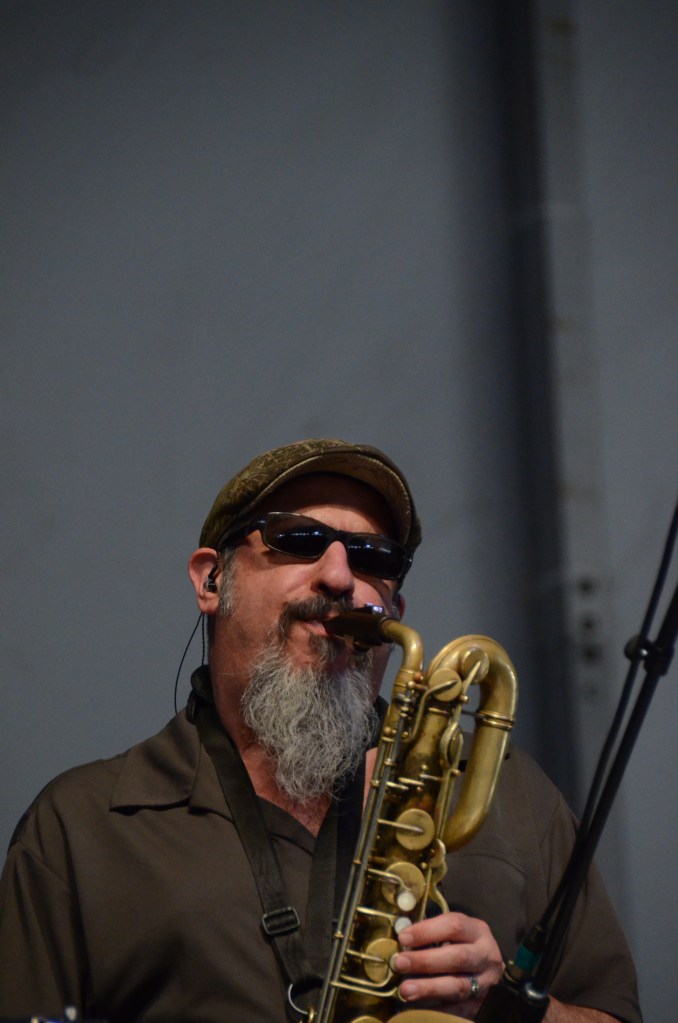
Los Lobos is guitarist-singer and accordion player Hidalgo, left-handed guitarist-singer Cesar Rosas, bassist-singer Conrad Lozano, guitarist-singer and player of acoustic folkloric instruments Perez, saxophonist and keyboard player Steve Berlin and drummer Alfredo Ortiz; Perez also plays drums occasionally.
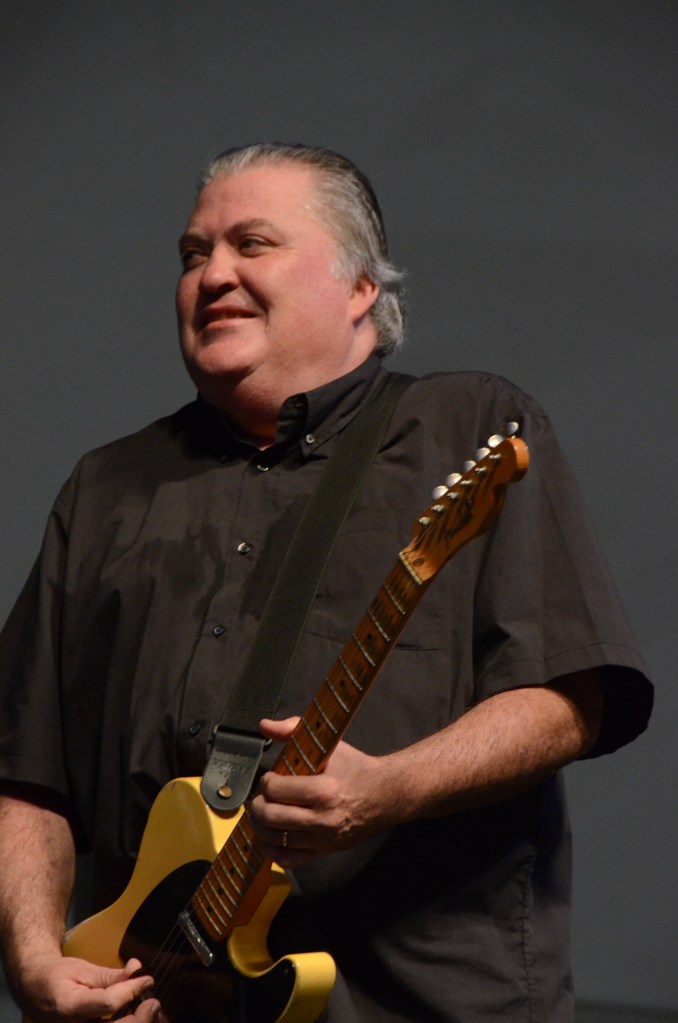
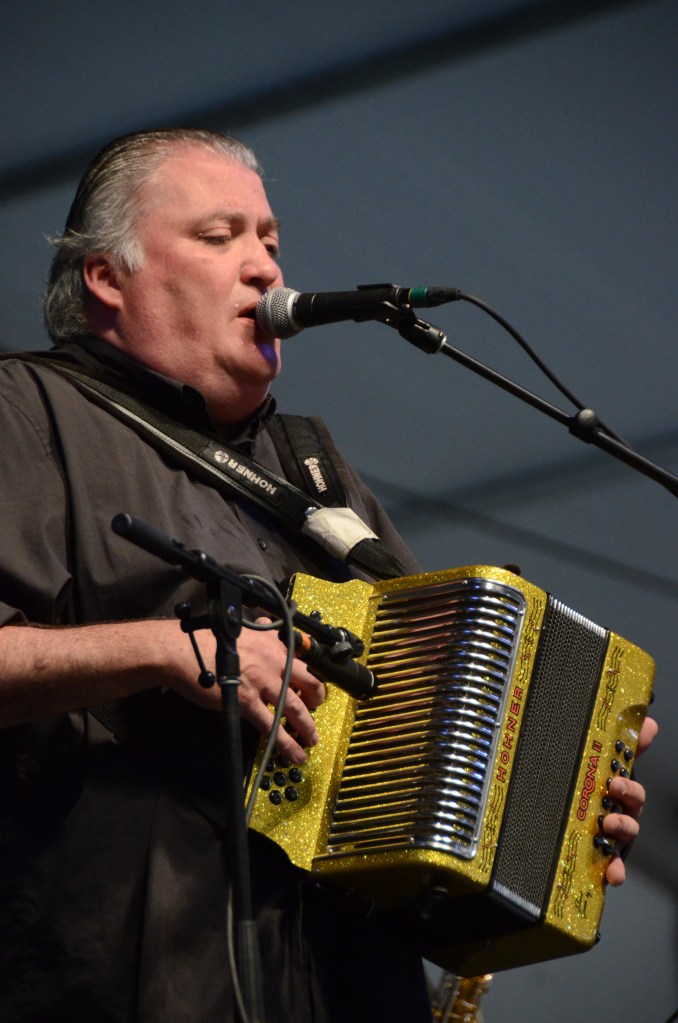
David Hidalgo, above and below, at New Orleans Jazz and Heritage Festival, April 2015. Michael Hochanadel photos
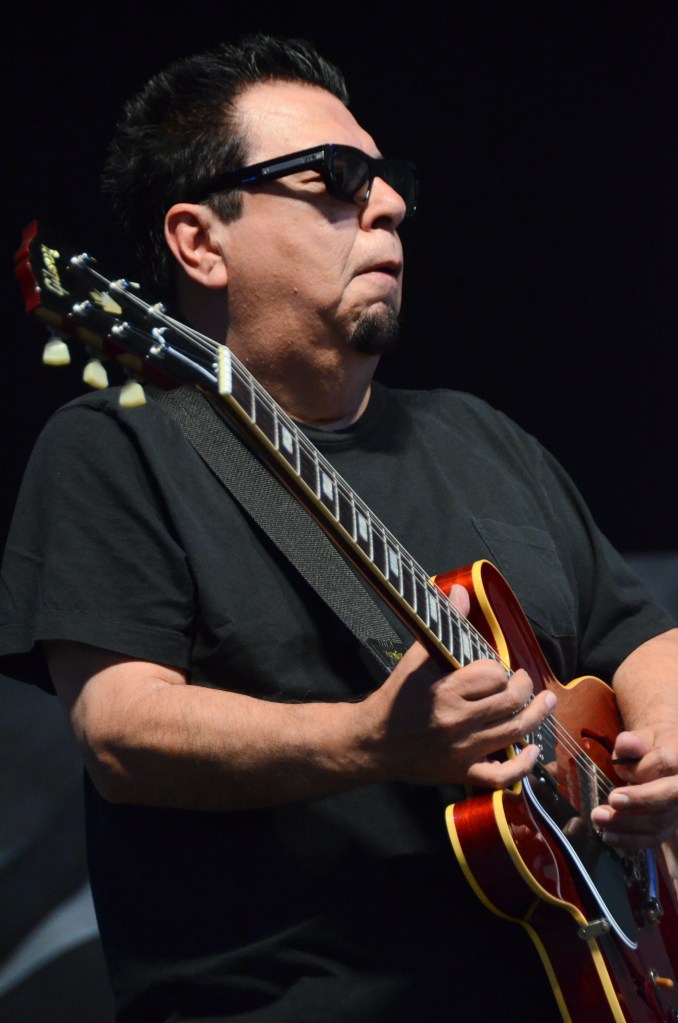
Cesar Rosas, above, Conrad Lozano, below
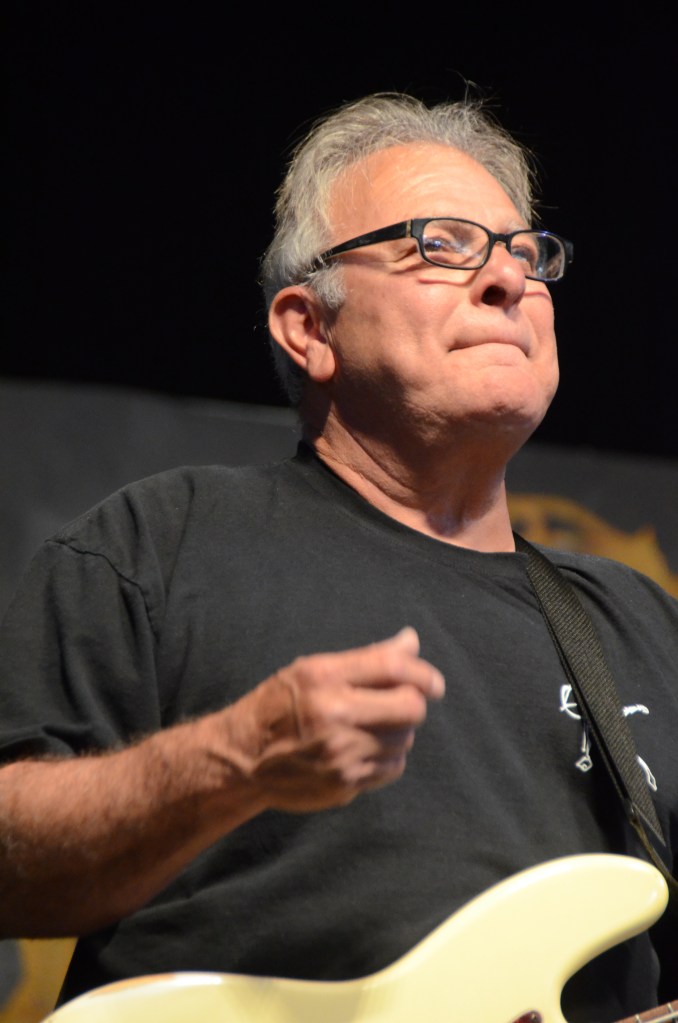
Steve Berlin

Los Lobos plays Sunday at 7:30 p.m. at Universal Preservation Hall (25 Washington St., Saratoga Springs). $56.93, $79.93, $114.43. 518-346-6204 www.atuph.org

EXTRA NAME-DROP SPECIAL

In an early 80s LA visit, after dinner in Beverly Hills with BeeGees’ producer Albhy Galuten, Nancy Lyons (Albhy’s Schenectady-born then-wife Nancy Lyons, a friend), Don Felder (Eagles), Jimmy Pankow (Chicago) and their wives, Galuten took me to the Country Club bar in Reseda to check out Lone Justice and its singer Maria McKee for Clive Davis at Arista Records. Los Lobos opened, followed by the Eric Martin Band; Martin was later a member of Mr. Big. Los Lobos was the best of the three, though McKee, then 19, got the most attention. After their set, Dolly Parton came into the dressing room where bassist Leland Sklar, whom I’d met at Proctors playing in James Taylor’s band in a Union College concert, introduced us. Parton praised McKee, who broke into tears. My best name-dropping night so far. 

They’ve Got the Funk

Preview: Lettuce at Empire Live on Wednesday, Jan. 28, 2026

The seven-months since Lettuce played the Saratoga Jazz Festival and their Empire Live show on Wednesday may feel like just an extra-long set break. But since then, the funk-jazz juggernaut toured Europe and everywhere else – sometimes with the Wu-Tang Clan or Ziggy Marley – released a symphony-backed live album, then the new studio album, “Cook” – which they do. They even launched a wine brand and scholarships to Berklee where they met.

I reviewed their SPAC set here, contrasting “a deliciously relentless funk-fest by Lettuce” with the mellower soul-jazz baritone vocals of Gregory Porter who preceded them onstage – where they lifted off in an unusual, seamless way.

“The Boston sextet jammed in soundcheck, ’til we get it right,’ then flowed straight into their set. Festival producer Danny Melnick went to the mic to introduce them, smiled and waved them on. In an earth-shaking riff explosion, Eric Coomes’s seismic bass hit like the thunderstorm that mercifully never happened Saturday. Groove melted into groove, like a P-Funk show; storming from sonic overwhelm to simmering at less heat, and surprising late with Tears For Fears’ pop hit ‘Everybody Wants to Rule the World.’”

Talk about range: They jazz-rocked like Miles’ Bitches Brew band and rummaged through the funk traditions of James Brown and P-Funk, spicing things with soul fervor and emphatic hip-hop beat force. For a Boston band originally, they often sounded very New York. They echoed every uptown jam adventure since the bebop age to hyper-energetic downtown experimentation. And they wound up with one of the tastiest pop melodies of recent decades in full melodic flight; funky, too.

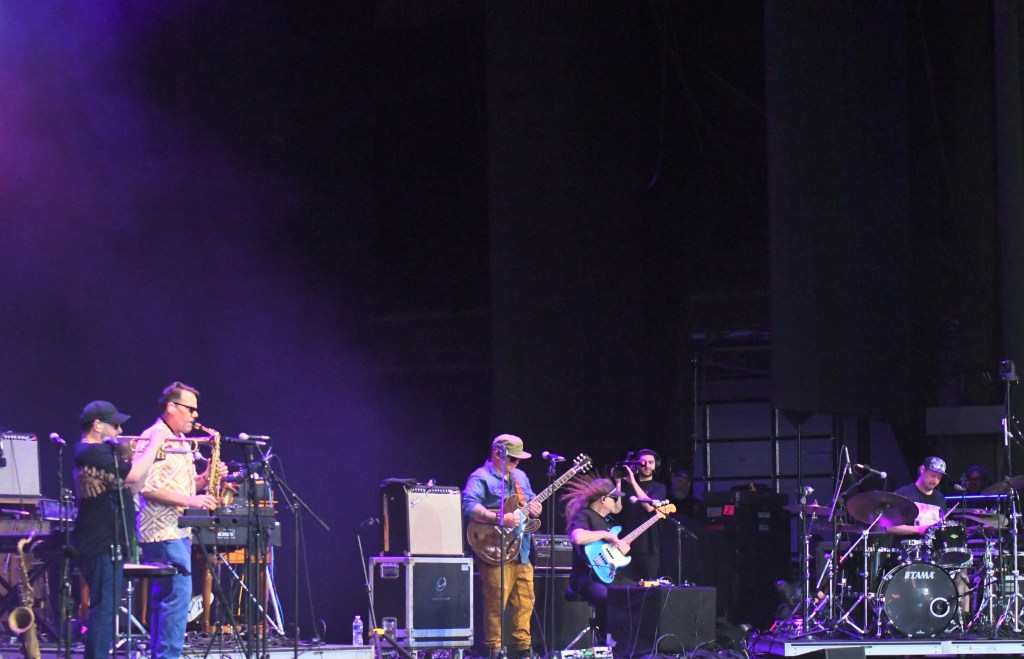
Lettuce at SPAC on June 28, 2025; from left: Eric “Benny” Bloom, trumpet; Ryan “Zoid” Zoidis, saxophone; Adam “Shmeaans” Smirnoff, guitar: Erick “Maverick” Coomes, bass; and Adam Dietch, drums. Keyboardist/singer Nigel Hall is obscured behind the horns at stage right.

Fun and fierce, they played with a happy relentless drive that easily engaged the crowd, even at their spikiest or most complex.

Lettuce’s website lists drummer Adam Deitch first; maybe because he’s the wheels on the bus carrying guitarist Adam “Shmeaans” Smirnoff, saxophonist and keyboard player Ryan “Zoid” Zoidis, trumpeter Eric “Benny” Bloom and keyboardist/singer Nigel Hall – while bassist Erick “Maverick” Coomes is the engine. At SPAC, Coomes reminded me of funk-powered and -powering bassists Bootsy Collins, Rocco Prestia (RIP) and (current) Marc van Waginen with Tower of Power and our own Tony Markellis (also, RIP). 

As Deitch told R.J. DeLuke in a fine Times-Union interview piece last Thursday, “…the time feel, the collective rhythm that we have as a band, is unique. And that’s our calling card. That’s who we are.”

Streams of past live shows are available on their website: http://www.lettucefunk.com.

Expect some of the 16 tracks from “Cook” Wednesday; the vinyl version of the new album offers favorite recipes by each band member.

  1. Great
  2. Clav it Your Way
  3. Sesshins 1
  4. 7 Tribes
  5. Rising to the Top
  6. Sesshins 2
  7. Gold Tooth
  8. Breathe
  9. The Matador
  10. Sesshins 3
  11. Cook
  12. Storm Coming
  13. Keep On
  14. Sesshins 4
  15. The Mac
  16. Ghosts of Yest 

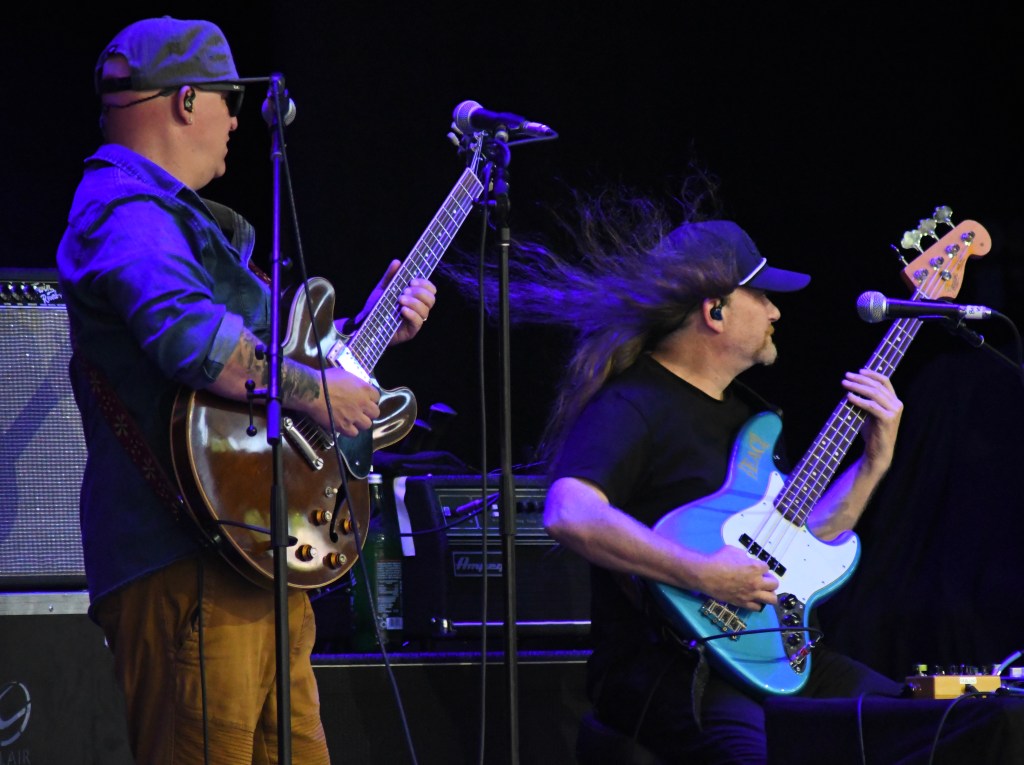
Adam “Shmeaans” Smirnoff, guitar: Erick “Maverick” Coomes, bass

“Clav” is short for the clavinet, an electric keyboard instrument.

Bloom has explained they wrote the title track at a party in Denver, adopted home of half the band. He called it, and I quote from their website, “a hip little banger of a song to put a stank face on.”

Lettuce plays Wednesday at Empire Live (93 N. Pearl St., Albany). 8 p.m. doors 7. 16 and up, photo ID required. $45.15 general admission. 518-900-5900 www.empirelivealbany.com

TO THE RECORD SHELF

“…this is not ok…” by Matt Smith

Matt Smith may be the most prolific and consistent of our musical exports, you know: artists from here whose stars also shine elsewhere. 

From regional fan favorite bands including Interstate and E.B. Jeb, Smith went to New York then wound up in Austin. He’s moved back and forth some, with frequent summertime returns here – playing, recording, teaching and producing all the way. Like Jorma Kaukonen, who operates his Ohio Fur Peace Ranch as a teaching center, Smith runs 6 String Ranch in Austin, also the studio and record label of the same name.

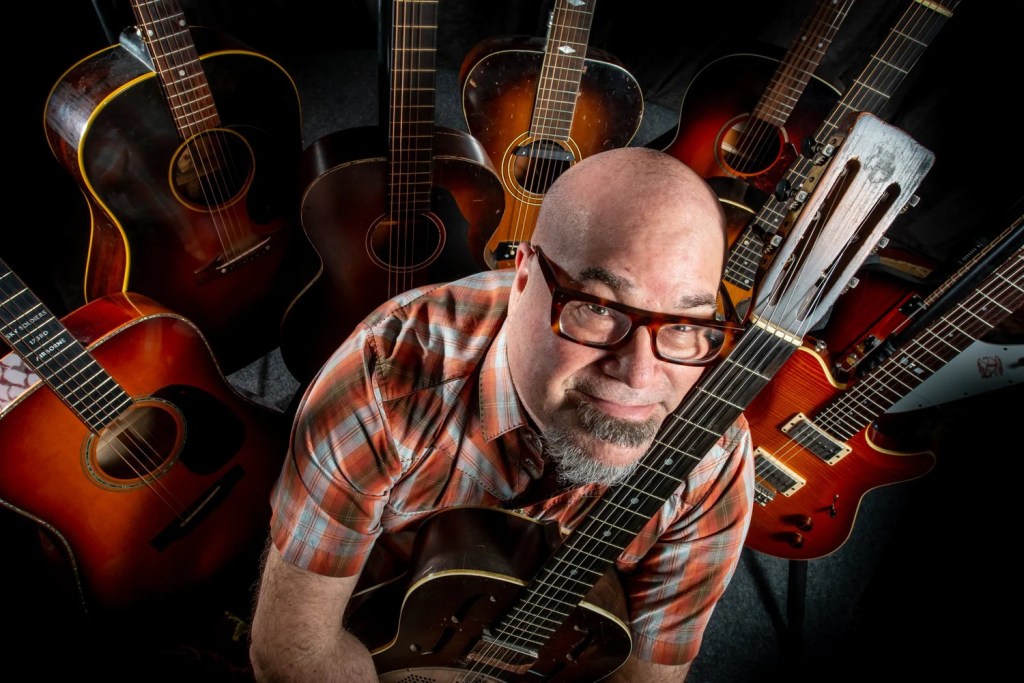
Matt Smith. Photo provided

“…this is not ok…” – 20th album by the guitarist, songwriter, singer and producer – balances urgent timely messaging with solidly timeless expression. A soulful long view of present-day angst, of horror yielding to hope, its authoritative big rock sound would feel contemporary anywhere from a decades-old jukebox to tomorrow’s streaming services where the new album is available..

This comes from deep experience and honed mastery, sharpened with present-day concerns.

“I began this album in June of 2025,” Smith explained recently by email from Austin. “Things were looking grim for people of color, immigrants, and working class Americans,” he said, pointing an angry finger at “a megalomaniacal wanna be dictator in the White House, surrounded by sycophants who enabled his every whim.”

Smith said, “I was angry. very angry, to the point of contempt, for those who voted for this. I had seen this before, being New York born and raised being a centrist democrat and student of history.” Another motivation hit closer to home: the death of both parents.

In response, as he explained, “After much reflection I responded the way I always have. I make music.”

To make this music, “I realized I couldn’t be an agent of division, yet I had to voice my feelings or they would fester inside me.” He said, “I also hoped to inspire other artists to speak up.”

For a guitarist and master of many other stringed things, Smith employs lots of keyboards here. Right out of the box, the Gospel-y opener “World Is a Wheel” has a powerful electric organ undertow that echoes Memphis soul grooves, plus a drawling Dr. John-like vocal. The tune turns the corner from division, bitterness and stupidity to a search for hope in the earth’s momentum and durability.

“Cry for America” remakes Ray Charles’s trademark majestic take on “America the Beautiful,” painting a dire picture of doom yielding to dramatic defiance: “We will not be denied.” Mixed male and female vocals simmer with a seething piano.

“Orphans” gets personal, musing about death and memory’s power to outlast it, over wistful pedal steel (or slide guitar?), acknowledging loss but finding serenity in love’s power to preserve.

Solitary survival – his mother outlived his father by eight years – also relies on prominent piano in “Level Ground,” a slow waltz with a lyric that wraps around the album title.

Irony rings strong in “I’ll Never Fall in Love Again,” an upbeat rock shuffle starring stringed things in a hymn of heartbreak with hope breaking through.

A cinematic look at love frames “A Life In Love,” whose atmospheric sound Smith says stems from his love of moody film-noir jazz. We can imagine Gregory Porter singing his bluesy waltz, but not singing it any better than Smith does over electric piano and generous guitar at a deliberate tempo.

“Outside My Fence” shifts the focus back from the personal to the political, a chunky beat powering big guitar licks in a despairing isolationist/survivalist saga of futility. Appropriately, it hits a hard-stop wall after juggling rugged individualist pugnacity with loneliness.

Smith takes off the gloves in “Bad Man,” big-rock power punching up, as Smith said, “late-70s hard-rock…to match the anger I was feeling about a certain person.” It’s a knockout guitar scramble.

This emotional album needed strength in hope, and in quiet confidence, and Smith tunes those feelings right up in “From the Ashes.” Majestic, built on A-B vocals and sheer Gospel-y power like vintage Staples Singers, this one feels like a north star of moral clarity. It’s not preachy-righteous; it’s personal. Its message, sincere and strong, stirs the hopes of listeners by expressing those of its maker so clearly.

Smith’s online bio notes he plays a music store’s range of instruments: acoustic, electric and baritone guitars; bass;  banjo; mandolin; dobro; sitar, mohan vina; steel guitar; ukulele; saz; cumbus; charango; tiple. But he resists the temptation to go fussy or fancy. This music is about message, mood and mighty feelings.

Like every summer for decades, Smith will come home here to play a handful of live shows. (He leads an Austin band and a hometown band.) And he’ll have a new album with him, of live performances.

Meanwhile, “…this is not ok…” is available on Apple Music and many streaming platforms.

The Art Vandelay* Export–Import Roster

Our musical exports – musicians from here who left to do big things elsewhere – include the Knickerbockers, Nick Brignola, Steve Katz, Hal Ketchum, Eddie Angel, David Malachowski, Cliff Lyons, Gregg August, Sirsy, Super 400, Jocelyn and Chris, Felicia Collins, Sawyer Fredericks and too many more to list here.

Balancing those exports with imports, let’s tip the hat to Lee Shaw, Ed Hamell, Rory Block, Bert Sommer, Reeves Gabrels, and Commander Cody among others. When we look past Area Code 518 at 645 to our south we find veritable armies of musicians who went to, or came from, the Catskills, from The Band to John Sebastian, Jack DeJohnette, Pat Metheny, Sonny Rollins, the Felice Brothers and the Slambovian Circus of Dreams.

  • “Art Vandelay” is the name George Costanza adopted for an aspirational/phony identity as exporter-importer, or vice versa, on Seinfeld. “What does that have to do with music?” – you might well ask. Years ago, I phone interviewed the great Texas blues/country-rocker Delbert McClinton before a show here. The conversation was going nowhere, McClinton was distracted and curt. So I offered to call back another time. McClinton said, “Thanks; “Seinfeld just started,” and hung up. Things went way better when I called back later.

BOB Weir…”all the voices are now gone…”

“Wasn’t Weir great?” exulted Steve Webb.

We were in Buffalo to see the Rolling Stones play Rich Stadium, third date on their 1981 Tattoo You tour; Webb to review it for the Knickerbocker News, Don Wilcock for the Troy Record and me for the Gazette. But we had lucked into tickets for the Grateful Dead the night before; walking to our car afterward, Steve had distilled that exceptional show down to a right-on observation.

The publicist on that Stones tour was the always amiable Ren Grevatt, whom I’d known for years. When I requested review tickets, he said, “I’ve got the Grateful Dead playing the War Memorial Auditorium the night before: wanna go see that, too? It’s a one-off; they’re flying from Toronto to London the next day and got a good offer, so they took it to get a payday on the East Coast before touring Europe.” 

Thanks, Ren; sweet bonus. 

The Dead had rehearsed before heading east and were sharper than sharp, in fine form, totally unified and full of life. Far better than the Stones the next day and thoroughly wonderful, it was one of the top three Dead shows I ever saw.

That night, September 26, 1981, rhythm guitarist and singer Bob Weir was the star.

In an asymmetrical kaleidoscopic way, one or another of them would emerge from the big flow to direct, inspire and propel. 

Anybody could grab the wheel; so it wasn’t always guitar fire from Jerry Garcia, the Dead’s lead soloist, bearded icon and second-best singer. Third best when Pigpen was alive. One night, Phil Lesh’s bass would hit so hard your heartbeat would sync to it. The next, linked drums would make you dance in polyrhythms, like at a reggae show; or a soulful keyboard break would fly you to Memphis when Booker T and the MGs were still kids. That night in Buffalo, it was Weir, pushing the jams as “the best rhythm guitarist on wheels,” as Garcia once described him, singing strong and energizing the whole thing.

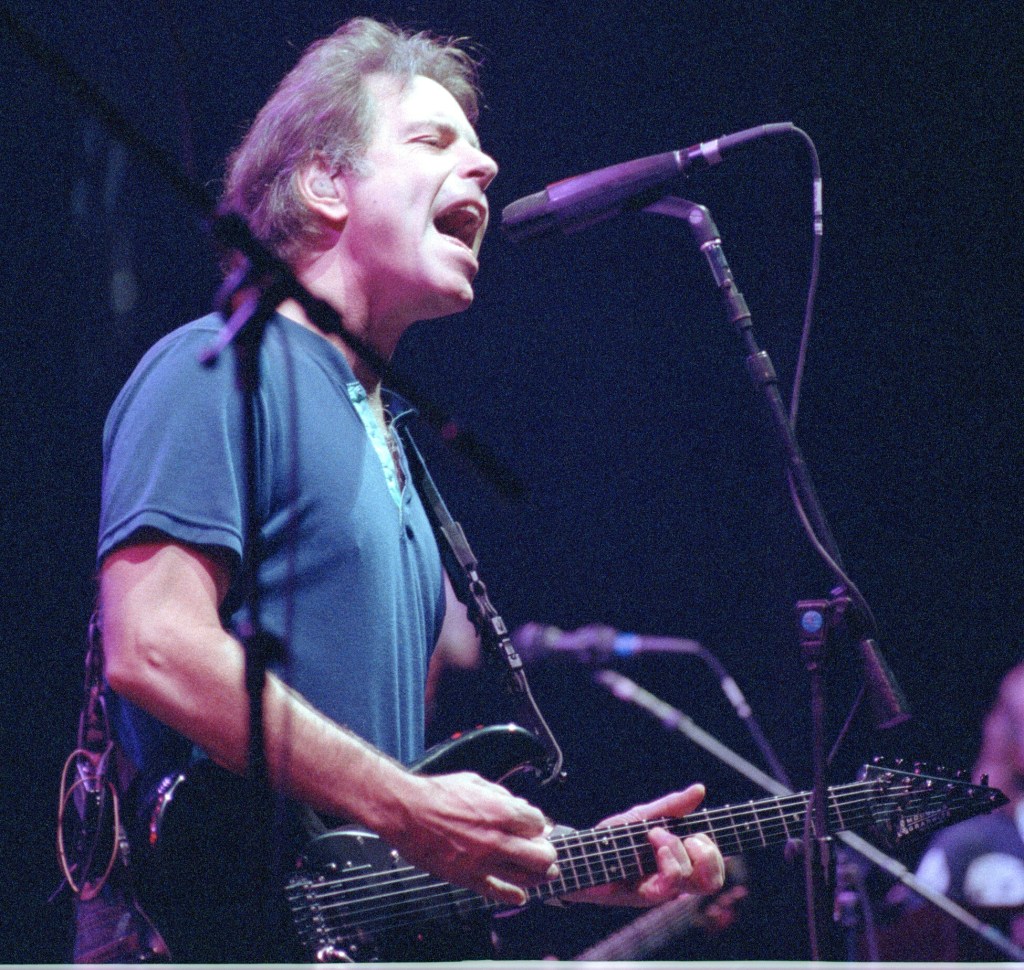
Bob Weir onstage at the Knickerbocker Arena; March 26, 1993. My photo

Obituaries have described Weir’s career with the Dead, from 1964 when he joined at 17 to Garcia’s death in 1995; acknowledging his writing of mostly upbeat songs and affection for country classics. They mention his solo album “Ace” (1972), his solo bands from the 1970s to just months ago, and echoes of the Dead including a 1997 Furthur Festival SPAC show when he joined moe. in their opening number “Cryptical Envelopment” and drove everybody crazy. 

Through generous Dead publicists Robbie Taylor, Ren Grevatt and – longest-tenured and best – Dennis McNally, I saw dozens of Dead shows, more than any other band but NRBQ. 

When I phone-interviewed Weir once, he introduced himself kind of formally as Robert Weir and spoke with easy open-ness of how the Dead did what they did. Then I met him briefly on the Ratdog tour-bus after a late 2007 Palace Theatre show the same night when McNally introduced me to Tom Davis (of SNL’s Al Franken and Tom Davis comedy team) over drinks before the show. I sent my Gazette review (see below) from the tour-bus, writing as Weir and the band filed aboard and Weir offered me a beer.

When I heard Saturday that Bob Weir had died, I emailed Dennis McNally:

Dennis, I have no idea what sort of connection you had with Bob Weir, but I have to believe some sense of loss follows the news of his passing. Sorry, man.

MH

Dennis wrote back:

Thank you. I rode the bus with him for four years of RatDog, and altogether we were pretty close, although less so in the last few years. But collectively, all the voices are now gone. And that’s a bit shocking…

As Dennis noted, everyone who sang in the Grateful Dead is now gone and the only original, founding member still with us is drummer Bill Kreutzmann who’d retired by the last (probably) Dead & Co. shows this spring with Weir and drummer Mickey Hart, a longtime but not founding member. 

In similar news, only drummer Jaimoe (Jai Johnny Johansen) survives of the original Allman Brothers Band. 

SOME EXTRAS – LOOKING BACK

THE STONES IN BUFFALO, THEN SYRACUSE

Years later, I wrote this in a letter to a friend:

The Rich Stadium show outside Buffalo was OK at best, thrilling at first for the scale and spectacle, but a let-down. When George Thorogood opened, rain was falling and folks were pissed. But the clouds parted and the sun came out when he played “Move it on Over” – then joy and exultation took over. Journey had a tough time in the middle slot, though, and left early; giving fans the finger. And the Stones were just OK: the songs were fun, but you wished they meant them more. 

A few months later at the Syracuse Carrier Dome, the Stones were barely OK and the opening acts were lame. The thing didn’t reach critical mass. But, Keith did something in that show that impressed me and told me a lot about those guys. The energy was flagging in one song, so Keith went around the stage, standing face to face with every other guy there, in turn, and playing the flaming blue fuck out of his guitar, hitting the strings so damn hard and glaring at them with such “Get your shit together!” fierceness that they all did. That song went from about 30 percent power to about 95. 

DEAD SET-LIST FROM THAT BUFFALO SHOW

SET 1

Shakedown Street >

C.C. Rider

They Love Each Other

Cassidy

Jack-A-Roe

On The Road Again

Ramble On Rose >

Looks Like Rain

Brown Eyed Women >

Let It Grow >

Don’t Ease Me In

SET 2

Playing In The Band >

Bertha >

Estimated Prophet >

Goin’ Down The Road Feeling Bad >

Drums >

Space >

Not Fade Away >

Morning Dew >

Playing In The Band >

One More Saturday Night

ENCORE

Johnny B. Goode

RATDOG CONCERT REVIEW (WRITTEN ON THE TOUR-BUS)

RatDog at the Palace on Sat., Nov. 2, 2007

By MICHAEL HOCHANADEL

ALBANY – There’s a lot of this going around: Veteran rock performers re-framing their music and making their boomer-age fans really happy. On Saturday, the night after Terry Adams introduced a new, younger mutation of NRBQ at WAMC and a few weeks after Grateful Dead bassist Phil Lesh & Friends detonated a tremendous show at the Glens Falls Civic Center, his former bandmate Bob Weir did the same thing at the Palace Theatre with RatDog, not so much paying tribute to the Dead’s legacy as expanding it.

The 90-minute first set generally moved at a deliberate piece, the capacity crowd often giving more energy to the band than the band projected from the stage. A leisurely launching pad vamp-with-solos slowly coalesced into “Terrapin Station” but it only attained significant momentum as it began to change into “All Along the Watchtower.” This wandered a bit, through a reggae episode, and reached its true instrumental majesty after Weir’s last fevered intonation “the wind began to howl” and the band did. A Tom Waits-like R&B skid-row pub crawl supplied the set’s second peak, as the band went somewhere past funk into another time zone, blasted there as much by Kenny Brooks’ tenor sax as by Steve Kimock’s Jerry Garcia-like jewel-beautiful guitar. Fans lifted off with the band, filling the aisles, dancing the furry biplane, the thunder-snake, the my-arms-don’t-respond-to-gravity. In a perfect and powerful feedback loop, the band rode the crowd’s energy, surging into “Eyes of the World” in a 20-minute, ecstatic roll that climaxed the first set.

After the break came an acoustic segment, paced quietly like the start of the first. “Peggy-O” and “Corrina” felt relaxed, restrained, especially when Weir reined in Kimock to toss the solo spot to Brooks. Robin Sylvester’s bass detonated “The Other One” and this venerable, can’t-miss classic had all the Dead-like essentials – swirling organ from Jeff Chimenti; a confident, questing drive flowing under the guitars; and hearty group vocals, plus Brooks darting in and out of the groove.

Weir was in good voice and complete, if loose, control of the band. Fans applauded his familiar tricks of building tension with repetition and eerie falsetto howls. Early on in both sets, he signaled the launch of each new episode. However, once he saw how well it was all working, he then directed traffic in a more relaxed fashion, offering clear but subtle direction via rhythm guitar riffs, sometimes insistent, sometimes soft-spoken but always effective. Playing alongside the famously intrepid Garcia cast Weir’s own playing within a long shadow, and it wasn’t always clear how well he held his own and how essential his propulsive chording was. Alongside Kimock, his playing stood out more strongly, the essential element in the band’s beats, its melodic force, its seamless flow from one tune to the next, its everything.