
Review: “Ms. Music: Jackie Alper – Her Story” at the Eighth Step at Proctors GE Theatre; Saturday, Nov. 1, 2025

Andy Spence, at left, conducts the ensemble
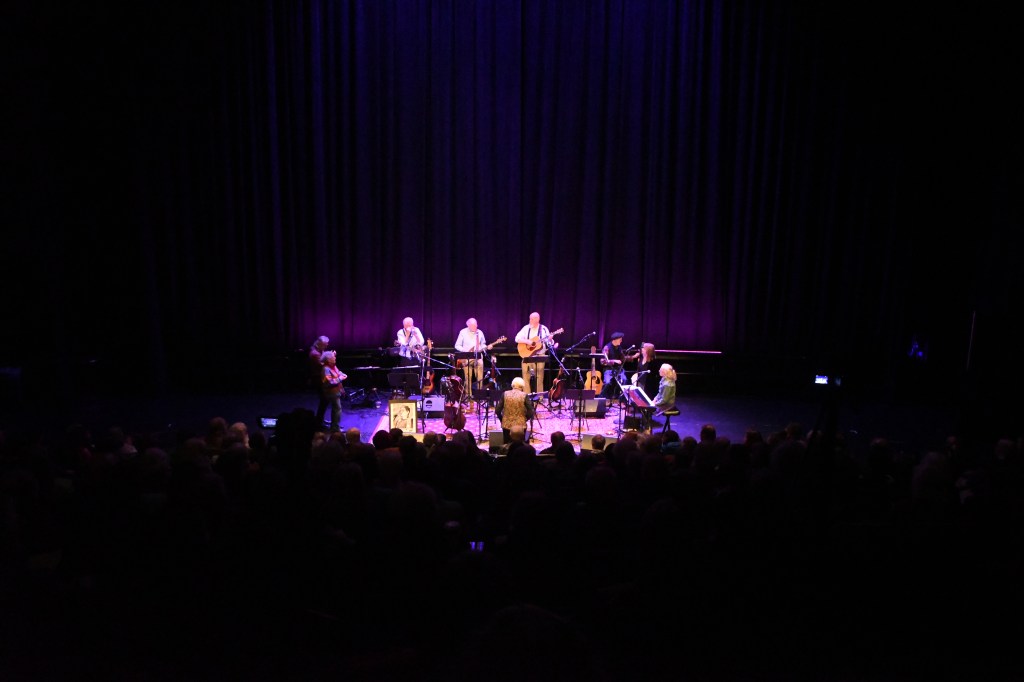
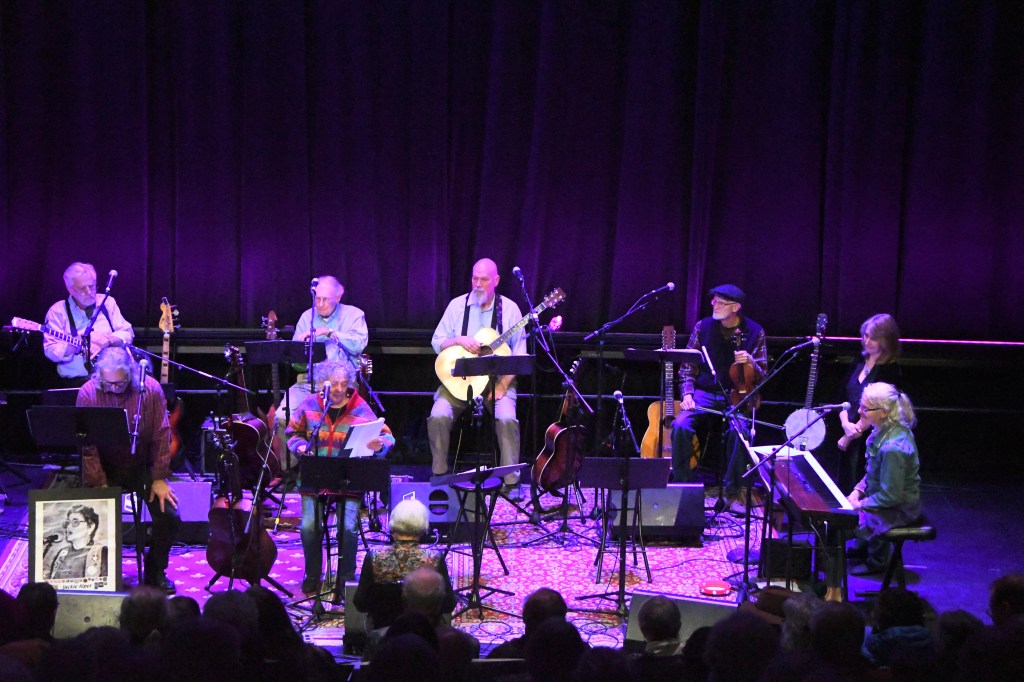
Spirits of folk heroes hovered over the Eighth Step stage Saturday – Woody Guthrie, Pete Seeger, Leadbelly, Ronnie Gilbert, Nina Simone, Utah Phillips – all friends of the late, great Jackie Alper. Nine area musicians honored Alper, our own folk-music Forrest Gump, as Eighth Step host-impresario Margie Rosenkranz describes her. A forest of microphones and instruments, the stage looked like a music store; facing them out front sat Andy Spence like the conductor she was Saturday. Spence and Sarah Dillon wrote the the two-part tribute in songs and stories, working since January through books, interviews and song research.

Margie Rosenkranz
It held together wonderfully well; though some singers sounded stronger than others, some players, too. But it all felt strong in the spirit of the much-loved and admired singer, activist and radio voice.
Nearly-packed – as it was during the Step’s 2007 Alper memorial – the place had the easy warmth of a family reunion; some hadn’t seen each other since Alper died. Part hootenanny, part progressive issues rally, part hero tribute, it felt both universal in its message and personal in its delivery as the performers brought themselves, fully. Rosenkranz called it “a gathering of the clan.”
As Spence told me last week, the two-part tribute sketched Alper’s life in her own words that Ruth Pelham collected in a 2000 interview, plus published recollections by Seeger, Gilbert and a dozen other sources, notably Alper’s son George. Previously committed elsewhere, he couldn’t attend.

Ruth Pelham, narrating, above; Greg Giorgio, below

First-set narration sketched Alper’s long life, launched in an impoverished New York City childhood that powered her contributions to both social movements and music. Pelham recited recollections in Alper’s own words; Greg Giorgio framed them in history: the Depression, WWII, the “red-scare.” Alper declined the star-making opportunity to join the Weavers to work in legal defense of progressive activists.
Songs fit and filled out this framework; Pelham delivering “The Greenhorn Cousin,” written by Alper’s father Jacob Leiserowitz, with very old-New York flavor and Kate Blaine’s bluesy “Frankie and Johnny” providing rootsy-period flavor. Union organizing songs dominated, however, Blaine strong in “Union Maid” and Toby Stover challenging anyone on the fence between boss and workers with “Which Side Are You On.” Narration painted all this in very Jackie terms: When a paddy wagon took her away from a demonstration, her mother yelled, “At least I know where you’ll be tonight,” a night when Jackie took up cigarette smoking in jail.

Kate Blain, above; Toby Stover, below, George Wilson, background

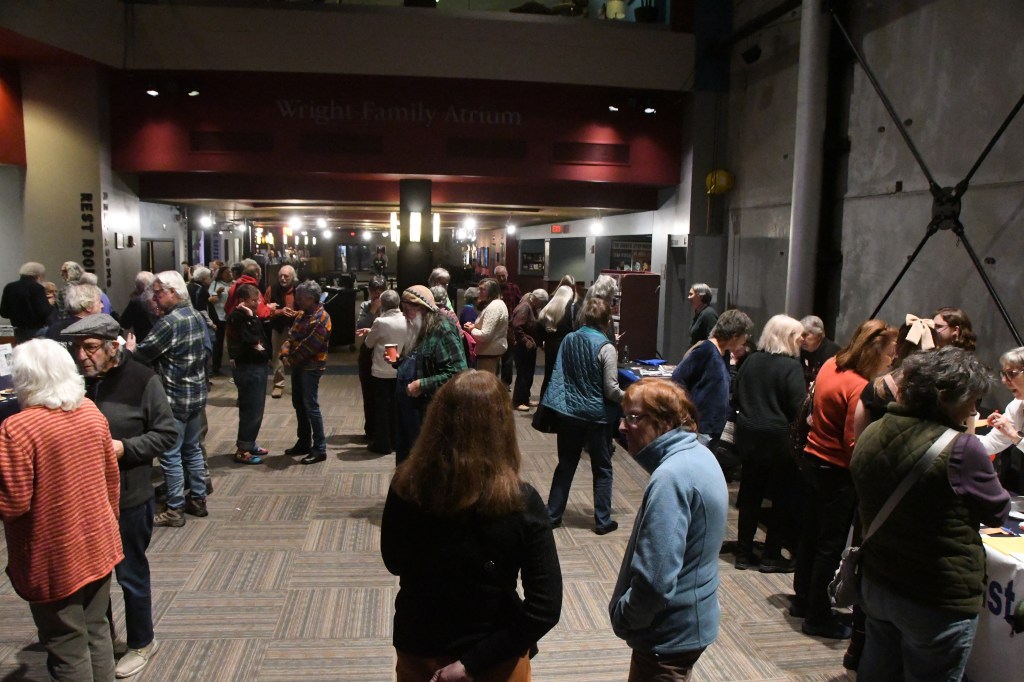
At intermission, the performers smiled their way into the dressing room, happy laughter audible in the theatre as fans greeted each other on the stage in a happy schmooze. In the lobby, activists staffed tables full of signs, brochures, stickers and buttons.
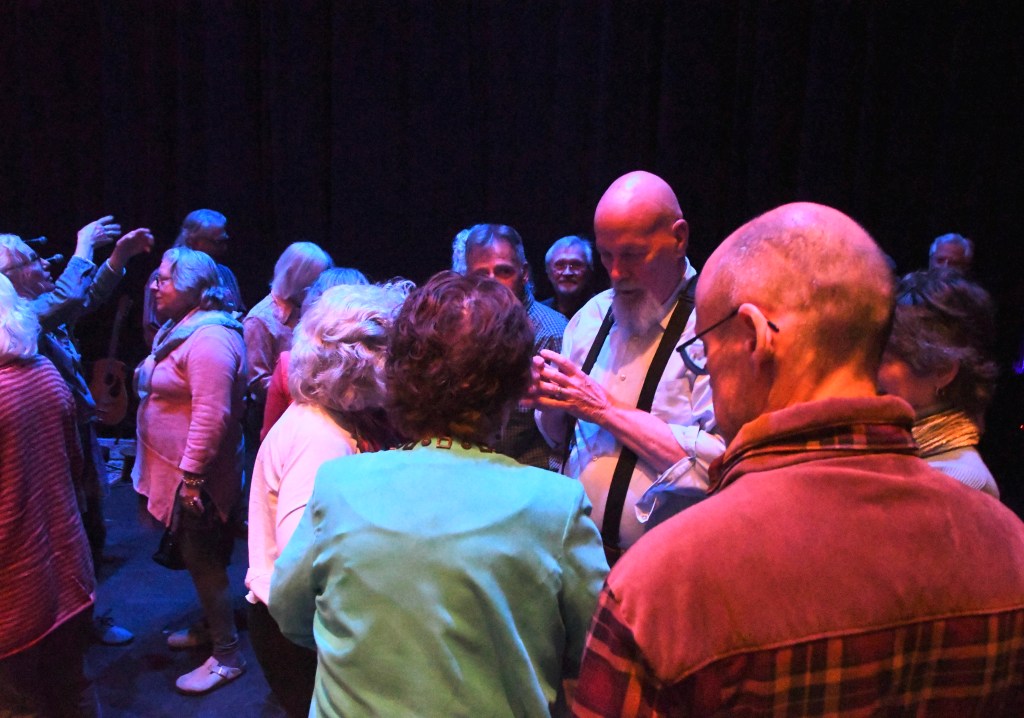
Intermission schmooze onstage, above; folksingers Cathy Winter and Ruth Pelham, below


As Spence explained in an interview last week, she built the second set on the principles Alper’s buttons proclaimed. Some wear their hearts on their sleeves, maybe; but Alper proclaimed them in buttons crowded onto her vest.
Spence cleverly built the narration and music around these messages, as performers periodically popped up in a whack-a-mole relay of principle, reciting a button each, then sitting as another performer intoned another button. This amused, enlightened and punctuated song and story sequences that – like the first-set songs – used blues or pop songs to punctuate activist material.
Stover demonstrated the folk process in “Round & Round Hitler’s Grave,” setting scornful messages by Guthrie, Seeger and Lampell to “Old Joe Clark.” Blues by Sonny Terry & Brownie McGee and Leadbelly, and “Old Jim Crow” – which Alper wrote with jazz-blues giant Nina Simone – were more than entertaining period pieces; the singers clearly meant them from the heart.
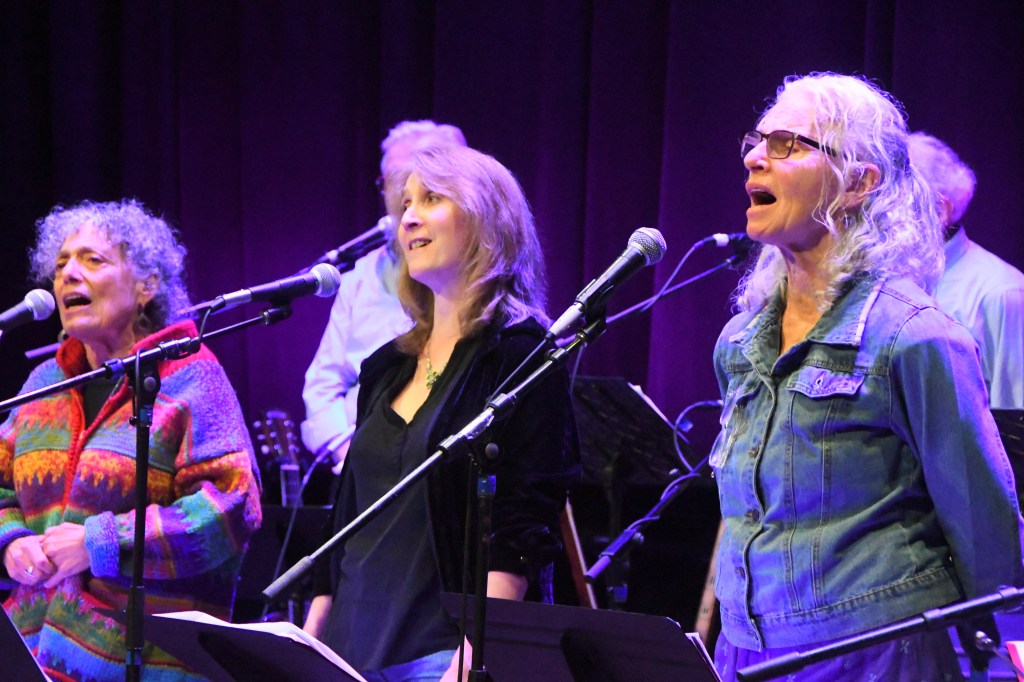
Ruth Pelham, Kate Blain, and Toby Stover
But nothing else in the show packed the punch of “Singing for Our Lives,” written by Holly Near and sung at first in close harmony by Stover, Pelham and Blain. When the men joined in – fiddler/banjoist/12-string guitar player George Wilson, guitarist/dobro player Michael Slik, bassists/guitarists Howard Jack and Charlie Rhynhart, singer/narrator Greg Giorgio and pianist Alan Thomson – this grew wings, a mighty chorus.

George Wilson, above; Michael Slik, below


Howard Jack, above; Charlie Rhynhart, below; Kate Blain, foreground

Charlie Rynhart

Alan Thomson, foreground
The men took their turn in the life-summing-up “Starlight on the Rails” before Pelham summed up Alper’s later life, fighting Lewy Body Dementia while advocating for staff in her nursing home. Pelham sang Malvina Reynolds’s “Magic Penny” as compassion and love in song.
To choose the evening’s single, brightest star, it would be Pelham who sang and spoke in compelling conviction and read the crowd beautifully. When she heaped scorn on “red-scare” bullies McCarthy, Nixon and Roy Cohn – mentor of a certain amoral real-estate swindler – she looked up as boos filled the room. Then she repeated Cohn’s name to more ridicule.
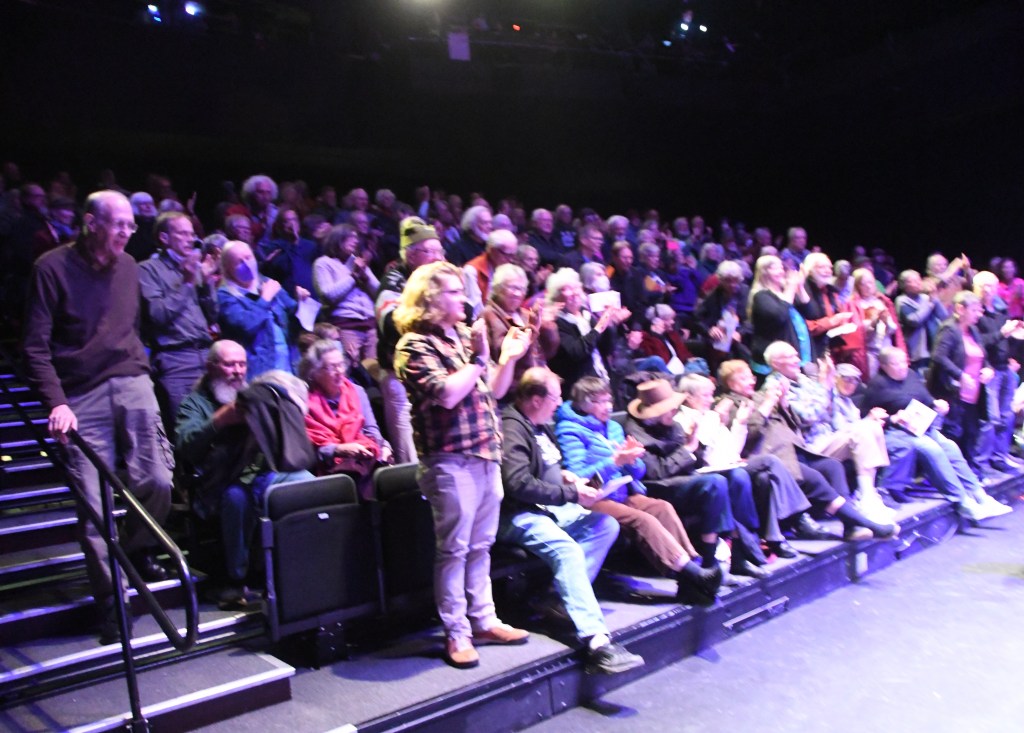
The rousing closer “If I Had a Hammer” united all the voices and as Spence rang on cue the bell that lay at her feet throughout. More laughs, then a standing ovation.
Without leaving and after a short consultation, they encored in a strong repeat of “Solidarity Forever” to the familiar tune of “John Brown’s Body.”

This was a family reunion, a hootenanny, a progressive-issues rally, a hero tribute, “a gathering of the clan” – a clan including leaders and fans of the Eighth Step, Caffe Lena, Old Songs, and WRPI; institutions Jackie Alper supported and that hold her memory close.
The Songs and who Sang Them – From Spence’s program
ACT ONE
Come and Go with Me Howard
On the Picket Line Ruth
Frankie and Johnny Kate
There is Power in the Union Charlie
Brother, can you spare a dime Michael
Talking Union George
Di Grine Kuzine (The Greenhorn Cousin) Ruth
Solidarity Forever Howard
Union Maid Kate
ALMANAC MEDLEY (Jackie was a member of the Almanac Singers, a predecessor of the Weavers, and the Priority Ramblers, likewise.)
Union Train George
Which Side Are You On? Toby
Get thee behind me, Satan George
ACT TWO
I Never Will Marry Kate & Toby
I’m a-looking for Home George
Round and Round Hitler’s Grave Toby
Overtime Pay Alan
Walk’n My Blues Away Charlie
How Long Blues George
Reuben James Michael
Wasn’t That a Time? Howard, Toby, Ruth
Good Night Irene George & Ruth
Old Jim Crow Toby
Waist Deep in the Big Muddy George
Singing for our Lives Toby, Ruth, Kate
Starlight on the Rails Howard, Charlie, Michael
Magic Penny Ruth
If I Had a Hammer Howard et al
Solidarity Forever Everybody
Spence’s Acknowledgements
Special thanks to Margie Rosenkranz, who encouraged me to do this project.
Thanks to all the folks who shared their knowledge of Jackie, especially her son, George Alper and her local friends Mabel & Ruth. Thanks to Ruth Pelham, Kevin Roberts, Michael Eck, Alan Thomson, Don Person, Greg Georgio, Sarah Dillon and Marsha Lazarus and Kathleen O’Conner for their memories.

Andy Spence, foreground, with Greg Giorgio
Credits
Producer & Director: Andy Spence
Writing and Script Editor: Sarah Dillon
Interview with Jackie in 2000 by Ruth Pelham
Program: Dan Roesser

Tabling in the Lobby

Performer photos by Joe Alper, Jackie’s husband

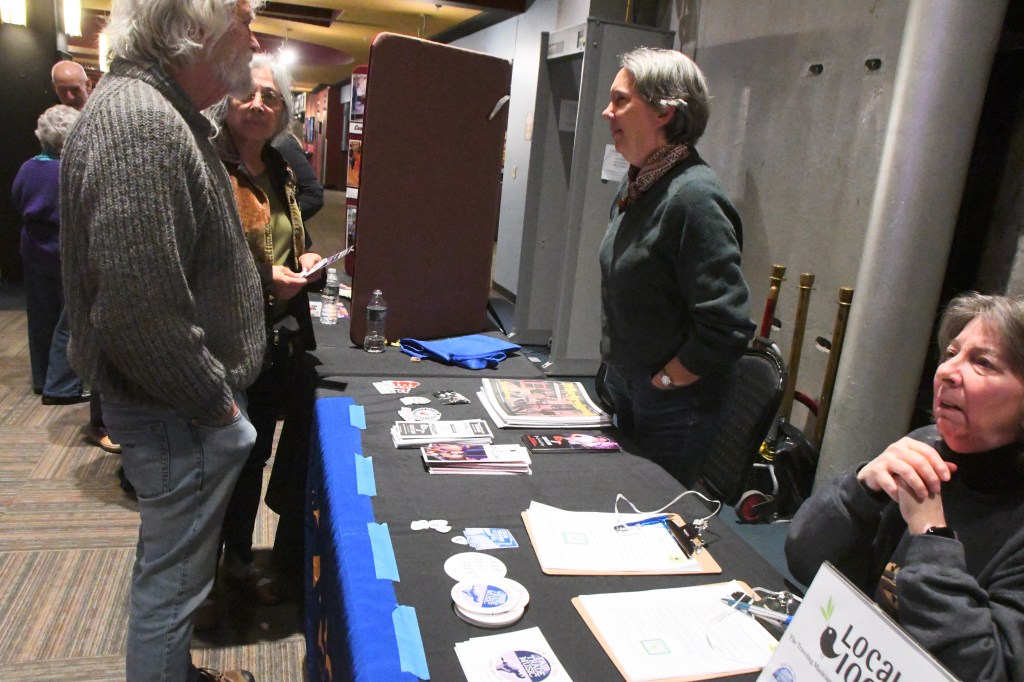
Sarah Craig, standing, of Caffe Lena, tabling in the lobby


Ruth Pelham sings atop a stool, with Alan Thomson, left, and George Wilson

Eighth Step board member Ed Guider urges membership support for Caffe Lena, Old Songs and the Eighth Step

 Hoke's Jukebox