The stars aligned at the Lenox Music Inn that sweet sunny afternoon in August 1976; and Jimmy Cliff’s star shone brightest.
It all felt perfect: the beautiful warm weather, the shared sense of happy anticipation, the usual friendly vibe at my favorite-ever venue.
So, when Jimmy Cliff and his band came onstage, the place was primed for joy. I’ve never felt such jubilation before or since, in hundreds, thousands of live concerts. We all surged to our feet on that sloping grassy hill, and stayed there through every song, every bit of banter.
That may have been reggae’s high-water mark, the early- to mid-70s when Cliff, Bob Marley and the Wailers and Toots and the Maytals all peaked. That’s not to diminish their later achievements, nor those of other powerful and accomplished reggae artists since then. (Check in with Sir Walford Saturday afternoons on WCDB-FM for guidance.) But those years were a sort of golden age, with Cliff at the forefront of that multiple cultural explosion – after “The Harder They Come” made him a movie star in 1972 as well as a musical giant. Wiki reports, “The film ‘The Harder They Come’ played in midnight screenings at the Orson Welles Cinema in Cambridge for seven years…”
Mourning Cliff’s death today at 81 in Kingston, reggae fan Keith Richards FaceBooked this today: “He wrote some of the most beautiful ballads that ever came out of Jamaica. Unbeatable songs, and the voice of an angel.”
All that, and fiery rebel songs, and musings on his homeland – all in the voice of an angel.
I feel grateful – blessed, really – for the half dozen or so times I saw him sing over the years.
The last time was at Jazz Fest in New Orleans, May 3, 2013. He played the Congo Square Stage that specializes in soulful, funky fare – and Cliff was every bit as magnificent then as decades before. His voice swung sweetly yearning or strongly emphatic and portrayed every emotional color in between; his timing impeccably rhythmic.
But most of all, he meant it; his soul came to us in every word.
Ellie von Wellsheim is our guest writer here. Married nearly half a century, I’ve found her to be the most capable person I know; founder and executive director of the MoonCatcher Project. http://www.mooncatcher.org. She once fell asleep with her head on my shoulder in the sixth row of a Bruce Springsteen show at Albany’s Palace Theatre. Here’s her take on a Montreal road trip to see Paul McCartney.
I turned down a front row seat to see Paul McCartney.
“Are you crazy?” was my son Zak’s response.
When I told my husband Michael (this is his blog you’re reading) about the offer and my turning it down, he said, “Are you crazy?” And when Linda my board president reacted the same way, I thought perhaps I should revisit my decision.
My college friend Leila (O’Brien Raymond) got two tickets from her son Peter, and when he couldn’t go with her he asked me to please take his seat and go with his Mom. Finally, I said yes. I rearranged meetings and presentations and concentrated on travel plans instead.
Montreal, here we come.
The concert was the second of a two night run. Peter says second night shows are the best because all the bugs are worked out the first night. So Leila and I made our way to Row A seats 41 and 42, night two, of the Paul McCartney: Got Back Tour.
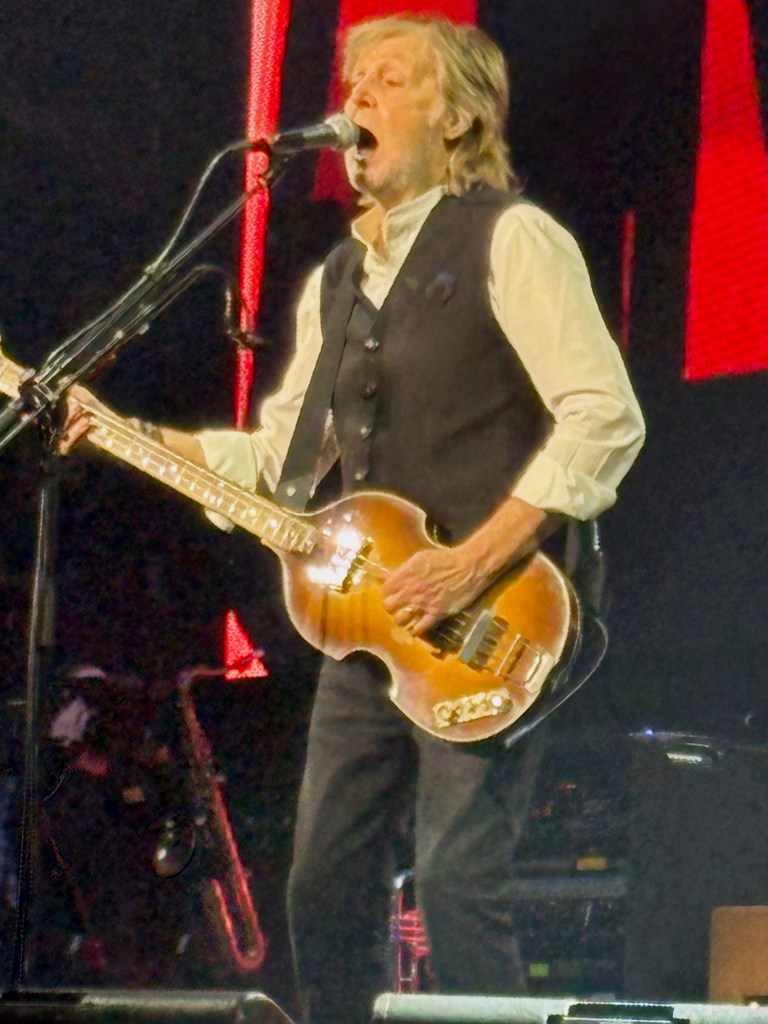
Ellie von Wellsheim photo
I had laughingly told Michael that I’d write a review for this blog. He’s been writing music reviews for over 50 years and this would be my first. He joked with me about paying attention to when the show started (8:12 p.m., by the way). He said you have to write down all the songs and what tempo each has. He said think terms like largo, adagio or allegro, and I said OK: tortoise, hare and galloping horse. He laughed. ‘Pay attention to the crowd and the vibe of the place, and have fun,’ he said. “Paul has amazing energy. You’ll love it.”
So I folded up a piece of paper and found a pen to carry in my pocket and off we went. 19,000 people were there (in Montreal’s Bell Centre). Every seat was filled and everyone was ready for a good time. It was noisy and the stage was right in front of our front-row faces. I turned around and gasped at the crowd. All these people there to see Paul, there to relive something about our idols the Beatles.
As we waited for the show to start, there was recorded music playing and I watched the man who was making that happen. He knew every word to “Come Together,” “Why Can’t We Do It in the Road,” “Lucy in the Sky (with Diamonds),” and endless other songs. We all knew those words. Pictures of the Beatles scrolled the screens behind and at each side of the stage.
They started with “Help” and I wrote “#1 HELP tempo: galloping horses!” We were off to a good start. Everyone jumped to their feet and in the end I don’t think my ass touched that chair for more than about seven minutes that whole night.
The place smelled of popcorn and fried food and everyone was singing along and just plain feeling good. The tunes all had video and stills of the Beatles on the screens behind the band. Sooo many pictures of Paul, John, George and Ringo. Pictures of them young and silly and growing more serious as their hair grew longer and they grew up. I knew most of the music and sang my heart out because not even I could hear me with all the screaming and singing and all around good cheer surrounding me.
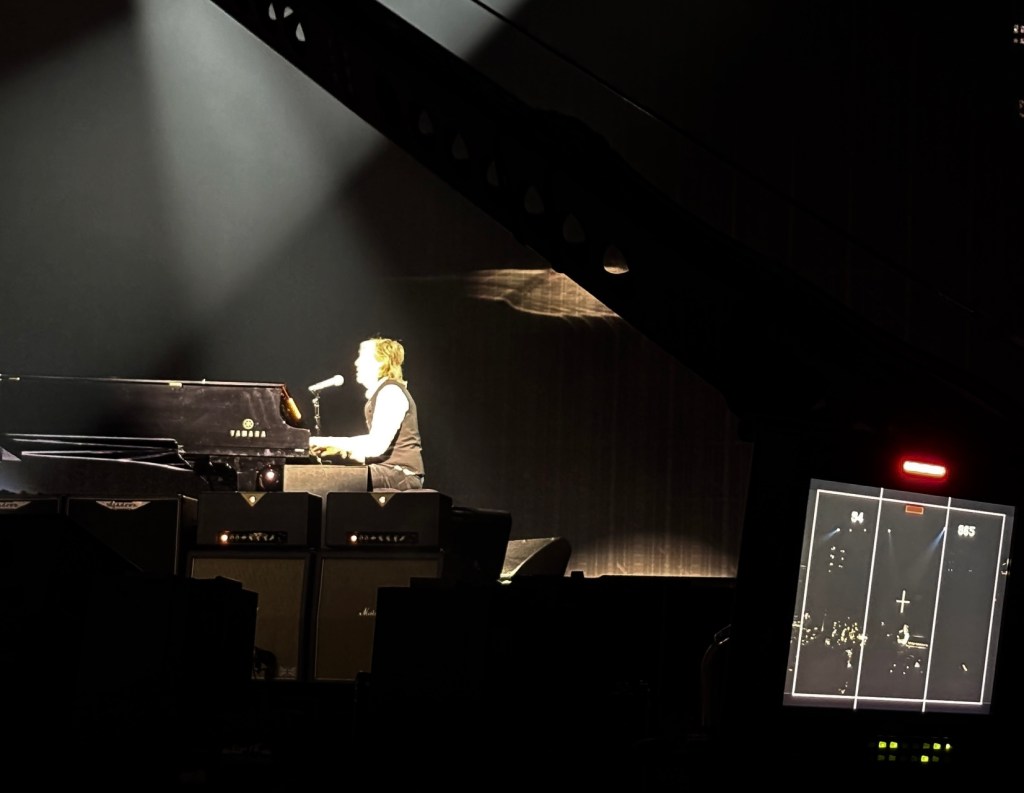
Leila Raymond photo
The show ebbed and flowed taking us from gentle to ferocious waves of emotion, truly making us laugh and cry. The photos and videos were visual reminders of the Beatles, and the songs jerked us back to how it all felt. You know how music does that? That touching something about your past that brings feeling rushing into your soul was racing into the souls of 19,000 people that night.
I loved it all but there were highlights.
Paul sang to John; a song that made me cry, it was so filled with love and longing and proclaimed “If you were here today I’d say ‘I love you.’” He sang with John too: The screen showed John singing “Get Back;” and on stage Paul sang with him, ending saying “it’s good to sing with John again.”
And there was a shout out and thank you to George too. With ukulele in hand, Paul told a story of going to George’s house to play a song that George had written and Paul had just learned to play. He quietly started to strum “Something” and soon the whole band joined in and we swayed and were missing this Beatle, too. Leila leaned over and told me she walked down the isle to this. These songs have marked our happy occasions and the sad ones too, like “Blackbird,” a melancholy protest song written during the civil rights movement in the US south.
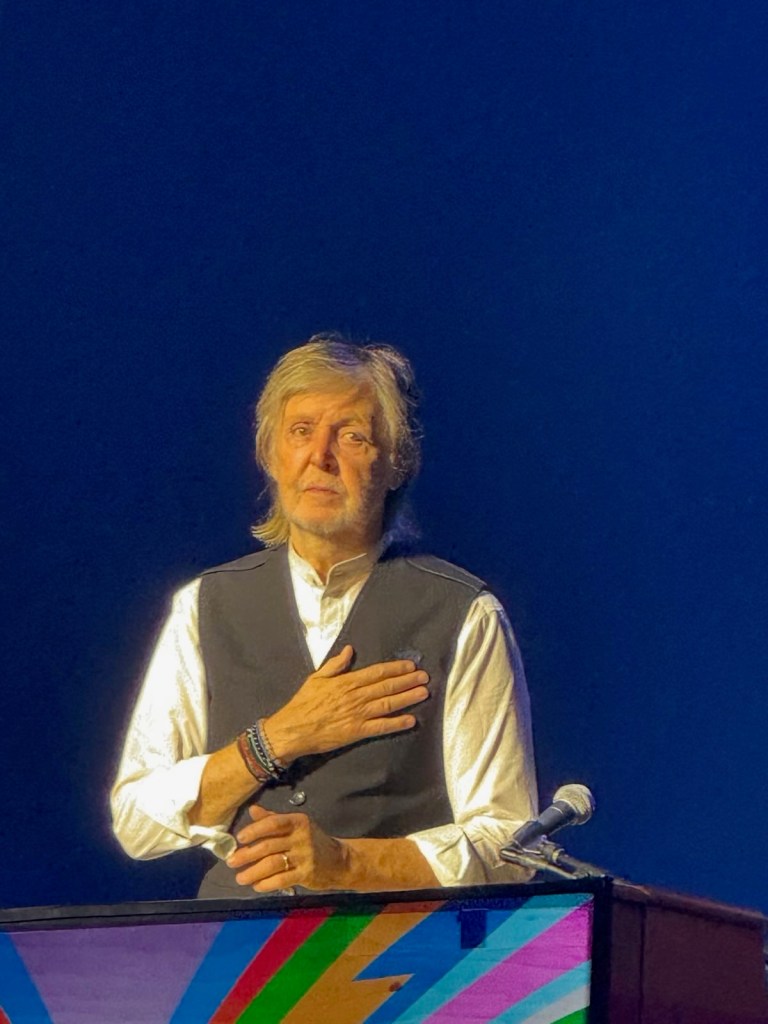
Ellie von Wellsheim photo
“My Valentine,” a beautiful tortoise tempo-ed love song for Nancy, Paul’s wife, was silently ASL hand signed on screen by Johnny Depp and Natalie Portman’s as Paul sang, out loud, to his sweetheart. Paul told us his wife was there and he hands-formed a heart for her.
We jumped out of our skins and covered our ears when “Live and Let Die” was paired with cannon sounds and leaping flames of hot fire, six feet in front of us and too hot for comfort. But with all the smoke and lights, it was thrilling. I noticed Paul taking out earplugs after the song ended.
Leila Raymond photo
The set ended with “Hey Jude.” The audience went crazy and people held up NaNaNaNa signs as we all sang the chorus together.
We stood there amazed, wondering if there would be an encore when a man came up to me and asked what I was writing. I explained that my husband was a music reviewer and couldn’t be there, so I was writing down the song titles for him. I was a little nervous as I wondered if I was doing something illegal but he simply smiled and said “I can help you with that” and handed me the set list. I kissed his cheek knowing Michael would love to have that piece of paper.
I listened to the three encores and thought to myself “You got to experience this; you’re not crazy!”
TO The Record Shelf – A review of “Ginger Ale” by David Greenberger & The Hi-Ho Barbers
Versatile and creative as Greg Haymes or Bill DeMain, prolific as Bill Frisell or Chandler Travis, David Greenberger does what nobody else does, and lots of it.
“Ginger Ale,” his 30th (at least) words and music project presents a masterpiece experience of unique and powerfully evocative kind.
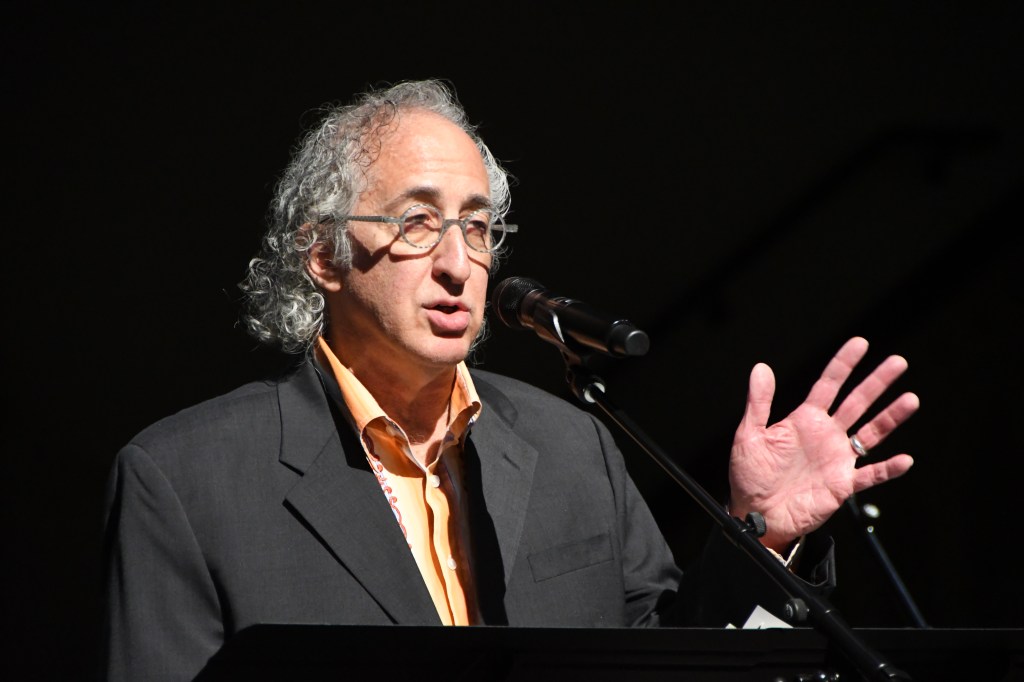
David Greenberger onstage at Universal Preservation Hall in January
A trained visual artist and always a musician, Greenberger detoured as a young guy into working with older folks as activities director of the Duplex, a Boston nursing home whose name brands a nonstop flow of projects since 1979 when he started a newsletter there.
Instead of regarding elders as recording devices recalling things, he gleans and shares gems from their conversations about the here and now. Without the amused condescending tolerance many aim at the aging, he harvests their humor, wisdom and wit in a life’s work of sharing them. From that first newsletter grew a magazine, books and audio monologues with music.
Fitting tunes to tales, he performs and records them with some of the most creative and curious artists on the scene and around its edges.
Members of well-known bands NRBQ, Los Lobos, XTC, the Blasters, the Minutemen, Yo La Tengo, and the Posies join the fun, also Richard Thompson and Robyn Hitchcock; plus others, maybe less prominent but also sharing Greenberger’s energy and enthusiasm for the wonderfully strange. Chandler Travis, Jad Fair, Ken Stringfellow, the Fuggs, Shaky Jake and the All-Stars, Prime Lens, Birdsongs of the Mesozoic, the Pahltone Scooters, Paul Cebar, Madder Rose, the Shaking Ray Levis also chime in.
Locally, the Greenwich resident has recorded and performed with Michael Eck, the Figgs, Jupiter Circle (Elizabeth Woodbury Kasius band before Heard), A Strong Dog (Kevin Maul, Matthew Loiacono, Mitch Throop) and the Huckleberries who played with Greenberger at Universal Preservation Hall last January. (See below)
Over the past decade, Greenberger created “Ginger Ale” – 22 monologues-with-music that range from under a minute to about four. He recites the monologues and plays bass with guitarist/singer Robyn Hitchcock, drummer Mark Greenberg and singers Paul Cebar and Kelly Hogan. He also credits the elders who first spoke the monologues.
The Seinfeld-ian title/opening track spins a spry alt-pop fable, fairly straight. Then words and music wander from humorous to profound, light to somber.
Singers Q&A with Greenberger in “Lower Case” – a retired accountant gets called back to fix a company’s records over a guitar track as laid-back lovely as the Allman Brothers’ “Little Martha.”
“Everything’s Crooked Nowadays” laments a business world with too much crime but too little punishment as spacey guitar parallels escalating confrontation.
The easy groove of “Still” frames a calm account of racism in a a restaurant episode, revealing that San Antonio “is prejudiced, still.” In a calm voice on relaxed music, it hits hard.
A George Clinton-like funk vamp powers “Early Coney Island,” unfolding in the tattoo inventory of an oldster everybody thought had served in the Navy but was actually too young for WWI.
The mood is most serene in “Great Day” with beautifully resonant guitar under words of contentment and gratitude; blending in happy wonderment. But there’s indignation in “Dancing Worms,” escalating with stereo panning that portrays a discussion sonically.
“Alaskan Feet” dialogs Greenberger’s northeastern inflection, which sounds neutral hereabouts, with guitarist Hitchcock’s British accent.
“Get-off-my-lawn” crankiness erupts in “Lawn Snakes,” scorching bent-note guitar spiking the monologue’s complaint.
Jokes never over-power the profound, nor vice versa. In delicate, dynamic balance, the the most affecting pieces wander the space ways in “Silver Light,” a sci-fi excursion in sparse, spooky guitar; then mourn a dying mother in “She Knew.”
In its seamless mastery of music and words, mood and motion, “Ginger Ale” jumps to the head of the class among Greenberger’s dozens of CDs (and one DVD). Stream or purchase at https://davidgreenberger.bandcamp.com/
For additional info on David Greenberger, check these posts about the UPH show:
The late Greg Haymes was a musician, writer, visual artist and sculptor of matchless output, a giant on our creative scene who is much missed as creative force and friend.
Bill DeMain, also cited up top, is a singer-songwriter in the original, entertaining pop-rock bands Swan Dive and Crackerboots. A music journalist and author who meets the stars on their own turf, he also draws magazine cartoons and jokes with words as the Fr. Guido Sarducci-like letter-writer Sterling Huck. A Francophile who studies in Paris, he’s in Tokyo as I write this, on a Swan Dive gig, and guides visitors through Nashville on music-lore tours. Full disclosure: My brother Jim plays on Bill’s projects; a Nashville lunch he arranged for us with Bill and Jim Moran, another formidable talent, maybe had the best across the table conversation I’ve enjoyed on my Nashville visits or elsewhere. This also suggested to me that Bill is the same sort of renaissance man as David Greenberger. I think I should introduce those guys. Check out Bill’s episode on the podcast ThisIsNashville.
Bill DeMain, in hat, with friends in Tokyo. Photo from his Facebook
Chandler Travis makes music of impressive quality on dozens of albums with the Chandler Travis Philharmonic and its little brother the Philharmonette, the Buttercups, the Chandler Travis Three-O, the Catbirds, the Incredible Casuals (and the Invincible Casuals), Lester, Travis & Shook and likely others. “Bocce & Bourbon” is a collaboration with David Greenberger.
Jazz guitarist Bill Frisell releases a new album about every 10 minutes; plays with everybody and dazzled at The Egg a year ago.
Review: John McCutcheon at the Eighth Step at Proctors GE Theatre; Friday, Nov. 14, 2025
“I’m the Bruce Springsteen of folk music,” John McCutcheon quoted a reviewer late in his Friday show at the Eighth Step in Proctors GE Theatre, wryly noting this referred to his duration onstage.
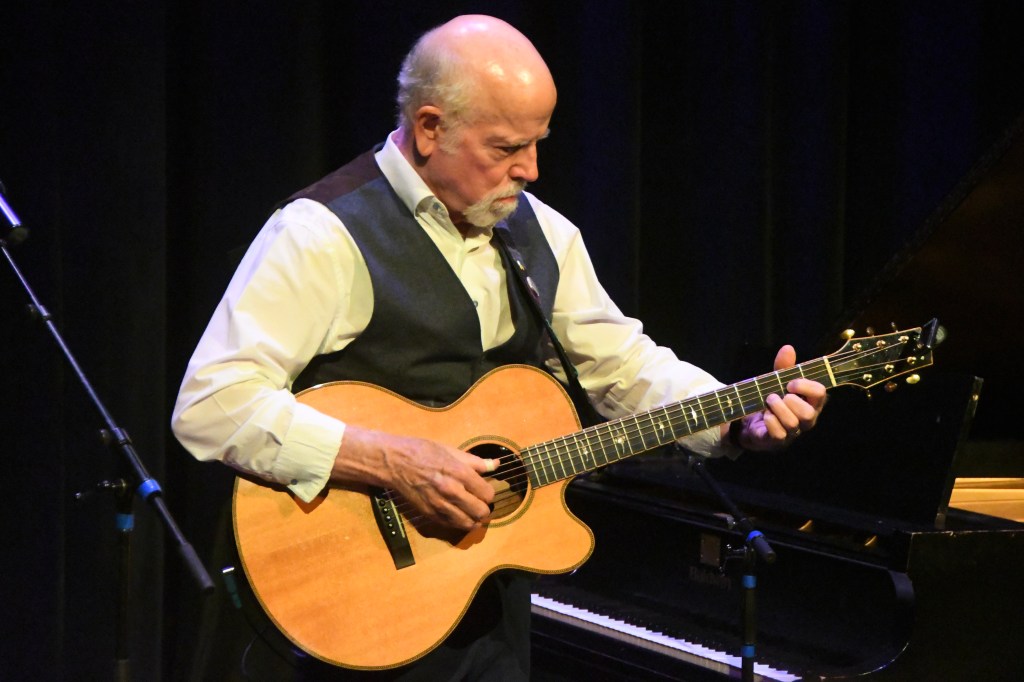
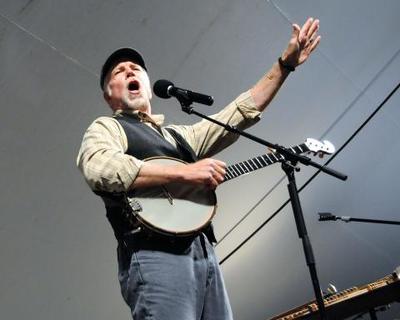
In two sets, each 70 minutes, plus intermission, McCutcheon proved as impressive in quality as quantity and earned other superlatives Friday. The Jimi Hendrix of the hammered dulcimer, a Richard Thompson-level guitarist, an ace pre-Scruggs-style banjoist, a Vassar Clements-like fiddler, a more impressive autoharp virtuoso than John Sebastian, a mellow, persuasive singer and a fun and fluent story-teller – oh, and he played expert piano, too.
Curator of song gems in the Great American Folkbook, he’s still creating, with songwriters young – Carrie Newcomer and others – and old, notably Tom Paxton, who shared the Eighth Step stage with McCutcheon three years ago and who played the Step on his farewell tour.
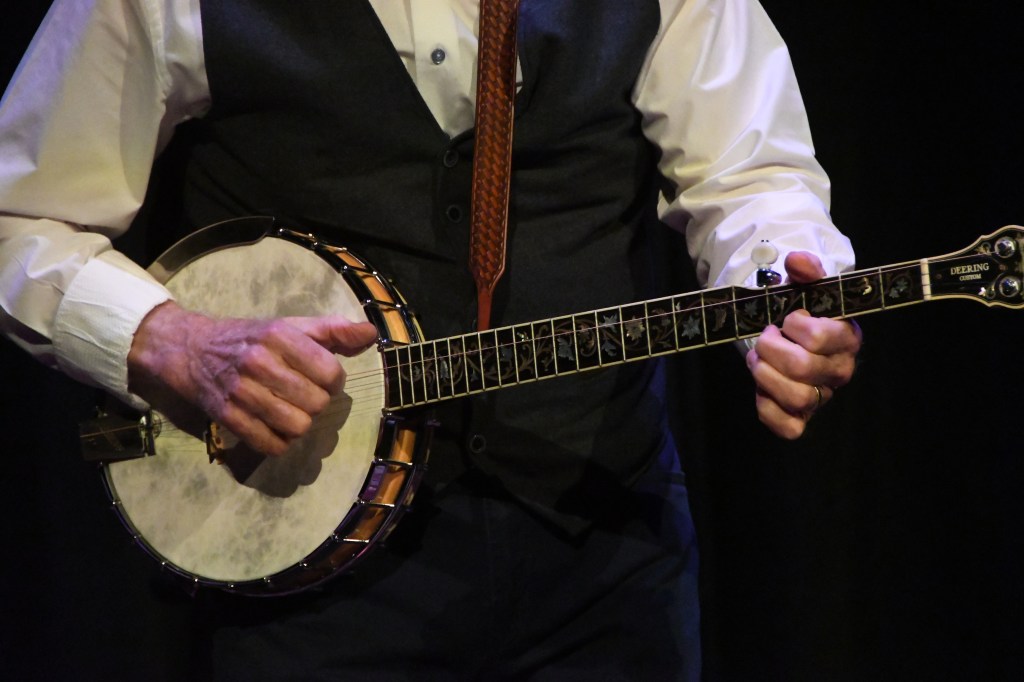
McCutcheon drew laughs when Step impresario Margie Rosenkranz introduced “the great John McCutcheon.” He came on joking “The GREAT John McCutcheon couldn’t be here,” in mock humility, then lit into “John Henry,” easy storytelling voice sailing over zippy banjo riffs. This vintage story-song flowed into autobiography: a hyperactive fourth grader who discovered folk music during after-school detention, whose music-making confused his family. A detail from that tale turned up later in sly sonata form echo.
He then evoked Paxton, describing their COVID-era Zoom songwriting that produced their “Christmas in the Desert,” with cars, not camels and a shift to guitar. In “Two Old To Die Young,” he wove rhymes around “old fart” and hesitated with expert comic timing after claiming his mind was intact. He later got a bit lost in some lyrics, briefly, recovering quickly and never losing momentum. “Desert” drew his first of several singalongs.
A leg fracture forestalled McCutcheon’s planned trek on the Camino de Santiago to Compostela in Spain. As he told co-writer Carrie Newcomer, “songwriters make up crap all the time,” so, without actually making the trek, their “Field of Stars” profiles four pilgrims to touching, empathetic effect. “Springfield, OH,” a Paxton co-write McCutcheon sang at the piano, poked the MAGA bear, hard and hilarious. McCutcheon stayed topical with the sympathetic “Ukrainian Now” hailing fighters’ courage. The somber waltz “One Hundred Years” mused on legacy to elegiac effect.
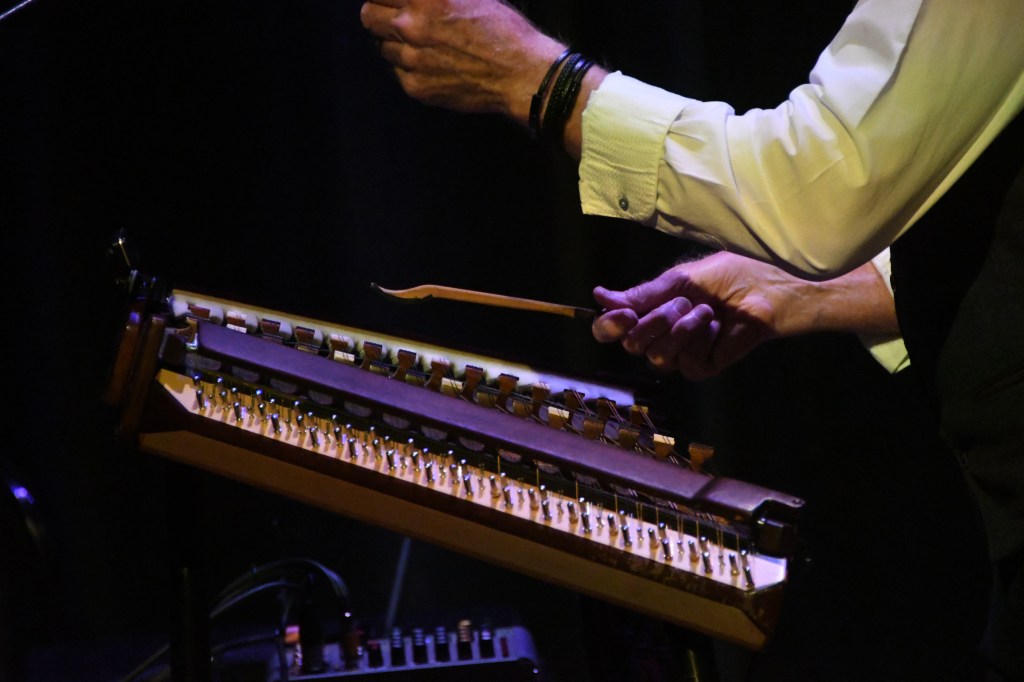
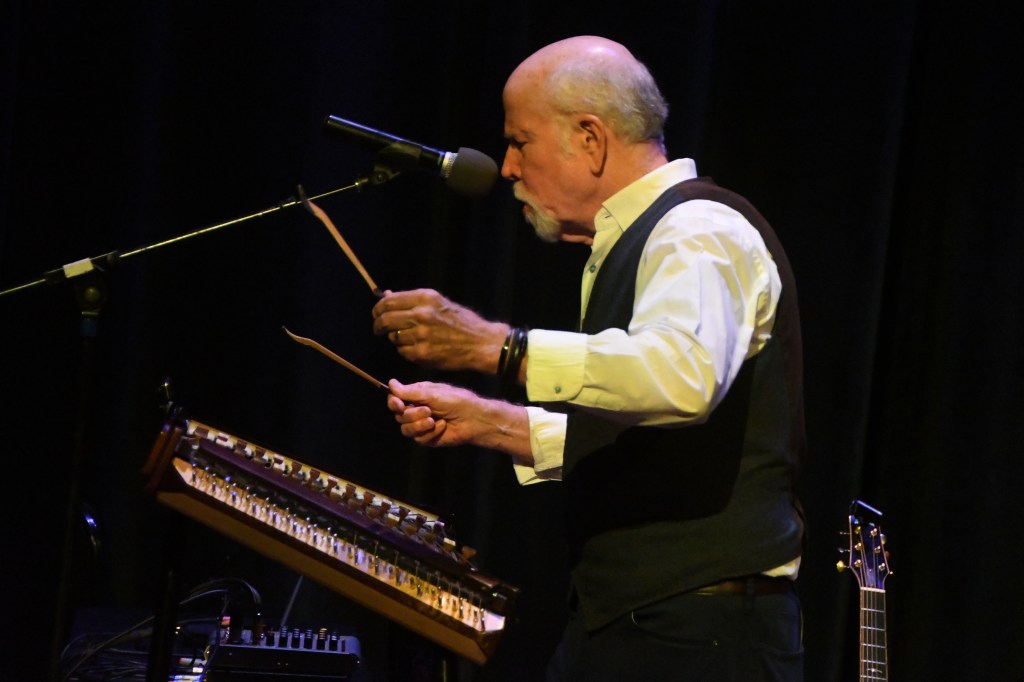
Shifting to dulcimer, McCutcheon medleyed peppy Appalachian tunes, winding up with “Niskayuna Ramble,” then stayed with the percussive stringed antique for “Letters from Joe,” mourning a soldier fallen at Normandy and echoing “Ukrainian Now.”
Another light-hearted autobiographical chat recalled his first guitar and discovering Woody Guthrie at the library by way of introducing “Pastures of Plenty” with a plenty-fine solo. After promoting his many enterprises and praising Paxton, McCutcheon sang his buddy’s superb wistful signature number “The Last Thing On My Mind” – last thing in the first set.
Catching McCutcheon’s self-deprecating tone, Rosenkranz got a laugh by introducing his second set by “seven-time Grammy loser John McCutcheon” who laughed, too. Playing slow, sad guitar, he deepened the mood with “Joe Hill’s Last Will,” somber and mournful, then lightened up and tweaked religion in “Me and Jesus,” his solo quoting “What a Friend We Have in Jesus.”
“The Machine” turned the inscription on Woody Guthrie’s guitar – “This Machine Kills Fascists” – into a challenge to continue Woody’s fight, citing the deadly Charlottesville riots. Lightening up, he identified himself as “the fiddle player” for dances and other gatherings around his Georgia home and lit into some high-energy bowing before toggling back to serious fare in “You Don’t Have to be Jewish” about school shootings. Entertaining novelty numbers on Jew’s harp closed with a marriage tale in which his father became “my own son-in-law.” A waltz on banjo wished for a world where money didn’t matter.
And this warmed up for the second set’s peak moments at hammered dulcimer – yeah, that Jimi Hendrix thing. In “Leviathan,” McCutcheon used both looping to repeat phrases and a mechanical pitch shifter that altered both the notes’ decay and their shape. As often previously, McCutcheon evoked his predecessors and mentors, but in his own innovative way, on the lovely, reverent “Wild Rose of the Mountain” based on shape-note hymns and the anthemic “Step By Step” – sizzling, stunning, strong.
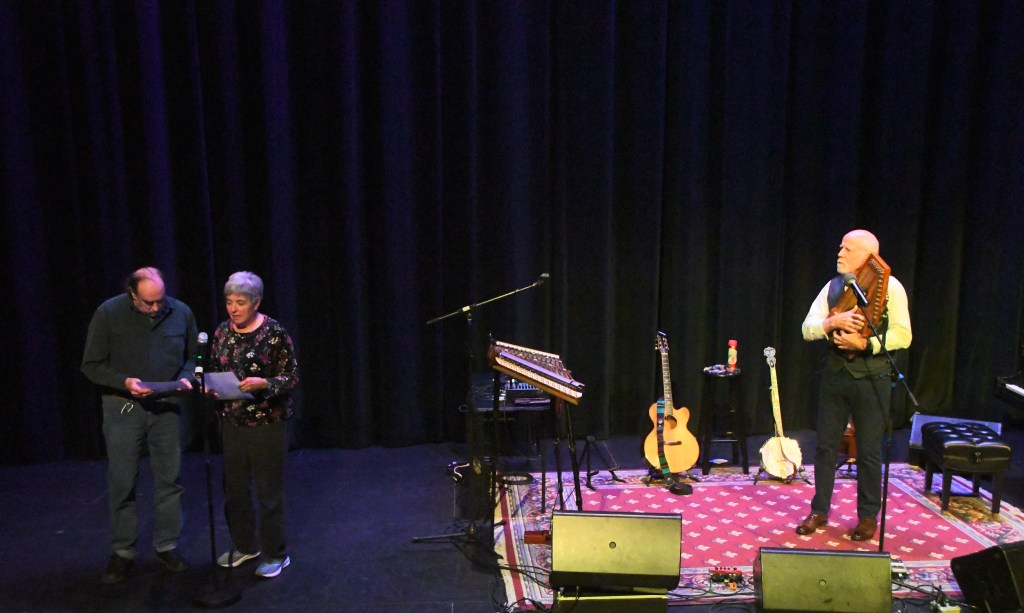
Switching to autoharp, and showing as much skill on this obscure chordal zither as on everything else, McCutcheon enlisted two readers to recite the names of those anonymous air-crash victims Woody Guthrie memorialized namelessly – and that was the point – in “Deportee.” McCutcheon had discovered their names and added them to Guthrie’s lyrics; a perfect example of the folk process and subtle dig at current ICE abuses.
“Alleluia, The Great Storm Is Over” honored its writer, the recently deceased Bob Franke with its lovely melody and uplifting words of hard-won optimism. A departure-less “encore” – McCutcheon, 73, contemporary with most fans Friday, sympathized “I know what it takes to stand” – echoed that uplift in his own best-known song.
“Christmas in the Trenches” recalls a famous Christmas morning WWI truce when British and German troops met in peace to sing, share and play soccer.
In her introduction, Rosenkranz said she looked to McCutcheon to bring light in these dark times. He did, in megawatt brightness and warmth, with unmatched skill powered by a great soul full of hope.
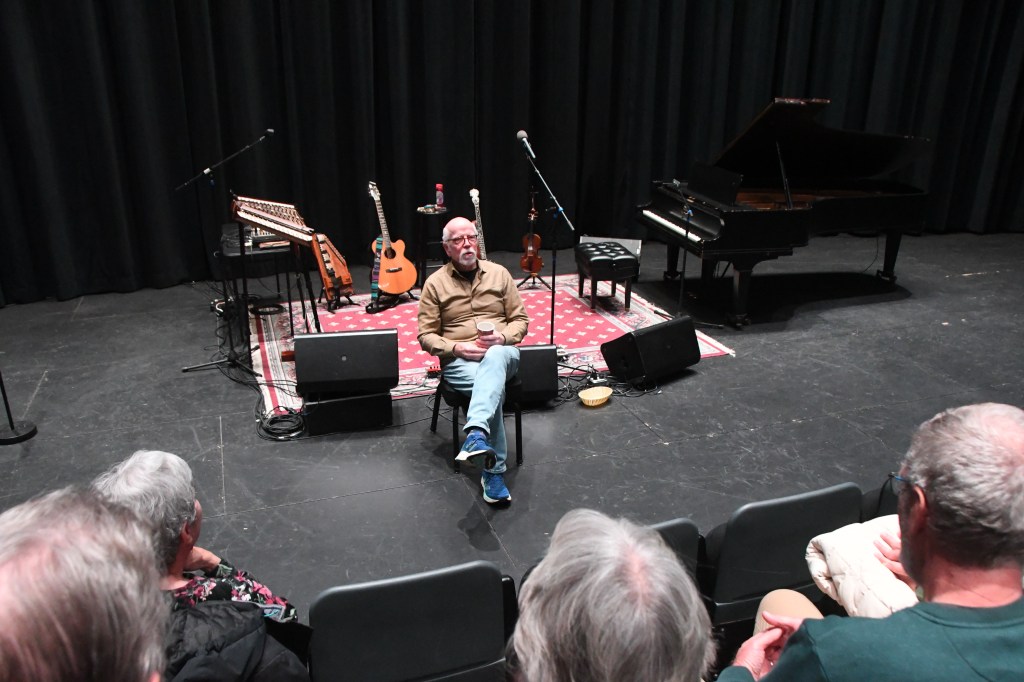
McCutcheon met fans before the show, in an informal chat/Q&A
Preview: John McCutcheon at the Eighth Step at Proctors GE Theatre; Friday, Nov. 14, 2025
Playing weddings may pay musicians well; everything else, not so good. Drunks invade the stage to sing along or holler for “Free Bird!” Two musicians I know stopped playing weddings by destroying their tuxedos, but I digress.
For John McCutcheon – playing the Eighth Step at Proctors GE Theatre Friday – playing a Nashville wedding won a priceless endorsement when the father of the bride praised him. Johnny Cash said of McCutcheon, “This is just the most impressive instrumentalist I’ve ever heard.” – amid a congregation that included Chet Atkins, Ricky Skaggs and other eminent musicians.
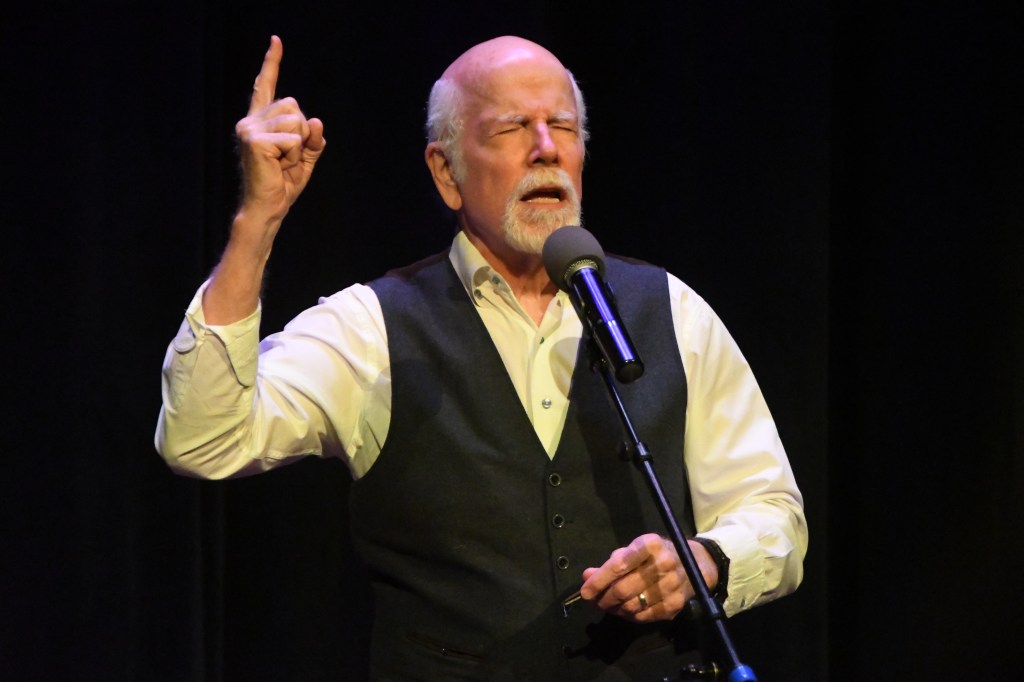
John McCutcheon. Photos provided
While heading to see him Friday at the Eighth Step at Proctors GE Theatre – which I recommend – there’s another McCutcheon distinction to remember. He actually scored a hit song, or at least a folk-level hit: “Christmas in the Trenches.”
Wedding or no wedding, everybody always expects musicians to play the hits. And McCutcheon will likely sing “Christmas in the Trenches” Friday because Its humanist message, the heart-warming tale of a WWI holiday truce between enemies, could hardly be more timely.
But that expectation might unfairly limit the actually unlimited McCutcheon.
He plays hammered dulcimer, banjo, guitar, autoharp, fiddle and more at “most impressive” levels; and he’s made 45 albums of songs while producing 20 albums for other artists.
Like Pete Seeger, the Carolina Chocolate Drops and many others who traveled the rural south to discover traditional music, the Wisconsin-born McCutcheon roamed for rifts and tunes. “While in his 20s,” Wikipedia reports, “he travelled to Appalachia and learned from some of the legendary greats of traditional folk music, including Roscoe Holcomb and Tommy Hunter.”
McCutcheon also excels at story-telling, both in his songs and in introducing them.
“John McCutcheon plays for us every two years, and it’s always a big occasion,” as Eighth Step Executive Artistic Director Margie Rosenkranz told me. “He’s been nominated for seven Grammys over his career (some are children’s music, some instructional), and is still writing some of the best songs of an exceptional career…We hope for a great audience, which always brings out the best in our performers.”
Show time for John McCutcheon at the Eighth Step at Proctors GE Theatre (432 State St., Schenectady) is 7:30 p.m. Tickets $32 advance, $35 on Friday; $55 front and center; this includes 6:30 p.m. onstage meet and greet with McCutcheon. http://www.eighthstep.org. 518-346-6204.
Review: Tyreek McDole at A Place for Jazz; Friday, Nov. 7, 2025
Singer Tyreek McDole surprised even himself Friday in the season-concluding concert at A Place for Jazz. “That was the best ‘Lush Life’ I ever did!” he exclaimed after a kaleidoscopic tender yet muscular duet rendition of the Billy Strayhorn classic.
The whole two-set show surprised with both wings and roots in right-now feisty young immediacy and respect for the jazz giants McDole reveres as inspirations. Everybody is an elder to 24-year-old McDole, but his music felt as authentic in celebrating generations past as in the jittery modernism of his opening tune.
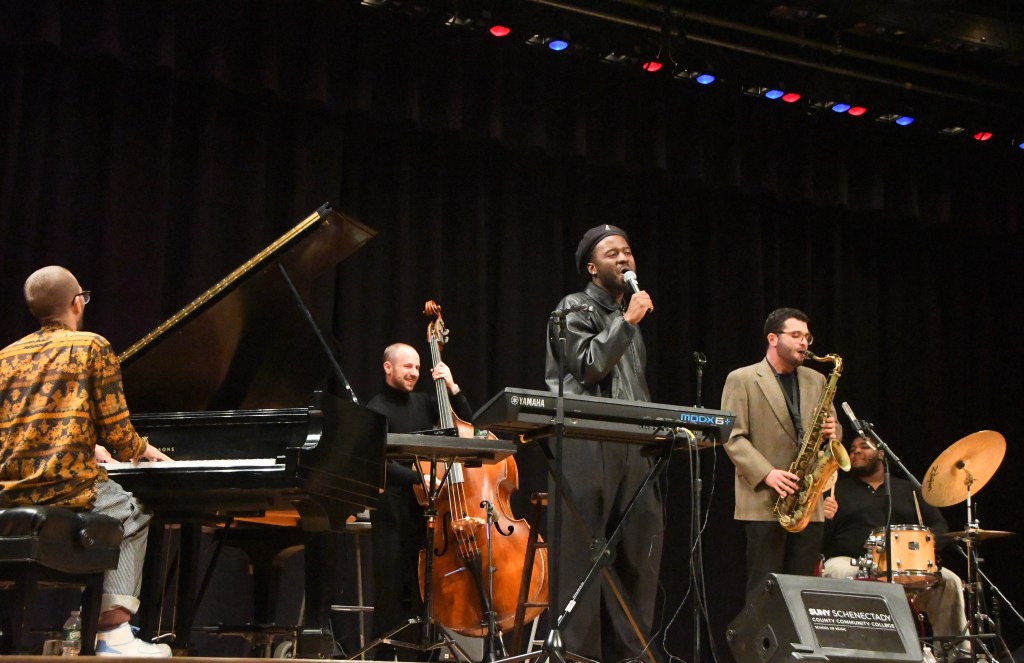
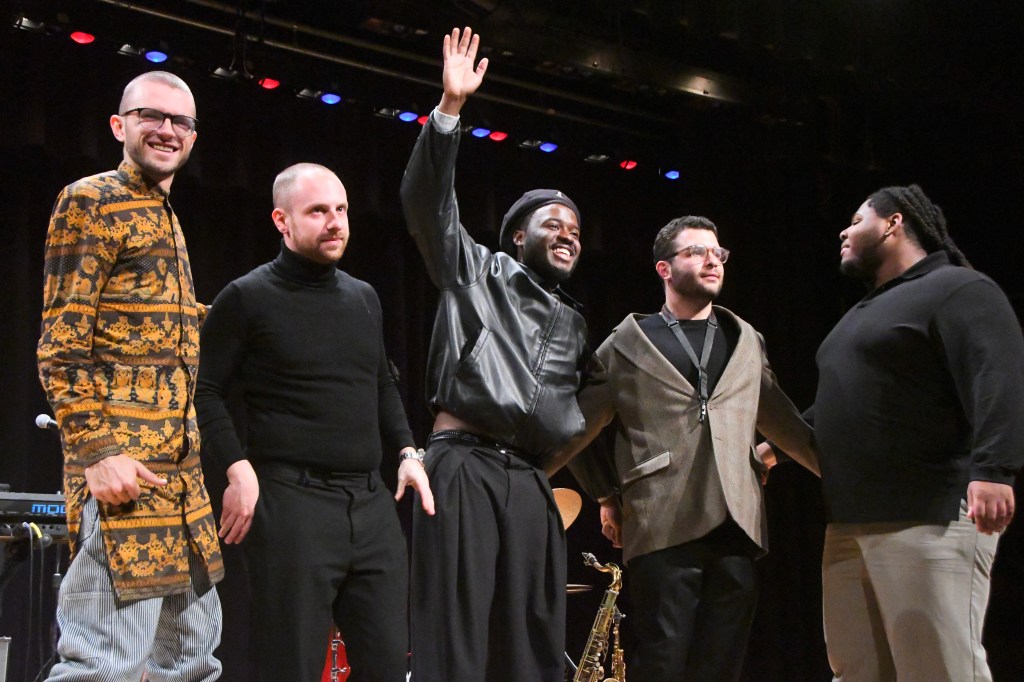
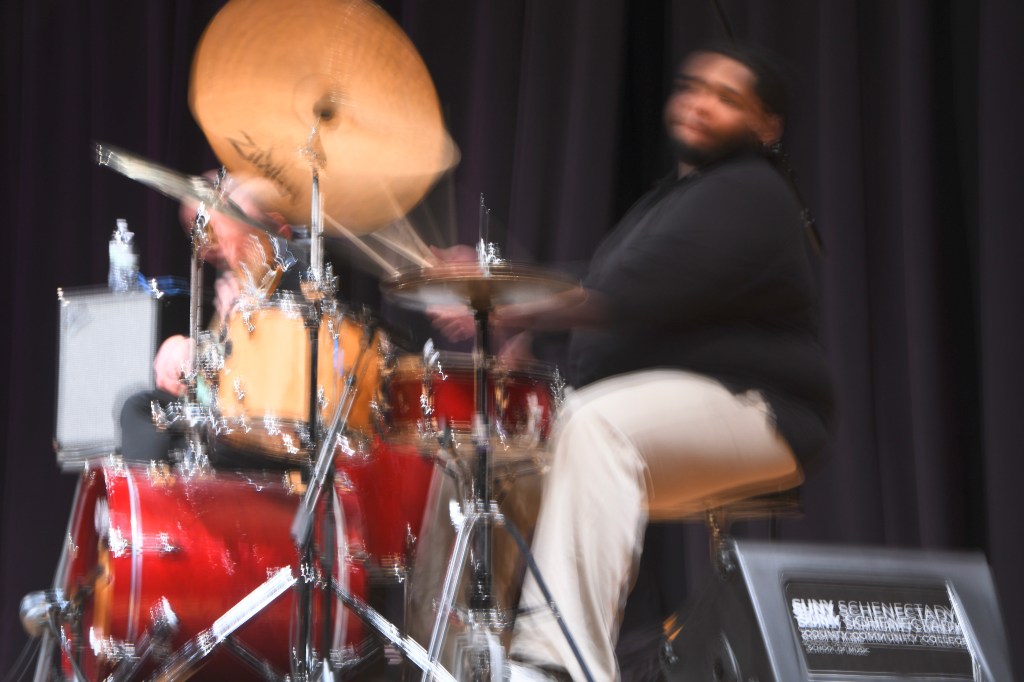
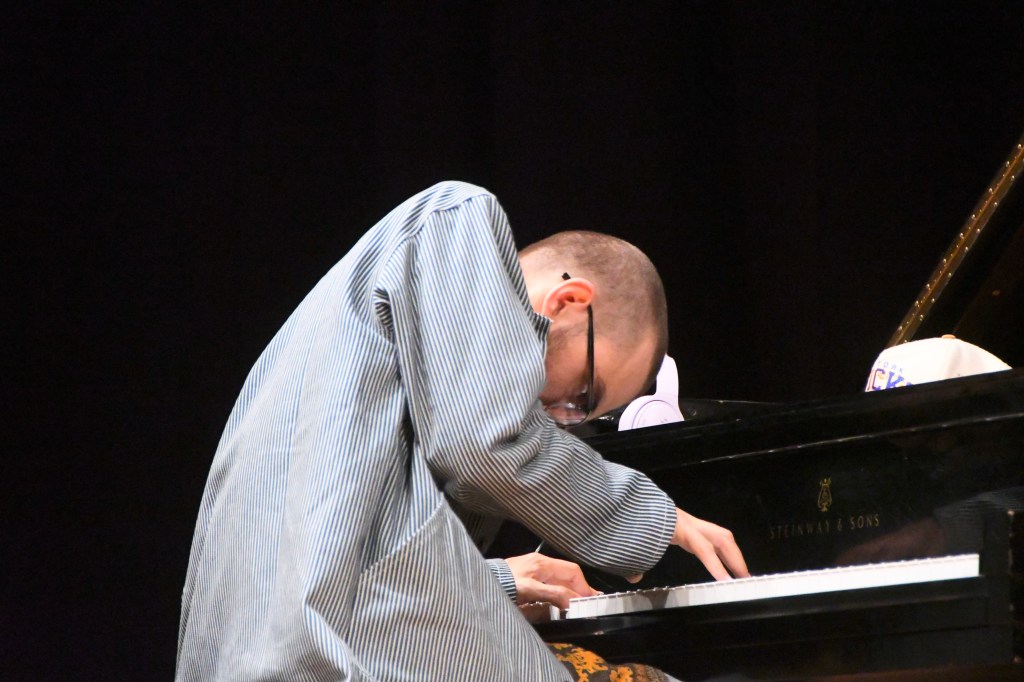
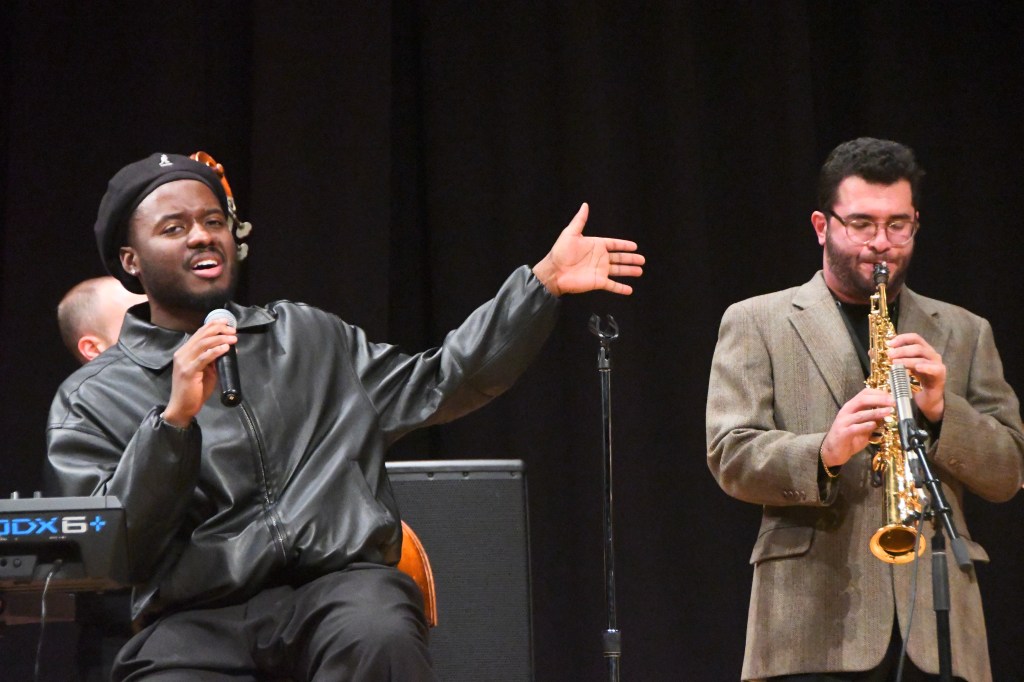
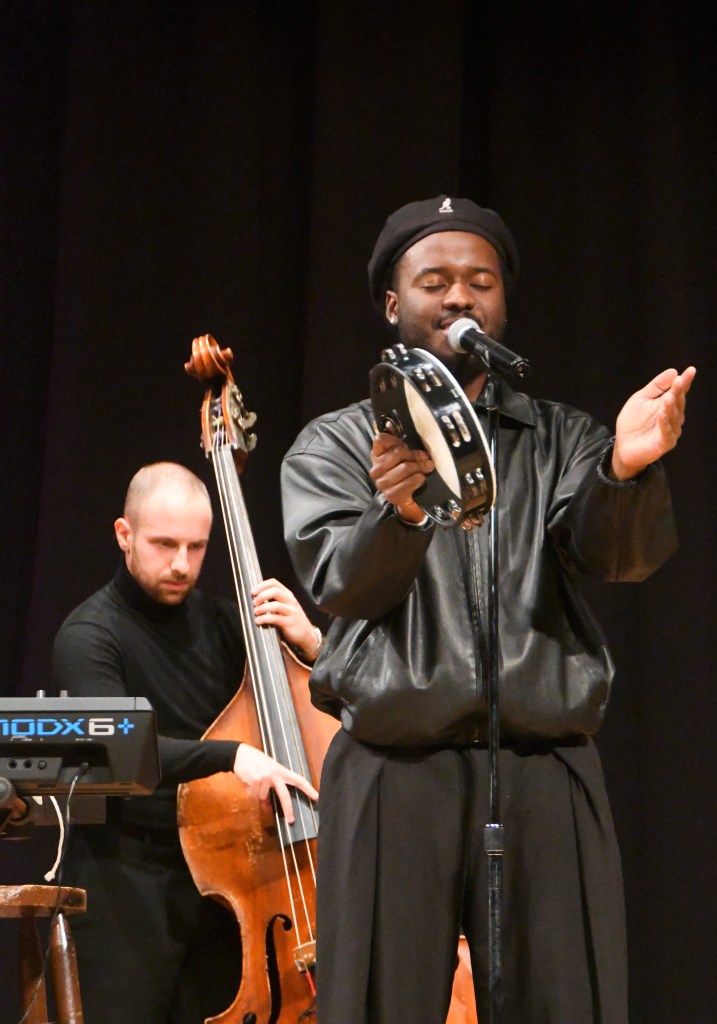
Tyreek McDole, center, with, from left: Joel Wenhardt, piano; Dan Finn, bass; Dylan Band, tenor saxophone (he also played soprano); and Gary Jones III, drums
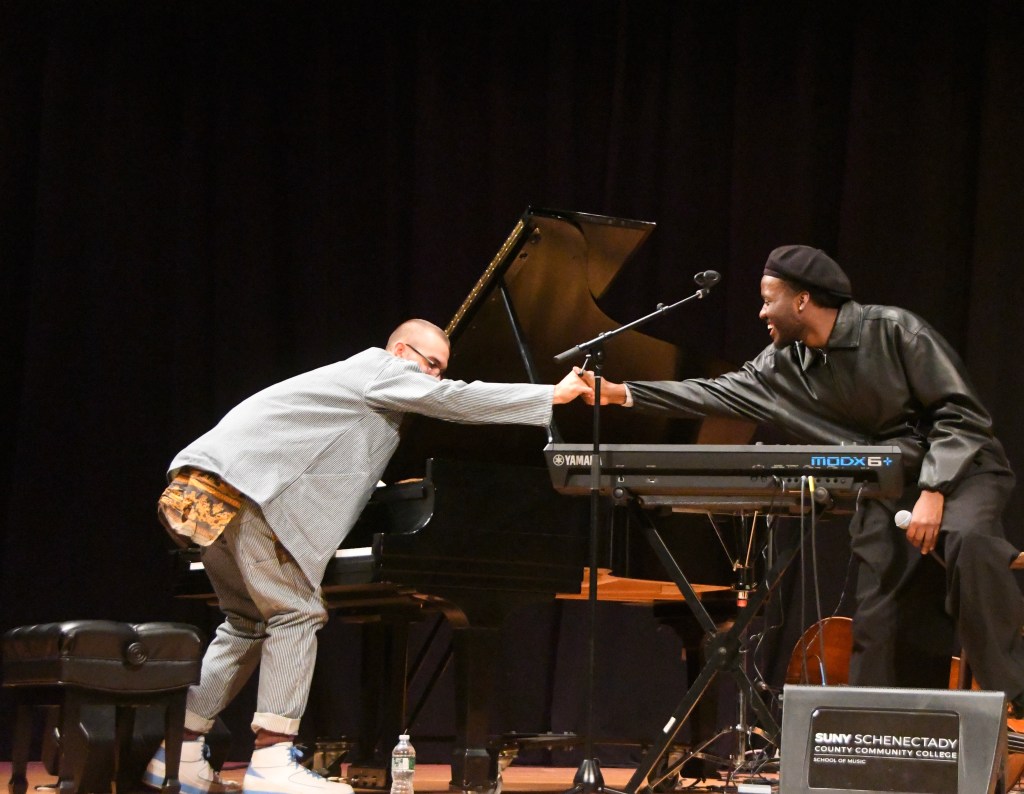
They filed onstage without a word: McDole to a synthesizer, surrounded by bassist Dan Finn, drummer Gary Jones III, saxophonist Dylan Band and pianist Joel Wenhardt; a surprise all by himself as last-minute replacement for Caelan Cardello.
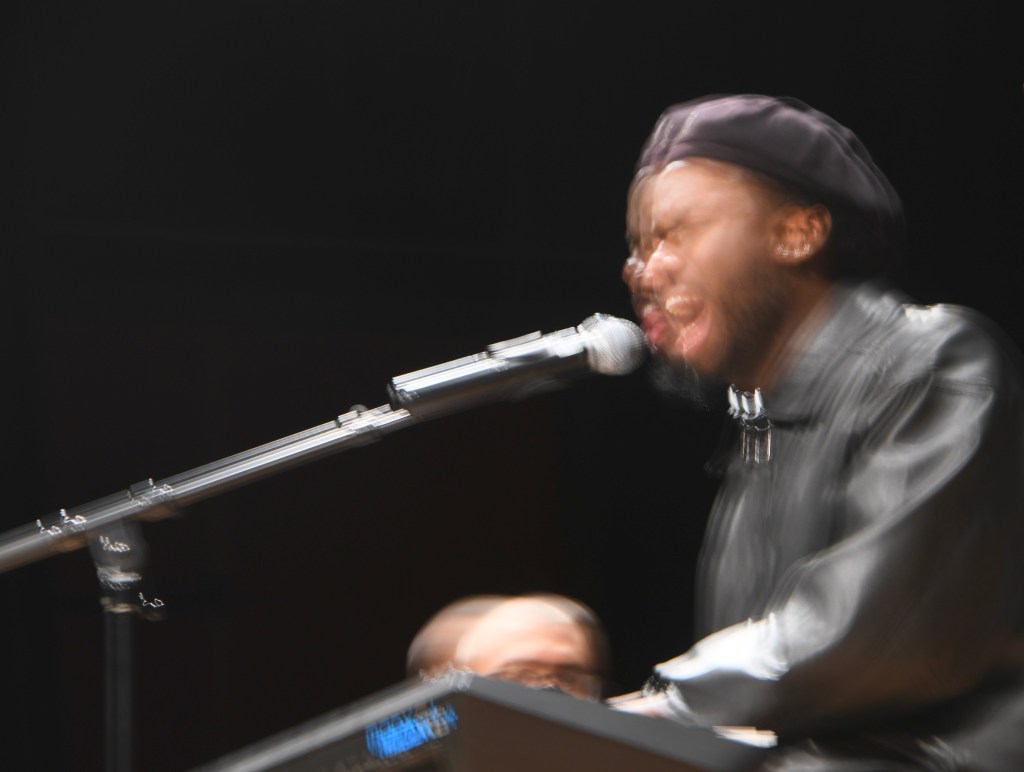
Impassive, workmanlike, McDole led into a funk vamp, at first airy and eerie, then meaty and thick in seamless waves; two-chord vamps with repeats, shifting tempos, solos pushing in, fading out.
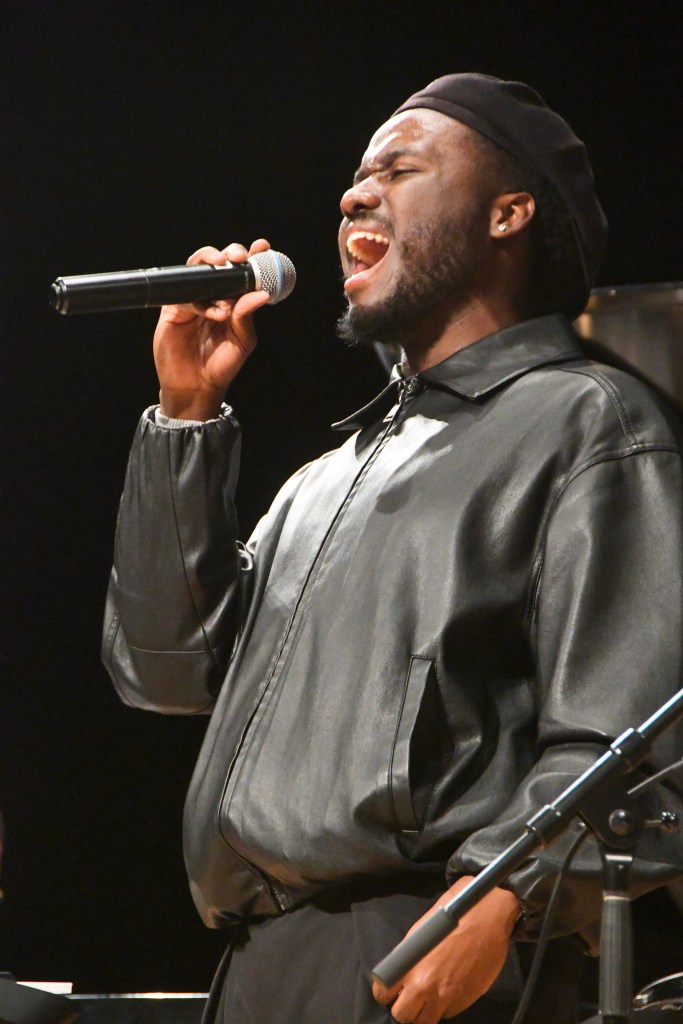
This oblique suite challenged the audience, which went right with it. Sensing they were fully onboard – big, happy, vocal, welcoming – McDole took the mic for the first time, ten minutes in, and sang “Open Up Your Senses,” title track of his debut album, with firm confidence.
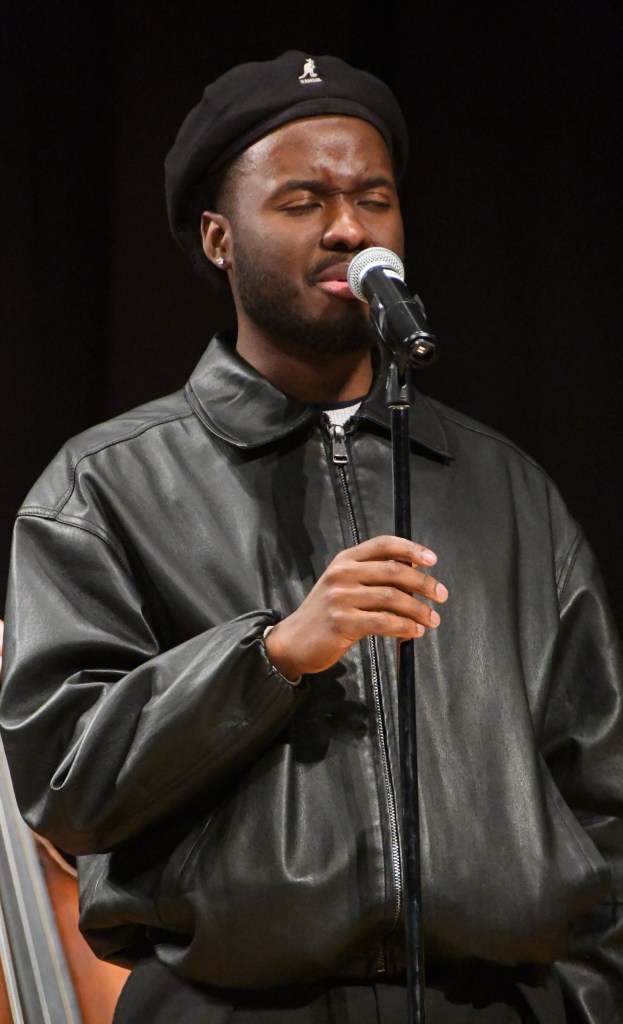
McDole’s voice proved a subtle, strong instrument, ranging from a buttery baritone with Johnny Hartman-like ease to bluesy shouts later and ethereal falsetto glides soaring sky-high. His heart powers that instrument; his music is mission-driven, idealistic.
After introducing the band as the rhythm section softly vamped and marveling that Wenhardt had learned the music in just 48 hours, McDole connected the lyric he’d just sung to the work of making a better world through open communication.
Modern master Nicholas Payton’s “The Backward Step” built from a chant-like vocal in the same pocket as Band’s soprano sax. At times breezy and Latin, like early Return to Forever, vocals subdued and calm, it grew wings as Jones’s drums fired up before a repeating-vocal coda.
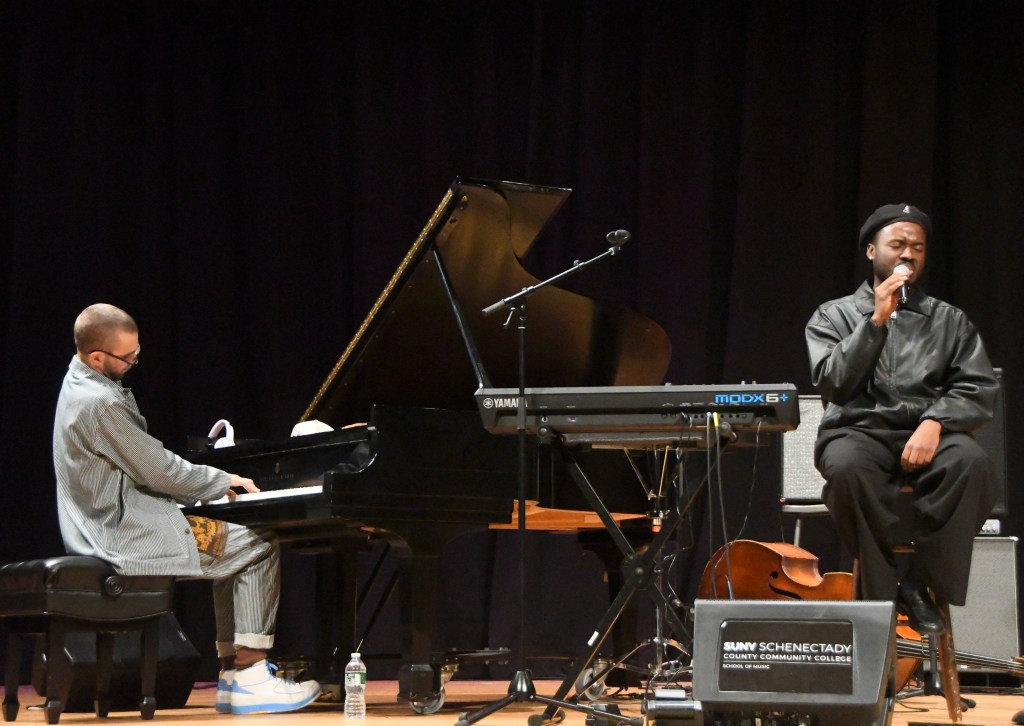
Joel Wenhardt, left, and Tyreek McDole in “Lush Life,” above; and afterward, below
“Lush Life” began with nostalgic, lacy piano, like Teddy Wilson in a dream, then burst into exuberant Harlem stride, a very different antique that seemed to rev McDole’s vocal in this strong and subtle duet. McDole introduced “Somalia Rose” as a healing expression, a waltz soft and sweet in the intro, robust and pulsating as wordless voice locked with Band’s soprano sax to thrilling effect. McDole and Band built this together, easing into a recap and light-stepping coda.
Dylan Band, soprano saxophone
McDole adopted a carnival barker’s nasal bray to announce intermission, leaving us laughing, wanting more.
Like the first set, the second came cloaked in mysterious synthesizer washes, but sweet and restrained. This grew into Herbie Hancock’s beautiful “Butterfly,” a syncopated vamp that Wenhardt’s piano and McDole’s vocal carried in tight communication, soft and lyrical.
Dan Finn, bass
Another Payton tune followed, “Jazz Is a Four-Letter Word,” though McDole expanded this from a wispy skat intro into a bustling suite, changing the lyric to “Love Is A Four-Letter Word” and glancing at Jones as a cue to rev the beat. This struck Jones like lightning, like permission to push it. Always forceful, he dug deep here. After most songs he reached out to tug back his kick-drum, pushed forward by his forceful right foot; here he had to do this during the solo. McDole led a singalong here, afterward praising the “Schenectady Gospel Choir.” Some of that Gospel feel lit up what came next.
Dan Finn, electric bass, left; and Gary Jones III, drums
Rhetorically asking permission to sing a blues, McDole absolutely detonated “Lonely Avenue.” Earthy yet heavenly, soaringly soulful, this was a knock-out. Band’s tenor sax first strolled alongside McDole’s voice, then they linked like one instrument.
Tyreek McDole, left, and Dylan Brand, tenor saxophone
Down-shifting into Tadd Dameron’s ballad “If You Could See Me Now,” they echoed that same dynamic, but softly, Band’s breathy tenor and McDole’s feathery falsetto croon linking close in the retrained easy-flow middle section before a big finish.
McDole mock-fretted he was having too much fun, then quipped the intro to “The Sun Song” was “SO Hallmark!” before aiming fleet skat runs at the ceiling to reclaim the sweet number and ignite another singalong. Then he linked tight with Band’s tenor and closed by engaging the crowd again in a happy chorus.
They left to big applause and returned, with McDole taking over Jones’s drums to hit a funk groove before confessing “I had NO business doing that!” Jones reclaimed his place after jokingly refusing to rescue McDole at first.
From left, above: Joel Wenhardt, Dan Finn, Tyreek McDole, Dylan Band and Gary Jones III; below, McDole highjacks Jones’s drums
Good choice for the encore: “Everyday I Have the Blues,” all spirit, spunk and soul.
Just as McDole had revved up Jones in “Jazz Is a Four-Letter Word,” Finn’s bass, acoustic or five-string electric, basically led the band throughout. He glance-cued new-kid Wenhardt in the transitions, locked grooves tight with Jones, laid back under vocals and sax in quiet passages and stepped on the gas to push and pull the energy. He seldom soloed, though his break in “The Sun Song” was a gem; but he didn’t have to. He co-starred, all the way.
Before this season’s final show, A Place for Jazz Board President (and WCDB and WAMC jazz DJ) Bill McCann said the longtime non-profit presenter will announce its 2026 season in a spring kick-off and membership drive concert next April 19, a centennial birthday celebration honoring the late great pianist Lee Shaw.
Preview: Tyreek McDole at A Place for Jazz; Friday, Nov. 7, 2025
Tyreek McDole closes the season at A Place For Jazz Friday, the only singer in the series and its youngest performer. His band, like all but one other artist this season, features a saxophonist.
Tyreek McDole. Photo provided
Now 25, McDole is even younger than (saxophonist!) Sarah Hanahan, 28. A Haitian-American Florida resident, McDole, like Hanahan, has gained attention in the jazz world through significant awards.
Photo provided
At just 18, McDole won as Outstanding Vocalist at the Jazz at Lincoln Centers 2018 Essentially Ellington Competition. This opened the door to collaborations with fellow emerging stars pianist Joey Alexander (22), plus young veteran trumpeters Theo Croker (40) and Maurice Brown (44); and established stars alto saxophonist Gary Bartz, bassist Rodney Whitaker, drummer Terri Lyne Carrington, trumpeter Nicholas Payton and more.
In 2023, he stepped up among such his-generation jazz vocal talents as Samara Joy, Cyrille Aimee and Lucia Gutierrez Rebolloso as winner of the Sarah Vaughan International Jazz Vocal Competition.
In addition to jazz festivals in Newport, Monterey, Marciac and Nice, he has performed in top clubs including Blue Note New York, Salle Pleyel, Nublu, Dizzy’s Jazz Club, Ronnie Scott’s, Birdland Jazz Club, Jazz at Lincoln Center, and Salle Wilfrid-Pelletier.
Like Hanahan, his debut album won Downbeat magazine respect; “Open Up Your Senses” earned four stars there, plus No. 1 honors in Jazz Week.
Caelan Cardello. Michael Hochanadel photos
McDole sings Friday with pianist Caelan Cardello who played AP4J with Hanahan Oct. 3, saxophonist Dylan Band (not to be confused with Bob Dylan’s band…), bassist Daniel Finn, and drummer Gary Jones III. During her set, Hanahan announced Cardello’s return with McDole, suggesting the singer might not cut the pianist as loose to solo as she does. We’ll see…
In this AP4J season of saxophones, only guitarist Peter Bernstein’s band lacked a saxophone player while the quartets of David Murray (Sept. 5) and Sarah Hanahan starred saxophonists in the lead role and Leo Russo’s Sextet (Oct. 17) featured two, both leader Leo and his son Lee.
McDole sings Friday at 7:30 p.m. at A Place for Jazz in the Carl B. Taylor Auditorium, SUNY Schenectady County Community College music department. $25 www.aplaceforjazz.org
Review: “Ms. Music: Jackie Alper – Her Story” at the Eighth Step at Proctors GE Theatre; Saturday, Nov. 1, 2025
Andy Spence, at left, conducts the ensemble
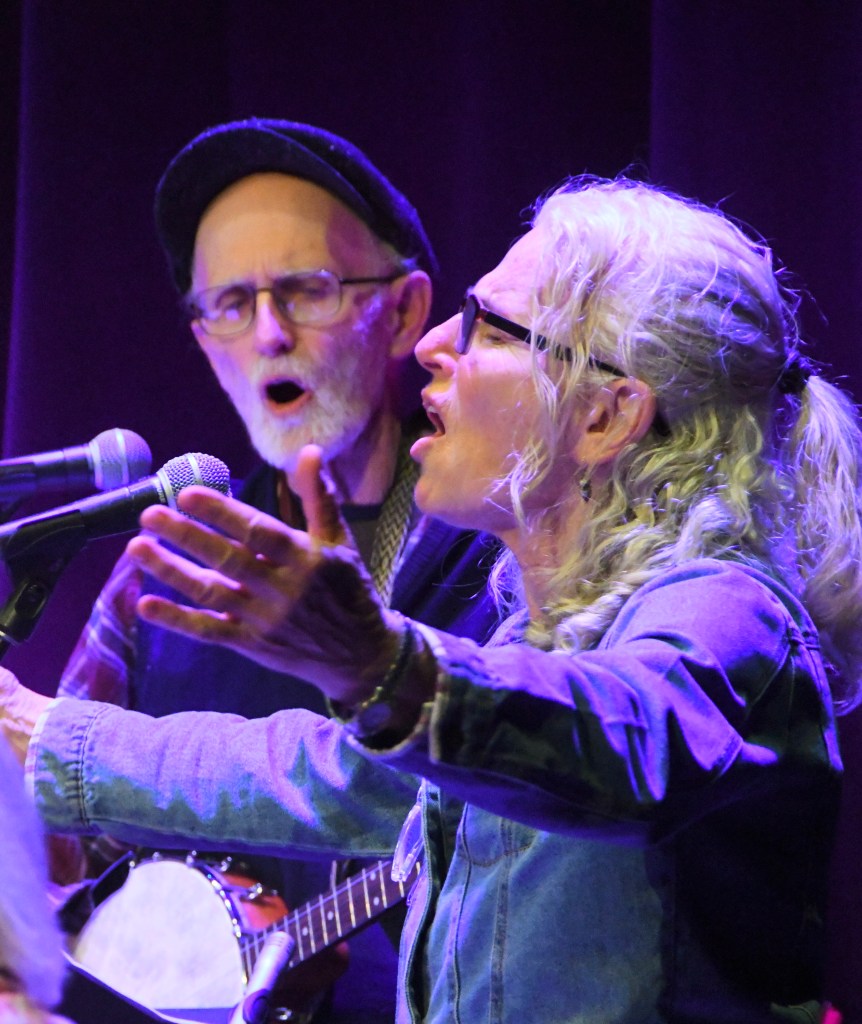
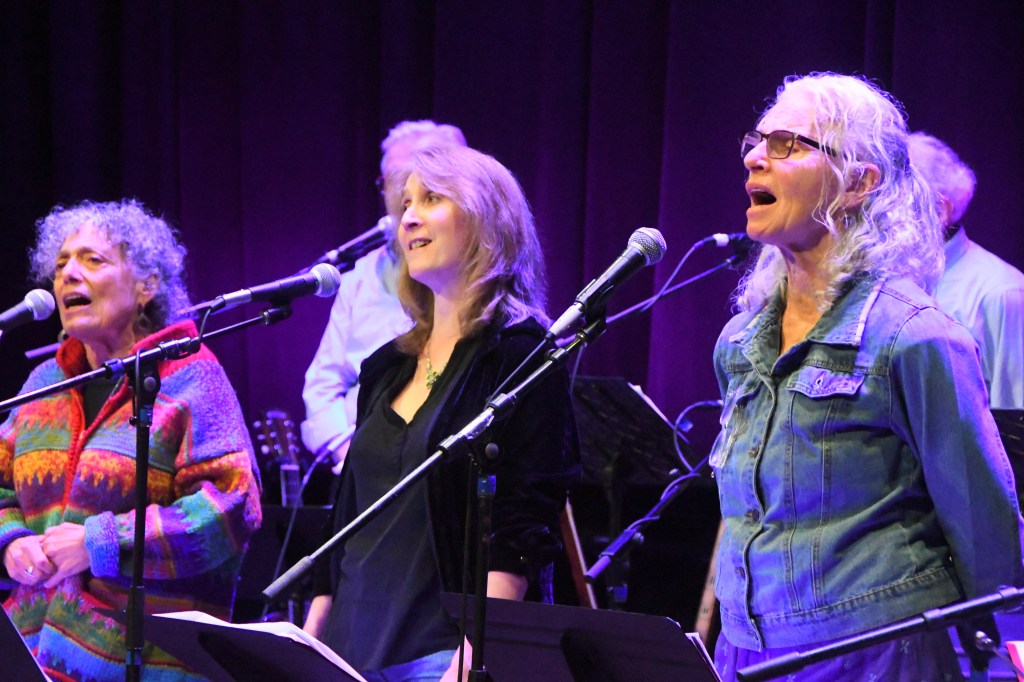
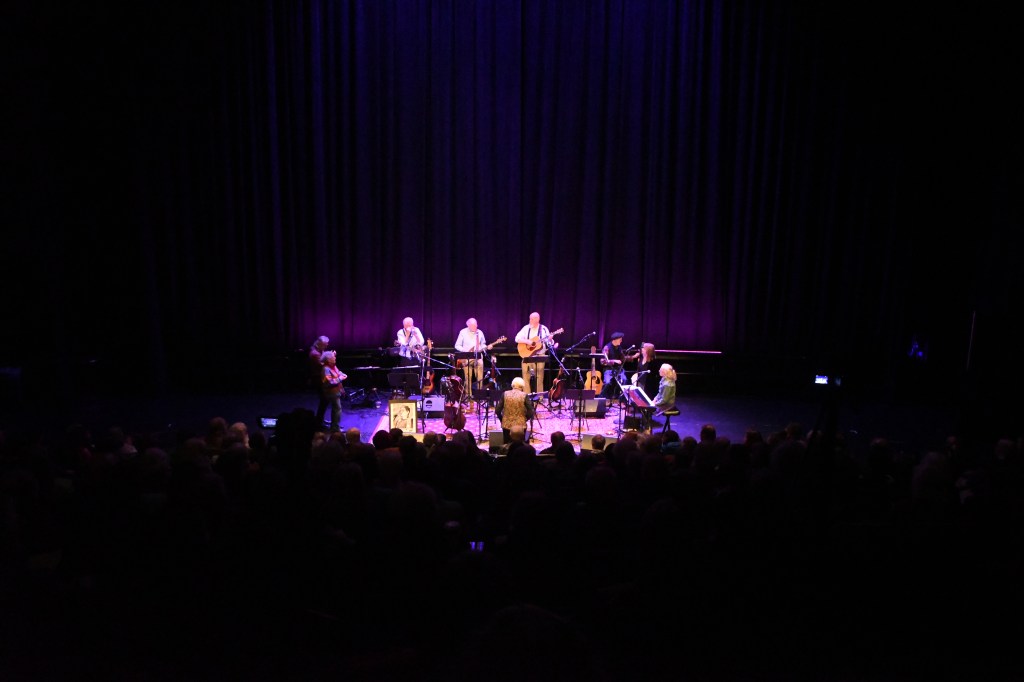
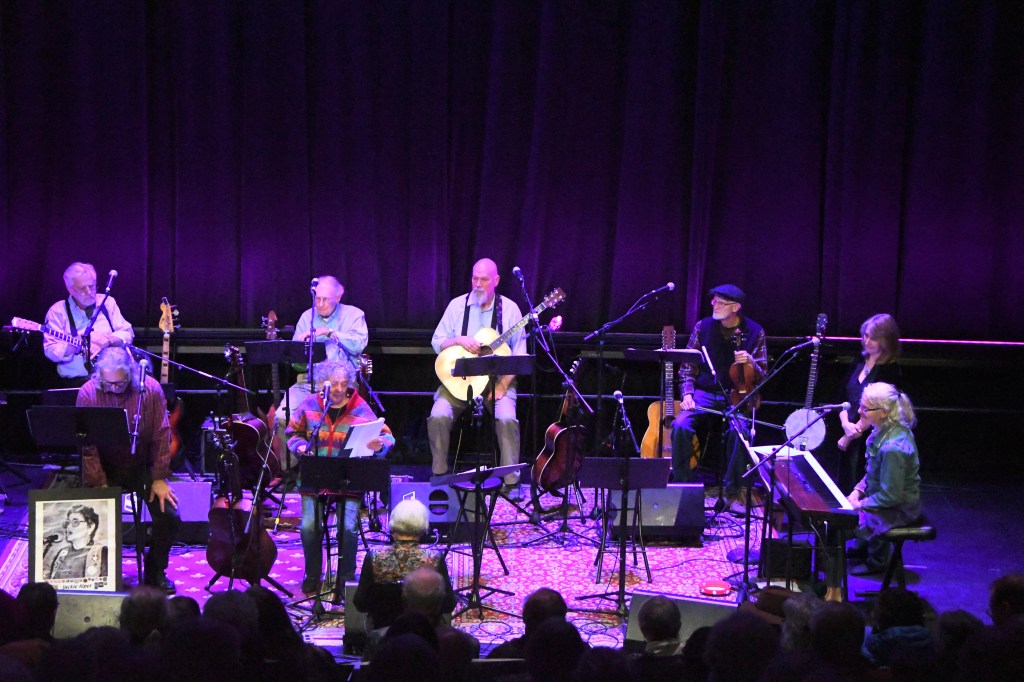
Spirits of folk heroes hovered over the Eighth Step stage Saturday – Woody Guthrie, Pete Seeger, Leadbelly, Ronnie Gilbert, Nina Simone, Utah Phillips – all friends of the late, great Jackie Alper. Nine area musicians honored Alper, our own folk-music Forrest Gump, as Eighth Step host-impresario Margie Rosenkranz describes her. A forest of microphones and instruments, the stage looked like a music store; facing them out front sat Andy Spence like the conductor she was Saturday. Spence and Sarah Dillon wrote the the two-part tribute in songs and stories, working since January through books, interviews and song research.
Margie Rosenkranz
It held together wonderfully well; though some singers sounded stronger than others, some players, too. But it all felt strong in the spirit of the much-loved and admired singer, activist and radio voice.
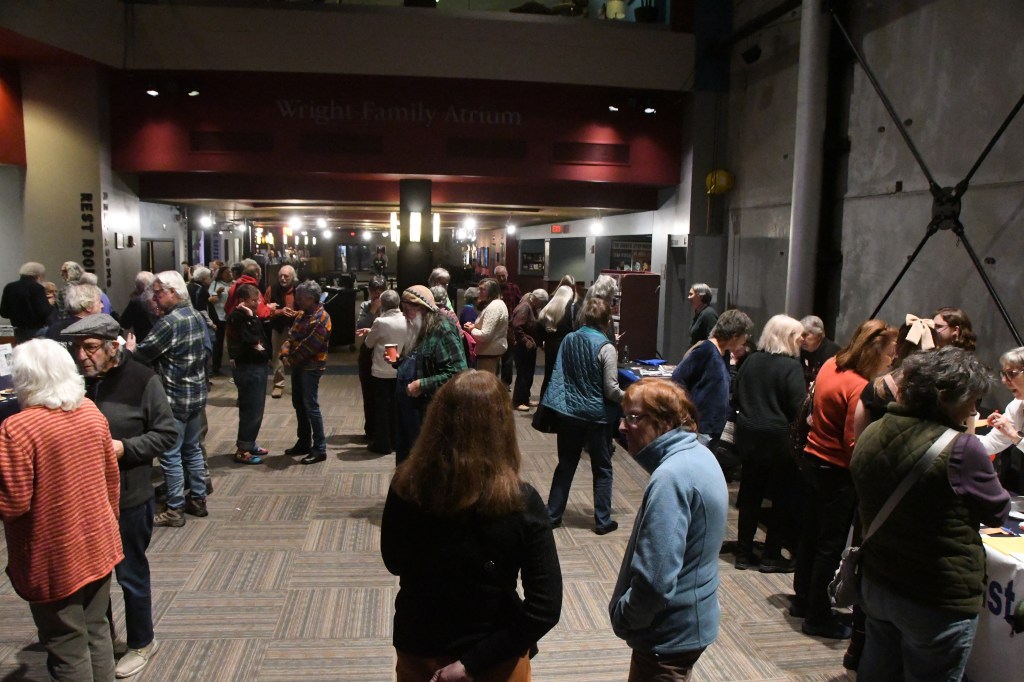
Nearly-packed – as it was during the Step’s 2007 Alper memorial – the place had the easy warmth of a family reunion; some hadn’t seen each other since Alper died. Part hootenanny, part progressive issues rally, part hero tribute, it felt both universal in its message and personal in its delivery as the performers brought themselves, fully. Rosenkranz called it “a gathering of the clan.”
As Spence told me last week, the two-part tribute sketched Alper’s life in her own words that Ruth Pelham collected in a 2000 interview, plus published recollections by Seeger, Gilbert and a dozen other sources, notably Alper’s son George. Previously committed elsewhere, he couldn’t attend.
First-set narration sketched Alper’s long life, launched in an impoverished New York City childhood that powered her contributions to both social movements and music. Pelham recited recollections in Alper’s own words; Greg Giorgio framed them in history: the Depression, WWII, the “red-scare.” Alper declined the star-making opportunity to join the Weavers to work in legal defense of progressive activists.
Songs fit and filled out this framework; Pelham delivering “The Greenhorn Cousin,” written by Alper’s father Jacob Leiserowitz, with very old-New York flavor and Kate Blaine’s bluesy “Frankie and Johnny” providing rootsy-period flavor. Union organizing songs dominated, however, Blaine strong in “Union Maid” and Toby Stover challenging anyone on the fence between boss and workers with “Which Side Are You On.” Narration painted all this in very Jackie terms: When a paddy wagon took her away from a demonstration, her mother yelled, “At least I know where you’ll be tonight,” a night when Jackie took up cigarette smoking in jail.
Kate Blain, above; Toby Stover, below, George Wilson, background
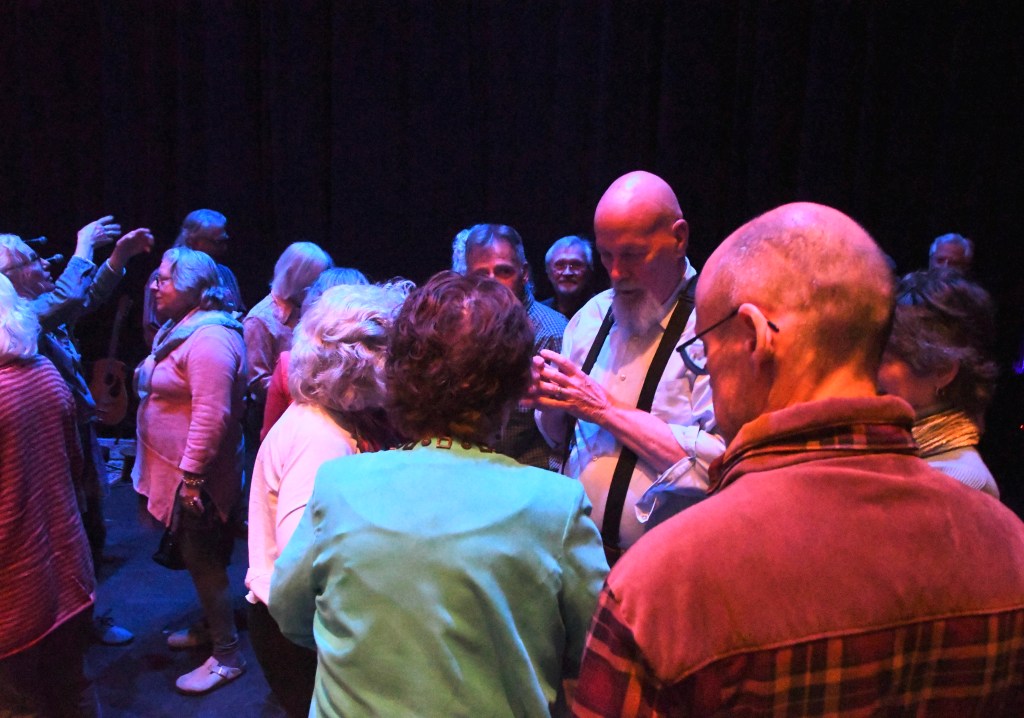
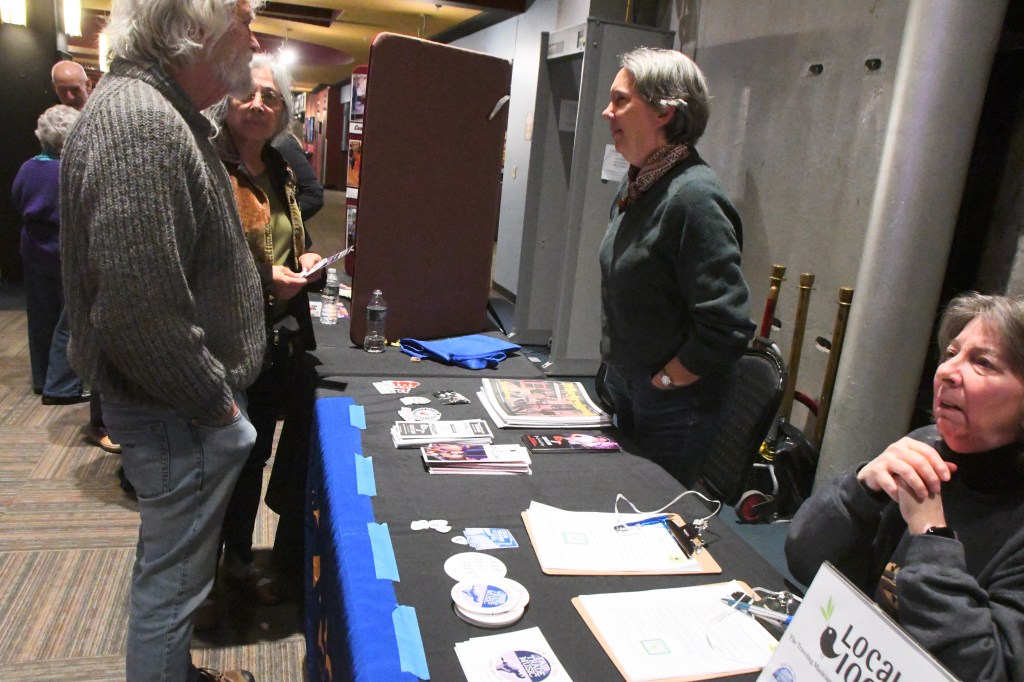
At intermission, the performers smiled their way into the dressing room, happy laughter audible in the theatre as fans greeted each other on the stage in a happy schmooze. In the lobby, activists staffed tables full of signs, brochures, stickers and buttons.
As Spence explained in an interview last week, she built the second set on the principles Alper’s buttons proclaimed. Some wear their hearts on their sleeves, maybe; but Alper proclaimed them in buttons crowded onto her vest.
Spence cleverly built the narration and music around these messages, as performers periodically popped up in a whack-a-mole relay of principle, reciting a button each, then sitting as another performer intoned another button. This amused, enlightened and punctuated song and story sequences that – like the first-set songs – used blues or pop songs to punctuate activist material.
Stover demonstrated the folk process in “Round & Round Hitler’s Grave,” setting scornful messages by Guthrie, Seeger and Lampell to “Old Joe Clark.” Blues by Sonny Terry & Brownie McGee and Leadbelly, and “Old Jim Crow” – which Alper wrote with jazz-blues giant Nina Simone – were more than entertaining period pieces; the singers clearly meant them from the heart.
Ruth Pelham, Kate Blain, and Toby Stover
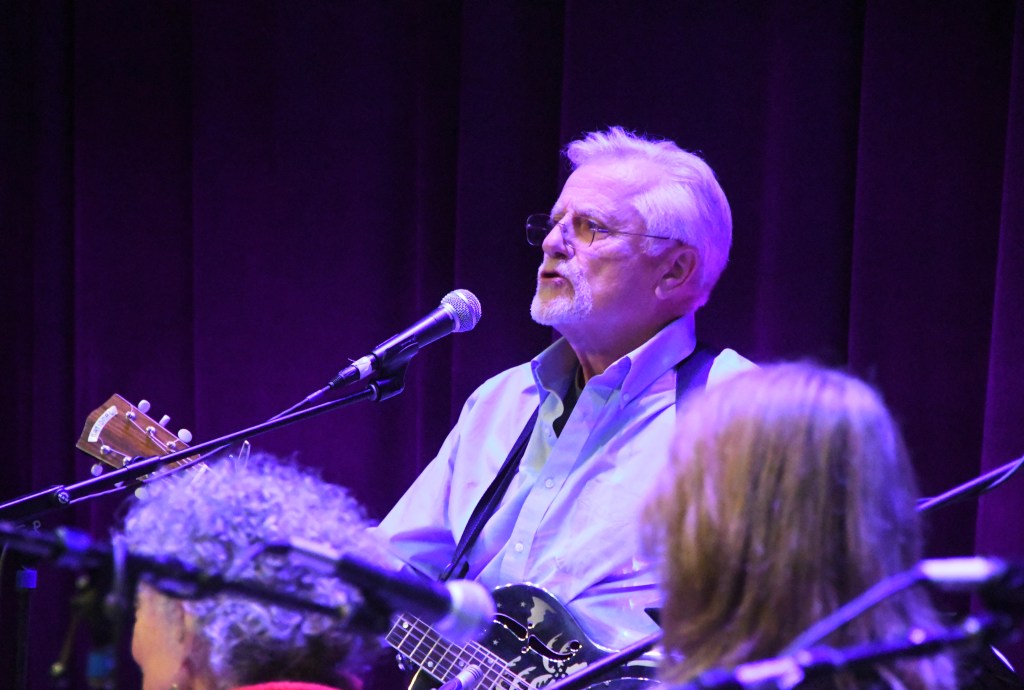
But nothing else in the show packed the punch of “Singing for Our Lives,” written by Holly Near and sung at first in close harmony by Stover, Pelham and Blain. When the men joined in – fiddler/banjoist/12-string guitar player George Wilson, guitarist/dobro player Michael Slik, bassists/guitarists Howard Jack and Charlie Rhynhart, singer/narrator Greg Giorgio and pianist Alan Thomson – this grew wings, a mighty chorus.
George Wilson, above; Michael Slik, below
Howard Jack, above; Charlie Rhynhart, below; Kate Blain, foreground
Charlie Rynhart
Alan Thomson, foreground
The men took their turn in the life-summing-up “Starlight on the Rails” before Pelham summed up Alper’s later life, fighting Lewy Body Dementia while advocating for staff in her nursing home. Pelham sang Malvina Reynolds’s “Magic Penny” as compassion and love in song.
To choose the evening’s single, brightest star, it would be Pelham who sang and spoke in compelling conviction and read the crowd beautifully. When she heaped scorn on “red-scare” bullies McCarthy, Nixon and Roy Cohn – mentor of a certain amoral real-estate swindler – she looked up as boos filled the room. Then she repeated Cohn’s name to more ridicule.
The rousing closer “If I Had a Hammer” united all the voices and as Spence rang on cue the bell that lay at her feet throughout. More laughs, then a standing ovation.
Without leaving and after a short consultation, they encored in a strong repeat of “Solidarity Forever” to the familiar tune of “John Brown’s Body.”
This was a family reunion, a hootenanny, a progressive-issues rally, a hero tribute, “a gathering of the clan” – a clan including leaders and fans of the Eighth Step, Caffe Lena, Old Songs, and WRPI; institutions Jackie Alper supported and that hold her memory close.
The Songs and who Sang Them – From Spence’s program
ACT ONE
Come and Go with Me Howard
On the Picket Line Ruth
Frankie and Johnny Kate
There is Power in the Union Charlie
Brother, can you spare a dimeMichael
Talking UnionGeorge
Di Grine Kuzine (The Greenhorn Cousin) Ruth
Solidarity Forever Howard
Union Maid Kate
ALMANAC MEDLEY (Jackie was a member of the Almanac Singers, a predecessor of the Weavers, and the Priority Ramblers, likewise.)
Union Train George
Which Side Are You On? Toby
Get thee behind me, Satan George
ACT TWO
I Never Will Marry Kate & Toby
I’m a-looking for Home George
Round and Round Hitler’s Grave Toby
Overtime Pay Alan
Walk’n My Blues Away Charlie
How Long Blues George
Reuben James Michael
Wasn’t That a Time? Howard, Toby, Ruth
Good Night Irene George & Ruth
Old Jim Crow Toby
Waist Deep in the Big Muddy George
Singing for our Lives Toby, Ruth, Kate
Starlight on the Rails Howard, Charlie, Michael
Magic Penny Ruth
If I Had a Hammer Howard et al
Solidarity Forever Everybody
Spence’s Acknowledgements
Special thanks to Margie Rosenkranz, who encouraged me to do this project.
Thanks to all the folks who shared their knowledge of Jackie, especially her son, George Alper and her local friends Mabel & Ruth. Thanks to Ruth Pelham, Kevin Roberts, Michael Eck, Alan Thomson, Don Person, Greg Georgio, Sarah Dillon and Marsha Lazarus and Kathleen O’Conner for their memories.
Andy Spence, foreground, with Greg Giorgio
Credits
Producer & Director: Andy Spence
Writing and Script Editor: Sarah Dillon
Interview with Jackie in 2000 by Ruth Pelham
Program: Dan Roesser
Tabling in the Lobby
Performer photos by Joe Alper, Jackie’s husband
Sarah Craig, standing, of Caffe Lena, tabling in the lobby
Ruth Pelham sings atop a stool, with Alan Thomson, left, and George Wilson
Eighth Step board member Ed Guider urges membership support for Caffe Lena, Old Songs and the Eighth Step





































 Hoke's Jukebox