

Preview: “Ms. Music: The Jackie Alper Story” at the Eighth Step at Proctor’s GE Theatre, Saturday, Nov. 1, 2025
How to distill a long, musically and politically active, admired and heroic life into a words and music show shorter than a season-long TV mini-series?
Saturday’s Eighth Step premiere of “Ms. Music: The Jackie Alper Story” represents the triumph in a shared struggle by two leaders of the folk community who’d worked for decades with the activist, singer, radio host and guiding spirit.
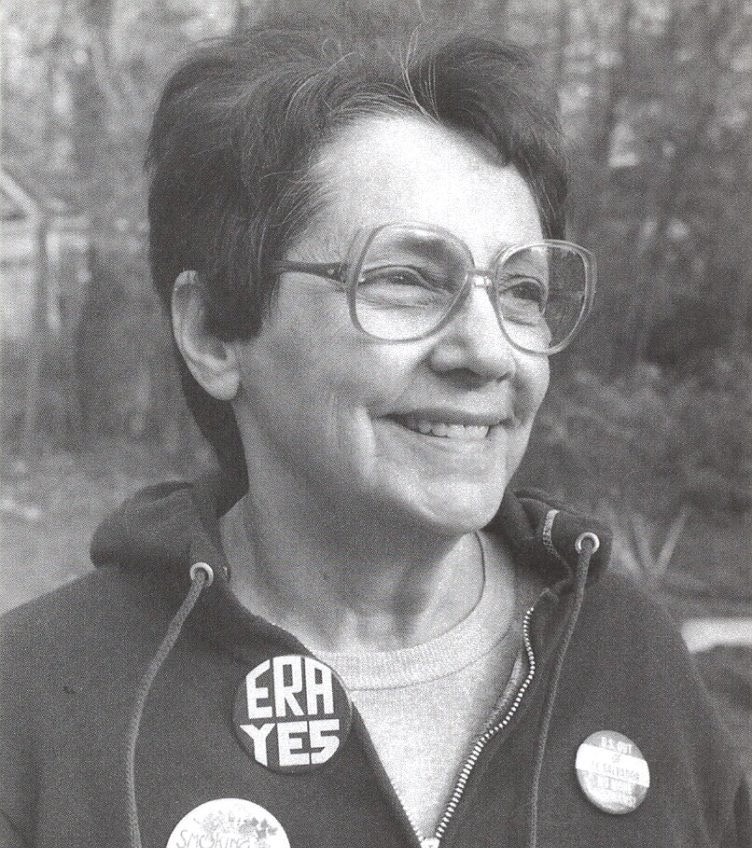
Jackie Alper. Photo provided
“I’ve had a terrible time writing about this, terrible,” lamented Eighth Step impresario Margie Rosenkranz, who’s presenting the show Saturday at the Eighth Step at Proctors GE Theatre. “Jackie was the Forrest Gump of the folk world; she was in all the hot places.”
“In the research of this show, I learned way too much,” agreed Spence, now-retired chief of Old Songs and partner with Sarah Dillon in the year-long writing of what she calls a folk musical. “She was a friend to all of us and she helped all the folk organizations in the area,” said Spence. “She pointed the way, how to think about how music effects peoples’ lives.”
“We talked about Jackie all the time,” said Rosenkranz of co-launching the project with Spence. “Andy and Sarah Dillon picked up the ball when I went to do my (Eighth Step fall and winter) season,” now underway through December.
In the show’s program booklet, Spence cites eight source books including by Weavers Pete Seeger and Ronnie Gilbert, plus others about Seeger and Woody Guthrie, and Scott Alarik’s posthumous Jackie tribute in Sing Out magazine. Spence also acknowledges 11 interview sources including Jackie’s son George and many musicians, notably Ruth Pelham whose interview with Jackie provided the narrative structure for the first act of the two-part show. Those segments are prefaced as “in Jackie’s words.”
Guided by Buttons of Belief
Spence found her path through too much information in the button collection Jackie wore on her vest. Those buttons told “what she believed in,” Spence explained. In the program’s second half, “We tried to put in the things that she wore on her buttons.” As Rosenkranz notes in the concert news release, they include “War is not the Answer,” “Peace Through Music,” “If You’re not outraged You’re Not Paying Attention,” “My Karma Ran Over My Dogma” and “Buttons are Not Enough.”
The program cover shows Greg Artzner’s button collection that paralleled Jackie’s, with messages supporting peace, justice, love and community.
The program lists songs the cast of nine will perform, expressing those values, plus the choruses for each so all can sing along. They’ll sing gospel, blues and folk, including “Old Jim Crow” which Jackie co-wrote with jazz giant Nina Simone.
“This kind of music and singing brings people together,” said Spence. “What I’m hoping is that we have a swelling of pride in this country…and we can survive this,” she said, noting current political and social strife.
Hard Times, Saved by Song
Jackie lived through similarly troubled times: the Great Depression, WWII, the 1950s red scare/McCarthy-ism and the 1960s folk-scare that was largely a progressives’ reaction.
Fellow folksinger Paul Robeson was a Greenwich Village grammar school classmate and sang at the infamous Peekskill riots years later when KKK thugs attacked a free folk concert, throwing stones at their bus as they fled. Pete Seeger told me that afterward, “I combed the broken glass out of my children’s hair.” Rosenkranz said, “He also picked up one of the stones they were throwing and built his hearth around it” in his hand-built Beacon home. Laughing, she added, “Isn’t that just vintage Pete?”
Between growing up in New York and arriving in Schenectady with husband Joe in 1950, Jackie sang with the Almanac Singers with Woody Guthrie and other folk revival pioneers, and with the equally progressive Priority Ramblers while working with folklorist Alan Lomax in the Office of War Information in Washington during WWII. Returning to New York, she presented concerts by Guthrie, Seeger, Leadbelly and more through People’s Songs. Their fees, Spence found: $15 a concert. “Ms. Music” features songs by all these giants.
A Weaver, for a Time
Jackie was in the original lineup of breakthrough folk stars the Weavers before returning to DC to organize the legal defense of artists and activists the McCarthy Hearings targeted in the “red scare” days. She nominated her friend and room-mate Ronnie Gilbert, whose contralto voice resembled Jackie’s, to replace her after just one concert; and moved to Schenectady when typesetter husband Joe left his printing career in New York to become a photographer, risking this life change after a deadly diagnosis of kidney disease.
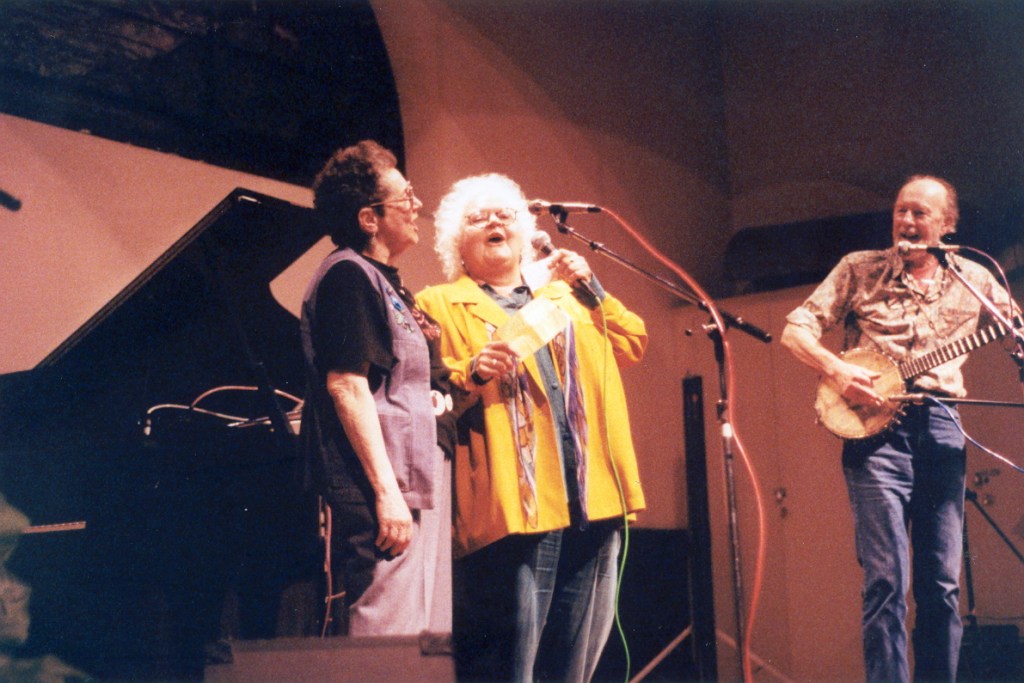
Jackie Alper, Ronnie Gilbert and Pete Seeger at Jackie’s 1994 retirement celebration at the Eighth Step. Photo provided
In 1960, Joe and Jackie met Bob Dylan at the newly opened Caffe Lena; one of many folk and jazz stars he’d photograph for publications and record companies. (See Photo Pass, below.) Meanwhile Jackie began volunteering in area folk venues the Eighth Step and Old Songs as well as Caffe Lena, serving on their boards. She also hosted “Mostly Folk” on WRPI for 23 years; when she retired in 1994, Seeger played her retirement celebration at the Eighth Step.
Rosenkranz said longtime folk artist and booking agent David Tamulevich, who played the Eighth Step recently, agreed that “this region is, if not the most active folk music community in the country, it was then.” When Jackie was on WRPI every week, “Jackie had an enormous amount to do with that,” Rosenkranz added.

Friends in Song, from left: Ruth Pelham, Jackie Alper, Ronnie Gilbert, Jacke’s daughter Jaye, and (partly obscured) Margie Rosenkranz – all singing at the original Eighth Step on Willett St. in Albany. Photo provided
Active in all directions during that time, Jackie fostered artists both established and just emerging while also working for Schenectady City Schools and managing Joe’s photo archives after his too-early death. Spence said, “The whole second half (from 1950 to her death in 2007) was tough to write…because we knew how many (artists) she liked,” and whose music is in the show.
Rosenkranz supported Jackie in her long decline with Lewy Body Dementia, just as Jackie visited Lena Spencer of Caffe Lena and read to her in the hospital after the fall that ultimately took Lena’s life. And just as Jackie was widely known as “the fifth Weaver,” she joked that Rosenkranz was her fourth child, after son George and daughters Jaye and Jeri, the latter two now deceased.
Packed with Tunes
Songs outlive their makers and good songs stay good; and “Ms. Music: The Jackie Alper Story” is packed with tunes. The first half is framed by Ruth Pelham’s invaluable 2000 interview and the second by the ideals that inspired Jackie’s decades of creativity and activism, non-stop work that earned her 2024 induction into the Thomas Edison (“Eddies”) Hall of Fame.
The cast of “Ms. Music: The Jackie Alper Story” are all veteran area artists; most played in Andy Spence’s previous “folk musicals”(See Folk Musicals, below) – Kate Blain, vocals; Greg Griorgio, vocals and narration; Howard Jack, bass and vocals; Ruth Pelham, guitar, vocals and narration; Charlie Rhynhart, guitar, bass and vocals, Michael Slik, dobro, steel guitar and vocals; Toby Stover, keyboards, percussion and vocals; Allen Thomson, keyboards and vocals; and George Wilson, fiddle, banjo and 12-string guitar and vocals.
Show time 7:30, doors 7. $26 adv., $28 on Saturday, $40 front and center. 518-346-6204 www.8thstep.org
BACKSTAGE PASS
Backstage at a Peter, Paul & Mary concert at Saratoga Performing Arts Center, I mentioned to Mary Travers that Jackie was there, waiting at the loading dock area with other fans hoping to meet the stars.
Mary jumped up, asked “Where?” and took my hand. We swept along a long hallway from the dressing room to where fans waited. Mary was a majestic, rapid-rolling presence so I felt like the engineer of a freight train, moving fast, as we approached the fan throng. When we got to Jackie, Mary dropped my hand and I basically disappeared as she took up Jackie in a warm hug and they reminisced about being Village neighbors.
PHOTO PASS
My friend George Alper, Jackie’s son, once offered to share some family snaps. I knew George’s late father Joe Alper had been a photographer so I said, “Sure, what have you got?” He handed me contact sheets one at a time, each a single print collecting an entire roll of 35 mm black and white negatives in tight rows. One showed George, about five years old, in his pajamas, building a castle of blocks on the floor…with Bob Dylan.
When Dylan came to Schenectady and Saratoga Springs for his first gigs outside the Village, he couldn’t afford a hotel after his Caffe Lena debut, so Jackie and Joe put him up at their place along with his girlfriend Suze Rotolo. They’re shown walking in the snow together in the Village on the album cover of “The Freewheeling Bob Dylan.”) The Alpers welcomed Dylan and Rotolo to their home at 1620 Brandywine Ave., half a mile from where I now sit; a building we in my family revere by bowing to it whenever we drive past.
FOLK MUSICALS
Andy Spence pioneered the words and music format that shapes “Ms. Music: The Jackie Alper Story.” Her first such effort, “The Visitors – the history, music and songs of the Adirondacks” (2009) featured story-teller/poet Joe Bruchac, troubadour Dan Berggren and others. Spence followed with “The Civil War: A Musical Journey” (2012), her first with narration. Her “Down with the Rent: The Anti-Rent Rebellion of New York State” (2014) inspired UAlbany professor Nancy Newman’s “Songs and Sounds of the Anti-Rent Movement in Upstate New York,” recently published by SUNY Press. Then came Spence’s “Forward Into Light: The American Women’s Suffrage Movement in New York State in Song & Story” (2017), and its shortened version “New York Women: Singing for Suffrage” (2017), and “The Remarkable, Irresistible Erie: Snapshots & Voices” (2023).
 Hoke's Jukebox