
Alternate Title: Almost Famous
I walked into the Open Door book shop on Schenectady’s Jay Street a few weeks ago, a favorite destination where I’ve found many cherished books and one lover, ditto.
Decades ago and half a block south, Stereo Sound (now Orion) sold audio gear on the first floor, admin stuff happened on the second and Kite arts weekly was published on the third; first pub to run my stories. (Thanks, Don Wilcock, my first editor.) When I came back after six years mostly away – two years in a not-very-good college, four overseas in the Navy – almost everybody I knew in town worked there.
Across the street, the Jay Tavern (now Ambition) made big sandwiches, but proprietor Ed Karwan grumbled about longhairs filling the red-seated booths of the narrow, dark saloon. Some doors away, Hy Sofer’s deli sold big sandwiches, too. Whatever you ordered, even if it were lunch for 400, Hy would up-sell, asking, “And, vhat else?”
The New World Theater staged plays upstairs from an exotic boutique; and nearby Joe Holloway founded the first health food store in town, Earthly Delights. My friend Mary Swatt ran it for years thereafter.
Back when you could still drive down it, Jay Street was a charming one-block hippie enclave that’s changed a lot. Except to grow larger, the Open Door fortunately hasn’t. Thank you, Betty Fleming, then Janet Hutchinson.
I walked in a few weeks ago to pick up a book I’d ordered for Ellie, my intrepid traveler wife. In April, she took an icebreaker cruise around Greenland, gifted by a generous friend. Then I heard about a novel called “The White Bear” set in tiny Inuit villages along its rocky, ice-rimed coast.
As I paid, my friend Lily came from the back to stock books on reserve in the shelves behind the register. She had worked at the Gazette part of the time I did, too; but had been at the Open Door for years.
She asked, “Have you read Dennis McNally’s new book yet?”
I told her I hadn’t, and she said her husband George had just read and loved it. “He says you’re in it.”
“What?! Do you have a copy here?”
She went to the display shelves and brought back this:

I found my name in the index, turned to page 315 and found myself described and quoted.
You know: almost famous.
The first time I saw the name Dennis McNally was on a book spine. His “Desolate Angel: The Beat Generation & America” (1979) is a well-researched and highly readable biography of Jack Kerouac. Expanded for publication from his Ph.D. thesis in history at UMass, and based on secondary sources rather than interviews with the principals, it would have felt scholarly and stiff if McNally hadn’t been such an adroit and vivid prose stylist. It reads as fun as much as information.
Grateful Dead guitarist-singer-symbol Jerry Garcia also admired McNally’s Kerouac bio and hired him to write the Dead’s biography. When they realized they needed a full-time publicist, Garcia said, “McNally can do it.” He did, for busy decades, his bio book set aside.
When McNally first came to town as the Grateful Dead’s publicist, I brought “Desolate Angel: The Beat Generation & America” to our meet-up to get my press tickets and backstage pass. He was delighted, graciously signed it for me and ever after greeted when we met, as his inscription reads, “a friend on the road.”
McNally changed the Grateful Dead public narrative from the sometimes disruptive intrusion of happy aromatic longhairs, pilgrimaging into parks and parking lots in towns the Dead played, to focus instead on the music.
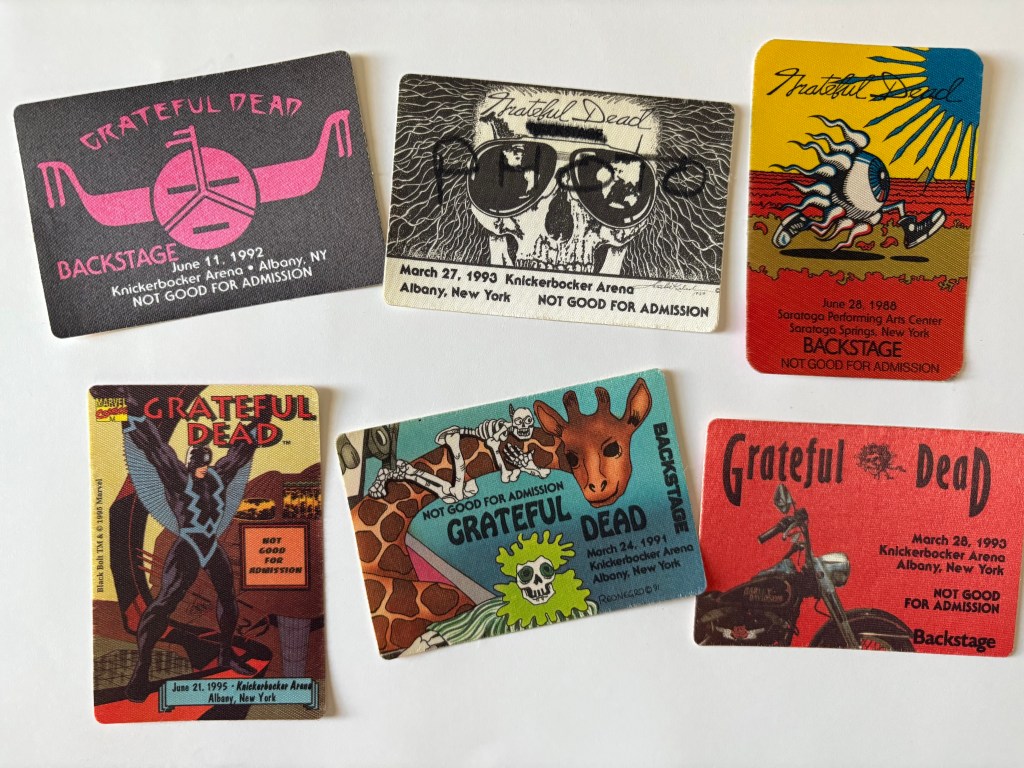
So he generously provided access to the music and musicians through phone interviews, MANY tickets and passes. He once shrugged off my thanks for taking a bunch of us writers out to lunch, saying, “Jerry’s got this.”
In the years since Jerry Garcia passed (1995), McNally published “A Long Strange Trip: The Inside History of the Grateful Dead” (2003), augmented later by “Jerry on Jerry: The Unpublished Jerry Garcia Interviews” (2015), and “On Highway 61: Music, Race, and the Evolution of Cultural Freedom” (2015).
These academic-sounding titles may suggest a scholar’s over-reach, to expand a discrete story into broader cultural analysis. McNally, however, is an Olympic-level master of that jump, springing from incidents and episodes to their meaning – both as understood then and more clearly seen now. “On Highway 61,” for example, launches from our earliest social critics Thoreau and Clemens/Twain to an appreciation of bebop jazz saxophonist Charlie Parker, without inducing thematic whiplash.
McNally’s new “The Last Great Dream” shines a clear light (and rear-view mirror) on the evolution of American popular culture from the 1950s into the 60s, sketching vivid capsule bios of hero-influencers and setting their achievements within the zeitgeist.
He examines 1950s and 60s culture heroes we know under just one name: Kerouac, Ginsberg, Kesey, Leary, Miles, Dylan, Ferlinghetti, McClure, Snyder, Rexroth. They’re poets, musicians, radio DJs, booksellers; the inventors of musical styles, newsletters and onstage liquid light shows. He traces the introduction, evolution, adoption and influence of their ideas and ideals; and the opposition that often greeted many.
For example, he describes the influence of Harry Smith’s epic “The Anthology of American Folk Music” on generations of musicians, writers, scholars and fans. “It was our Talmud, it was our Bible,” said folksinger Dave Van Ronk, the fabled pope of Greenwich Village. While McNally gives San Francisco its due as cradle of the egalitarian let-the-good-times-roll hippie ethos in the Haight-Ashbury “Summer of Love,” Greenwich Village is the book’s geographical co-star, where Smith collected the 78 rpm antique records that became his 84-song, six-LP anthology and where such fellow, following folksingers as Bob Dylan discovered buried treasure tunes.
McNally also adds that when Allen Ginsberg tired of Smith’s overlong residency on his couch, he asked Jerry Garcia to provide Smith a grant from the Dead’s Rex Foundation. McNally reports that Garcia replied, “Of course. I owe him a lot for that collection.”
McNally describes Smith this way. “A cosmic visionary and a serious anthropologist from the age of fifteen, a true bohemian and psychedelic pioneer, Smith’s physical growth had been stunted in his childhood by rickets, and he was small, hunched, and not infrequently difficult, a penurious, maddening, cranky and belligerently opinionated alcoholic mooch.”
What a fun parade of adjectives there.
I love the book less because I’m in it than because Dennis McNally wrote it.
BACK PAGES
I sub-titled this “Almost Famous” – so thank you, Cameron Crowe, whose 2000 rock ’n’ roll film title I borrow here. That title sits next door to “Almost Magic,” the celestial song by marvelous singer-songwriter Syd Straw. Seeing her sing it at QE2 around three in the morning was one of the most astonishing musical moments I’ve seen in decades of shows. Stevie Wonder’s “If It’s Magic” isn’t far behind, but I digress.
When Jerry Garcia heard that Ben & Jerry’s had named their ice-cream flavor Cherry Garcia after him, he told McNally, “At least they got my name right.” McNally suggested a compensation arrangement, to mutual satisfaction.
When I met McNally on his book tour for “A Long Strange Trip” that brought him to Stuyvesant Plaza, he called me over and had a second chair brought behind his author’s table so we could catch up. That same night, years after his Dead publicist gig had ended, The Other Ones were playing downtown at the Knick-Pepsi-Times Union-MVP Arena. The first, and in my view the best, Dead successor band, it featured all the surviving Grateful Dead members, also singer Joan Osborne and guitarists Jimmy Herring and Warren Haynes.
When Dead guitarist Bob Weir’s other band Ratdog played Albany’s Palace Theater, McNally met me under the marquee with my tickets and backstage pass; then suggested we meet an old friend at the Quackenbush House (now the Olde English Pub), down Clinton Street on Broadway. At the bar sat Tom Davis of his Saturday Night Live-spawned duo with Al Franken. After introductions, McNally walked back up to the Palace to meet my writer colleagues while Davis talked about the memoir he was then writing; well, struggling to write. He didn’t have a title then, and had doubts and questions he didn’t mind airing with a fellow scribe he’d just met. The project became “Thirty-Nine Years of Short-Term Memory Loss.”
That night, when my primitive modem wouldn’t connect with the Palace’s phone system to send my review, McNally took me onto the Ratdog tour bus parked on Pearl Street and connected me with the bus’s online service. How odd to write a review of musicians as they came aboard the bus, walked right past me and said “hi,” then send it to the Gazette while sharing beers.
Once at Jazz Fest in New Orleans, McNally and Gulf Coast boogie pianist Marcia Ball appeared together in a cozy talking-and-playing presentation in the grandstand area. They spoke of musical styles and demonstrated them. Afterward, McNally spoke with sweet reverence of how fun it was to sit just a few feet from where her hands made magic on the keyboard.
McNally does the same at his keyboard.
 Hoke's Jukebox