The Weekend

Previews: Weather changes mean venue changes as music moves indoors. This weekend brings one of the season’s last shows-under-the-sun: Caffe Lena at SPAC on Saturday. Indoors, there’s plenty.

Virtuoso BEATrio at Universal Preservation Hall Thursday
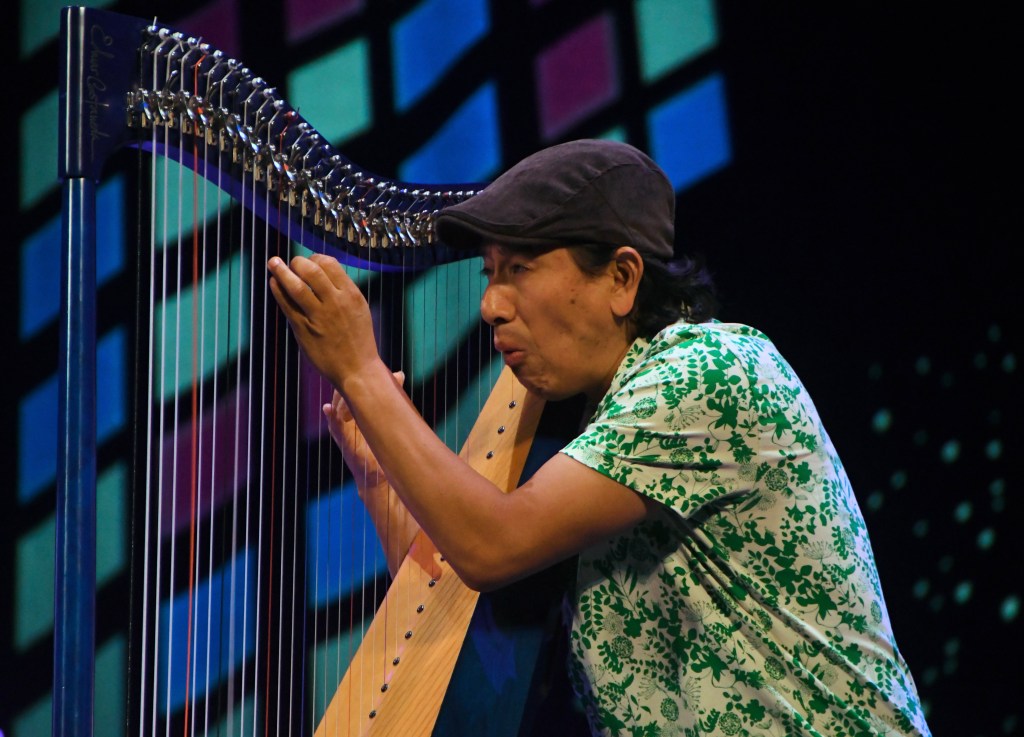
Edmar Castaneda in August at Proctors in a Music Haven presentation. Michael Hochanadel photo

Does Edmar Castaneda live here now? He played Music Haven’s gala in late August at Proctors, then the Lake George Jazz Weekend in September.

The jazz harp pioneer returns in very fast company. 

BEATrio, from left: Edmar Castaneda, harp; Bela Fleck, banjo; Antonio Sanchez, drums. Shervin Lainez photo supplied.

Thursday at Universal Preservation Hall, Castaneda plays with the newly formed (last year) BEATrio world-music combo with banjoist Bela Fleck and drummer Antonio Sanchez.

Fleck also plays here often, with fantastic bands including the Flecktones, symphony orchestras, banjoist wife Abigail Washburn and all-star crews in many styles and traditions. BEATrio is the latest of many and one of the most intriguing.

Since Earl Scruggs’s “Beverly Hillbillies” theme inspired Fleck right through his NYC TV screen, Fleck became the most versatile and ambitious banjoist since Scruggs himself. Through dazzling virtuoso skill and wide-open collaborations, Fleck has won 19 Grammys in categories from historic to innovative, classical to country to jazz to folk to world-beat to roots to pop. Highlights here have included duos at the Van Dyck with jazz pianist Chick Corea and Indian percussionist Zakir Hussain, and a show at RPI’s EMPAC with top traditional African players on his award winning “Throw Down Your Heart” album and film.

The BEATrio promises similar fireworks.

Colombian-born Castaneda is to jazz harp what Fleck is to omni-banjo, a startlingly fresh stylist pioneering a new tradition in varying formats. He led a nine-piece world-jazz combo at Proctors, then a trio at Lake George; and has recorded with Japanese jazz pianist Hiromi, French harmonica wizard Gregoire Maret and Cuban saxophonist Paquito D’Rivera.

Mexican drummer Antonio Sanchez is their peer in talent and curiosity. Pat Metheny told me when he first heard Sanchez, from outside a New York jazz club, he thought he was hearing two drummers and was shocked to find Sanchez making all those beats alone. Like Fleck, Sanchez played with Corea, plus multitudes of jazz greats; but his most impressive achievement may be the Golden Globe-nominated score for director Alejandro González Iñárritu’s film Birdman (2014).

“I tend to find people to collaborate with who are the only person who plays that way,” says Fleck in his website bio. “I connect with people over rhythm…The rhythm is so compelling between Antonio and Edmar that I can roll, like on a bluegrass song, and have it sound perfectly natural.”

Fleck, Castaneda and Sanchez play Thursday as the BEATrio at Universal Preservation Hall (25 Washington St., Saratoga Springs). 7:30 p.m. $79.50-$40.50. 518-346-6204 www.proctors.org.

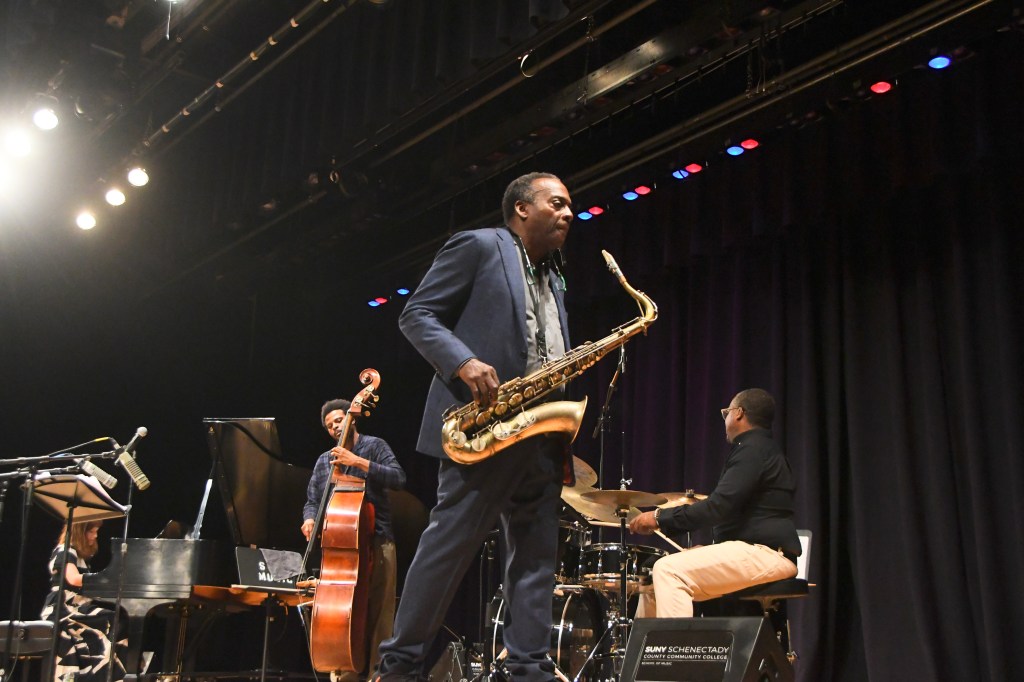
Saxophonist Sarah Hanahan at A Place for Jazz

In a season of saxophones at A Place for Jazz– three of five shows star saxophonists – Sarah Hanahan stands out as a young woman (28) unafraid to tackle tunes nearly every saxophone colossus before her claimed and played, explored or exploded. Her playing on alto has the fluid, joyful bounce of Charlie Parker and Jackie McLean: The beat is having fun, the notes happy to hear each other. 

Sarah Hanahan. Photo provided

Thursday at A Place for Jazz, she brings top credentials and critical praise. 

Trained at the Jackie McLean Institute of Jazz at the Hartt School of Music of the University of Hartford (B.A., 2019) and The Juilliard School (M.M., 2022), Hanahan’s debut album “Among Giants” won a five-star review in Downbeat and a spot on the magazine’s list of Best Albums of the Year for 2024; and she was named Number One Rising Star on Alto Saxophone in it’s 2025 Critics Poll.

In addition to leading her own trio, she also plays in the Mingus Big Band.

The Sarah Hanahan Quartet plays Friday at A Place for Jazz in the Carl B. Taylor Auditorium of the SUNY Schenectady County Community College music school. 7:30 p.m. $25 at the door, cash or check. www.aplaceforjazz.org.

Mustard’s Retreat at the Eighth Step

David Tamulevich wears several hats, like stellar singer-songwriter and savvy country music publicist Lance Cowan. Tamulevich was a performer before becoming artist manager for folk stars John Gorka, Ani DiFranco, Stan Rogers, Kate Wolf, Greg Brown, Dar Williams, and Ellis Paul, He hit the road in 1975 with Mustard’s Retreat, originally a trio, now a duo. They’ve made more than a dozen albums, though they toured sporadically as Tamulevich busily represented other artists.
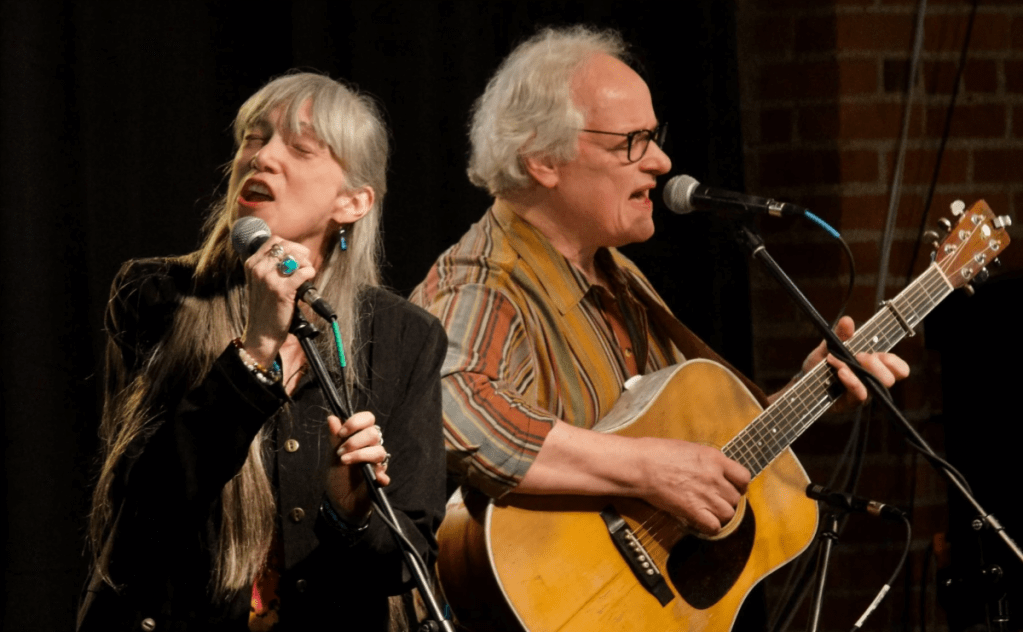
Mustard’s Retreat; Libby Glover, left; and David Tamulevich. Photo provided

Friday, he returns to the Eighth Step, a frequent tour stop, like other regional venues including the Falcon Ridge Folk Festival and Clearwater’s Great Hudson River Revival – and such national-caliber venues as the folk showcases at Wolf Trap, Lincoln Center and Kennedy Center. Mustard’s Retreat is now a duo of Tamulevich with Libby Glover, armed with a stage full of instruments and deep bags of songs and stories. 

He calls their music “defiantly hopeful,” and expresses “joy and fun, mystery and wonder, then heartbreak and resiliency…it’s celebrating life.”

7:30 pm., doors at 7. $26 in advance, $28 on Friday; $40 front and center. 518-346-6204 http://www.proctors.org.

Caffe Lena at SPAC

Saturday brings the return of Caffe Lena at SPAC; a free outdoor multi-act show at SPAC’s Charles R. Wood Stage. During late-June’s Saratoga Jazz Festival presented by GE Vernova, it becomes the Charles R. Wood Jazz Discovery Stage. Saturday’s slate features mainly folk or folk-adjacent artists.

Unlike LiveNation events, fans can bring in chairs and blankets for the free event. Doors open at 11:30 a.m.

Noon: Aleksi Campagne. Bilingual Canadian fiddler and singer-songwriter

1:10 p.m.: Farah Sirah. Time Out New York hails the Jordanian cross-cultural singer as “the Norah Jones of the Middle East.

2:20 p.m.: Tom Chapin. Triple Grammy-winning singer-songwriter with 27 albums and key role in National Geographic Explorer TV series

3:30 p.m.: Chatham County Line. Harmonizing bluegrass/Americana trio with four albums that topped Billboard’s Bluegrass Chart

4:40 p.m.: Misty Blues. Powerhouse Berkshires blues band with 17 albums and tour dates here, across Canada and the UK

Caffe Lena at Caffe Lena

Also Saturday, at 7 p.m. and as part of the Saratoga Book Festival, Caffe Lena presents author/musician Tom Piazza in “John Prine: A Night of Song and Stories” celebrating Piazza’s book Living in the Present with John Prine. New Orleans-based novelist and essayist Piazza is a Yaddo alum and four-time winner of the ASCAP Deems Taylor Award for Music Writing. He was working with Prine on an autobiography when Prine died of COVID in April 2020. 

WAMC’s Joe Donahue interviewed Piazza for a Roundtable segment available at www.wamc.org.

A Swan Song by a Tiny Giant

Review: Janis Ian at Caffe Lena; Saturday, Sept. 27, 2025

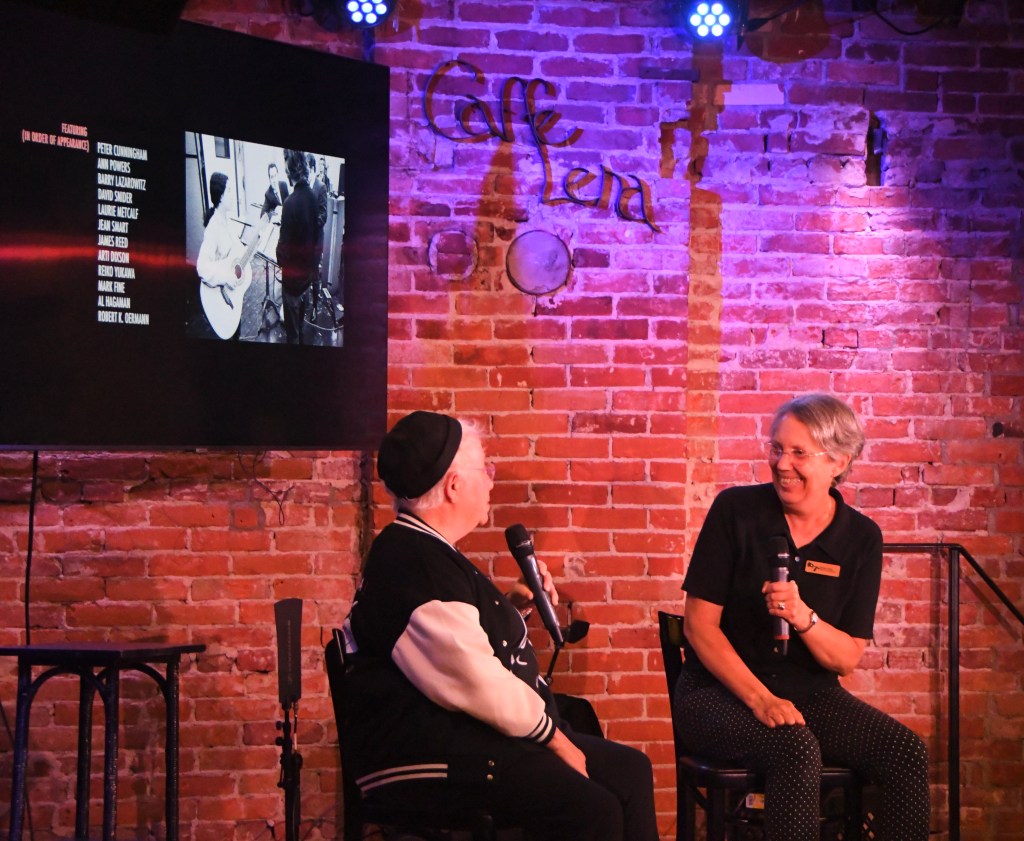
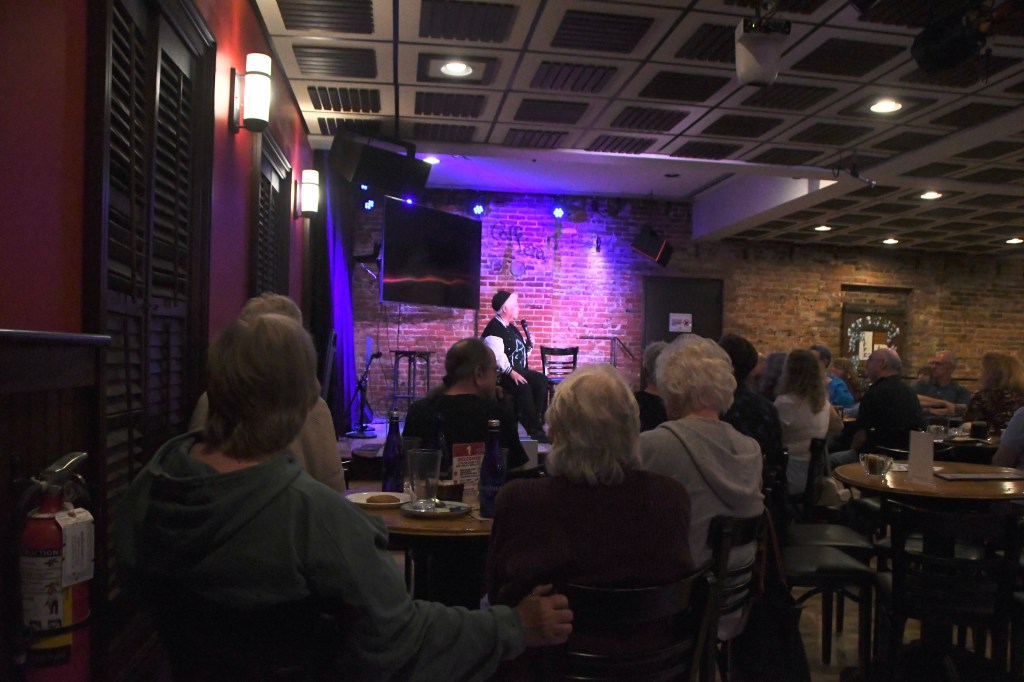
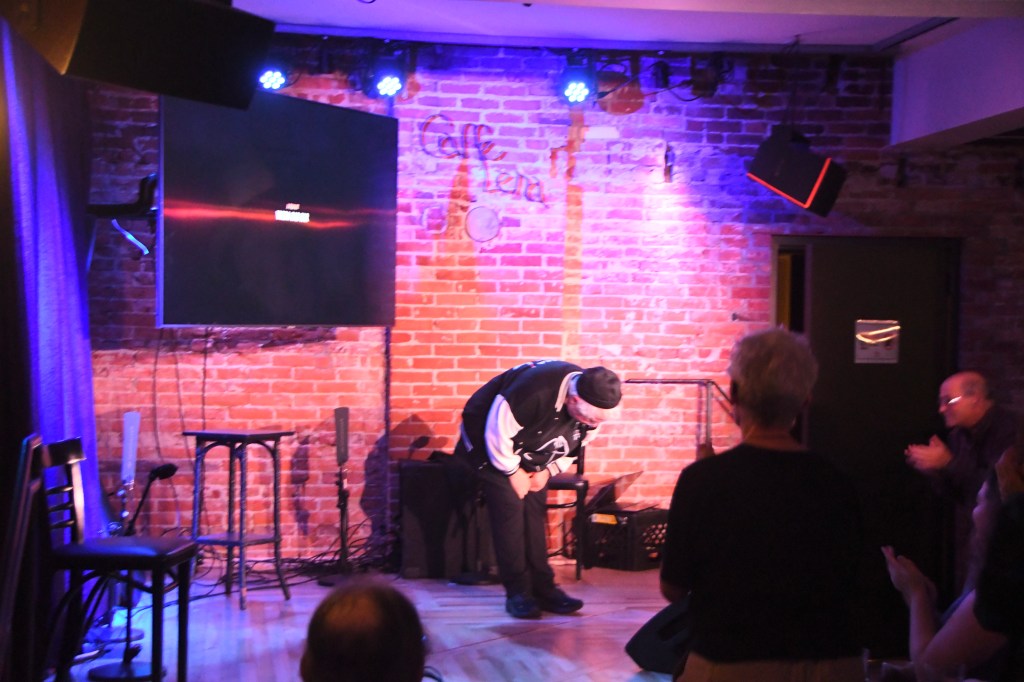
Janis Ian performed a sweet/sad swan song Saturday at Caffe Lena without singing a note, except on the screen where her “Breaking Silence” bio-documentary film showed before a Q&A and meet-and-greet.

Singer-songwriter Janis Ian, left, and Caffe Lena Executive Director Sarah Craig

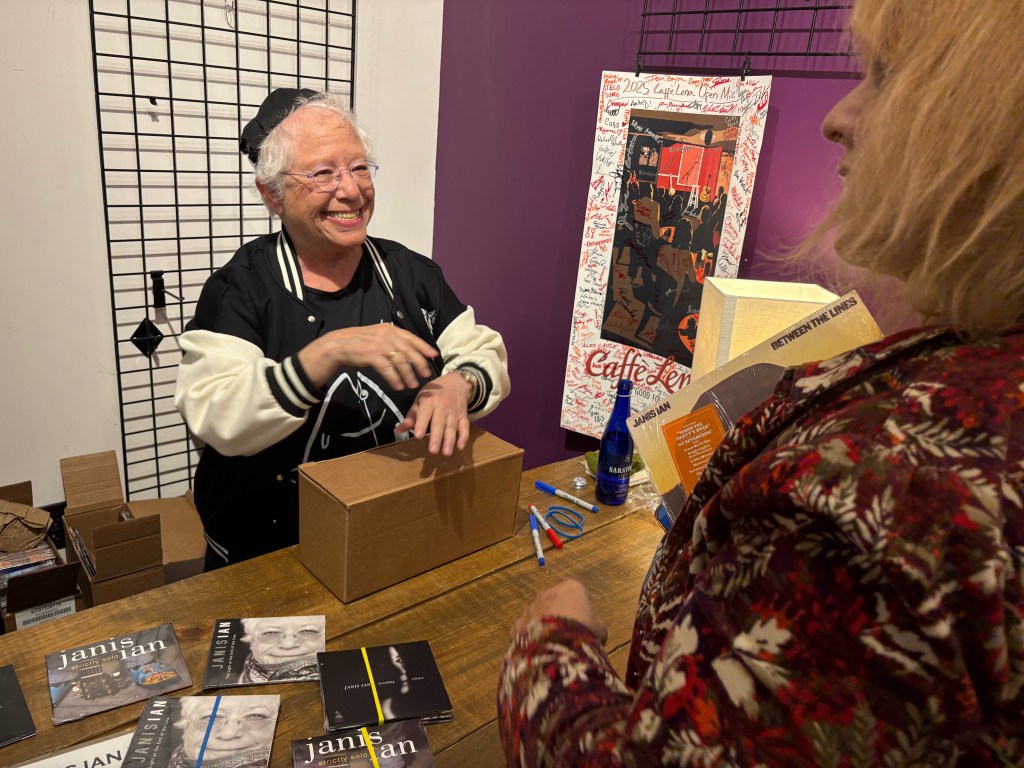
Caffe Executive Director Sarah Craig led the Q&A, scurrying through the crowd with a mic for fan-questioners, like Phil Donahue back in the day. For many fans, the main event was meeting Ian at the merch table. There she signed albums, many dating from her 1960s and 1970s early fame, and listened graciously as fans poured out their hearts to the iconic singer-songwriter whose tour promoting the film may be her last.

Before showing the film, Craig asked who had delayed seeing the film until Saturday’s event, although it’s streamed on PBS’s American Masters series since June. Many in the mostly boomer crowd claimed they’d waited, and the experience felt fresh again in warmly welcoming company, even though I had seen it. 

“Breaking Silence” shares its title with her 1992 album, an uncommonly candid expression, even for the open-book Ian. It traces her artistic and personal journey in eye-opening detail through onstage performances, interviews with peer artists (she has very, very few of those) and with Ian herself; plus well-staged re-enactments. From precociously ambitious folkie who learned literally at Pete Seeger’s knee to early teen-aged success in the 1960s Greenwich Village “folk scare” to rapid achievement and influence, it’s a vivid story of oscillating ups and downs, creatively and personally. 

No spoilers here; go watch it; after reading this.

In the Q&A that followed the two-hour film, Ian gently steered questioners away from worshipful praise for her music’s impact on their lives to matters at hand, as framed by the film. 

She spoke of the stage as not a safe place, citing the courage it takes to perform where anything can happen, from patrons booing, or worse, to blithely leaving after finishing their pizza. She told of being driven offstage by organized-bigot protests at an early concert, but returned to finish the show, a crucial lesson in persevering in service to her artistic vision and purpose.

Other lessons followed; how drive and talent opens doors; how today’s political and social struggles take persistence, and the optimism she finds in seeing younger artists coming up who sing the same values of acceptance, honesty and courage that power her songs.

Now 74, acknowledging Saturday that “I have more behind me than in front of me” and that health challenges now prevent her from performing or recording – but not from writing – she seldom seemed nostalgic. She did, however, show warm affection for how heroes in the cultural centers of Greenwich Village, LA’s Laurel Canyon and San Francisco’s Haight-Ashbury had nurtured her career and life.

Technical insights about writing, making records and performing included such practical tips as writing in rhythm to let listeners recover from heavy lines, and “Don’t fuck the band.” 

Fans inspired by her as a bisexual Jewish woman now married to a woman and a stubbornly creative force who struggled in a male-dominated industry and society expressed grateful awe at her courage. 

When the half-hour Q&A ended, Ian told Sarah Craig, sitting beside her onstage, “I love coming here” – to the Caffe where she’d often performed. 

Before playing cozy Caffe Lena, Ian had also performed at SPAC, where Alice Cooper and Judas Priest played Saturday.

Ian had played that same big stage, opening for Kris Kristofferson; late 1970s, early 1980s.

After her opening set, Kristofferson invited us writers backstage – a strong physical presence then, a tanned, fit, blade of a man after a month training with Muhammad Ali at the boxer’s Poconos camp. 

Radiating energy and confidence, he was nonetheless genuinely cowed by the daunting prospect of following Ian onstage.

His career strong with plentiful hits, he could afford a strong band and brought a mighty crew to SPAC: drummer “Slammin’ Sammy” Creason, keyboardists Donnie Fritts and Glen Clark (of the great duo Delbert and Glen), guitarist Stephen Bruton, multi-instrumentalist Billy Swan, and bassist Tommy McClure – all killers.

Even with all that – honed charisma, big hits, killer band – Kristofferson was terrified of going on after Ian, who had played with just another guitarist.

He was awed by her songs and said he feared his own wouldn’t measure up. His humility felt totally genuine and really touching.

Onstage, he told the audience all this; how he was awed by her talent, her songs and her presence.

When my turn to meet Ian at the merch table came Saturday at Caffe Lena, I handed her a note about what Kristofferson had said, rather than hold up the fans behind me to tell her. And I handed her the CD booklet to “Breaking Silence” for her to sign, noting my brother Jim Hoke played on it. 

“Ah, Jim – he’s great; Jim’s the best,” she said, and pointed to other albums on the merch table he’d played on with her.

“One of the saddest things about not recording any more is that I don’t get to work with Jim.” 

Yet, even on this farewell tour of sorts, Janis Ian seemed a happy presence, a tiny woman of enormous presence, power and achievement, whose songs and singing, words and voice, remain to inspire, to teach, to awe.

Bearing Witness, Singing Truth

Preview: Kemp Harris at the Eighth Step at Proctors; Saturday, Sept. 27, 2025 (The Addy Theatre, 432 State St., Schenectady)

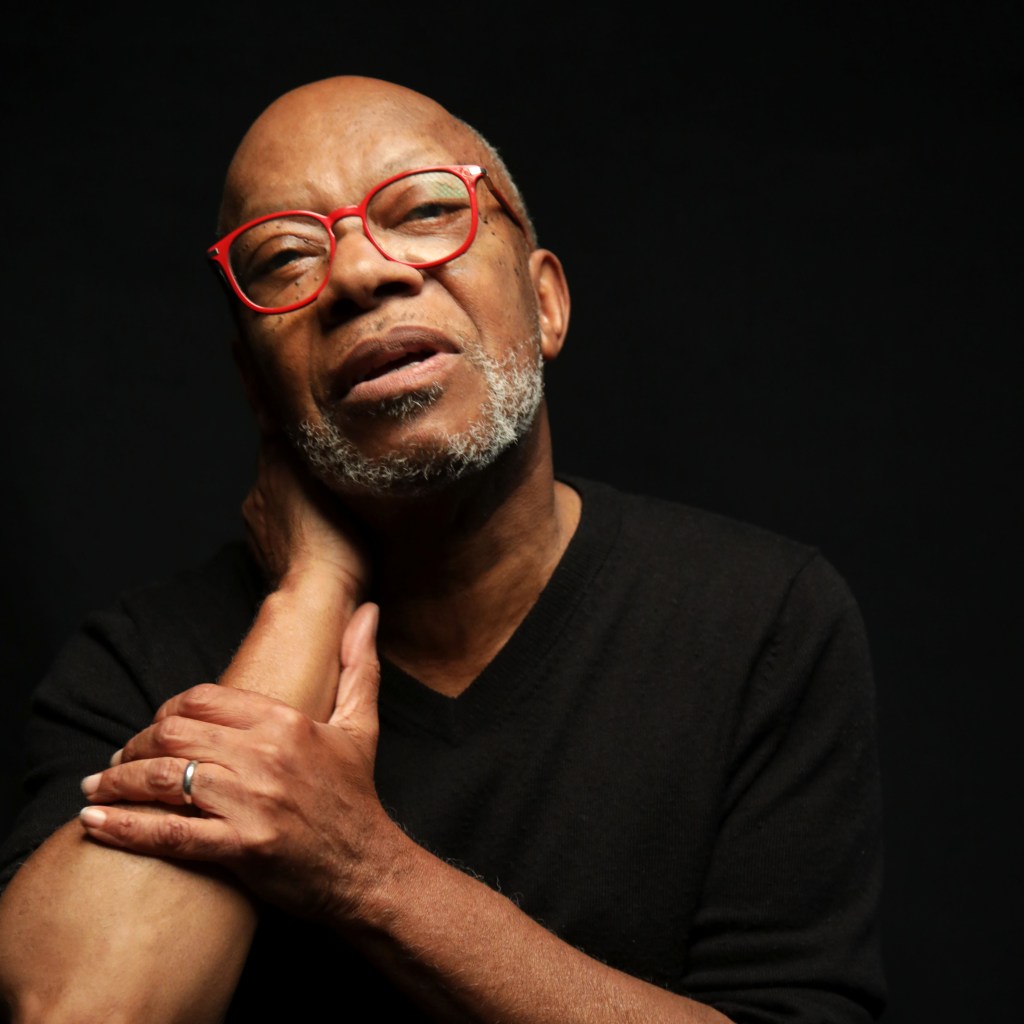
Singer-songwriter Kemp Harris plays his Eighth Step debut this weekend after making music for decades. The under-the-radar artist has perhaps been overlooked, like NRBQ, for example, because he makes more than one kind of music.

Kemp Harris. Photo provided

All About Jazz hailed his “Edenton” album, named for his segregated North Carolina hometown and recorded with now-departed gospel-soul singing Holmes Brothers, for its diverse covers. The pub reported “Donny Hathaway’s ‘Tryin’ Times’ is a hypnotic blues vamp, rolling along in a place where Howlin’ Wolf would have felt at home.” The review also singled out Harris’s versions of Willie Nelson’s country classic “Night Life” and the gospel jewel “Didn’t It Rain.”

Downbeat, another jazz pub, also sang Harris’s praises for “Edenton,” citing it as “Earthy, insightful, haunting…sacred and profane. Harris is in perfect communion with the Holmes Brothers and his earthy band.”

A retired teacher and gay Black man, Harris is a northeastern transplant. He’s made big-city scenes, composing music for the Alvin Ailey American Dance Theatre and Complexions Contemporary Ballet. He set up a songwriting residency at Boston’s Wang Theatre, and presented master classes at Berklee College of Music on Artists as Activists – along with Chad Stokes of the band Dispatch and members of the Urban Bush Women dance troupe.

Activism also shaped his new album “The America Chronicles” whose song titles illuminate the concerns inspiring his jazz/R&B/soul/gospel tunes: “Ruthie’s,” “Don’t You Hear Them America,” “Tulsa,” “Edenton,” “Standing Your Ground,” “Down,” “In For the Kill,” “This Is America,” “America/Border Song” and “Goodnight America.”

This is music and message working together at a high level, aimed at hearts and minds. It’s tough truths, written more in sadness than in anger; hard tales to tell at times, and sung with wise, pained tenderness. Like Randy Newman at his most devastatingly wry, and Joni Mitchell at her most sweetly hopeful, Harris sees his flawed, beloved country clearly and his aim at those flaws is true. Sometimes you can hear humor, but you always hear the truth in his words and voice.

Harris sang “Goodnight, America” to wide acclaim on Wanda Fischer’s “Hudson River Sampler” (WAMC) edition of Phil Ochs Song Night, and an audience vote selected him as winner of the Falcon Ridge 2024 Folk Festival Emerging Artist Showcase.

Freebo, Bonnie Raitt’s former longtime bassist, produced and arranged Harris’s songs on “The America Chronicles,” whose recent release will be celebrated at the Eighth Step Saturday. They recorded at the aptly-named Fame Studios in Muscle Shoals, Alabama, with Harris at the mic and the piano and Freebo playing bass, plus Clayton Ivy, organ; Will McFarlane, guitar; Justin Holder, drums, and singer Alice Howe.

At the Eighth Step, Harris will play piano, with harmonica player Adam Osgood.

Speaking of the new album, Harris told Americana UK magazine, “At the end of the day, I’m an old Black man telling stories and spreading love.”

“Scary times,” mused Eighth Step executive artistic director Margie Rosenkranz of  the volunteer-run Eighth Step. “We need voices like his.”

Show time for Kemp Harris and Adam Osgood Saturday at the Eighth Step in Proctors The Addy Theatre is 7:30 p.m., doors at 7.

Tickets: $28 advance, $30 on Saturday, $45 Gold Circle (front and center) Other than Gold Circle, seating is open: first come, first served. 518-473-0723 or 346-6204. www.8thstep.org or www.proctors.org

A Beautiful Musical Day in the Neighborhood

Review: Porchfest No. 3, Saturday, Sept. 20, 2025

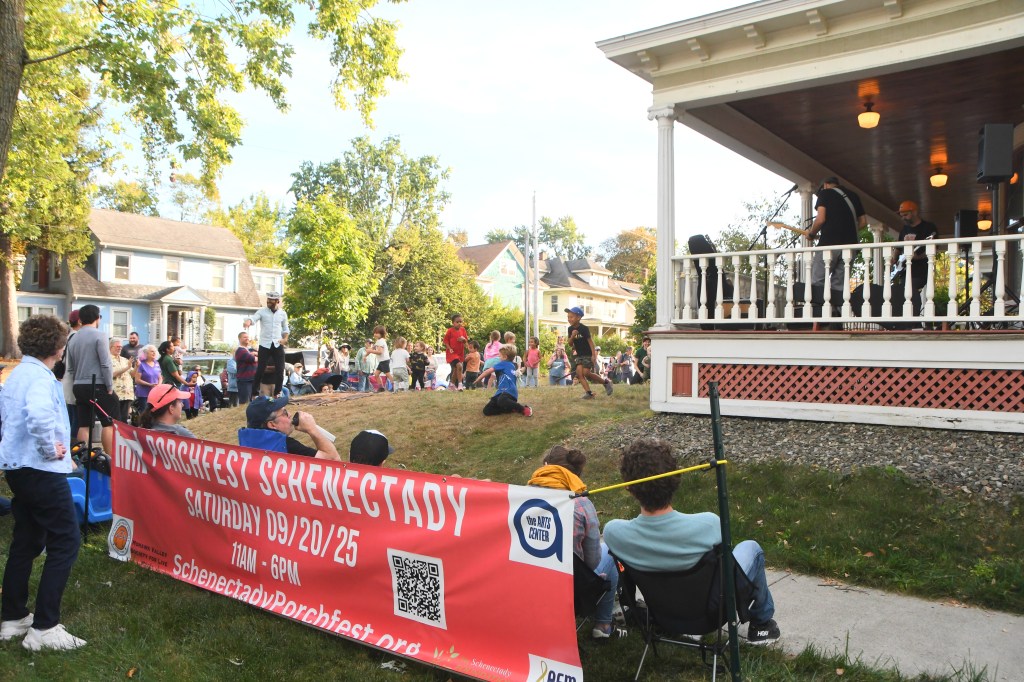
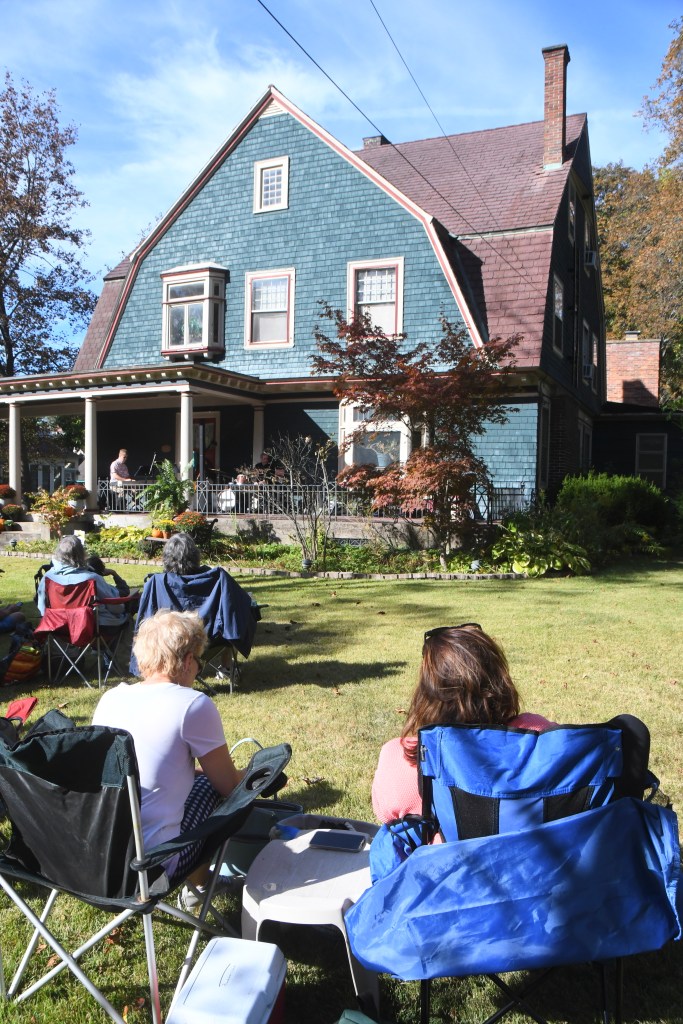
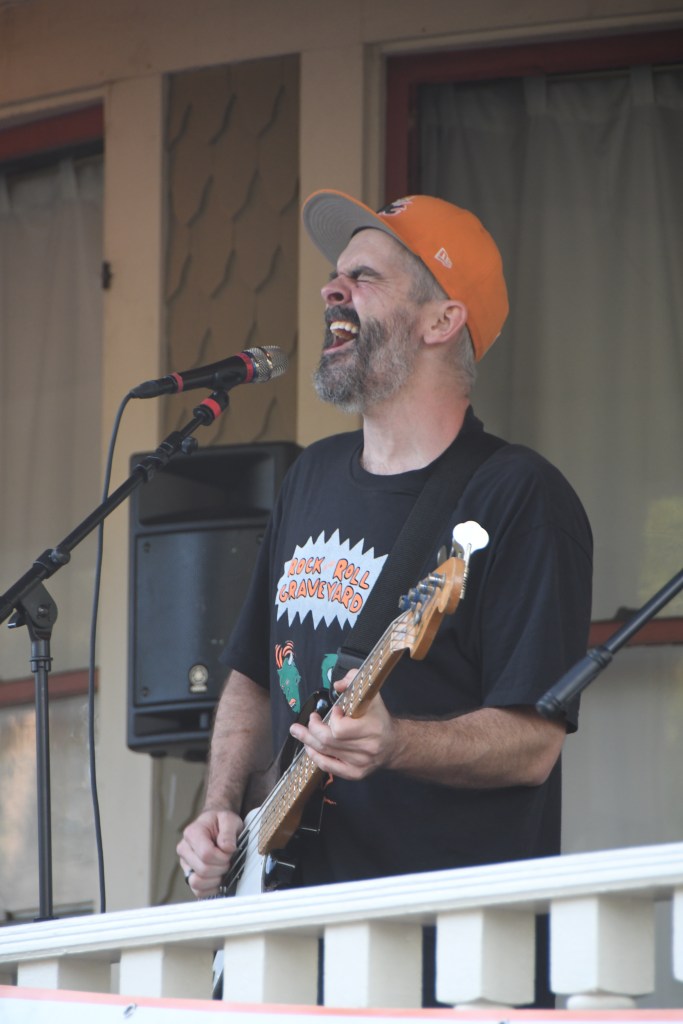
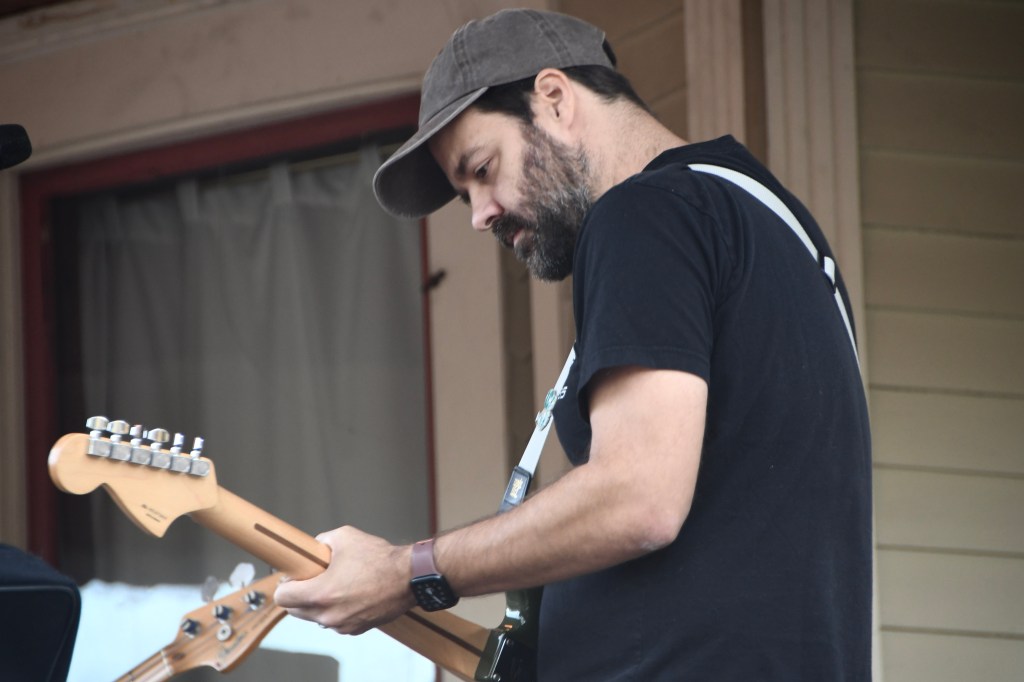
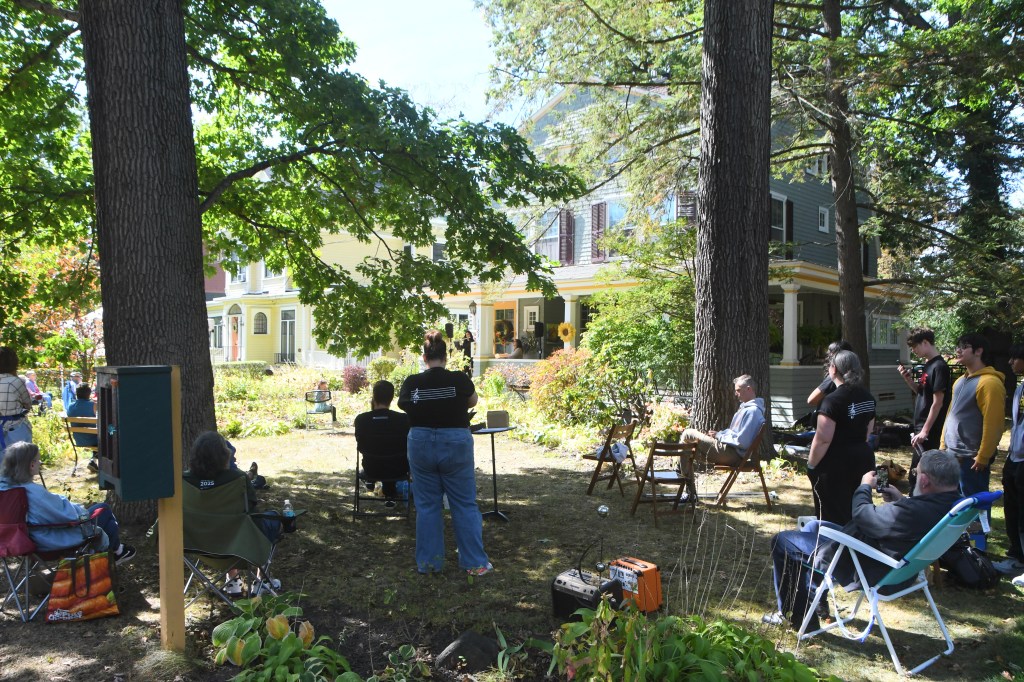
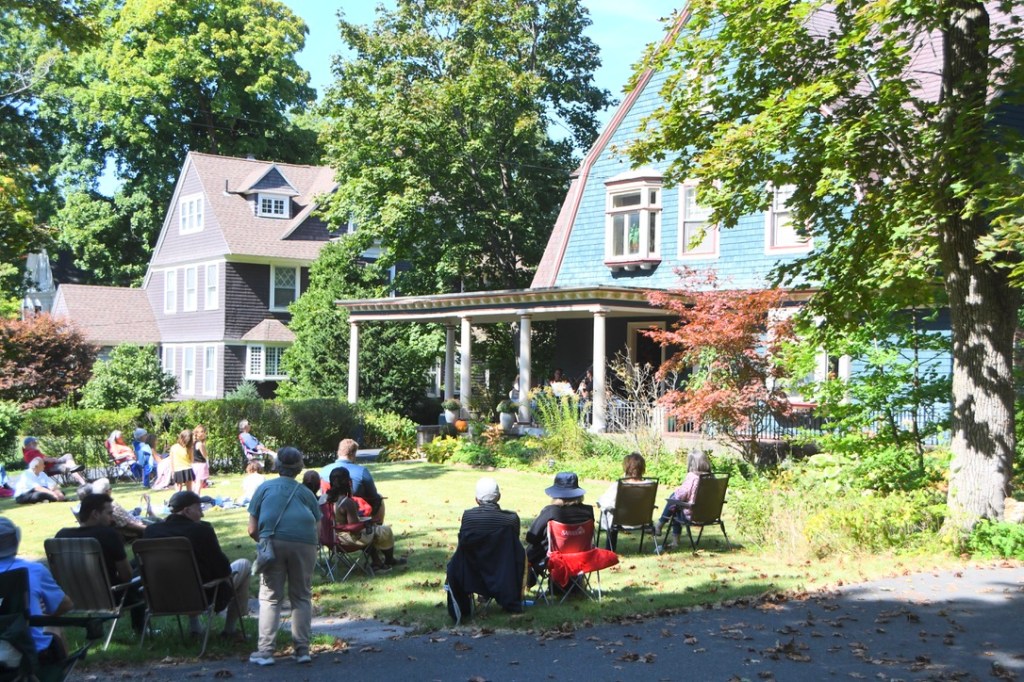
Rock trio Nice Hockey wrote their “City of My Dreams” about Montreal, but Saturday those words fit a north-side Schenectady neighborhood in and around its historic GE Plot. There seven porches – well, six plus a church – hosted 14 musical acts in the third annual Porchfest, a nomadic, free-music festival that draws ever-larger crowds.

Nice Hockey, above; Kevin Carey Group below

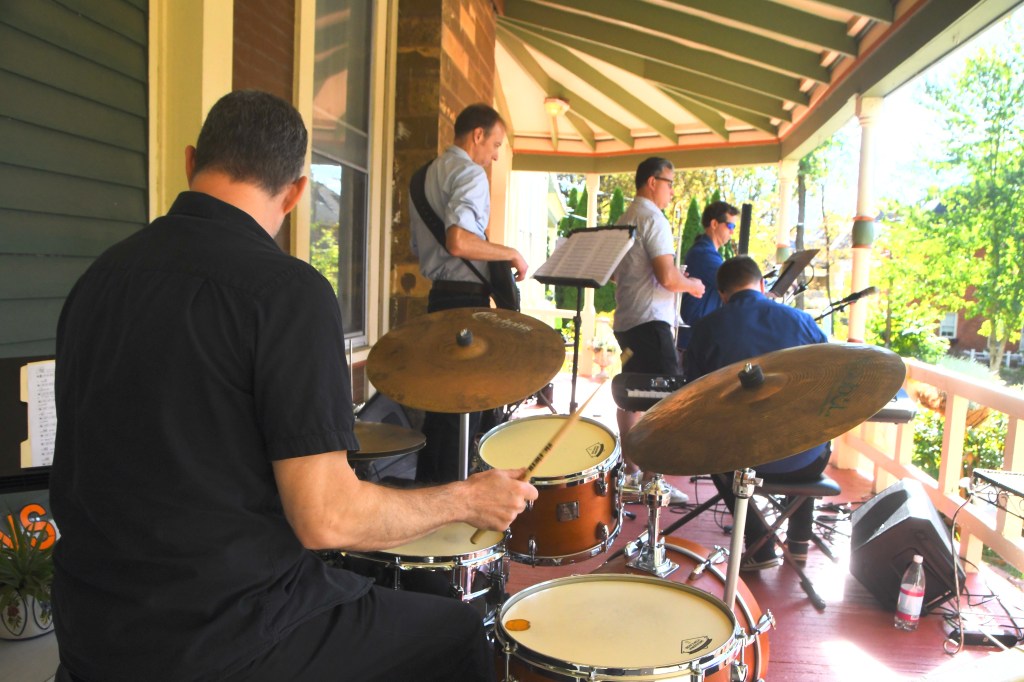
Looking down from a Wendell Ave. porch wide enough for his seven-piece jazz combo, keyboardist Kevin Carey pronounced the throng below on portable chairs or blankets to be three times larger than last year’s; the weather was equally perfect for both.

A bit before noon, the Backyard Brass, one of three brass ensembles, played classy tunes on an Avon Rd. side porch. Formed as a COVID-era hobby band, they’ve outlasted the plague through happy persistence, aiming their five trumpets Saturday at a somewhat rocky “Masterpiece Theater” theme to start. They played smoother in the peppy syncopated “America” from “West Side Story,” then a mellow “Shenandoah” as the audience grew.

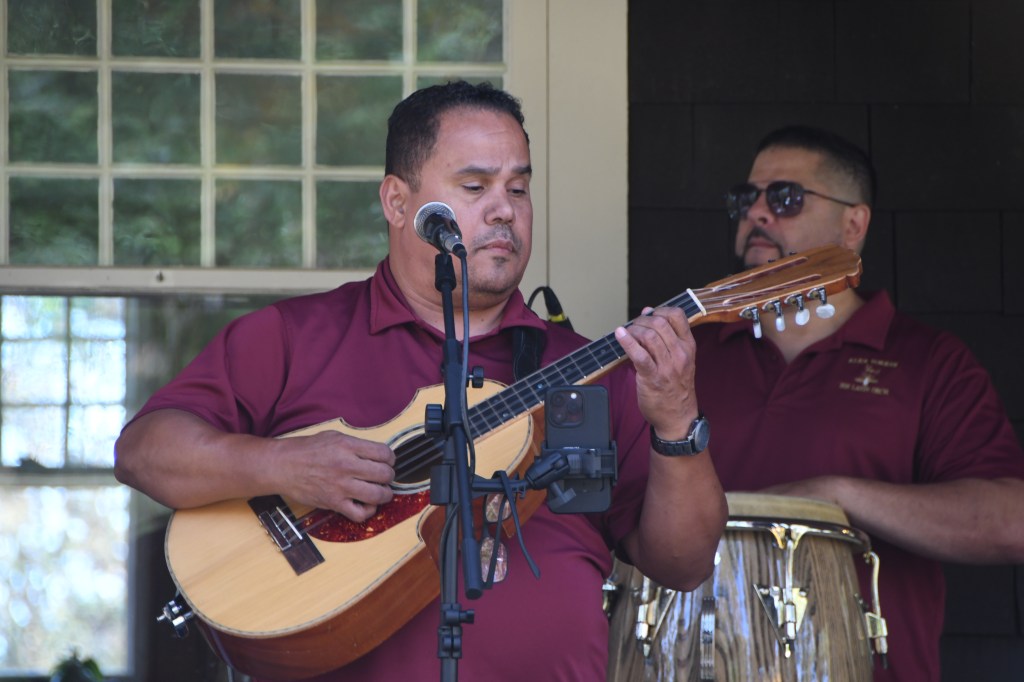
Backyard Brass, above; Alex Torres and His Latin Orchestra, below

Brass Abbey followed a few blocks away on Douglas Rd., a polished, playful crew whose early numbers I missed to catch Alex Torres and His Latin Orchestra – our best musical party on wheels – who started at the same time (noon) on Rugby Rd. A Latin rhythm section with a crisp jazz horn section and strong singers, the Orchestra plays everywhere, all the time, achieving a muscular swing in cha-cha, meringue and Cuban tunes that got folks dancing.

Brass Abbey

After a happy taste of Latin, walking down Rugby, right on Wendell and left down Douglas Rd., I caught Brass Abbey in a clever medley of patriotic flag-wavers before injecting Duke Ellington’s “Caravan” with quotes including TV themes (“Get Smart”!) and other surprises, a fun Name-That-Tune puzzle.

Vocal Jazz Vanguard, above; from left: Kaitlyn Fay, Dave Shoudy (bassist), Jeanine Ouderkirk and Mowgli Gianitti. Below, John LeRoy, left, Dave Shoudy, Jeanine Ouderkirk (obscured) and Kaitlyn Fay

Nearby (east in Douglas, a short block north on Wendell) the Vocal Jazz Vanguard – singers Kaitlyn Fay, Jeanine Ouderkirk and Mowgli Gianitti, plus pianist Jon LeRoy, bassist Dave Shoudy and drummer Cliff Brucker – shuffled through the Great American Songbook with exciting results. The Lambert, Hendricks and Ross classic “Centerpiece” united all three voices in bluesy swing, or vice versa. Solo or harmonized, the singers worked wonderfully well with the players.

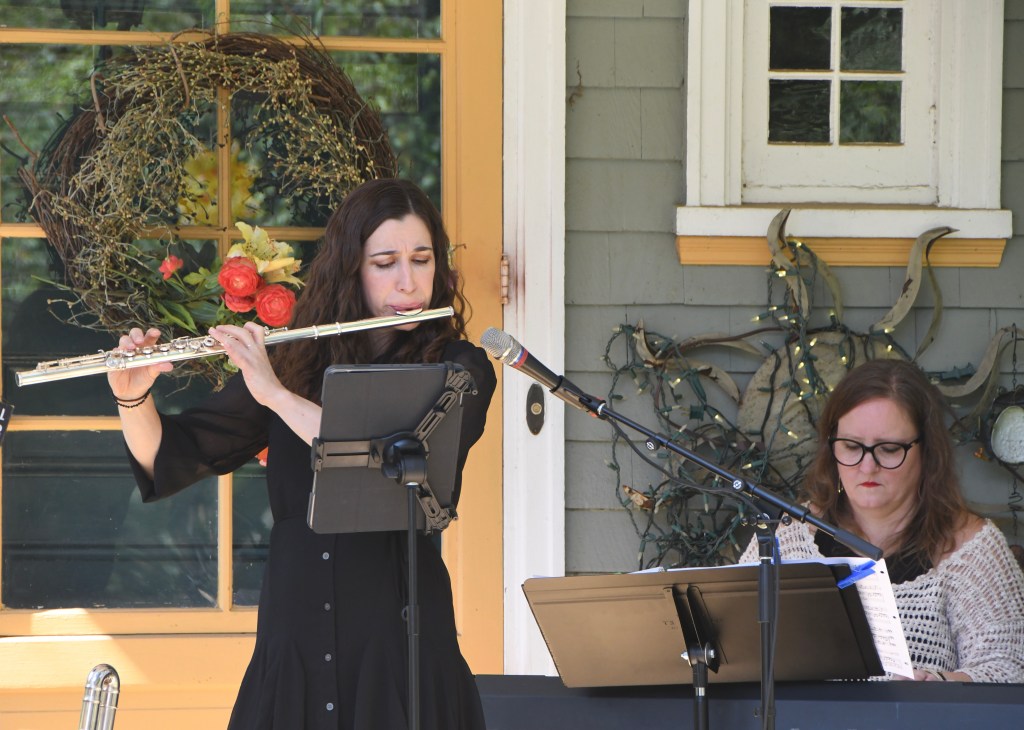
A more subdued mood settled over the crowd on Stratford where the meditative, quiet classical duo of two Melanies – flautist Chirignan and pianist Hardage – cast a serene spell, gentle and sweet. Like chamber music in miniature, the pieces had an inviting calm grace.

Above, The Chirignan-Hardage Duo; Melanie Chirignan, flute, left; and Melanie Hardage, piano. Below, Unken Brew, from left: Bruce Thompson, Sam Katz and Dave Liebman

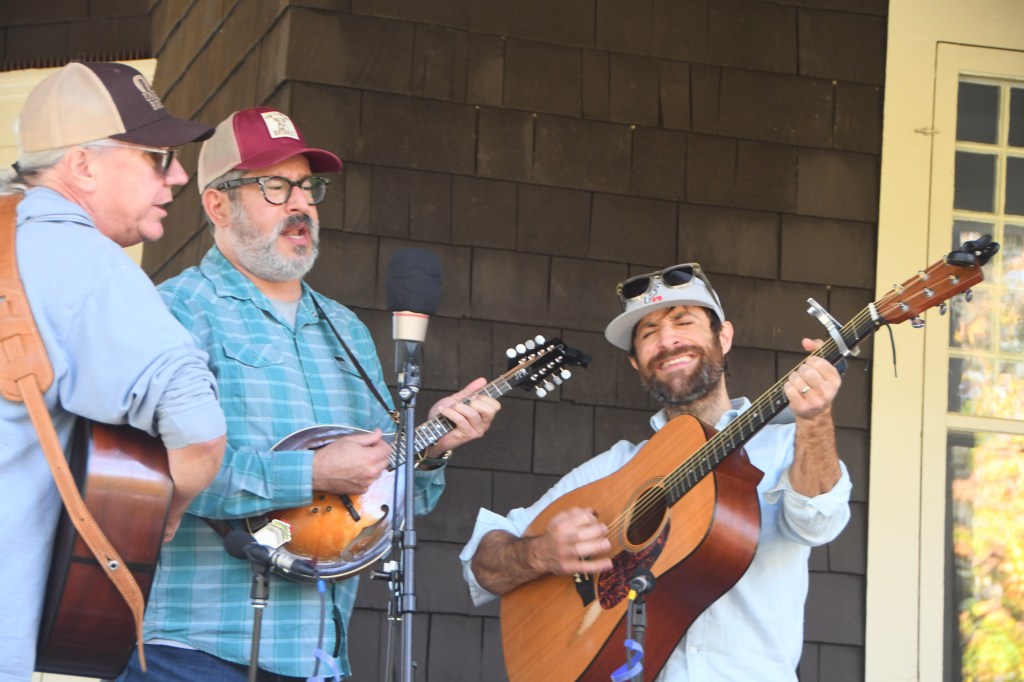
Back on Rugby, Unken Brew went for rowdy bluegrass zip, bluesy depth and, as guitarist-singer Dave Lieberman announced, “enough stomp to keep the bears away,” scanning the shady streets in mock alarm. With mandolinist Sam Katz and guitarist/dobro player Bruce Thompson, Katz revved the Flatt & Scruggs antique “100 Years From Now” and they never looked back, a spirited set with stringed-things playing as precise as their harmonized vocals. 

Kevin Carey’s Grpup, nearly as big as Torres’s Latin Orchestra, brought similar strength to Carey’s modernist-but-melodic jazz compositions in small/big band style. Top players gave all-in sections a brisk cohesion and soloed over the moon. While Carey’s piano led strong, saxophonists Keith Pray (alto) and Matt Steckler (tenor) got the most spotlight time, with trombonist Phil Pandori and trumpeter Omar Williams also holding their own. Bassist Dave Shoudy switched from acoustic bass with the Vocal Jazz Vanguard to electric with Carey and stayed right where he was, playing busier than he had with the singers and linking tight with drummer Dave Berger. The mellow swing of “Easy In Blue” set up the complex, episodic “D.O.A.,” Carey letting his soloists fly before tapping his head to bring back the main melody.

Above, Kevin Carey Group horns, from left: Phil Pandori, Matt Steckler, Keith Pray, Omar Williams

Smaller scale, decidedly Latin, Bossamba leaned into the Antonio Carlos Jobim songbook as Maggie McDougall sang in English or Portuguese with equal fluency. Pianist Wayne Hawkins led in one of his own Brazilian-inspired instrumentals as McDougall admired from the sidelines and bassist Lou Pappas and drummer Mark Foster dug deep in this complex number. She reclaimed her lead spot with Jobim’s classic “Photograph.”

Bossamba above, singer Maggie McDougall, below

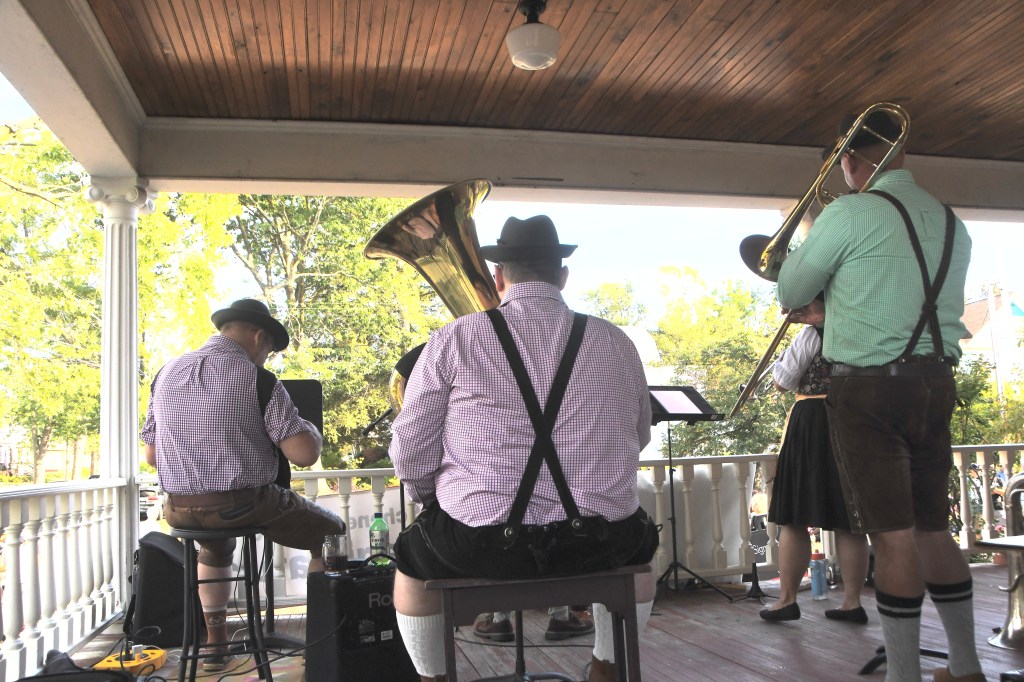
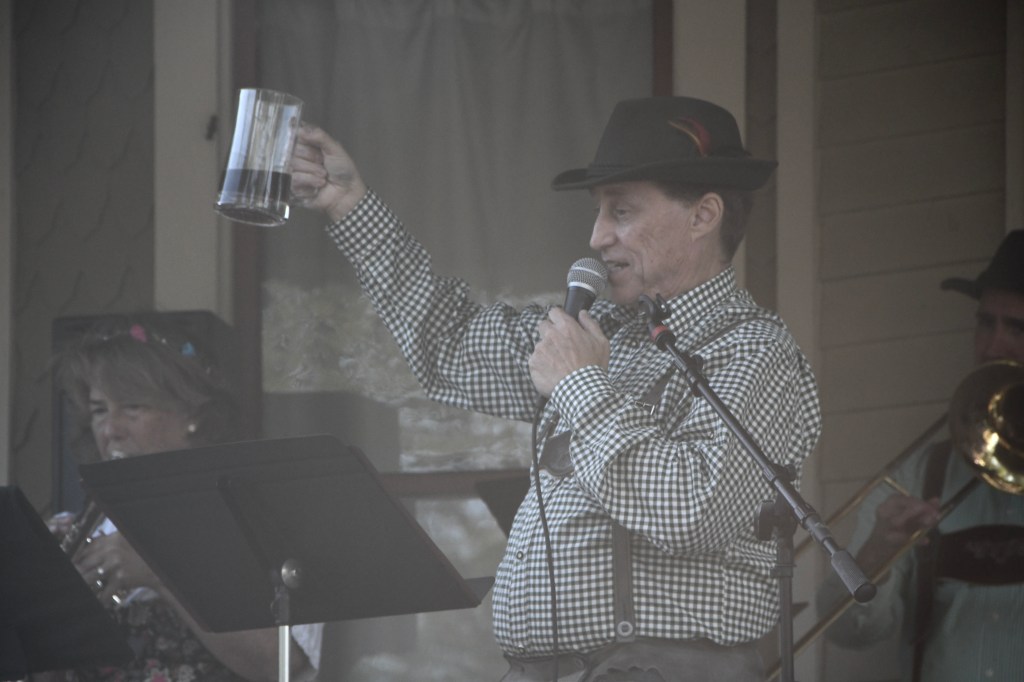
Porchfest’s silliest band, Signature Brass, brought Oktoberfest fun to the corner of Rugby and Ardsley, wearing lederhosen and dirndl and going gleefully oompah in smile-pumping party songs. Tunes felt like a toast of celebration – and not just “The Chicken Dance” – although “Ein Prost” didn’t excite the can-can dancing that leader-trumpeter-Porchfest organizer Steve Weisse hoped to ignite. They played it straight, and really well, Sousaphone player Jeremy Pearson pushing from below and Weisse carrying the melodies up top.

Signature Brass, above; Chicken-dancing fans, below

Above, Steve Weisse toasts the crowd; below, Nice Hockey rocks the same porch

Next, Nice Hockey rocked on bassist Chad Rogers’s own Rugby and Ardsley porch, bringing the most joyful mood of the whole fun day as kids from toddler to kindergarten age danced, jumped and ran around in a dust-raising happy frenzy of music-pumped energy. Parents – the same folks who did “The Chicken Dance” there – enjoyed their kids’ happy motion, and the band’s. It felt like neighborhoods should do.

Chad Rogers

In 2024 Porchfest, the COVID-positive Rogers had to play from his own living room, looking through its bay window at his bandmates. Saturday, he joined guitarist Eric Ayotte and drummer Harrison Schmitt on the porch where they started with “Siren Swell” about the scream of ambulances passing on Rugby, a busy route to Ellis Hospital. Even that song sounded happy – and so did others about taking nights off to relax from over-busy lives, how life is better together and how to keep toddlers entertained.

Eric Ayotte of Nice Hockey, which also plays as the Eric Ayotte Band

The music did that, for everybody, in the most rocking and upbeat set that whole sun splashed day. The most stylistically varied and best attended Porchfest yet, it felt like a neighborhood should feel, on a perfect afternoon.

On foot, 12,000 steps, starting at my house just blocks from the nearest porch-stage, I still didn’t manage to see everything. I missed the young fiddlers of the Empire State Youth Orchestra CHIME program, blues-jazz-rockers the Evidence, the innovative jazz group Yolanda Bush Cool Water Collective and the Calvary Choir and Musicians.

But the music I did catch all worked just fine, and I appreciated the two porta-johns and two food set-ups.

And, oh yeah – meanwhile, Union football won their first game of the season just half a block west of the Douglas Rd. porch-stage. There, hosts Barbara and Tony opened their home – bathroom, drinks and snacks – to the players. And another host, away for the weekend, had friends open her home and porch to players and fans.

ENCORES:

After playing with Kevin Carey’s Group, Matt Steckler played Saturday at Stella Pasta Bar with his new MS Organ Trio with Jon Leroy, organ (he played Porchfest with the Vocal Jazz Vanguard) and Pete Sweeney, drums.

Nice Hockey plays the Schenectady Green Market at noon today (Sunday).

Alex Torres and His Latin Orchestra celebrate 45 years together on Nov. 1 at Universal Preservation Hall.

Saturday Schenectady Sounds

Joe Jencks At the Eighth Step

Troubadour Joe Jencks opens the Eighth Step’s 58th season Saturday in Proctors cozy The Addy theater (upstairs at 432 State Street, Schenectady).

Singer-songwriter Jencks headlined WAMC’s Wanda Fischer-hosted On the Road version of Hudson River Sampler in August at Music Haven; a spot he earned through fine area shows so frequent he seemed to live here. Actually, a Chicagoan, he’s a constant presence in folk, alternative and Americana radio through prolific recordings: 10 solo albums and three with harmonizing trio Brother Sun.

Joe Jencks singing at Music Haven

At Music Haven, Jencks sang lyrics he adapted from Pete Seeger’s inspirational 1955 testimony before the House Un-American Activities Committee. As Jencks sang, Seeger stressed his right to sing for anyone. Jencks echoed Seeger’s defense of cherished freedoms, and dropped a verse of Seeger’s “If I Had a Hammer” into his song.

In a similarly strong message song, dual US and Irish citizen Jencks praised South Africa’s pluralism before hailing his grandfather Felix Kilbride’s courageous immigration here in the sentimental “Rose of Tralee.” Jencks said Kilbride arrived via Ellis Island before recounting the horrifying recent arrest of Hopi tribal people in Arizona for failing to produce green cards. This set up the pro-immigration “Lady of the Harbor” – Lady Liberty. Many fans knew Jencks’s words and sang along here and in “Bells of Freedom.” Jencks reached back to historic prison recordings as source for his “Take this Hammer,” a tool of hope and defiance.

Jencks never went preachy. He’s just too good a musician for that; too skilled and subtle, with a robust guitar and strong, low-pressure voice. His original lyrics had the same topical bite as vintage sources that inspired him, powered by compassion and principle. In other words: folk music of heartfelt authenticity and virtuoso skill.

Joe Jencks sings Saturday at 7:30 p.m. in Proctors The Addy. Tickets: $28 in advance, $30 at the door, $45 priority (center front). www.8thstep.org 518-434-1703

The Eighth Step season continues with Kemp Harris Sept. 27, Mustard’s Retreat Oct. 3, Tom Rush with Matt Nakoa Oct. 18, Whispering Bones: An Evening of Ghost Stories Oct. 28, Ms. Music: Jackie Alper Nov. 1, John McCutcheon Nov. 14, and “Very Slambovian Christmas” (holiday show by the Slambovian Circus of Dreams) Dec. 6.

Seven Porches, 14 Bands on Saturday

Schenectady’s third end of summer Porchfest offers a migratory music experience free to fans wandering the city’s tree-shaded GE Plot neighborhood.

All photos from Porchfest 2024

The two busiest porches, at 1095 Ardsley Rd. and 1183 Stratford Rd., each host three acts; so staying at one porch works, too. 

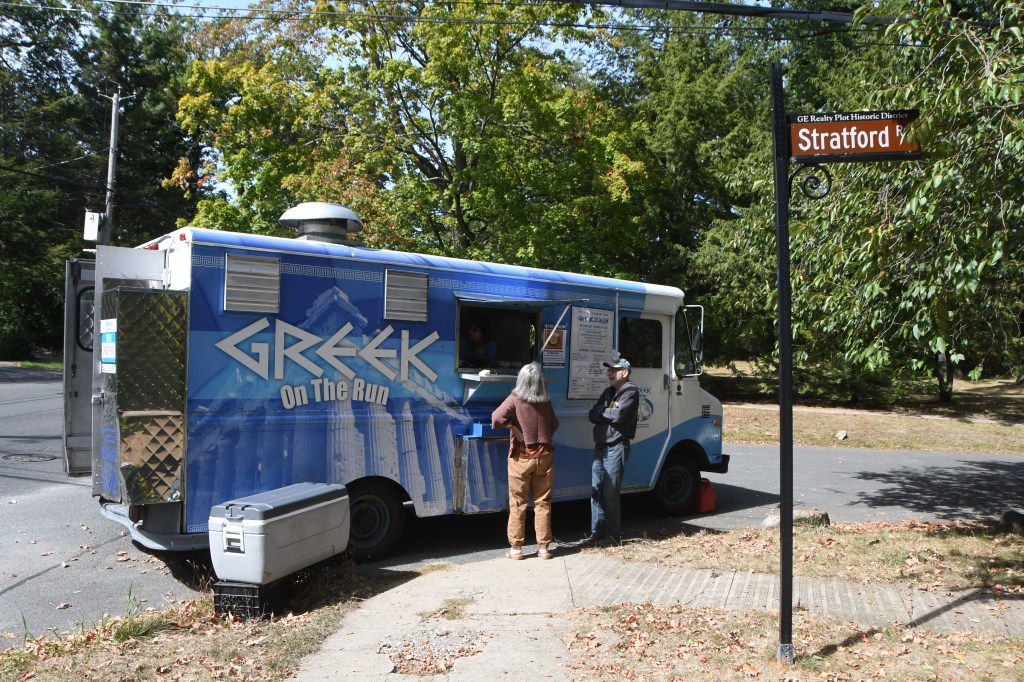
While parking is less dense/problematic than some might expect, most wanderers roam from porch to porch on bicycles, scooters, skateboards, roller-blades or just on foot. Google Maps locates the two most distant porches at 18 minutes apart on foot, just less than a mile. Food trucks by the Broken Inn and Greek On the Run serve on Rugby Rd. and Ardsley Rd. while porta-johns also await.

The music ranges from Gospel by the Calvary Choir and Musicians to classical with the Chirignan-Hardage duo, blues by The Evidence, Latin-jazz dance music by Alex Torres and his Latin Orchestra, jazz by players and singers including brass bands Signature Brass, Backyard Brass and Brass Abbey. One plays in alpine lederhosen with happy oompah oomph and features trumpeter Steve Weisse. He auditions porches and performers and rounds up support by the American Federation of Musicians (all musicians are paid), the Mohawk Valley Society for Live Music, the Music Performance Trust Fund, Mona Golub, the Schenectady County Legislature Arts and Culture Fund, Stewart’s Shops and the Schenectady Foundation.

All this support means PorchFest is free to fans; so we can all sample stuff we’ve never heard of. I recommend this. Like something? – stick around. Or, not? – just drift; something else is right around the corner. For example, in the past, I’ve been pleasantly surprised by the inventive pop group Nice Hockey, and expect more surprises Saturday. 

Ignore the loud cannon shots that signal scores by the Union College football team, playing close by the Douglas Rd. porch that presents two jazz groups.

Check www.schenectadyporchfest.org for who’s playing when, on which porch and how to find them.

Jazz Dessert

Stella Pasta Bar serves a jazz dessert Saturday: the newly formed MS Organ Trio. MS is prolific, restless reeds player and composer Matt Steckler, who forms a new band every few minutes. OK, I exaggerate; but he often creates fresh contexts for his compositions.

The MS Organ Trio is Steckler, saxophones and flute, Jon LeRoy, organ; and Pete Sweeney, drums. Show time is 6 p.m. for this free-admission weekly showcase. Steckler says they play “Right after Kevin Carey’s group at Porchfest!” 

FYI, Stella Pasta Bar is at 237 Union St., Schenectady; it’s the bar and dining room space downstairs from the Van Dyck Music Club, which has also resumed presenting live music.

Two Much Jazz; A Preview

Jazz fans face a tough choice Friday between two cool shows. There’s no wrong one: guitarist Peter Bernstein Quartet at A Place for Jazz, OR drummer Ari Hoenig in Caffe Lena’s Peak Jazz series.

A Jim Hall protege at New York’s New School, Bernstein hit the big-time when Hall invited him into a guitar showcase at the 1990 JVC Jazz Festival with Pat Metheny, John Scofield and others.

Peter Bernstein. Photo provided

That same year, Bernstein joined saxophonist Lou Donaldson’s band, then (drummer Jimmy) Cobb’s Mob. He played with organist Larry Goldings and drummer Billy Stewart in what the New York Times called “best organ trio of the last decade.” He’s released nine albums and a DVD, “Live at Smoke,” as a leader and played with Sonny Rollins, Lee Konitz, Wes Montgomery, Tom Harrell, Joshua Rodman, Diana Krall, Nicholas Payton and Eric Alexander.

Hall hailed Bernstein’s “attention to the past as well as the future,” while Donaldson noted “Some people just have it…Peter just knows it all.” Bernstein’s recent albums include the tribute “Monk” (2009) and “Solo Guitar – Live at Smalls (2013).” 

Friday, he plays A Place for Jazz with David Hazeltine, piano; John Webber, bass; and Joe Strasser, drums; in the Carl B. Taylor Auditorium in the music school of SUNY Schenectady County Community College. 7:30 p.m. $25 at the door, cash or check. http://www.aplaceforjazz.org.

Ari Hoenig. Photo provided

Hoenig follows innovators, notably hard-bop pioneer Max Roach, who punched big holes in the notion that drummers can’t, or shouldn’t, lead bands. Hoenig emphasizes melody in his playing, in small bands where each player must reaches beyond their instruments’ traditional roles.

Friday at Caffe Lena, Hoenig drums with pianist Gadi Lehavi and bassist Ben Tiberio, the same trio that released “Golden Treasures” (2022) and Tea for Three” (2024).

On more than 120 albums as leader and sideman, Hoenig has developed his melodic style with stars including Joshua Rodman, Shirley Scott, Kurt Rosenwinkel and Chris Potter. 

He plays Caffe Lena (47 Phila St., Saratoga Springs) Friday as part of the Caffe’s Peak Jazz Series, sponsored by Joseph and Luann Conlon, in memory of Corinne Simonds. 8 p.m. Tickets: $27.15 (members), $30.40 (general) and $15.20 (students and children). 518-583-0022 www.caffelena.org.

Seriously Sad Caffe Lena Note: 

Monday night, the Caffe lost Joel Moss, longtime sound engineer for live streaming. Grammy winner as producer or engineer, Moss was a reassuringly confident, super-competent musical technician; also a sweet, quietly witty presence that made him a friend to everyone who crossed his path.

Joel Moss, the late, great. Photo provided

When New Orleans-style jazz clarinetist Evan Christopher played Caffe Lena some seasons ago, he recognized Moss from playing a Los Angeles session Moss had produced. Awed, Christopher asked to be introduced to Moss.

Moving from Detroit to Los Angeles in 1969, Moss produced or engineered records for Little Richard, Ray Charles, Joe Cocker, Johnny Cash, the Eagles, Talking Heads, Red Hot Chili Peppers and too many more to list.

By 1986, he ran LA’s Record Plant and Paramount Pictures studio where he produced film and TV scores.

Later, in New York, he made Broadway cast recordings and won a Grammy for Best Musical Show Album for the Lin-Manuel Miranda/Quiara Alegria Hudes smash  “In The Heights.” Nominated 11 times, Moss won seven Grammy Awards, including for Ray Charles’s last album. He also won an Academy Award, was nominated for two Emmy Awards and was inducted into the 2022 Capital Region Thomas Edison (the “Eddys”) Hall of Fame.

In Saratoga, Moss produced the regional compilation “Saratoga Pie” and many other projects, and engineered hundreds of live streaming performances from Caffe Lena – where he had performed as a member of Detroit’s folk group the Hi-Liters not long after the Caffe opened. He was so modestly self-effacing you’d only know his achievements by talking with musicians.

“Joel, I’m incredibly grateful to have had you in my life and honored to have become good friends,” wrote Brian Malick on Facebook. “The world is a lot darker and colder today, but your warm loving beautiful spirit will be with us for the rest of our days… Blessed to have been in the music with you more times then I can count, and thank you for a truly remarkable inspiring legacy of work.”

“Joel was a fierce, loving, impassioned force of a man” wrote Lecco Morris. “He was always buzzing — with the beauty of his current project, his anger and hope for the state of the world, his belief that making incredible things together would chip away at the ugliness of the world and lift people up…He was utterly disinterested in anything except beauty and honesty, and would tirelessly support anyone and any project that he believed in….So honored to have spent so many working years on so many projects with such a dauntless, pure artist as Joel. My love to (wife, photographer and music lover) Terri-Lynn Pellegri, who hung the sky for Joel. In his honor we have to make true, beautiful things, without compromise.”

Amen and amen.

Road Trip: Alejandro Escovedo in Northampton

Review: Alejandro Escovedo at the Iron Horse, Northampton, Mass., Saturday, Sept. 13, 2025

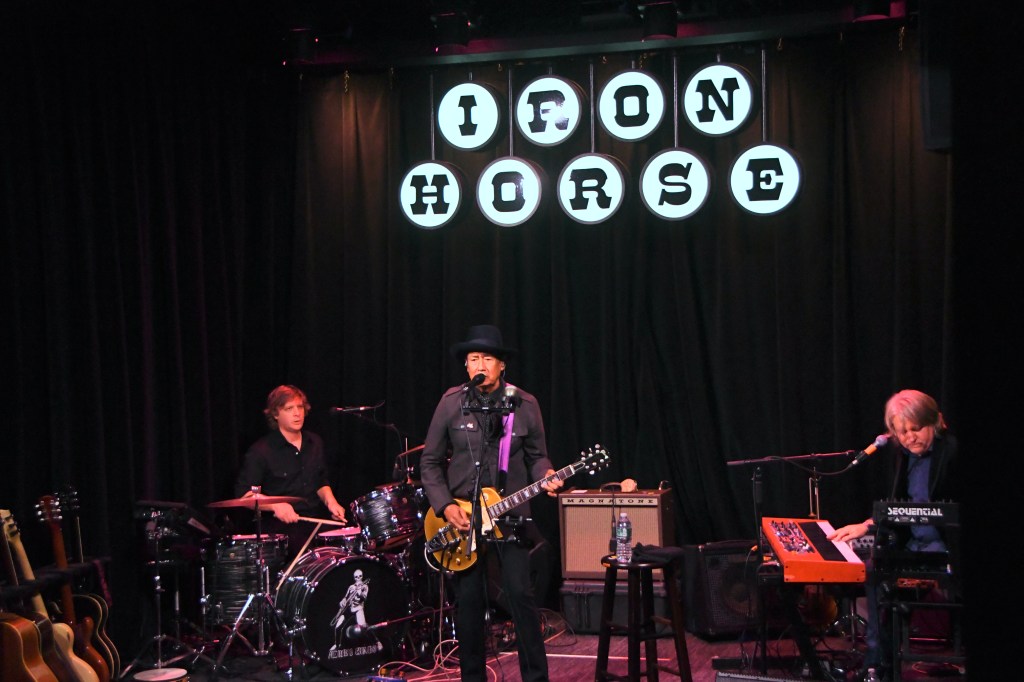
Alejandro Escovedo, center; with Mark Henne, drums; and Scott Danborn, keyboards

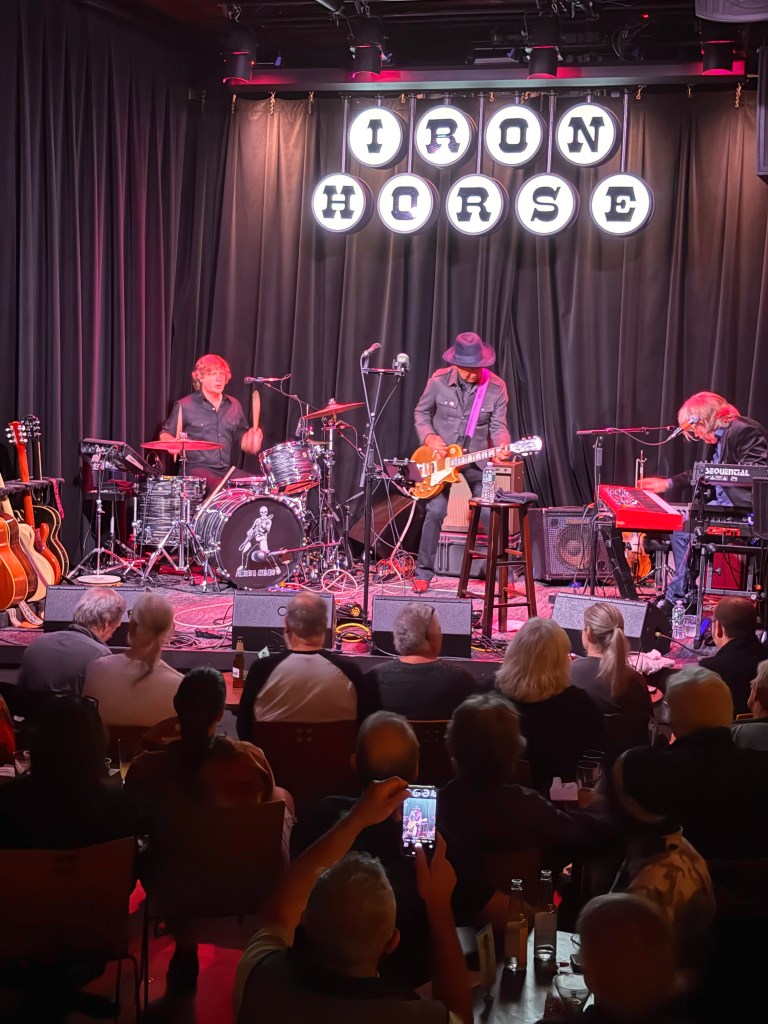
Alejandro Escovedo peered around the recently restored/reopened Iron Horse Saturday. He said, “Everything changes” and proved it. He led a new band – he always leads a new band – but in mostly familiar songs. Young Texans drummer Mark Henne and keyboardist Scott Danborn – he played three, one producing thunderous bass – replaced Don Antonio, the Italian band heard on his “The Crossing” album and recent tours.

The new trio’s stripped strong sound rang loud and clear, thanks to road manager/sound engineer Brandon Eggleston. At our balcony table in the packed house, we could feel Danborn’s keyboard bass booming up through our feet while Henne’s four-on-the-floor drum beats – kick and snare, mostly – and feedback blasts from Escovedo’s guitar made exposed skin tingle. 

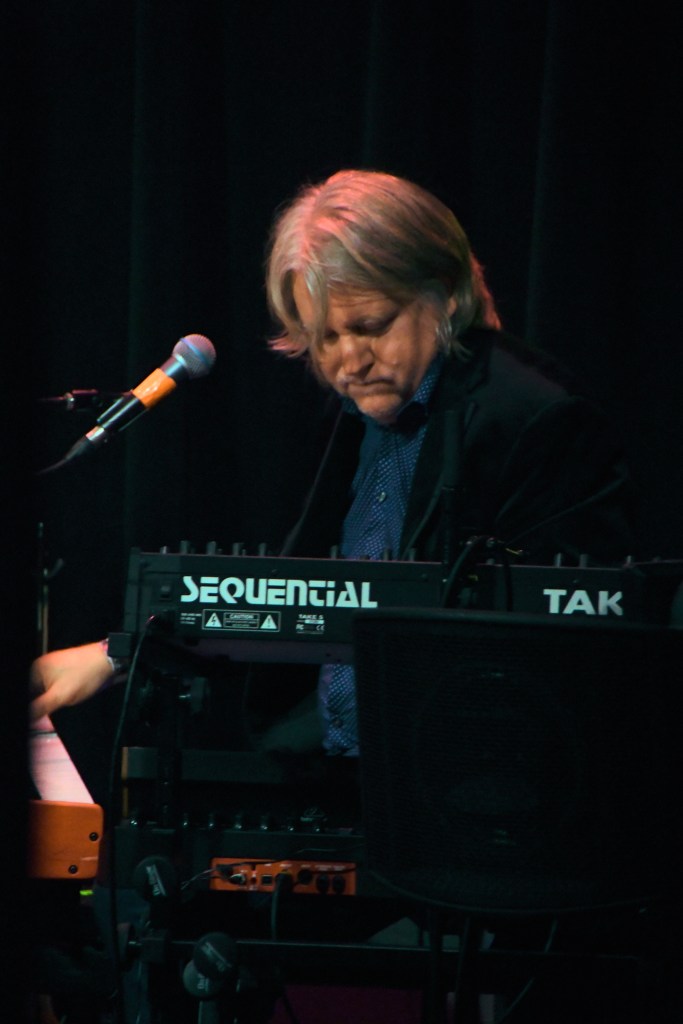
Scott Danborn, left, back to the camera; Alejandro Escovedo, and Mark Henne

Before he played a note, Escovedo set his music in place and time, telling a five-minute immigrant family’s kinetic history from Texas to California and back before launching at a roar into “Wave,” set in his birthplace, San Antonio. A later tune titled “San Antonio Rain” was set in surf-town California, but it made autobiographical sense, hinting at a geographically and culturally divided childhood. What was a displaced guy from a musical family to do but fall in love with punk rock, write songs like a heart’s road-map and sing them like life and death?

At 70, Escovedo’s shows have grown ever more autobiographical over time, so the honeymoon-hurricane valentine “Luna de Miel” (“honeymoon”) combined romance with a very real disaster threat both in his affectionate intro-dedication to wife Nancy and daredevil performance. He reached back to his second album “Thirteen Years” (1993) for his earliest tune Saturday; but everything shared consistently powerful sound and complete investment in the bone-deep songs.

The band played tight and dynamic after weeks on the road (Bearsville Theatre Thursday, Stone Mountain in Maine Friday). Everybody sang, and pretty well, while Danborn worked high and low, left hand on the bass-tuned keyboard, his right sculpting melodies in piano, electric piano and organ sonic colors.

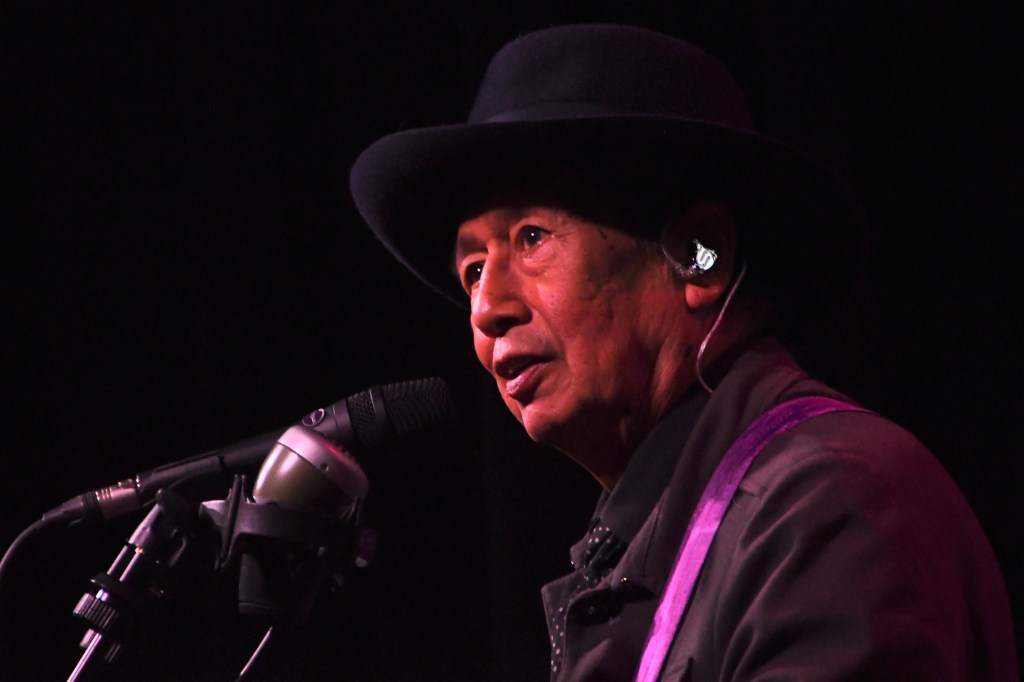
Alejandro Escovedo, top; and Scott Danborn, below

The stop-and-go cadence in “Break This Time” hit with breathtaking precision as Escovedo, warmed up by his big guitar break in “Sometimes,” chainsawed through the chorus. Danborn put some Texas tang on it, echoing the curly organ break in “96 Tears.” 

Keyboard power also punched up the plaintive “Baby’s Got New Plans,” igniting a unified riff rush.

Things grew quiet(er) when Escovedo swapped to an acoustic guitar and launched a slow, soft intro to “Dear Head On the Wall;” he paused to describe it as concerning taxidermy and Buddhism, but then rocked it anyway, bass booming.

“Something Blue” from the Don Antonio “The Crossing” sessions traced a similar dynamic from wistful musings to assertive keyboard blitz; so did “San Antonio Rain” and the dramatic doom-struck very New York “Down in the Bowery.”

Mark Henne, left; and Alejandro Escovedo

Grabbing his electric guitar signaled a return to all out rock and roll force, as in the early songs, but bigger, fiercer as guitar feedback over a menacing keyboard drone built “Sally Was a Cop” into a mournful explosion of violence. Its peak left listeners too stunned to clap, so Escovedo guided the mood into a singalong.

This peaceful respite proved temporary as Escovedo revved the band, the place, and everybody with uptempo flat-out favorites that did what they always do – including a thrilling departure-less encore of “Always A Friend” and “Castanets.”

Folk Style Opener

Chris Gruen, right; and Paul Casanova

Vermont singer-songwriter Chris Gruen – yes, son of rock photographer Bob Gruen – set a quiet, thoughtful mood in a gentle, lyrically smart opener. He strummed or picked an acoustic six-string alongside electric guitarist Paul Casanova, a master of subtle and beautiful coloration whose delicate lyricism echoed the late great Jesse Ed Davis who, in a post-set conversation, he said he’d never heard of.

Paul Casanova

He didn’t have to; his playing was as original as it was lovely, spicing and spacing well-made songs including “Water Into Wine,” “When She Says,” “Heaven on a Car Ride” and “Mothers in the World.”

Chris Gruen

Alejandro Escovedo Set List

(I maybe missed a title or two near the end, swept away. Titles are listed with their source albums.)

Wave – By The Hand of the Father (2002) A Man Under the Influence (2001)

Sometimes – With These Hands (1996)

Break This Time – The Boxing Mirror (2006)

Luna de Miel – Burn Something Beautiful (2016)

Baby’s Got New Plans – 13 Years (1993)

Dear Head on the Wall – The Boxing Mirror (2006)

Something Blue – The Crossing (2018)

San Antonio Rain – Big Station (2012 – Chuck Prophet co-write)

Down in the Bowery – Street Songs of Love (2010)

Sally Was a Cop – Big Station (2012 – Chuck Prophet co-write; also on Live From Norfolk Street album, 2022)

Put You Down – With These Hands (1996)

Always a Friend – Real Animal (2008) 

Castanets – A Man Under the Influence (2001)

BACK PAGES

Two hours, door to door, from my Schenectady home to the Iron Horse

Taste of Northampton, a two-day afternoon food festival in downtown Northampton’s Armory Street Parking Lot off Main Street, packed dozens of food and beverage tent-booths and hundreds of diners into a happily clamorous and aromatic gathering. Eateries in that town of good restaurants pared down their menus for efficient prep and service. Live music, mostly Latin and/or soul, was OK, but unnecessary with Alejandro Escovedo on the Iron Horse menu.

I don’t know if he recognized me, passing close from the downstairs green room through the crowd to the stage where I lurked to photograph. But he fist-bumped me, like in Albany at The Egg, like at the Cohoes Music Hall (playing solo); like at Revolution Hall (big band) the same week the Stones played the Pepsi Arena after Charlie’s cancer scare, like back at the hotel after playing Chickie Wah-Wah in New Orleans.

Before the show

Opener Chris Gruen, left; and Paul Casanova

Escovedo’s set list from Friday at Stone Mountain. Though this was set on the stage, he detoured away early in the Northampton show.

HAVE YOU READ…?

Alternate Title: Almost Famous

I walked into the Open Door book shop on Schenectady’s Jay Street a few weeks ago, a favorite destination where I’ve found many cherished books and one lover, ditto.

Decades ago and half a block south, Stereo Sound (now Orion) sold audio gear on the first floor, admin stuff happened on the second and Kite arts weekly was published on the third; first pub to run my stories. (Thanks, Don Wilcock, my first editor.) When I came back after six years mostly away – two years in a not-very-good college, four overseas in the Navy – almost everybody I knew in town worked there. 

Across the street, the Jay Tavern (now Ambition) made big sandwiches, but proprietor Ed Karwan grumbled about longhairs filling the red-seated booths of the narrow, dark saloon. Some doors away, Hy Sofer’s deli sold big sandwiches, too. Whatever you ordered, even if it were lunch for 400, Hy would up-sell, asking, “And, vhat else?”

The New World Theater staged plays upstairs from an exotic boutique; and nearby Joe Holloway founded the first health food store in town, Earthly Delights. My friend Mary Swatt ran it for years thereafter.

Back when you could still drive down it, Jay Street was a charming one-block hippie enclave that’s changed a lot. Except to grow larger, the Open Door fortunately hasn’t. Thank you, Betty Fleming, then Janet Hutchinson. 

I walked in a few weeks ago to pick up a book I’d ordered for Ellie, my intrepid traveler wife. In April, she took an icebreaker cruise around Greenland, gifted by a generous friend. Then I heard about a novel called “The White Bear” set in tiny Inuit villages along its rocky, ice-rimed coast.

As I paid, my friend Lily came from the back to stock books on reserve in the shelves behind the register. She had worked at the Gazette part of the time I did, too; but had been at the Open Door for years.

She asked, “Have you read Dennis McNally’s new book yet?”

I told her I hadn’t, and she said her husband George had just read and loved it. “He says you’re in it.”

“What?! Do you have a copy here?”

She went to the display shelves and brought back this:

I found my name in the index, turned to page 315 and found myself described and quoted.

You know: almost famous.

The first time I saw the name Dennis McNally was on a book spine. His “Desolate Angel: The Beat Generation & America” (1979) is a well-researched and highly readable biography of Jack Kerouac. Expanded for publication from his Ph.D. thesis in history at UMass, and based on secondary sources rather than interviews with the principals, it would have felt scholarly and stiff if McNally hadn’t been such an adroit and vivid prose stylist. It reads as fun as much as information.

Grateful Dead guitarist-singer-symbol Jerry Garcia also admired McNally’s Kerouac bio and hired him to write the Dead’s biography. When they realized they needed a full-time publicist, Garcia said, “McNally can do it.” He did, for busy decades, his bio book set aside.

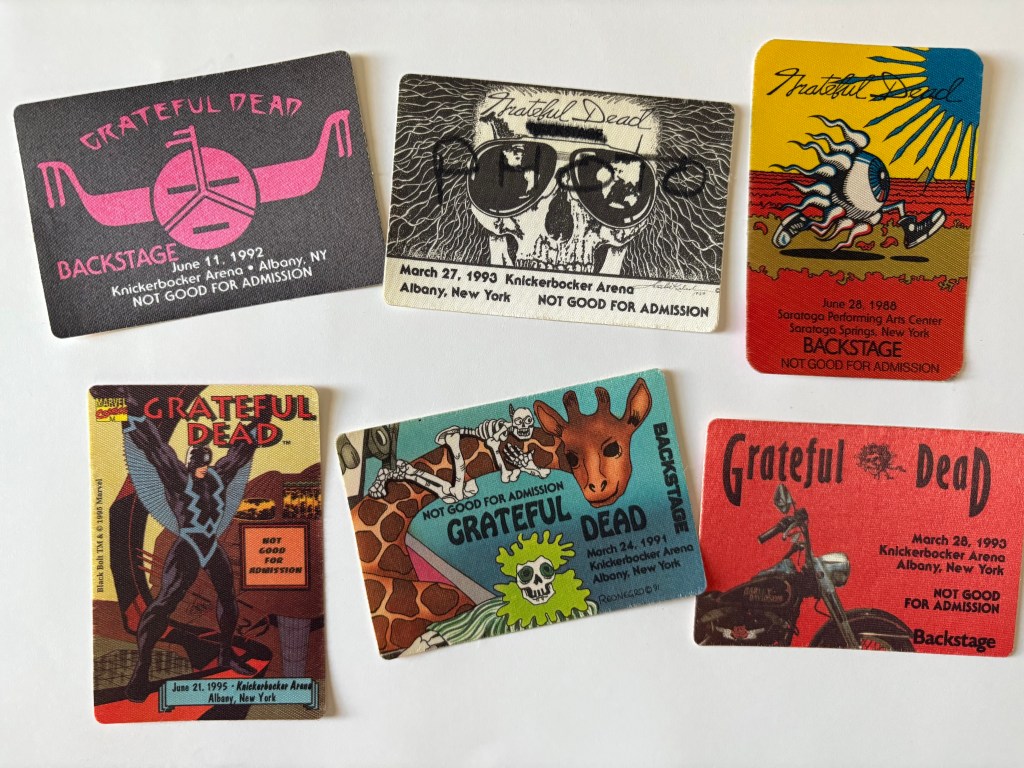
When McNally first came to town as the Grateful Dead’s publicist, I brought “Desolate Angel: The Beat Generation & America” to our meet-up to get my press tickets and backstage pass. He was delighted, graciously signed it for me and ever after greeted when we met, as his inscription reads, “a friend on the road.” 

McNally changed the Grateful Dead public narrative from the sometimes disruptive intrusion of happy aromatic longhairs, pilgrimaging into parks and parking lots in towns the Dead played, to focus instead on the music. 

So he generously provided access to the music and musicians through phone interviews, MANY tickets and passes. He once shrugged off my thanks for taking a bunch of us writers out to lunch, saying, “Jerry’s got this.”

In the years since Jerry Garcia passed (1995), McNally published “A Long Strange Trip: The Inside History of the Grateful Dead” (2003), augmented later by “Jerry on Jerry: The Unpublished Jerry Garcia Interviews” (2015), and “On Highway 61: Music, Race, and the Evolution of Cultural Freedom” (2015). 

These academic-sounding titles may suggest a scholar’s over-reach, to expand a discrete story into broader cultural analysis. McNally, however, is an Olympic-level master of that jump, springing from incidents and episodes to their meaning – both as understood then and more clearly seen now. “On Highway 61,” for example, launches from our earliest social critics Thoreau and Clemens/Twain to an appreciation of bebop jazz saxophonist Charlie Parker, without inducing thematic whiplash.

McNally’s new “The Last Great Dream” shines a clear light (and rear-view mirror) on the evolution of American popular culture from the 1950s into the  60s, sketching vivid capsule bios of hero-influencers and setting their achievements within the zeitgeist.

He examines 1950s and 60s culture heroes we know under just one name: Kerouac, Ginsberg, Kesey, Leary, Miles, Dylan, Ferlinghetti, McClure, Snyder, Rexroth. They’re poets, musicians, radio DJs, booksellers; the inventors of musical styles, newsletters and onstage liquid light shows. He traces the introduction, evolution, adoption and influence of their ideas and ideals; and the opposition that often greeted many.

For example, he describes the influence of Harry Smith’s epic “The Anthology of American Folk Music” on generations of musicians, writers, scholars and fans. “It was our Talmud, it was our Bible,” said folksinger Dave Van Ronk, the fabled pope of Greenwich Village. While McNally gives San Francisco its due as cradle of the egalitarian let-the-good-times-roll hippie ethos in the Haight-Ashbury “Summer of Love,” Greenwich Village is the book’s geographical co-star, where Smith collected the 78 rpm antique records that became his 84-song, six-LP anthology and where such fellow, following folksingers as Bob Dylan discovered buried treasure tunes. 

McNally also adds that when Allen Ginsberg tired of Smith’s overlong residency on his couch, he asked Jerry Garcia to provide Smith a grant from the Dead’s Rex Foundation. McNally reports that Garcia replied, “Of course. I owe him a lot for that collection.”

McNally describes Smith this way. “A cosmic visionary and a serious anthropologist from the age of fifteen, a true bohemian and psychedelic pioneer, Smith’s physical growth had been stunted in his childhood by rickets, and he was small, hunched, and not infrequently difficult, a penurious, maddening, cranky and belligerently opinionated alcoholic mooch.”

What a fun parade of adjectives there.

I love the book less because I’m in it than because Dennis McNally wrote it.

BACK PAGES

I sub-titled this “Almost Famous” –  so thank you, Cameron Crowe, whose 2000 rock ’n’ roll film title I borrow here. That title sits next door to “Almost Magic,” the celestial song by marvelous singer-songwriter Syd Straw. Seeing her sing it at QE2 around three in the morning was one of the most astonishing musical moments I’ve seen in decades of shows. Stevie Wonder’s “If It’s Magic” isn’t far behind, but I digress.

When Jerry Garcia heard that Ben & Jerry’s had named their ice-cream flavor Cherry Garcia after him, he told McNally, “At least they got my name right.” McNally suggested a compensation arrangement, to mutual satisfaction.

When I met McNally on his book tour for “A Long Strange Trip” that brought him to Stuyvesant Plaza, he called me over and had a second chair brought behind his author’s table so we could catch up. That same night, years after his Dead publicist gig had ended, The Other Ones were playing downtown at the Knick-Pepsi-Times Union-MVP Arena. The first, and in my view the best, Dead successor band, it featured all the surviving Grateful Dead members, also singer Joan Osborne and guitarists Jimmy Herring and Warren Haynes.

When Dead guitarist Bob Weir’s other band Ratdog played Albany’s Palace Theater, McNally met me under the marquee with my tickets and backstage pass; then suggested we meet an old friend at the Quackenbush House (now the Olde English Pub), down Clinton Street on Broadway. At the bar sat Tom Davis of his Saturday Night Live-spawned duo with Al Franken. After introductions, McNally walked back up to the Palace to meet my writer colleagues while Davis talked about the memoir he was then writing; well, struggling to write. He didn’t have a title then, and had doubts and questions he didn’t mind airing with a fellow scribe he’d just met. The project became “Thirty-Nine Years of Short-Term Memory Loss.”

That night, when my primitive modem wouldn’t connect with the Palace’s phone system to send my review, McNally took me onto the Ratdog tour bus parked on Pearl Street and connected me with the bus’s online service. How odd to write a review of musicians as they came aboard the bus, walked right past me and said “hi,” then send it to the Gazette while sharing beers.

Once at Jazz Fest in New Orleans, McNally and Gulf Coast boogie pianist Marcia Ball appeared together in a cozy talking-and-playing presentation in the grandstand area. They spoke of musical styles and demonstrated them. Afterward, McNally spoke with sweet reverence of how fun it was to sit just a few feet from where her hands made magic on the keyboard.

McNally does the same at his keyboard.

A Wild and Fierce Flame

Review: The David Murray Quartet; Friday, Sept. 5 at A Place for Jazz

Veteran reeds player David Murray lit a wild and fierce flame Friday at A Place for Jazz. Launching the non-profit, all-volunteer programming crew’s 38th season, he evoked the ferocious anarchy of last-generation free-jazz pioneers Albert Ayler and Archie Shepp, with gentler tastes of swing evoking balladeer Ben Webster and bop giant Sonny Rollins.

David Murray Quartet, from left: Marta Sanchez, piano; Murray, tenor saxophone; Luke Stewart, bass; Russell Carter, drums

Murray challenged the audience right out of the box with the kinetic “Come and Go” – 20 minutes of wild waltz. He played the whole tenor, from low whomps in the basement to rummaging from room to room in restless chord explorations to kicking open the attic door where the really high notes waited for their moment.

He set a high bar for energy and invention but his generation-younger band-mates hung tight with him. Marta Sanchez played within the tunes, mostly, spicing things up with percussive Cecil Taylor rips when things went furthest outside. Bassist Luke Stewart and drummer Russell Carter seldom even glanced at each other to coordinate; they didn’t have to, as they played from deep in the same pocket, and they happily made strange sounds when things went wild.

That happened a lot, over a 75-minute first set and 70-minute second; when fans in A Place for Jazz’s home in SUNY Schenectady County Community College’s Carl B. Taylor Auditorium might have appreciated seat belts.

David Murray, tenor saxophone

Songs exploded in Murray’s energetic exploration of their furthest sonic possibilities. When (or if) the shock of the new abated some, their logic revealed itself. Everything fit and everything swung, even the jagged bits.

In “Ninno,” Murray’s tenor fluttered around the main theme before stating it clearly, then racing outside. He strolled into the wings after his first solo here, as in most songs; but tuned in to what his bandmates played in his absence. Returning to take over after Sanchez had her say at the piano, he echoed on his tenor the trills she’d just played. Then he tucked a mellow melodic interlude between blazing blasts. Most times, he played his way back onstage, his horn growing louder as he approached the mic.

Marta Sanchez, piano, above; Luke Stewart, bass, below

Explaining the bird-call inspirations of his new album “Birdly Serenade,” he played “Song of the World” mostly in the middle register and in such mellow tones you could imagine Ben Webster or Coleman Hawkins calmly laying it down. Then, as if Albert Ayler invaded the session, high-note squeals and squawks erupted.

Russell Carter, drums

Bebop spunk powered “Black Bird’s Gonna Light Up the Night,” Murray and Sanchez playing in parallel before he left the stage for a bottle of water, leaving his crew to fly it around at length. Stewart echoed Murray’s high-note fire with percussive treble scratching that accelerated into a gallop, then a repeating riff that cued the returning Murray into unified hard-bop funk. 

As the band vamped, he then recited Amira Baraka’s ferocious slavery lament “At the bottom of the Atlantic Ocean, there’s a railroad made of human bones.”

Nothing but intermission could follow that.

Around the time most A Place for Jazz shows end, they returned to bebop something on the chords of “It Ain’t Necessarily So,” at first gently, then faster, denser; this time mutating the rhythm as much as the melody.

And even “Beautiful Child,” the show’s sweetest and prettiest number that followed, offered its taste of wild and free, a storm between rainbows. 

For Monk’s “Let’s Cool One,” Murray swapped tenor for bass clarinet, swinging it as a New Orleans antique with a bluesy feel; then appending a breezy rush as the coda while the band laid out.

David Murray, bass clarinet, above; reciting a tribute to Albert Ayler, below

As in the first set, Murray ended the second with a recitation, the spoken-sung refrain “He left us here to sing his song” identifying it as his tribute “Flowers for Albert” (Ayler) – title track of his 1976 debut album. Like most things they played, this packed a surprise; but rather than the launch-out-past-Jupiter high-note romp that stretched most songs, this was gentler, evoking the sunny Caribbean flair of Sunny Rollins at his happiest. Here Murray briefly used rotary breathing to stretch phrases past what most players could deliver; inflating his cheeks, Dizzy style, while breathing in and simultaneously blowing hard through the horn.

At 70, aided by generation-younger Sanchez, Stewart and Carter – whose drumming packed both power and smarts – Murray proved he can play anything he wants to. And Friday, he wanted to shake things up, or blow them up, then bring them home, or not.

A Place for Jazz – www.aplaceforjazz.org – continues with shows on alternate Fridays:

Sept. 19: (Guitarist) Peter Bernstein Quartet

Oct. 3: (Saxophonist) Sarah Hanahan Quartet

Oct. 17: (Saxophonist) Leo Russo Sextet

Nov. 7: (Singer) Tyreek McDole

A Place for Jazz Door Swings Open Friday

Preview: David Murray at A Place for Jazz, Friday, Sept. 5, 2025

Prolific, versatile saxophonist and bass clarinet player David Murray brings credibility miles wide to open the new season at A Place for Jazz Friday. 

Even if it never actually happened, we can imagine him, underage, sneaking into 52nd Street clubs where giants invented bebop in the 50s; then other geniuses roughed it up into hard bop. And we might be surprised to see Deadheads coming in to see him Friday, drawn by Murray’s 1996 album “Dark Star: The Music of the Grateful Dead*.” Murray has made music everywhere between those influences and may be the most influential jazz artist to play here in years.

David Murray. Photo provided

Wikipedia – it’s OK, I support them – cites noisy 1960s free-jazz saxophonists Ornette Coleman, Albert Ayler and Archie Sheep as early influences but also notes earlier, gentler swing stylists Coleman Hawkins, Paul Gonsalves and Ben Webster shaped the fluent and lyrical side of Murray’s playing. However, his debut album, “Flowers for Albert” (1976- an Albert Ayler tribute), has a happy hard-bop bounce – and he’s recorded it several times with different bands, big and small.

Announcing Friday’s show, A Place for Jazz credited Murray with 200 albums as leader and sideman while Wiki’s Discography specifically lists nearly 100 as leader or co-leader. That doesn’t count 22 he made with the World Saxophone Quartet from 1977 to 2010; Murray was a founder, with Hamiet Bluiett, Julius Hemphill and Oliver Lake. Murray collaborations in all directions include albums with Sunny Murray (no relation), Teresa Brewer, the Roots, Jack DeJohnette and James Blood Ulmer.

Murray released eight albums in 1978 alone, then 13 in 1991. These appear on 10 different record labels; I consider this a mark of honor, of stubborn creative independence in listening to his ambitious, wide-ranging muse more than corporate commercial considerations.

These many albums, and live performances ranging from solo saxophone explorations to bustling big bands, have earned impressive awards that stack tall on paper and would fill yards of mantel space:

In 1980, the Village Voice named (then 25-year-old) David Murray its Musician of the Decade.

North Sea Jazz gave Murray its 1986 Bird Award. 

Murray received a Guggenheim Fellowship three years later, when he also won the Grammy Award for Best Jazz Instrumental Group Performance honoring his “Blues for Coltrane: A Tribute to John Coltrane.”

Denmark’s Jazzpar Prize came to Murray in 1991, only its second year.

Newsday newspaper named him Musician of the Year in 1993.

He received an honorary doctorate in music from Pomona College in 2012, 35 years after he’d enrolled there but left after two years, having already released seven albums on five different labels.

In 2021, the California Arts Council honored Murray with its legacy grant.

Last year, Murray led his new quartet in recording “Francesca,” a tribute to his multi-talented wife Francesca Cinelli-Murray who contributes poetry (as lyrics) and visuals for his albums. She produced and directed an animated video for the song “Ninno” on the album with painter and animator Nancy Ostrovsky.

The New York Times named “Francesca” No. 2 Jazz Album of the Year while Downbeat listed it among the best jazz albums of the year.

The same quartet that released “Francesca” plays with Murray at A Place for Jazz Friday: Marta Sanchez, piano; Luke Stewart, bass; and Russell Carter, drums.

These days Murray mainly plays tenor saxophone and bass clarinet, joining Eric Dolphy and Benny Maupin in fostering the latter saxophone-sized “licorice stick” as a jazz instrument. Like Dolphy, Murray has also been influential in restoring the flute to jazz prominence. Murray uses rotary breathing – inhale through the nose while exhaling from the mouth through the instrument – to play spectacularly long phrases. While Rahsaan Roland Kirk used this technique to astonishing effect on “Bright Moments” (1973) and other masterpieces, Trombone Shorty has recently wowed audiences by playing forever-long lines on trumpet.

A new album, “Birdly Serenade,” features the same crew as on “Francesca” and onstage Friday at A Place for Jazz.

This new A Place for Jazz season, the 38th, presents both established stars and young breakout performers, with homegrown-legend saxophonist Leo Russo in the traditional local heroes slot. 

Sept. 19: (Guitarist) Peter Bernstein Quartet

Oct. 3: (Saxophonist) Sarah Hanahan Quartet

Oct. 17: (Saxophonist) Leo Russo Sextet

Nov. 7: (Singer) Tyreek McDole

Show time is 7:30 p.m. at the Carl B. Taylor Auditorium in the Begley Building (Music Department) of SUNY Schenectady County Community College. Admission is $25 with a season discount: seven tickets for the price of five. http://www.aplaceforjazz.org.
Admission at the door is $25, cash or check (ATM available). 

  • In David Murray’s album “Dark Star: The Music of the Grateful Dead,” the title track explodes in free-jazz anarchy before a trombone emerges from the fray to state the main theme of this jam-band classic. Dead guitarist and singer Bob Weir, who led the periodically reconstituted (since Jerry Garcia’s death in 1995) band in recent farewell shows in San Francisco’s Golden Gate Park, plays on one track.
  • Jazzification of the Grateful Dead repertoire continues at full speed, but for this conversation, let me just mention Murray’s fellow saxophonist, the similarly-named, David McMurray’s two Grateful Dead albums “Grateful Deadication” (2021) and “Grateful Deadication 2” (2023).