

Review: SteelDrivers, and Reese Fulmer and the Carriage House Band, Sunday, Aug. 10 at Music Haven
As young bluegrass players Billy Strings, Sierra Hull and Molly Tuttle, focus widening attention on this venerable style, the SteelDrivers made their point Sunday at Music Haven without reaching into the Bill Monroe songbook at all; they write their own.
When Vassar Clements dubbed his band Hillbilly Jazz, he described bluegrass in binary-but-combined terms. Sunday at Music Haven, the headlining SteelDrivers worked from the polished, jewel-like side of that comparison; country music on acoustic instruments. Openers Reese Fulmer and the Carriage House Band played looser, more spontaneously. If the name SteelDrivers suggests inexorable locomotive force, Fulmer’s crew felt cozy, organic.
More important than any differences, though, was how both bands made music mostly of menace, mayhem and mortality, threatening retribution down here, hoping for redemption up there. As singer Matt Dame sang in a piercing wail in “I’m On My Way” late in the SteelDrivers’ 80-minute set, their music vibrates “between the bars and the Bible.” Check the set list for titles lamenting/praising various sorts of sin.
They explained where in that space their songs fit, and also did the commercial country thing, tracing tunes back to albums; easily forgivable as they celebrate 20 years onstage and on the charts. Managing to cruise past the departure of former lead singer Chris Stapleton into solo stardom attests to the sturdy materials of their sound.

SteelDrivers, from left: Richard Bailey, banjo; Brent Truitt, mandolin; Tammy Rogers, fiddle and vocals; Mike Fleming, bass and vocals; Matt Dame, guitar and lead vocals
Mike Fleming’s understated bass firmly supported the treble zip up top: Dame’s strummed Martin acoustic six-string and piercing lighthouse-through-the-fog voice, Tammy Rogers’s fiddle (arguably the jazziest facet of their sound), Brent Truitt’s pedal-to-the-metal mandolin and Richard Bailey’s wry banjo, mostly as understated as Fleming’s bass. Fleming, Rogers and Dame harmonized from stage left.

Tammy Rogers, left; Mike Fleming, and Matt Dame
They opened warning at a spry mid-tempo that no one can outrun the grim reaper, then sped up to complain to an absent lover, then to warn hell awaits, a long way down. Noting most of their songs tell of jail, drinking or killing people, they efficiently got their one happy song out of the way. In the happy yearn of “I Choose You,” Dame pointed into the wings to an unseen love.
Then, back to incarceration, alcohol and grim death; and the dire has seldom seemed so delicious.

Matt Dame
Dame waved off conversation with a neighbor at the bar asserting he’s just here for the booze and cigarettes. Later, he gloried in “Guitars and Whiskey”– guns and knives complete that checklist. If “Midnight Train to Memphis” evokes happy images of travel, banjoist Bailey wryly wrecked that notion, noting the substantial difference between jail and prison.
Songs paired nicely; the (relatively) happy “At the River” setting up the cautionary “The River Knows,” for example. The latter’s intro ominously noted, “It was justified, and he deserved it.”

Richard Bailey
Bailey’s banjo, subdued, mostly, erupted into snazzy Scruggs rolls in “Heaven Sent,” the Stapleton and Kevin Welch-penned hit. Otherwise, the riff fireworks flowed from Truitt’s mandolin or Rogers’s fiddle. Their expert picking never completely eclipsed such hard-hitting lyrics as the revenge-for-abusive-parenting anger of “Burnin’ The Woodshed Down.” But they did frame harrowing tales in lovely sounds, precise as bluegrass must be. They followed its conventions, Dame stretching the last syllable of most lyric lines, for example, but they sounded original nonetheless.

Brent Truitt

Mike Fleming

Tammy Rogers
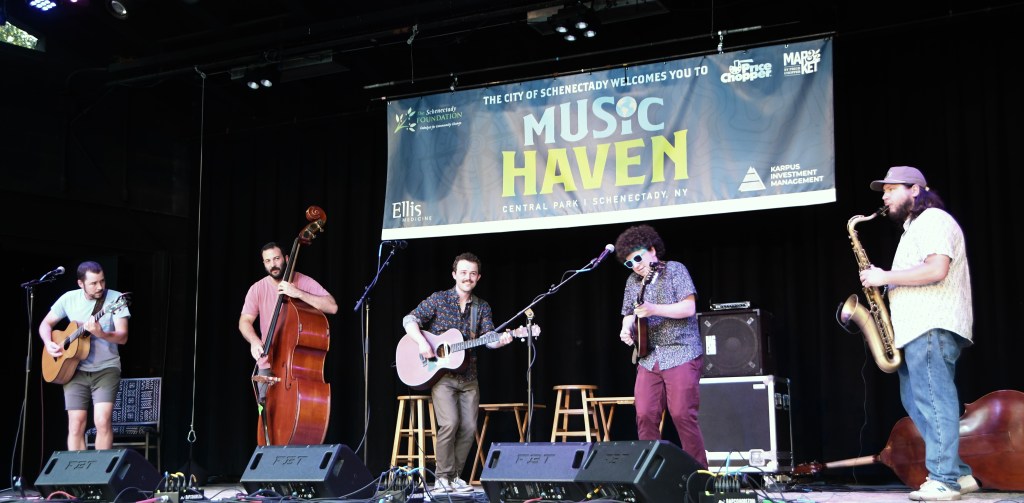
Reese Fulmer, guitar, center; and the Carriage House Band, from left: Jimi Woodul, guitar; Dylan Perillo, bass; Chris Bloniarz, octave mandolin; Connor Dunn, tenor saxophone. Reese Fulmer, below

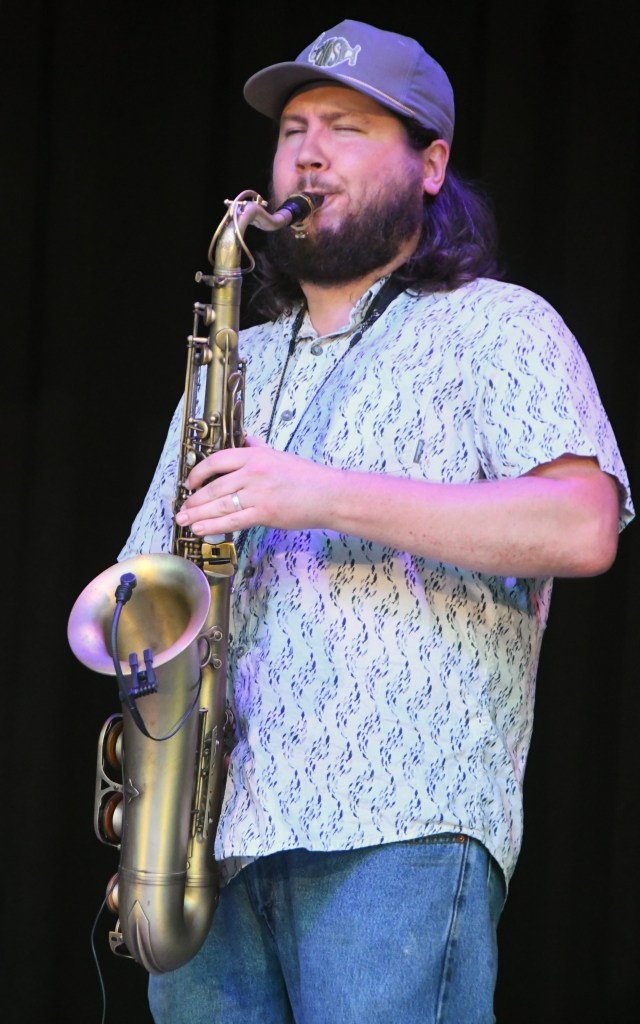
Like many area ensembles, Fulmer’s Carriage House Band boasts an elastic membership but creates a smooth sound anyway. Also like many area ensembles, it features he-plays-with-everybody bassist Dylan Perrillo; always a plus. “Elastic” also describes Connor Dunn’s surprising tenor saxophone. Some brassy evidence of jazz, right there; and it really worked. More traditional: Jimi Woodul’s acoustic guitar and Chris Bloniarz’s octave mandolin; also the acoustic guitar Fulmer strummed at the mic. Playing flowed smooth when they all cooked a groove. In between: skilled solos.

Dylan Perillo
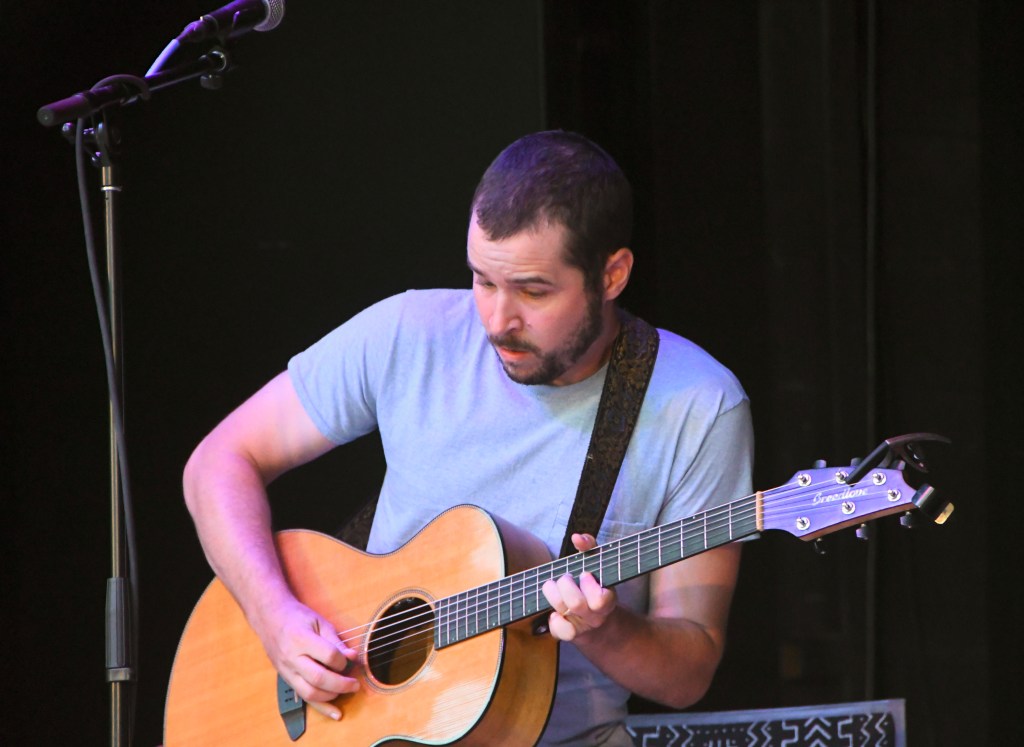
Jimi Woodul
Desire, doom, destiny, dread and death powered most songs, Fulmer going sweet or gravelly as the fates behind the words demanded. In his first two tunes Sunday, Fulmer proclaimed “I Was Born to Die” and “I lay my body down” in “3am;” the former an impressive harmony vocal showcase, the latter a propulsive groove like the cozy acoustic power-glide of “Workingman’s Dead.” And that’s a compliment.

Chris Bloniarz, octave mandolin; Connor Dunn, tenor saxophone, below
Spry sounds often belied somber themes. As Fulmer sang in a dirge-y tune dedicated to friends who’d just lost their father, “If your soul should leave your body, I hope you find comfort in a song.” Such redemption songs moved mostly slowly, to let the words take hold. And they did.
SteelDrivers Set List (courtesy of friend/reader JD)
Outrun
When You Don’t
Long Way Down
I Choose You
Booze & Cigarettes
Midnight Train
Guitars and Whiskey
At The River
The River Knows
Heaven Sent
Woodshed
Banjo Tune (actually, this was Blue Side of the Mountain)
On My Way
Where the Rainbows Never Die (Encore)
Yes, they gave us some redemption at the end, at encore time. Rainbows wasn’t on the set list, but they called an audible to let us down easy.
Bonus Borrowed Historical Notes
Courtesy of Flame Tree Pro publication whose explanation below offers ample evidence that proves Clements rode the right railroad; and I quote:
“When Vassar Clements formed a band called Hillbilly Jazz in 1975, Bill Monroe’s former fiddler pulled the cover off the hidden connection between country music and jazz. The two genres had more in common than most people thought.
“After all, Jimmie Rodgers recorded with Louis Armstrong early in their careers; jazz legend Charlie Christian debuted on Bob Wills’ radio show; Les Paul (then known as Rhubarb Red) was a country guitarist before he became a jazz and pop hero; steel guitarist Wesley ‘Speedy’ West earned his nickname for his blistering jazz-like solos; top Nashville session guitarist Hank Garland moonlighted as a jazzer; Miles Davis titled one of his songs ‘Willie Nelson’; and Nelson made a jazz record with guitarist Jackie King.”
 Hoke's Jukebox