Review: Chuck Lamb/Ria Curley Quartet at Jazz on Jay, Thursday, Aug. 28, 2025

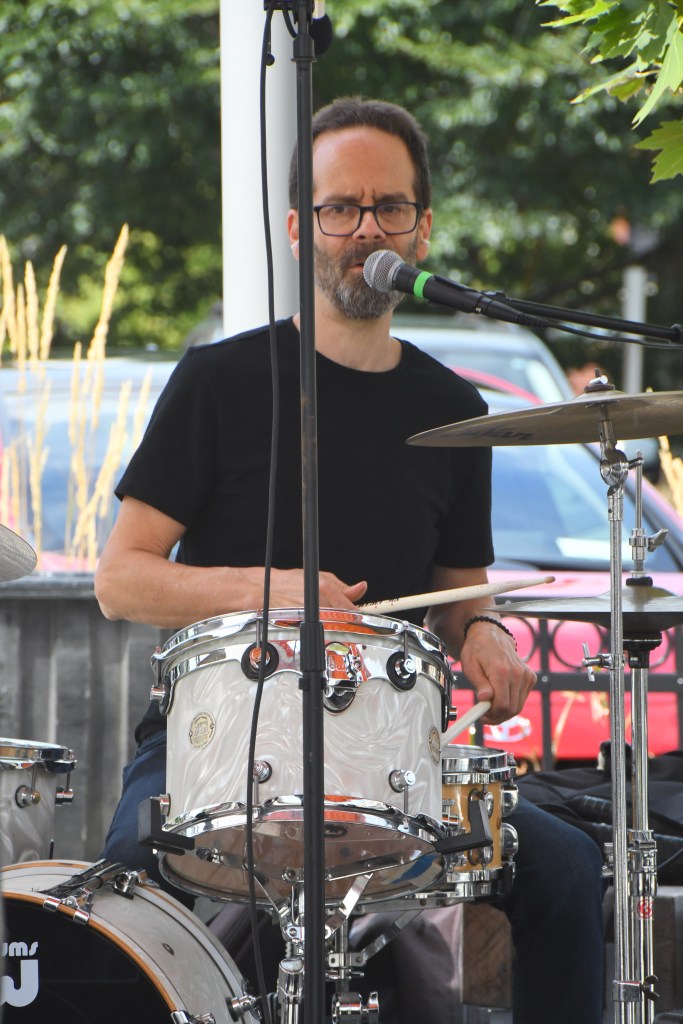
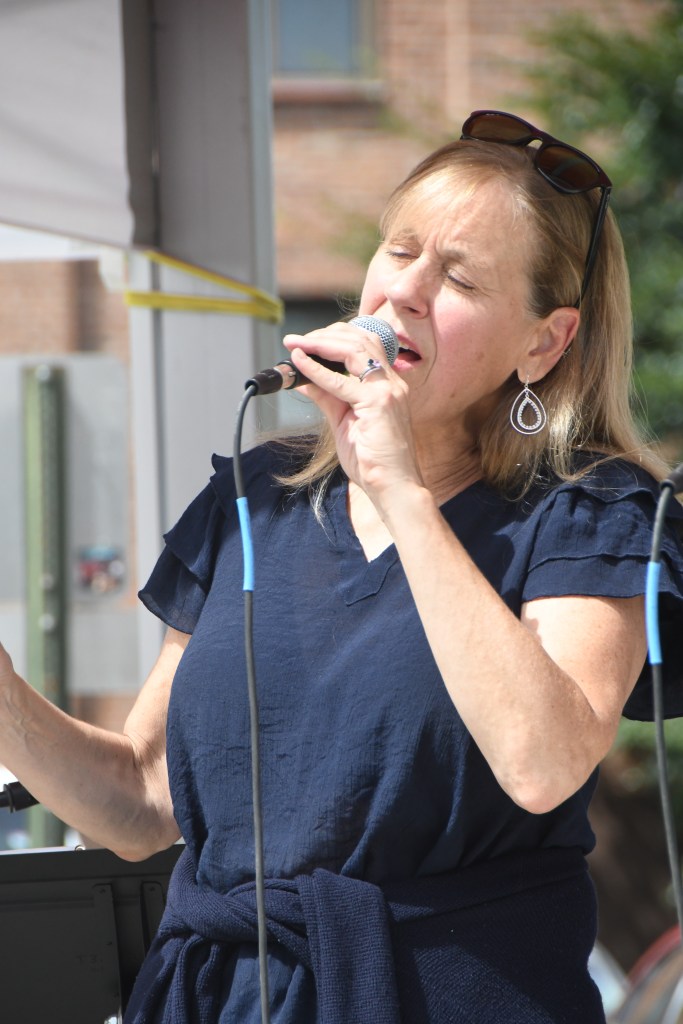
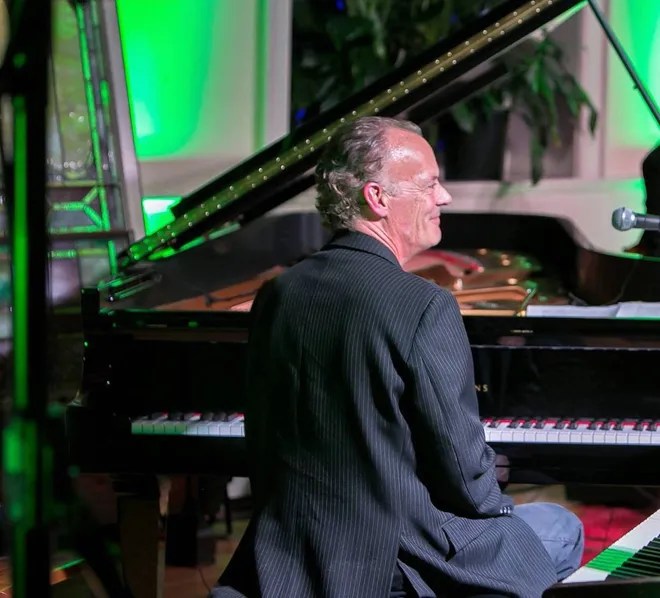
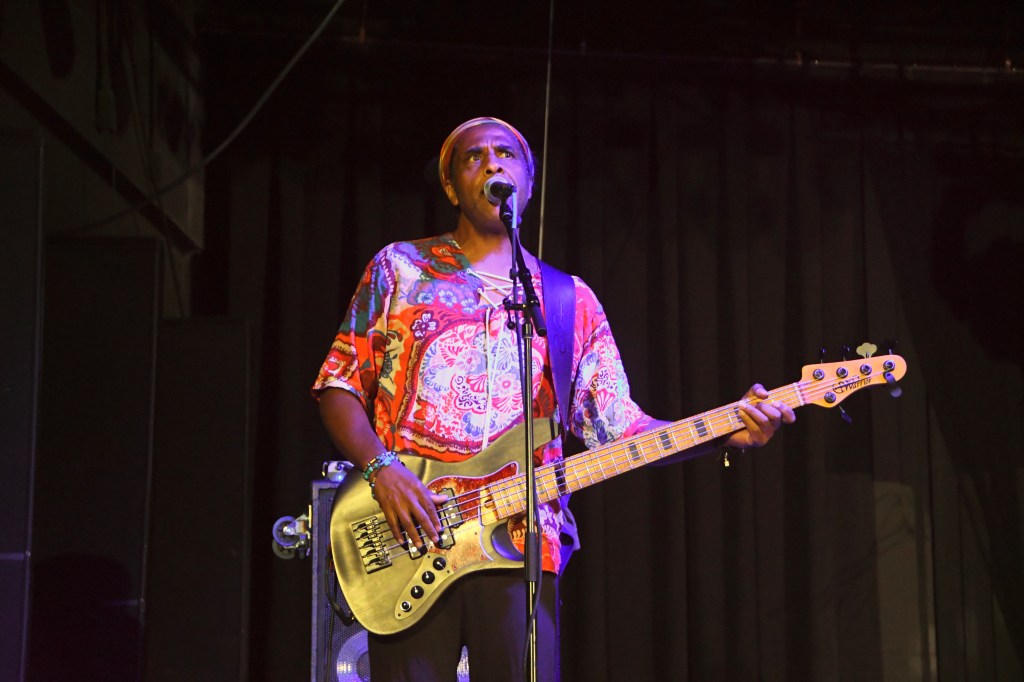
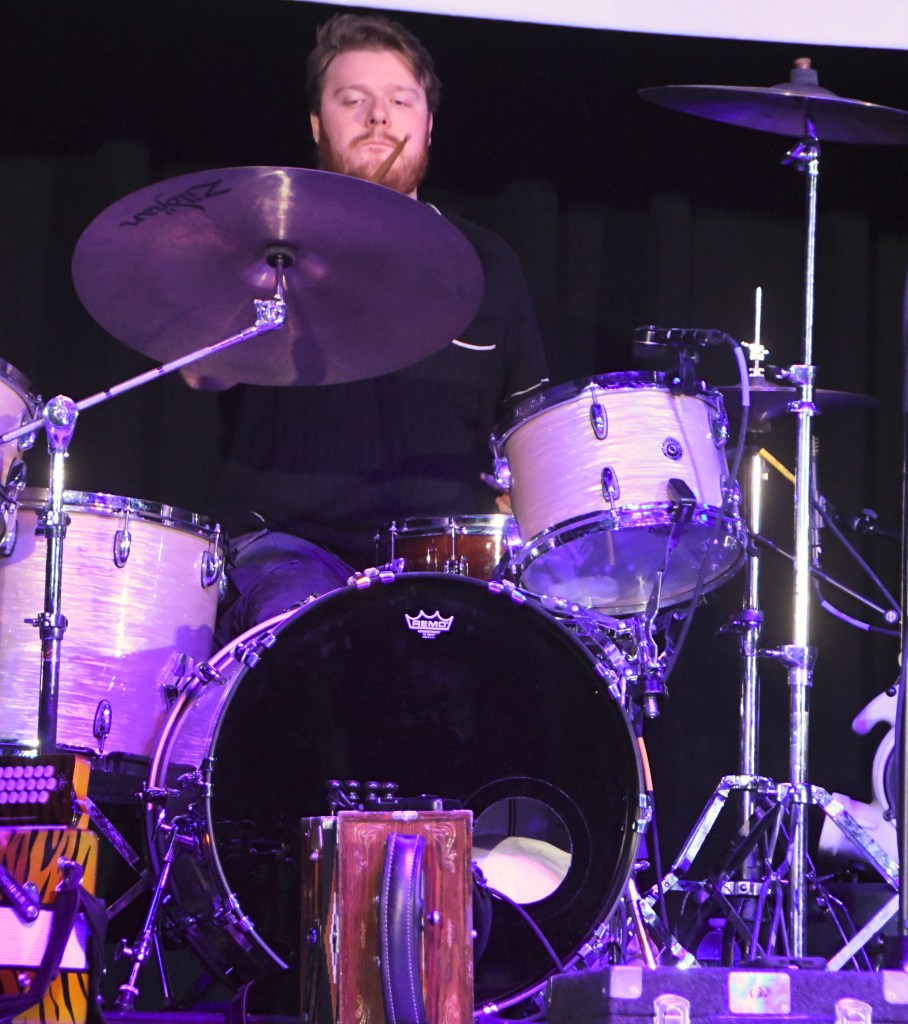
The Chuck Lamb/Ria Curley Quartet brought down the curtain Thursday at Jazz on Jay, the final act of 13 to play the free-admission concert series of regionally-based jazz players and singers. The Lamb/Curley Quartet presented both. While pianist Chuck Lamb and bassist Brad Monkell – dubbed “Mohawk” for his ‘do – played their instruments, Ria Curley both played piano and sang while drummer Sam Zucchini occasionally sang quiet harmonies behind her.

Two lively trio instrumentals opened, the easy-going funk of “Mr. Slinky” and Lamb’s tribute tune “Punkin’ Eater” honoring his late brother Peter with a peppy groove. They knew these Lamb originals well; everything rolled smoothly and the solos had swagger and swing.
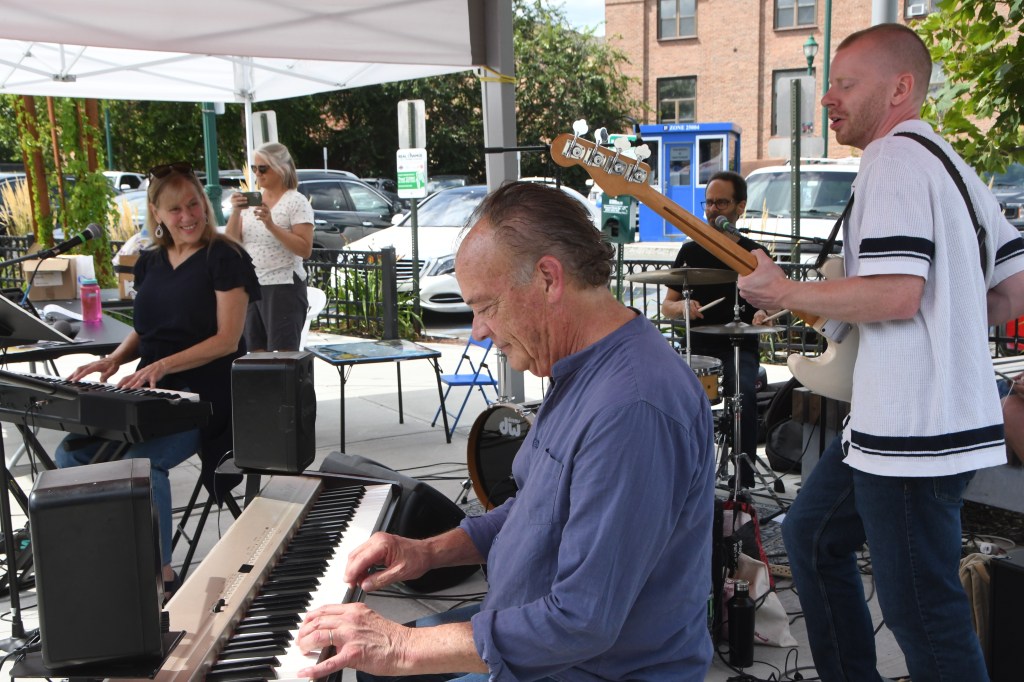
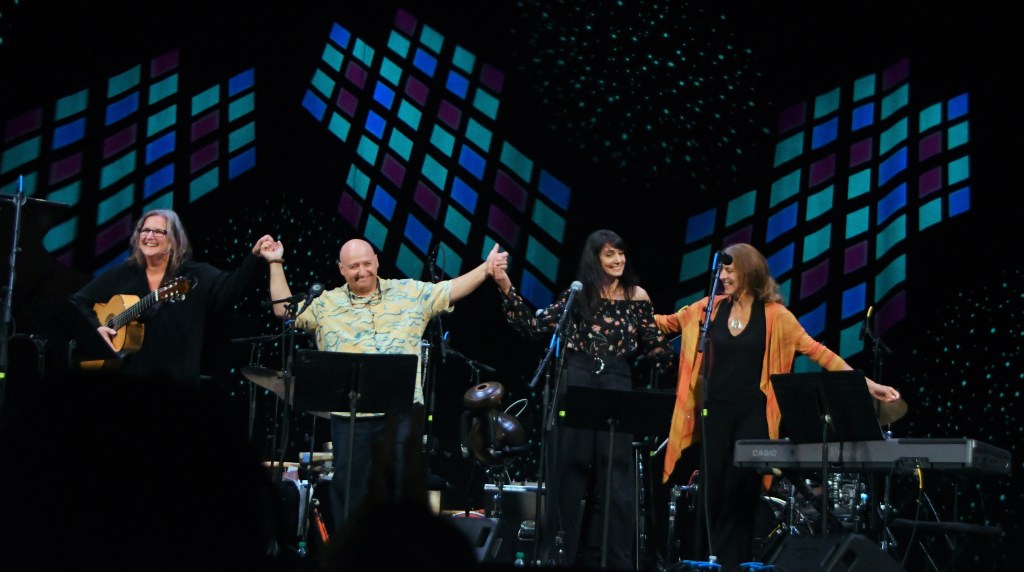
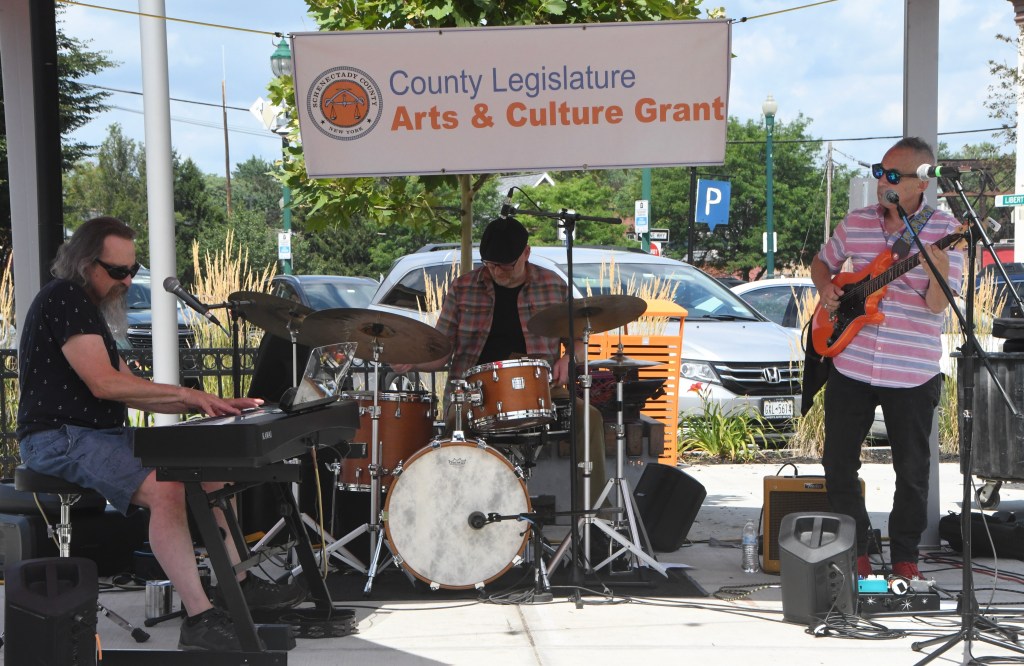
The Chuck Lamb/Ria Curley Quartet, from left: singer-keyboardist Ria Curley (Betsy Sandberg behind her), keyboardist Chuck Lamb, drummer Sam Zucchini, and bassist Brad Monkell.

Adding Curley over-matched the sound system at first as delays and adjustments – some worked, some didn’t – prompted detours off the set list and reduced her vocal contributions by emphasizing instrumentals in self-defense.
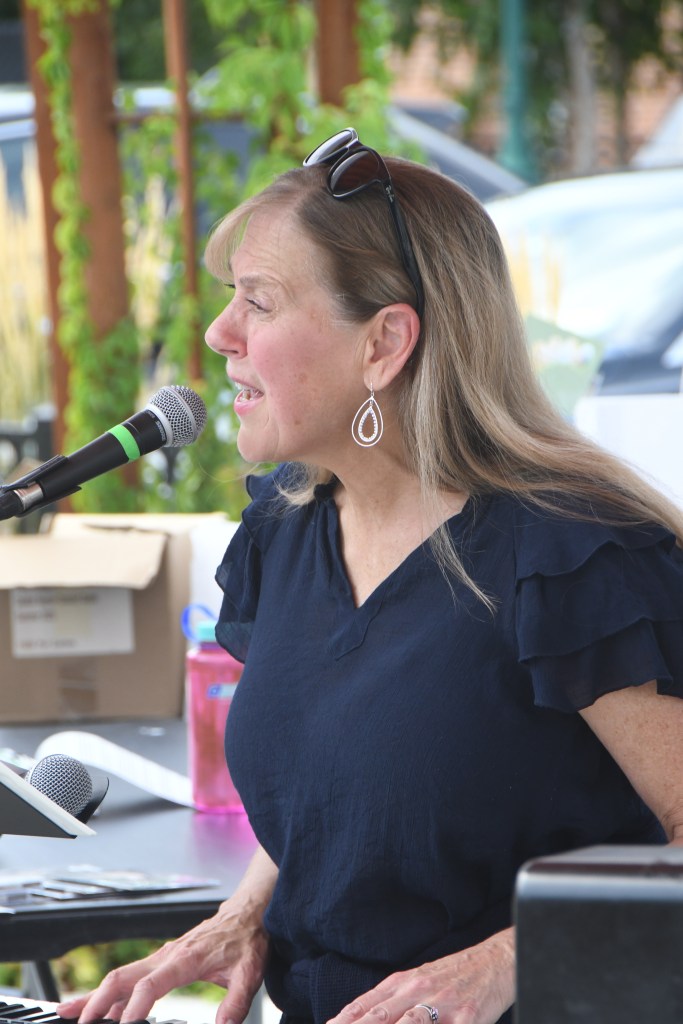
She first sang an impromptu unplanned tune, accompanied only by her own piano. Then, everybody everybody joined in for “Almost Like Being In Love” at full strength, despite a tentative feel amid audio jitters. When Curley left, however, the players adapted by again playing strong trio instrumentals; first “The Road More Traveled” from Lamb’s second album of piano duets (now under construction) with Jorge Gomez. 

This upbeat, busy number restored the show’s momentum as everybody made the most of their solo spots over supportive vamping; then carried strong into a second instrumental the returning Curley identified as “Dorothy’s Song” before she sang her jaunty Latin “Two Note Samba.” Inspired by Antonio Carlos Jobim’s “One Note Samba,” this was a bit bumpy as audio angst recurred. To their credit, they recovered beautifully and hit a mellow, sweet groove under Curley’s wordless, atmospheric vocal coda.

The mellow, summery pop of her “Wanna to Be There” cast a sunny mood as Lamb’s piano supplied a sort of soundtrack for a dreamy walk in the beach.

“Take Five” by Lamb’s mentor Dave Brubeck worked well despite the lack of a saxophone (ala Paul Desmond’s alto on the original), but his ingenious arrangement of this aggressive, complex-time classic turned sparseness into strength as everybody soloed brilliantly here.

Curley returned for the closer, her own playful “Girls Night Out” that adroitly balanced a party vibe and a relaxed groove to pleasing effect.

Whether playing as a trio or a quartet with Curley adding strong and supple vocals, the band showed off a pleasing balance and unity. Even the (maybe under-rehearsed?) “Two Note Samba” with Curley cueing Lamb – “G-flat” and “chorus” – moved in confident veteran nonchalance.
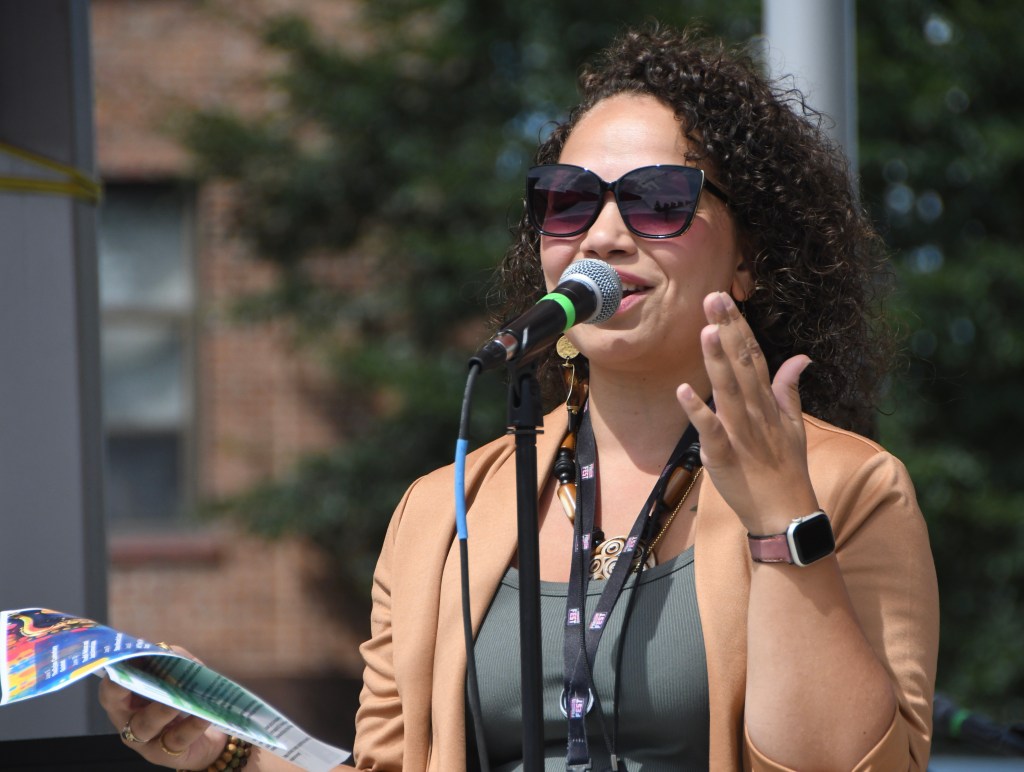
Linnea Bailey

After the music, Jazz on Jay host Linnea Bailey thanked sponsors, crew and volunteers – especially the indispensable, she-does-everything Betsy Sandberg – and served cookies to everyone.

MORE JAZZ

Let’s give Chuck Lamb top billing here as a kind of Trouper’s Award for valiantly playing through trouble. The Chuck Lamb Trio plays Jazz at Caffe Lena on Tuesday, Sept. 9 featuring special guest trumpeter Mike Rodriguez. www.caffelena.org.

A few days before, saxophonist David Murray opens the season at A Place for Jazz, Friday, Sept. 5 at the Carl B. Taylor Auditorium of the Music Department at SUNY Schenectady County Community College. http://www.aplaceforjazz.org.

The next afternoon, the Albany Riverfront Jazz Festival, a free-admission fest, presents four regional acts, then headliner saxophonist Karl Denson’s Tiny Universe, at Jennings Landing. http://www.albanyevents.org/events/albany-jazz-festival.

And, the following weekend, Sept. 12 – 14, the Lake George Jazz Weekend starts Friday evening with four shows in four locations. Saturday includes a jazz breakfast and four acts in Shepard Park, and Sunday kicks off with a morning jazz cruise, then three acts in Shepard Park. http://www.lakegeorge.com/annual-events/jazz-festival/.

Jazz on Jay Wraps for 2025

Preview: Chuck Lamb/Ria Curley Quartet at Jazz on Jay, Thursday, Aug. 28, 2025
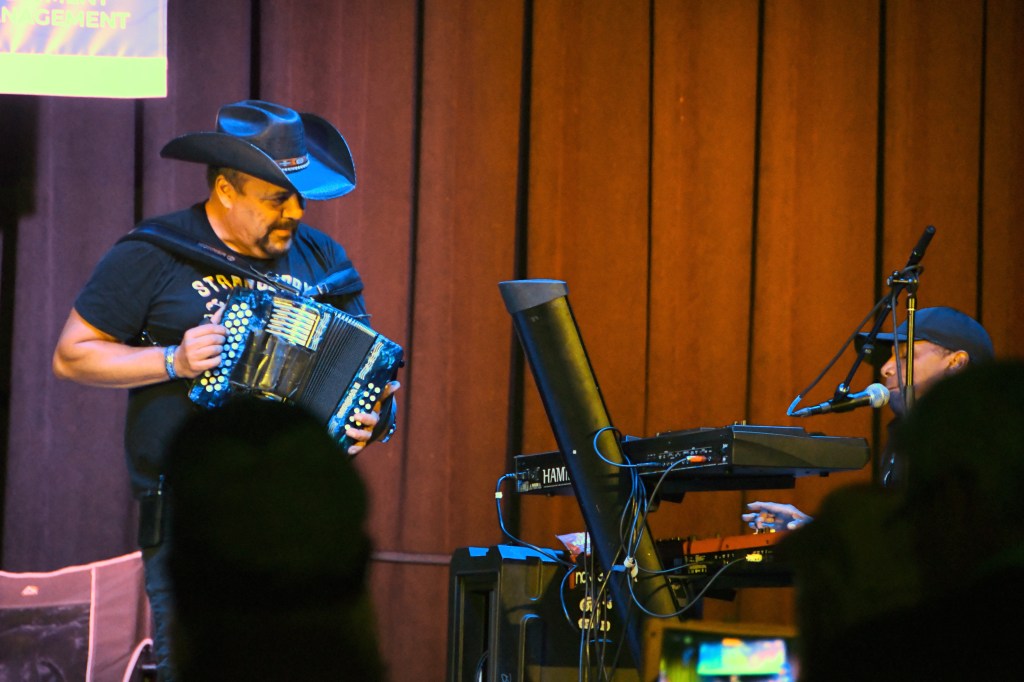
Jazz on Jay wraps 2025 Thursday with arguably the most honored artist of this great season.

As the late, great jazz piano giant Dave Brubeck said in 2011, “Chuck (Lamb) is an extremely creative, harmonically interesting, rhythmically exciting pianist and one of the best improvisers I’ve heard in recent times!”

Ria Curley and Chuck Lamb at the piano. Photo provided

Thursday, Lamb leads a quartet with singer-pianist, music and life partner Ria Curley plus bassist Brad Monkell and drummer Sam Zucchini. They’ll play “mostly originals with perhaps a few standards mixed in,” as Lamb explains, specifying his original jazz and fusion instrumentals plus Curley’s “jazzy vocal r&b/pop/rock.” 

For two decades, Lamb has played with Brubeck’s sons in the Brubeck Brothers Quartet: bassist and trombonist Chris Brubeck and drummer Dan Brubeck, and guitarist Mike DeMicco. The quartet has played festivals around the world, but its tours and handful of albums comprise just one chapter in Lamb’s creative journey.

His late-70s/early-80s jazz fusion band Dry Jack recorded two albums that Rolling Stone’s “History of Music” hailed as “one of the premier, cutting edge bands of the electric jazz movement.” His later albums include a tribute to Dave Brubeck and a collaboration with Jorge Gomez who recently performed with Lamb and Curley at Putnam Place in a Caffe Lena presentation.

As artist-in-residence, host and lead performer of the monthly “Jazz at Caffe Lena” series, he has hosted and performed with jazz notables including vibraphonist Joe Locke, saxophonists Chico Freeman, Dick Oatts and Cliff Lyons, and guitarist Vic Juris. 

Meanwhile, Curley has earned renown as singer, songwriter, actor, dancer and visual artist who shows in New York galleries. She has toured in equity productions of “Godspell,” “Grease,” and “Roaring 20s Musical Review;” and she’s acted in TV dramas including “As The World Turns,” “Guiding Light,” and “Loving.” Credited as associate executive producer of the Grammy-nominated CD box set of Frank Sinatra’s Columbia recordings, she has also made two solo albums.

Their “Between the Shadows” instrumental appears in comic Hannah Einbinder’s HBO special “Everything Must Go” and three Lamb instrumentals appear in Dimitris Athiridis’s documentary film “Exergue on documenta 14.”

Chuck Lamb. Photo provided

In addition to national and international acclaim, Lamb and Curley have also been honored here at home.

They received an Artist Grant from Saratoga Arts in 2024. That same year, Lamb was honored as Jazz Artist of the Year at the Eddies Awards and Curley’s song “Wanna Be There” was nominated for Record of the Year.

Onstage, as Lamb explains, “Improvising is a big part of this music, and we plan to have at least one improvised solo on every song.”

The Chuck Lamb/Ria Curley Quartet perform Thursday as the 13th and last Jazz on Jay show for 2025.

Jazz on Jay free concerts are noon to 1:30 p.m. at Jay Square, the new park space opposite Schenectady City Hall. The rain site is Robb Alley at Proctors, 432 State St. Seating is provided indoors at Robb Alley, but patrons are invited to bring their own seating and refreshments to Jay Square.

Jazz on Jay is presented by the ElectriCity Arts and Entertainment District and sponsored by the New York State Council on the Arts, a Schenectady County Legislature Arts & Culture Grant, Downtown Schenectady Improvement Corporation, The Schenectady Foundation, Price Chopper/Market 32, MVP Health Care, Schenectady County, Schenectady City Hall, and Proctors Collaborative. This blog is a series media sponsor.

Harp Jazz, Udu Jazz; Virtuoso and International

Review: Edmar Castaneda World Ensemble, and Brian Melick & Friends at Music Haven in Proctors on Sunday, Aug. 24, 2025

Before Edmar Castaneda brought the harp back into jazz a generation after Alice Coltrane, few made jazz on its many strings. When he cracked the code by playing busy bass lines on the long low strings with zippy melodies on the treble short strings, those who’ve followed mainly play in small bands.

Edmar Castaneda

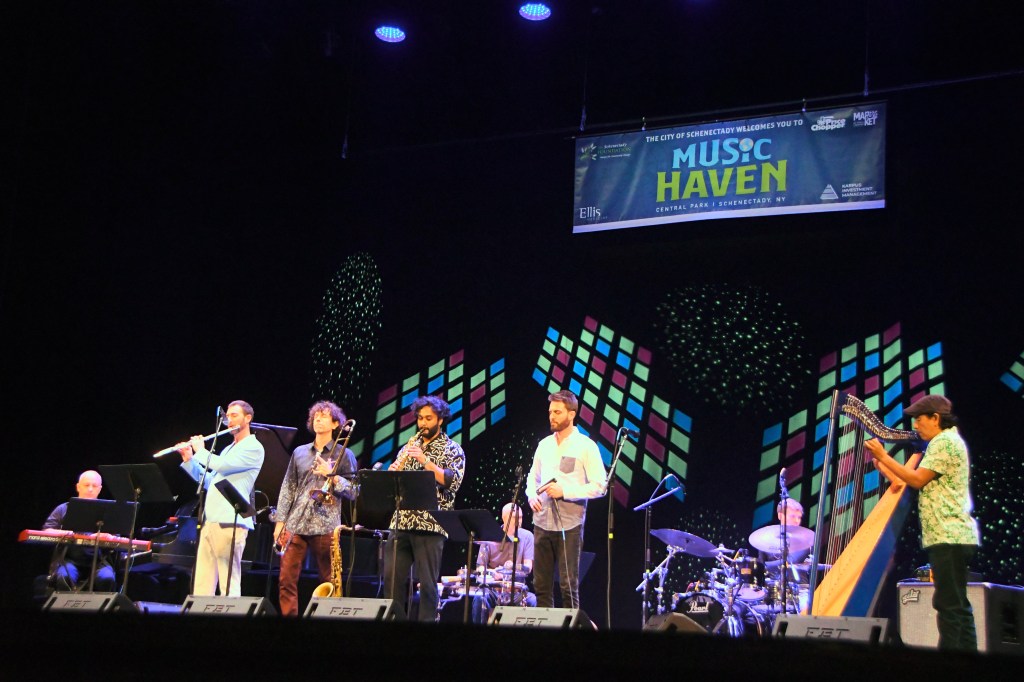
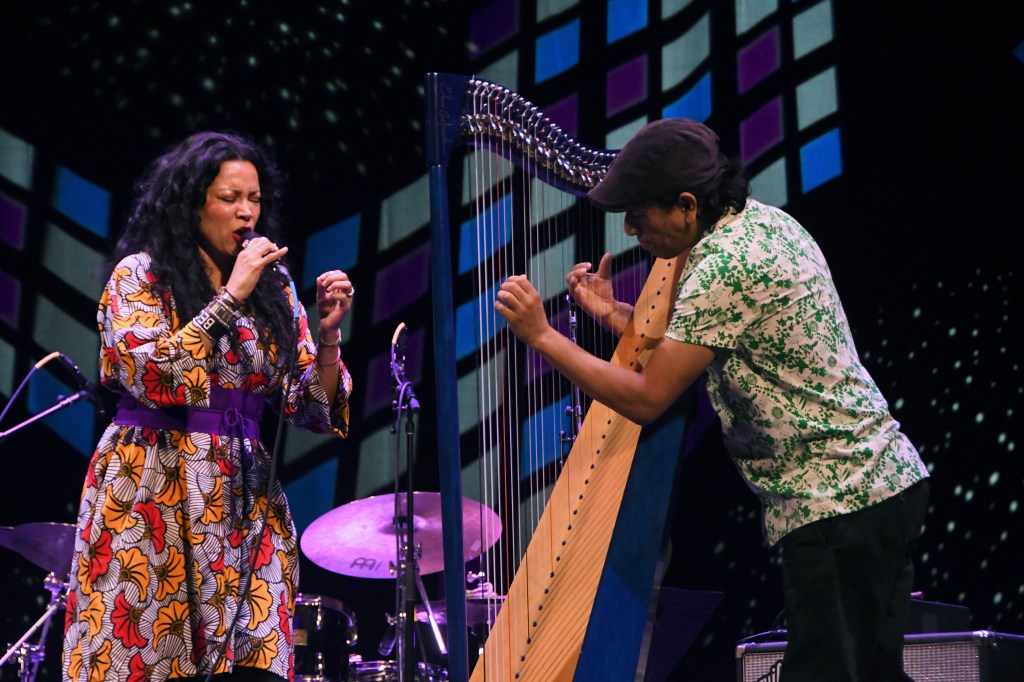
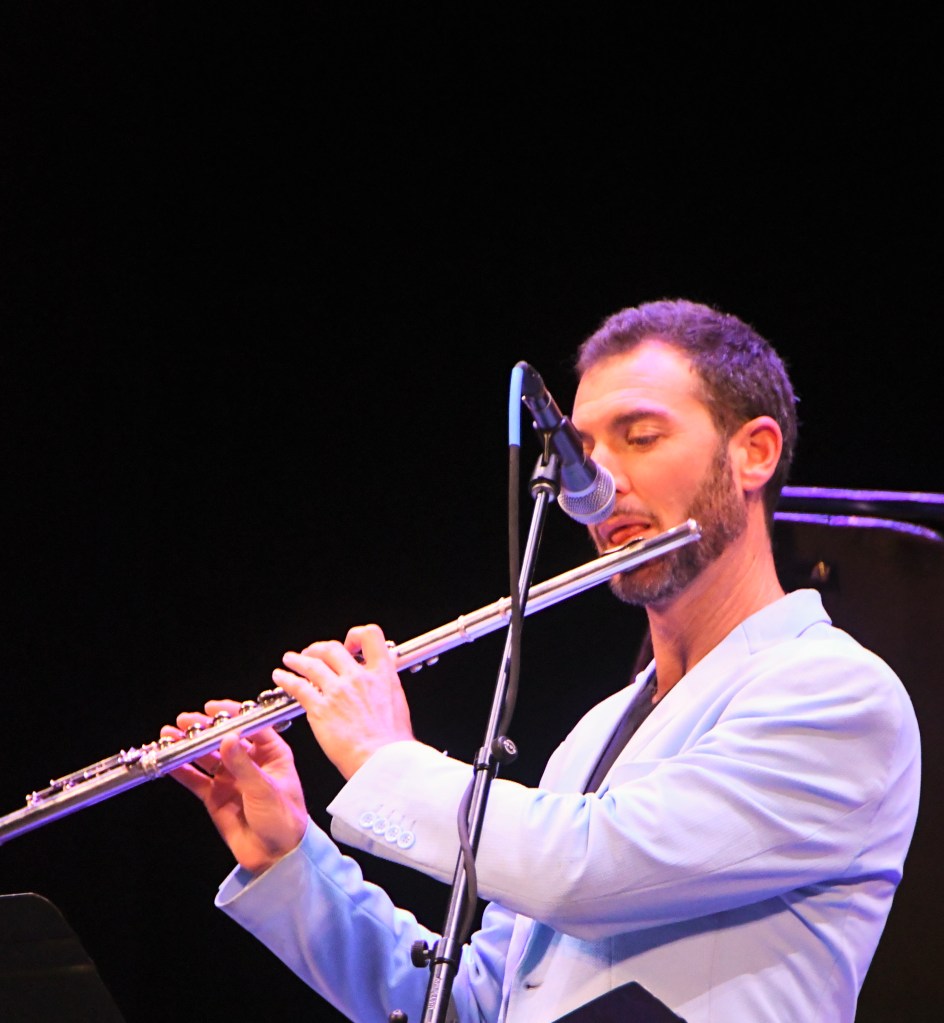
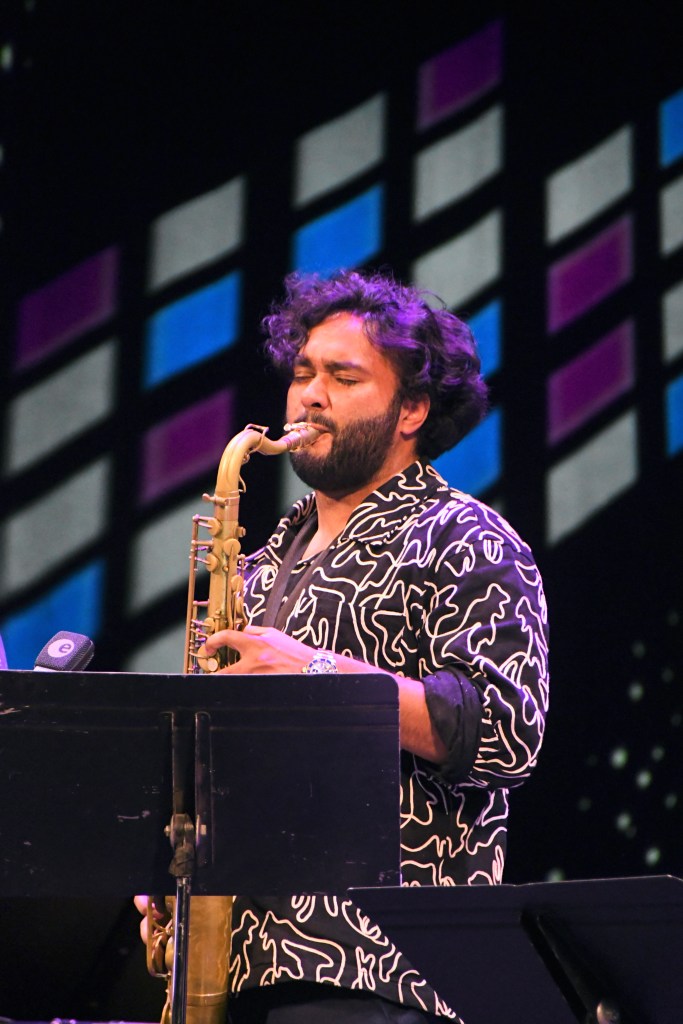
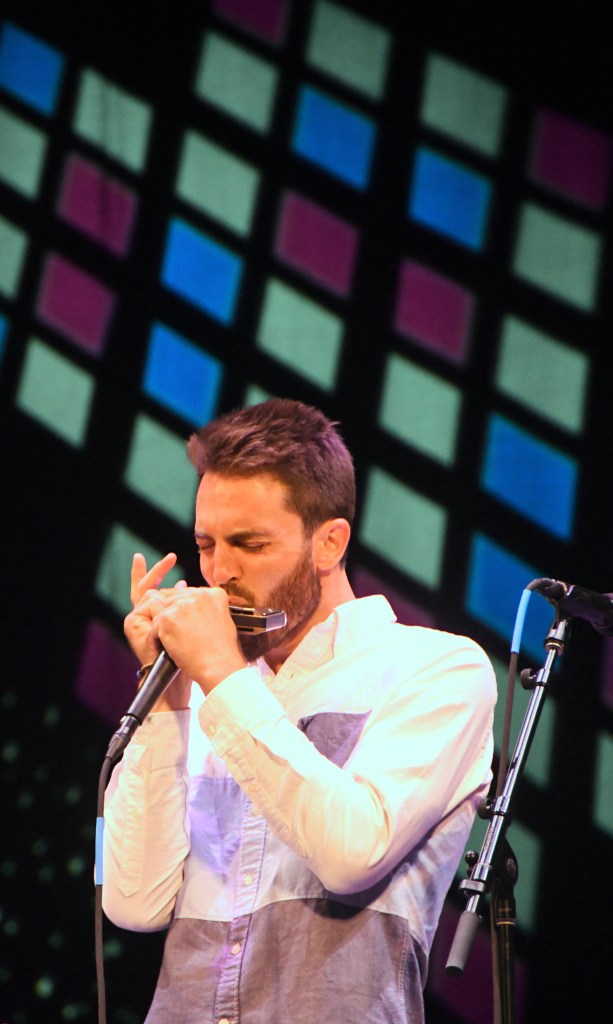
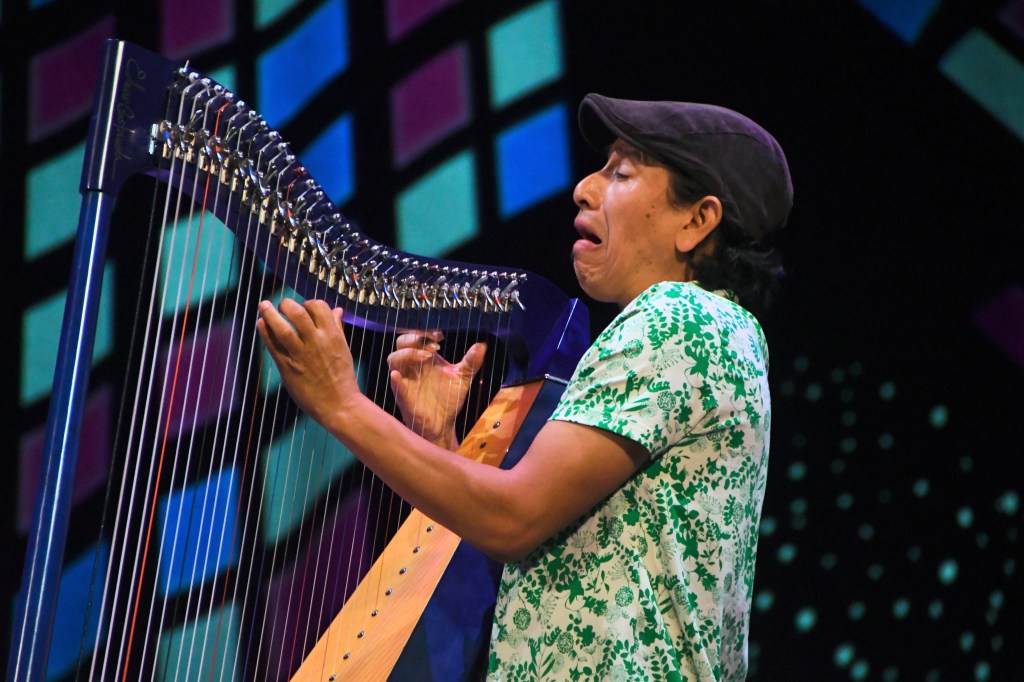
At Music Haven in Proctors Sunday, he led a big band, his World Ensemble. Before calling the roll by player and country, Castaneda showed off uncanny speed, restless melodic invention and pulsating rhythm in a breathtaking intro-eruption before anybody else played a note. Then everybody played lots of notes in the dense, staccato suite “Tabom.” First, Rogerio Boccato (Brazil) hit a repeating triangle figure, then a groove-and-solos machine formed. From stage right they were keyboardist Helio Alves (Brazil); flautist Itai Kriss (Israel), trombonist Ryan Keberle (US), saxophonist Birsa Chatterjee (India), chromatic harmonica player Yotam (Switzerland), drummer Julian Miltenberger (US) and Castaneda playing the most amazing stuff, stage left.

All but Miltenberger soloed in that first strong number, percussionist Boccato strapping on a small bass drum whose pitch he controlled so it was in tune.

Rogerio Boccato

The Astor Piazolla/tango-inspired “Ventarron” earned its title (“strong wind” in English), an agitated sound storm with Castaneda and Alves’s piano in harmony (different notes, hitting in the same place). Then came all-in horn section bebop before Yotam’s harmonica led a downshift; then the bebop took over again and drums and percussion owned the coda.

Andrea Tierra and Edmar Castaneda

Castaneda then dismissed all but Alves and spun the charming tale of spotting a beautiful woman singer at a Queens jam session, instantly announcing they’d marry and doing so just 20 days later, all by way of introducing singer Andrea Tierra, his wife of 21 years. She sang in a strong alto, holding her own with harp and piano in the passionate trio “Piedra y a Camino.”

The band back at full strength, a Caribbean dance flavor powered her next tune, “Raza,” but her strong voice carried its protest message even without translation, sharing the spotlight with Keberle’s best trombone break all night.

Ryan Keberle

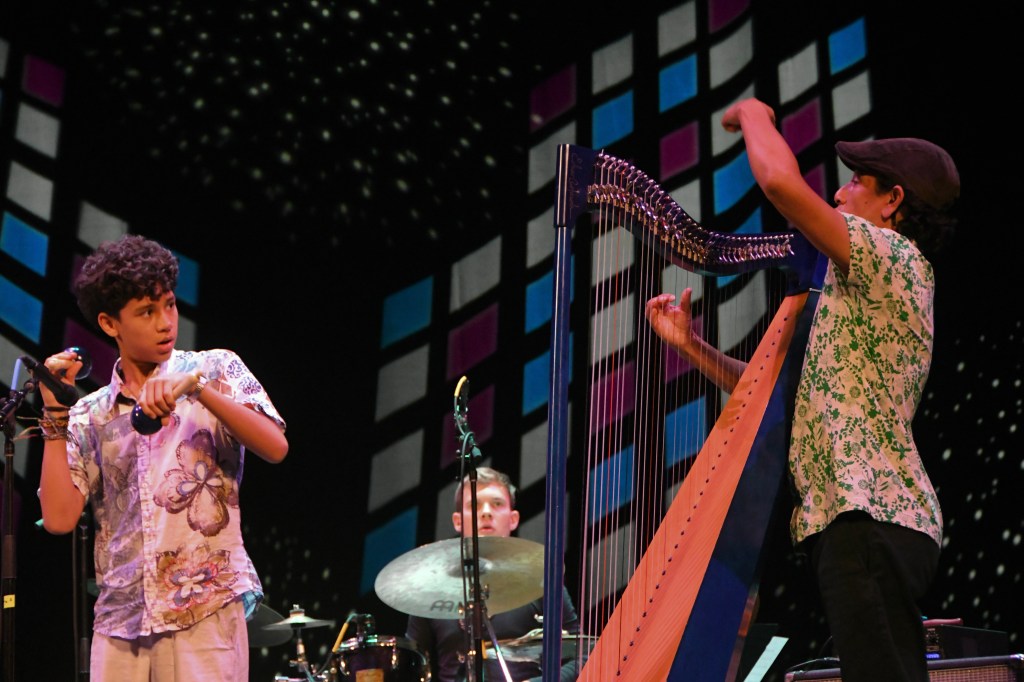
Castaneda paid tribute to Cuban saxophonist Paquito D’Rivera in “Arpaquito,” a breakneck romp featuring teenaged son Zamir playing high-speed maracas in hot horn riffing. Kriss’s flute and Castaneda soloed brilliantly here while Keberle’s trombone swapped fours with Chatterjee’s tenor sax, bop style.

Itai Kriss, above, and Birsa Chatterjee, below

Zamir Castaneda, left; Julian Miltenberger and Edmar Castaneda, above; Yotam, below

“La Vie en Chande” syncopated a brisk dance beat in full flight, flute, tenor, trombone and drums handling the solos as Miltenberger seemed telepathic with Castaneda, feeling when changes would hit and riding them. 

Tierra returned to sing their closer, “Eclesiastes,” about gratefully enjoying moments with those we love, even in tough times. Built on a complex riff, this was both big, bustling groove and solo showcase, especially by Castaneda who launched it with a churning ostinato then soloed the thing out past the Milky Way. It subsided into a cozy bridge before exploding again, harp, harmonica and voice just soaring, dramatic.

In Castaneda’s solo here, in fact, throughout, the band all watched him closely, not for cues to solo or go back to the head; they were as amazed by his playing as everybody else. His jazz energy fused well with the Latin folk inspiration of many songs. Dance tunes evoked swirling skirts and feet hammering cobblestones while bebop blasts went all 52nd Street.

Strong Local Opener

Brian Melick & Friends opened in a charming, internationally appropriate, if smaller scale, virtuoso display of top area talent. 

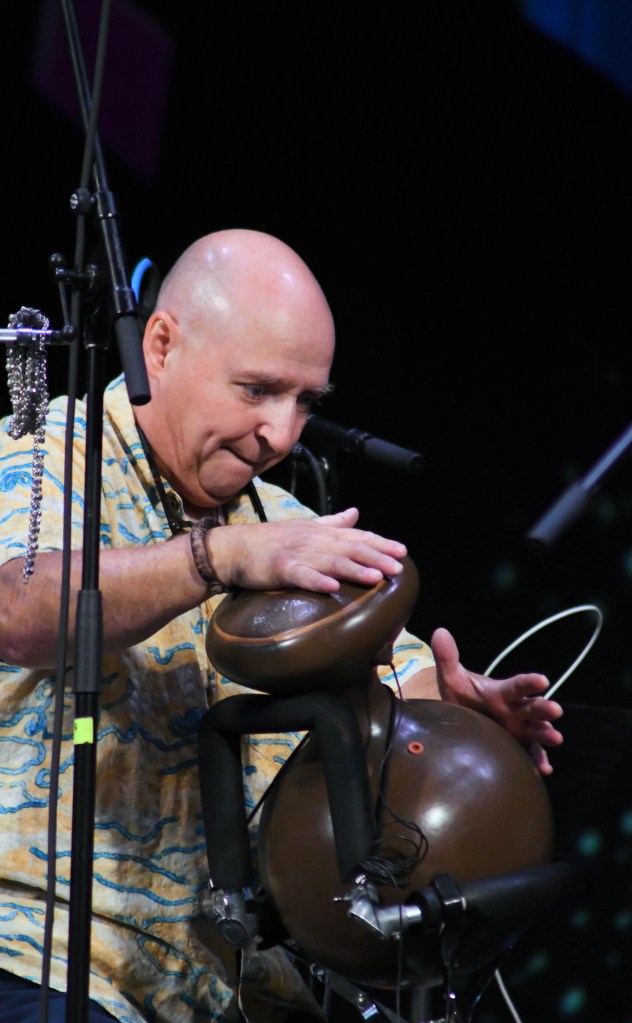
Brian Melick

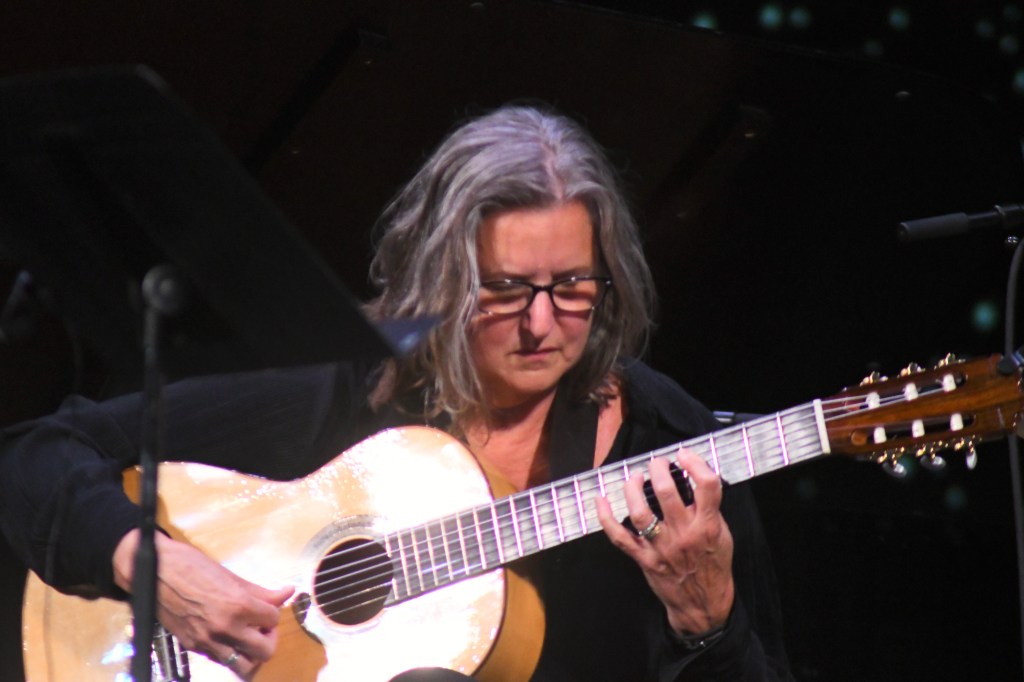
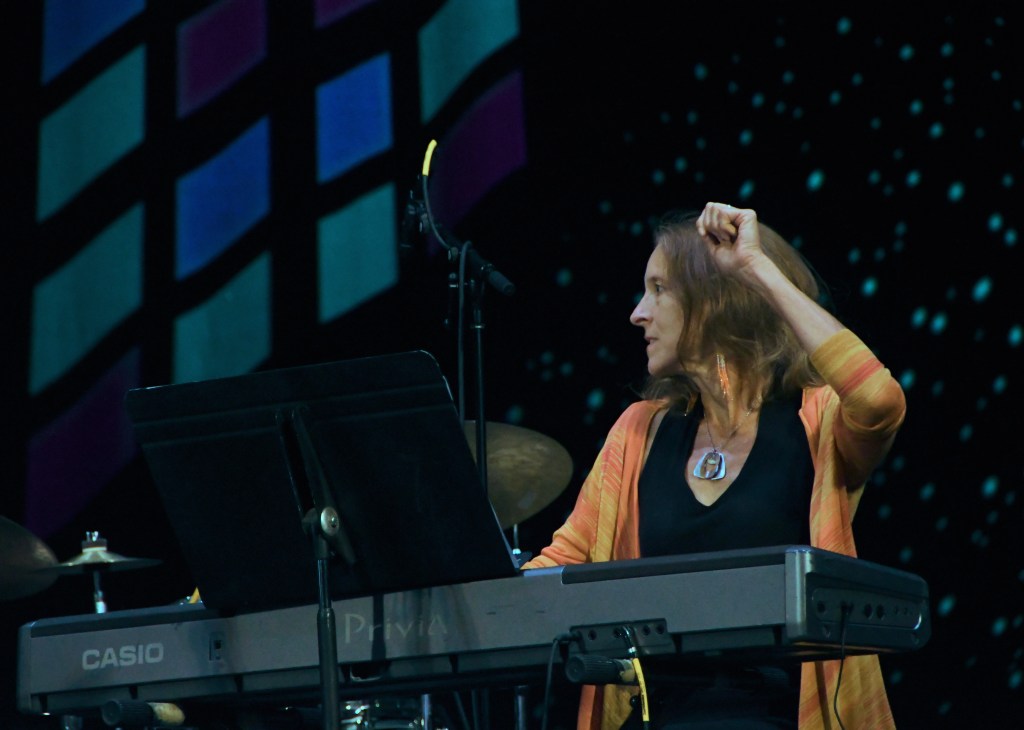
Melick started solo at the molded clay udu drum, making deep swoops of “Udu Play Clay.” He then introduced his collaborators in duets. Flamenco guitarist Maria Zemantauski kept pace with Melick’s udu in her percussive fingers-flying “Rosita.” Keyboardist (and leader of world-jazz combo Heard; Melick is a member) Elizabeth Woodbury Kasius conjured Montreal snow in “Cote Des Nieges,” Melick’s lacy, tinkling hand percussion evoking bright flakes falling over her graceful melody. Singer Shiri Zorn recited a poem on love versus solitude to introduce “Alone Together,” a complex jazzy, torch-song with recorded voice tracks harmonizing her voice as Melick underscored everything with woody cajon riffs.

Maria Zemantauski, above; Elizabeth Woodbury Kasius, below

“Pinto Varano” united the four, Zemantauski all flamenco zing, Melick punctuating with the metallic clang of an orchestral anvil, Kasius’s keyboard exploring rhythm and melody and Zorn singing sweet but bluesy.

Shiri Zorn

They left everyone wanting more, with impressive skill and disparate creative visions coming together in a meeting of musical minds, the six hands of Melick, Kasius and Zemantauski and Shiri Zorn’s remarkable voice, though her expressive hands added to its effect.

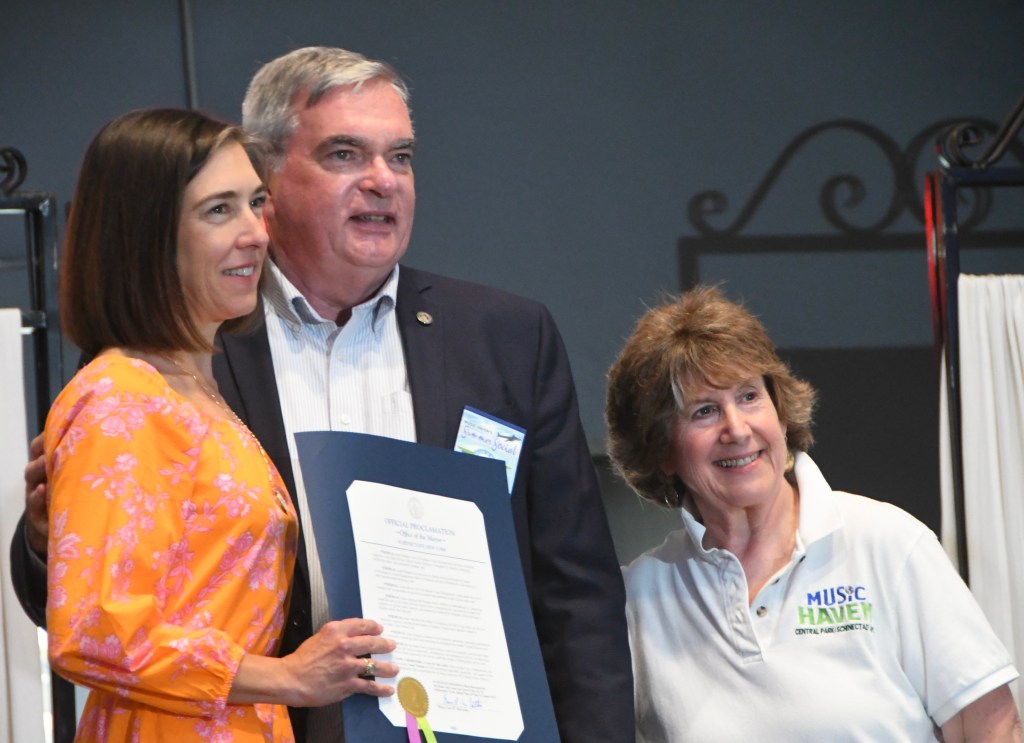
The pre-concert Music Haven Summer Social, above, a paid admission meet-up, with catering, filled the adjacent Key Hall, with Schenectady Mayor Gary McCarthy and NYS Senator Jim Tedisco presenting proclamations to both Music Haven Producing Artistic Director Mona Golub in honor of the free concert program’s 35th season and CEO Anne Putnam of Fenimore Asset Management, honored as Music Maven of the Year for her volunteer efforts and other support for Music Haven.

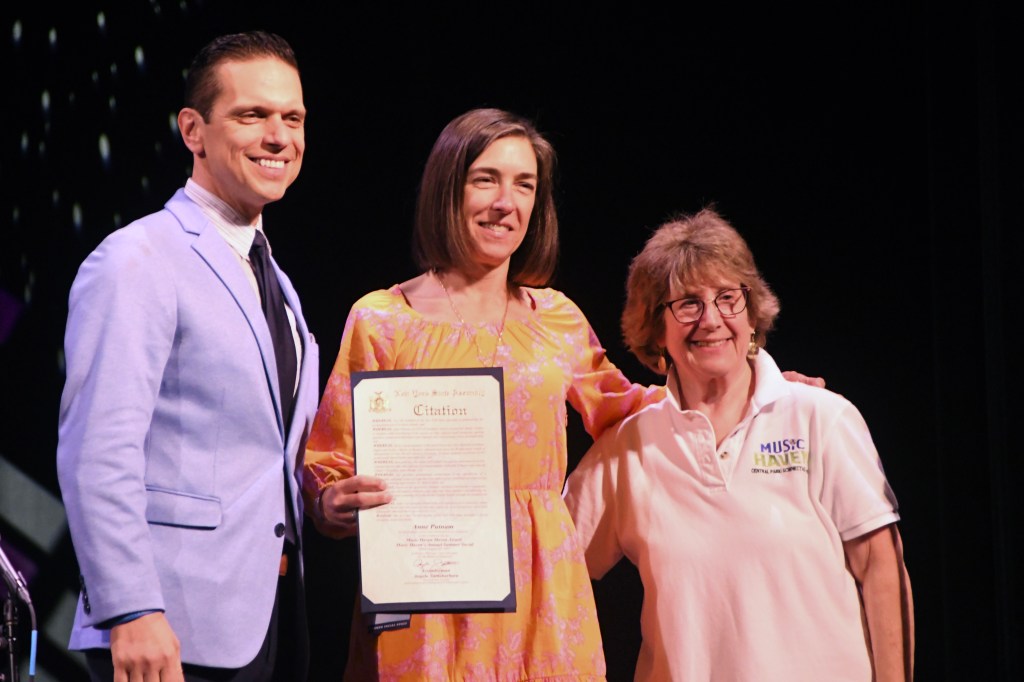
From left, above: Anne Putnam, Schenectady Mayor Gary McCarthy, Music Haven Producing Artistic Director Mona Golub. Below, from left: Putnam, NYS Senator Jim Tedisco, and Golub

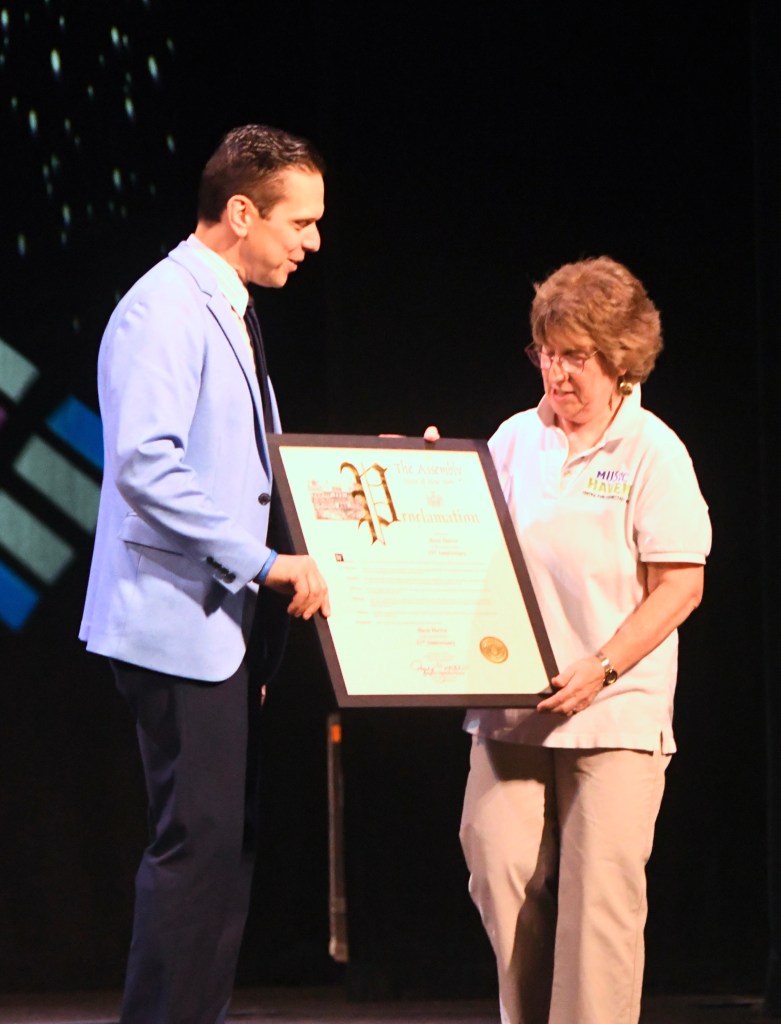
NYS Assemblyman Angelo Santabarbara and Mona Golub

During intermission, NYS Assemblyman Angelo Santabarbara echoed those sentiments with proclamations and praise for Golub and Putnam.

Sunday’s show was Music Haven season’s first event to be moved into the Proctors rain site all season. Nine concerts, a festival and two films took place in Central Park while a third film. “Wicked,” closes the season on Friday, Aug. 29.

MORE HARP, MORE CASTANEDA

On Sunday, Sept. 14, he plays Lake George Jazz Weekend in Shepard Park with his quartet; likely singer Andrea Tierra, saxophonist Birsa Chatterjee, and drummer Julian Miltenberger.

Then, on Thursday, Oct. 2, he plays Universal Preservation Hall (a Proctors Collaborative venue) with banjoist Bela Fleck and drummer Antonio Sanchez. The trio released its debut album “BEATrio” in March and has been touring off and on since.

And, since nearly all eight members of Castaneda’s World Ensemble lead or play in other bands, Sunday’s Music Haven at Proctors show was a rare treat.

Happy Music, Mostly; from New Orleans and the Heart

Review: Jon Batiste and the Philadelphia Orchestra, Friday, Aug. 22, 2025 at Saratoga Performing Arts Center

Happy multitudes united at Saratoga Performing Arts Center in lively musical celebration Friday, drawn by a strong sense of occasion and warmed in the sentiment and skill of gleaming-suited star Jon Batiste.

Onstage the Philadelphia Orchestra wrapped around pianist-singer Batiste and the band he’ll take on tour from Kansas City next week to Milan in October.

In the seats and on the hill, an extraordinarily large, enthusiastic and younger-skewing crowd for an orchestra event sat or, often, stood in the unanimous, joyous adulation only the most beloved artists and entertainers earn.

Batiste glowed in his unprecedented opportunity to perform in a gloriously expansive orchestral context. The two-set show included new tunes from “Big Money,” his ninth album that hit Friday morning, soul classics, and the sweet sounds of his New Orleans home.

He played and sang from the heart, as he told us while introducing a love song for his wife that they’d met and become a couple in Saratoga; he often pointed to friends and family in the audience, smiling wide.

Every inch the star, he had a confidently relaxed way when he spoke but became a charismatic, kinetic whirlwind when the songs revved or a sensitive interpreter of deep feelings in slower numbers. He held the eye in a spangled suit likely visible in Montreal. 

A blues tango instrumental opened, the orchestra injecting abrupt percussion and soaring brass into the flow Batiste set at the piano. Un-classical-concert-like whoops rewarded him at the end.

In “Lonely Avenue,” recorded with Randy Newman for his new album, Batiste sang in Ray Charles’s staccato phrasing and an agile falsetto, going plaintive at the piano as the orchestra paused. He sang in sync with his piano, compressing and relaxing the beat; then, urging “sing it from your soul,” he got a good singalong. Citing his video-game childhood, he led an affectionate “Green Hill Zone” tribute to “Sonic the Hedgehog” before using the piano again as transition into “When the Saints Go Marching In.” Obligatory for New Orleans musicians, this felt cliche-free as Batiste tugged at the beat, turned the chords inside out and brought in the crowd to sing, stand and clap. He jumped up, grabbed a red melodica and scaled back the coda, with crowd voices.

He got the audience doing whatever he wanted, listening in quiet places, and going upbeat, too; jumping, singing, clapping (mostly…) on the one, applauding slick spin moves. 

Here’s the thing: Just as he now does better dance moves in “Freedom” than on the exuberant video, Batiste has evolved as pianist and singer since we all saw him on “The Late Show.” He commanded lovely lyricism or explosive, rapid power on the keys; he sang nuanced phrasing or emotional fire. Best of all, his enthusiasm invited the audience aboard a love-train of sound and spirit.

In “Georgia On My Mind,” he again dug Ray Charles with hesitation cadences in a dynamic vocal the orchestra paralleled to grand perfection, sounding bluesy and brassy.

Singer Desiree Washington came on to add her alto to Batiste’s falsetto in “Lean On My Love,” second song from his “Big Money” album in the show. Bassist Nick Clark, drummer Alvin Ford and guitarist/keyboardist Max Townsley joined, too. 

They gave “Raindance” an upbeat punch, riding stop-and-go riffs in energetic precision. They held the momentum in Jackie Wilson’s hit “Higher and Higher” as the crowd jumped to its feet. They stayed up in the exuberant “Freedom” with a big orchestra finish. After the cautionary title track from the new album, Batiste closed the first set with melodica and voice.

“Prosecco time,” declared a woman heading for the bar.

“Petrichor” launched the second set, angrily warning of environmental apocalypse. Batiste began the pleading “I Need You” with quiet humming then revved it at the piano before the band joined. Torchy saxophone punctuated the hopeful “We Are” before Stockhausen-like orchestral anguish cued the dramatic ballad “Cry,” low strings simmering.

Bill Withers’s somber “Ain’t No Sunshine” got big recognition applause but, like “Higher and Higher,” felt a bit cramped; brief as the original hit. In “Wonderful World,” the orchestra set a quiet mood, the woman ahead of me wiping her eyes, especially when Batiste swept his arm to include the whole audience, singing “I love you.” 

That’s the other thing: Listeners respond strongly to Batiste, recognizing he means the music, loves and lives it.

Citing Saratoga as where he met his Saratoga resident wife Suleika Jaouad, he both sang his love for her and celebrated New Orleans in a seamless, happy suite. The love song “Butterfly” opened and ended a flow through “Lil Liza Jane,” “Blueberry Hill,” “Big Chief,” something with the same chords as “Softly As in a Morning Sunrise,” though that wasn’t it, “Tipitina” and “I Love You So.”

Then he dismissed the orchestra and led his band through the amphitheater and into the crowd, medley-ing jazz and pop tunes including “Killing Me Softly With His Song” and “A Night in Tunisia.”

As they reached the lawn outside the cameras’ reach, the screens went dark. The music seemed to come from everywhere; Batiste and company, anywhere. Everybody milled around in a happy throng smiling and clapping, feeling part of something wonderful.

The audience included fans of every kind of music. Goth geezers, Hawaiian shirted suburban beach- and golf-clad folks, the oh-so-hip and the too-hip-to-care, posh picnickers and jaunty jazz-bos all mingled easily. A slick-suited, short, slim gent in cowboy boots (no tie) sat in a good seat near a whatever-gender Truman Capote look-alike. Mostly it comprised younger people than usually attend orchestra events; exceeding that for similarly youth-appealing Icelandic smooth-jazz singer Laufey who fronted the Philadelphians on Aug. 9.

The Philadelphians close tonight with “Back to the Future In Concert.” 

Preview: The Arch Stanton Quartet Thursday at Jazz on Jay

For somebody who doesn’t exist, Arch Stanton gets around.

Nobody in the Arch Stanton Quartet is named Arch Stanton. A phony name in Sergio Leone’s spaghetti western classic “The Good, the Bad and the Ugly,” it’s engraved on a fake tombstone criminals placed in a cemetery to mark where robbery loot is buried.

There’s nothing buried about the guys in this band; prominent veteran players Terry Gordon, trumpet and flugelhorn; Roger Noyes, guitar; Chris Macchia, bass; and Jim Ketterer, drums. In 16 years together they’ve created so much original music they play few standards. “We choose less-than-standard standards,” says Gordon. “We do our own version of Bob Dylan’s ‘Gotta Serve Somebody.’”

They base their original music, most in the post-bop tradition, on both pop culture – their name, for example – and their own travels. Their second album ”Blues for Soli” (2014) features a suite of music from a tour of Egypt; their debut ”Along For the Ride” hit in 2012. They recently received an Albany County Arts & Culture Advisory Council grant to produce music inspired by Paul Bowles’ novel “The Sheltering Sky.”

The Arch Stanton Quartet – From left, Terry Gordon, James Ketterer, Chris Macchia, Roger Noyes. Photo supplied

Their resumes read like a who’s who of area jazz, Americana and alt-rock crews: Gordon with Alex Torres and his Latin Orchestra, Brass-O-Mania, Soul Provider, Joey Thomas Big Band, Empire Jazz Orchestra, Keith Pray’s Big Soul Ensemble and his own Terry Gordon Quintet (which played Jazz on Jay last year); Noyes with Rusticator, Red Haired Strangers, Grainbelt, Dan Johnson and The Expert Sidemen, Jazz Caravan and Rebel Darling; Macchia with Dennis Jacobs, Lily of the Valley, Alex Jornov Band, Rivergrass, Broken Heartstrings, Good Time Machine, Laura Leigh Band and Kurt Herman; and Ketterer with Jazz Caravan, Alan Thomson Trio, Giant Steps Quartet, Nova/Antiqua, Tern Rounders and Triple Play.

All are highly trained: Gordon at Houghton College and Mansfield University; Noyes with Ian MacDougall, then Tim Olsen at Union College; Macchia with jazz stars John Menegon, Mark Dziuba, Vinnie Martucci, Jeff Siegel, Teri Roiger and John Esposito; and Ketterer with Robert Meade, Rich Phillips, Gary France and Richard Albagli. 

Only Gordon, whose mother was a church organist, and Ketterer, both of whose parents made music, come from musical families. But all started performing in high school. 

Gordon played first in the Clubmen, a small big band, on New Year’s Eve at the Bolivar Country Club in Little Genessee for $40. Noyes played instrumental rock in high school, then at mid-90s college frat parties. “We were paid $200 a guy,” he recalls, “not much different from today’s pay.” Macchia’s first gig was with the Fertile Crescent at the Right Track Inn in Freeport. “I think I made close to $20.” Ketterer played first with a country and western band near the back stretch at the Saratoga harness track in 1979. “I don’t recall the name of the place, but it was similar to Bob’s Country Bunker in “‘The Blues Brothers,’” he recalled. The film showed this as rowdy dive bar with chicken wire shielding the stage to protect the musicians from flying beer bottles.

These days, they play classier gigs as seasoned performers who’ve toured internationally and create their own repertoire. “We have nearly 30 originals,” Gordon explains, “including a suite of music inspired by the band’s State Department tour of Egypt and another inspired by the great American novel ‘Invisible Man.’”

They also play standards in post-bop, Latin or free-jazz styles. Playing true to the melody, as Gordon says, “We attempt to occupy the tune with our own sense of atmosphere and mood, staying open to pushing them in different directions.” He adds, “There is tremendous freedom in playing with the musicians in the Arch Stanton Quartet.”

Jazz on Jay free concerts are noon to 1:30 p.m. at Jay Square, the new park space opposite Schenectady City Hall. The rain site is Robb Alley at Proctors, 432 State St. Seating is provided indoors at Robb Alley, but patrons are invited to bring their own seating and refreshments to Jay Square.

Jazz on Jay is presented by the ElectriCity Arts and Entertainment District and sponsored by the New York State Council on the Arts, a Schenectady County Legislature Arts & Culture Grant, Downtown Schenectady Improvement Corporation, The Schenectady Foundation, Price Chopper/Market 32, MVP Health Care, Schenectady County, Schenectady City Hall, and Proctors Collaborative. This blog is a series media sponsor.

The Arch Stanton Quartet also performs Sept. 16 at (7-9 p.m.) at the Lark Street Tavern in Albany and Sept. 27 at 9 Maple Ave. (9 p.m.-midnight) in Saratoga Springs.

Review: Terrance Simien & the Zydeco Experience, and the Mohawk Brass Band at Music Haven, Sunday, Aug. 27, 2025

Who but Terrance Simien can lead a conga line grinning through the rain?

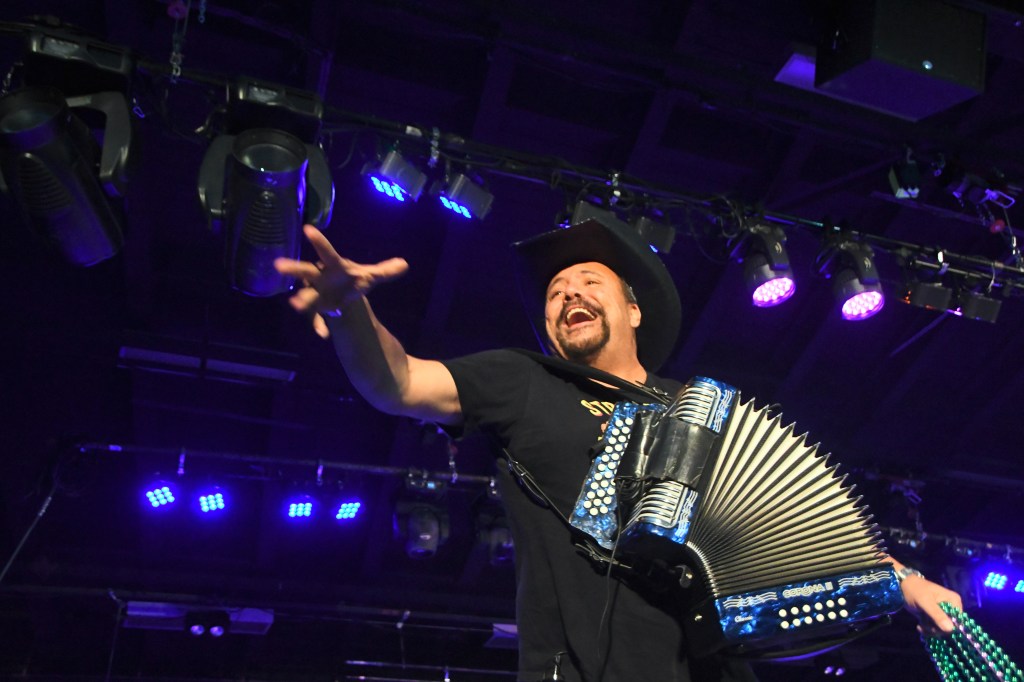
Terrance Simien

Sunday at Music Haven, the zydeco singer and accordionist did what he always does, as he’s done in many shows here. He gave great fun by visibly having so much of it himself.

Zydeco may have come from one small point on the globe; bayou country west of New Orleans. Simien spins it all over the world and across musical styles through the power of joy among virtuosos.

Acting on his simple mission statement – “help you feel it right” – in ambitiously complex ways, he expanded the common definition of zydeco from Creole accordion dance music to include soul, rock, pop and folk. Behind him, an all-aces band played with jazz band precision.

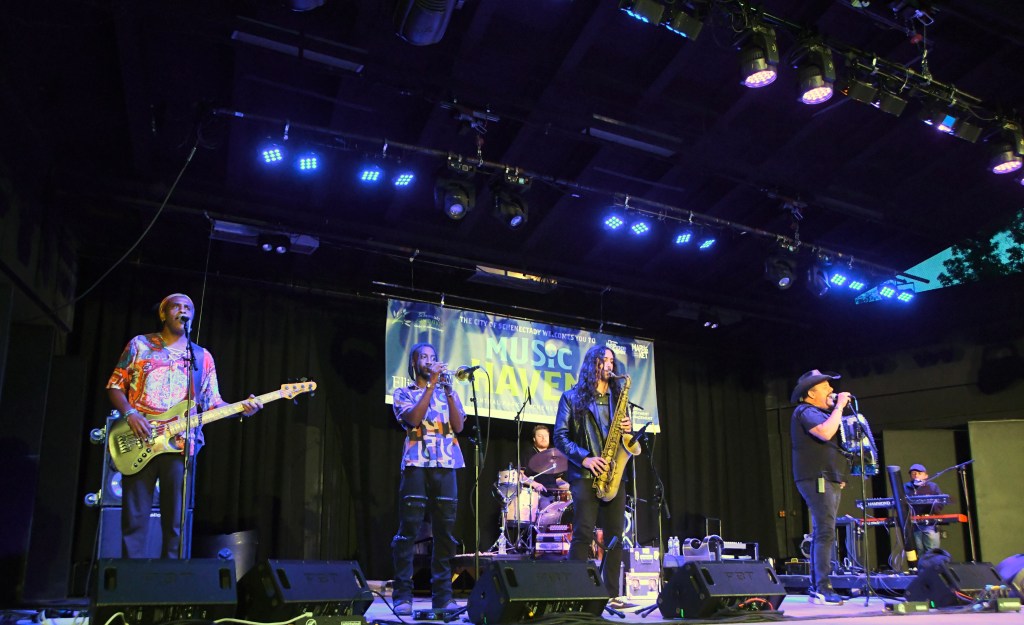
They started down home, inviting folks onto the dance floor with zippy two-steps. Then they reached into mainstream folk-rock in the exuberant “500 Miles” before flying back to the bayou with “Creole Mardi Gras Run.” Alternating zydeco dance numbers with zydeco-fied everything else was their path through 90 dynamic minutes onstage.

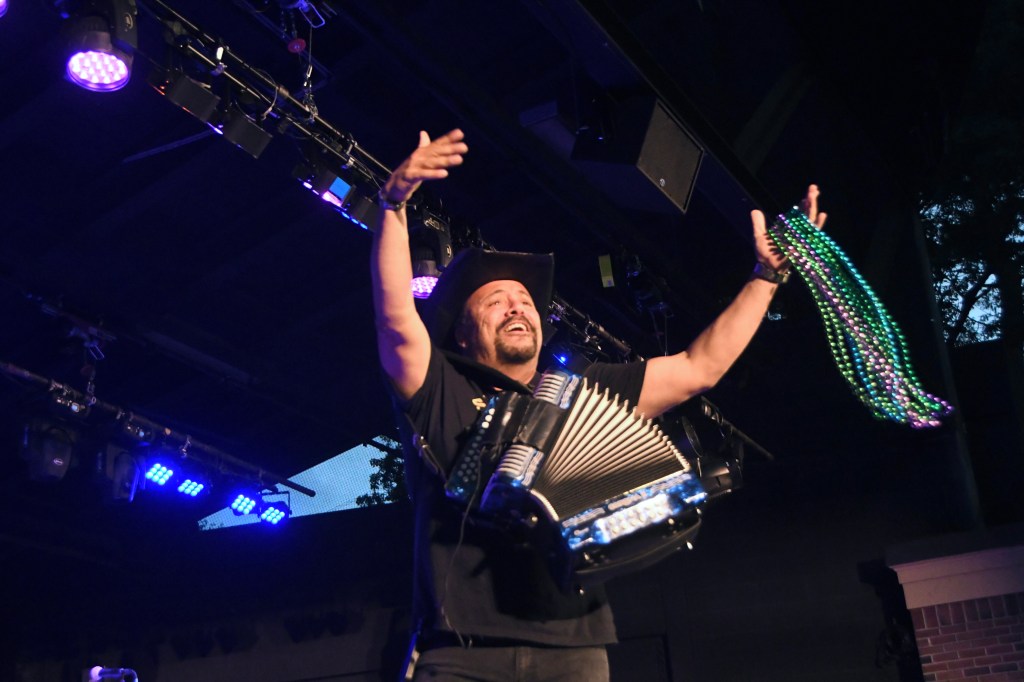
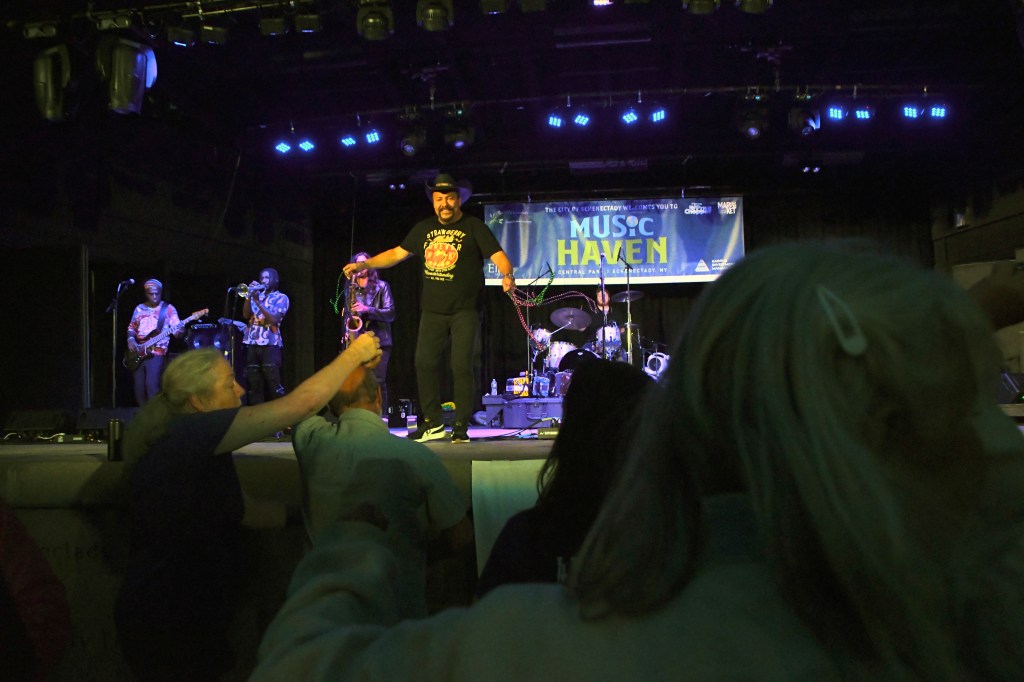
Tie together all the Mardi Gras beads Simien tossed into the crowd and they’d likely reach Proctors, the rain site downtown. Proctors proved unnecessary as staying in the park despite the dodgy, rapidly changing forecast proved the right choice. As evening turned windy and wet at times, few left and those who stayed kept dancing, or chair-dancing.

Since reggae and zydeco are distant cousins across the Caribbean, “500 Miles” worked well as a cross-styles hybrid. Then when Simien lit into Bob Marley’s “No Woman No Cry,” DJ Sir Walford was the first among many springing up in delight. Here and elsewhere, Simien proved a great soul singer, using nuance to delineate feeling. A singer armed with an accordion, Simien and keyboardist Danny Williams played like one mind with four hands, riffs wrapping riffs.

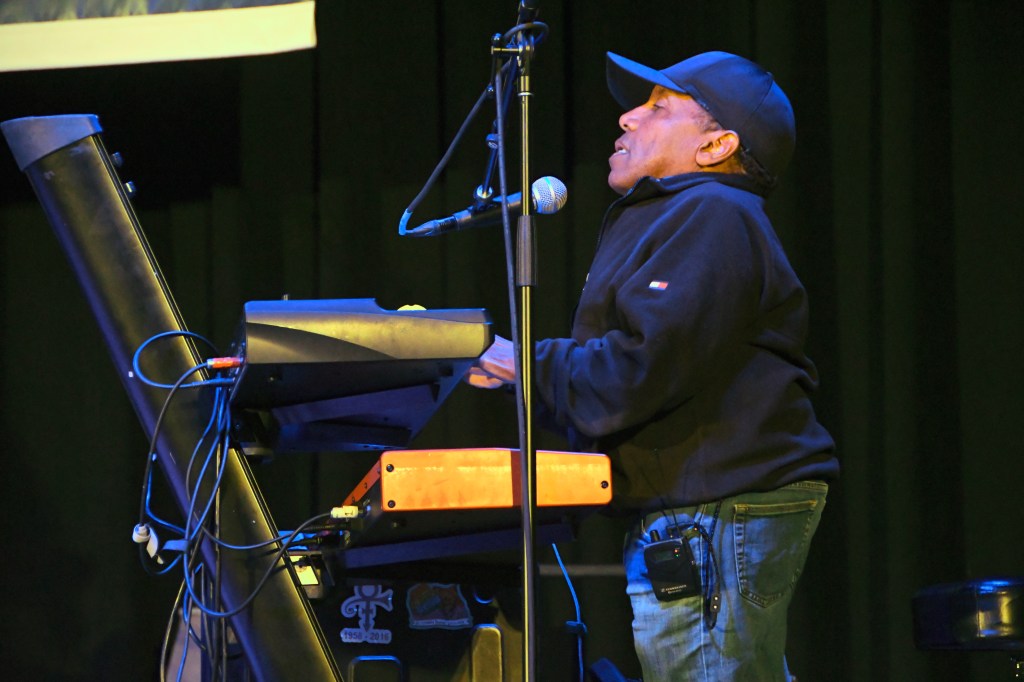
Terrance Simien, left; and Danny Williams, keyboards

Noting he’d collaborated with Randy Newman on the first zydeco song among Disney works, soundtrack of the “Tiana’s Bayou Adventure” ride, they played “Gonna Take You There” with non-cartoon-y commitment. From this zydeco tune, they sprang back into the mainstream with The Band’s “I Shall Be Released,” Simien going all Sam Cooke on the chorus. I don’t know if the next uptempo dance tune was “Zydeco Boogaloo,” but it was surely A zydeco boogaloo. 

Addressing “Love the One You’re With” to “my hippies” who filled the dance floor among everybody else, Simien injected another rock chestnut right inside, the Rolling Stones “You Can’t Always Get What You Want” before wrapping “Love” around it as coda. In between, the band copped grooves from Sly and Stevie, making it all fit.

Stan Chambers, above; Ian Molinaro-Thompson, below

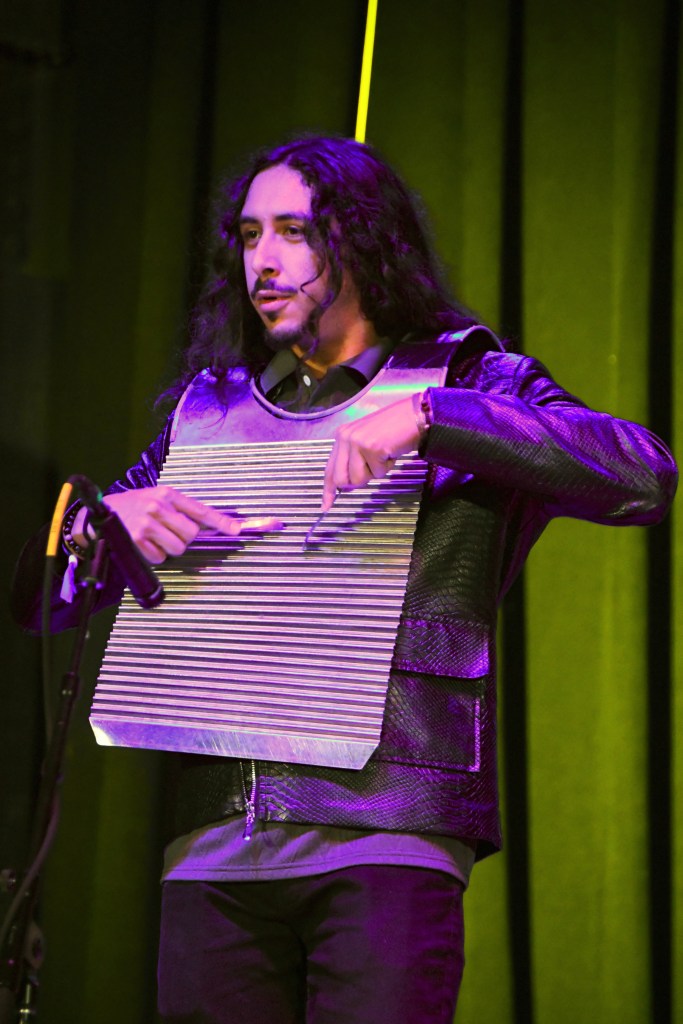
Here’s let’s give the band some, starting with its versatile beat masters. Bassist Stan Chambers played busy and relentless, right on the pulse set by drummer Ian Molinaro-Thompson. Trumpeter Emanuel Mitchell and tenor saxophonist Noah Boshra blended well as a section or soloed hot or subtle. Putting aside their brass when Simien cued them into the rhythm section, Mitchell smacked a tambourine and Boshra scratched a frottoir (metal rub-board) with bent spoons.  

Emanuel Mitchell, above; Noah Boshra, below

Mardi Gras chants gave this expanded rhythm section plenty to do behind Simien calling “Mighty Cooti Fiyo,” “Indian Red” and more before settling into “Iko Iko” at full force. Leading Mitchell and Boshra strutting down through the crowd, Simien lit into – what else? – “When the Saints Go Marching In” on returning to the stage. Afterward, urging peace and love, they left. As encore, they played and sang The Band’s classic “The Weight” in soulful authenticity. Here Simien raised his hand in a slow wave that also raised the crowd’s voices with him.

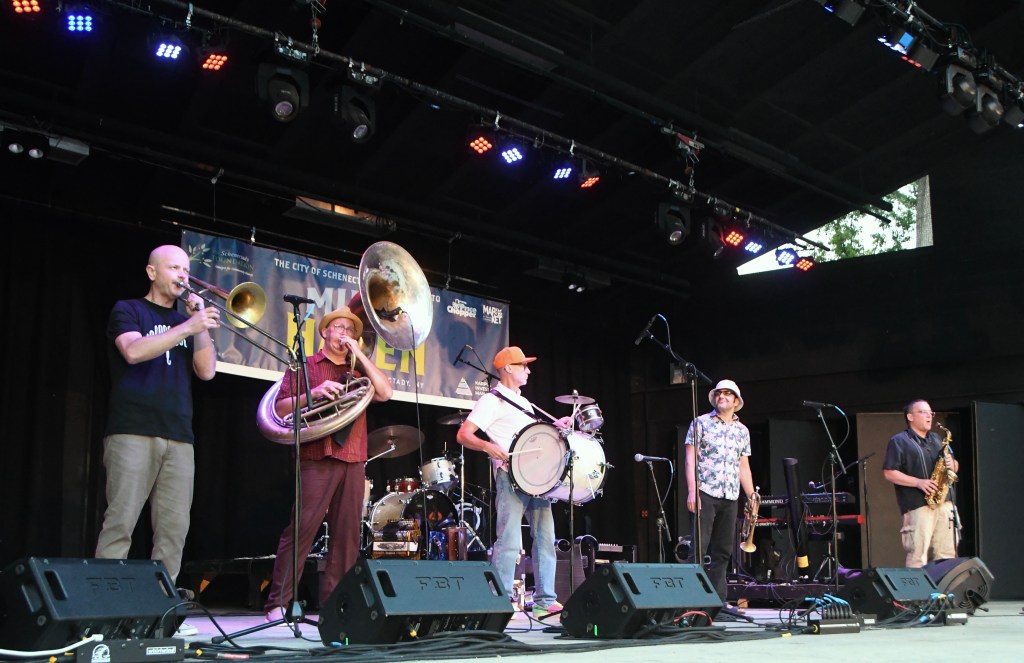
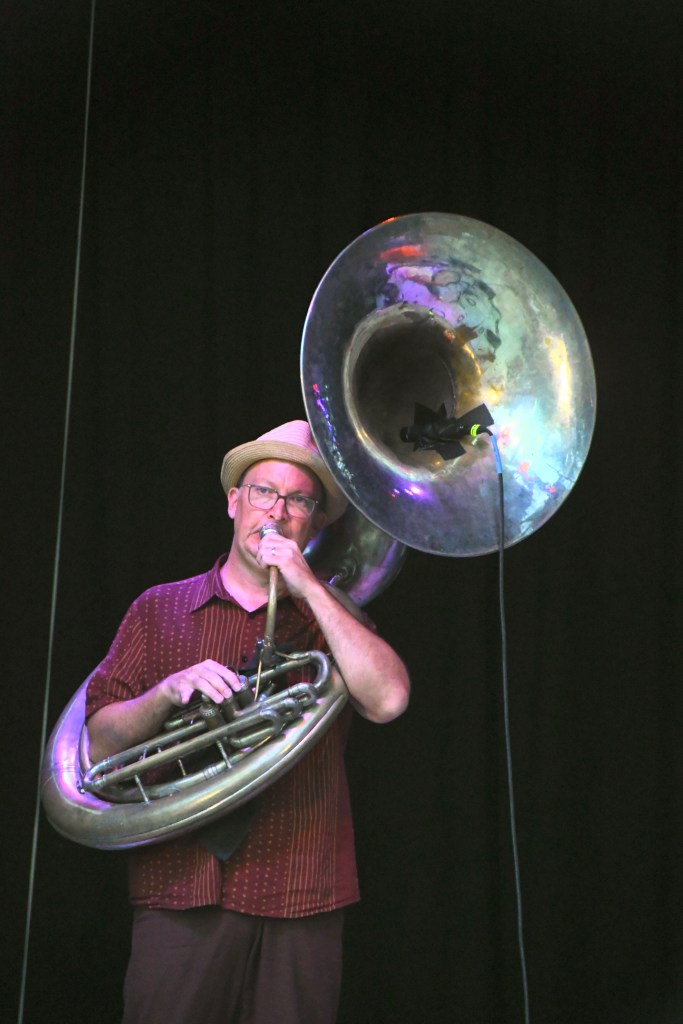
Keith Pray’s Mohawk Brass Band – From left: Pray, alto saxophone; Ben O’Shea, trombone; Chad Ploss (behind O’Shea), drums; Steve Lambert, trumpet; and Adam Streeter (behind Lambert), Sousaphone

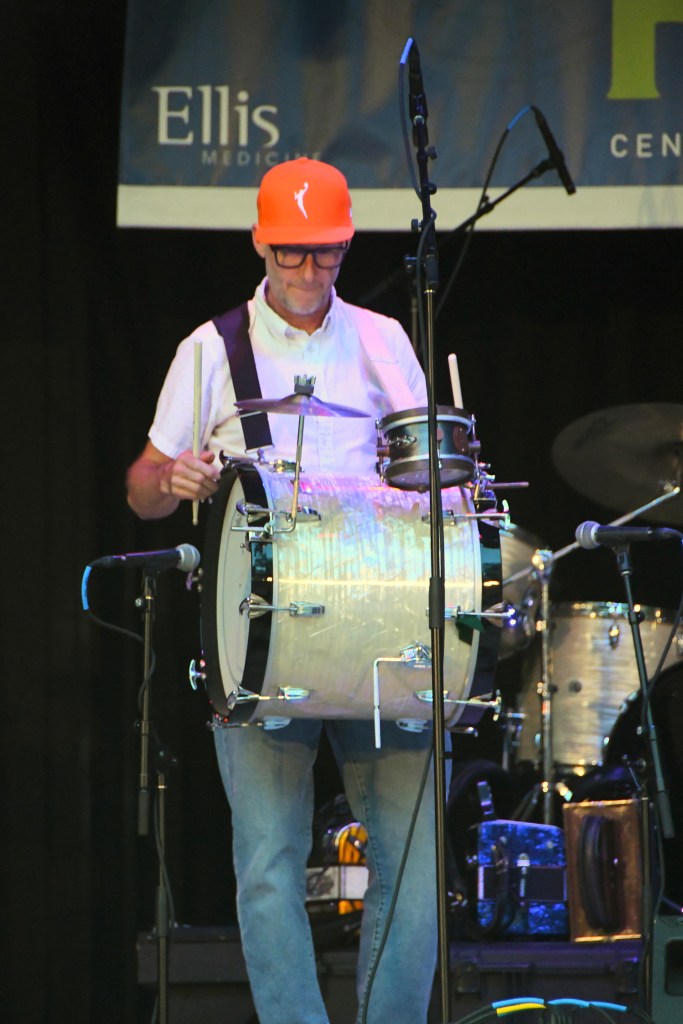
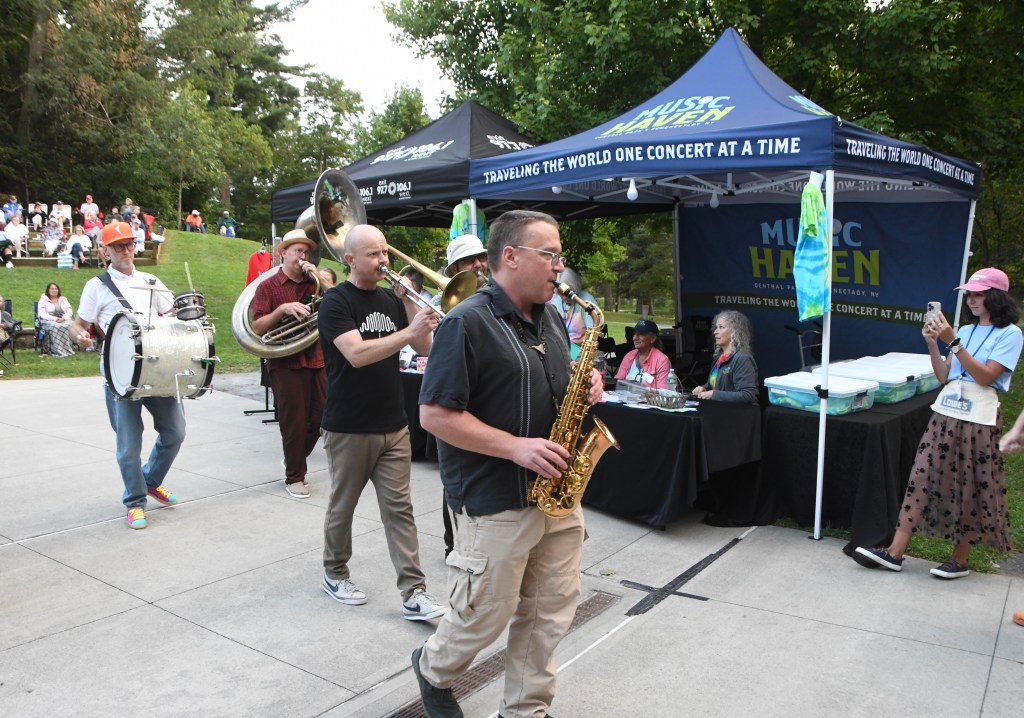
The show began with an earlier parade, from near the Ben & Jerry’s scoop stand and all around the crowd to the stage, by saxophonist Keith Pray’s Mohawk Brass Band. Trumpeter Steve Lambert, trombonist Ben O’Shea, Sousaphonist Adam Streeter and Pray himself, playing alto, all also play in Pray’s Big Soul Ensemble (only drummer Chad Ploss doesn’t), so they know how to lock a groove and solo all over it.

From left: Ben O’Shea, Adam Streeter, Chad Ploss, Steve Lambert, Keith Pray

Marching around or standing still onstage, they honored New Orleans brass band traditions in song choices, arrangements with round-robin solos or both. They paid tribute to the Rebirth and Hot 8 brass bands, turned “I’ll Fly Away” into a Sousaphone showcase and easily navigated the reggae/Second Line changes of the Hot 8’s “Rastafunk.”

Photo Gallery

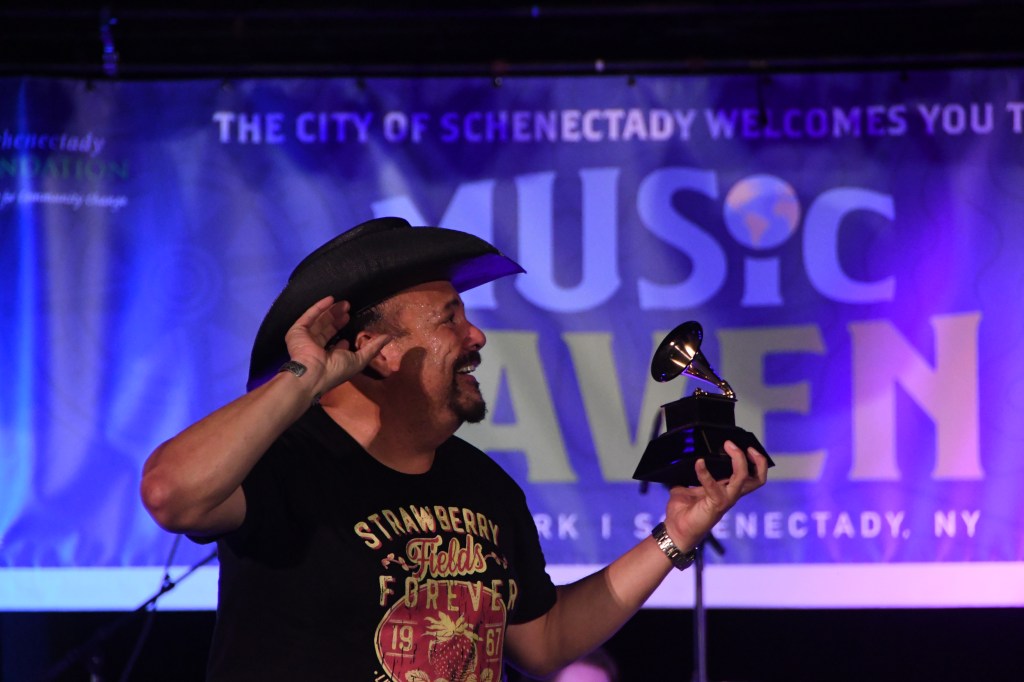
Terrance Simien cues applause for his Grammy

Danny Williams

WAMC Marks Folk Music Milestones at Music Haven

Review WAMC’s “Hudson River Sampler” Goes on the Road in Music Haven Concert Recorded for Future Broadcast

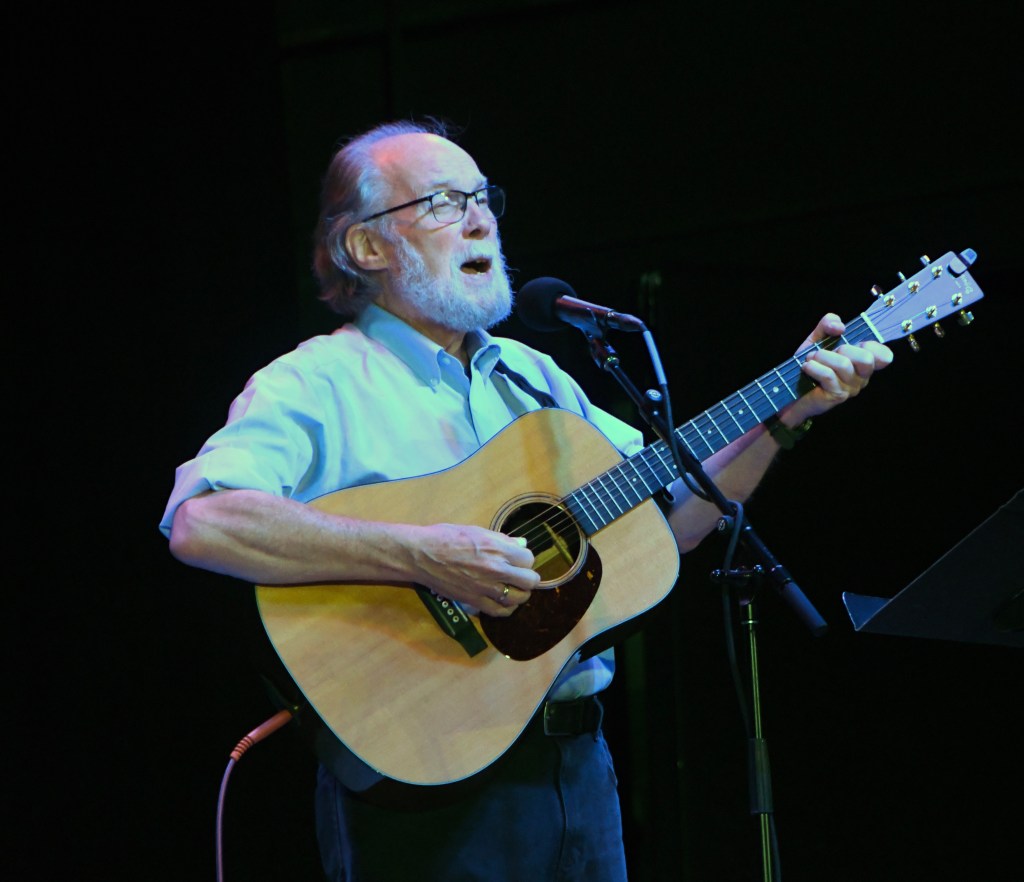
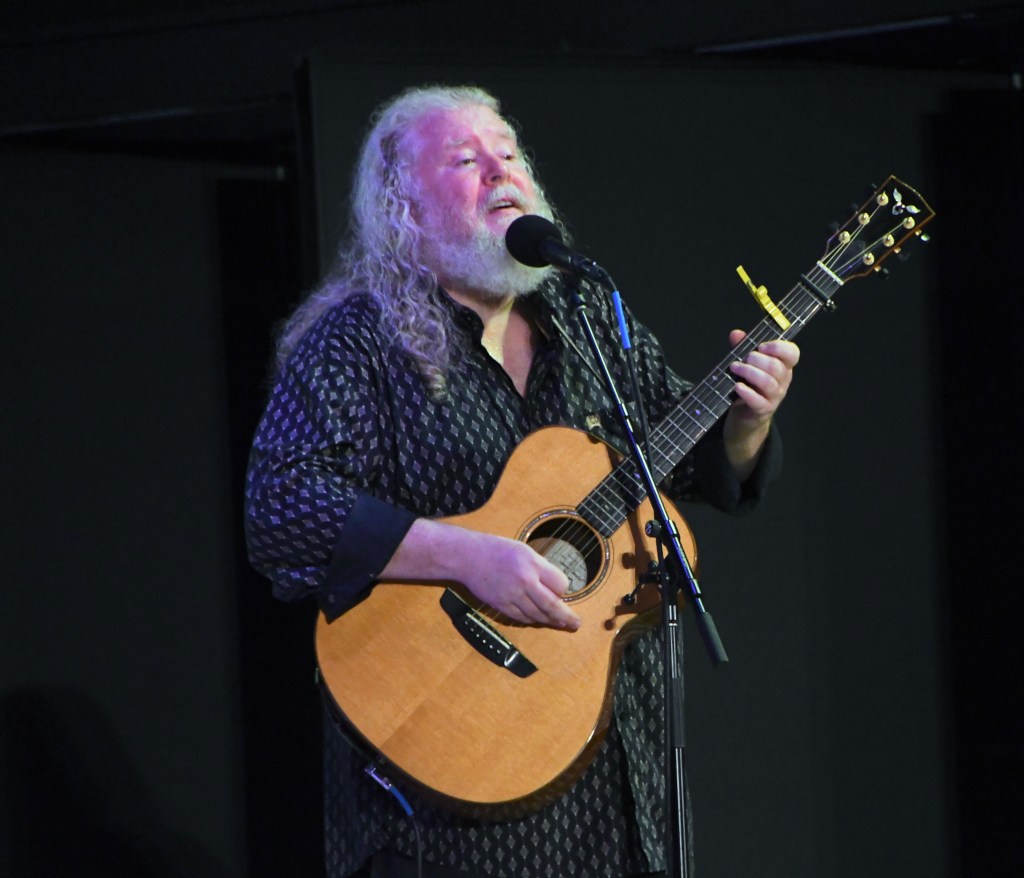
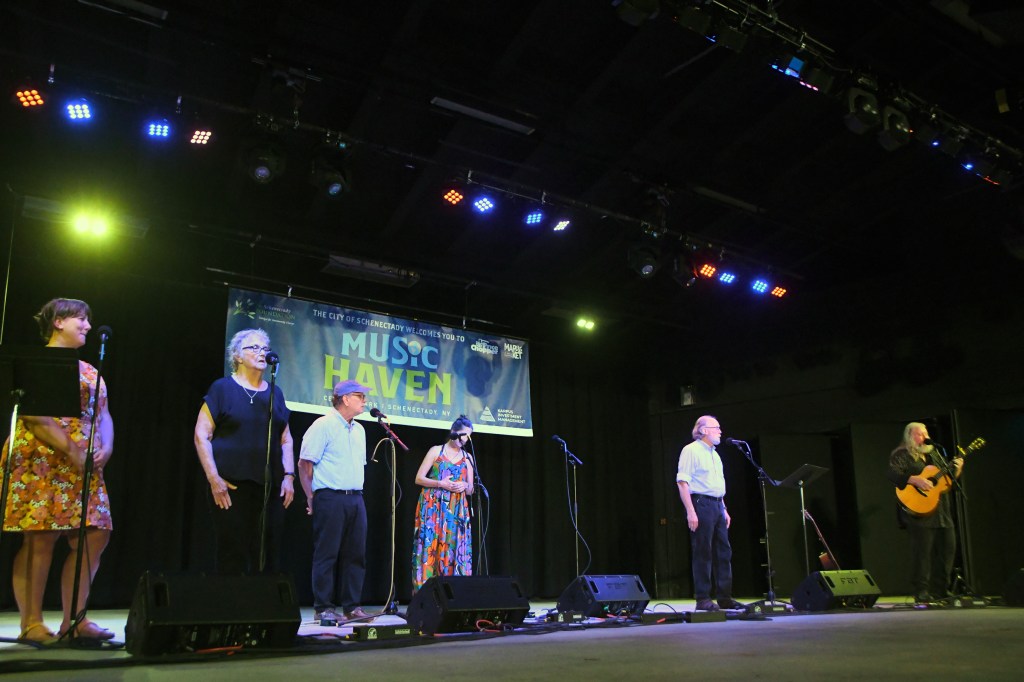
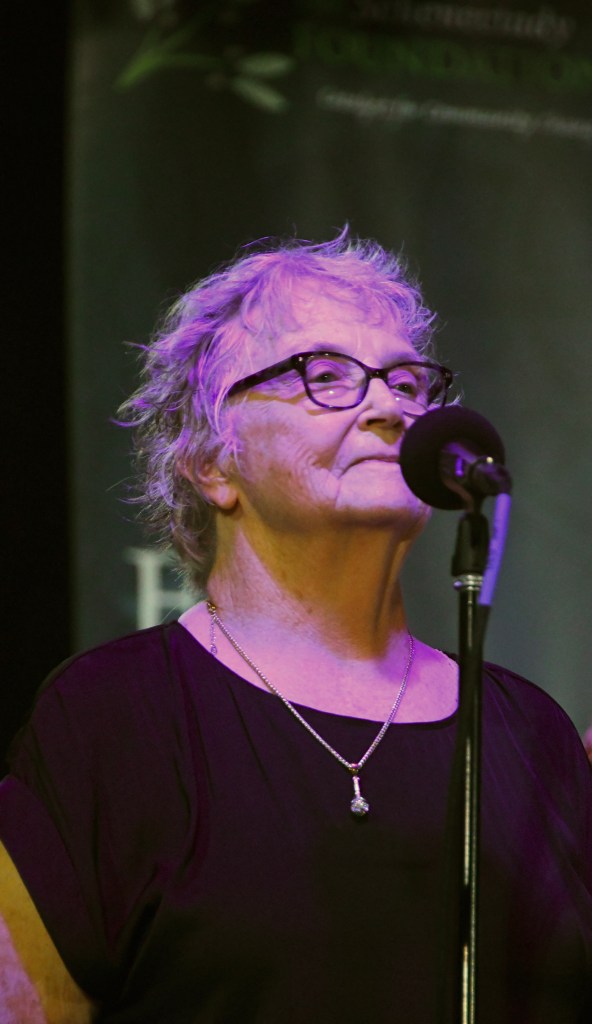
Wanda Fischer marked 43 years as host of WAMC’s “Hudson River Sampler” with folksinging friends at Music Haven Saturday. Celebrating folk’s durability, and Fischer’s, fell on Woodstock weekend, 66 years after the festival that forever changed pop music: It was never so diverse thereafter, but more profitable. Most in Saturday’s crowd fit the coulda-been-there boomer demo.

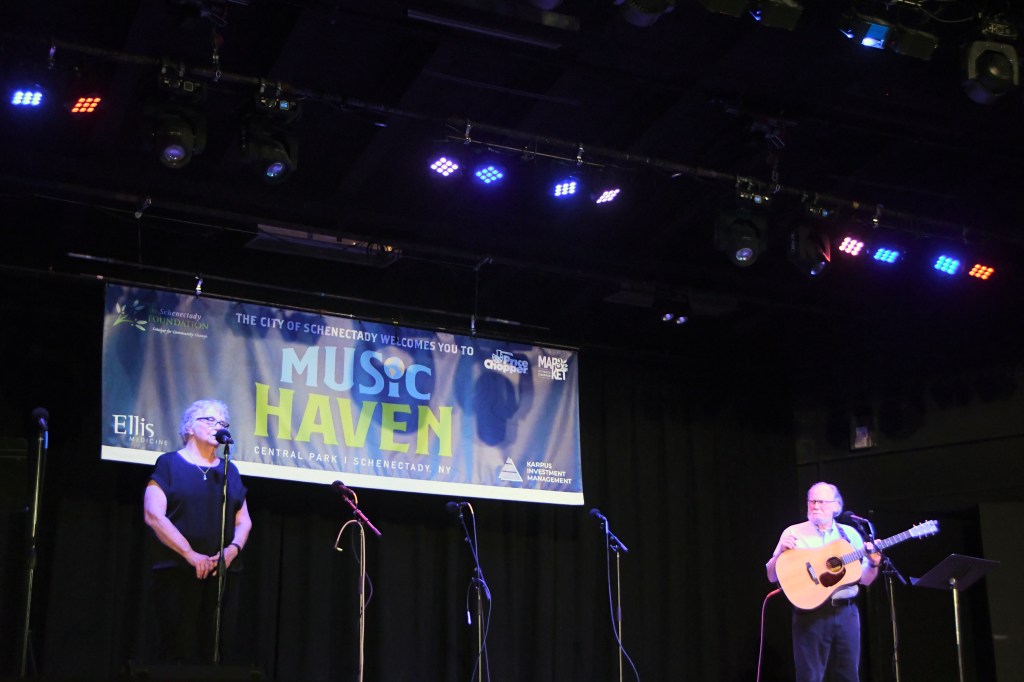
Music Haven maestro Mona Golub briefly introduced the evening, which otherwise belonged to WAMC. The regional NPR station’s On the Road chief Peter Hughes, producer and sometime morning host Sarah LaDuke and Fischer herself ran the show whose traditional Music Haven intermission raffle benefited the station. They and some performers noted NPR and affiliates are under threat, losing federal support. Many urged support of the station and its work, and the music they played demonstrated its importance as a community builder and catalyst while Music Haven and Golub earned major love and respect for hosting it.

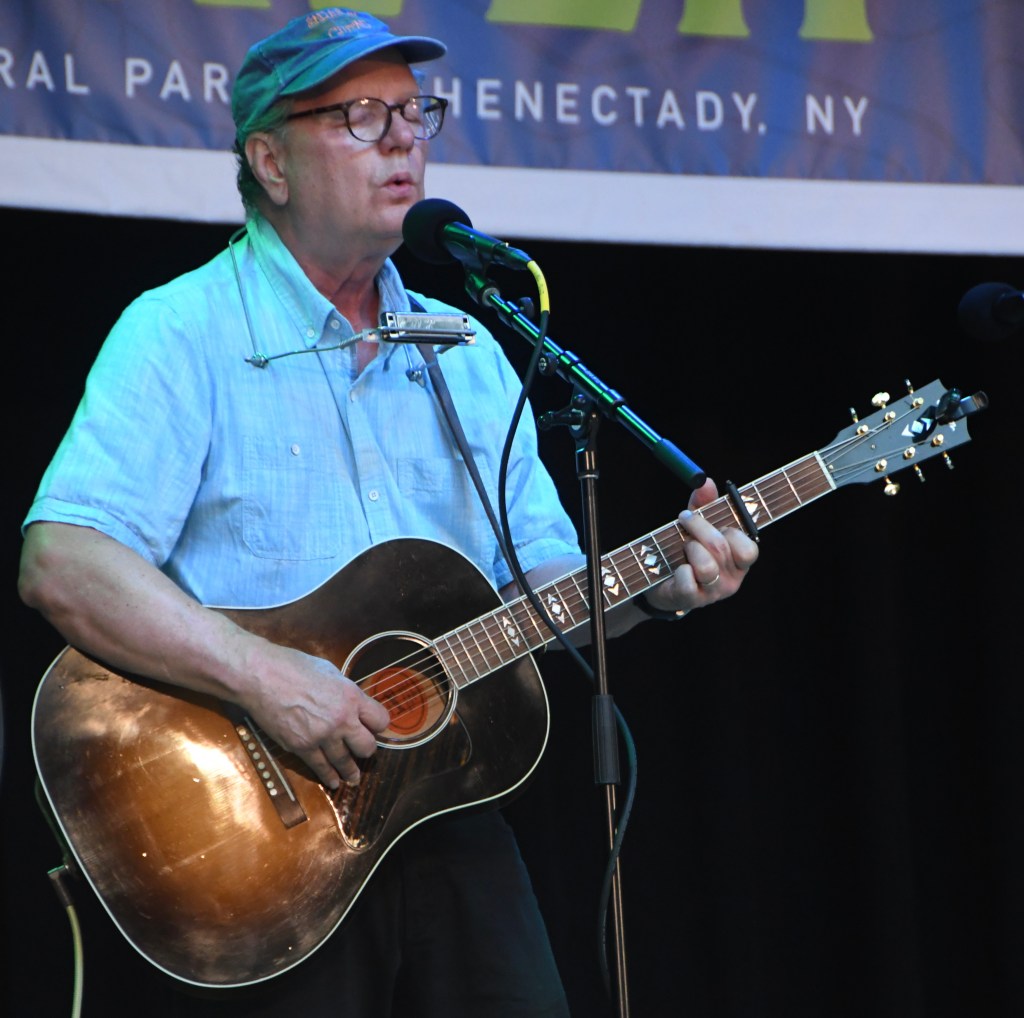
Fischer (at right) and LaDuke sang the first number, duetting shyly but well enough on “Five Hundred Miles” with headliner Joe Jencks playing acoustic guitar. 

Michael Jerling

North country troubadour Michael Jerling opened with well-honed, low-key charm, skilled and straightforward guitar picking and easy-going vocals. After a naturalist’s observation of his forested home in “Blue Heartland,” he paid witty, affectionate tribute to Merle Haggard, inspiration for “In Lieu of Flowers” about honoring the departed with love for those still here. 

His musician wife Teresina Huxtable had chided, “You’re not going to play that in front of people, are you?” on first hearing “Personal Appearance.” But sing it, he did, to amusing effect. He sang he’s short for his weight and he’d look like a boiled ham with ears if he shaved his head.

“Fish Trout Lake” nostalgically recalled family vacations before his self-improvement promise “Starting Tomorrow” tickled the funny bone like “Personal Appearances.”

Kate McDonnell and Jimmy Woodul

Kate McDonnell played guitar upside down and backwards, as Fischer noted in her intro. Her percussive thumb strums hit hard under treble lead runs by guitarist Jimmy Woodul, who played last Sunday at Music Haven in Reese Fulmer’s Carriage House Band opening for SteelDrivers. He also harmonized Saturday with McDonnell’s beautiful voice; singing blended as well as their playing.

Unstated socio-political trouble lurked in the shadows behind “Pretty Good Day” and “No Ordinary Time,” both positing simple pleasures and human connection as antidotes to fear and division. In “Trapeze,” she sketched the difficulties of music as career, a cautionary tale about running away to the circus of any art. “Step Right Up” also cautioned: “you’re the next what might have been.” “Oh, Mercy” was both a slam on George Bush as “the boy-king…the sequel” and a singalong call to action.

After intermission and the raffle of folk-related prizes, Dan Berggren first saluted the forever wild Adirondacks and the people who appreciate and nurture rather than exploit this delicate/rugged land and its creatures. “Whippoorwill Blues” lamented threats to that place and that ethos before extolling noble hard work in “Big Beams.” 

Dan Berggren

Berggren explained the folk process of recycling old melodies with new words, transforming “Wayfaring Stranger” into a call for peace and justice and “So Long, It’s Been Good to Know You” from sentimental adios to a singalong call to action: “Hold on and keep moving forward” – toward peace and justice.

His persuasive lyrics packed Tom Paxton-like righteous moral clarity packaged in cozy melodies, but could have used more of Seeger’s humor.

Joe Jencks

Joe Jencks started where modern protest folk did, in conversation with Pete Seeger. Adapting Seeger’s 1955 testimony before the House Un-American Activities Committee into lyrics, Jencks sang a defense of the First Amendment rather than the Fifth which a hostile interrogator accused Seeger of using, as if guilty of something. Seeger never named names, as some frightened coerced witnesses did, and stressed his right to sing for anyone. He was never prosecuted; the inquisition simply died of neglect or embarrassment, as ICE now also should.

Maybe history doesn’t repeat itself, but it often rhymes as Jencks implied, dropping a verse of “If I Had a Hammer” into his Seeger quotes song.

A dual US and Irish citizen, Jencks praised South Africa’s pluralism before hailing his ancestors’ immigration here in the homeland-sentimental waltz “Rose of Tralee.” Praising his grandfather Felix Kilbride’s courage in coming here via Ellis Island, he recounted the horrifying/preposterous recent arrest of Hopi tribal people in Arizona for failing to produce green cards – all by way of setting up the pro-immigration “Lady of the Harbor,” Lady Liberty. Many fans knew Jencks’s words and sang along, and did so again in “Bells of Freedom.” Jencks reached back to the Lomax 1939 recordings in Rayford prison as source for his “Take this Hammer,” a tool of hope and defiance.

The finale; from left: Sarah LaDuke, Wanda Fischer, Michael Jerling, Kate McDonnell, Dan Berggren and Joe Jencks

The full cast came on to join Jencks and sing “Get Together,” the Dino Valente (born Chet Powers) hit for the Youngbloods – changing the words a bit to sing “Smile on each other.” (The Youngbloods’ hit arrived in 1969, the Woodstock year, and they sang it at their last-ever show Aug. 5, 1972 at the late lamented Lenox Music Inn. But we digress.)

Wanda Fischer beams in the finale

The whole thing was sweet, inspiring and well-performed, but the staging seemed awkward. A seemingly permanent mic placement positioned the performers in odd places, as if their stage blocking in the finale determined where they’d stand whenever they played. They also performed oddly down-stage when greater closeness to the audience, physically, would have enhanced their connection in communicating sentiments all seemed to share.

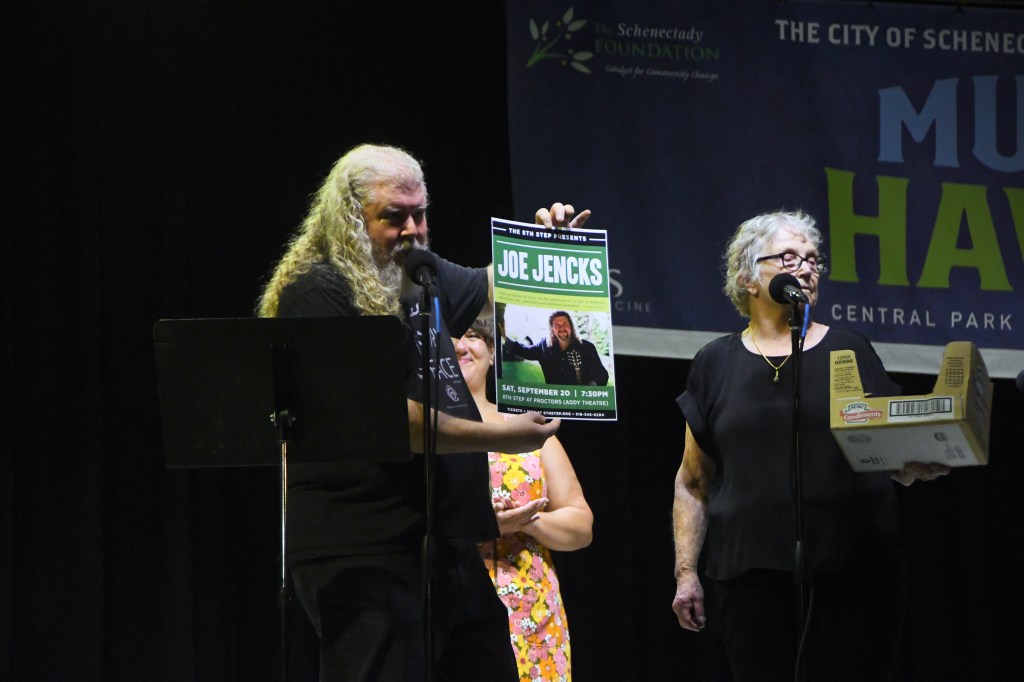
Joe Jencks touts his Sept. 20 Eighth Step show during the raffle, with Sarah LaDuke, behind Jencks, and Wanda Fischer

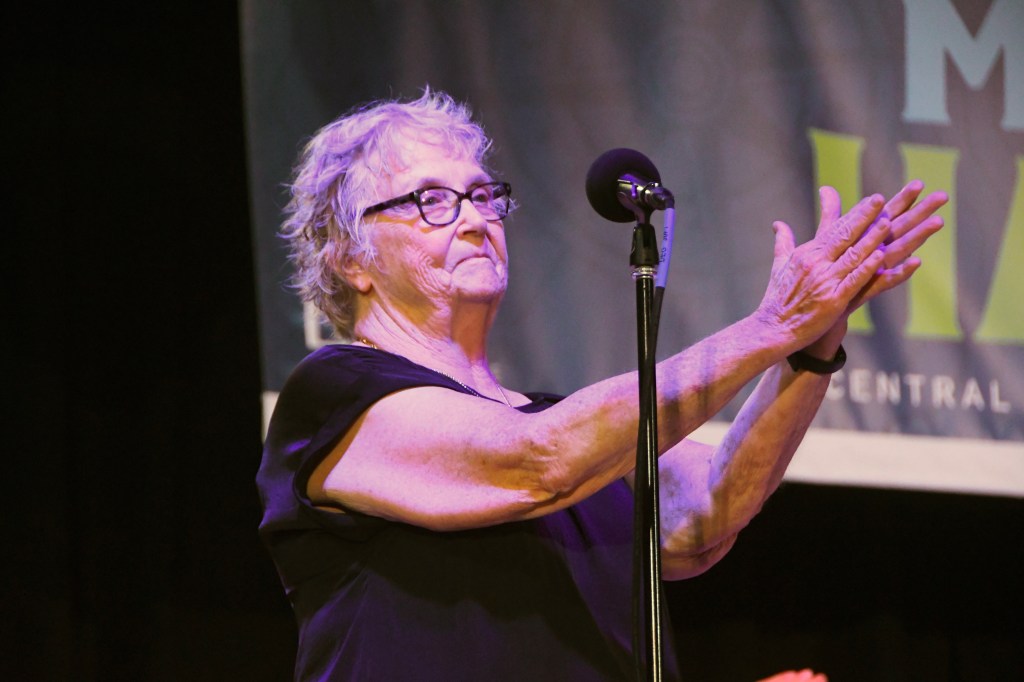
Wanda Fischer introduces Dan Berggren

Fans file out of Music Haven afterward; over the pastel-lit treed hill, a baseball game was underway at Central Park’s A Diamond.

Review: Renee Fleming and the Philadelphia Orchestra; Friday, Aug. 15, 2025 at Saratoga Performing Arts Center

Friday night at SPAC was almost, almost too much: Wide-screen nature-zen National Geographic visuals over the Philadelphia Orchestra and lyric soprano Renee Fleming. Star of opera, Broadway and everything else she’s tried, she sang songwriters’ lyrics or poets’ words. Her voice and elegant presence plus glorious images overhead all but eclipsed the Philadelphians in the touring version of “Voice of Nature: The Anthropocene” that won a Grammy. 

She explained that in this Covid project, she and Philadelphia Orchestra Musical Director Yannick Nezet-Seguin reached from quarantine to embrace a world then out of reach. Friday, images re-opened that once-closed earth. This beautiful blend of sights and sounds that comprised the concert’s first half also had a point; as did the initially disjunct but increasingly cohesive second half whose visuals were of the performers.

At first “Voice of Nature” overwhelmed, from aerial splendor far aloft in auroras, clouds and stars to tiny plant and animal organisms. The flow of visual images was seamless, mostly, with more lap-dissolves than hard cuts in the editing. The sounds were segmented; 10 sung and spoken pieces with orchestral accompaniment. Soaring sequoias, sparse desert scapes, waters serene or stormy, creatures tiny or titanic, spread their wings, played in the waves. Sometimes images and lyrics matched; words we heard described scenes we saw. But they didn’t have to; meanings more often fit metaphorically than literally.

The music ranged from Handel to Bjork; the first words expressed awe at towering forests, its last words mourned “Red Mountains Sometimes Cry.” Conductor Robert Moody elicited the distinctive character of each accompanying orchestral episode while also preserving a unity that never felt forced.

If the images were romantic, the orchestral sounds were maybe more so, in the impressionist style of Debussy, Ravel or Vaughn Williams. Fleming’s voice – she may be our most modestly self-effacing and unarguably great vocal artist in range, sheer sound and affect – bridged the visual and the verbal. 

Gradually, both began to express alarm at environmental damage and the distress of natural systems beset by fire and flood, glaciers calving icebergs – all linked implicitly to industrial pollution.

Even before this beauty-under-threat oratorio began, Fleming had directed the audience to kiosks uphill from the amphitheater, promoting programs and organizations mobilized to protect the environment.

It was all too gorgeous to feel didactic; it implied rather than insisted, and the closing credits onscreen highlighted the work of close allies to Fleming and Nezet-Seguin in creating the piece and promoting its cause.

After those credits, as a first-half encore, Burt Bacharach’s romantic pop classic “What the World Needs Now Is Love Sweet Love,” urged love as antidote to disaster.

The second half began in a slightly jarring generic feel; Wagner’s “Prelude to Die Meistersinger” that might have introduced a “greatest hits” run of familiar classical war-horses. Visuals over this opener and throughout the second half showed orchestra players onscreen. 

Fleming’s return gave shape and intent as a unified statement unfolded, song by song.

Arias of Leoncavallo and Puccini followed before Gould’s “An American Salute,” variations on “When Johnny Comes Marching Home” that spanned simple jingoism into parody and back again. 

Then the music Broadway composer John Kander wrote for Fleming to sing “A Letter from Sullivan Ballou,” a compelling piece Ken Burns used in “The Civil War,” told the heartbreaking story of a soldier going into battle. Conveying to his wife his feelings focused by the risk of death, he proclaimed his deep, devoted and hopeful love for her. In plainspoken candor, his words conveyed the sentiments of a tender heart. And he expressed his willingness to forfeit his future with her and their sons to defend his country. Within a week, the letter writer was killed in the Civil War’s first major battle.

Now, sadly as true patriotism, devotion to truth and principle and self-sacrifice in defending them are derided as woke by amoral leaders who value nothing beyond power-mad ego and greed, the simple nobility of these sentiments shone like the sun in the National Geographic videos. Ballou’s words spoke for themselves; Fleming sang them to breathtakingly poignant effect.

She then lightened the mood in a show-tunes run, two John Kander Broadway-ish numbers culminating in the comforting word “Always;” the stirring “You’ll Never Walk Alone,” then the hilariously self-deprecating “Diva,” a delicious bit of show-biz brassy flash turned inside out with humor. 

Here, Fleming proved she could sing the phone book to powerful and entertaining effect, and bring the laughs at the same time.

A generous encore began with the breezy romance of “I Could Have Danced All Night” before Leonard Cohen’s dependably exalting “Hallelujah.” Arguably no one has sung it better than Fleming on Friday, melody and words wrapping the evening in a velvety elegance as audience voices rose around Fleming’s in a chorus of everybody.

Jazz on Jay (and Blues and Pop and rock…)

Review: The Evidence at Jazz on Jay, Thursday. August. 14, 2025

Sure, jazz musicians Eliane Elias, Woody Herman and Astrud Gilberto recorded the Doors’ “Light My Fire;” so did singers Al Green, Jose Feliciano and Trini Lopez, plus countless others. 

With all these cover versions out there, the straightforward version that jazz-blues trio The Evidence performed as set-closer Thursday at Jazz on Jay steamrolled past any sense of transgression because they had already blues’ed up or jazz-ified vintage pop ballads, jump-blues, soul numbers and Tin Pan Alley selections from the Great American Songbook.

In a pre-concert written interview for the program bio handed out Thursday, The Evidence keyboardist, singer and trumpeter Rob Aronstein noted, “I’m really a blues player, so (those styles) tend to show that influence pretty heavily.” Arguably guitarist Mike Derrico and drummer Andy Hearn played in more conventionally jazz styles that would have placated any purists in the musical border patrol because the thing swung, the familiar tunes worked and it was all good fun – entertaining rather than ground-breaking.

The Evidence, from left: Rob Aronstein, keyboard, vocals and trumpet; Andy Hearn, drums; Mike Derrico, guitar

The spunky instrumental blues groove “Honky Tonk” earned its title, a smoky shuffle that opened the 90-minute set with happy riff energy. The next two, both classics, featured Aronstein’s vocals, accurate and solid: a spry “Straighten Up and Fly Right” and a hot-weather-languid “Summertime.” 

Rob Aronstein, above and below

A Derrico instrumental “Catz’s Bossa” was all tropical groove and aggressive guitar, though Aronstein’s piano held its own. Then they did “That’s the Time I Feel Like Making Love to You” as an instrumental, showcasing crisp unified playing with solos springing up amid the flow. Aronstein played firm bass lines with his left hand, adroit melodies and chords with his right, while Derrico finger-picked both chords and single-note runs with pleasing tone, good taste and skillful touch. Hearn fit well between keys and guitar, low-key and economical. The Evidence most often plays as a duo; he did a fine job of making it a trio.

Mike Derrico, above; and Andy Hearn, below

In “Nobody Knows You When You’re Down and Out,” Derrico’s accompaniment for Aronstein’s keyboard and vocal showed off more snazzy electronic effects than his plainspoken solo, clear sign of a honed and confident trio approach. But he brought the fire to his original “Catz’s Blues;” then Aronstein similarly cut loose at the keyboard in the jump-blues antique “Choo-Choo Ch-Boogie.” 

Rob Aronstein plays pocket trumpet

Noting the next number was new for them, Aronstein swung the band into a funk shuffle the setlist ID’ed as “April.” Hearn sat out the next number; a trumpet and guitar duet on “The Nearness of You.” Muting the bell with his hand, then playing open, Aronstein sounded both sincere and a bit shaky here, answering a fan’s query about his instrument by explaining the compact pocket trumpet is “a standard trumpet but wound tighter – like me!”

As with the earlier “Feel Like Making Love,” they transformed “You Better Shop Around” into a stop-and-go instrumental shuffle before three vocal antiques: “Sunny” with terrific Derrico guitar; “Fly Me to the Moon,” refreshed with bustling tempo shifts and “This Masquerade” with Aronstein’s only foray into skat-singing all day.

Then, “Light My Fire;” although Aronstein nixed the familiar Ray Manzarek organ solo, Derrico did recreate, briefly, Robbie Krieger’s similarly patented staccato guitar runs.

Next Thursday, Jazz on Jay continues with the Arch Stanton Quartet, although nobody in the band is named Arch Stanton…  

The Evidence at Jazz on Jay

Accordion Fire Fun and Funk

Preview: Terrance Simien & The Zydeco Experience with Special Guest Keith Pray’s Mohawk Brass Band, Sunday, Aug. 17, 2025

 Terrance Simien excitedly ushered me into his band’s dressing room trailer on a years-ago Thursday at Alive at Five.

We’d met before, in phone interviews and backstage hangs; but this was special. He had something he wanted to share.

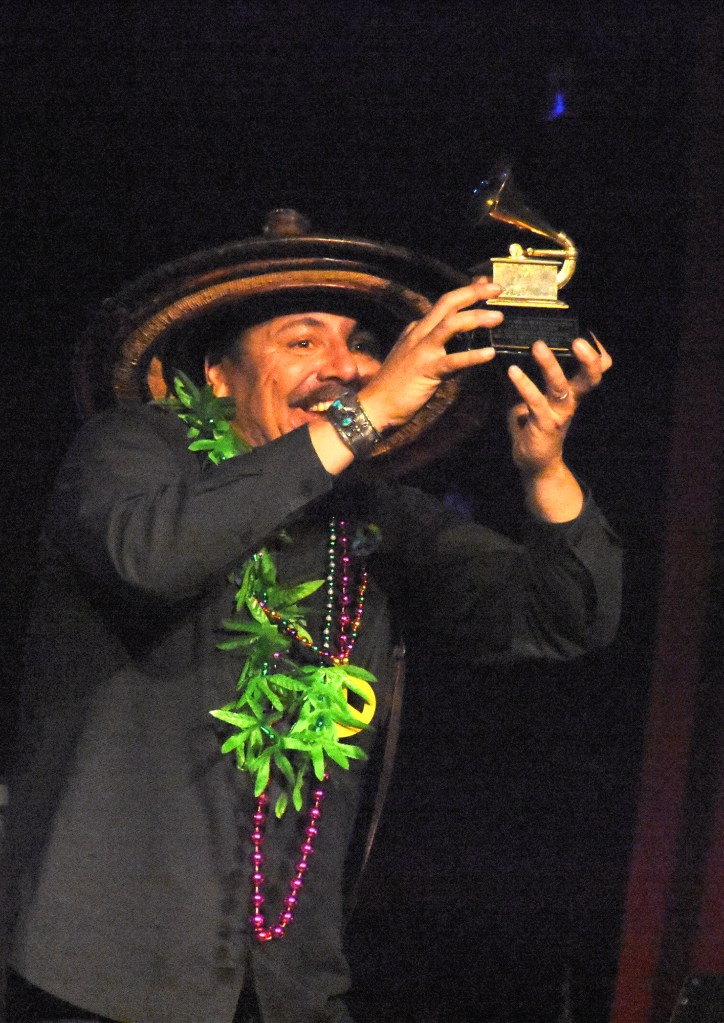
Simien grabbed up a miniature Anvil case – you know the kind, those stout, metal-cornered bullet-proof protectors of instruments and amps. Popping it open with a smile wide as its opening, he pulled forth a glistening, heavy model of an antique gramophone, a talisman bright with honor.

The first; well, the only, Grammy award I ever held in my hands.

It was also the the first-ever Grammy Award for Best Zydeco or Cajun Music Album the Academy ever awarded, in 2008. Renaming it the Best Regional Roots Music Album Award in 2014 didn’t stop Simien. He won that, too.

Not that he needed the affirmation, much as he enjoyed showing it off and sharing it around.

Terrance Simien at Cohoes Music Hall 2019, with Grammy

Simien started his decades-long career by echoing his heroes and mentors on tribute albums honoring zydeco pioneers Clifton Chenier, John Delafose, Boozoo Chavis, Rockin Dopsie and Rockin’ Sidney. In addition to heartfelt tributes to these close-to-home (Louisiana) influences, he has increasingly looked beyond zydeco for inspiration, to Art “Poppa Funk” Neville, Sam Cooke, Bob Dylan, Earth Wind and Fire and the Commodores.

In other words, he dove into the funk, simmered with soul, bantered around with the Bard’s lyrics and harmonized with every tradition he ambitiously explored.

Simien is mostly seen grinning or singing or both behind an accordion, which a witty Albany musician who played one himself calls “musical luggage.” He also sings in the finest voice in zydeco and entertains with wild, engaging gusto. Even Simien’s toes get into the act. Without missing a note at the squeezebox or the mic he can kick Mardi Gras beats far from the stage to happy fans.

Tossing beads at Cohoes Music Hall

He started his first band while still in high school, and his Mallet Playboys (Mallet, LA is his hometown) grew into the Zydeco Experience, paralleling his evolving ambition. He was 19 when he answered Paul Simon’s call to play on “Graceland” – arguably earning a bite of Simon’s Album of the Year Grammy. 

Stirring soul, funk and singer-songwriter innovations into a thick zydeco gumbo, Simien  has cooked up over time a traditional-contemporary recipe. His peers find this mix so compelling that jam-band stalwarts the Dave Matthews Band, New Orleans funk masters the Neville Brothers and other major box office stars have asked him to open their shows. 
 
Singing and playing accordion, Simien leads The Zydeco Experience. He played his first area show in Proctors former Mardi Gras Festival and has also played here in Washington Park in Music Haven impresario Mona Golub’s previous free concert program, also at the former College of St. Rose’s Massry Center among doubtless others. At the Massry, longtime fans Ben Cohen and Jerry Greenfield – yeah, Ben and Jerry – turned up to campaign for Bernie Sanders and dance barefoot alongside the barefooted Simien.

At Jazz Fest in New Orleans, he plays the big stages and I’ve seen him foot-fling Mardi Gras beads deep into happy crowds.

When he played the Cohoes Music Hall in 2019, he invited openers Professor Louie onstage with his Zydeco Experience band.

Terrance Simien at the Cohoes Music Hall 2019; Simien center, in hat; Danny Williams at right

This versatile veteran band pumps traditional waltzes and two-steps; rocking everything and pouring on rich funk, jazz and soul spice. The Experience’s secret weapon is tiny keyboard titan and singer Danny Williams, Simien’s bandmate for 30-plus years. Bassist Stan Chambers has been aboard for 15-plus years while drummer Ian Molinaro-Thompson, trumpeter Michael Christie and saxophonist Noah Boshra are newer additions.

Saxophonist, organist, educator and bandleader Keith Pray opens Sunday. He formed the Mohawk Brass Band in 2011, leading its evolution from a mentorship program for Schenectady middle- and high-schoolers into a professional ensemble playing traditional New Orleans brass band music: Steve Lambert, trumpet; Keith Pray, saxophone; Ben O’Shea, trombone; Adam Streeter, tuba; and Chad Ploss, drums.

Terrance Simien at The Merch Table

Depending on who’s counting, he’s made nine or 11 albums, enough to crowd the merch table. Some favorites:

“The Dockside Sessions” (2001) has three Bob Dylan songs and the Grateful Dead’s “Franklin’s Tower.”

“The Tribute Sessions” (2001) includes not only Rockin’ Sidney’s straight zydeco swamp-pop classic “My Toot Toot” but also “Waiting in Vain,” one of Bob Marley’s best songs, “Will the Circle Be Unbroken” by the Carter Family and “It Makes No Difference.” This one takes real nerve for any singer to tackle since the late, great Rick Danko made this one of The Band’s most plaintive tunes ever, on their debut “Music From Big Pink.”

“There’s Room for Us All” (1993) similarly includes “I Shall be Released,” another Dylan classic that Manuel sang wonderfully, achingly on “Music from Big Pink.”

Positively Beadhead (1999) uncorks “Jolie Blonde,” the “Cajun national anthem,” plus Hedy West’s “500 Miles,” a longtime onstage favorite; also “Mardi Gras in the Country.” Simien explained this over the phone years ago: On Mardi Gras day, country kids roam farm to farm in cars or on horseback; residents feed them and everybody dances with the lady of the house. The late Anthony Bourdain filmed this high-alcohol-content ramble in “Cajun Mardi Gras” – Season 11, episode 7 of “Parts Unknown.”

By the 2000s, Simien was recording most of his albums live at Jazz Fest, which shows his energies shifting from studio to stage.

Terrance Simien at Jazz Fest in New Orleans 2015

His “Live! Worldwide” won Best Zydeco or Cajun Music Album in 2008, and “Dockside Sessions” won Best Regional Roots Music Album in 2014.

.