

Bettye LaVette at Caffe Lena, Saturday, May 17, 2025
When traditional Japanese potters repair a broken pot, they pour molten gold into the cracks.
When Bettye LaVette’s voice cracked onstage at Caffe Lena Saturday, it burnished the lyric with the pure gold soul sound of deep feeling.
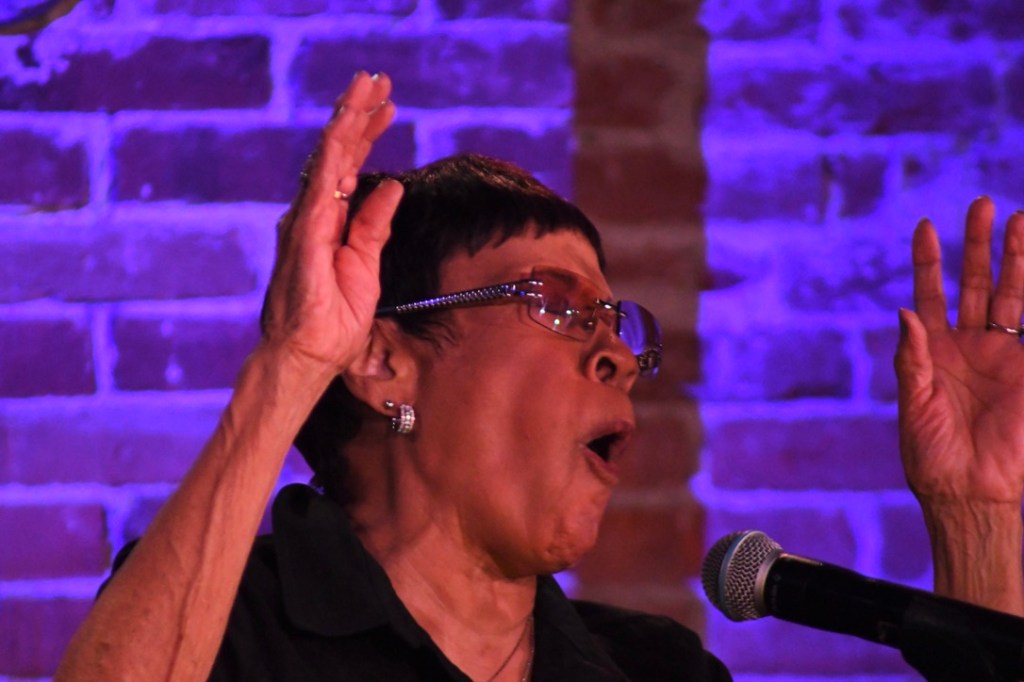
Singers either have pretty voices or they don’t; Bettye LaVette knows she doesn’t and said hers was more James Brown than Doris Day. She called her 85-minute song recital “not really a show.” No band, no dance moves. She sat, mostly, and cast an intimate spell, of “coming over to my house.” In song intros she noted “I have so many lies to tell you” – but she and the songs rang true. No band, maybe, but Alan Hill accompanied her beautifully on either the Caffe’s venerable upright piano or an electric keyboard. Seldom soloing, he ranged in well-made, minimalist backgrounds from funky soul to fervent Gospel to broken-heart blues. He calmly rolled along as she changed up the set list.
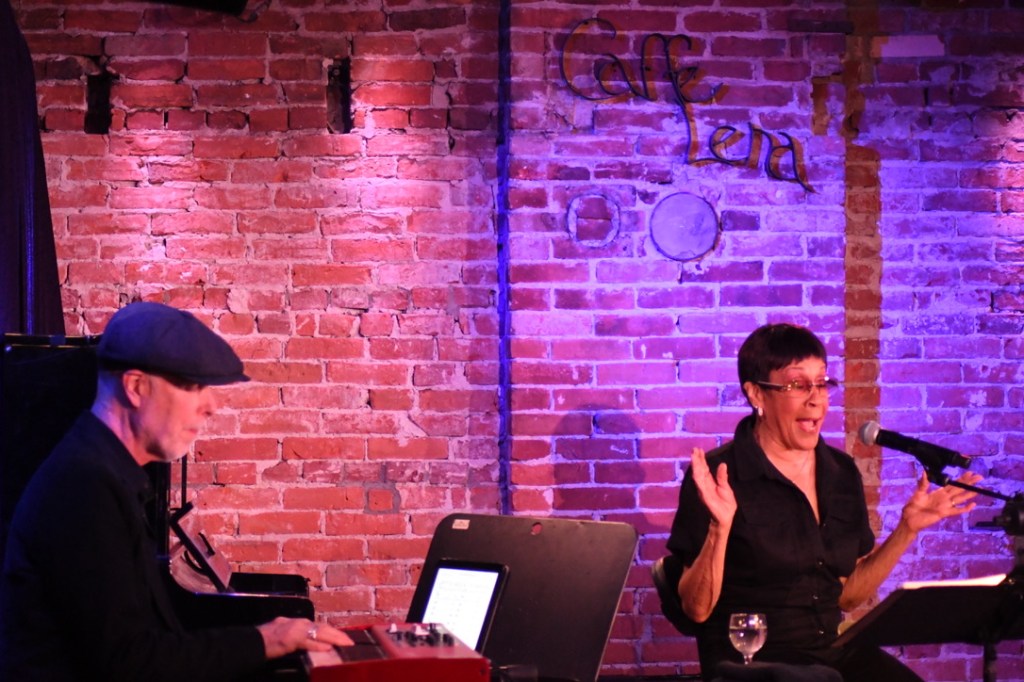
Alan Hill, left; and Bettye LaVette
Tiny, trim, she leaned on grandson/road manager Randall’s arm to mount and leave the stage. Up there, though, she ruled.
LaVette started with “Things Have Changed” by another non-pretty-voiced singer (and returned to Dylan’s songbook later with “Emotionally Yours.”) She packed room-filling drama, brassy dynamic intensity and Dylan’s own trademark ambiguous regret and resignation into “Changed.” Then, when when her voice cracked and quavered in Angelo Badalamenti’s complex “I Hold No Grudge,” it only heightened its poignancy, without sounding at all contrived or theatrical.
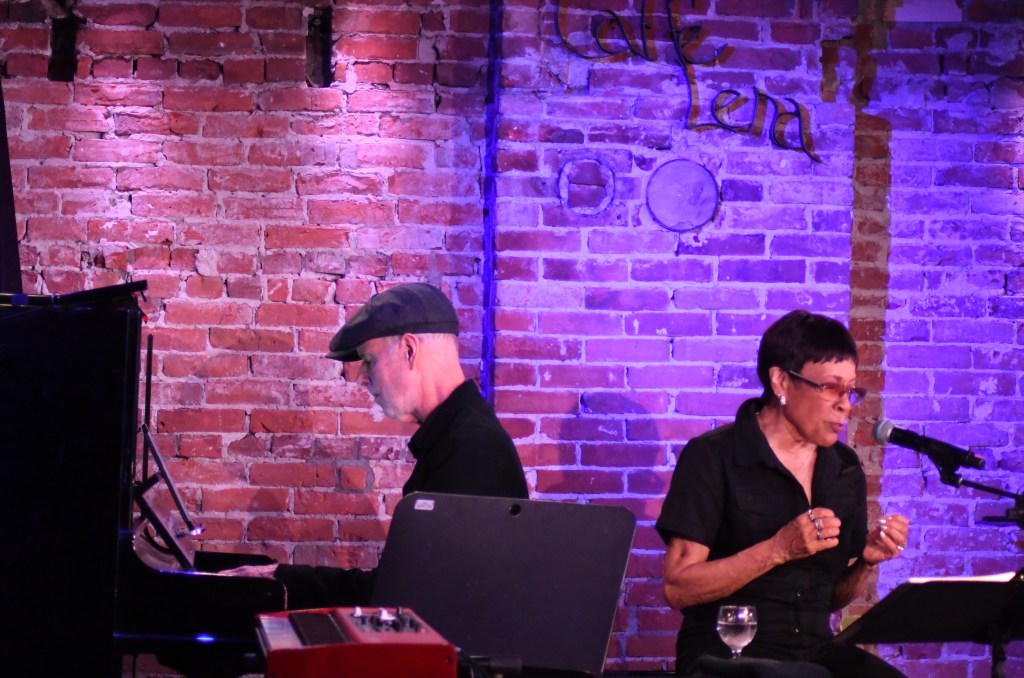
The same emotional directness marked, or elevated, Sharon Robinson’s “One More Song” which she noted proudly is on “Blackbirds,” her 2020 album of all women-written songs. (“I’ve Got My Own Hell to Raise” [2025] is another. But we digress.) When she rhymed “call it quits” with “that’s it,” she might have been delivering a death sentence.
Slowing down “I Just Dropped In (To See What Condition My Condition Was In)” tugged the Kenny Rogers/First Edition hit from novelty-song superficiality into something mature and meaningful.
In other words, she made very good indeed on her claim to be a song interpreter whom songwriters trust. Everything was a Bettye LaVette song, claimed mainly by slowing the tempo to accentuate dynamics and punch up the drama. LaVette’s acknowledgement that she can’t write lyrics may inspire her reverence for them, and how she sings them with full clarity and punch from the first note.
Praising (the under-rated) Randall Bramlett’s writing, LaVette gave his “The Meantime” a wistful, yearning but complex reading. Half-joking that she recorded (Canadian) “Neil Young’s “Heart of Gold” to get airplay across the border from Detroit, she was all business, and fervor,, tossing the high notes high and muscling up a stop and go coda.
These songs flowed like a sampler, showing off her skills and sound, but she shaped the show, late, into a somber arc of loneliness and loss, aging and awareness of the end approaching. Even a spry “Eleanor Rigby” – her lightest delivery and tempo, Hill’s hottest playing – painted a sad picture. And LaVette does sad very very well.
Elton John’s “Talking Old Soldiers” proved that, although some singers trust the lyrics to deliver a song’s emotion, LaVette instead uses all of her own feeling to carry the words; adding immeasurably to their power. She doesn’t over-sing, though she brought the fire works to many tunes Saturday. She put so much of her hard-won wisdom into others’ writing that she transformed everything.
That wisdom has more than a little bitterness about show business, and this emerged in some introductions. She mused, for example, that “One More Song” marked her fifth career, as defined by a sequence of record deals gone bad. In years of radio silence between albums, she sang for a scanty living in tiny Detroit clubs. She may not have been widely heard in the show-biz mainstream, but she maintained her performing power.

Only “Before The Money Came (Battle of Bettye LaVette)” actually used LaVette’s own words. Producer Patterson Hood (Drive-By Truckers) eavesdropped on LaVette’s daily phone calls from the studio to her mother and assembled the lyric. (A generation before, LaVette had recorded with Hood’s father David and the Muscle Shoals “Swampers” studio aces.)
In “Money,” she wailed her frustration with the music business that had marginalized her for decades, achieving a dignified resolution as she stood for the first time and sang her way off-stage, through the crowd and out the door, to a general awed tumult.
She let the applause build and simmer before returning to sing, all alone, on the lip of the stage, Sinead O’Connor’s fervent hymn of resignation “I Do Not Want What I Haven’t Got.”
Some singers have pretty voices, some don’t – but few can summon the deep confiding candor, the range from desperation to outrage and back to peace that Bettye LaVette invited her fans at Caffe Lena to feel with her Saturday, like coming over to her house.
SONGS
Things Have Changed (Dylan)
I Hold No Grudge (Badalamenti)
One More Song (Robinson)
“I Just Dropped In (To See What Condition My Condition Was In)” (Newbury)
In The Meantime (Bramlett)
Heart of Gold (Young)
Emotionally Yours (Dylan)
Streets of Philadelphia (Springsteen)
Eleanor Rigby (Lennon-McCartney)
Talking Old Soldiers (Elton John)
Yesterday Is Here (Tom Waits)
Before the Money Came (Battle of Bettye LaVette) (LaVette and Hood)
I Do Not Want What I Haven’t Got (Sinead O’Connor)

RIGHT-SIZING
Before Saturday, I saw Bettye LaVette sing for 1,000 in Troy Savings Bank Music Hall and 5,000 at Jazz Fest in New Orleans. Caffe Lena holds 120, but it felt just right for LaVette’s music to fill – a boundless, brave talent made intimate and welcoming without downsizing its intensity.
In the coming months, the Music Hall will close for renovations, as will The Egg (two rooms; 400 seats, and 900 seats), and the Spa Little Theater in Saratoga Springs (500). But even before this shuffle, Caffe Lena right-sized shows – even a New Orleans-style brass band last fall – by cramming more musicians than you might think would fit onto its cozy stage and by live-streaming. The coming months will show how artists, presenters and audiences adapt. For now, fans will recall the Caffe was where they saw Bettye LaVette sing, just as she acknowledged the room as where Bob Dylan once sang.
 Hoke's Jukebox