

Less is more for both jazz masters playing The Egg this weekend; guitarist Bill Frisell Saturday and pianist Abdullah Ibrahim Sunday.
Both play with sparse, atmospheric restraint. Both are also busily prolific, and both play solo and with ensembles ranging from duos and trios to orchestras.
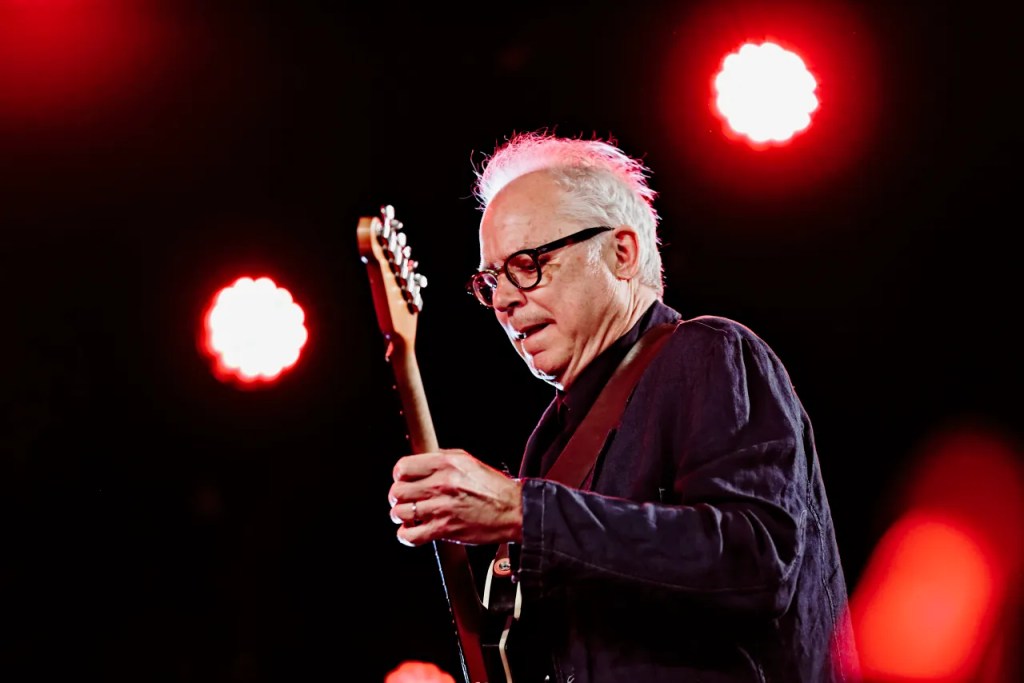
Bill Frisell. Photo by Peter Van Breukelen / Getty / The New Yorker
On Saturday, Frisell leads his trio of bassist Luke Bergman and longtime drummer Rudy Royston; just one of his several active bands.
He’s made 40-plus albums since 1983, earning six Grammy nominations with one win. They’ve appeared on a dozen-plus different labels, sure sign of a restlessly creative spirit. Fearlessly rummaging among bands, styles and traditions, he’s nonetheless consistent in his elegantly understated playing, likely influenced by early training on clarinet in his main hometown of Denver. You can almost hear the breaths in his phrasing, like a winds player, just as you can hear straight-ahead jazz, bluegrass and even psychedelic tones and structures.
Co-starring with fellow explorer John Zorn on New York’s combustible downtown scene, Frisell has recorded and performed in more or less traditional trios with Dave Holland and Elvin Jones (2001) and Ron Carter and Paul Motian (2006). By then he had already started intrepidly jumping around.
“Have a Little Faith In Me” (1992) celebrates John Hiatt (the title track) and other modern pop and rock songwriters.
“Disfarmer” (2008) forms the soundtrack for photos by the obscure outsider artist Mike Disfarmer, stark and simple images, like Frisell’s guitar. Two 1995 albums collect music for Buster Keaton films, and “Hunter S. Thompson – The Kentucky Derby Is Decadent and Depraved” (2012) takes its iconoclastic attitude from the gonzo journalist.
“Lagrimas Mexicanas” (2011) with singer Vinicius Cantuaria takes a beautifully rhapsodic journey into south of the border melancholy with vocals in Spanish. And, in that same year, Frisell released a sweet Beatles tribute “All We Are Saying” with one of his best bands: violinist Jenny Scheinman, bassist Tony Scherr, drummer Kenny Wollesen and Greg Leisz playing guitar and pedal steel.
Frisell pioneered what’s come to be known as Americana, arguably one of its first practitioners: “Nashville” hit in 1997.
Frisell’s latest release, the two-CD “Orchestras,” features the 60-piece Brussels Philharmonic.
And, as if that somehow weren’t variety enough he’s released 22 albums as downloads, mostly of live performances; plus four compilations; 19 collaborations with Paul Motion and Joe Lovano, 13 with John Zorn, nine with Naked City, eight with the Gnostic Trio; seven with Julian Lage and Gyan Riley and 22 one-off collaborations and dozens of shorter guest appearances.
Meanwhile, his “Unspeakable” (2005) won the Grammy as Best Contemporary Jazz Album.
And the thing, the big thing, is: you can tell it’s Frisell playing after about two notes.
The Bill Frisell Trio plays The Egg Saturday at 8 p.m. Tickets: $49.50 and $39.50. 518-473-1845 www.theegg.org.
Pianist Abdullah Ibrahim leads his trio at The Egg on Sunday; the Sandhi Trio opens.
Now 90 – Frisell is 73 – North African-born Ibrahim has released 72 albums and been hailed as a 2019 National Endowment for the Arts Jazz Master along with composer and big-band leader Maria Schneider, writer Stanley Crouch and singer pianist Bob Dorough.
A mixed-race “coloured” person under apartheid racist rules, Ibrahim is the son of a church pianist. Hymns were an early influence as he began playing in Capetown and Johannesburg with small bands including the Jazz Epistles who recorded the first-ever full-length jazz album by Black South Africans.

Abdullah Ibrahim. Photo by Dr. Minari Umari / Downbeat
Apartheid inspired a globe-trotting exile through Europe and the Americas, landing in Europe in 1962 and New York in 1965; he’s lived and worked in both places since, plus South Africa.
During his international musical wanderings, Ibrahim found a major mentor in Duke Ellington, arguably America’s greatest jazz hero after Louis Armstrong and a composer of both intimate and large-scale works. Then known as Dollar Brand, Ibrahim and singer-wife Sathima Bea Benjamin moved to New York in 1965, playing the Newport Jazz Festival and substituting for the ailing Ellington in five shows leading the Duke’s Orchestra. Studies at Juilliard and playing with such leading creative forces as John Coltrane, Pharaoh Sanders, Cecil Taylor and Archie Shepp broadened Ibrahim’s power and ambition.
On a brief return to South Africa in 1968, Ibrahim converted to Islam, leaving his birth name behind. He returned to New York after the Soweto Uprising in 1976, founding his own record label Epaka and the band Ekaya while also composing music for film and television and launching the M7 music academy in Capetown after the apartheid ended.
Ibrahim returned again to perform at Nelson Mandela’s inauguration as their nation’s first-ever Black president in 1994. Mandela hailed Ibrahim as “our Mozart,” which seems entirely apt as the pianist’s ambitious “Mannenberg” (1974) had become an anti-apartheid anthem.
Like Frisell, Ibrahim has performed and recorded with groups large and small including drummer Max Roach and the Munich Radio Philharmonic Orchestra in the 1990s. Also like Frisell, Ibrahim plays in a sparse but eloquent style instantly recognizable as his but also evoking his heroes Ellington, Thelonious Monk and Fats Waller.
He has continued to perform solo and to lead Ekaya and other ensembles.
The Sandhi Trio opens for Ibrahim’s Trio, an ambitiously international group mixing West African and South Asian styles. The Sandi Trio comprises Malian kora master Yacouba Sissoko, South Indian violinist Arun Ramamurthy and a percussionist, likely Silk Road Ensemble percussionist Shane Shanahan.
Ramamurthy also curates the Resonance Series that explores musical connections with South Asia with other world musics and sponsors Sunday’s concert. The Michele L. Vennard Hospitality Grant Program of the Albany County Convention and Visitor’s Bureau Fund (AKA Discover Albany), a fund of the Community Foundation for the Greater Capital Region finances the series, along with an Arts Thrive & Grow Grant of the Art Center of the Capital Region, funded by New York State.
Show time for Abdullah Ibrahim Trio and the Sandhi Trio is 7:30 p.m. Tickets: $55, $45.
 Hoke's Jukebox