Breahhach Plays Proctors GE Theater Passport Series, Friday, Oct. 11, 2024
Spin a globe.
Close your eyes and point at it, blind.
If your finger hasn’t landed in an ocean, odds are there’s music where you’re pointing.
And, odds are, Music Haven has brought that music here, from wherever – or will.
After winding down its summer season of free Central Park shows, Music Maven moves indoors to Proctors GE Theatre or Universal Preservation Hall. In whichever venue, the music is international. And this season it begins with Breabach from Scotland on Friday, October 11, in Proctors GE Theatre (432 State St., Schenectady).
Right – I wasn’t sure how to pronounce the band’s name either. The HowToPronounce site shows two options: “BREE Ah bach” and “Neh-buck.” But we digress.
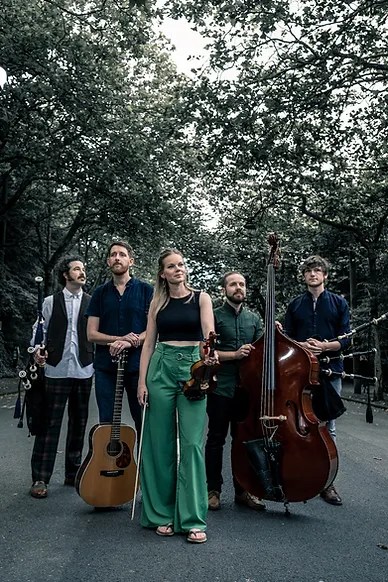
Photo from Breabach web site
However it’s pronounced, Breabach sounds every bit as strong as their fellow Celtic folk updaters across the Irish Sea, the great Irish bands Lunasa and Solas.
On seven albums, Breabach’s stringband instrumentals give the music melodic wings while vocals ground it in stories and soul. (OK, so there’s bagpipes and whistles, too…)
Their latest release, their seventh, is titled “Fàs,” Gaelic for “growth.” They earn it in pastoral sounds inspired by Scotland’s scenery and cultural atmosphere. But they also expand on their folkloric sound with a new and more ambitious sonic experimentation.
Onstage it impressed Edinburgh’s The Scotsman newspaper this way: “As polished as it was passionate, matching fiery intensity with exquisite finesse, this was a magnificent set.”
Beloved at home, Breabach also goes international with cross-ocean collaborators including the indigenous Australian folklorists Moana and the Tribe & The Black Arm Band; Le Vent du Nord in Quebec, numerous bands at Celtic Colors on Cape Breton Island, even video game composer Big Giant Circles; and they collaborated with BAFTA-award-winning animator Cat Bruce on the soundtrack of his short film “Dusgadh.”
Breabach is Megan Henderson, fiddle; James Lindsay, double bass; Calum MacCrimmon, highland bagpipe, whistle, and bouzouki; Conal McDonagh, highland bagpipe and whistle; and Ewan Robertson, guitar and cajon. They all sing, and Henderson step-dances.
In 19 years on tour, they’ve played around the world including Sydney Opera House, New York’s Central Park; the Cambridge Folk Festival, and WOMAD New Zealand. Their awards include six “Scots Trad Music Awards,” nominations as ‘Best Group’ (BBC Radio 2 Folk Awards), Songlines’s “European Album of the Year” and the “Quarterly Critic’s Choice” at the German Record Critic’s Awards.
The new Music Haven Proctors Passport Series presents:
Friday, October. 11: Breabach (Scotland) at GE Theatre
Friday, Feb. 7: Nathan and the Zydeco Cha Chas (Louisiana, musically a nation all its own) at Universal Preservation Hall (hereafter UPH)
Thursday, Feb. 27, 2025: Plena Libre (Puerto Rico) at GE Theatre
Saturday, March 29, 2025: Moonlight Benjamin (Haiti) at UPH
Friday, Apr. 11, 2025: Damir Imamovic (Bosnia-Herzegovina) at GE Theatre
Saturday, April. 26, 2025: Vieux Farka Touré (Mali) at UPH
Like A Place for Jazz, Proctors Passport Series offers a season ticket discount: six shows for the price of four: $130.80/season, or $30 per show if bought singly.
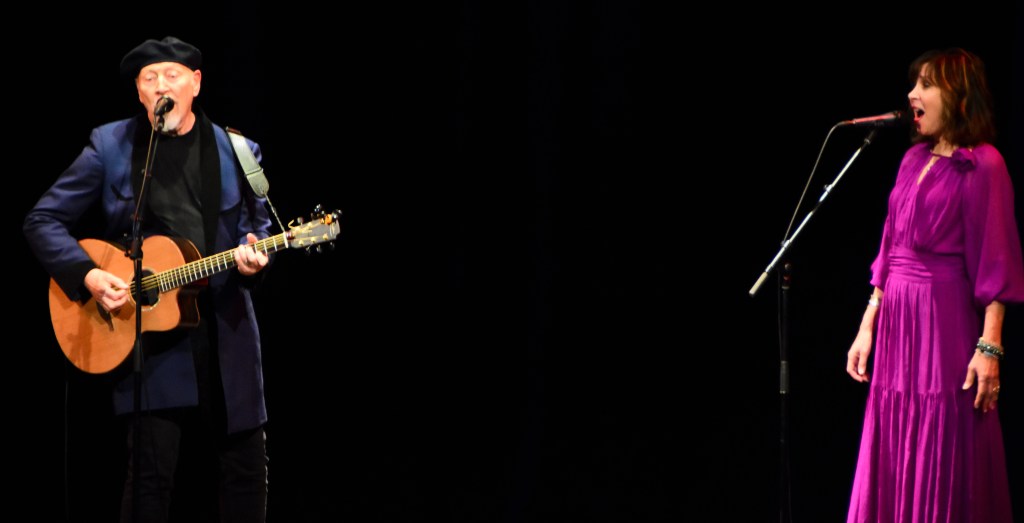
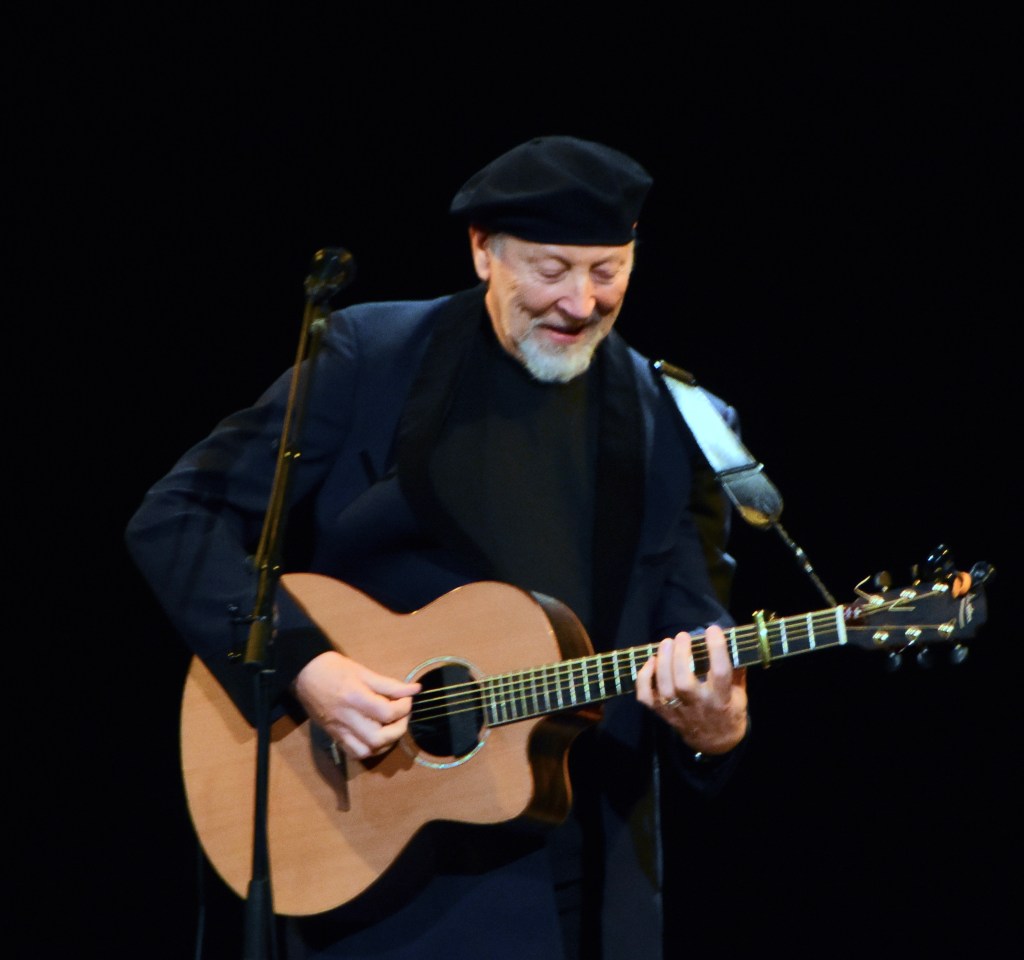
Richard Thompson returns to The Egg Saturday for his first full-band show here in years. In March, he played solo at the Academy of Music in Northampton’s Back Porch Festival, though his singer wife Zara Phillips harmonized on about half the show.
Richard Thompson and Zara Phillips
Since then, Thompson turned 75 and released “Ship to Shore,” his 20th album. He introduced three of its new songs in Northampton.
The 12-song album is at once instrumentally beefy and very British-sounding. It’s also charged with tough emotional truths as despairingly distinctive as his shimmering guitar sounds are pleasing, absolutely gorgeous.
“I like the idea of having a seductive surface where the listener gets sucked in by a fairly pleasant melody,” Thompson explains in the album’s publicity materials. “But then, there are hidden sharks in the water.”
In Thompson’s fraught world of disappointment, decay and desolation, traversing from ship to shore is a journey both dangerous and dazzling. His “seductive surface” is a polished, powerful thing of singular sonic beauty and musical momentum, at whatever tempo or density. The sharks swirl in the words.
The album opens with “Freeze,” a spry mix of Celtic and Afro-pop atmospheres as ambivalent emotionally as the frustrated would-be suicide in Fredrik Backman’s novel “A Man Called Ove.” Then the doom-struck “The Fear Never Leaves You” traces a vets’ nightmares, amplifying the torment of Thompson’s older anti-war “Dad’s Gonna Kill Me.”
Then come the three songs he had performed in Northampton in March.
As I reported then, “‘Singapore Sadie’ sketched intrigue in an exotic port, ‘The Old Pack Mule’ recounted an ill-fated animal’s surgical disassembly and ‘The Day That I Give In’ – well, that title tells the tale.”
Listening to them again on the album, “Singapore Sadie” weaves a folk waltz on seduction and envy; “Beeswing” but with a happier ending? Well, maybe, and “maybe” is the most we get from Thompson here. “The Old Pack Mule” sets the slaughter of a valued working animal in apocalyptic desperation. And, “The Day That I Give In” finds Thompson declaring “I love in vain.”
On the album, “Trust” lands between “Singapore Sadie” and “The Day That I Give In;” asking dejectedly “Who do I believe.”
However, also on the new “Ship to Shore” album, which he recorded in Woodstock, Thompson performs with longtime accompanists bassist Taras Prodaniuk, drummer Michael Jerome, and guitarist Bobby Eichorn, plus Phillips and fiddler David Mansfield. The Egg’s concert info promises a Full Band Show, probably these same musicians. On “Ship to Shore,” they make beautiful sounds.
The Canadian (Saskatchewan) folk-roots duo Kacy & Clayton opens for Thompson and band on Saturday. Wilco’s Jeff Tweedy produced their 2017 album “The Siren’s Song;” they’ve toured with Wilco, and the Decembrists. Their sixth album “Plastic Bouquet” (2020) features Marlon Williams.
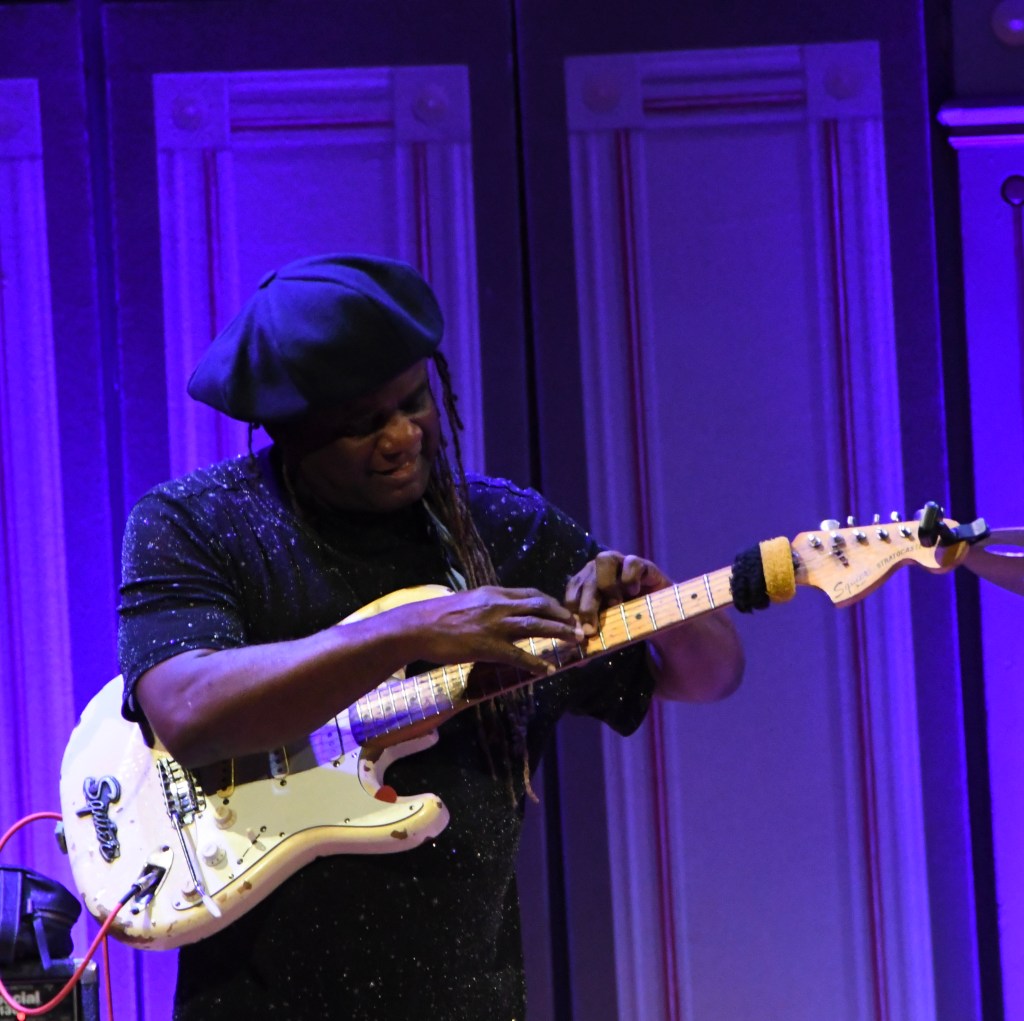
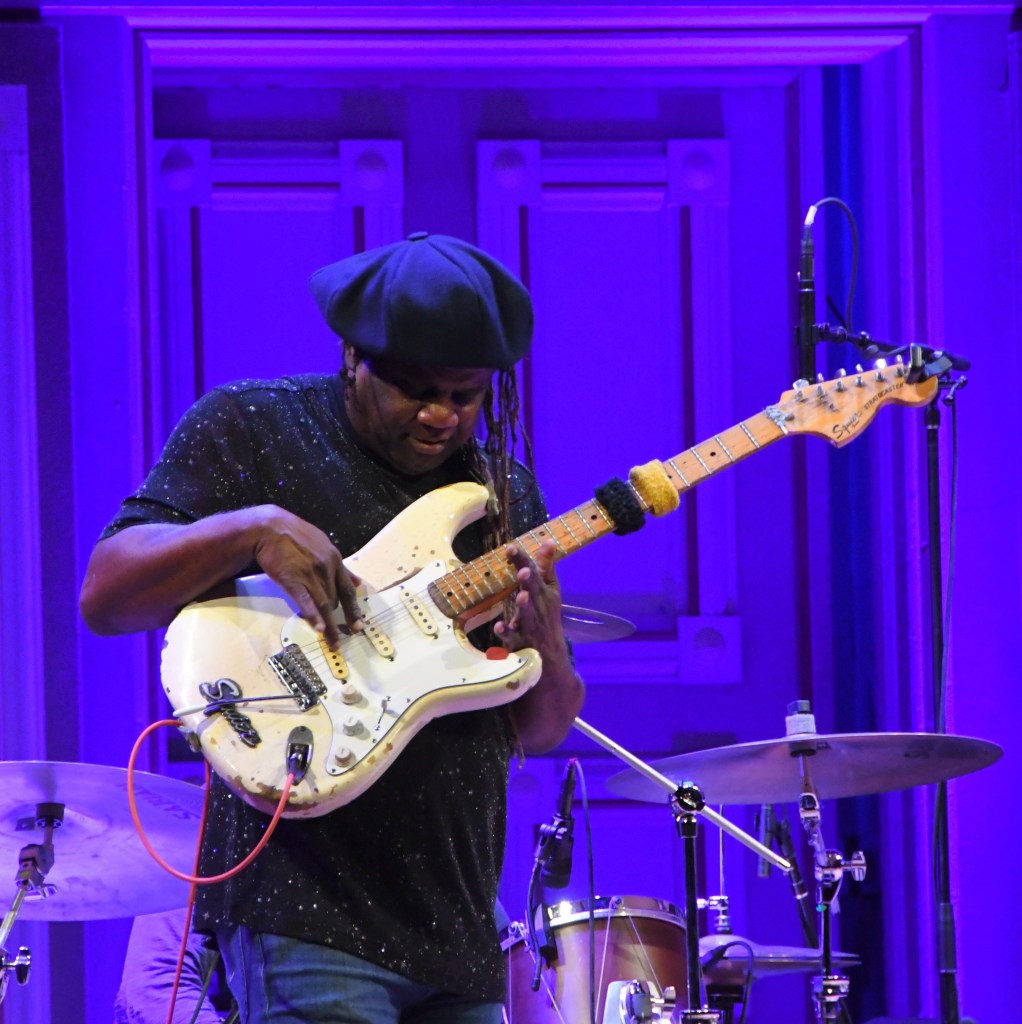
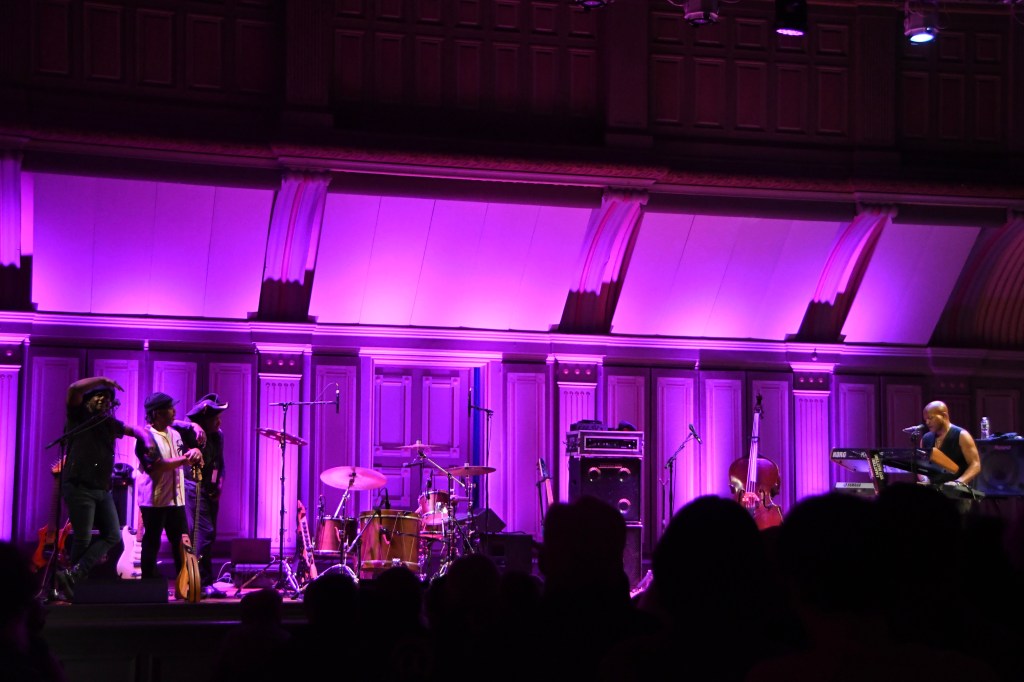
Of the wondrously talented Wootens, bassist Victor, the youngest, got most famous first. But the eldest, guitarist Regi – his brothers call him the Teacher – owned the Troy Savings Bank Music Hall Monday with fire on the frets.
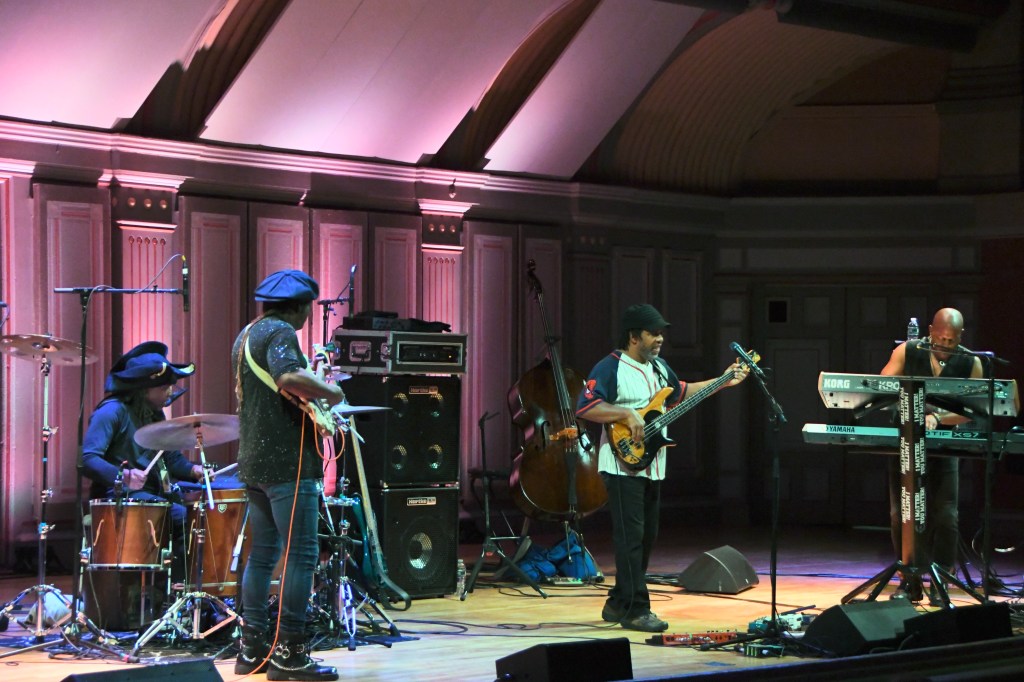
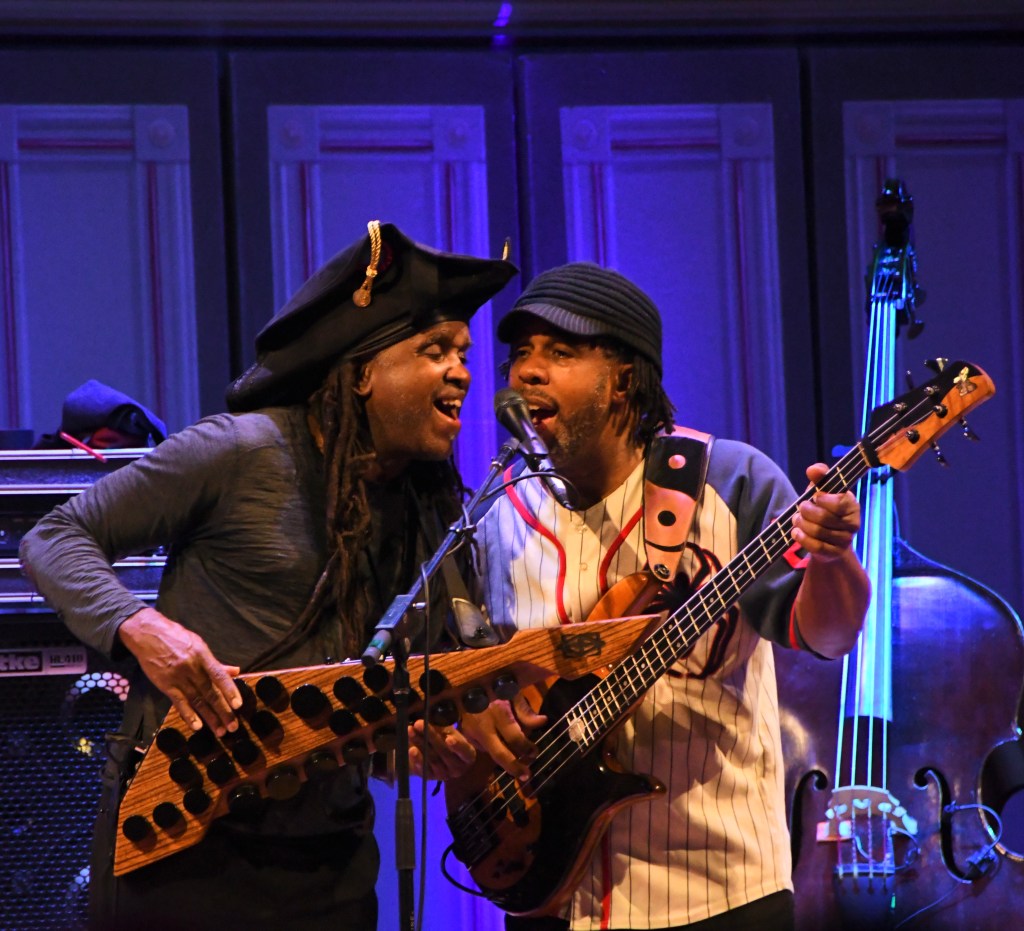
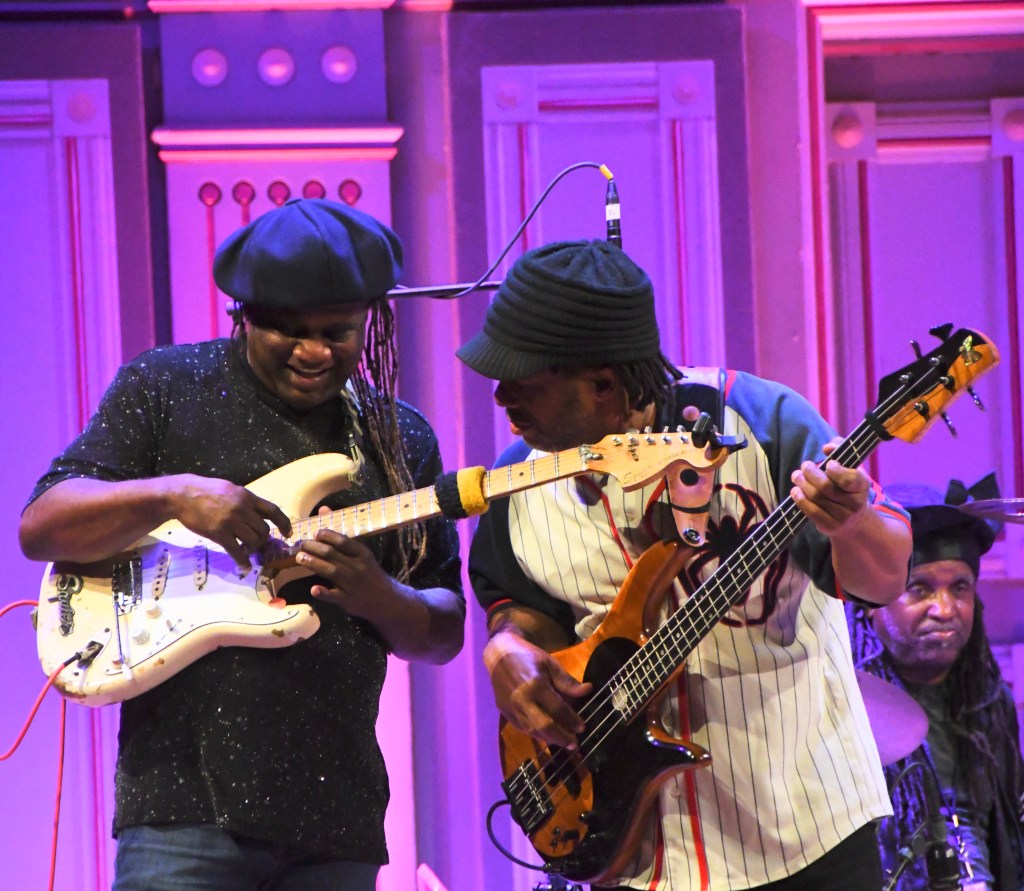
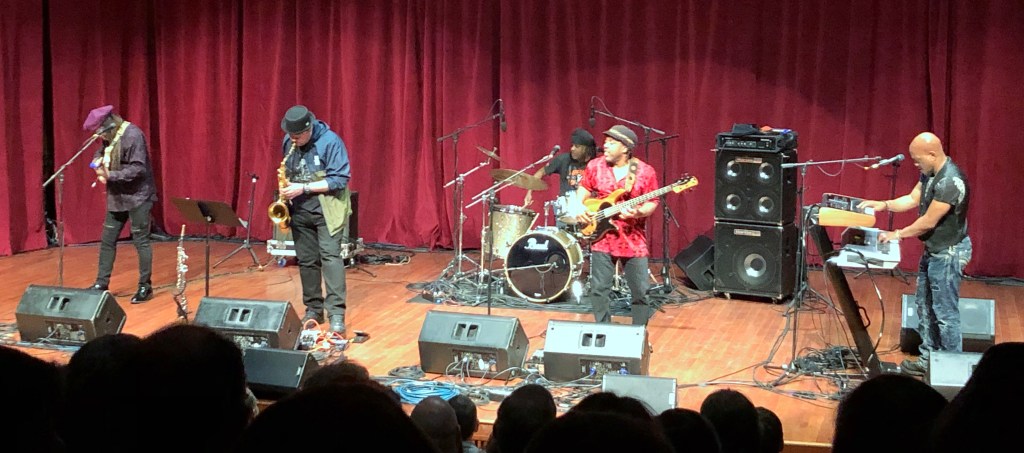
Wooten Brothers in Troy – From left, Regi “the Teacher”, guitar; Roy “Futureman,” drums; Victor, bass; and Joe keyboards. All four sing.
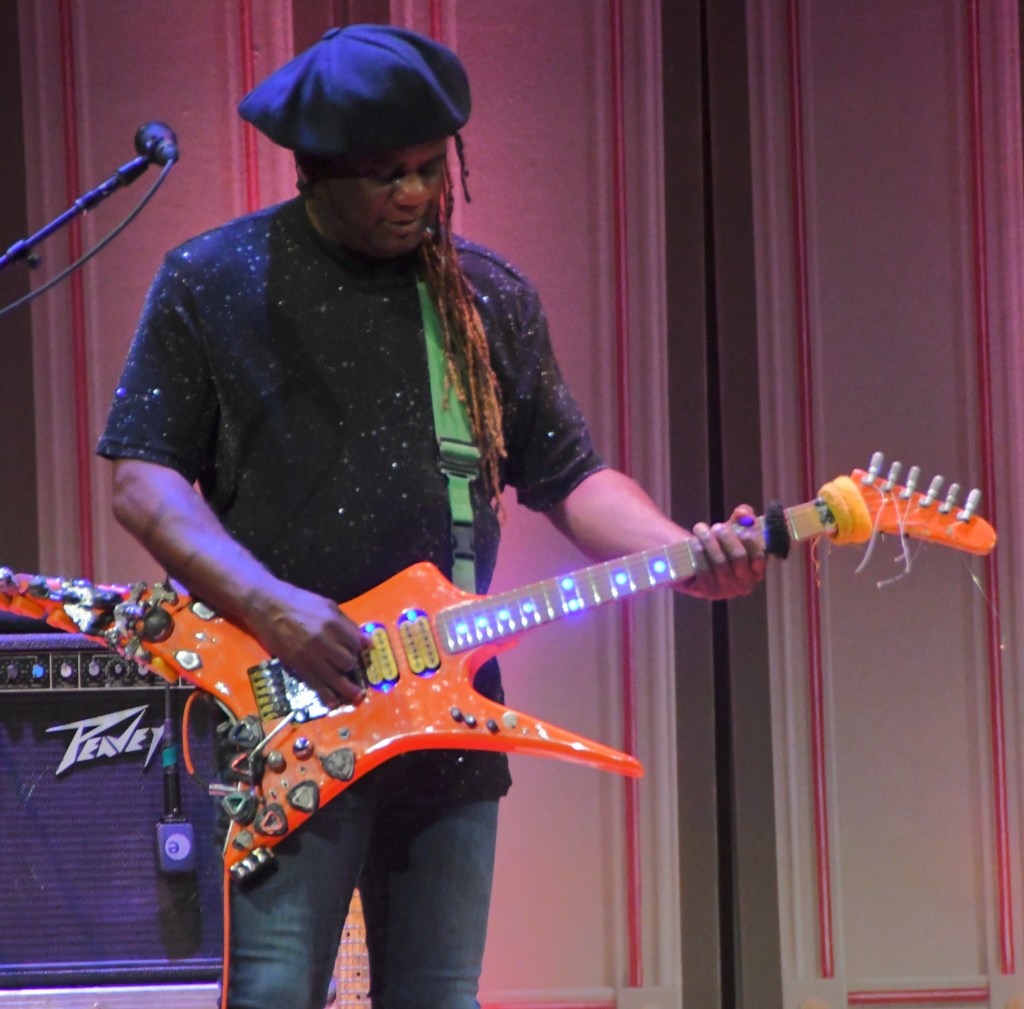
Regi
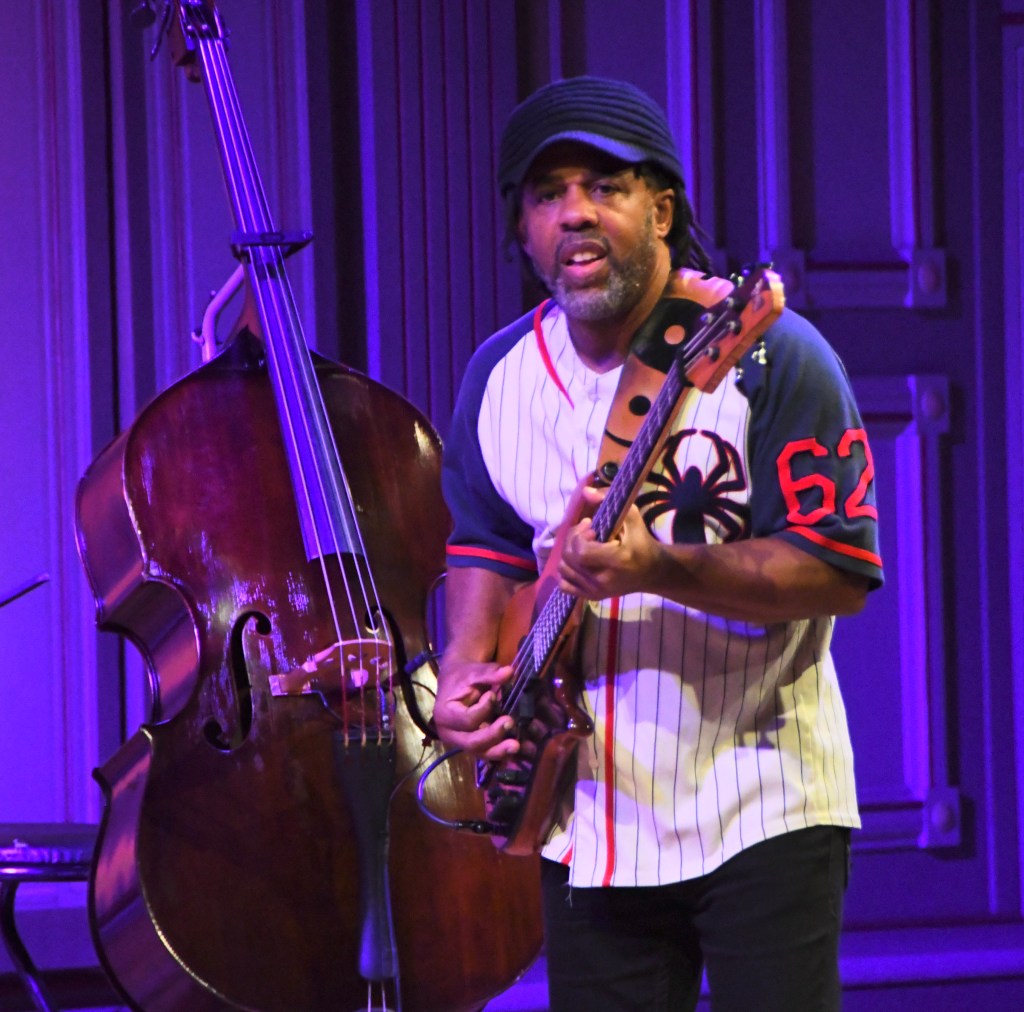
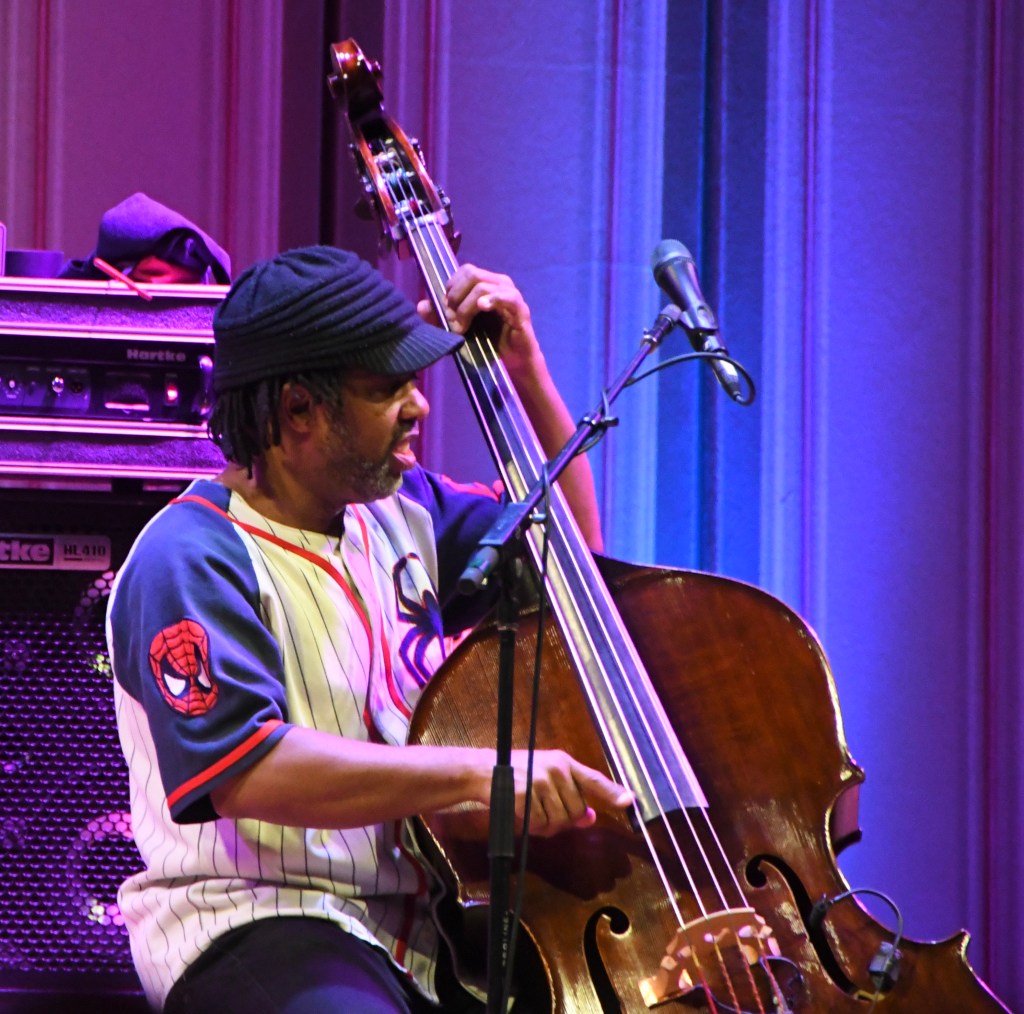
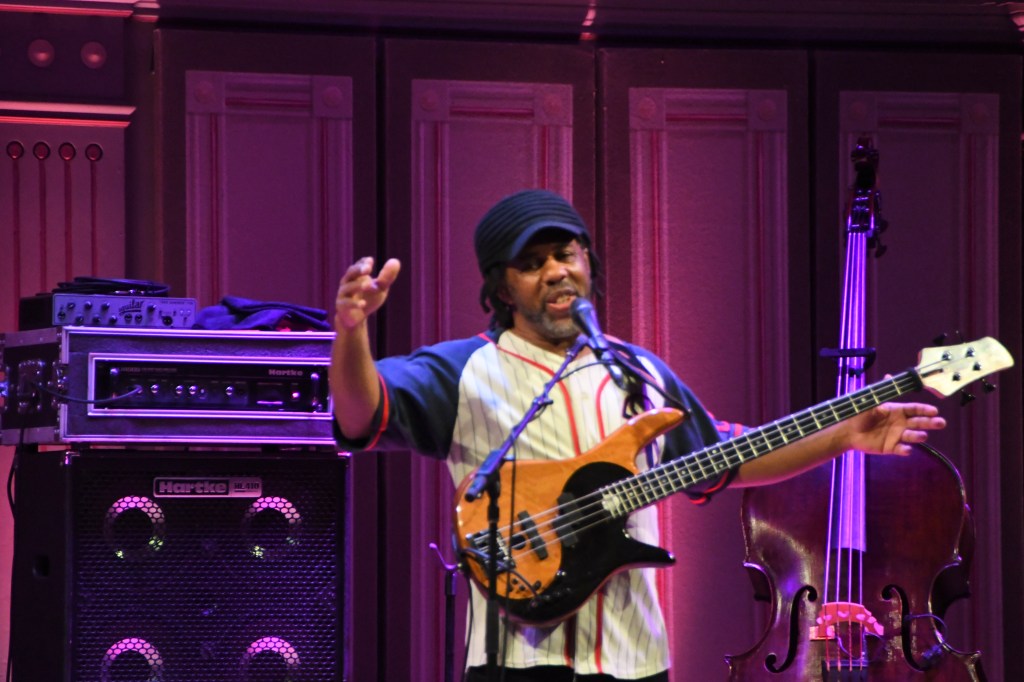
Victor’s high profile with Bela Fleck and the Flecktones, jazz collaborations, solo projects and amiable persona make him the natural leader of the quartet with his brothers Regi, drummer Roy and keyboardist Joe.
A family band (with their late brother, saxophonist Rudy) since Victor was five, the Wooten Brothers are a highly entertaining time machine set to the 60s/70s heyday of funky soul. Monday, as usual, they brought party-down dance floor glee, jazzy-jam freedom and messages of unity’s power for change.
Their anthemic opener “W-Double-O-10” flowed mid-slow with tight playing and all-in vocals before Joe led in “Not Just Religion” suggesting principle or morality don’t need church. The brothers seamlessly welded this into “Unity,” its earnest “thank a soldier” call underlining their heritage as Army brats.
Then things got playful. They teased with the bass line of the Temptations’ “Papa Was a Rolling Stone” before full-on funk anarchy erupted. Victor milked applause by announcing, then repeating, “I’ve got my brothers with me!” then introduced them all. Noting brother Joe’s long tenure with the Steve Miller Band, Joe played the trademark swirl from Miller’s “Fly Like an Eagle” to laughs onstage and off.
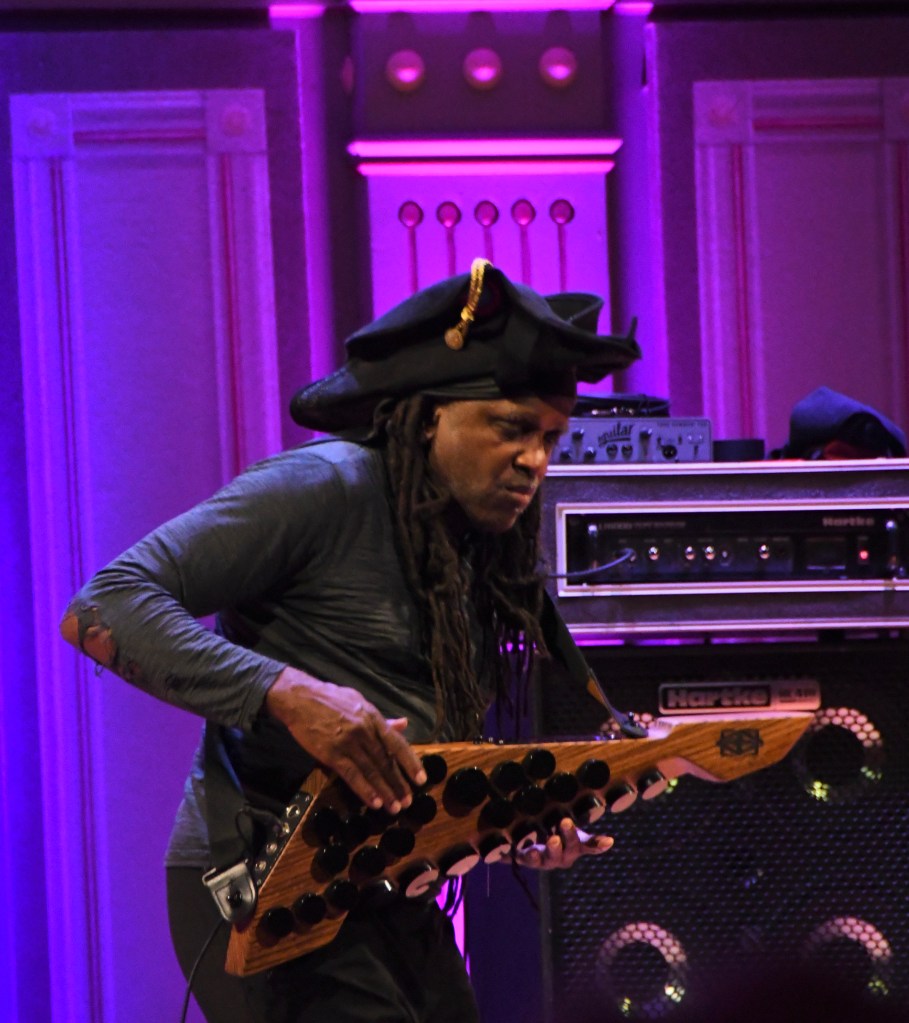
The show then segmented, brother by brother. Victor pulled “My Life” in all directions via looped bass tracks building to a cacophony before bringing it back home. He exploded one impossible riff after another, then another. Next Roy strapped on a guitar-like drum synthesizer to step front and ignite a James Brown tribute that he invited everybody inside, cueing happy audience chants of “Hah!”
Before the other brothers took their turns, they united in “John Coltrane,” the tribute their teacher Consuela Lee’s brother Bill Lee (father of Spike) wrote for the great saxophonist. They energetically wandered all over with this, a dynamic meditation that surged forceful and hot, simmered soft and gentle. Playing tight together is a given, but their sweet vocal blend here impressed even more.
Victor next explained the rediscovery of vintage (1970s) studio tapes honoring their late one-man horn section brother Rudy in “Come On Let’s Dance.” This starred Regi’s fierce guitar work, setting up his solo showcase that showed off tremendous riff power with lots of Hendrix influence (including quotes of “Castles Made of Sand” and others) plus wild echoes of Sonny Sharrock and James “Blood” Ulmer, a thrilling ride. Regi’s voice worked the tune hard, too, though he closed by singing a plaintive, yearning passage, like his bluesiest guitar runs.
Joe’s star turn also used vocals strategically, to jukebox classic soul and pop tunes including “This Is Your Song,” “Love Is Love Today,” “Someday We’ll All Be Free” and Everyday People,” with “Ma Cherie Amour,” as a framing device and a talk-box to distort his voice near the end.
Their recent release “Sweat” closed in cheerful, simple soulfulness, complete with stop-and-go coda and arm-waving the brothers coordinated with the crowd. They entertained at times with such stage-y business; Victor and Regi slinging their instruments around their bodies in unison, for example, Roy coming forward from his drum kit to synthesize James Brown beats and cheer-lead the crowd, or Joe going high-tech with his voice. But nothing got in the way of their astounding funk performing power in their fast-moving show; a bit short of two hours, but with no encore.
The fabled Motown studio cats were dubbed the Funk Brothers, but the Wootens own that title now.
It’s not as if we’re starved for jazz around here lately; but Saturday’s “Jazz is Back” reopening of the Van Dyck Music Club felt like the joyous end of a drought – also like a Schenectady double-header after Artemis lit up A Place for Jazz nearby on Friday.
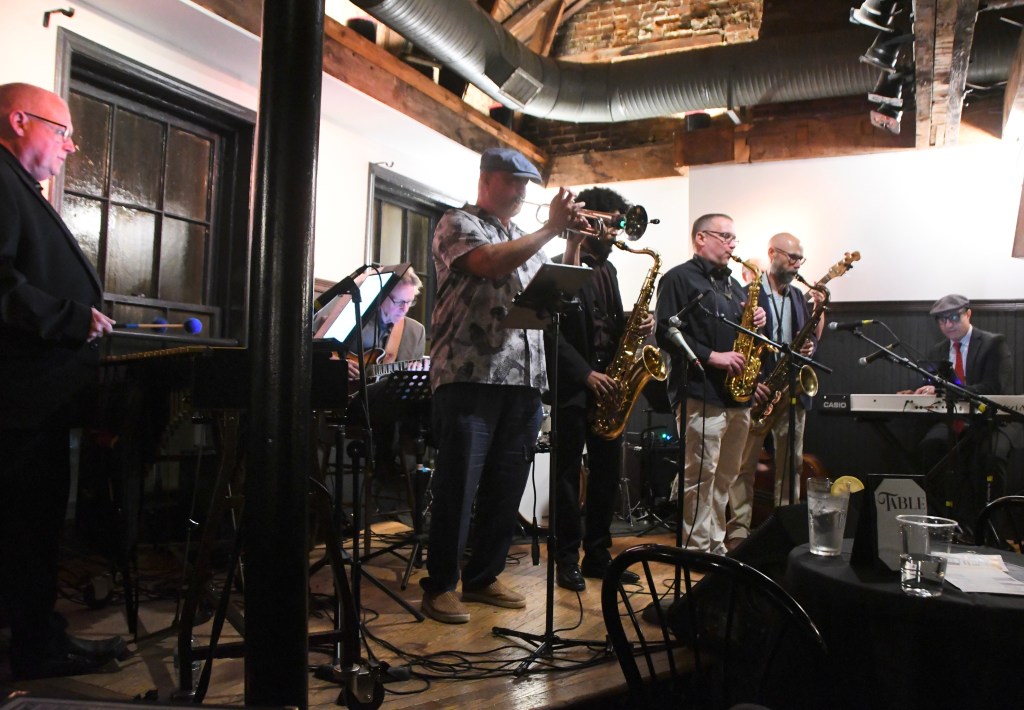
All In. From left: Michael Benedict, vibraphone, Chris Pasin, trumpet; Kaitlyn Fay, vocal; Awan Rashad, tenor saxophone; Keith Pray, alto saxophone; Mike Lawrence, bass; Lee Russo, tenor saxophone; David Gleason, keyboard. Blocked from view: Chad McLoughlin, guitar; Cliff Brucker, drums
While Artemis played with smooth assurance, the all-star nonet at the Van Dyck achieved a swinging looseness in its solo-rich, all-in sense of fun. The Van Dyck crew projected a warm community feel, human and engaging.
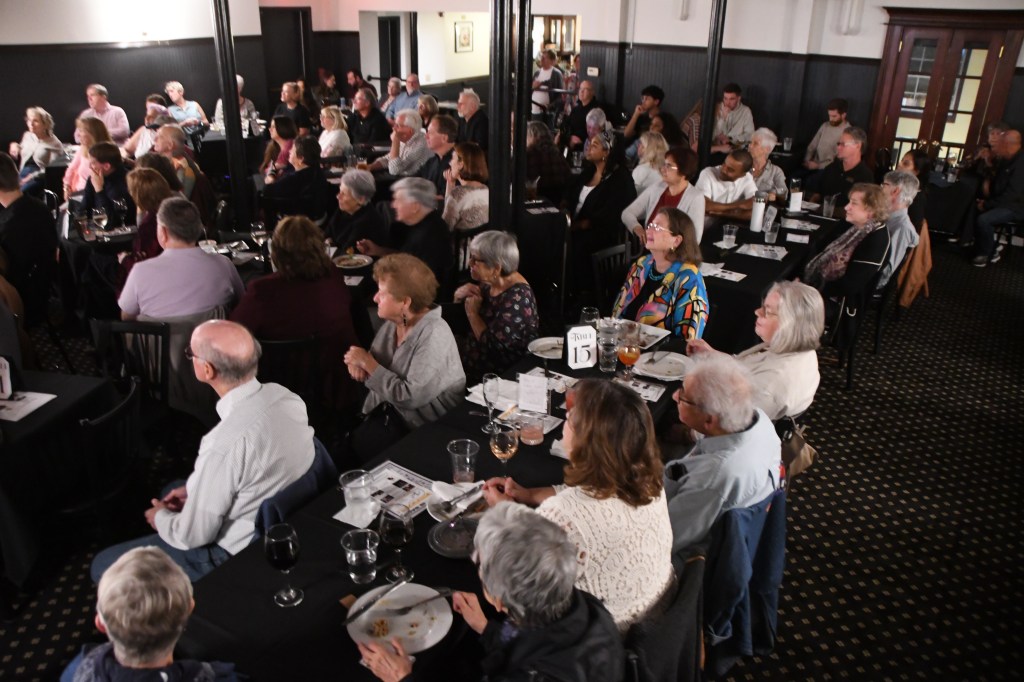
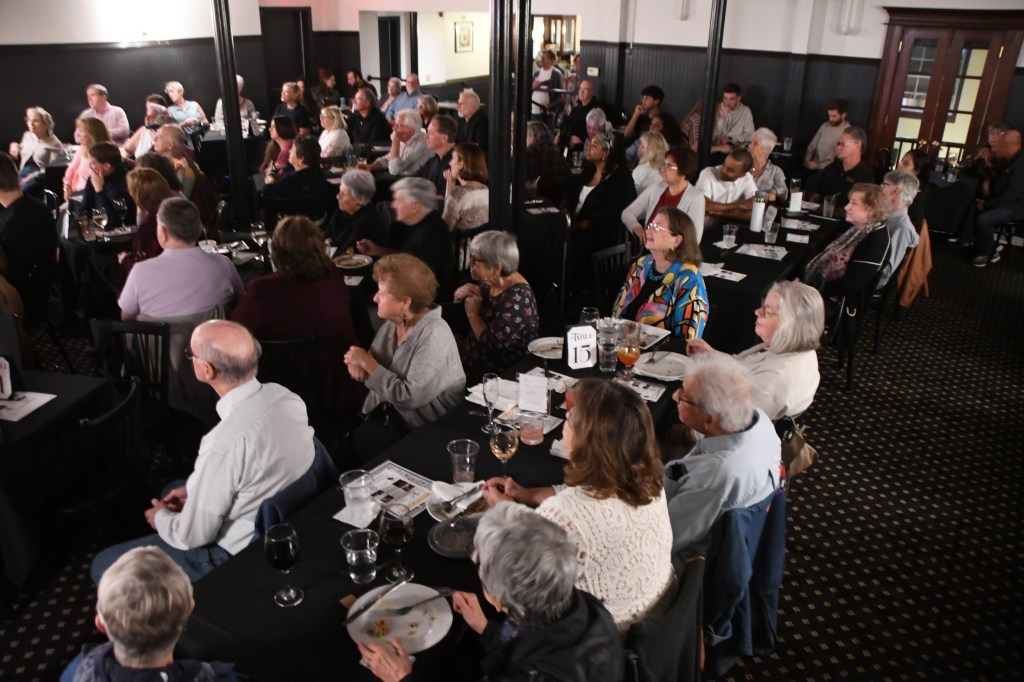
Many of the same faces turned up at both A Place for Jazz and the Van Dyck, so the word “Club” worked for real. In addition to graybeards like me and co-host Bill McCann, younger fans also helped completely fill the 100 seats in the long-dormant upstairs performance venue in the Stella Pasta Bar that now occupies the Stockade neighborhood music Mecca.
McCann and fellow radio DJ Tim Coakley, the former for decades at WCDB, the latter an almost equally long run on WAMC, highlighted both the onstage action and the venue’s deep jazz history since 1948 with anecdotes and recommendations for ace recordings of tunes.
From left: Cliff Brucker, Chad McLoughlin, Mike Lawrence, David Gleason
The rhythm section trio – drummer Cliff Brucker, bassist Mike Lawrence and keyboardist David Gleason – took their places stage left and stayed put as soloists shifted in and out, each playing a single song. Up first was guitarist Chad McLoughlin, who also joined the trio periodically behind other soloists. Nearly all had played Schenectady’s recent Porchfest and/or have collaborated in various combinations over time. In fact, most had played in Keith Pray’s Big Soul Ensemble whose monthly Van Dyck shows drew jazz fans for more than a decade, pre-COVID.
Pray played second, after McLoughlin opened with spry Wes Montgomery-style riffing in “Have You Met Miss Jones?” Everybody soloed here, as in most first-set songs. Everybody soloed in the second, all over the place, and improvised section riffs, too.
Keith Pray
Pray tackled “Wabash” with aplomb, a cheerful, driving Cannonball Adderley number that, like “Jones,” featured short riff exchanges before going back to the head.
Chris Pasin
A wireless hook-up on his trumpet, Chris Pasin took over with “Delilah,” getting all of this Clifford Brown/Max Roach blast as McLoughlin joined the rhythm section and delivered a solo of his own.
Kaitlyn Fay
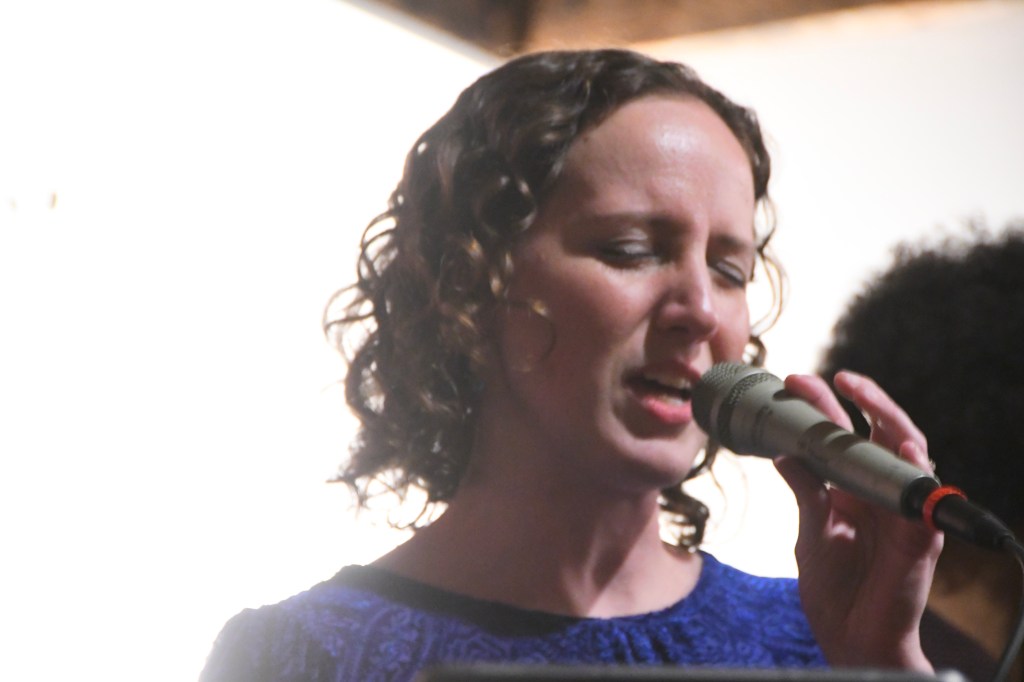
Singer Kaitlyn Fay wasted no time hitting skat mode in the torchy “I Thought About You;” Gleason echoed a vocal phrase in his fine solo and shrugged off distracting cellphone noise from the crowd.
Lee Russo; Mike Lawrence, background left
Tenor saxophonist Lee Russo, fresh from a tribute gig honoring his saxophonist father Leo with Brucker’s band at WAMC’s The Linda, changed the mood in a big way. His tender take on the mellow “But Beautiful” moved with soulful, simple, elegant and eloquent grace, a lovely change of pace after the mostly 50s, mostly hard-bop tunes before him.
From left: Michael Benedict, Chad McLoughlin, Cliff Brucker, Mike Lawrence, David Gleason
McLoughlin returned to the stage for Milt Jackson’s swinging “Bags Groove,” Michael Benedict leading on vibes and going all speedy and smooth. He soloed with just two mallets, but played with four when comping behind McLoughlin’s solo, shifting back to two in a duet with Gleason.
Awan Rashad
Tenor saxophonist Awan Rashad kept the energy level high, emulating Sonny Rollins in full flight with his upbeat romp through “All God’s Chillun Got Rhythm.” All the guys did, McLoughlin helping the rhythm section rev it.
From left, Chad McLoughlin, Cliff Brucker (obscured by music stand), Awan Rashad, Mike Lawrence, David Gleason
After the break, a whole new mood galvanized the place. The set-list specified only two tunes, plus an encore to be determined.
Well, pretty great, in a thrillingly organic run of solo after solo, and the horns improvising whole sections on the fly. This wonderful mischief started early in the set-opening “Caravan,” after Rashad popped the tune open with a fiery tenor break. Pray looked around at his frontline colleagues, whispered a riff to Rashad and the two led the other horns in simple chords behind the melody. This was music-making at its purest and most playful; obviously fun to do and delicious to hear.
Everybody got a piece of “Caravan,” maybe most impressively Rashad, then Benedict who raced the riff with two flying mallets. Benedict directed traffic, waving off a recap the horns were just about to detonate in favor of a Brucker drum solo; then the horns had their say in a free-for-all full of spirit, 25 minutes after they’d started this Duke Ellington classic.
Fay returned to the stage for “Things Ain’t What They Used to Be” (theme song of McCann’s Saturday morning WCDB radio show), and things started to mutate faster even than “Caravan.” As in her first-set solo, Fay skatted right away, in verses one and three, singing the words in between.
This was a hyperactive harvest of riffs following fast on riffs, horn sections forming out of nowhere, then vanishing in the flow, and all kinds of moods celebrated and eclipsed. Gleason slowed the pace at one point, articulating quietly, serene; then he shifted up and invited Benedict into a duet that the horns jumped aboard as Benedict cued audience clapping. The encore turned out to be “Autumn Leaves,” a soft, easy swing at first, then a solo-riff parade even more restless and intense than in “Things,” just before. Everybody was the star here, and everybody gave stalwart support. Cooperation, community.
David Gleason
After the seven-song first set played just over an hour; the jam-prone three-song second also ran about an hour. The mood was ebullient, onstage and off; the sound strong and smooth. Fay thanked engineer Nathan Scheid from the stage to happy agreement, while the lighting system could use more wattage.
Service worked this way: Patrons ordered food and drinks from the bar at the rear. Tenders made and handed drinks over the bar and sent food orders to the kitchen. Then servers delivered food by table numbers, a less intrusive method than when servers took orders, too.
Setlist (soloists in parentheses)
Have You Met Miss Jones (Chad McLoughlin, guitar)Wabash (Keith Pray, alto saxophone)
Delilah (Chris Pasin, trumpet)
I Thought About You (Kaitlyn Fay, vocal)
But Beautiful (Lee Russo, tenor saxophone)
Bags Groove (Michael Benedict, vibraphone)
All God’s Chillun Got Rhythm (Awan Rashad, tenor saxophone)
Nobody swung the bop, or bopped the swing, like Thelonious Monk; and Artemis hit the master’s “Hackensack” both ways Friday at A Place for Jazz. All-stars, in all ways, the sextet drew and thrilled a bigger-than-usual crowd with shrewd song choices, including originals, strong ensemble sections and fearless soloing.
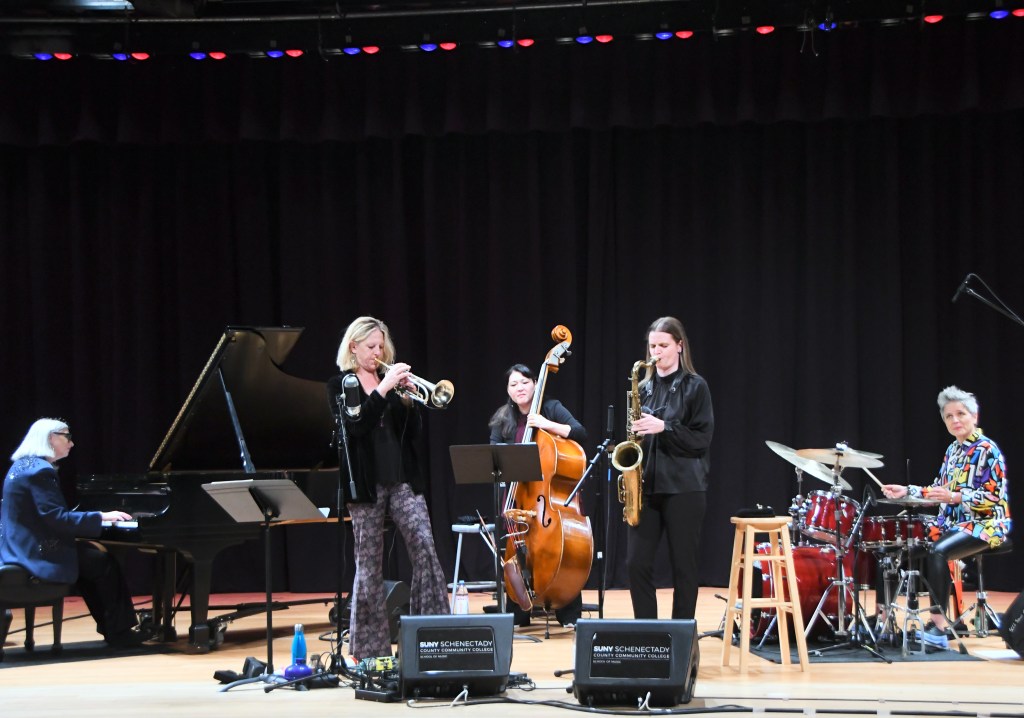
Artemis, from left: Renee Rosnes, Ingid Jenson, Noriko Ueda, Nicole Glover, and Allison Miller
Between its 2020 self-named debut album and last year’s “In Real Time,” leader-pianist Renee (REE-NEE) Rosnes has solidified Artemis into a stable configuration; stars-on-their-own Cecile McLorin Salvant, Anat Cohen and Melissa Aldana departing and new saxophonist Nicole Glover joining the original nucleus of Rosnes, drummer Allison Miller, trumpeter Ingrid Jensen and bassist Noriko Ueda.
Right: all women, but no big deal. I think it was Robert Christgau who said Pretenders Chrissie Hynde eradicated any consideration of gender in rock excellence; Artemis does this in jazz.
In addition to their intrepid performance elan, they turned in a completely fresh performance Friday by avoiding altogether the tunes on their two albums for both well-chosen classic numbers by jazz masters and new originals.
They were special, from the start. In “Dolphin Dance,” a mellow all-in intro yielded to imaginative remaking of this Herbie Hancock classic. Jensen dipped away from her mic then played close in again for a staccato sonic wah-wah effect before Glover played every note on her tenor, limitless and free. Then Rosnes and Miller played an exciting duet, Miller going double-time, racing ahead, then Rosnes responding by echoing Miller’s riffs, listening and amplifying while Ueda lay a steady pulse under everything.
In Rosnes’s own “Galapagos,” a trio meditation pulsated into a skittering groove, all internal commentary and affirmations in confident horn work as Miller went ferociously melodic in zippy tom-tom runs.
Everybody helped everybody, especially Jensen, who stepped toward the wings at times, when not soloing (as did Glover) or riff-bonding with Glover’s tenor. Always listening, she gave a supportive glance-as-applause when Ueda hit a particularly apt riff in “Galapagos,” for example, and an awed “Woooo!” to Allison’s fireworks in the same tune. Jensen also adjusted her horn and its electronic interfaces often, and it always sounded right.
Performed without intermission, the 90-minute show ranged from solid to sensational, and showed smart pacing. Glover’s pastoral “Petrichor” set a gentle oasis between “Galapagos” and the Bacharach/David pop ballad “What the World Needs Now,” then the bebop adrenalin of “Hackensack,” for example.
In “Petrichor,” Jensen Harmon-muted her trumpet as Glover led the way; and they played a similar blend in “What the World Needs Now” with its thoughtful start and staccato bounce later. Jensen used her hand like a plunger mute in “Hackensack” and when she fell short in a fiery riff, she gave a brief look of dismay before going at it again and nailing it, then repeating several times in triumphant bravado. Rosnes really sparkled in this Monk tune, injecting a kaleidoscope of piano styles into it, including a brisk stride passage and a quote of “Exactly Like You” – and was that the “Salt Peanuts” cadence in Miller’s solo?
Miller also starred in Jensen’s seething hard-bop original “Sights Unseen,” after Jensen herself steered it though tempo shifts, everybody right on the money rhythmically. And Miller took the energy she’d generated in “Sights” straight into her own “Little Cranberry” (about a Maine vacation to the island of that name). Jensen’s muted trumpet took the melody in surprising directions through this summer breeze of a tune, and cued us in applause for Rosnes’s solo. Miller wrapped the tune by playing with her hands and started their last tune the same way: Wayne Shorter’s “Footprints,” a series of conversations with the players pairing and kibitzing fluently. This worked beautifully, as when Glover, whose tenor solo earlier provided a highlight, chimed in as Rosnes and Jensen mused on the melody and brought fresh ideas to bear.
They came back to encore with a great let-them-down-easy choice: Billy Strayhorn’s “A Flower is a Lovesome Thing” – all breathy and soft-spoken, like a petal in its delicacy; Glover shining here, too.
A Place for Jazz continues Friday, Oct. 18 with pianist Bill O’Connell’s Quartet featuring saxophonist Craig Handy (also bassist and former Schenectady resident Santi DeBriano and drummer eminence Billy Hart) and concludes Nov. 1 with trumpeter Bria Skonberg’s Quintet.
Setlist
Dolphin Dance (Herbie Hancock)
Galapagos (Renee Rosnes)
Petrichor (Nicole Glover))
What the World Needs Now (Is Love, Sweet Love) (Burt Bacharach and Hal David)
The Wooten Brothers started early and have kept on, keeping on. They play the Troy Savings Bank Music Hall Monday as one of America’s preeminent soul/R&B/funk crews.
More than half a century ago, they opened for the late, great Curtis Mayfield on his “Superfly” tour. The eldest Wooten, guitarist Regi, was 14; the youngest, bassist Victor, was five. In between: keyboardist Joe, drummer Roy and saxophonist Rudy (RIP 2010). Each is a virtuoso; as a family band they’re formidably unified.
As I reported in the Gazette of their Massry Center show in March 2020, “They welded individual skills into a synapse-quick ensemble when their birthdays still numbered single-digits; 40 years later, they’re one mighty groove-and-solos machine.
“Sunday they reached back to high-flying soul songs recently rediscovered on their first demo cassette, also to similar-vintage chestnuts by Sly Stone, James Brown and other giants.
The Wooten Brothers, Plus One – At the Massry Center at the College of St. Rose in spring, 2020, they were, from left: Regi “the Teacher” Wooten, guitar; Bob Franceschini, saxophones; Roy “Futureman” Wooten, drums; Victor Wooten, bass; and Joe Wooten, keyboards.
“After Victor challenged the band to riff in complex times, from busy 11/8 to the sudden silly silence of 0/8, Joseph led the hit-it-and-quit-it climax of odd intervals. The last giant unison blast hit after 45 beats. As they chatted, walked around, put down their instruments, of course, they never lost the count; delighting the on-its-feet cheering crowd with one last ferocious funk stroke.”
Victor, the youngest Wooten, is arguably the greatest electric bassist since Jaco Pastorious, best known of the brothers and leads the Wooten Brothers Monday.
He’s as prolific as he is powerful, on 14 albums with Bela Fleck and the Flecktones (drummer Roy “Futureman” is also a Flecktone), plus 10 albums as a leader, six more with Bass Extremes and other collaborations, and one with his brothers, “Sweat.” This album, and songs recorded decades earlier between their main gigs, supplied the repertoire for their most recent area appearance, also at the Hall.
Onstage, they perform a program, a song cycle built on family lore, including honoring their late saxophonist brother Rudy, and on a shared life-long love of soul music, jazz and pop.
He’s played here many times, from our biggest venues (SPAC, MVP Arena) with the Flecktones to the cozy Parting Glass in Saratoga Springs in a duo with drummer J.D. Blair, in funky instrumental combos at The Egg, the Massry Center at the College of St. Rose and elsewhere and several times with his brothers since their “Sweat” album hit.
Victor also educates students in his music-nature camp outside Nashville; and he’s a singularly sweet modest man, always gracious to fans.
Once when son Zak couldn’t make it to a Wootens show at the Egg with me, I approached Victor at the after show-merch-table meet and greet and told him Zak was ailing and couldn’t make it. We’d met before, so Vic knew who I meant. When I handed him a blank note card and a pen, he laughed and wrote a sweet get-well message to Zak. It worked, like his music always does.
The Wooten Brothers play the Troy Savings Bank Music Hall (30 Second St.) on Monday. Showtime: 7:30 p.m. VIP (pre-show meet & greet, Q&A, sound check access, limited edition poster) $94.50; concert only $44.50, $34.50, students $15. $4 processing fee per ticket, additional facility fee and venue fee may apply. 518-273-0038 http://www.troymusichall.org.
The Times Union’s recalling an uncomfortable episode in Kris Kristofferson’s career – after his death Saturday at 88 – seems gratuitous, petty and parochial.
In Wednesday’s edition, “Kristofferson and the Vietnam vets plaque” retold the tale of a 1987 Kristofferson show at the Coliseum Theatre (formerly the Colony Tent Theater, later something else, and now gone).
The story is simple, but feels wrong:
Vets’ group presents Kristofferson a plague recognizing his advocacy for veterans.
Plaque is found the day after the show, discarded in the trash.
Outraged kerfluffle.
Kristofferson returns to apologize, seems sincere.
Grumbles persist.
Now, that’s all true, I suppose.
But it’s trashy in speaking ill of the dead. An offense always resounds louder than an apology, and this seems like a pigeon shitting on a monument.
For Kristofferson was a monument.
Willie Nelson, who knows about such things and recorded a full album of Kristofferson’s songs, spoke highly of his fellow Highwayman band member; the all-star outlaw country revue of Nelson, Kristofferson, Johnny Cash and Waylon Jennings that played the Knickerbocker Arena in the 1980s. “There’s no better songwriter alive than Kris Kristofferson,” Nelson said at a 2009 BMI award ceremony for Kristofferson. “Everything he writes is a standard and we’re all just going to have to live with that.”
This echoes (or refutes?) Steve Earle on another Texan troubadour: “Townes Van Zandt’s the best songwriter in the world, and I’ll stand on Bob Dylan’s coffee table in my cowboy boots and say that.” But we digress.
The essential Kris Kristofferson moment for me was backstage at Saratoga Performing Arts Center after the physically tiny, genius-talent singer-songwriterJanis Ian had just opened for him.
Now, Kristofferson was prime; he told a gang of us writers backstage that he’d been training for a month with Muhammad Ali at the boxer’s Pennsylvania camp. He looked lean, tanned and fit, radiating strength and confidence. He had hits aplenty then so he could afford a strong band; and he brought a mighty crew to SPAC: drummer “Slammin’ Sammy” Creason, keyboardists Donnie Fritts and Glen Clark (of the great duo Delbert and Glen), guitarist Stephen Bruton, multi-instrumentalist Billy Swan, and bassist Tommy McClure – all killers.
Even with all that going for him, Kristofferson was terrified of going on after Janis Ian, who’d played with just another guitarist.
He was awed by her songs, and feared his own wouldn’t measure up. The guy’s humility felt totally genuine and really touching. And when he took his turn onstage, he told the audience all this.
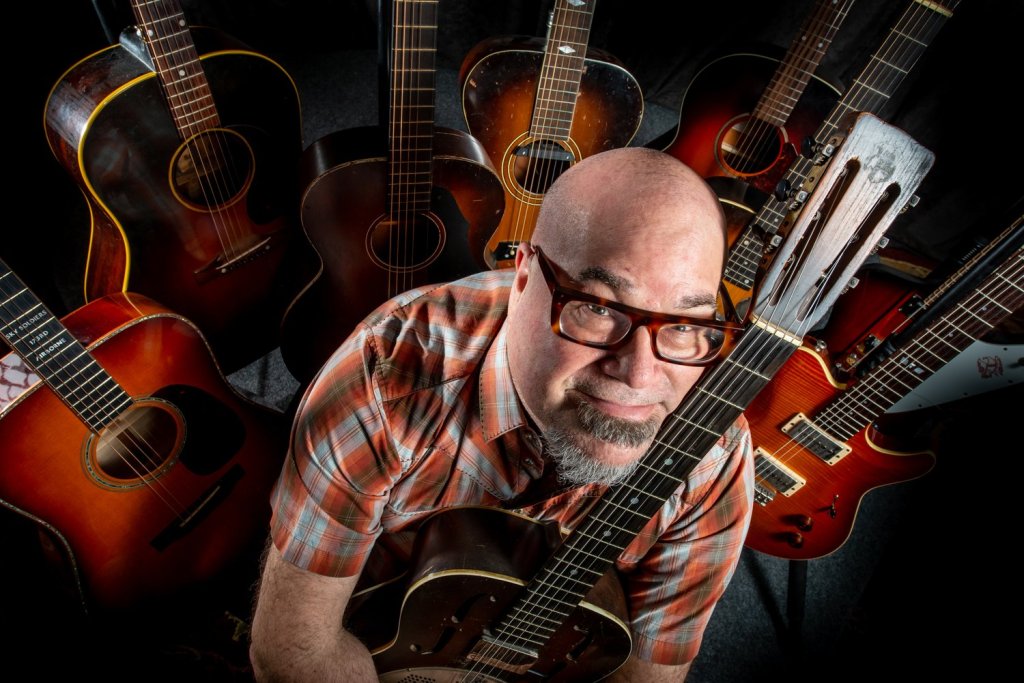
When master guitarist Matt Smith hits town, he hits with a big, rocking, joyous noise.
Raised here and a longtime star with top rockers Interstate and E.B. Jebb, the currently Austin-based picker, bandleader, songwriter, producer and teacher is, not surprisingly, a man with two bands.
There’s the hometown crew he leads here this week: Thursday at Ophelia’s, Saturday at Putnam Place. (Details below) It’s fellow local heroes: Tony Perrino, keyboards; Chris Peck, bass; Pete Sweeney, drums; Brian Melick, percussion; and Charlie Tokarz, saxophone. The latter two are relatively new (since 1994); the others are longtime bandmates (since 1988).
Smith also leads an Austin band since he spends most of his time there these days, running the 6 String Ranch for recording, teaching, producing and running instructional clinics.
Both bands bear the name Matt Smith’s World, a musical geography easily spanned by Smith’s wide-ranging musical mind. Two bands: one fearless approach to personal but accessible music-making. Geography has never stopped Smith, who presents workshops in every U.S. music center, plus the UK and Germany.
Before his visit last year, Smith told me, “After spending 15 years in New York City and 14 years in Austin, the capital district is still my hometown. I have so many great friends here.” He’s earned them; his two most prominent blues-based but sometimes country-flavored rock bands Interstate and E.B. Jebb played everywhere here, and all the time.
Since Smith is working on his 20th album back in his Austin studio, he’s likely to pack new tunes in his shows here, following up on the strong recent efforts “Being Human” (2020) and “In The Light” (2023).
Matt Smith’s World plays Thursday, Oct. 3 at Ophelia’s (388 Broadway, Albany 518-587-3000 http://www.opheliasrocks.com) 8 p.m. $15; and Saturday, Oct. 5 at Putnam Place (63 Putnam St., Saratoga Springs 518-886-9585 http://www.putnamplace.com) 9 p.m. $10. That’s about what Interstate and E.B. Jebb used to charge. And for those who want to make a full pilgrimage of this Matt Smith Eastern run, head to the Bitter End Friday, in between those two local shows. The self proclaimed New York City’s Rock Club is in the Village, 147 Bleecker St. 212-673-7030 http://www.bitterend.com. 6:30 p.m. $15.






















 Hoke's Jukebox