

Half a minute into “New Potatoe Caboose,” I got it.
Listening to the first side of “Anthem of the Sun” after Phil Lesh died, I got it.
There on the Grateful Dead’s second and trippiest album, the jam on “The Faster We Go the Rounder We Get” had faded into delicate guitar filigree.
Then a nine-note Lesh bass guitar line opened the door into what came next. The chiming treble stuff before felt serene and relaxed. But this, this was it – a gentle string of notes so peaceful and consoling that I felt I understood, once again and completely, what the Grateful Dead were and did. As Lesh developed the song from underneath, they followed his map.
In the Grateful Dead’s mission, to get people and places high by shaping feeling states in sound, Lesh was uniquely central. As the bridge between beat and melody, he played around with time, so the band swung; and he brought a classically-trained harmonic sophistication to jams. He came to the Grateful Dead, to the electric bass guitar, via violin and trumpet, through orchestras and jazz big bands, so his musical mind was a big tool box. Lesh nudged the voices, guitars and keyboard in new directions, whether they were all in full flight or dank doldrums in need of a fresh idea. He had the key.

Phil Lesh onstage at the Knickerbocker Arena; March 26, 1993
Lesh played with a pick, phasing with clean, percussive articulation. He seldom played very fast; his grooves were restrained, sparse – but also propulsive, powerful when he pushed things. You can hear the urgency, the glee, in every note.
Put on “New Potatoe Caboose” and you can hear all of that, and might find yourself hanging out, as I did, in Phil’s section of the bus, listening to the song especially to hear what he did with it.
“Anthem of the Sun” and “Aoxomoxoa” (1969, the year after “Anthem” and same year as “Live Dead”) may feature Lesh’s spaciest, out-there playing, ethereal and abstract. But his best-known composition “Box of Rain” (from “American Beauty” 1970) reaches just as deep in the opposite direction, mourning his father’s passing in earthy, emotionally accessible simplicity.
After Jerry Garcia died in 1995, Phil was part (or not…) of successor bands that formed and faded. After 30 years of mostly knowing who the Grateful Dead were (except for keyboard players and some guests), things got murky amid rumors of power struggles.
Some of those bands were cool despite all that, and I mostly liked them because each, under whatever name and however briefly, managed that joyous Grateful Dead powerglide.
I saw the Grateful Dead nearly as much as I’ve seen NRBQ; including shows at SPAC, in Albany and Troy.
Thank you, ticket-generous longtime Dead publicist Dennis McNally!
Diving into nostalgia, let me recall some extra-fine Dead shows. When I caught them with the New Riders at the Agora in Columbus in November 1970, I was blundering lost around America after leaving the Navy and years spent overseas. They brought me back home, in the same city where I was born.
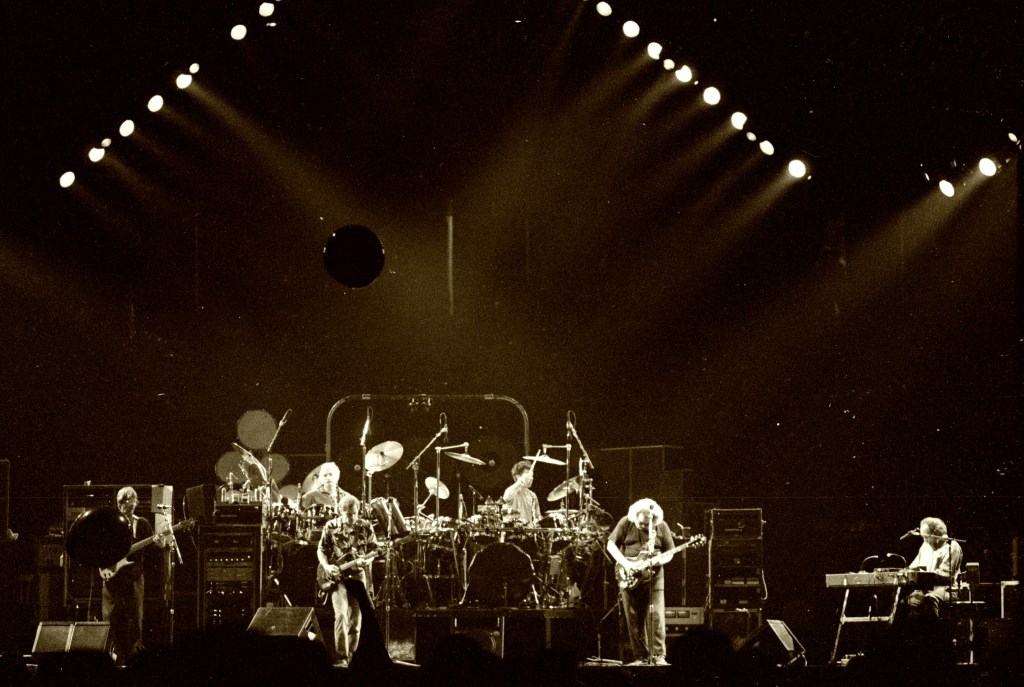
The Grateful Dead at Knickerbocker Arena, March 24, 1990. From left: Phil Lesh, Bill Kreutzmann, Bob Weir, Mickey Hart, Jerry Garcia, and Vince Welnick
They brought their “Wall of Sound” monster PA to Hartford’s Dillon Stadium in July 1974 and played three full sets. They bonus’ed us with Phil’s break-time set with Ned Lagin in “Seastones” – a surging space-rock torrent of electronic noise. In this deep-exploration interlude – and the whole five-hour marathon – Phil’s bass shook the ground.
Another bonus: When the Rolling Stones played the former Rich Stadium in Buffalo, third date on their 1981 tour, their publicist Ren Grevatt graciously provided press tickets, then offered, “Want to see the Grateful Dead the night before? They’re at War Memorial Auditorium.” Yes, yes, please. My fellow Capital Region writers and I – Don Wilcock, Troy Record; and Steve Webb, Knickerbocker News – got to see the most musically coherent and powerful Dead show of the 50 or so I’ve caught over the decades. They’d actually been rehearsing, before touring Europe, and were razor-sharp; WAY better than the Stones.
But I never saw them play Phil’s heavenly segue from “The Faster We Go the Rounder We Get” into “New Potatoe Caboose.” I never saw Phil play onstage the warmly comforting peace of those nine perfect notes.
Now I’m glad I can hear them on the album any time. And I need them now in these fear-filled, ugly times. Miles Davis’s “Kind of Blue” is my healing music for solace in the dentist’s chair or cardiac fixes. But those nine notes really do it for me, too.
On my walk yesterday, I spotted a pickup down the block with a big blue and red banner flying from its bed. I groaned a bit, fearing a particular flavor of ugly campaign graphic. But I felt relieved when a breeze lifted and unfurled it so I could read: “Presidents are temporary but Wu-Tang is permanent.”
So are those nine notes.
So is Phil Lesh.
 Hoke's Jukebox