
It’s not as if we’re starved for jazz around here lately; but Saturday’s “Jazz is Back” reopening of the Van Dyck Music Club felt like the joyous end of a drought – also like a Schenectady double-header after Artemis lit up A Place for Jazz nearby on Friday.

All In. From left: Michael Benedict, vibraphone, Chris Pasin, trumpet; Kaitlyn Fay, vocal; Awan Rashad, tenor saxophone; Keith Pray, alto saxophone; Mike Lawrence, bass; Lee Russo, tenor saxophone; David Gleason, keyboard. Blocked from view: Chad McLoughlin, guitar; Cliff Brucker, drums
While Artemis played with smooth assurance, the all-star nonet at the Van Dyck achieved a swinging looseness in its solo-rich, all-in sense of fun. The Van Dyck crew projected a warm community feel, human and engaging.
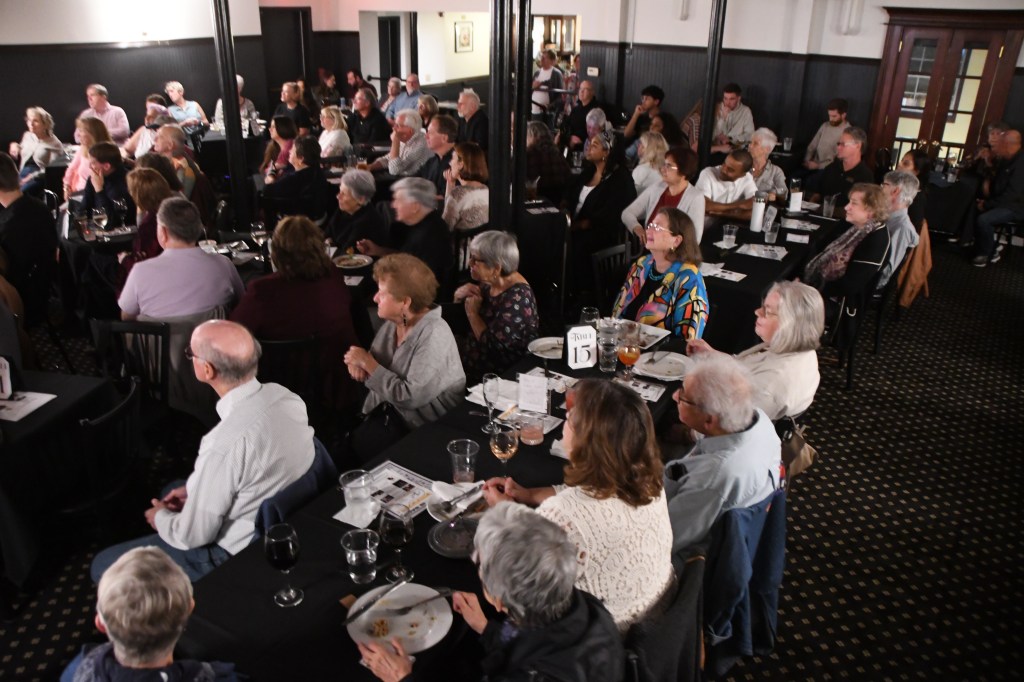
Many of the same faces turned up at both A Place for Jazz and the Van Dyck, so the word “Club” worked for real. In addition to graybeards like me and co-host Bill McCann, younger fans also helped completely fill the 100 seats in the long-dormant upstairs performance venue in the Stella Pasta Bar that now occupies the Stockade neighborhood music Mecca.
McCann and fellow radio DJ Tim Coakley, the former for decades at WCDB, the latter an almost equally long run on WAMC, highlighted both the onstage action and the venue’s deep jazz history since 1948 with anecdotes and recommendations for ace recordings of tunes.

From left: Cliff Brucker, Chad McLoughlin, Mike Lawrence, David Gleason

The rhythm section trio – drummer Cliff Brucker, bassist Mike Lawrence and keyboardist David Gleason – took their places stage left and stayed put as soloists shifted in and out, each playing a single song. Up first was guitarist Chad McLoughlin, who also joined the trio periodically behind other soloists. Nearly all had played Schenectady’s recent Porchfest and/or have collaborated in various combinations over time. In fact, most had played in Keith Pray’s Big Soul Ensemble whose monthly Van Dyck shows drew jazz fans for more than a decade, pre-COVID.
Pray played second, after McLoughlin opened with spry Wes Montgomery-style riffing in “Have You Met Miss Jones?” Everybody soloed here, as in most first-set songs. Everybody soloed in the second, all over the place, and improvised section riffs, too.

Keith Pray
Pray tackled “Wabash” with aplomb, a cheerful, driving Cannonball Adderley number that, like “Jones,” featured short riff exchanges before going back to the head.

Chris Pasin
A wireless hook-up on his trumpet, Chris Pasin took over with “Delilah,” getting all of this Clifford Brown/Max Roach blast as McLoughlin joined the rhythm section and delivered a solo of his own.
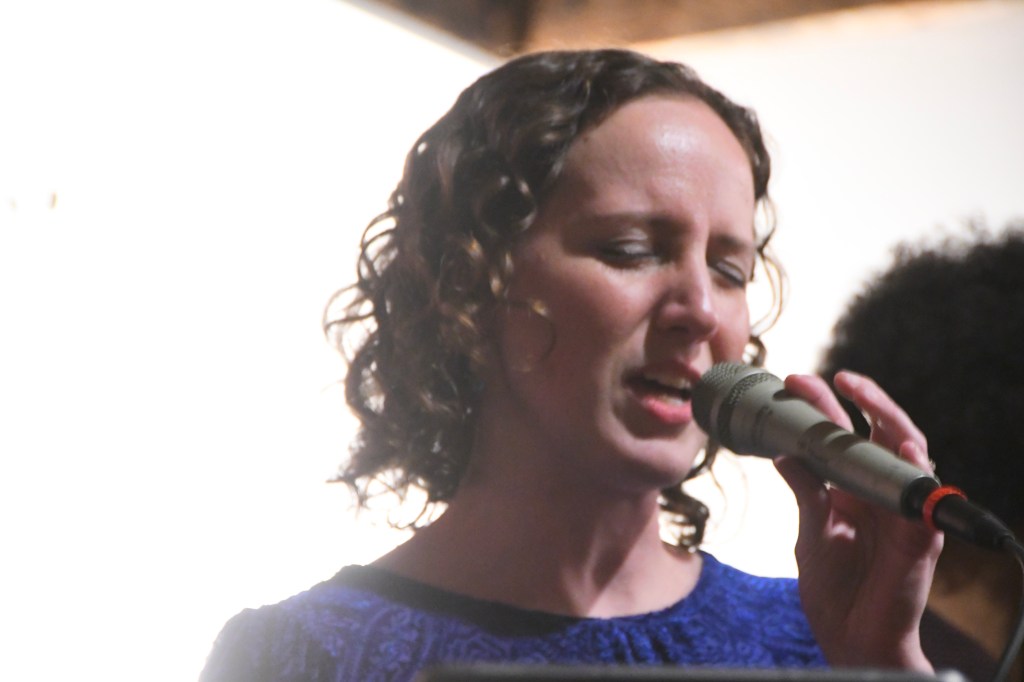
Kaitlyn Fay
Singer Kaitlyn Fay wasted no time hitting skat mode in the torchy “I Thought About You;” Gleason echoed a vocal phrase in his fine solo and shrugged off distracting cellphone noise from the crowd.

Lee Russo; Mike Lawrence, background left
Tenor saxophonist Lee Russo, fresh from a tribute gig honoring his saxophonist father Leo with Brucker’s band at WAMC’s The Linda, changed the mood in a big way. His tender take on the mellow “But Beautiful” moved with soulful, simple, elegant and eloquent grace, a lovely change of pace after the mostly 50s, mostly hard-bop tunes before him.


From left: Michael Benedict, Chad McLoughlin, Cliff Brucker, Mike Lawrence, David Gleason
McLoughlin returned to the stage for Milt Jackson’s swinging “Bags Groove,” Michael Benedict leading on vibes and going all speedy and smooth. He soloed with just two mallets, but played with four when comping behind McLoughlin’s solo, shifting back to two in a duet with Gleason.

Awan Rashad
Tenor saxophonist Awan Rashad kept the energy level high, emulating Sonny Rollins in full flight with his upbeat romp through “All God’s Chillun Got Rhythm.” All the guys did, McLoughlin helping the rhythm section rev it.

From left, Chad McLoughlin, Cliff Brucker (obscured by music stand), Awan Rashad, Mike Lawrence, David Gleason
After the break, a whole new mood galvanized the place. The set-list specified only two tunes, plus an encore to be determined.
Well, pretty great, in a thrillingly organic run of solo after solo, and the horns improvising whole sections on the fly. This wonderful mischief started early in the set-opening “Caravan,” after Rashad popped the tune open with a fiery tenor break. Pray looked around at his frontline colleagues, whispered a riff to Rashad and the two led the other horns in simple chords behind the melody. This was music-making at its purest and most playful; obviously fun to do and delicious to hear.
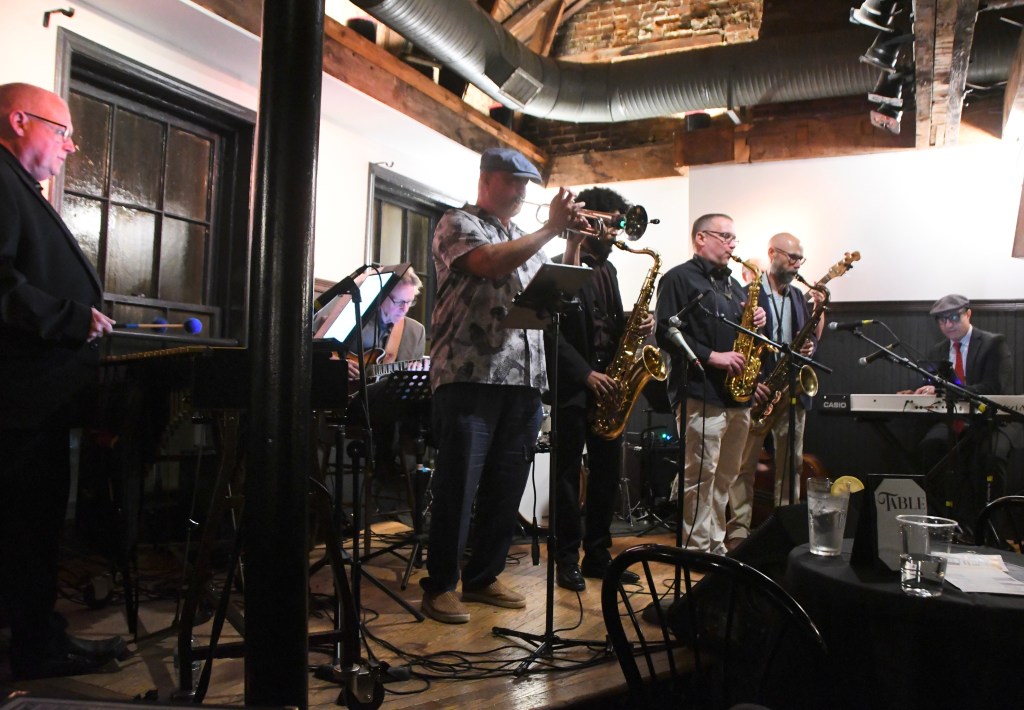
Everybody got a piece of “Caravan,” maybe most impressively Rashad, then Benedict who raced the riff with two flying mallets. Benedict directed traffic, waving off a recap the horns were just about to detonate in favor of a Brucker drum solo; then the horns had their say in a free-for-all full of spirit, 25 minutes after they’d started this Duke Ellington classic.
Fay returned to the stage for “Things Ain’t What They Used to Be” (theme song of McCann’s Saturday morning WCDB radio show), and things started to mutate faster even than “Caravan.” As in her first-set solo, Fay skatted right away, in verses one and three, singing the words in between.
This was a hyperactive harvest of riffs following fast on riffs, horn sections forming out of nowhere, then vanishing in the flow, and all kinds of moods celebrated and eclipsed. Gleason slowed the pace at one point, articulating quietly, serene; then he shifted up and invited Benedict into a duet that the horns jumped aboard as Benedict cued audience clapping. The encore turned out to be “Autumn Leaves,” a soft, easy swing at first, then a solo-riff parade even more restless and intense than in “Things,” just before. Everybody was the star here, and everybody gave stalwart support. Cooperation, community.

David Gleason
After the seven-song first set played just over an hour; the jam-prone three-song second also ran about an hour. The mood was ebullient, onstage and off; the sound strong and smooth. Fay thanked engineer Nathan Scheid from the stage to happy agreement, while the lighting system could use more wattage.
Service worked this way: Patrons ordered food and drinks from the bar at the rear. Tenders made and handed drinks over the bar and sent food orders to the kitchen. Then servers delivered food by table numbers, a less intrusive method than when servers took orders, too.
Setlist (soloists in parentheses)
Have You Met Miss Jones (Chad McLoughlin, guitar)Wabash (Keith Pray, alto saxophone)
Delilah (Chris Pasin, trumpet)
I Thought About You (Kaitlyn Fay, vocal)
But Beautiful (Lee Russo, tenor saxophone)
Bags Groove (Michael Benedict, vibraphone)
All God’s Chillun Got Rhythm (Awan Rashad, tenor saxophone)
Caravan
Things Ain’t What They Used to Be
Autumn Leaves
 Hoke's Jukebox