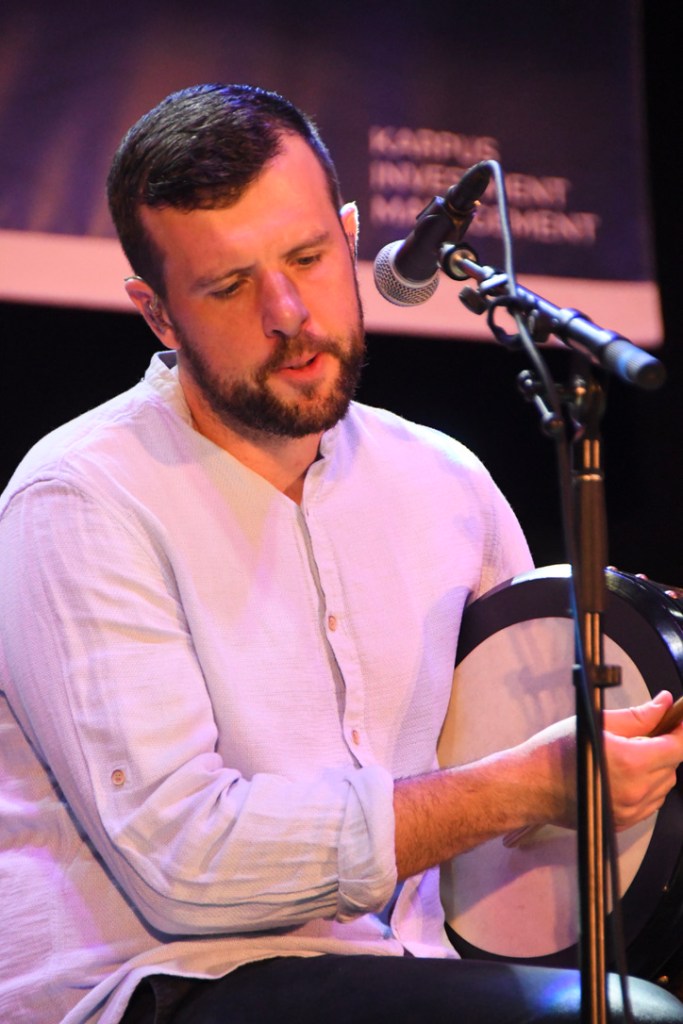
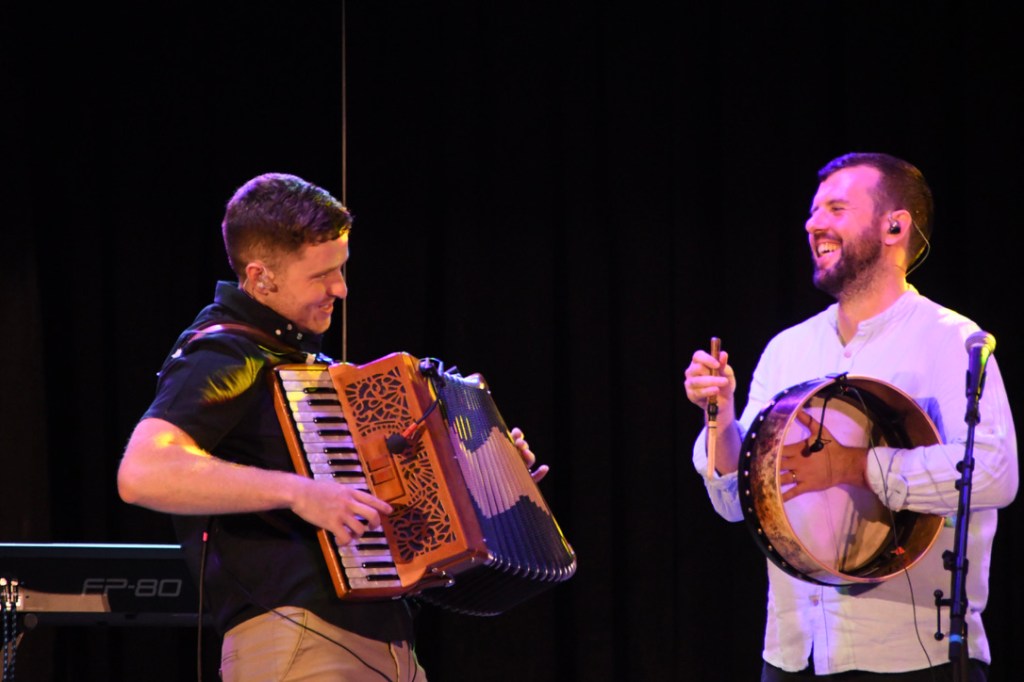
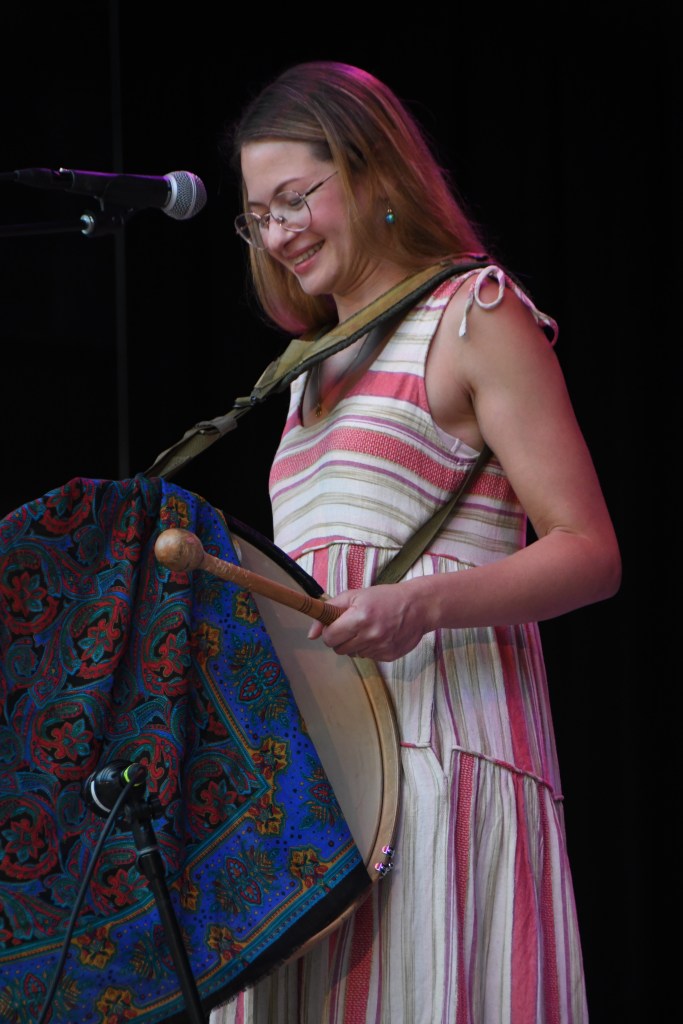
Goitse leader and bodhran player Colm Phelan joked that he practiced for hours to pronounce “Schenectady;” so we owe him this much: “g-WITCH-ah.”
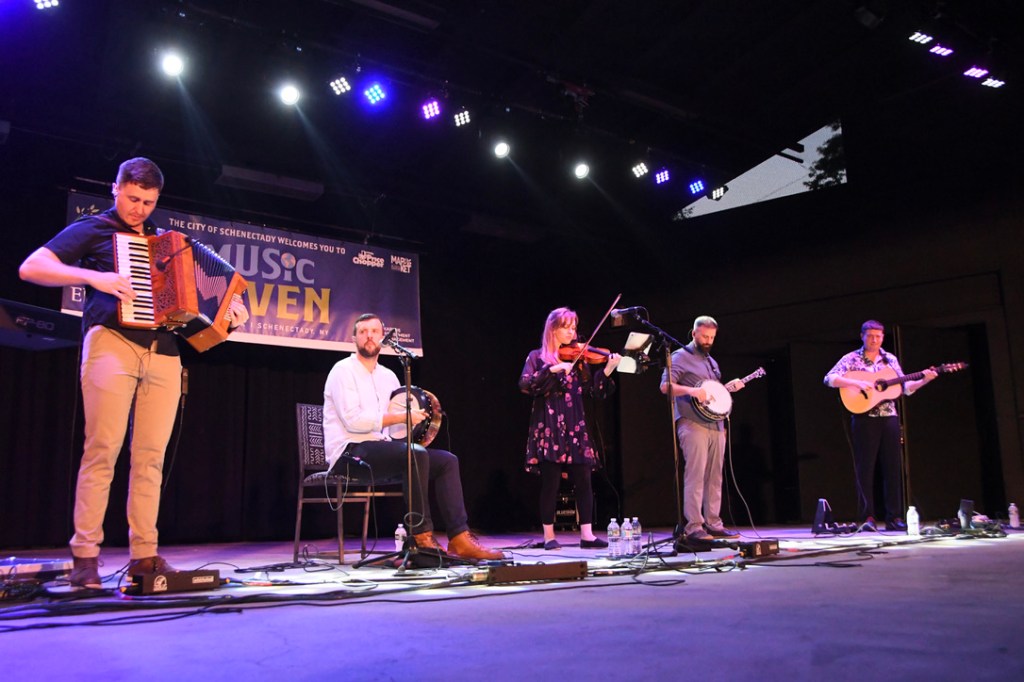
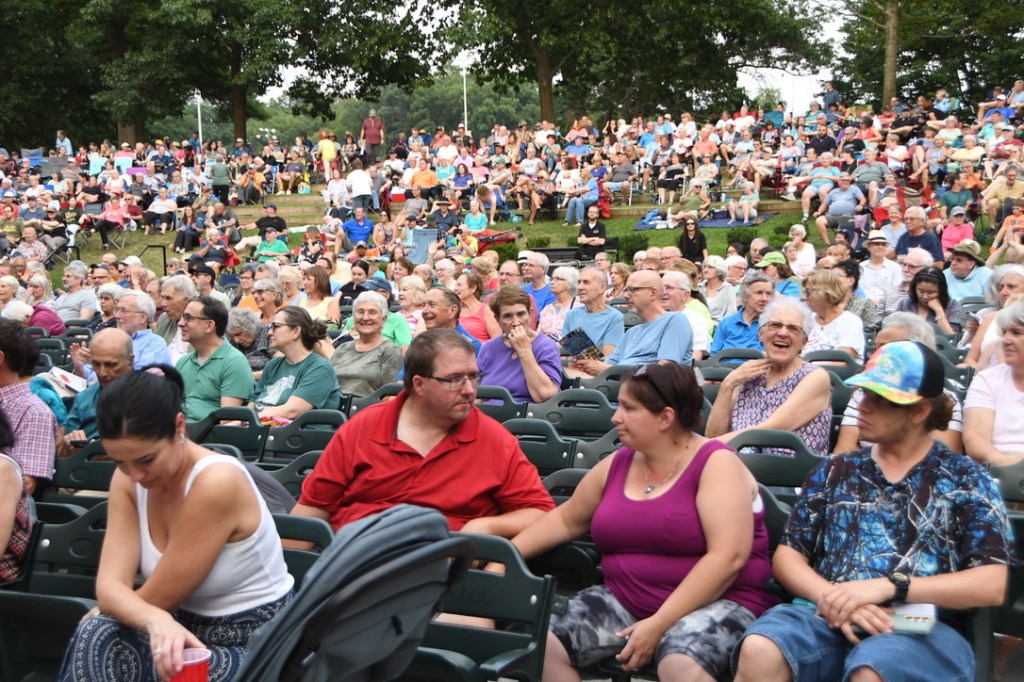
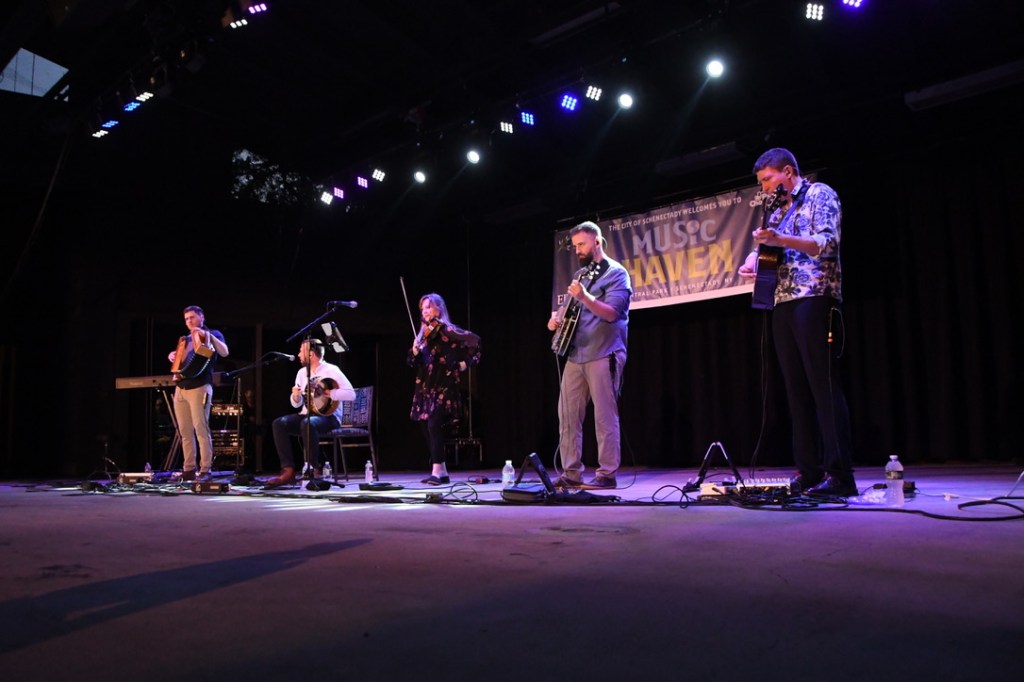
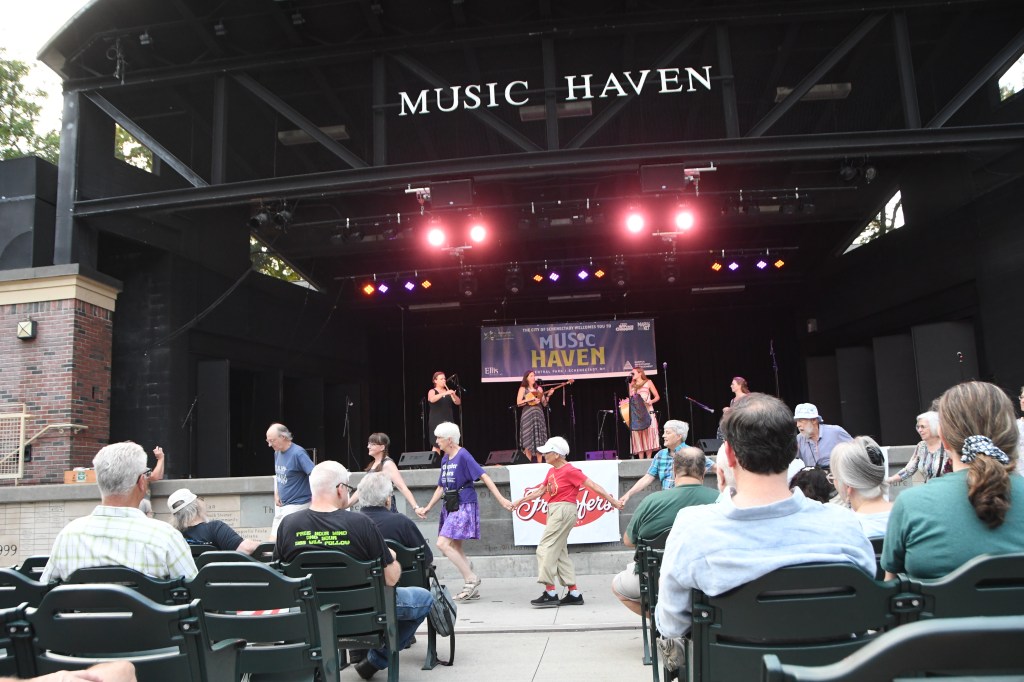
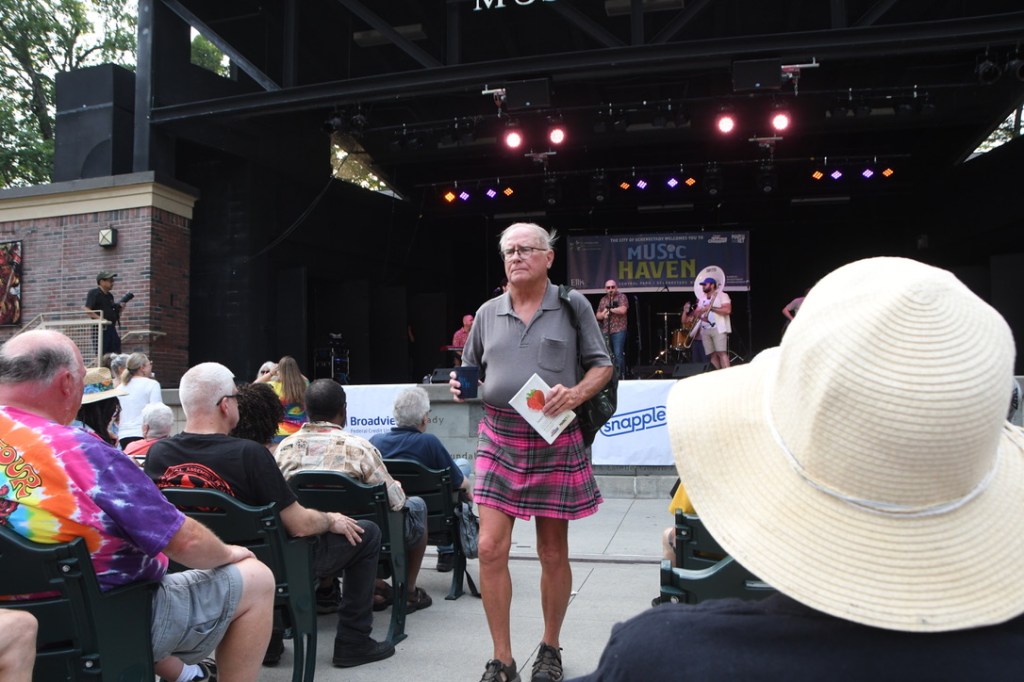
Long past those days when Irish traditional music mainly meant the Chieftains, then everybody else, Goitse charmed a large, happy crowd at Music Haven Sunday. Working with traditional tunes and tools, songs and sounds, they modernized only slightly by crafting fresh tunes that sounded like venerable old ones. They played and sang them in blends so seamless that no one bothered to play Name That Tune or decipher the seques and instead went along for the ride. However, dancing was disappointingly scanty, even with Steve Nover in the audience.
Rhythmically, Irish music hails from the opposite end of the groove world from funk. Rather than settle in for hypnotic effect, beats flow along, usually for just a short while, then mutate, usually to speed up.
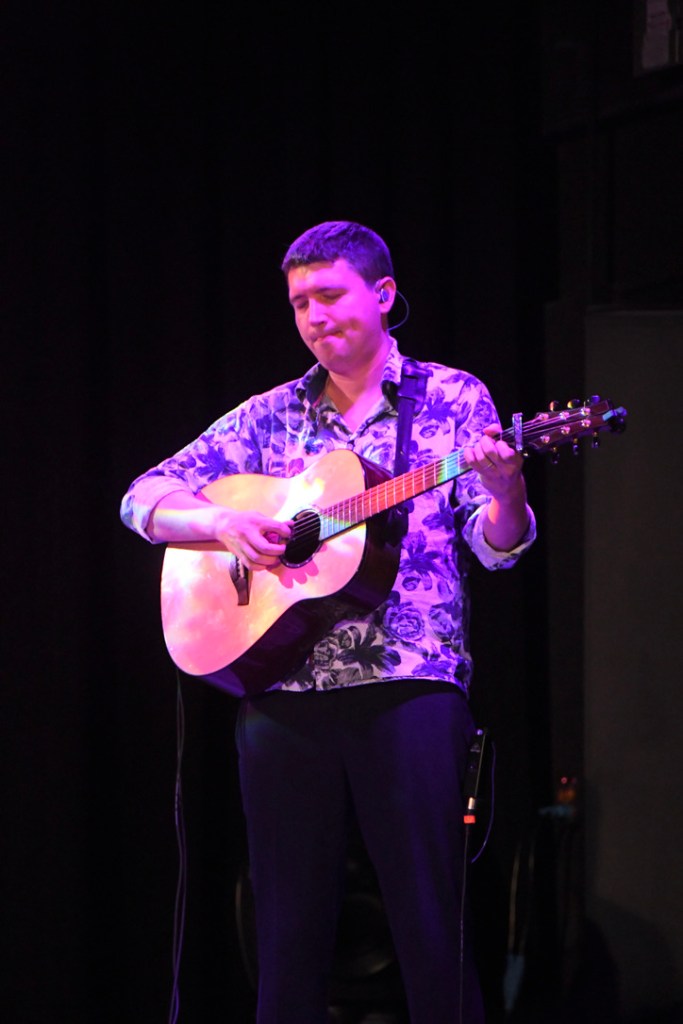
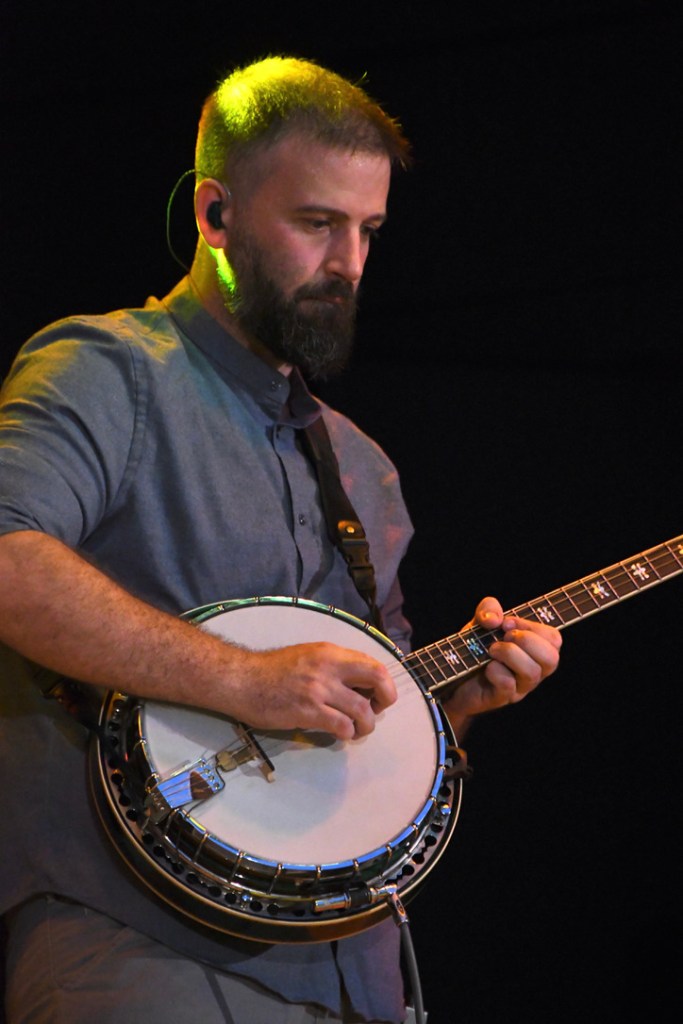
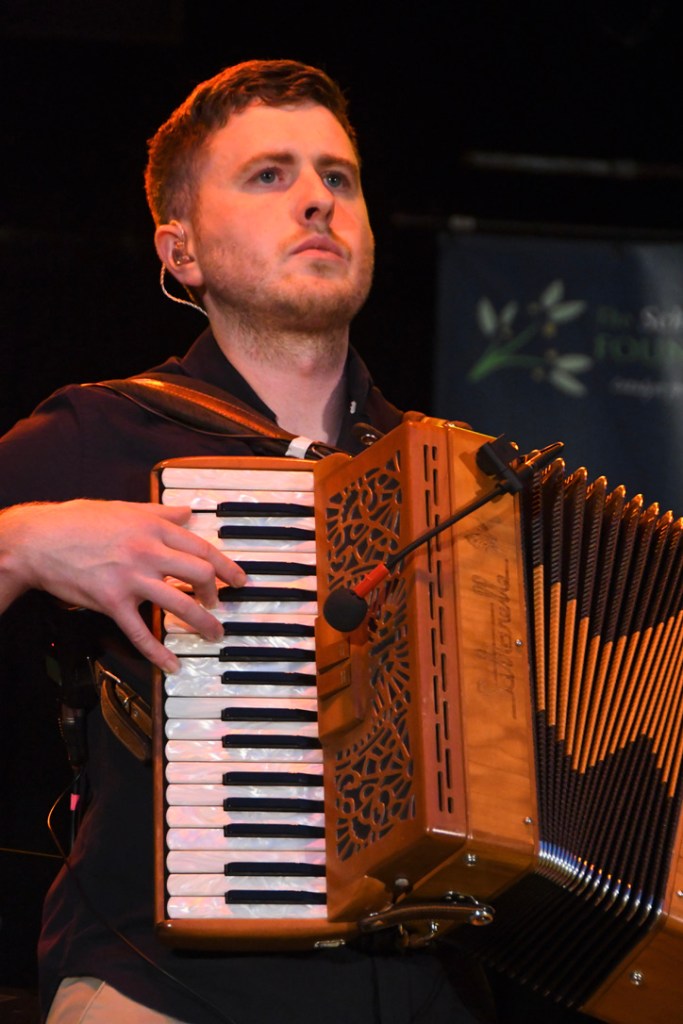
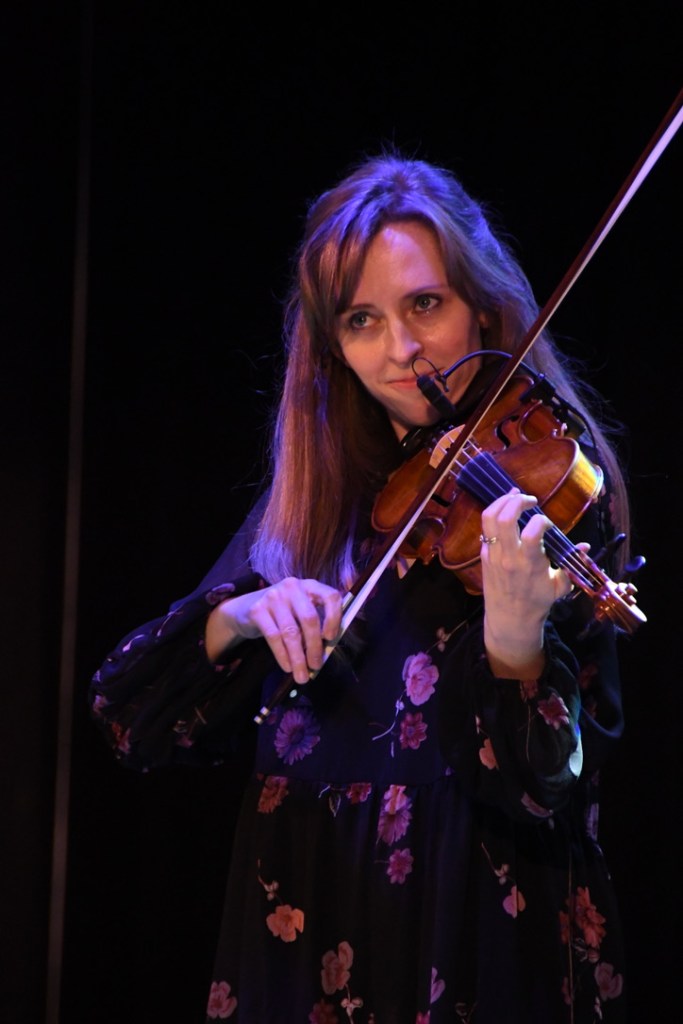
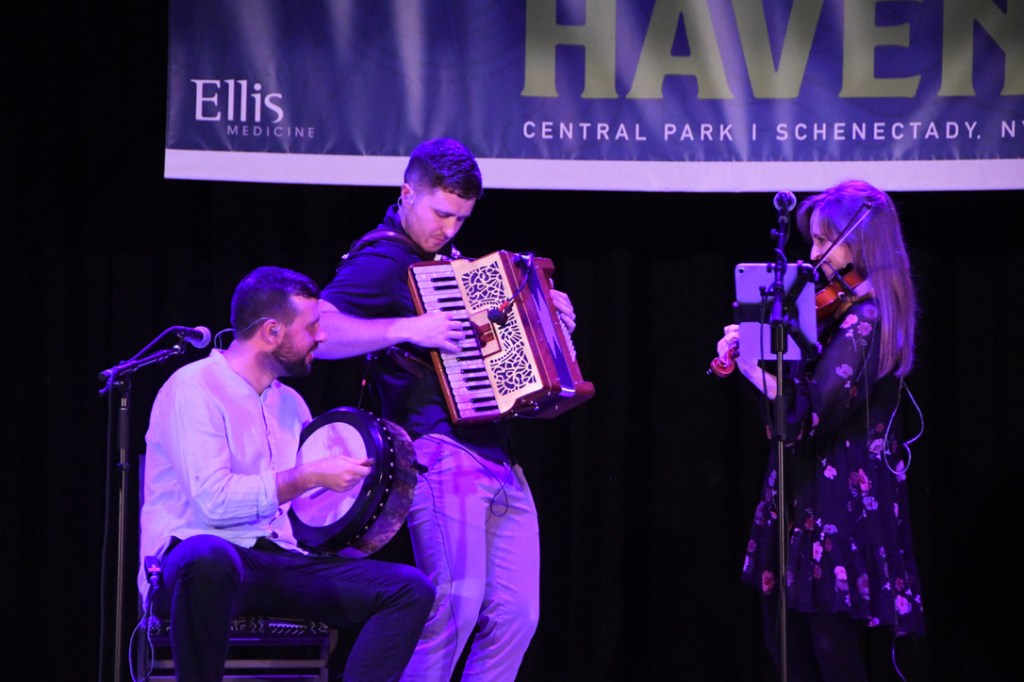
Goitse’s arrangements brought a fresh feel to dance tunes by aligning Conal O’Kane’s strummed acoustic guitar with Phelan’s bodhran (circular hand drum) played with several different-sized sticks; as Alan Reid’s banjo set up a cheerful, treble bridge between. Daniel Collins beefed up the beat when he shifted occasionally from keyboards to accordion, going low on the chord buttons while fingering melodies on the piano side. A late fill in on this tour, fiddler and singer Joanna Hyde proved highly compatible, confident and commanding. Soloing on most tunes, she sparkled at the mic also, going poignant in “Ireland’s Green Shore” early and later wryly introducing “Belfast Love” as one of few happy Irish tunes.
The dance tunes, rolled strong with smooth riffing punctuated with tempo shifts, as in the peppy “Months Apart” with a crackling accordion break and “Morning, Noon & Night” – its headlong momentum climaxing in a hard stop.
They eased the tempo some, both in the love songs Hyde crooned and the lullaby waltz “Write Me Down” that Phelan quipped afterward got a reggae spin. His intros often brought a laugh, as when he set up “Biggest Little Journey” with a wandering tale of travel travails he later admitted might have been the biggest little song introduction.
In the slow “Henry Joy,” Hyde warned they’d take their time, stretching to eight minutes; but then pointed out Queen’s “Bohemian Rhapsody” was even longer, so why not? She kept the laughs coming by inviting a singalong on tough-to-remember lengthy vocal phrases; some in the crowd actually managed to follow.
In fact, all their songs engaged this way: Inviting melodies, played with tight, shared expertise. All their songs, that is, except Phelan’s right-before-the-end unaccompanied bodhran solo. If this sounds dubious – a solo played in just one drum when full-kit drum solos earn yawns – Phelan made it work by changing the pitch by pressing the drumhead from inside – like Steve Amedee of the much-missed subdudes, the Jimi Hendrix of Cajun percussion.
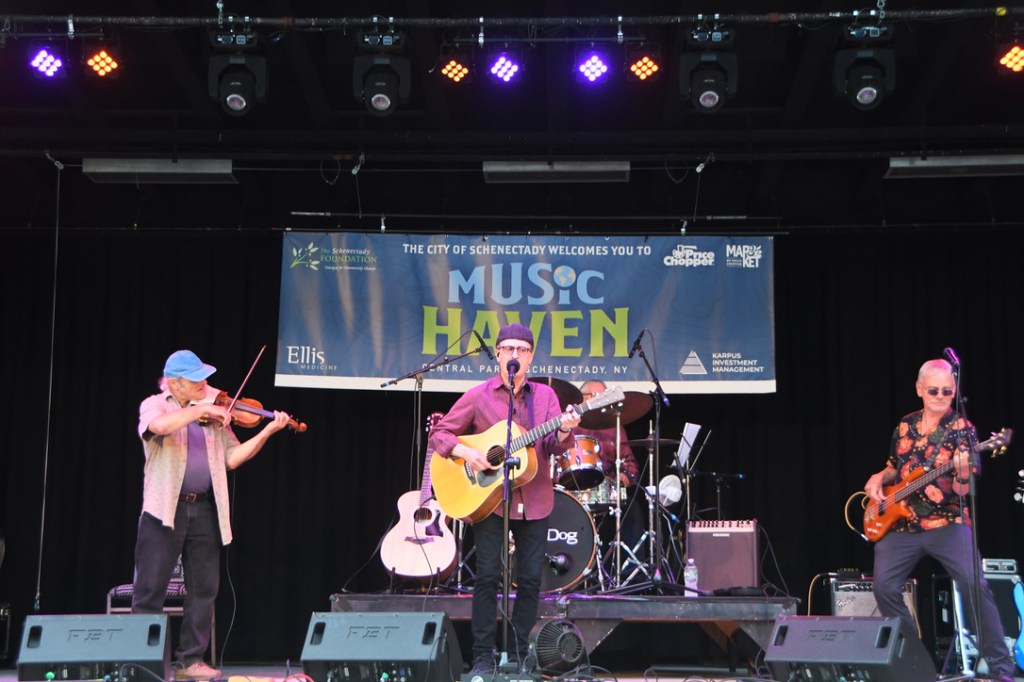
Hair of the Dog turned the place into one big pub maybe better than leader-singer-guitarist Rick Bedrosian feared. The quartet’s 45-minute opener felt rushed as songs blurred hastily together and Bedrosian noted time racing against their set list. Nonetheless, they entertained effectively with expert Celtic rock that took off from traditional jigs and reels and wound up with the anthemic “All Of the Hard Times Are Gone,” a staple of both Hair and McKrells shows.
Everything worked, confident grooves from backbeat drummer Gene Garone and finger-picking bassist Dan Samson, Larry Packer’s flashy fiddle and Bedrosian’s high vocals and acoustic guitar strums. Traditionals, including a spunky “Whiskey In the Jar,” had late-night-in-the-pub spirit, earning fans’ attention when they slowed the tempo.
GOITSE SET LIST
Invasion
House on the Hill
Ireland’s Green Shore
Months Apart
Trusty Messenger
Write Me Down
For Good Measure
Morning, Noon & Night
Henry Joy
Biggest Little Journey
Cave of the Wild Horses
Belfast Love
Tall Tales
Queen of Argyll
Bodhran Solo
Transformed
Dog Reels
Music Haven gets extra-busy with jazz next week. Clarinetist Anat Cohen leads her Brazilian-inspired Quartetinho Sunday when locals Art D’Echo Trio (plus percussion leprechaun Brian Melick) open. Monday, the SUNY Schenectady Jazz Faculty Combo features guest trombonist Delfeayo Marsalis (brother of Wynton, Branford and Jason; all sons of Ellis).
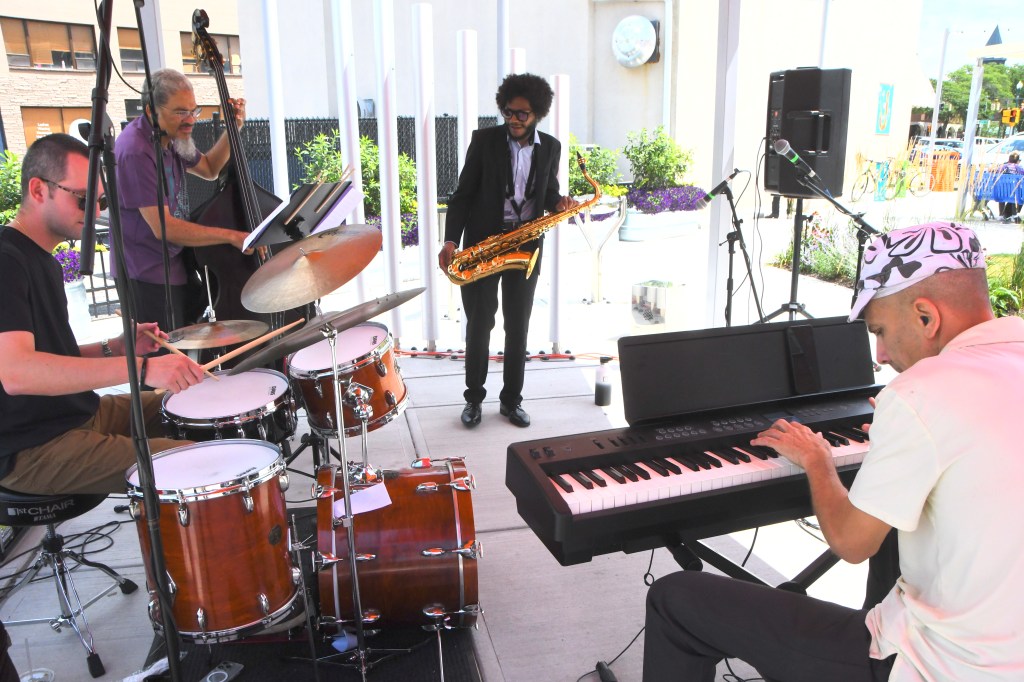
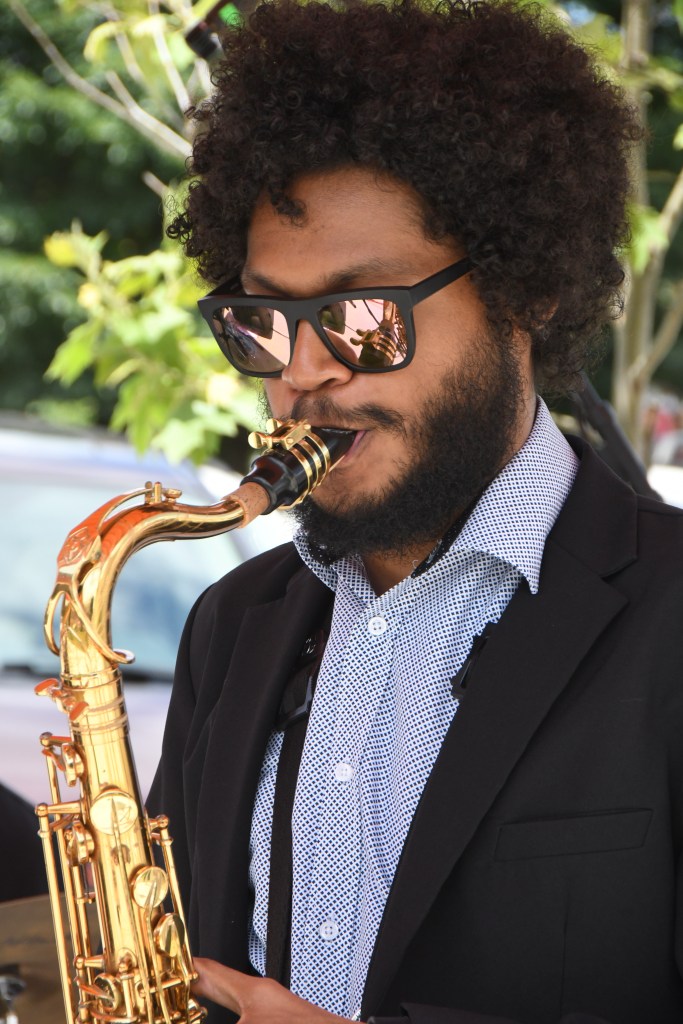
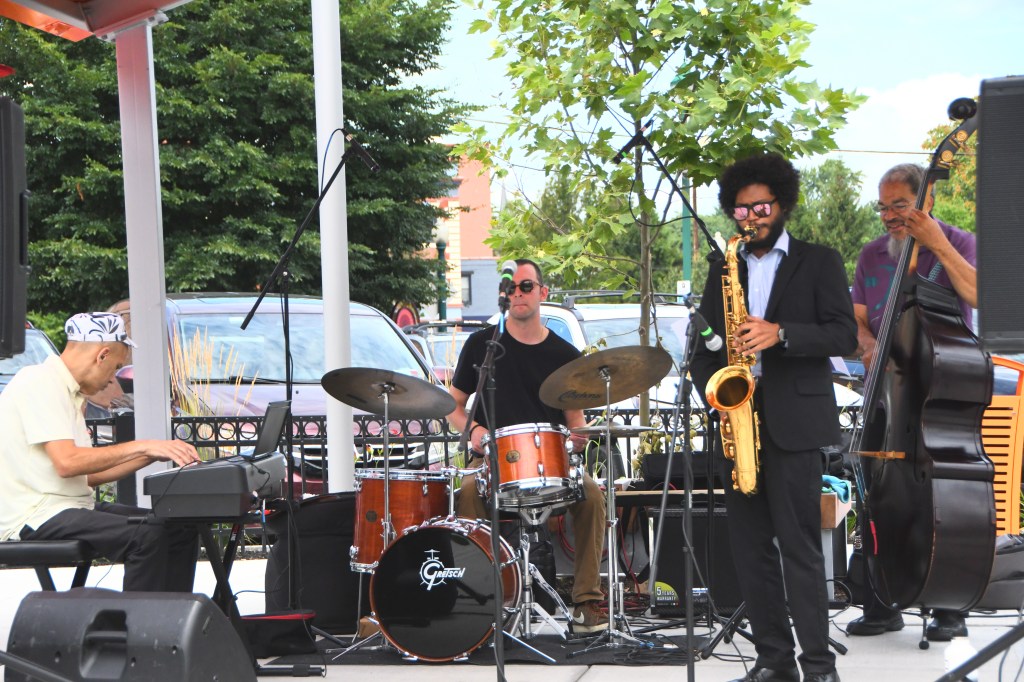
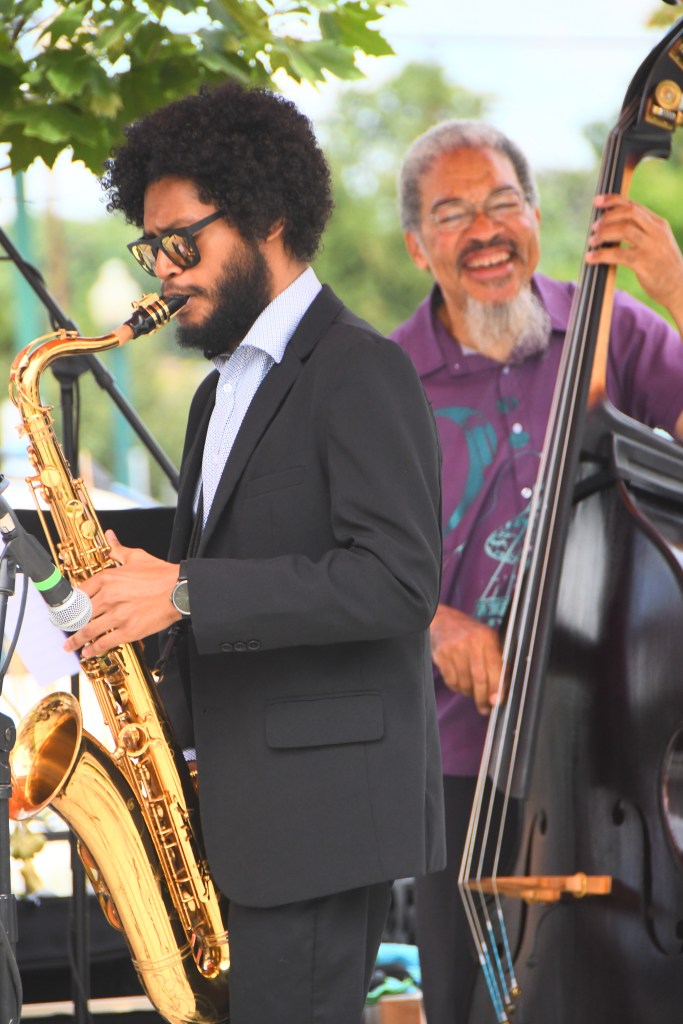
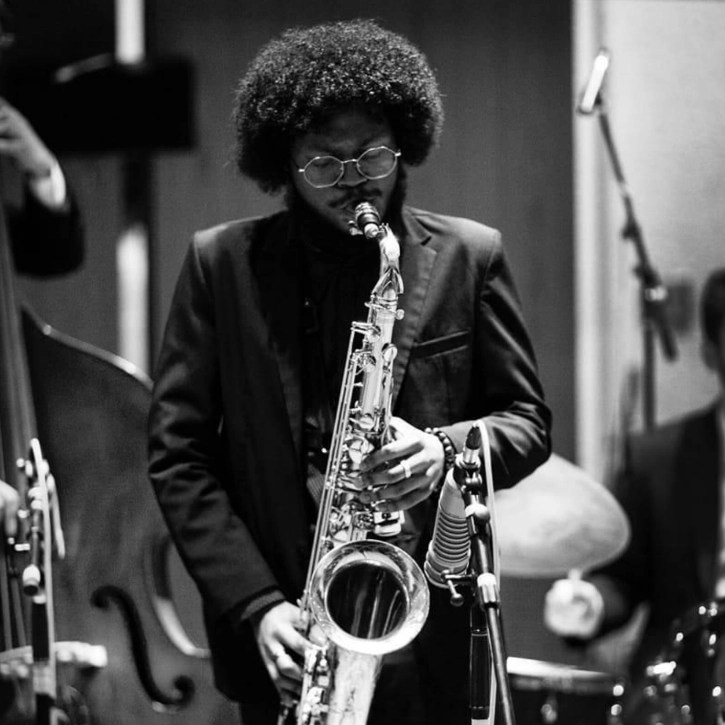
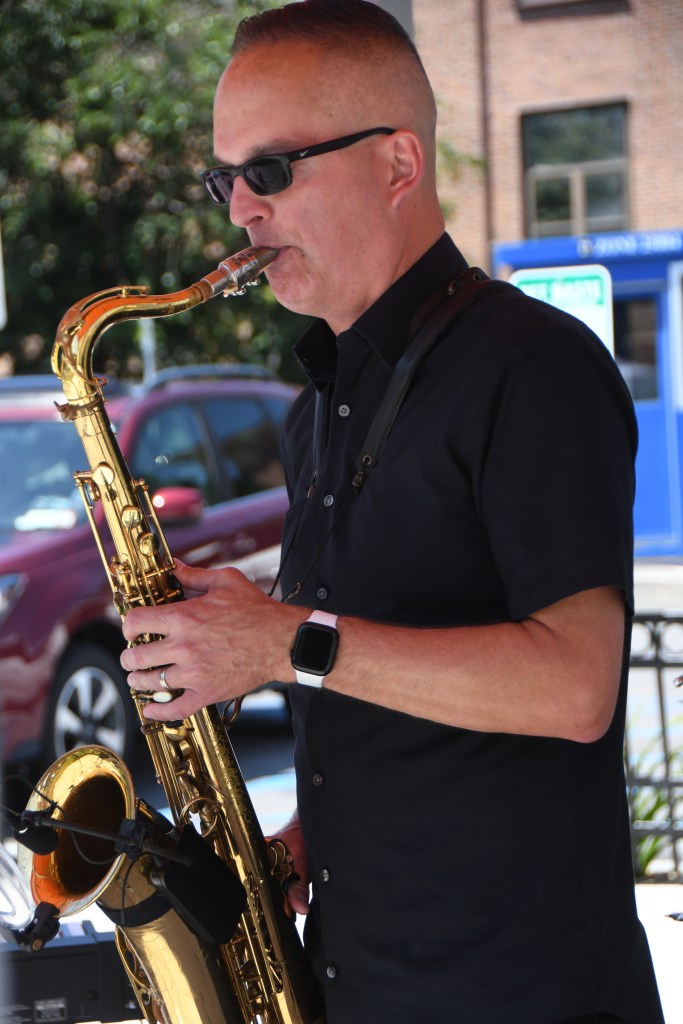
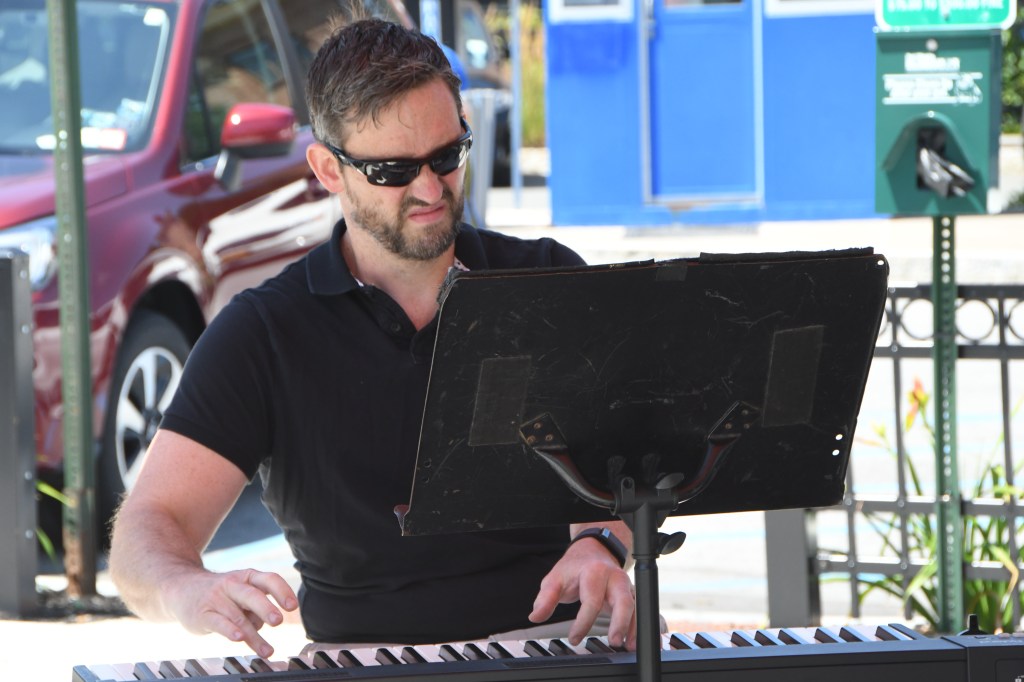
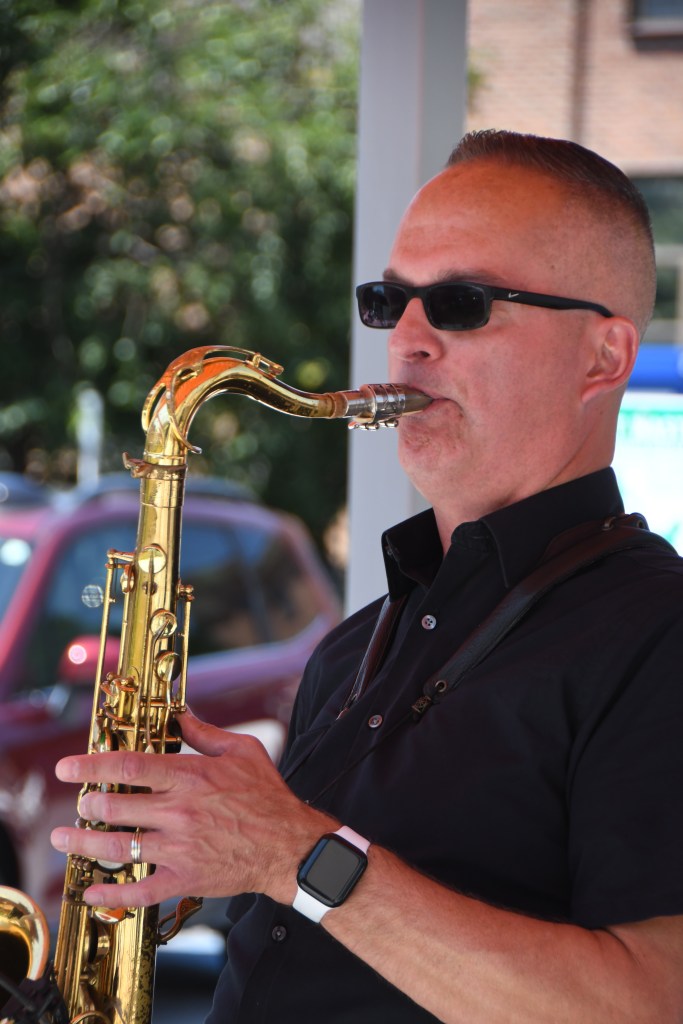
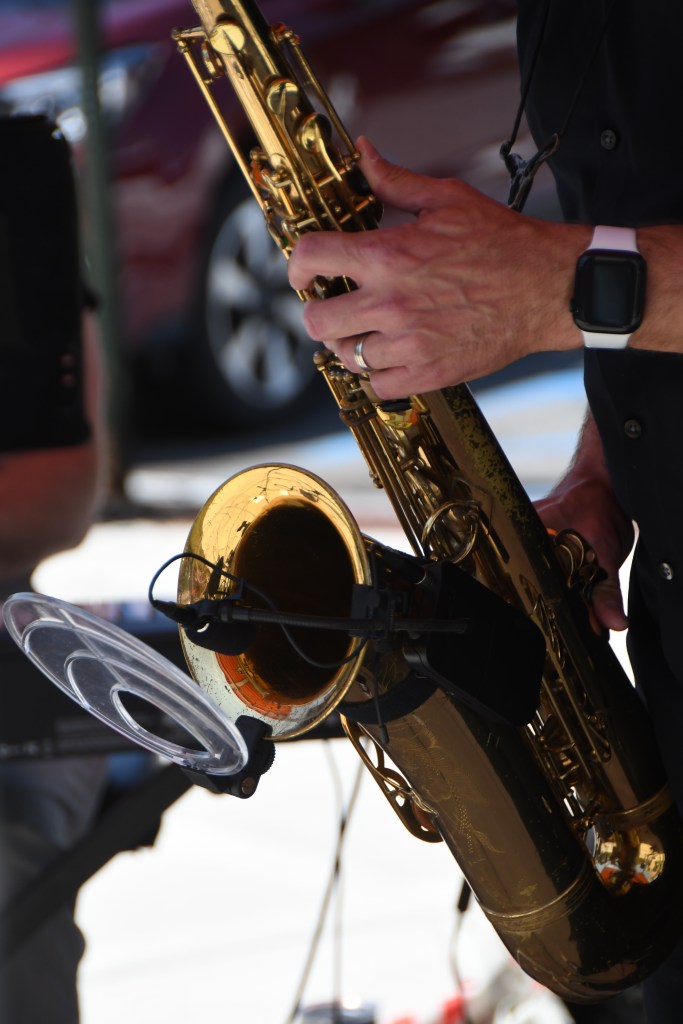
If saxophonist Awan Rashad hadn’t told me beforehand that the quartet he led at Jazz on Jay Thursday had never before played together in that configuration, I never would have believed it.
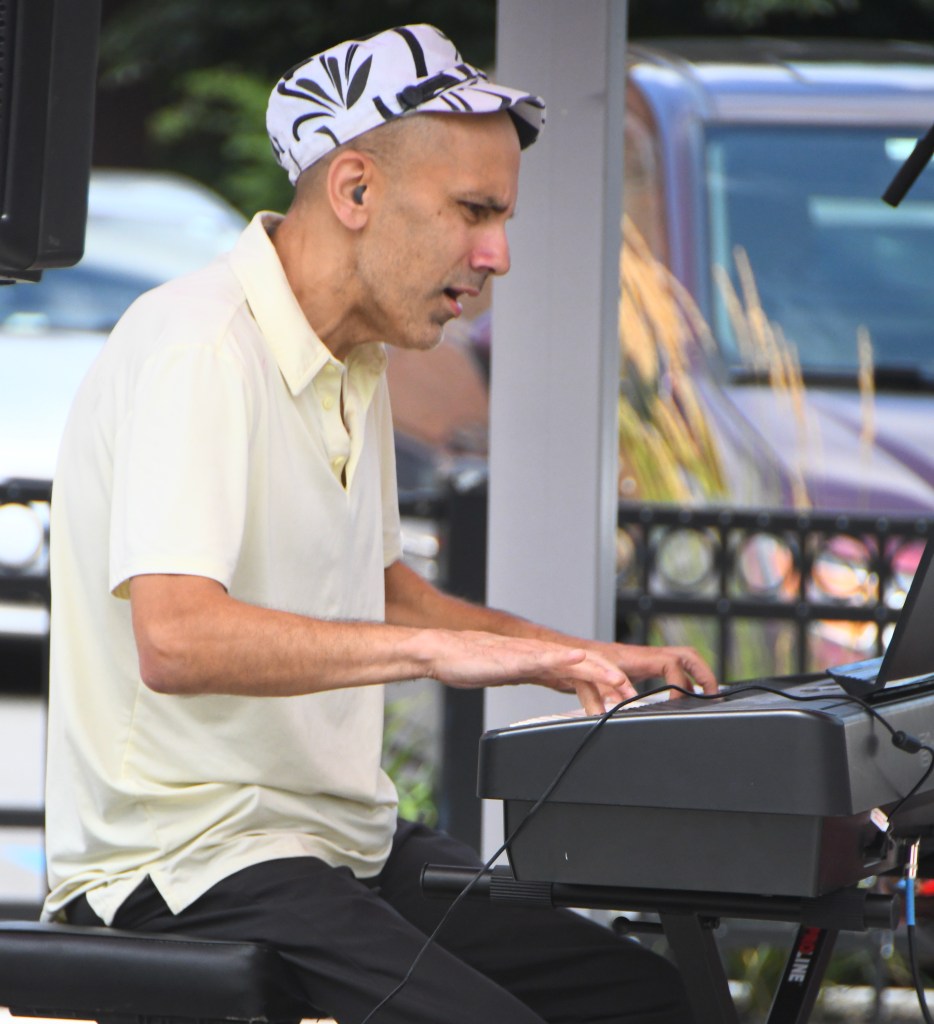
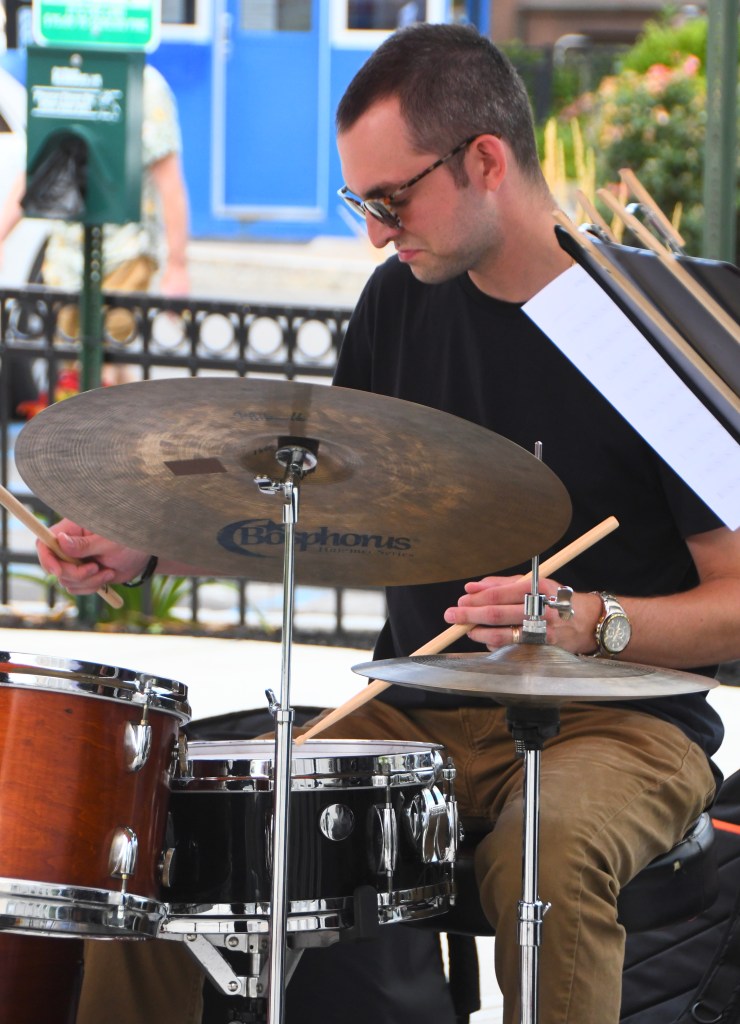
The four – Rashad, tenor sax; Tarik Shah, double bass; Ian MacDonald, piano; and Matt Niedbalski, drums – charged up vintage tunes with impressive, happy tightness; sharing fresh ideas quickly from player to player.
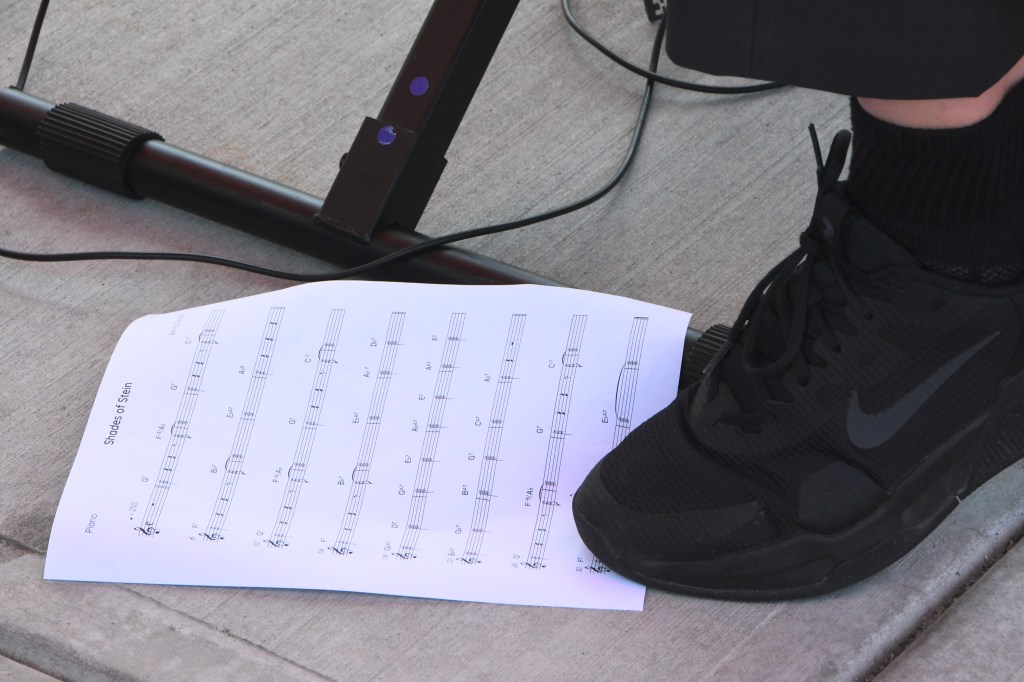
The virtue of playing older tunes is that everybody on the bandstand knows them. The cats proved it Thursday by hanging in even when wind blew charts off their stands; MacDonald at one point anchored an elusive sheet with his shoe, while Rashad reached over to secure Shah’s with a clamp.
The hazard of playing older tunes is that everybody in the audience knows them, too – and feels we all know what to expect. Not a problem for this creative crew.
Rashad’s musical heart beats with 50s bebop and its 60s successor, hard-bop. They refreshed these familiar forms in waves of friendly immediacy. Shah and MacDonald shared a warmly tight connection in echoing riffs back and forth, while Rashad did this with all his band-mates.
“Time to Smile” lived up to its happy title in a mid-tempo swing excursion to start the set, everybody soloing hot but Niedbalski, but he later got his shot in riff-swapping with each band-mate in turn.
Rashad eased into “Lullabye of Birdland” through an unaccompanied intro, then did the same in “Everything Happens to Me.” Each cooked up its own flavor: “Lullabye” jaunty and “Happens” gentle, with Niedbalski understating the beat, brush in one hand, the head of a mallet in the other, while Rashad, who’d started it mellow and slow, took it for a faster ride to close.
Benny Golson’s “Shades of Stein” brought an upbeat feel, framing Niedbalski’s drum solo.
In “Around the Corner,” Rashad led everybody on a similar path to “Lullabye” – a spirited start, then explosive rapid runs to bring it home.
He promised to slow things down in “It’s Alright With Me.” Well, not so much, as Shah in particular didn’t get the memo and pushed things hard, faster than “Corner.” Nonetheless, Rashad quipped about this “nice slow tune.” MacDonald romped here, too, jumping octaves, charging hot into minor key mutations, then pumping fat chords.
The guys really dug into the happy tunes Thursday, Shah’s walking bass positively swaggering in “On The Sunny Side of the Street,” he and Niedbalski swinging it from the bottom. The rhythm section also shone bright in “Jim Dunn’s Dilemma,” a peppy bop-and-go rip.
When Rashad dedicated “Big Foot” to Shah, the bemused bassist pointedly looked down at his feet. At first it flowed mellow, but then flexed harder as if the guys took this Charlie Parker classic to the gym.
To give fun, a band first has to have fun itself, and these guys did.
Like trumpeter Bria Skonberg (returning to A Place for Jazz Nov. 1), Rashad served up a survey of his instrument’s capabilities and history, though he was never obvious and seldom pushed its range down to low whomps or high cries. He delivered some Johnny Hodges mellowness, some rapid-fire Sonny Rollins arpeggio runs and tastes here and there of John Coltrane – always respecting the antiques he revived from former times.
Early on, he acknowledged how seldom he emerges from his “cave,” but said he’s always happy to find folks waiting to hear him play when he does. And no wonder.
The Songs
Time to Smile (Freddie Redd)
Lullabye of Birdland (George Shearing)
Everything Happens to Me (Tom Adair and Matt Dennis)
Shade of Stein (Benny Golson)
Around the Corner (Barry Harris)
It’s Alright With Me (Cole Porter)
On the Sunny Side of the Street (Jimmy McHugh and Dorothy Fields – though some say Fats Waller wrote it)
A Great Orchestra Supports a Tremendous Voice in a Symphony of Songs
In the current trend of non-classical artists singing with orchestras, Angelique Kidjo leads the way.
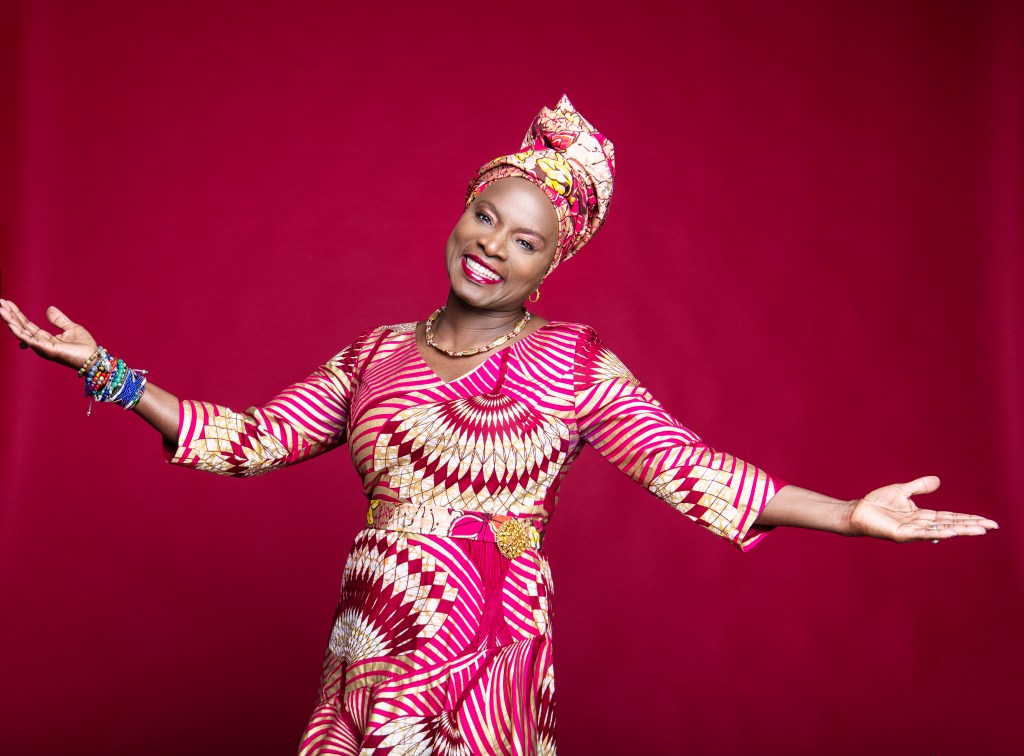
Angelique Kidjo. Photo provided
Last season, R&B singer Ledisi sang with the Philadelphia Orchestra just weeks after playing SPAC’s Jazz Festival. This season, pop giant Beck sang with the Boston Pops at Tanglewood on Tuesday, July 23 and pop-neo-soul artist John Legend sings with the Philadelphia Orchestra at SPAC August 7.
Five-time Grammy-winning. Benin-born singer Angelique Kidjo’s August 2 SPAC concert with the Philadelphia Orchestra focuses a fierce artistic intent powering unprecedented achievement across oceans and musical styles.
This is not her first symphony – and it stands as a significant milestone in a career four decades deep and marked by ambitious, bridge-building projects.
Phoning from Paris last week, she said of her new African Symphony, “I wanted to celebrate my 40 years in music, celebrate the African artists from my childhood and the 60s to today.”
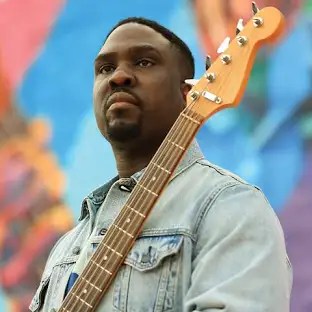
She chose songs for their moral and social messages, working with Derrick Hodge to orchestrate them. “I was absolutely flabbergasted by his work,” said Kidjo. “It’s so beautiful, it’s amazing the composition that he does.” Hailing his cooperative approach, she said, “It’s very rare to find people who are so flexible and so available, in music circles.”
Derrick Hodge. Photo provided
When questions arose, “”Pretty much everything I said, he took into account how to do this.” Said Kidjo gratefully, “Whatever you want to do, he’s willing to write it in that direction.”
On Friday, August 2, after the Philadelphians play an overture, Kidjo will sing “Lady” by Afro-pop force-of-nature Fela Kuti, first of the songs orchestrator Hodge wove into symphonic form.
“Lady,” as Kidjo explained, supports women’s empowerment and equality – in a man’s words, she carefully specified. “It’s followed by a song (Miriam Makeba’s “Nongqongqo”) paying tribute to the ones who have died before; for causes, for freedom,” said Kidjo, “women, men, who have died through conflict, through war, for us to be free today.”
“…always be your own agency, the best of yourself, and what you don’t want anybody to do to you, don’t do to anyone.”
Kidjo learned self-determination and tolerance from her parents, and by standing up to her seven brothers.
“The thing that I learned from parents was always be your own agency, the best of yourself, and what you don’t want anybody to do to you, don’t do to anyone.” She resisted her bossy brothers’ attempts at dominance by threatening to scare off their girlfriends.
Her parents supported her musical aspirations – her desire to BE James Brown and to emulate Aretha Franklin – but were also uncompromising critics, video-taping and assessing her performances. Kidjo’s mother told her, “The only people who tell you the truth are the people that love you.” In the face of this tough love, Kidjo proved tough, too.
“When I grow up I want to be James Brown.”
A self-proclaimed tomboy and “pain in the butt,” Kidjo proclaimed, “Anything my brothers do, I’m gonna do. They’re going to climb a tree? I’m in. They go to the motorcycle, I’m doing it. They’re playing soccer? I’m playing it. And my mom asked, ‘Are you a boy or a girl?’ I don’t care: When I grow up I want to be James Brown.”
Kidjo learned English to emulate Brown, and Aretha Franklin, whose “Amazing Grace” album gave Kidjo “the idea, the possibility, that a woman could be on the cover of an album.” She said, “I want more women on the covers of albums, especially Black women.”
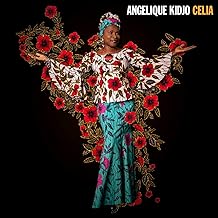
Soon, Kidjo was on the covers: 17 albums since 1992, including a tribute to Puerto Rican soul-salsa diva Celia Cruz and a song-by-song remake of Talking Heads’ “Remain in Light.”
“If I’m not inspired, I won’t do it; but if I’m inspired, I will do it.”
Kidjo’s acclaimed early albums took her to New York where she sang at Carnegie Hall in shows with Philip Glass, Lou Reed, Patti Smith and other cross-cultural giants. When David Byrne came backstage to meet her, “We had a great conversation and I’m looking at him and I’m like ‘This guy, he knows too much about the music of West Africa; he’s not really American, is he?’”
She loved Talking Heads’ “Remain in Light” album despite dismissive friends’ claims that it wasn’t African enough. “It’s African for me,” Kidjo defended. Overruling her team’s doubts, she resolved, “Guys, I don’t care what you say; I’m going to do this album track by track…Don’t worry: If I’m not inspired, I won’t do it; but if I’m inspired, I will do it.”
She did, inspired by a complicated muse that combined homegrown wisdom with Heads’ songs.
“For me, ‘Born Under Punches’ (a song on “Remain in Light”) meant we are born under the punches of corruption,” she said. “If corruption did not exist at the level that it is, we would have money for everybody to have a decent life…not that many homeless people and not that many who can’t go and have decent health care.” If money lost to corruption were invested in people, dictatorships would not exist,” Kidjo maintained. “We might not all be happy, but we would have less tension, less conflict, less war.”
Talking Heads’ song “Burning Down the House” had a similar moral resonance. “Fire is mesmerizing,” said Kidjo. “Starting a fire is easy, but when you start burning everything down and if you don’t know how to stop, it will burn you, too – and kill you.”
When I commented, “Every song seems to have a meaning that comes from far inside you,” Kidjo replied “Yep” with simple, quiet emotion.
I asked, “Talking Heads reached out to Africa, you reached back…This new symphony is also about reach, isn’t it?”
She agreed once again, and it became clear that her music builds bridges to reach across continents, from feeling to feeling and moral message to moral message – regardless of the form it takes.
“I know nothing about you, but your voice is something else.”
“My adventure with an orchestra started way back, almost 10 years now,” said Kidjo. It began, like her Talking Heads project, with a fortuitous meeting. A neighbor in New York told Kidjo, ”There’s somebody from the classical world who wants to speak with you.” That “somebody” was Timothy Walker, artistic director of the London Philharmonic. He told Kidjo, “I know nothing about you, but your voice is something else.” When Walker suggested she play with an orchestra, she wanted to know what he’d been smoking before their meeting. “He said you should be singing (British composer Henry) Purcell, ‘Dido’s Lament’!”
“I realized I had to be a part of the orchestra.”
When Walker re-introduced her to Philip Glass, he told Kidjo the prolific New York minimalist “was thinking what we need to do is write a symphony.” Glass worked with a poem Kidjo wrote in Yoruba, translated into English and French and wrote out phonetically “for him to get the rhythm and the tone of the language.”
“Angelique, together we have built a bridge that no one has walked on before.”
Kidjo recalled, “A year after, he wrote the first symphony for me.” Glass’s “Ife Songs” premiered in 2014, Kidjo singing with the Orchestre Philharmonique Du Luxembourg. (KIdjo later sang on Glass’s Symphony No. 12, using music by David Bowie and Brian Eno.) Glass told Kidjo, “Angelique, together we have built a bridge that no one has walked on before.”
Now, Kidjo is ready to walk another bridge.
“That’s how I started in the classical world,” she said. “Once I started working with the Luxembourg Philharmonic…I realized I had to be a part of the orchestra.”
“My voice is like an instrument, and in order for me to be part of that, I need to hear the orchestra with my body and with my ears and be absolutely part of the whole thing.“
Angelique Kidjo sings her African Symphony with the Philadelphia Orchestra Friday, August 2. 7:30 p.m. Saratoga Performing Arts Center, 108 Avenue of the Pines, Saratoga Springs. $117.75-$48.75 amphitheater, $38.75 lawn. 518-584-9330 www.spac.org
THE AFRICAN SYMPHONY
Based on African songs, vintage and contemporary, and orchestrated by Derrick Hodge, Angelique Kidjo’s African Symphony comprises these movements:
Márquez’ Danzón No.2 (Orchestra only)
Lady (Fela Kuti)
Nongqongqo (Miriam Makeba)
Soweto Blues (Hugh Masekela)
Soul Makossa (Manu Dibango)
Angola (Jah Bouks)
7 Seconds (Youssou N’Dour and Neneh Cherry with Cameron McVey and Jonathan Sharp)
Carnaval De San Vincente (Cesaria Evora)
Medley (Anybody/Calm Down/Shekere)
(Credits for above medley: Burna Boy/Rema/Angelique Kidjo)
INTERMISSION
“Brazil” by Ary Barroso (Orchestra only)
Folon (Salif Keita)
Bring Him Back Home (Hugh Masekela)
Malaika (guitar and vocal only; written by Adam Salim in 1945, first recorded by Fadhili William)
Jerusalema (Master KG, the original features singer Nomcebo)
Agolo (Angelique Kidjo)
Afirika (Angelique Kidjo)
Pata Pata (Miriam Makeba)
Kidjo said she chose these songs as “the meaningful ones, the ones that have issues of our times, that have been there before… and that are still there.“
She said, “Songs are simple yet complex, like human beings are. Because they’re the mirror of our emotions. Since we are complex, the music has to be simple and complex at the same time.”
CONDUCTOR MIGUEL HARTH-BEDOYA
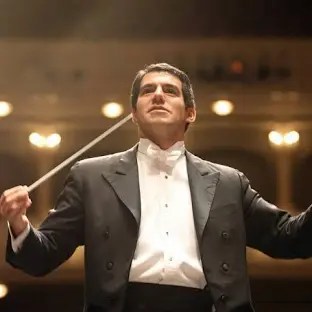
Peruvian-born Miguel Harth-Bedoya earned his Bachelor of Music from the Curtis Institute of Music and his Master of Music from the Juilliard School. He recently concluded a seven-year tenure with the Norwegian Radio Orchestra and 20 years with the Fort Worth Symphony Orchestra.
On more than 25 recordings over 30 years of conducting, Harth-Bedoya has released albums on Deutsche Grammaphon, Decca, Naxos and other classical record labels. He now teaches and conducts at Baylor University.
KIDJO
A five-time Grammy Award winner, Kidjo performed at the 2023 Saratoga Jazz Festival and has also played the Troy Savings Bank Music Hall.
Time Magazine has called her “Africa’s premier diva” and named her one of the 100 most influential people in the world for 2021. The BBC listed her among the continent’s 50 most iconic figures, and in 2011 The Guardian honored her as one of their Top 100 Most Inspiring Women in the World. Forbes Magazine has ranked Angelique as the first woman in their list of the Most Powerful Celebrities in Africa. Numerous awards honor her advocacy work: the 2015 Crystal Award of the World Economic Forum in Davos, Switzerland; the 2016 Amnesty International Ambassador of Conscience Award, the 2018 German Sustainability Award, the 2023 Vilcek Prize in Music, and the 2023 Polar Music Prize.
In 2014, Kidjo published her memoir “Spirit Rising, My Life, My Music” (Harper Collins) with co-writer Rachel Wenrick. It features a preface by Desmond Tutu and forward by Alicia Keys.
THAT GUY
Kidjo speaks very fast English, accented with both Yoruba and French. At one point, I missed a few words over the phone and asked her to repeat; “Philip Somebody,” I guessed. She replied, “Philip Glass” – who composed her first symphony.
When she repeated his name, I said, “Oh, THAT guy!” She said, “I don’t think anybody has ever called him ‘THAT guy,’” and laughed the greatest laugh – sounding like Odetta.
Saxophonist Awan Rashad plays Jazz on Jay Thursday, July 25 – a week after his longtime teacher, Brian Patneaude.
Patneaude’s show was his only performance this summer as a leader, and Rashad’s concert Thursday is just as unique.
Awan Rashad. Photo provided
“This will be the first time all four of us have played together,” Rashad says. His quartet is Ian MacDonald, piano: Tarik Shah, double bass; Matt Niedbalski, drums and cymbals; Rashad plays tenor. He played Jazz on Jay in September 2021, and Shah played the free series in July 2023.
Rashad’s grandfather played bluegrass guitar, “but that had nothing to do with my musical path,” Rashad says. “I always say the sax was forced into my hands in third or fourth grade.”
“The first person to actually mean something to me musically was Cannonball Adderley,” says Rashad who studied with Dwayne Bass at New Covenant Charter School, then with Patneaude from age 12 to 20.
Rashad won the Jazz High School Competition at the 36th Annual New England Saxophone Festival and Competition, earning the opening spot on a Yosvany Terry show. He was also selected to the All-State Instrumental Jazz Ensemble and the Symphonic Band of the New York State School Music Association (NYSSMA).
After graduating from Christian Brothers Academy, Rashad attended SUNY Schenectady County Community College then completed his bachelor’s degree at SUNY Purchase. “My college teachers were Ralph Lalama and Gary Smulyan,” says Rashad, who now combines teaching with performing.
At Jazz on Jay, his quartet will play bebop and hard bop tunes. “Mostly standards, maybe one or two originals,” Rashad says, listing composers Freddie Redd, Victor Feldman and Sonny Rollins.
“I just play the tune; I don’t think too hard about it,” he explains, adding the band enjoys “a LOT of room” to improvise.
Awan Rashad. Photo provided
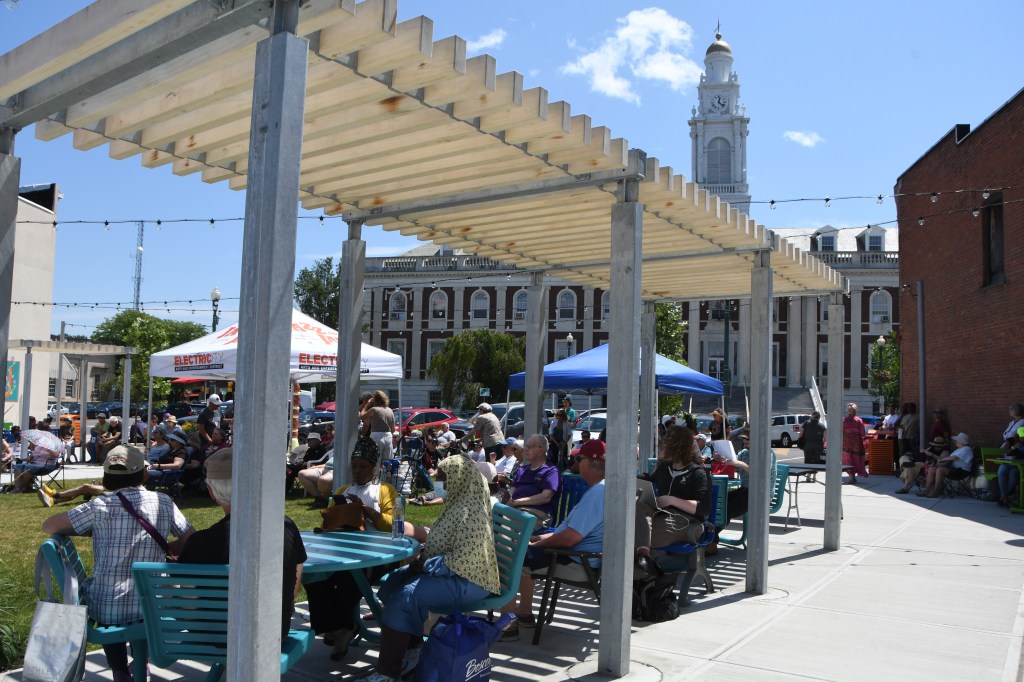
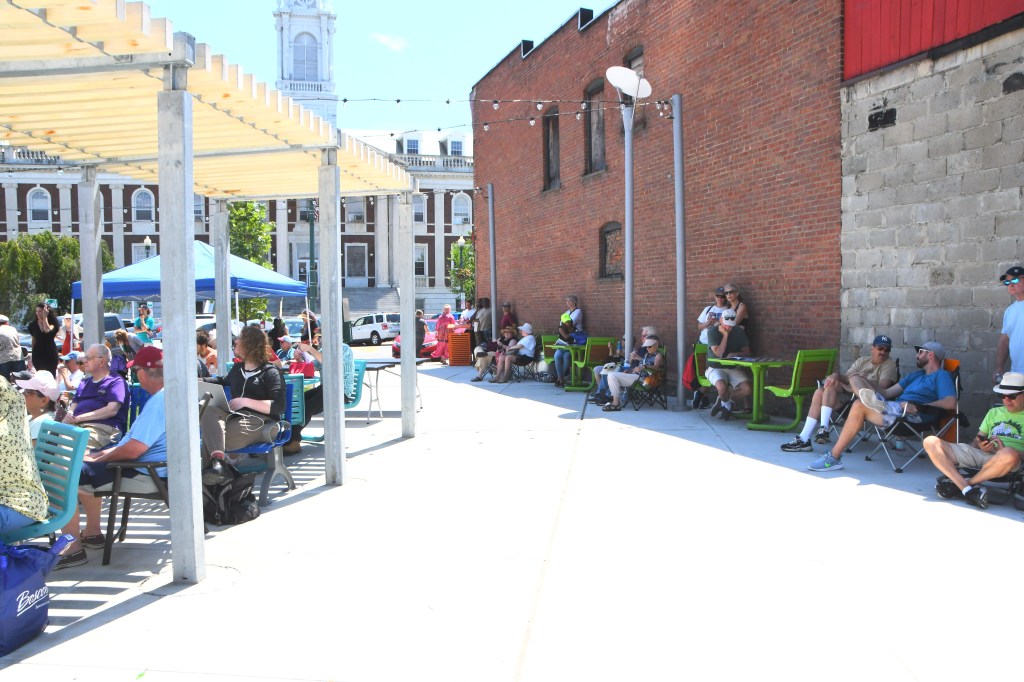
Jazz on Jay free concerts are noon to 1:30 p.m. at Jay Square, the new park space opposite Schenectady City Hall. The rain site is Robb Alley at Proctors, 432 State St., Schenectady. Seating is provided indoors at Robb Alley, but patrons are invited to bring their own seating and refreshments to Jay Square.
Jazz on Jay is presented by the ElectriCity Arts and Entertainment District and sponsored by the New York State Council on the Arts, a Schenectady County Legislature Arts & Culture Grant, Downtown Schenectady Improvement Corporation, The Schenectady Foundation, Price Chopper/Market 32, MVP Health Care, Schenectady County, Schenectady City Hall, and Proctors Collaborative.
Balkan-inspired New York brass band in knock-out upbeat show
“What’s ‘Slav’ got to do with it?” Slavic Soul Party leader and bass drummer Matt Moran punned rhetorically at Music Haven Sunday night.
He then answered with “People Make the World Go ‘Round,” the Philly soul anthem – as it might have sounded at a United Nations mixer pumped by jumpy Slavic rhythms and played as frantically as if curfew was about to hit.
Then, after the cryptically titled, fun-fierce “Synth Pants,” Moran mused: “What if Michael Jackson hung out with the Meters in Istanbul?” The answer was “Jackson,” introduced by Moran who explained pop music as a global thing where transcontinental influences become grooves that gallop like bebop.
Slavic Soul Party is to Balkan and Roma folk dances as Brave Combo is to polka music: caffeinated zip gathered from many nations, tossed into a blender and revved into something fiercely unified, a happily anarchic, muscular flow.
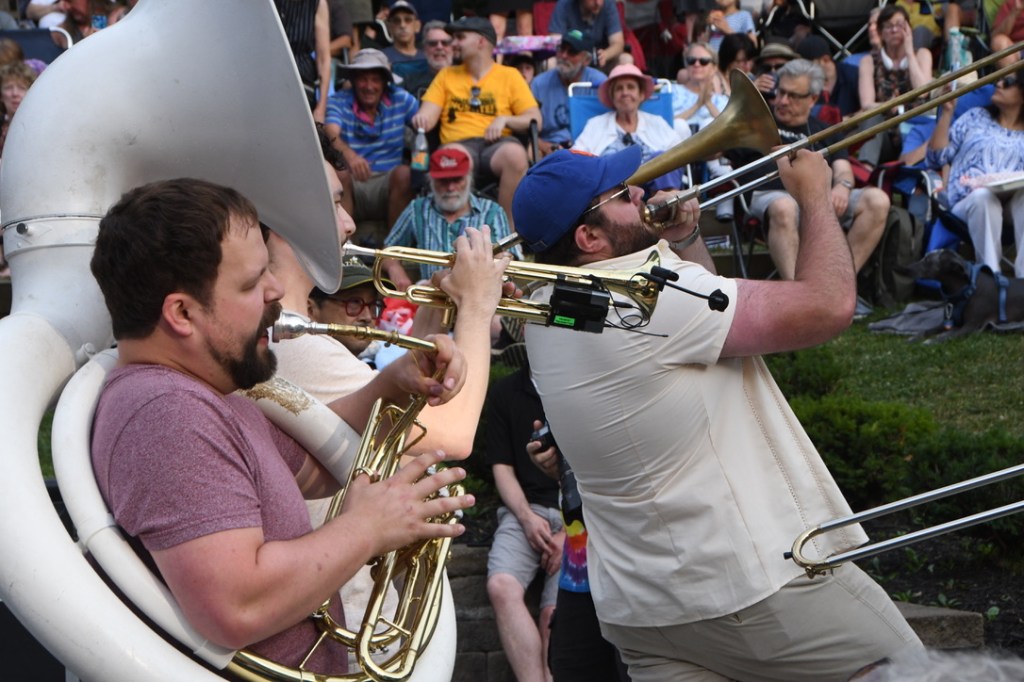
For all the brass-band pizzazz up top, SSP really rocked on the bottom, stage left, where Kenny Bentley’s tuba, percussionist Chris Stromquist and Moran himself cooked up complex beefy beats. A tiny mic on his bass drum trailed a long cord as Moran moved all over. He pulsed the right side of the drum with a mallet, tickled its left backhand with a stick long and thin as a conductor’s baton and sometimes tapped the cymbal atop the whole rig.
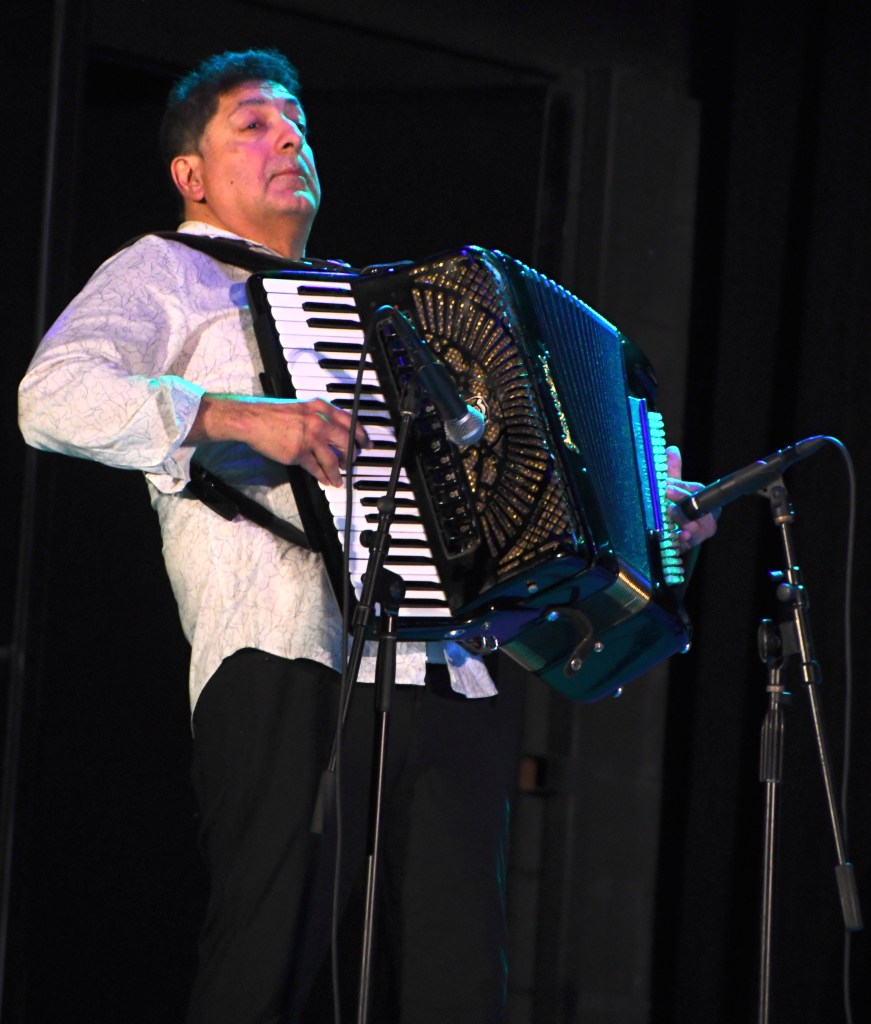
Accordionist Peter Stan anchored stage right, next to alto saxophonist Peter Hess, then trumpeters John Carlson and Kenny Warren and trombonists Adam Dodson and Tim Vaughn. Moran gradually introduced everybody by calling each to solo, bursting out of tight section playing to soar fine and far. Accordionist Peter Stan dazzled in an unaccompanied, all over the place, dynamic intro to “Nisovacko Kolo.” The solos flexed personality, drive and daring; and when everybody ganged up on a tune together, the effect was tidal like a big-band reed or brass section roaring unanimously to steamroll the place.
At times, as in the swinging new “Tipsy Kolo,” the whole band surged back into action even while solos were still underway – like Keith Pray’s Big Soul Ensemble often does.
Apart from “People Make the World Go ‘Round,” “Jackson” and “Tourist Point of View” (from their Balkanized mutation of Duke Ellington’s “Far East Suite”), everything was more directly Slavic.
Moran graciously praised openers Niva for playing – straight, but with spirit – the pure ethnic roots of what Slavic Soul Party pumped into pulsating, brass-band excitement.
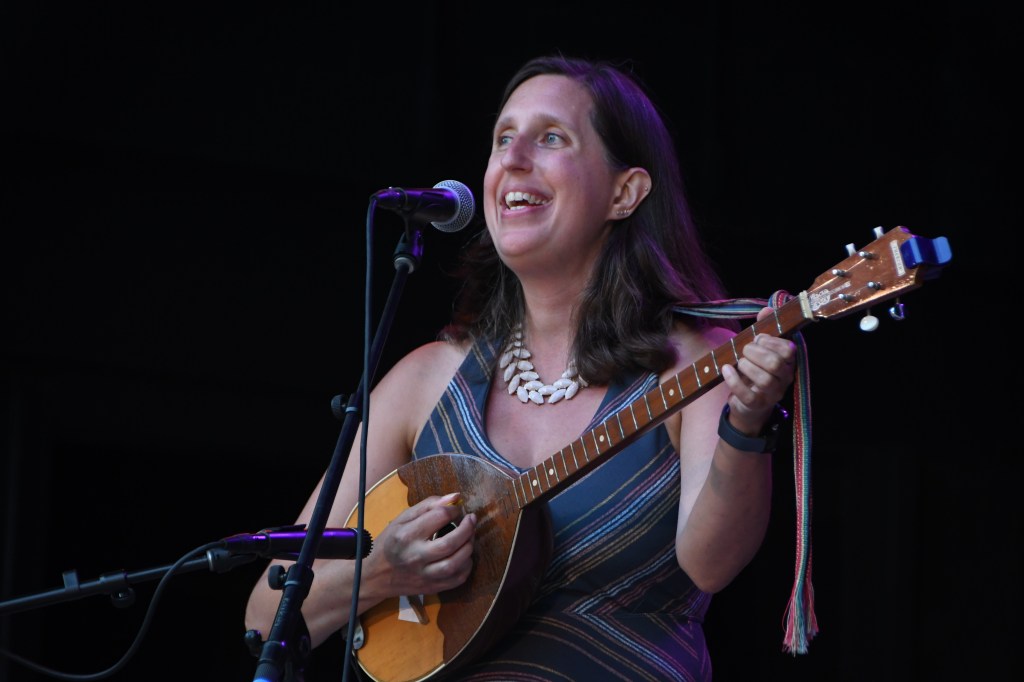
The all-woman quartet Niva played Macedonian dances and story-song laments; the dances flowing on simpler rhythms than the narrative numbers. These resounded dark and stark, doom struck Balkan blues about brandy-induced sleep quelling loneliness, or the poisoning of nightingales, for example.
Deadpan intros by tambura (four-string lute) player Kristina Vaskys rendered these grim subjects wryly entertaining. Besides, Slavic Soul Party waited in the wings to charge onstage and lighten and lift everything.
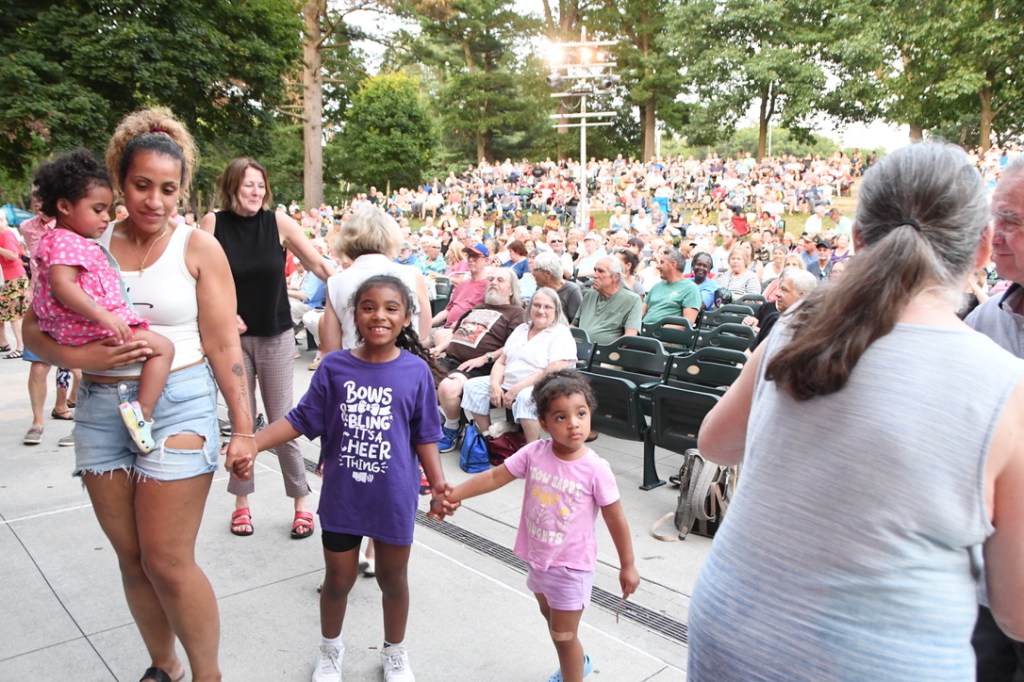
At times, lines of dancers linked hands and slide-stepped across the dance floor up front, then roamed around the edges of the seating area, recruiting new dancers who quickly learned the steps. Or, not.
Extra-fine weather and the promise of a rare set by super-in-demand saxophonist Brian Patneaude’s Quintet invited everybody into a shared great mood Thursday at Jazz on Jay. Maybe especially Patneaude himself. Introducing his band after their first song, he good-naturedly name-checked the Ryder truck whose loud reverse-alarm beeping failed to interrupt the music.
Brian Patneaude
Fans filed into Jay Square, toting chairs, seeking islands of shade or unfurling their own.
Even the clouds seemed to play along. Rotund cumulus orbs eased from the horizon to pass overhead; bassist Jarod Grieco and drummer Danny Whelchel pushed and punched harder than the clouds’ serene passage. Feathery cirrus higher overhead traced complex patterns like the treble-melody makers riding the groove; guitarist Justin Hendricks’s delicate chording launched and coda’d several songs, keyboardist Rob Lindquist’s staccato attack and the leader’s masterly work up front shared the same confident and elegant nonchalance.
They started with an easy flow, relaxed and restrained, and Patneaude turned his players loose to take Don Grolnick’s “Pools” somewhere else. Lindquist’s keys led the way from smooth to funkier, Hendricks and Grieco sped things up and Patneaude followed them at first but then took over to build the riff into a mighty roll.
Rob Lindquist
“Elevation of Love” by the Esbjorn Svensson Trio got there faster; this was the express, smoothing an at-first jittery groove into a unified flow. Then they surged to the altitude and melodic variation that Mike Mainieri sketched in his “Flying Colors.”
Patneaude made this a two-fer, following next with the same composer’s “Self-Portrait.” Here Hendricks’s guitar set a thoughtful mood with lacy chords whose beauty Patneaude rewarded with a nice solo spot for Hendricks’s more assertive statement after his own strong solo. They stretched the coda as if not wanting to let things end.
Patneaude echoed this approach in his own “Unending” (from his “Distance” album). He led all alone to start in subdued fashion before opening things up into a stutter beat everybody explored in questing solos. Grieco really shone here, before Hendricks again decorated the coda with airy chords.
Jarod Grieco
After this original came terrific covers, everybody listening, everybody helping.
In Chick Corea’s sweet ballad “Eternal Child,” they echoed the late pianist-composer’s lyricism with a descending melody that guided everybody’s playing. They even offered a taste of Corea’s Latin approach.
Patneaude told me some days before the show that “it felt like the right time” to play “Lotus Blossom,” a Grolnick composition the recently deceased David Sanborn, a principal Patneaude musical hero and influence, had often played. A generous leader happily sharing solo time with his friends throughout their 95-minute set, Patneaude owned this one himself. He opened it up eloquently after Hendricks’s guitar chords once again set the mood.
Patneaude noted Hendricks had made his appearance on the gig conditional on the quintet playing Pat Metheny’s James Taylor tribute “James,” and so they did, everybody showing the balance Metheny crafted among reverence and playfulness; momentum, muscle and melody. Put on the spot, Hendricks responded really well.
Justin Hendricks
Then Patneaude reached back to his own songbook for “Majority,” with its characteristic stutter beat easing into mellow groove until Whelchel erupted into his only solo of the set before a repeating melodic figure brought everything home.
Danny Whelchel
Jazz on Jay continues Thursday, July 25 with saxophonist Awan Rashad’s Quartet. Rashad is a Patneaude student who’s earned high marks on his own.
Saxophonist Brian Patneaude plays Jazz on Jay Thursday, July 18 in his only show this summer as a leader. The ever-busy, perennial poll winner will also play with five other bands, plus a week at Proctors in “Tina: The Tina Turner musical.” (See www.brianpatneaude.com for details.)
So, Patneaude will make the most of his show Thursday with regulars Rob Lindquist, piano; Justin Hendricks, guitar; Jarod Grieco, bass and Danny Whelchel, drums. “Rob, Danny and I have played with more bands than we can probably recall over the past 25 years,” says Patneaude, noting his quartet with Lindquist, Greico and Whelchel has played together for five years and Hendricks first played with them last summer.
After playing drums in middle-school, Patneaude switched to sax in Redline which played Pink Floyd and Sting tunes. He also studied with Schalmont High School band directors Dave Lambert and Mark Eiser; studied privately with Keith Bushy and Linden Gregory; also with Paul Evoskevich at the College of St. Rose, then Tom Walsh and Pat Harbison at the University of Cincinnati.
“Repertoire for this group is usually a mixture of original material and other folks’ music,” Patneaude explains, listing his originals “Unending” and “Majority” plus Pat Metheny’s “James,” Mike Mainieri’s “Flying Colors” and “Self Portrait” (both recorded with Steps Ahead featuring Michael Brecker), and Don Grolnick’s “Lotus Blossom,” which Sanborn often played.
My life was never the same,” says Patneaude, after Brecker and the recently deceased David Sanborn inspired him when band director Sean Lowry played their music for him.
Patneaude’s approach is modern as his quartet’s repertoire.
“Every song we play is a vehicle for each member of the band to express themselves as they see fit,” Patneaude explains.
“We don’t discuss how we’re going to play it ahead of time,” he says. “One of us will just start the tune and the rest of us hop on for the ride.”
Jazz on Jay free concerts are noon to 1:30 p.m. at Jay Square, the new park space opposite Schenectady City Hall. The rain site is Robb Alley at Proctors, 432 State St., Schenectady. Seating is provided indoors at Robb Alley, but patrons are invited to bring their own seating and refreshments to Jay Square.
Jazz on Jay is presented by the ElectriCity Arts and Entertainment District and sponsored by the New York State Council on the Arts, a Schenectady County Legislature Arts & Culture Grant, Downtown Schenectady Improvement Corporation, The Schenectady Foundation, Price Chopper/Market 32, MVP Health Care, Schenectady County, Schenectady City Hall, and Proctors Collaborative.
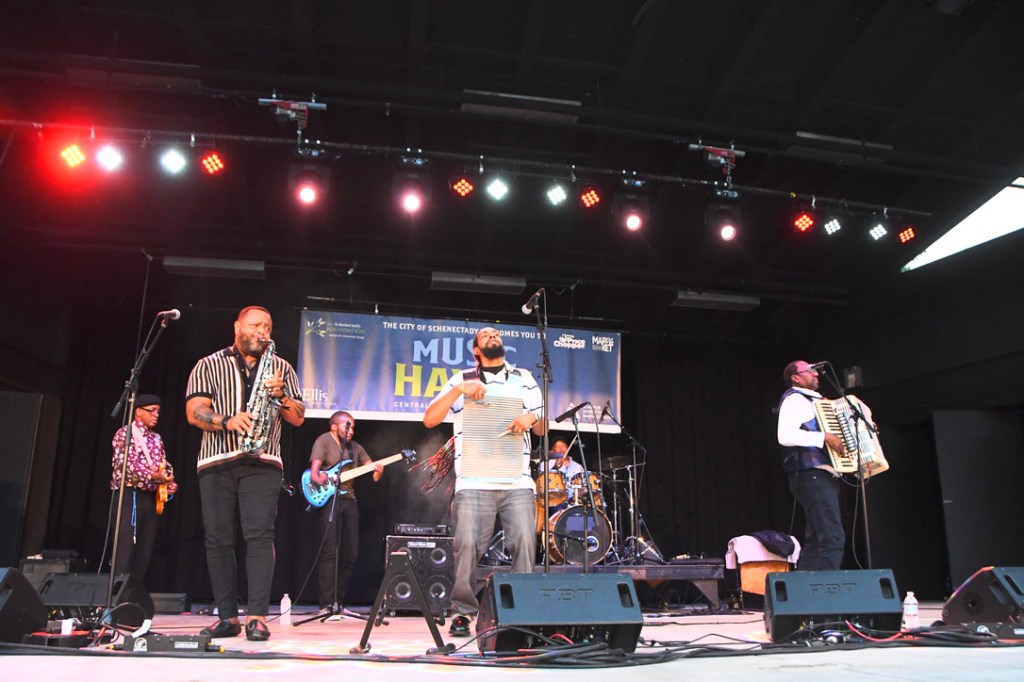
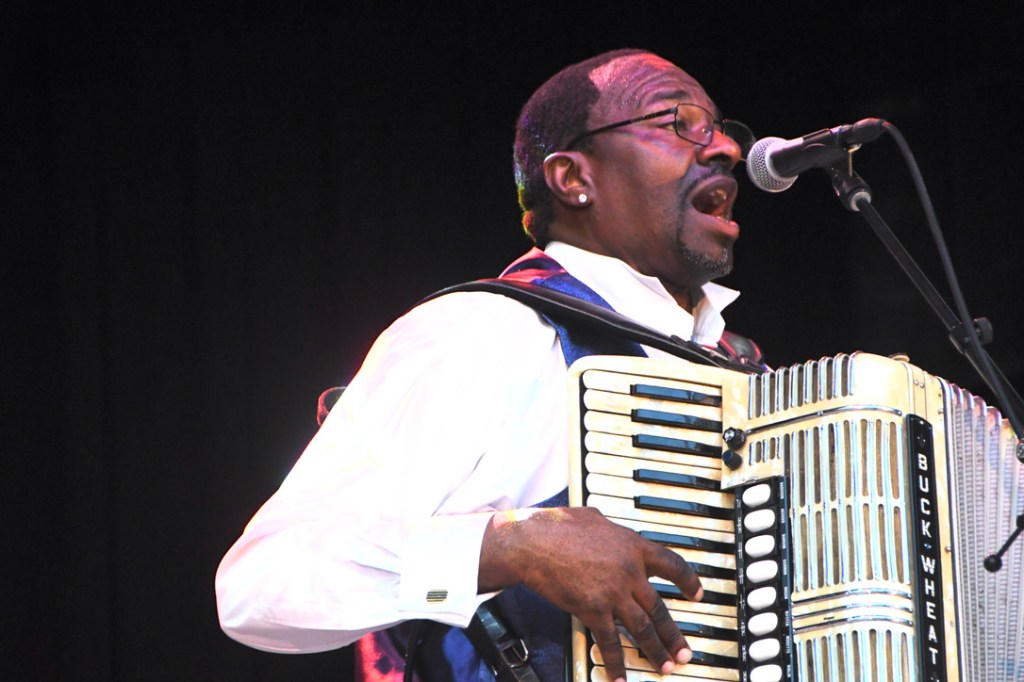
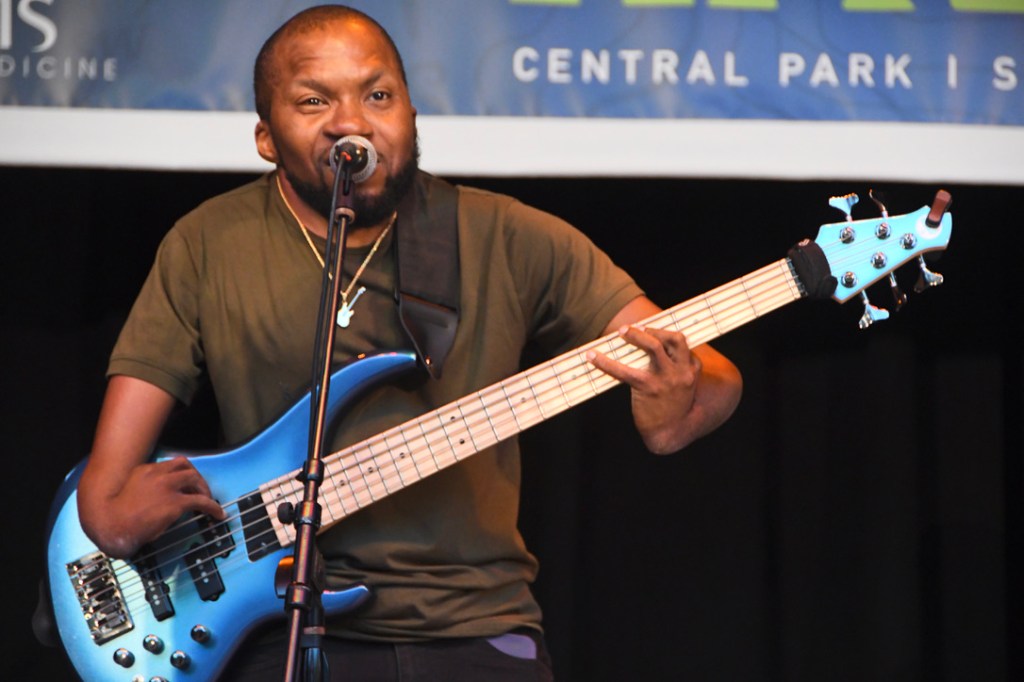
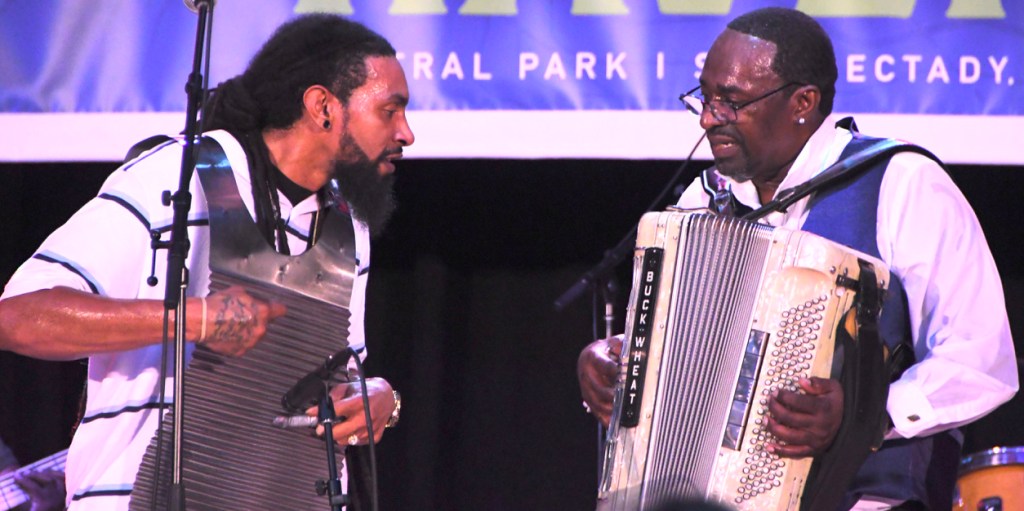
The funk-riffing Ils Sont Partis (We’re off) band Buckwheat Zydeco Jr. inherited from his late father grooved hard enough at Music Haven Sunday to break a sweat, onstage and off, even before Jr. came on to claim his birthright as accordion-wielding prince of south-Louisiana dance music.
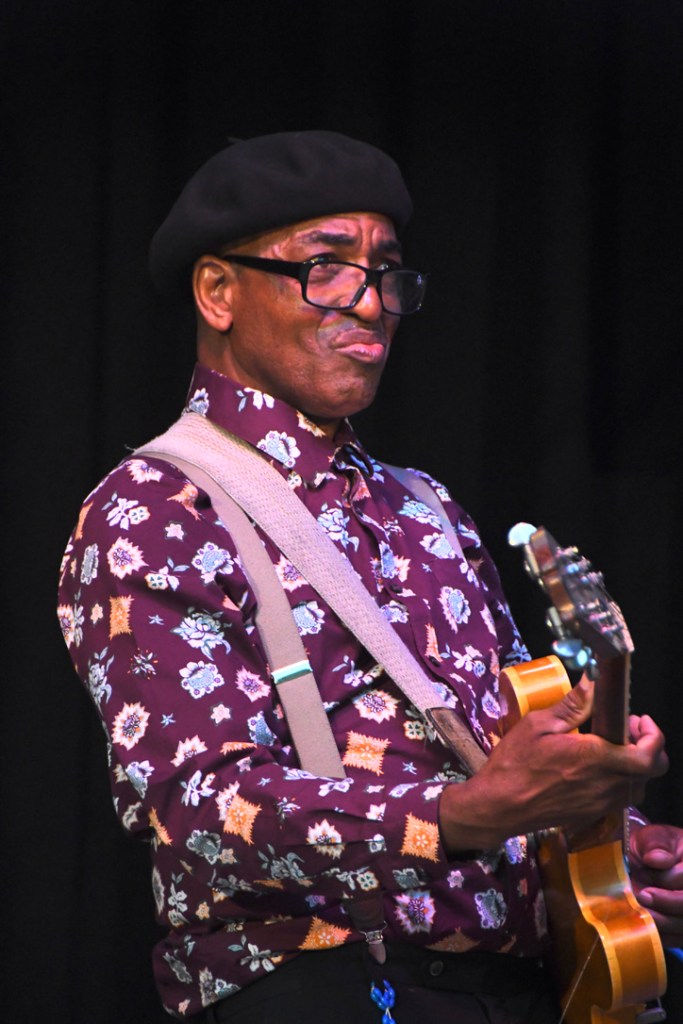
Son Kyle (fourth generation in this musical dynasty) helped Jr. doff his suit jacket, strap on a bulky piano accordion, proclaim “I know what you’re waiting for” and they were, indeed, off. Irresistible beats of thick bass undertow on snare and kick-drum boom pushed hard down below, Creole melodies in accordion riffs rolled up top, with alto sax solos here and there and bluesy guitar and metallic frottoir diving into the seams.
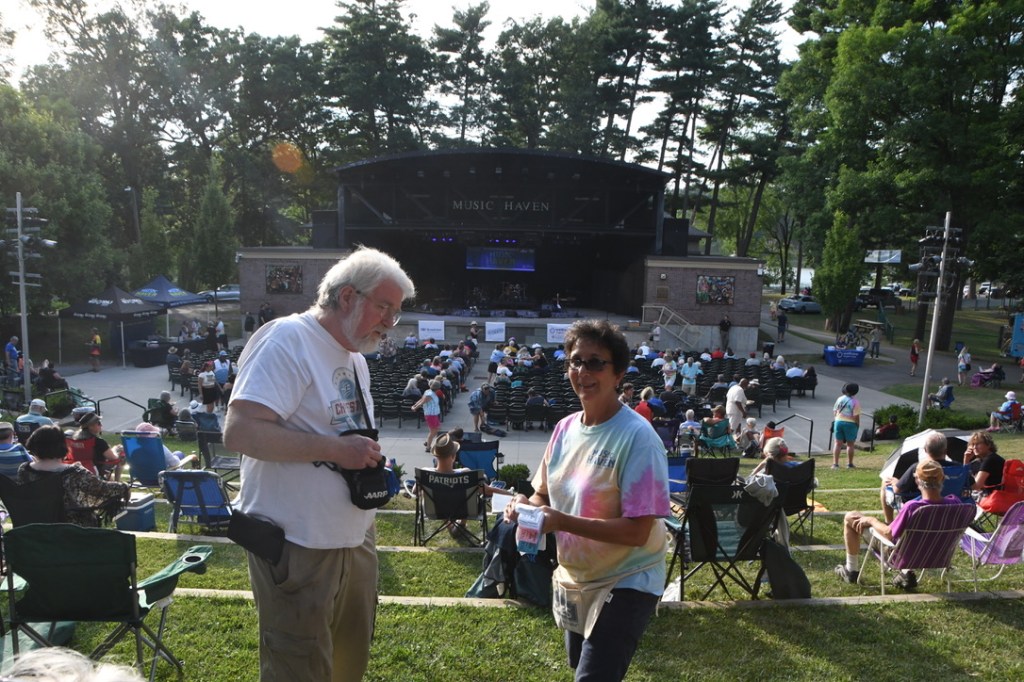
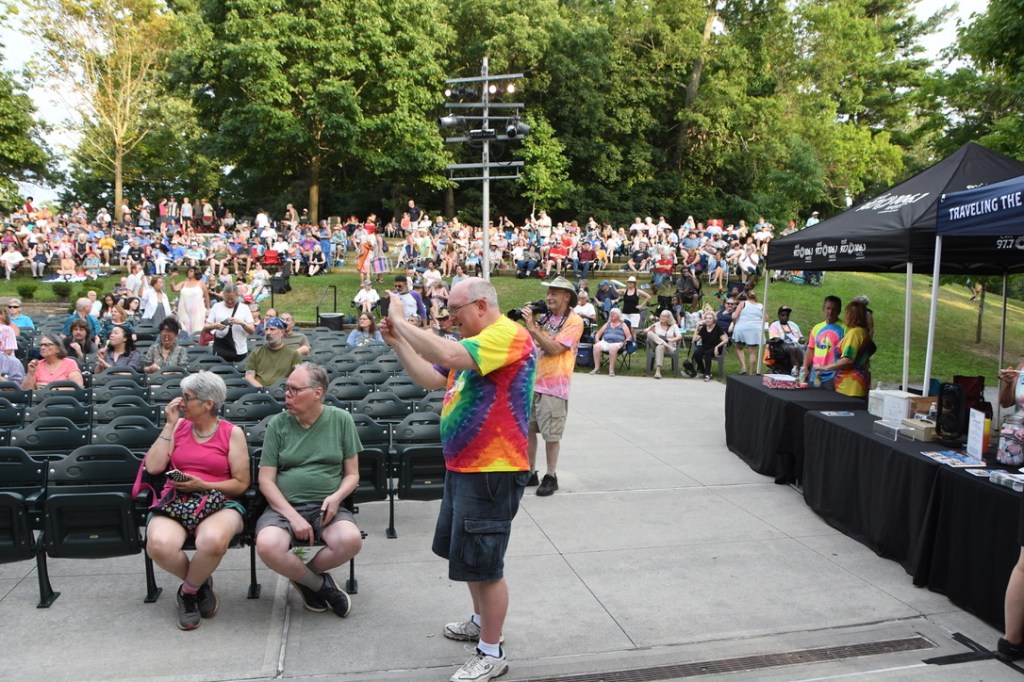
The stuff was built to party, and it worked: Between seats and stage, up the side past the seats and on the jam-packed terraced hill, dancers did everything from precise and sedate authentic two-steps to wild I-Was-A-Hippie human corkscrew writhe and – most fun of all to watch – that t-shirted guy who dropped to the dancefloor when the music paused before revving up again in an ambush coda.
Onstage, the band grooved with such engaging, friendly confidence they could have swung the same song all night and the dancers wouldn’t have minded a bit. But instead, they changed things up, again and again; tackling not only familiar groove songs dating back generations but also pop hits that got their funk on.
Jr. led the band with a firm hand, cueing solos by challenging “Give me a taste” or “Talk to me!” and stop-on-a-dime rhythm jumps with “We gone!”
Early on, he assured, “Everything Gonna Be Alright” and “I Heard the News” with an intro claiming he’d heard Schenectady folks are ready to party and then proved it. Sometimes more mainstream materials merged straight into old-school zydeco blasts; sometimes things mutated the other way. After “What You Gonna Do” (when the zydeco hits you), “Rock Me Baby” rode a Grand Canyon mainstream groove before reaching back to the tradition with a two-step shuffle pushed by Kyle’s frottoir – steel chest-mounted rub-board, scratched with spoons.
Jr. switched to organ when he went jazzy, and to melodica near the end; otherwise he steered things from behind the accordion. Al Quaglieri, who had played one, called the instrument “musical luggage” and Jr. packed a lot into it: hypnotically repeating riffs that animated your feet whether you wanted them to move or not, dazzling octave jumps and zippy arpeggios.
The songs went all over, too, from Fats Domino’s “Walkin’ to New Orleans” to Jr.’s late father’s “Hot Tamale Baby” to Billy Preston’s “Will It Go Round in Circles,” then back to his dad’s songbook for “Zydeco Boogaloo.” An even more antique-sounding two-step set up his own “Zydeco Party” from his recent Grammy winner “New Beginnings” – then back in time once again to Lee Dorsey’s “Ya Ya” – some fine, fun minutes past the usual 9:30 catch-our-breath-and-find-the-car time.
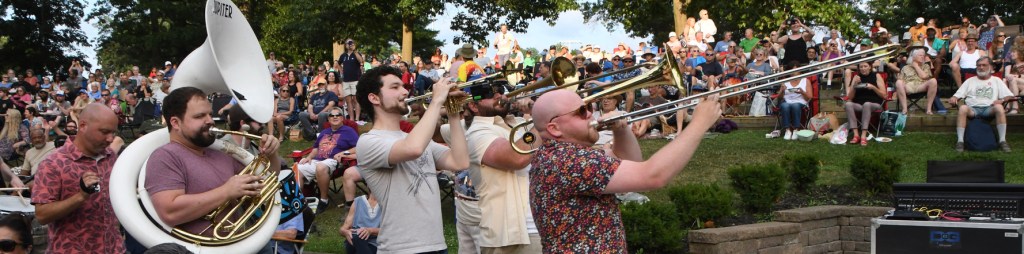
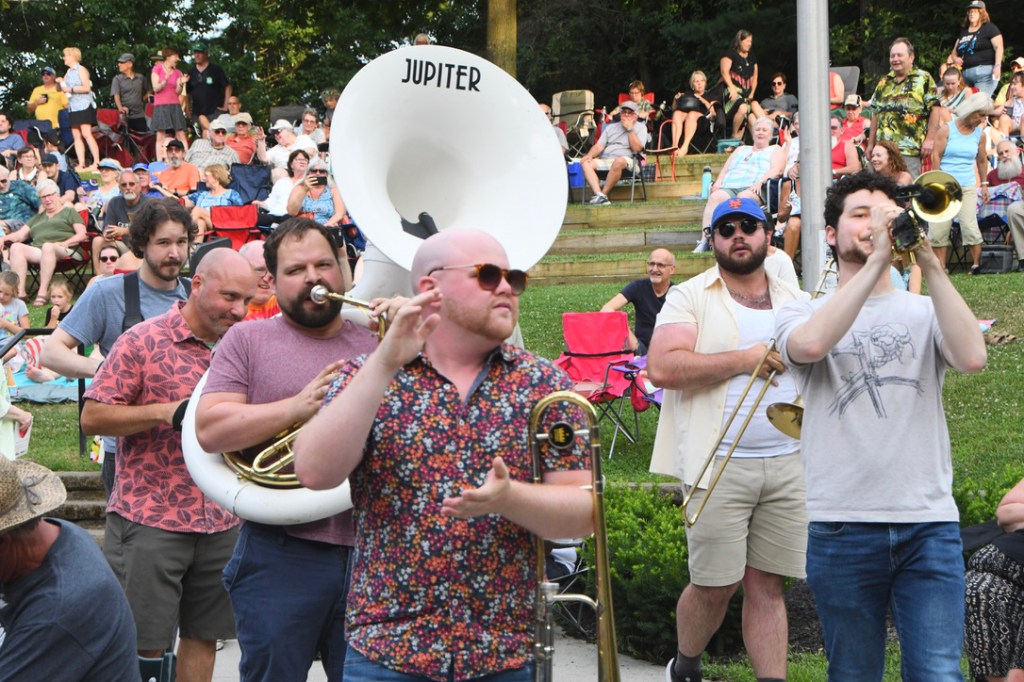
The Brass Machine started the party right at 7 in humid daylight, parading through the surprised/delighted crowd to the stage where they, too, mixed Louisiana traditions with more mainstream fare: “Your Mama Don’t Dance” as a street parade? Yes, indeed – plus another, “Iko Iko,” then the happy menace of Dr. John’s “Right Place, Wrong Time.”
Another Mardi Gras favorite, “Hey Pocky Way,” set up their own cocktail tribute “Mojito,” blurring into Steve Miller’s “Fly Like an Eagle,” before closing with “When the Saints Go Marching In,” claiming this was “legally obligated” for New Orleans-style bands. What in fact is legally obligated is a powerful surge of beat and horn-blasts. The Brass Machine did not break that law.
Music continues at Music Haven with Slavic Soul Party and Niva on Sunday, July 21.
Part 2 of a Thursday Jazz Double Header: The Brucker-Weisse-Canterbury (BWC) Jazz Orchestra at WAMC’s the Linda
The Brucker-Weisse-Canterbury Jazz Orchestra returns to WAMC’s The Linda (339 Central Ave., Albany) on Thursday, just hours after Melanie Chirignan’s MC*2 plays Jazz on Jay. And meanwhile, the Skidmore Jazz Institute Faculty All-Stars also play Thursday, at Skidmore’s Zankel Music Center.
With the BWC, first came the songs and arrangements, then came the band.
“Our band started off as a reading band,” reflected Brucker before BWC played WAMC’s a year ago.
“I was gifted hundreds of charts from Al Quaglieri Jr. that were his dad’s from the venerable Albany Jazz Workshop,” Brucker explained. The Workshop brought together the top area jazz luminaries of the 1960s including saxophonists Nick Brignola and Leo Russo, trumpeters Mike Canonico and Al Quaglieri Sr. (who also played piano), and others.
Organized and co-led by drummer Brucker, trumpeter Steve Weisse, and trumpeter/flugel horn player and arranger Dylan Canterbury, they began with open rehearsals in the clubhouse of the Schenectady Municipal Golf Course. Over the past three years, the big band has expanded both its its performance schedule into other area venues and its repertoire.
WAMC’s The Linda has become a favorite stage to play, and beyond the initial book from Quaglieri’s extensive library, “the book has grown to include original compositions and arrangements as well as other charts that span the stylistic gamut of jazz history,” said Brucker.
The BWC Jazz Orchestra in an earlier show. Photo Provided
The BWC Jazz Orchestra now plays music from Count Basie, Thad Jones, Quincy Jones, Duke Ellington and other giants of the jazz pantheon, plus such modern talents as Bob Mintzer (Yellowjackets) and Bill Cunliffe (recently seen at the Saratoga Jazz Festival with the Skidmore Jazz Institute Faculty All-Stars). “We also have young and seasoned arrangers in the band who offer original and fresh arrangements that we perform,” Brucker said.
Early on, the BWC book included:
“When Sunny Gets Blue” (Fisher/Segal, arr. Al Quaglieri)
“Bill’s Riff” (Jim Corigliano)
“Keepin’ On” (Dylan Canterbury)
“Just Friends” (Kenner/Lewis, arr. Elias Assimakopoulos)
“The Song Is You” (Kern/Hammerstein, arr. Bob Florence)
“Kansas City Shout” (Ernie Wilkins)
Dylan Canterbury updated on Thursday’s line-up. It includes substitutions due to scheduling complications – including COVID! – among these busy, in-demand players. Canterbury reported the BWC on Thursday comprises Jim Corigliano, Dalton Sargent, Awan Rashad, Kevin Barcomb, Kaitlyn Fay (also vocals) and Wally Johnson, saxophones; Steve Weisse, Jon Bronk, Vito Speranza, and Steve Horowitz, trumpets; Ken Olsen, Don Mikkelsen, Rick Rosoff, and Shaun Bazylewicz, trombones; David Gleason, piano; Dave Shoudy, bass; Cliff Brucker, drums; and Dylan Canterbury, flugelhorn, and conductor.
Canterbury also shared the set list:
“Mean What You Say” (Thad Jones)
“One Step at a Time” (Dylan Canterbury)
“Falling” (Wayne Hawkins, arr. Jim Corigliano)
Too Darn Hot (Cole Porter, arr. Buddy Bregman)
“I Thought About You” (Jimmy Van Heusen and Johnny Mercer, arr. Jim Corigliano)
“Night and Day” (Cole Porter, arr. Kevin Carey)
“Mood Swing” (Jim Corigliano)
“Simone” (Frank Foster)
“Muttnik” (Quincy Jones)
“Day by Day” (Sammy Cahn, Axel Stordahl, and Paul Weston, arr. Jim Corigliano)
“Every Night at Seven” (Alan Jay Lerner and Burton Lane, arr. Jim Corigliano)
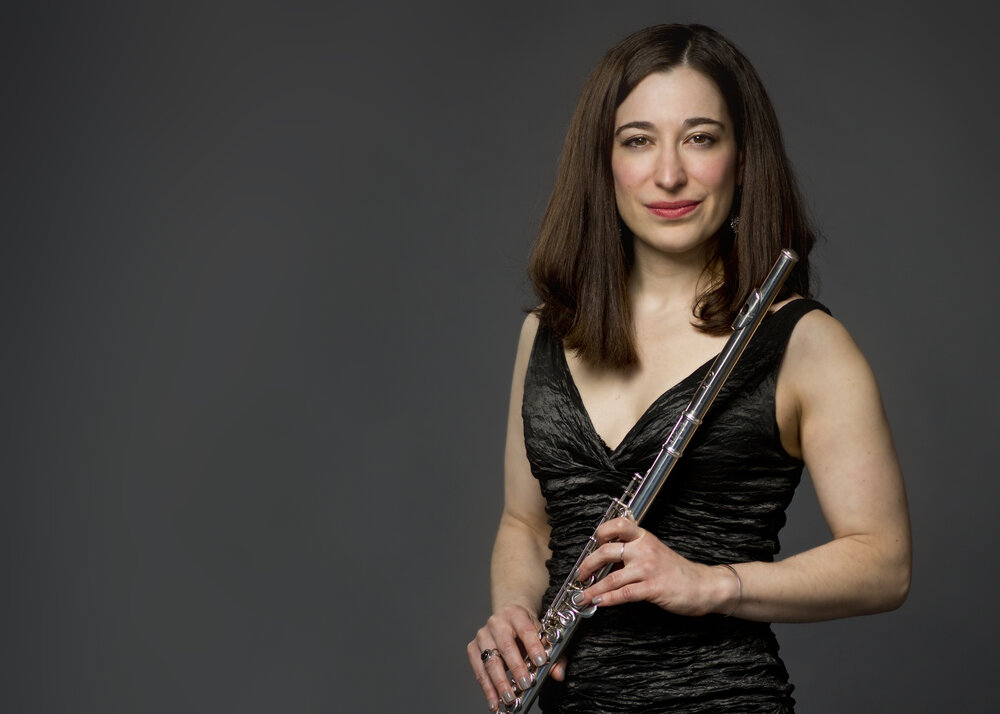
Jazz expressiveness meets rigorous classical composing as Melanie Chirignan leads her MC*2 quartet at Jazz on Jay: Max Caplan, keyboards, Andrew Hearn, drums; and David Shoudy, bass.
Chirignan’s father was named Claude after classical composer Claude Debussy, but another Claude – jazz flute star Bolling – inspired Melanie to play the flute and explore the border where jazz meets classical. In her family, “I’m the only one that plays an instrument,” she says.
Melanie Chirignan. Photo provided
She also plays with Caplan in Quintocracy and the classical ensemble Stringwynde; and in a duo with guitarist Scott Hill. Hearn plays with Catalyst (formerly the Jon LeRoy Trio) and quartets led by Dave Fisk and John Savage. Caplan also plays with the classical chamber ensemble Musicians of Ma’alwyck.
Michelle LaPorte taught Chirignan flute technique from sixth grade through high school, then Chirignan studied with Dr. Susan Royal in college, prepped for graduate school with Susan Deaver, then studied with Janet Arms in the Hartt School of Music. Chirignan says, “She’s so inspiring!” She later studied in New York with Kaori Fuji and Keith Underwood. Classically trained, Chirignan also says, “I really like (jazz flute masters) Hubert Laws, Dave Valentin and Yusef Lateef.”
Her earliest performances were at weddings, but she now plays both jazz and classical repertoire in theaters and festivals.
At Jazz on Jay, MC*2 will play Claude Bolling’s “Suite for Flute and Jazz Piano Trio,” Michael Mower’s “Opus Di Jazz,” Max Caplan’s “Three Jazz Preludes,” “Zoom Tube” by Ian Clarke, and sambas including “Girl from Ipanema” and “Black Orpheus.”
The quartet will play most pieces as written – “except for the sambas,” where there’s room to improvise.
Through the summer, she’ll play both classical and jazz dates, with Caplan, Melinda Faylor (under a Saratoga Community Arts grant), Laura Melnicoff and others; both locally and across the region. Details at http://www.melaniechirignan.org.
Jazz on Jay free concerts are noon to 1:30 p.m. at Jay Square, the new park space opposite Schenectady City Hall. The rain site is Robb Alley at Proctors, 432 State St., Schenectady. Seating is provided indoors at Robb Alley, but patrons are invited to bring their own seating and refreshments to Jay Square.
Jazz on Jay is presented by the ElectriCity Arts and Entertainment District and sponsored by the New York State Council on the Arts, a Schenectady County Legislature Arts & Culture Grant, Downtown Schenectady Improvement Corporation, The Schenectady Foundation, Price Chopper/Market 32, MVP Health Care, Schenectady County, Schenectady City Hall, and Proctors Collaborative.






















 Hoke's Jukebox