A Kinda Non-Review: BeauSoleil avec Michael Doucet at Universal Preservation Hall in Saratoga Springs, NY

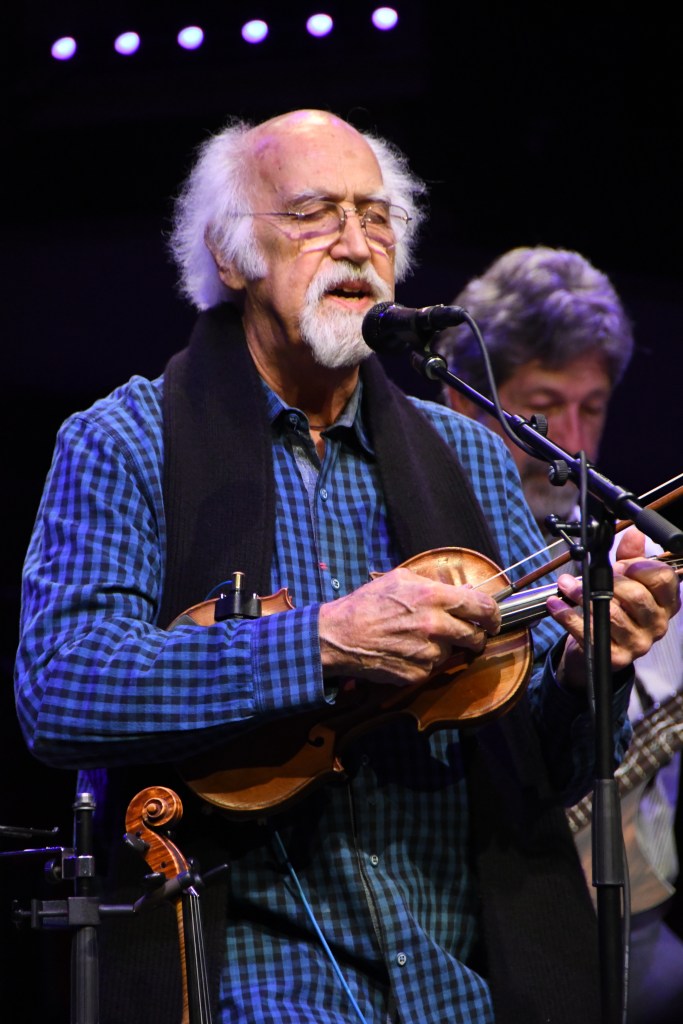
This is a non-review since my Nippertown colleague Don Wilcock got the assignment and I shot photos, on Thursday, April 18, 2024

So, this is mainly to share these images, though I also have some word-thoughts, including a stab at a set-list, below. 

This was a listening crowd, in a church-y space, and everybody sat to listen except a boy and girl, aged four or six, who jumped up when the music started and never stopped moving.

At first, fiddler/singer/leader Michael Doucet entertained with playful introductions in which the northeast weather, the state of Texas and a Montana fan who hailed their “Confederate music” took equal hits. Then, he increasingly stressed, though still playful, how his Cajun music honors a vulnerable minority population of immigrants. Near the end, he traced the painful history of his people as suffering marginalization and displacement, with its music-reinforced and family-based culture supplying a proud, enduring resilience.

The music etched a somewhat different dynamic arc, sounding sweet, sedate and folkloric to start and finish, but generating a ferocious head of steam mid-set with in “L’Amour ou la folie,” then “Poison Love” and “Le Chanky-Chank Francais” holding the pedal to the metal.

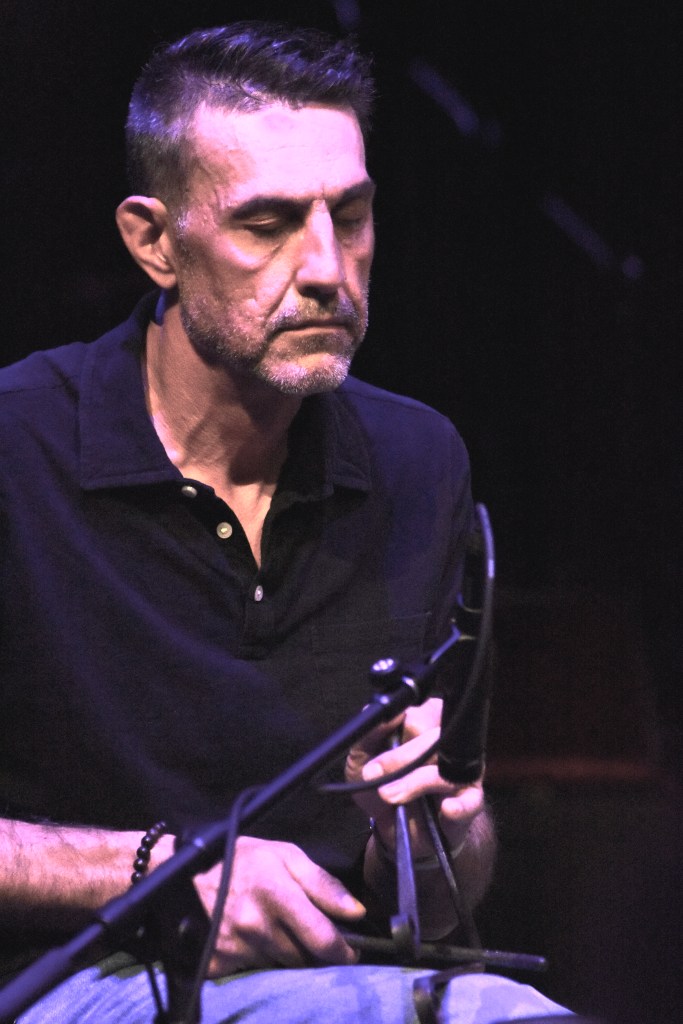
Stage right to left, the band was Matthew Doucet – Michael’s son, a fiddle-maker – playing some fiddle but mostly triangle. And if this sounds rudimentary, the guy is to the triangle what Steve Amedee (the subdudes) is to tambourine: Matthew made a short, emphatic metallic clank when he set the base of the triangle on his knee and struck it, but a more open, ringing tone, and higher pitch, when he raised it to strike in mid-air.

Michael Doucet proved his usual triple-threat self as fiddler, singer and talker.
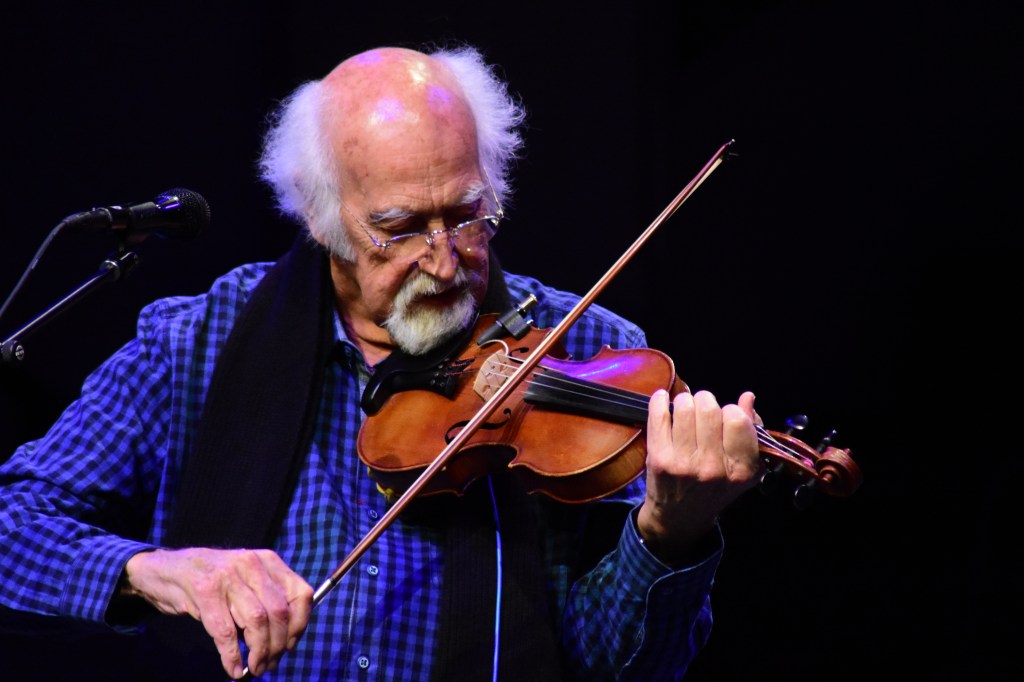
Tradition shaped his rhythms and supplied venerable melodies he taffy-pulled with elastic, jazzy gusto; his tenor voice had the same clarity. His song intros and digressions would work as standup even if he set the fiddle aside; but he honored his predecessors among Cajun and zydeco pioneers, both famous and obscure.
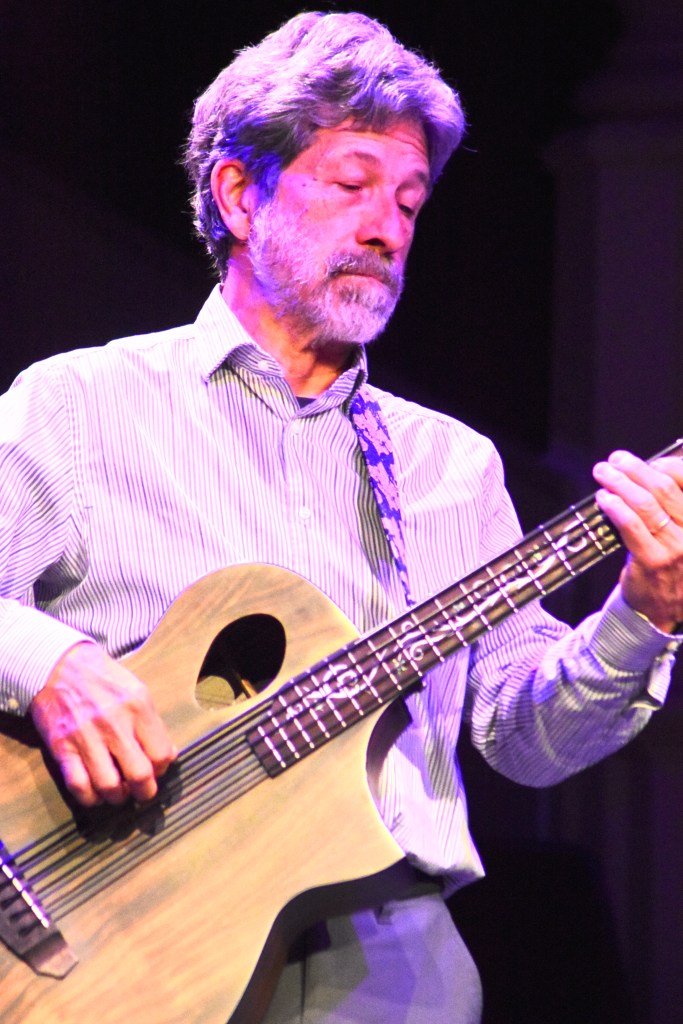
Bill Bennett’s acoustic bass guitar competed the rhythm section, playing tastefully few notes, always in the right place, where dancers’ feet would hit. 

The band’s bridge between beats and lead vocals and solos up front and strengthening everything, Chad Huval flexed Popeye-like forearms to squeeze a joyfully relentless, powerful chug from his diatonic (button-style) accordion, fingers flying around the melody.
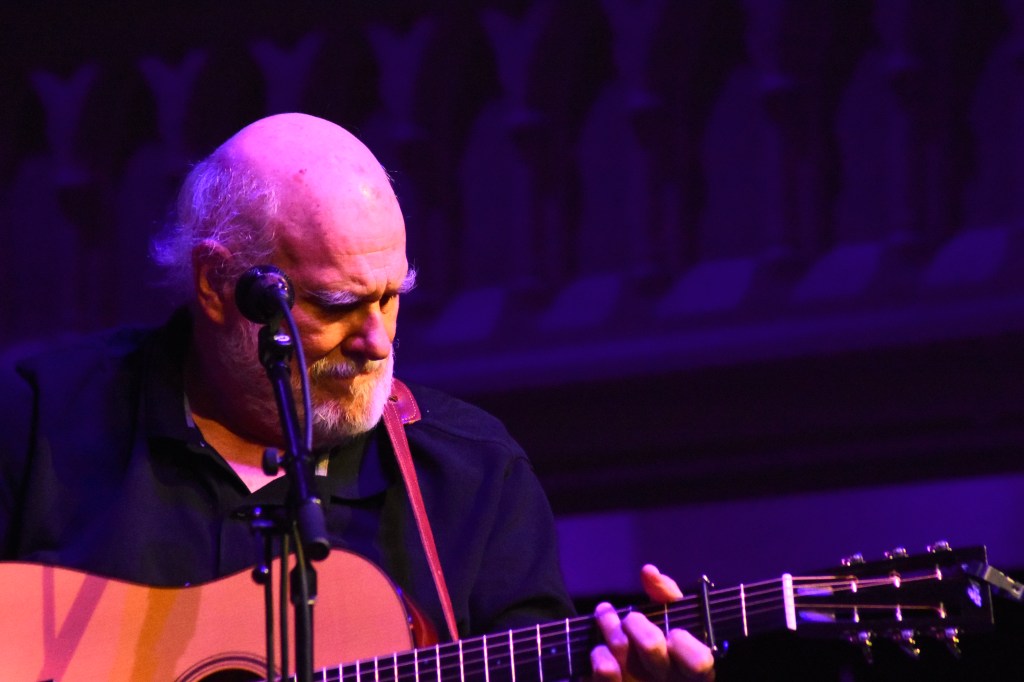
Flat-pick guitarist David Doucet – Michael’s brother – also served up equal parts beat push and melodic merriment, and sang both leads and harmonies with relaxed command.
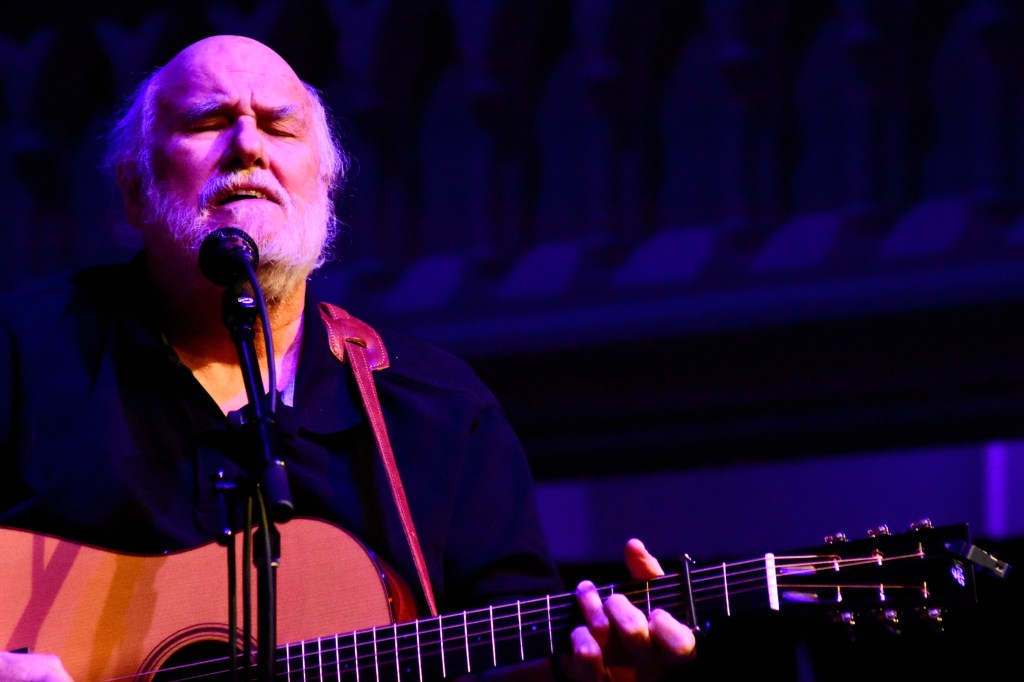
Together, they played as tight as the highest string on Michael Doucet’s fiddle.

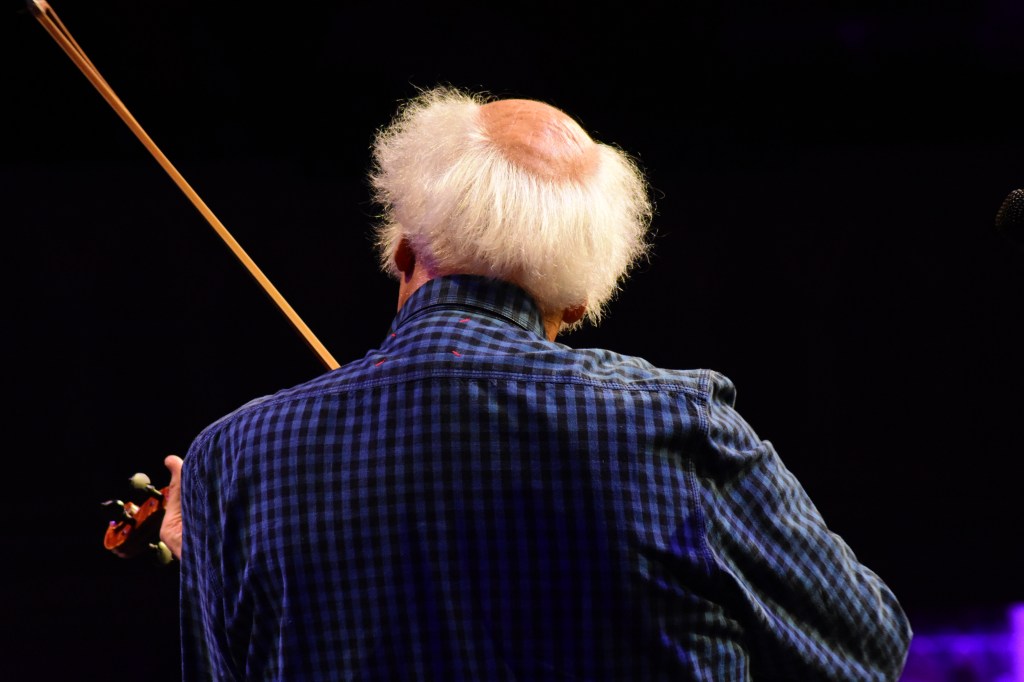
The songs all felt like dance numbers though some rocked and some swung. Some of these titles represent best guesses…

Eunice Two-Step

Jolie Blon – introduced as the Louisiana national anthem

Acadian Two-Step (Dewey Balfa)

L’Amour ou la folie

Poison Love

Le Chanky-Chank Francais

Tous Les Deux Pour la Meme

Freeman Zydeco (tribute to Freeman Fontenot)

Quelle belle vie – Here a front-row older woman yelled, “That’s my FAVORITE!” in joyful, show-stopping falsetto. Doucet graciously sang it to her 

Theogene Creole (by the almost unknown Barisse Chunav)

Starvation Waltz

Little Darlin’ (an audience request)

Zydeco Gris-Gris (an early Bo Diddley beat settled into two-step rhythm)

Fishing Song

Untitled waltz

Parlez-Nou A Boire (Encore)

MICHAEL ECK MAKES HIS MARK, SHARES THE SPOTLIGHT WITH FRIENDS, PLAYS HIS OWN BIRTHDAY PARTY

Michael Eck knows how to mark a milestone; right onto his own skin. 

On Friday, hours before he introduces his new album “fermata” in an all-star show at Caffe Lena, tattoo artist Deanna Louise* will etch a fermata symbol onto his arm. The show also marks Eck’s 60th birthday, another onstage major-birthday (with zeros) musical bash. In 2020, he played a sold out show celebrating 30 years since he first played Caffe Lena.

“Fermata” may sound like a menu item in a red-sauce restaurant, but it bears a specific, if elastic, musical meaning. Merriam-Webster defines it as “a prolongation at the discretion of the performer of a musical note, chord, or rest…” Its symbol, soon to mark Eck’s arm in a design adapted by his twin grown children, arches like an eyebrow over a pupil and gives a performer permission to stretch things. 

“To me, it speaks of freedom in music,” Eck wrote in the news release announcing Friday’s show. Freedom has never been a problem for the singer-songwriter and stringed-things picker who played electric guitar with a power drill in an early punk band and usually works with several bands at a time. These days, he performs with the Ramblin Jug Stompers and the Eddies-nominated Lost Radio Rounders; several other crews are on hiatus. On Friday, Eck, 2023 Eddie Award for Folk/Traditional Artist of the Year, leads a crew of longtime musical friends in vintage folk tunes, older tunes of his own and fresh fare from “fermata.”

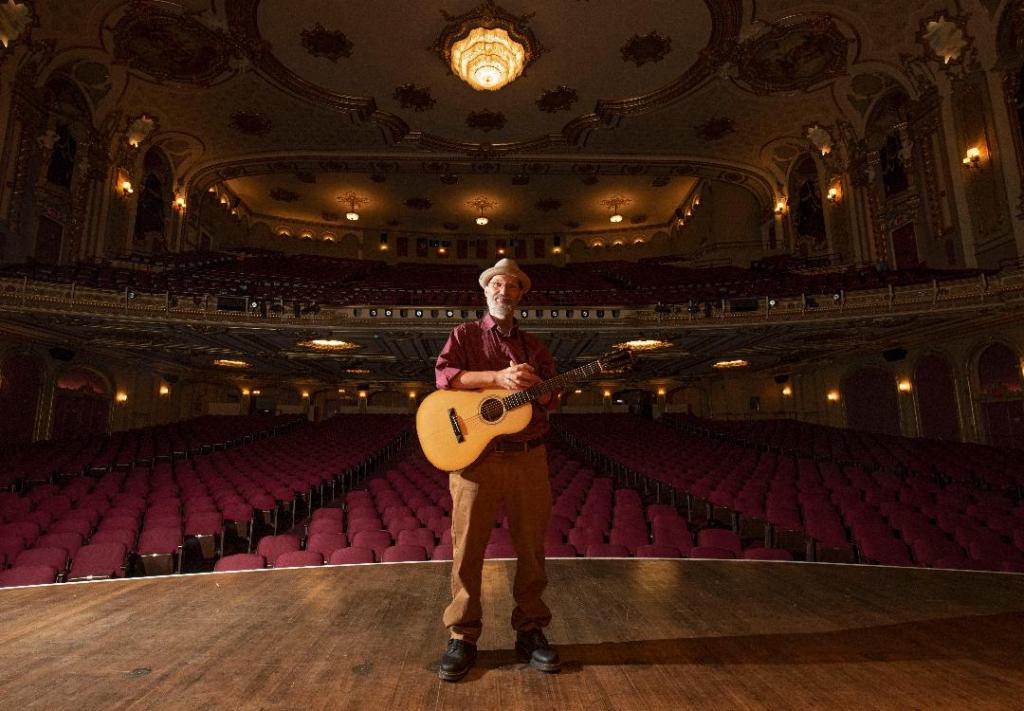
Michael Eck onstage at the Palace Theatre in Albany. Lori Van Buren/Times Union photo

Eck’s “fermata” summarizes in 15 songs his thoughts during, then after, a pause around health issues including a stroke and COVID. Eck bridged the plague time hiatus of live shows with online workshops including songwriting exercises through the Beacon Music Factory and the Caffe Lena School of Music. The deadlines and direction each program imposed set him on a strong creative roll. Eck noted, “I’ve actually written…an album’s worth of songs since I started recording ‘fermata.’” 

His news release explains, “Each of the characters singing these songs, whether myself, an addict in Kentucky, an old coin, a bereft wife, or a bullet in a revolver, has been thrown an unexpected pause” – a fermata. The songs push and probe at limits, work tension and release, sketch potential energy in destructive or healing expression.

As with his previous “your turn to shine” album (2022), Eck recorded “fermata” at WEXT studios, his players and singers creating together in the same room at the same time. 

“I remain madly in love with the concept of playing live,” Eck told me Saturday. “All that dang folk music I’ve been playing was originally recorded in one take by a bunch of folks around a microphone in the first half the 20th century!” He prepped his musicians with plentiful rehearsal, and noted, “Four of my six albums have actually been live in the studio affairs.”

Eck recruited expert talent for “fermata,” both at WEXT and onstage Friday at Caffe Lena. Asked to list his one-night band mates, he explained – and here, we’ll let his own words convey his respect. “Mr. Eck sings and strums. Bob Buckley plays standup bass, piano and sings. Sten Isachsen plays guitar and mandolin, like a monster I might add. Kevin Maul couldn’t make the recording sessions, but he is flying from Florida for the show, god bless him, and playing dobro and Hawaiian guitar and singing. I’m very excited to work with him again. Finally, Rosanne Raneri** will sing and play some guitar.” In a conversation with himself, Eck marveled, “I’m sorry, did you say Rosanne Raneri? Yes, I damn well did. How cool is that!?” 

Also cool: “I realized while preparing materials for this show that at least one song from each of my five preceding albums has been recorded and released by another artist,” said Eck. “As a songwriter, there is no greater feeling than that.”

Well, except possibly the joy of hearing skilled, soulful friends play and sing your songs with you onstage.

Michael Eck and Friends play Friday, April 19 at Caffe Lena (47 Phila St., Saratoga Springs) 8 p.m. $21.69, members $19.52, students and children $10.85. Ticket buyers can also add $5 donations to Caffe Lena with their purchase. 518-583-0022 www.caffelena.org. CD copies of “fermata” will be available for sale.

  • *Tattooist Deanna Louise earlier inscribed a drawing by the late Greg Haymes, now five years gone, onto Eck’s other arm.

**Assistant professor of Theatre Arts at Hudson Valley Community College, Rosanne Raneri has set aside music making for a time. She received the SUNY Chancellor’s Award for Excellence in Teaching in 2018. 

Full disclosure: Raneri used a photo of mine in the artwork for her “Parhelion” album, Metroland magazine’s Best Local Release for 2000. The late, great Greg Haymes hailed it as “one of the finest albums ever recorded in this area.” 

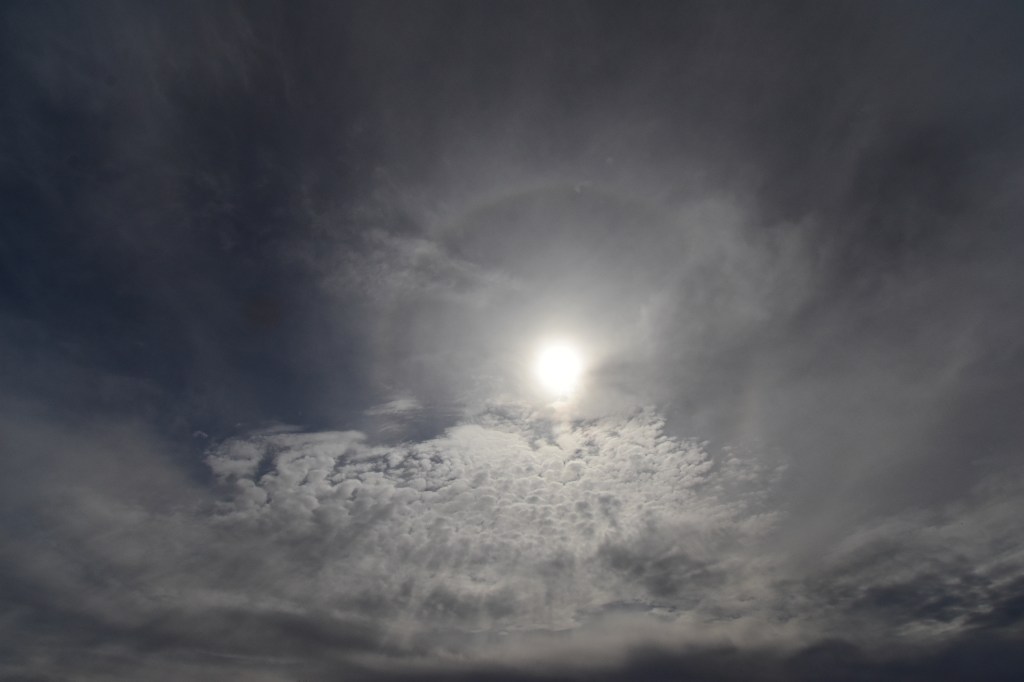
We defined “fermata;” might as well do “parhelion.” Merriam-Webster defines parhelion as “a bright spot, often with color, that appears on the parhelic circle on either side of the sun…also known as a sun dog.” Shown here, for reference, is the one that formed around last week’s eclipse, as seen from a farm road near Little Falls. 

When this happens around the moon, it’s a “moondog” – nickname of eccentric New York composer Edward Louis Hardin whose best line is worthy of an Eck lyric: “Machines were mice and men were lions once upon a time. Now that it’s the opposite, it’s twice upon a time.”